
Visiting Underwear Factories in China: What Every Buyer Needs to Know Before They Go.
Sourcing trips to China sound straightforward. Book a flight, visit a few factories, pick a partner. But most buyers leave with the wrong information—and don’t realize it until their first bulk order arrives.
A factory visit is a verification task, not a tour. The goal is to confirm three things: whether the factory’s QC process holds up in person, whether their sample capability matches real production volume, and whether this factory is the right fit for your order size. Get those three answers, and the trip is worth it.
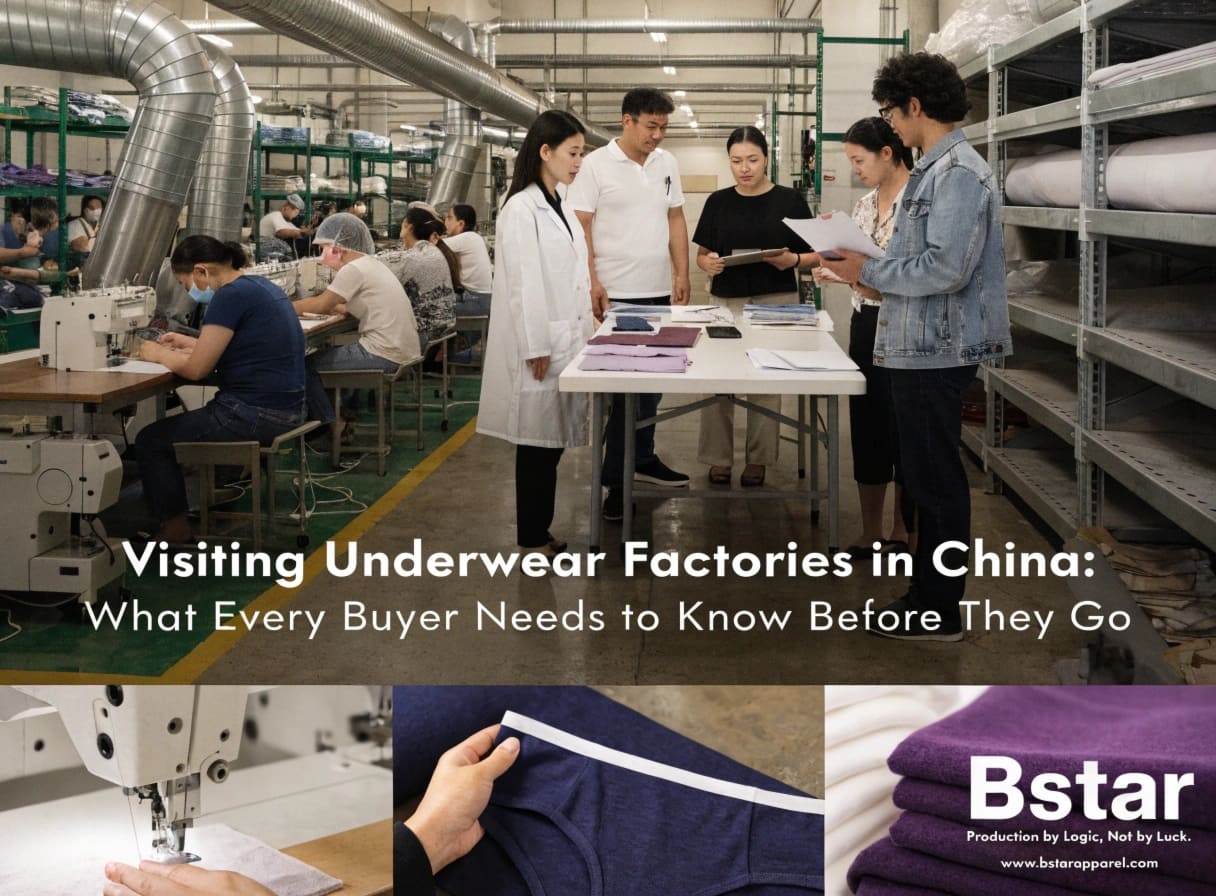
I’ve hosted overseas buyers at our factory in Zhongshan for years. I’ve seen buyers walk out confident when they shouldn’t be. I’ve also seen buyers miss the right signals because they didn’t know what to look for. This guide is based on what I’ve watched buyers consistently get right—and wrong—during in-person visits.
Where Should You Actually Go? Mapping China’s Key Underwear Manufacturing Clusters
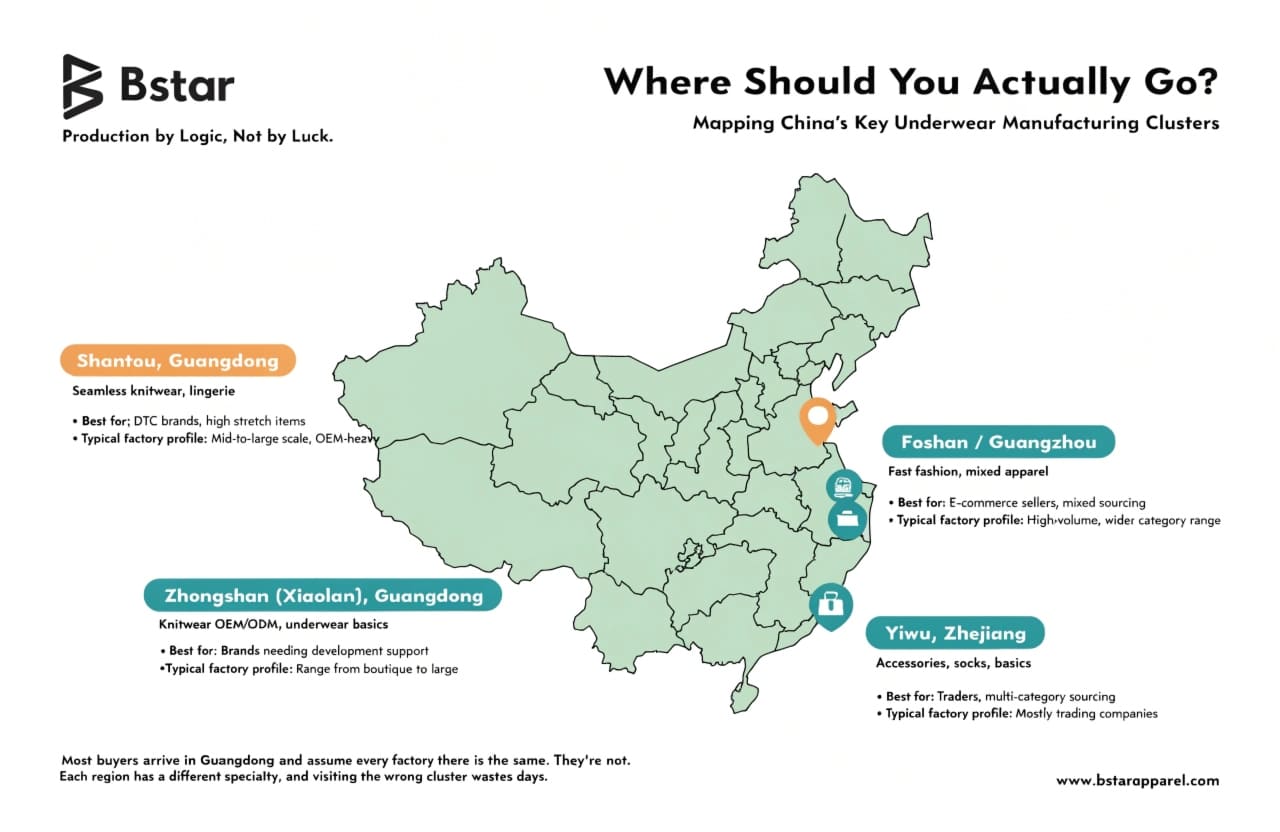
Most buyers arrive in Guangdong and assume every factory there is the same. They’re not. Each region has a different specialty, and visiting the wrong cluster wastes days.
China’s underwear manufacturing is concentrated in a few clusters. Guangdong (especially Shantou and Zhongshan) leads in knitwear and seamless underwear1. Yiwu in Zhejiang is a trading hub with strong accessory supply chains2. Each cluster has different MOQ norms, production focus, and factory size profiles.
Breaking Down the Clusters
Here’s a quick comparison to help you decide where to go first:
| Region | Specialty | Best For | Typical Factory Profile |
|---|---|---|---|
| Shantou, Guangdong | Seamless knitwear, lingerie | DTC brands, high stretch items | Mid-to-large scale, OEM-heavy |
| Zhongshan (Xiaolan), Guangdong | Knitwear OEM/ODM, underwear basics | Brands needing development support | Range from boutique to large |
| Foshan / Guangzhou | Fast fashion, mixed apparel | E-commerce sellers, mixed sourcing | High-volume, wider category range |
| Yiwu, Zhejiang | Accessories, socks, basics | Traders, multi-category sourcing | Mostly trading companies |
If you’re a DTC brand or e-commerce seller sourcing underwear and knitwear specifically, Guangdong is where you spend most of your time. Zhongshan’s Xiaolan town, for example, is a concentrated knitwear hub with direct factory access3—less middleman noise than Yiwu.
One thing I’d add: don’t try to visit more than two or three factories per day. After the third stop, every factory starts to look the same. Your notes get sloppy. You start making decisions based on who had the nicest conference room.
What Should You Actually Look At? Mastering Factory Visits and Key Inspection Points
The production floor is the first thing every buyer asks to see. It’s also the least useful part of the visit.
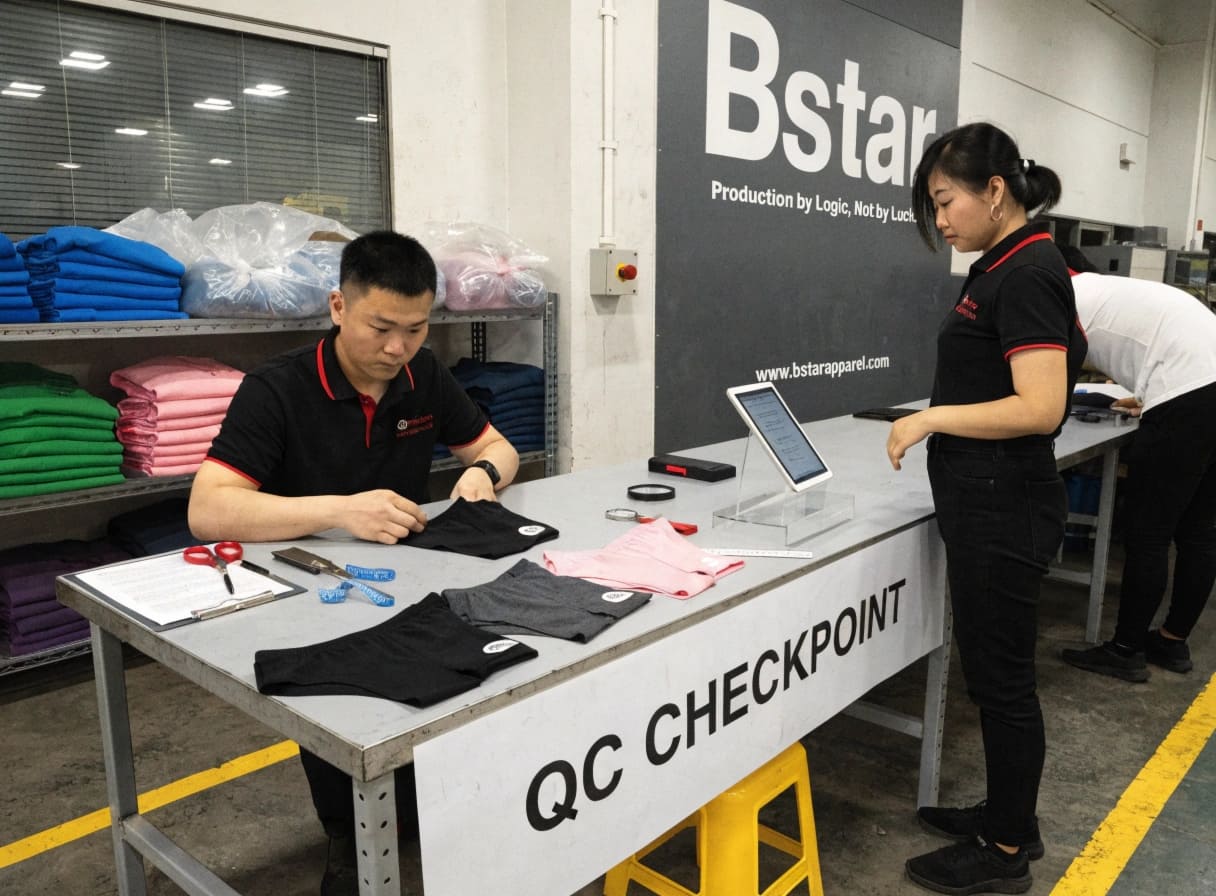
The machines on a factory floor don’t tell you about quality consistency. What matters is how defects are caught, logged, and handled before a product ships. Buyers should ask to walk through the QC checkpoints—not just the sewing line.
What to Look For—And What to Ask
Most factories expect buyers to look at equipment. Fewer factories expect buyers to ask about process. Here’s what separates a useful visit from a staged one:
In the sample room:
Ask to see a recent bulk production run for a product similar to yours. Not the showroom samples—those can sit there for two years. You want to compare the showroom piece against actual fabric swatches in current use and trim inventory on the floor. A factory that can’t show you recent production records is showing you their history, not their current capability.
At the QC stations:
Ask how many inspection stages exist between cutting and shipping. A serious factory will have at least four or five checkpoints: raw material inspection, in-process checks at the sewing stage, a semi-finished goods check, a finished goods inspection, and a pre-shipment audit. Ask to see how defects are logged. Is it paper-based? Digital? Who has access to the data? These questions either get confident answers or nervous deflections.
When a factory says "no":
Not every factory will show you everything. This is normal. Some areas—like R&D rooms or client-specific production lines—are legitimately restricted. What isn’t normal is being refused a look at the QC process itself. If a factory won’t show you how it catches defects, that’s information too.
| Checkpoint | What to Ask | Red Flag |
|---|---|---|
| Sample room | "Can I see a recent bulk production run?" | Only showroom samples available |
| QC stations | "How are defects logged and tracked?" | No documentation system |
| Fabric inventory | "Where do your materials come from?" | Vague answers about sourcing |
| Certifications | "Can I see your audit reports?" | Certificates but no actual reports |
Before You Land: Visas, Local Travel, and Business Etiquette
The logistics of getting to a Chinese factory matter more than most buyers expect—not because they’re complicated, but because small mistakes signal that you’re not a serious buyer.
For most overseas buyers visiting Chinese factories, a business visa (M or F type) is required4. Pre-arranging factory appointments is essential—both for visa processing and for getting real answers on-site. Arriving unannounced signals inexperience and typically results in a surface-level visit.
Practical Notes From the Factory Side
I’ve had buyers show up without an appointment. Here’s what happens: someone covers the floor, someone else finds the best samples, and you get a polished forty-minute show. You learn almost nothing useful. Pre-scheduling with a written agenda—shared in advance—forces the factory to prepare real answers. It also tells you whether the factory is organized enough to be worth visiting at all. A factory that can’t respond clearly to a pre-visit agenda is already showing you something.
On getting around: Guangdong is well-connected. High-speed rail between Guangzhou, Zhongshan, Foshan, and Shenzhen is fast and cheap5. For factory visits specifically, hire a local driver or use a sourcing agent who knows the industrial areas. Factory addresses in China are often in industrial zones that GPS handles badly.
On communication: Bring a translator if your Mandarin is limited—not to be polite, but because technical manufacturing terms don’t survive basic translation apps. Many factories in Guangdong have English-speaking sales or trade teams. At BSTAR, our trade team is 20+ people with dedicated English communication. But don’t assume this everywhere.
On business etiquette: Exchange cards with both hands. Don’t skip the factory meal if invited—it’s a real relationship signal6. But don’t mistake hospitality for alignment. A good lunch doesn’t mean a good factory.
After the Tour: Assessing Production Capacity, QC Systems, and Ethical Compliance On-Site
Walking the floor is one step. Deciding whether to commit to this factory is a different step entirely—and most buyers confuse the two.
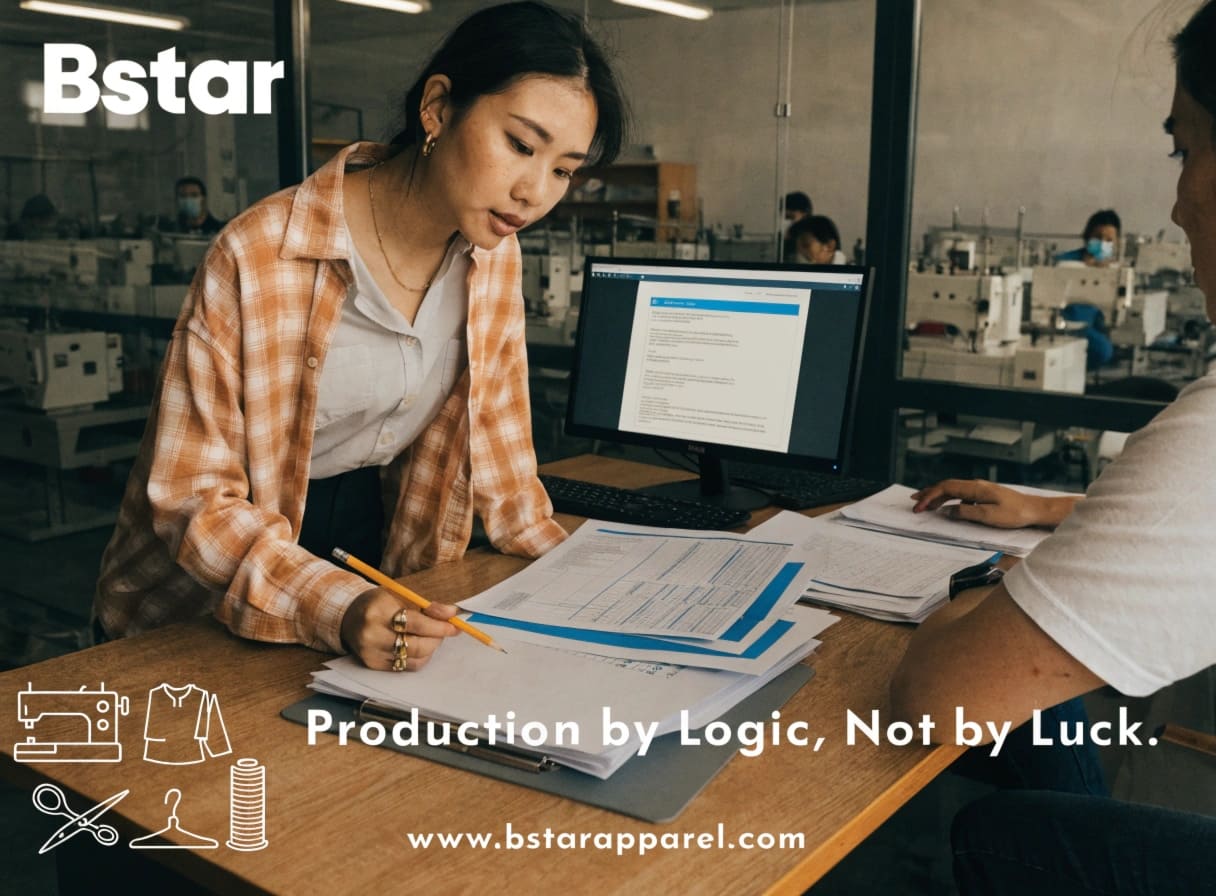
A factory visit is not a supplier audit7. An in-person visit can give you a directional read on capability, organization, and fit. It cannot replace sample testing, contractual protections, or a formal third-party audit for compliance verification.
What You Can and Can’t Conclude From a Visit
This is where I see buyers make the most expensive mistakes. They leave a factory visit feeling confident, skip the formal audit, place a large order, and then deal with problems that a third-party inspection would have caught in an afternoon.
Here’s what a visit can reasonably tell you:
| What You Can Assess On a Visit | What Requires Formal Verification |
|---|---|
| Factory organization and floor cleanliness | AQL-level defect rate data8 |
| Sample room capability | Third-party compliance audit (BSCI, SA8000) |
| Communication responsiveness | Lab test results for materials (OEKO-TEX, GOTS, GRS)9 |
| MOQ and lead time alignment | Legal contract terms and IP protection clauses |
| General production volume claims | Verified production records from recent orders |
On capacity claims: Every factory will tell you they can handle your volume. The question is whether it’s true for your timeline and your product type. Ask: "What percentage of your current capacity is booked?" and "What’s your current sampling lead time?" If a factory tells you 7–15 days for samples but is currently at 90% capacity, those numbers don’t match.
On ethical compliance: Ask to see certification documents—not just the certificates, but the actual audit reports behind them. Any serious factory producing for international brands should be able to show BSCI, OEKO-TEX, or equivalent documentation10 with dates and scope. If the certificate is framed on the wall but no one can find the report, that’s a gap worth noting.
On factory fit: A factory running 150,000 units a month with a 50,000-piece minimum is genuinely the wrong partner for a DTC brand starting at 500 units. This isn’t about the factory being bad—it’s about the fit being wrong. Confirm MOQ, development pace, and sampling support before you book the flight, then verify those numbers haven’t shifted during your visit.
Conclusion
A China factory visit gives you directional information—not certainty. Use it to check fit, watch the QC process, and ask the questions that emails can’t answer. Then do the formal verification work before you commit.
-
"Shantou Chaoyang District Xinnishi knitting underwear factory", https://xinnishi.en.made-in-china.com/. Industry and trade body reports on China’s textile manufacturing geography identify Guangdong province, including Shantou and Zhongshan, as major production clusters for knitwear and seamless garments, reflecting decades of industrial specialization in these districts. Evidence role: general_support; source type: institution. Supports: That Shantou and Zhongshan in Guangdong are established centers for knitwear and seamless underwear manufacturing in China. Scope note: Regional industrial cluster designations may shift over time; sources should be checked for recency. ↩
-
"Yiwu International Trade City – Wikipedia", https://en.wikipedia.org/wiki/Yiwu_International_Trade_City. Yiwu, Zhejiang is widely documented as one of the world’s largest small-commodities wholesale markets, with its Yiwu International Trade City serving as a major hub for traders sourcing accessories, textiles, and consumer goods from across China. Evidence role: definition; source type: encyclopedia. Supports: That Yiwu, Zhejiang is primarily a trading and wholesale hub for small commodities and accessories rather than a large-scale direct manufacturer. Scope note: General descriptions of Yiwu’s trading role may not specifically address underwear or knitwear accessory supply chains. ↩
-
"Xiaolan – Wikipedia", https://en.wikipedia.org/wiki/Xiaolan. Chinese government and trade association records on industrial cluster development in Guangdong identify Zhongshan’s Xiaolan township as a designated production base for knitwear and related apparel, consistent with the broader specialization of the Pearl River Delta in textile manufacturing. Evidence role: historical_context; source type: institution. Supports: That Xiaolan town in Zhongshan, Guangdong is a recognized concentration point for knitwear and underwear manufacturing. Scope note: English-language sources on sub-district industrial clusters in China are limited; Chinese government industrial planning documents may be the most authoritative but are not always accessible. ↩
-
"China – Travel – State Department", https://travel.state.gov/content/travel/en/us-visas/Visa-Reciprocity-and-Civil-Documents-by-Country/China.html. The Chinese government’s official visa classification system designates the M visa for commercial and trade activities and the F visa for exchanges, visits, and study, both of which may apply to foreign nationals conducting business sourcing visits to Chinese manufacturers. Evidence role: definition; source type: government. Supports: That China issues M-type visas for commercial and trade activities and F-type visas for non-commercial exchanges, both relevant to business visitors conducting factory sourcing trips. Scope note: Visa requirements vary by nationality and are subject to change; travelers should consult the Chinese embassy or consulate in their home country for current requirements. ↩
-
"Pearl River Delta Metropolitan Region intercity railway – Wikipedia", https://en.wikipedia.org/wiki/Pearl_River_Delta_Metropolitan_Region_intercity_railway. China’s national and provincial rail authorities document intercity high-speed rail services across the Pearl River Delta, including connections linking Guangzhou, Foshan, Zhongshan, and Shenzhen, as part of the broader Guangdong intercity rail network expansion. Evidence role: general_support; source type: government. Supports: That high-speed or intercity rail services connect Guangzhou, Zhongshan, Foshan, and Shenzhen within Guangdong province. Scope note: Specific fare and schedule information changes frequently; the claim of being ‘cheap’ is relative and not independently verifiable without current pricing data. ↩
-
"Get Chinese business etiquette right", https://www.hult.edu/blog/get-chinese-business-etiquette-right/. Cross-cultural business communication literature and guides on Chinese business practices consistently identify the two-handed exchange of business cards and shared meals as markers of respect and relationship investment within the Chinese business context, reflecting the broader cultural concept of guanxi (relational networks) in commercial interactions. Evidence role: historical_context; source type: education. Supports: That presenting and receiving business cards with both hands and accepting meal invitations are recognized components of business relationship-building etiquette in Chinese professional contexts. Scope note: Business etiquette norms vary by region, industry, and individual; these practices are general conventions rather than universal rules, and their significance may be overstated in some cross-cultural guides. ↩
-
"Factory Audit vs Supplier Verification: Which Do You Need?", https://tetrainspection.com/factory-audit-vs-supplier-verification/. Supply chain quality management literature and audit body guidelines consistently distinguish between informal buyer site visits and structured third-party audits, noting that formal audits follow defined protocols, sampling methodologies, and documentation requirements that ad hoc visits cannot replicate. Evidence role: expert_consensus; source type: institution. Supports: That informal buyer factory visits and formal third-party supplier audits serve different functions and the former cannot replace the latter for compliance or quality verification purposes. Scope note: This distinction is widely accepted in practice but may not be codified in a single authoritative source; the claim reflects professional consensus rather than a single definitive standard. ↩
-
"[PDF] ISO 2859-1 – UNT Chemistry", https://chemistry.unt.edu/~tgolden/courses/iso2859-1.pdf. The Acceptable Quality Level (AQL) framework, standardized under ISO 2859-1 (Sampling procedures for inspection by attributes), provides the statistical basis for determining acceptable defect rates in batch inspection and is widely adopted in garment and textile manufacturing as the benchmark for pre-shipment quality verification. Evidence role: definition; source type: institution. Supports: That AQL (Acceptable Quality Level) sampling methodology, codified in standards such as ISO 2859-1, is the widely used framework for statistical defect inspection in garment and textile manufacturing. ↩
-
"Certification – GOTS – Global Organic Textile Standard", https://global-standard.org/certification-and-labelling/certification. The Global Organic Textile Standard (GOTS) certifies the organic status of textiles from harvesting through manufacturing, while the Global Recycled Standard (GRS), administered by Textile Exchange, verifies recycled content and responsible social and environmental practices throughout a supply chain. Evidence role: definition; source type: institution. Supports: That GOTS and GRS are internationally recognized certification standards for organic textile content and recycled material content respectively, applicable to apparel and knitwear supply chains. Scope note: Certification applicability depends on specific product claims; not all underwear products require or benefit from GOTS or GRS certification. ↩
-
"amfori BSCI Certification & BSCI Audit Services – TÜV SÜD", https://www.tuvsud.com/en-us/services/auditing-and-system-certification/amfori-business-social-compliance-initiative. The amfori BSCI programme and the OEKO-TEX Association provide internationally recognized audit and certification frameworks for social compliance and chemical safety in textile supply chains, respectively; possession of current audit reports under these schemes is a standard expectation for factories supplying international apparel brands. Evidence role: definition; source type: institution. Supports: That BSCI (now amfori BSCI) and OEKO-TEX are recognized international compliance and certification frameworks used to verify social and chemical safety standards in textile and apparel manufacturing. Scope note: Certification scope and audit depth vary; holding a certificate does not guarantee ongoing compliance between audit cycles. ↩