
How to Choose the Right Elastic for Custom Underwear?
There’s one decision that quietly kills underwear launches: the wrong elastic. It doesn’t show up until returns start coming in, or your manufacturer tells you the sample can’t be replicated at scale.
Choosing the right elastic for custom underwear depends on where it sits, what job it does, and how it’s attached. A waistband elastic needs strong recovery. A leg opening needs softness and flexibility. No single elastic type works everywhere — the right choice is always application-specific.
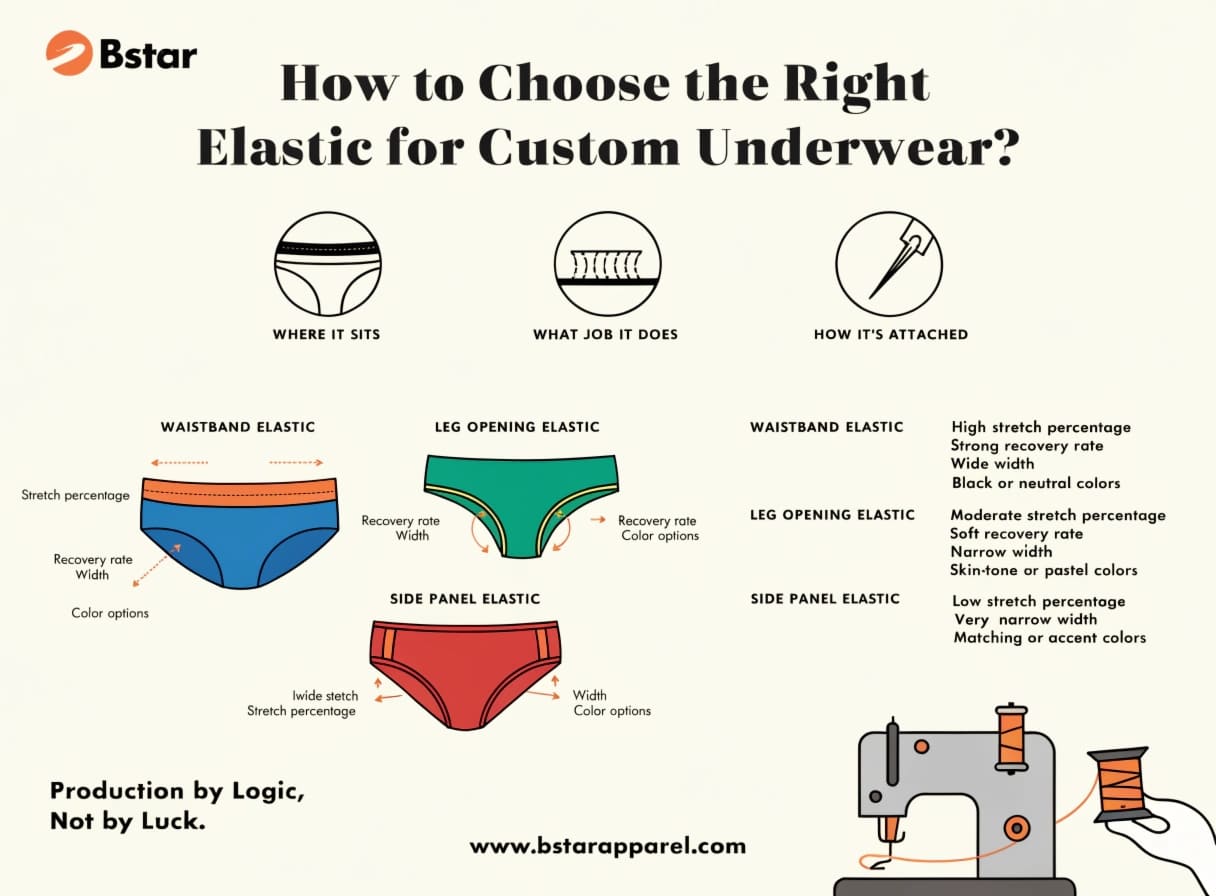
Most brand founders start this conversation with a stretch percentage. "I need 80% stretch." We hear this a lot. But that number alone tells us almost nothing. The real work starts when we ask: where exactly is this elastic going, and what does it need to survive?
Understanding Elastic Materials: What Are the Real Differences Between Rubber, Spandex, and Synthetic Blends?
Walk into any trims market and you’ll see hundreds of elastic options. They all look similar. They don’t perform the same way.
The three main elastic types used in underwear are rubber-core elastic (high recovery, less breathable)1, spandex-blend elastic (softer, more skin-friendly), and synthetic knit blends (more durable, less stretch). Each has a specific use case — and using the wrong one in the wrong place causes real problems.
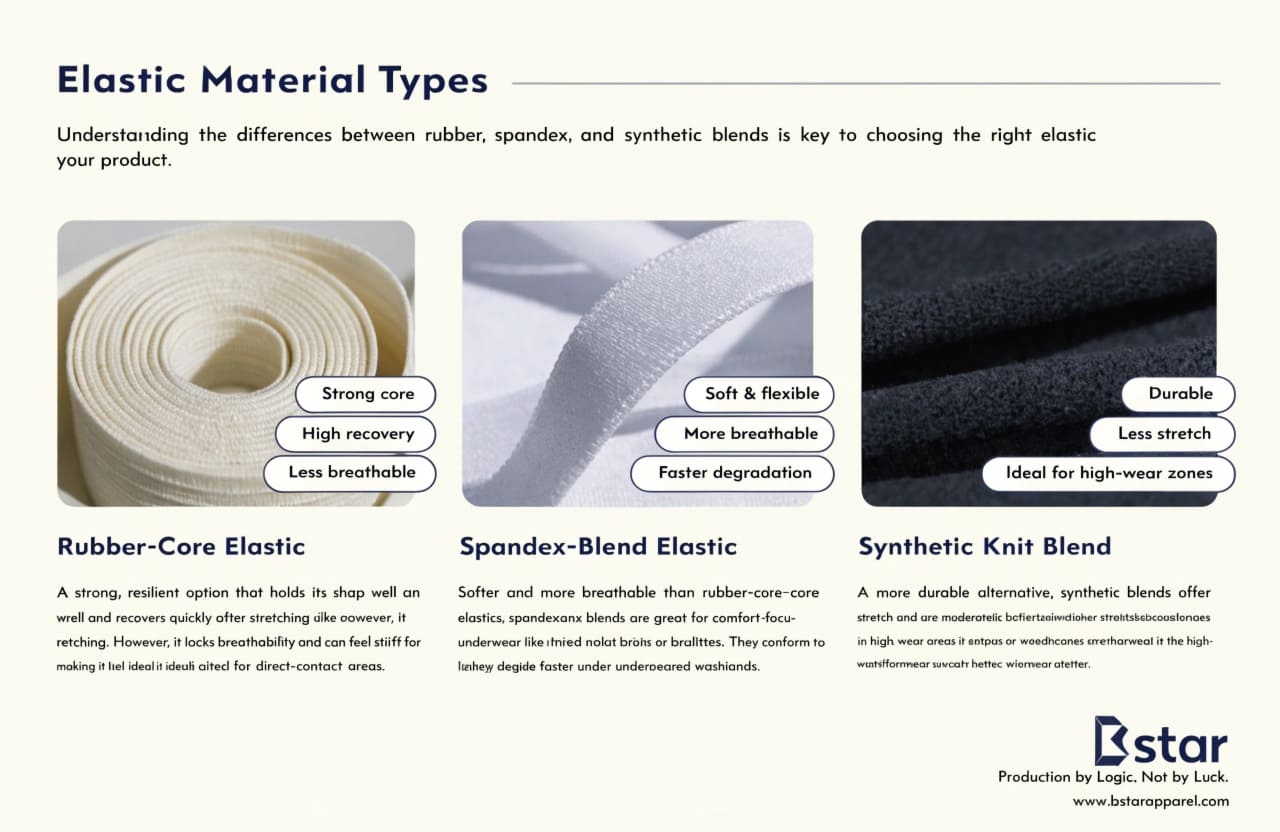
Where each material actually belongs
Rubber-core elastics are strong. They hold their shape well and recover fast after stretching. But they’re stiff against skin and can cause irritation in direct-contact areas. We generally see them used inside encased waistbands — where they’re covered by fabric and not touching skin directly.
Spandex-blend elastics are softer and more breathable. They’re a better fit for modal briefs, bralettes, or any underwear positioned as comfort-first. The trade-off is that softer elastics tend to degrade faster under repeated washing2. This is the mismatch we see most often with DTC brands targeting sensitive-skin consumers: they pick the softest elastic available, then get complaints at the six-month mark.
Synthetic knit blends sit in the middle. They’re more durable than spandex blends and more comfortable than hard rubber cores3. They’re common in athletic underwear where the elastic needs to hold up through sweat, stretching, and frequent washing.
The important point: these aren’t interchangeable. Picking a material without naming the application first is where most selection mistakes begin.
Performance Metrics: How Do You Actually Evaluate Stretch Recovery, Durability, and Tensile Strength?
"Stretch %" is the number everyone asks for. It’s also one of the least useful specs in isolation.
The metrics that matter for underwear elastic are stretch recovery (how fully it returns after being stretched), tensile strength (how much force it can handle before deforming)4, and wash durability (how it performs after repeated cycles). All three vary by application — a waistband needs different recovery than a leg band.
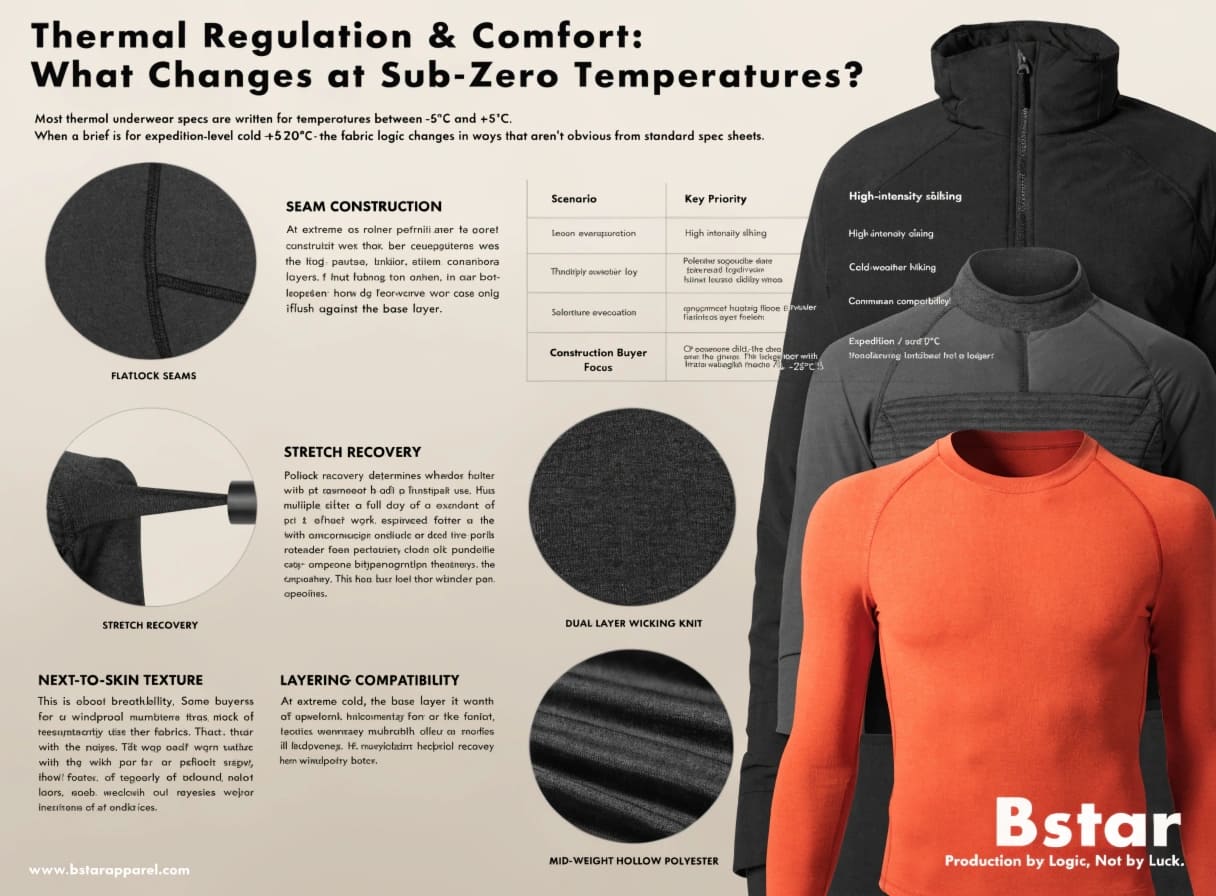
Breaking down what each metric means in practice
Stretch recovery is about memory. After you pull the elastic and let go, does it come back fully? A waistband with poor recovery starts to sag after a few wears. This is especially visible in fitted briefs and boxer briefs where the waistband is always under tension when worn. When we review samples with clients, we always stretch and release the elastic by hand several times before signing off. It’s not a lab test, but it catches obvious failures early.
Tensile strength matters most for leg openings. The leg band is under constant stress during movement — sitting, walking, bending. An elastic with low tensile strength will deform at the edges and start rolling. Suppliers will give you tensile strength figures, but treat those as directional, not guaranteed. We always recommend testing under your actual sewing conditions, not just evaluating the raw elastic off a roll.
Wash durability is where comfort-first decisions often backfire. The softest elastics on the market are usually the weakest after 20+ washes5. If your customer is buying a product they’ll wear twice a week for a year, that degradation matters. Ask your supplier directly: what does this elastic look like after 30 wash cycles? If they can’t answer that question, that’s a signal.
| Metric | Waistband Priority | Leg Opening Priority | Bralette Underbust Priority |
|---|---|---|---|
| Stretch Recovery | High | Medium | High |
| Tensile Strength | Medium | High | Medium |
| Wash Durability | High | High | Medium |
| Softness Against Skin | Low (usually encased) | High | High |
Comfort and Safety: How Do You Pick Skin-Friendly, Hypoallergenic Elastics for Intimate Apparel?
Underwear sits against skin all day. That makes material safety a non-negotiable part of the selection process — not a bonus feature.
For intimate apparel, skin-safe elastics should be free from latex, azo dyes, and formaldehyde-based finishes6. Look for elastics made from OEKO-TEX certified yarns as a baseline. For sensitive-skin or baby-adjacent products, the bar is higher — material traceability matters as much as certifications.
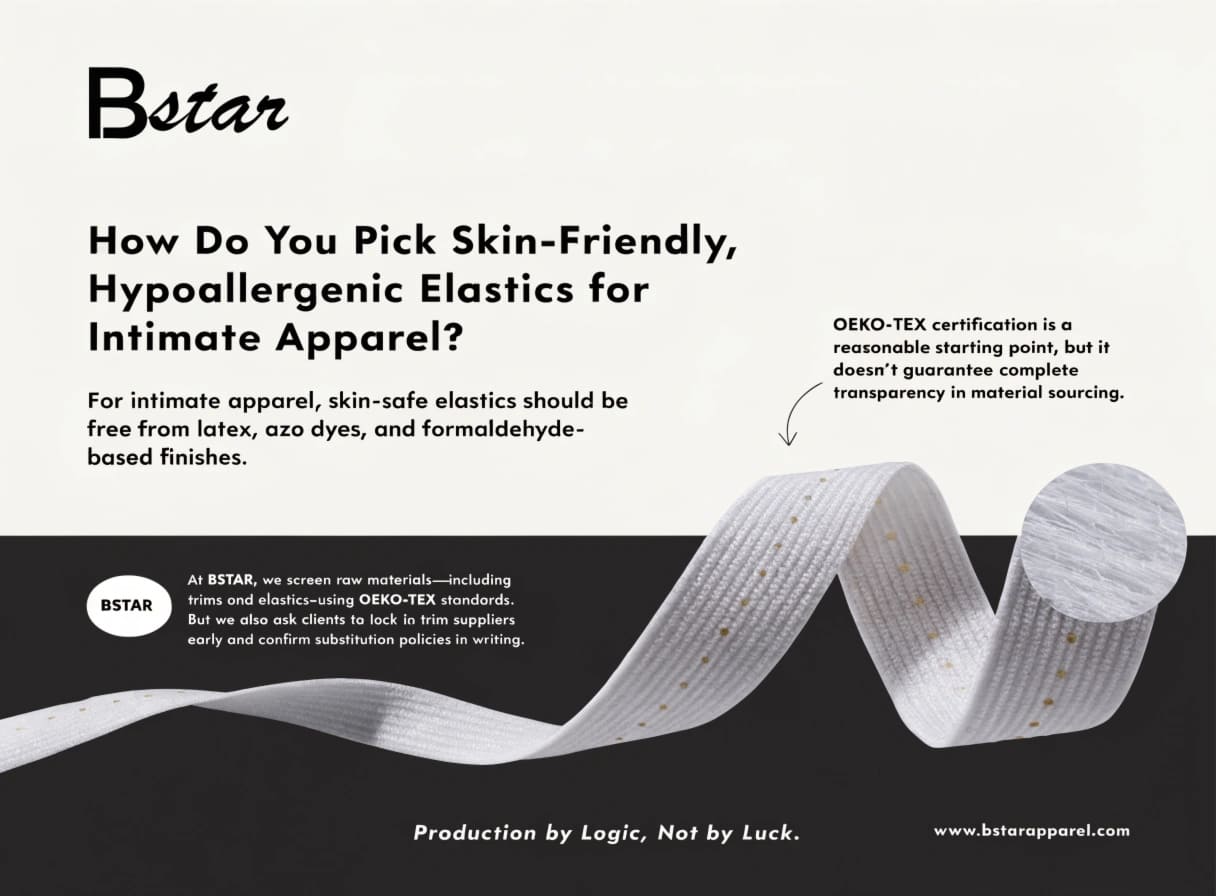
What to actually verify — and what to watch for
Latex allergies are more common than most brand founders expect7. If your product is positioned for sensitive skin, latex-free is a baseline requirement, not a premium feature. The problem is that "latex-free" on a trim card doesn’t always mean the elastic is fully hypoallergenic. Some synthetic blends still use chemical finishes that can cause irritation.
OEKO-TEX certification on elastic materials is a reasonable starting point. It tests for harmful substances and sets limits on things like heavy metals, pesticides, and pH levels8. At BSTAR, the raw materials we work with — including trims and elastics — go through OEKO-TEX screening as part of our standard process. But we always tell clients: certification covers what was tested at the source. It doesn’t cover what happens if a supplier substitutes materials mid-production.
This is why we ask clients to lock in trim suppliers early and confirm substitution policies in writing. It sounds like paperwork. It prevents real problems.
One more thing: period underwear and postpartum underwear have stricter comfort expectations than standard briefs9. If that’s your category, you need to build comfort testing into your sample approval stage — not assume that a certified elastic is automatically comfortable for your specific customer.
Matching Elastic to Style: How Do You Choose the Right Width, Texture, and Finish for Waistbands and Leg Openings?
You’ve picked the right material. Now comes the part most brands get wrong at the last step: the physical specs.
Elastic width, texture, and edge finish all affect how the final garment looks, feels, and performs. A 25mm waistband elastic reads as structured and sporty. A 10mm picot-edge elastic reads as feminine and delicate. Choosing based on aesthetics alone — without thinking about sewing method — creates production problems.
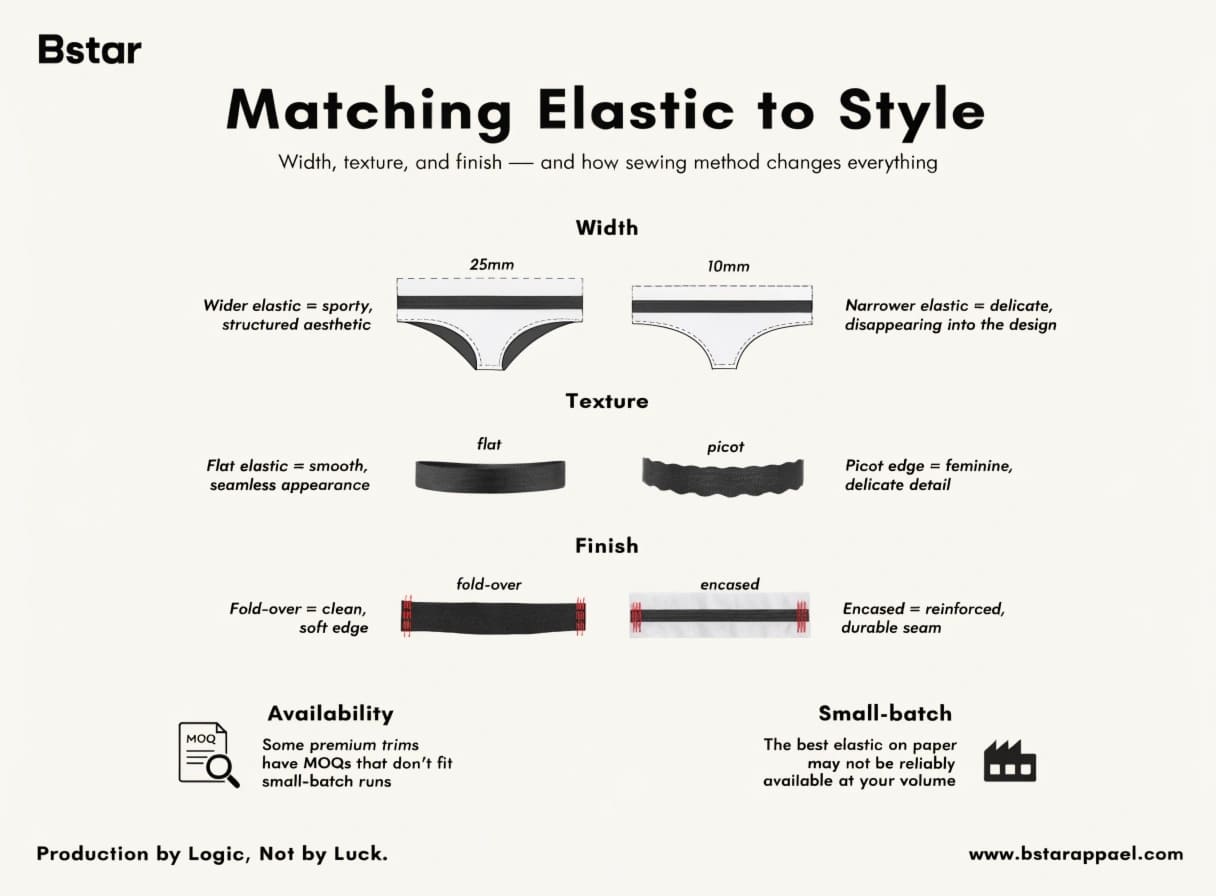
Width, texture, and finish — and how sewing method changes everything
Width sets the visual weight of the waistband or leg opening. Wider elastics (20mm–40mm) give a sporty, defined look. Narrower elastics (6mm–15mm) work better for delicate styles10 or anywhere you want the elastic to disappear into the design. For a bralette underbust, anything above 15mm will likely show through the fabric and change the silhouette.
Texture affects both grip and feel. A flat elastic lies smooth against skin. A ribbed or jacquard elastic has more grip, which helps it stay in place11 but can create a visible texture line through thin fabrics. This matters more than most clients expect — we’ve had samples come back from photo shoots where the elastic texture showed through leggings layered over briefs.
Finish and attachment method are linked decisions. This is the part that surprises clients most. A fold-over elastic (FOE) looks clean and is often chosen for its soft edge. But FOE requires a different sewing approach than a sewn-in elastic12. If you approve a sample made with fold-over elastic and then the production line switches to an encased method for cost efficiency, the garment feels and looks different. Always confirm the attachment method when you approve the elastic — not separately.
For small-batch DTC brands, there’s one more reality to factor in: the best elastic on paper may not be reliably available at your volume. Some premium trims have minimum order quantities that don’t fit a 300-unit run. When we work with early-stage brands, we always ask about their production volume before recommending specific trims. It’s a practical filter that saves time on both sides.
Conclusion
Choosing the right elastic comes down to four things: where it sits, what it needs to survive, how it gets attached, and whether your supplier can actually source it at your volume. Get those four right, and the rest follows.
Before you request a sample, prepare a one-page brief that includes: the garment category, the elastic placement, your target customer’s comfort expectations, your wash durability requirement, and your production volume. That brief will get you a faster, more accurate response from any manufacturer — and it will make your sample approval process much cleaner.
-
"Impact of the Elastane Percentage on the Elastic Properties of … – PMC", https://pmc.ncbi.nlm.nih.gov/articles/PMC9570736/. The low air permeability of natural rubber is a well-documented property arising from its dense polymer structure; studies on elastic textile components confirm that rubber-core constructions restrict airflow compared to open-knit spandex blends, while offering superior elastic recovery. Evidence role: mechanism; source type: paper. Supports: That rubber-core elastics exhibit high elastic recovery but reduced breathability relative to fiber-based alternatives due to the impermeable nature of rubber. Scope note: Direct comparative breathability data specific to narrow elastic trims used in underwear may not be available; general rubber polymer properties are used as a proxy. ↩
-
"[PDF] Effect of Laundering on Dynamic Elastic Behavior of Cotton and …", https://jtatm.textiles.ncsu.edu/index.php/JTATM/article/download/2593/1790. Research on elastane fiber degradation has shown measurable reductions in elongation at break and elastic recovery following repeated wash cycles, with the rate of degradation influenced by fiber fineness, chemical finishes, and wash temperature. Evidence role: mechanism; source type: paper. Supports: That spandex or elastane fibers lose elastic recovery and tensile properties after repeated laundering cycles. Scope note: Studies typically examine elastane yarns or fabrics rather than narrow elastic trims specifically; results may not translate directly to encased or sewn-in waistband applications. ↩
-
"[PDF] Performance Properties in Fibers and Fabrics – District 2 4-H", https://d24-h.tamu.edu/files/2023/02/D2D-Performance-Properties-in-Fibers-and-Fabrics-Copy.pdf. Textile engineering literature on fiber blending indicates that incorporating polyester or nylon into knit elastic constructions improves abrasion resistance and dimensional stability compared to high-elastane constructions, while the knit structure maintains greater flexibility and skin comfort than solid rubber-core alternatives. Evidence role: general_support; source type: paper. Supports: That synthetic fiber blends in knit constructions offer a balance of mechanical durability and tactile comfort relative to rubber-core and pure elastane constructions. Scope note: Direct three-way comparative studies of rubber-core, spandex-blend, and synthetic knit elastics in underwear applications are not widely published; this claim draws on general fiber property knowledge. ↩
-
"[PDF] D638.38935.pdf", https://borgoltz.aoe.vt.edu/aoe3054/manual/expt5/D638.38935.pdf. Standardized test methods such as ASTM D5034 (grab test) and ISO 13934 define procedures for measuring the tensile strength of textile fabrics, including elastic components, by recording the force required to cause rupture or permanent deformation under controlled conditions. Evidence role: definition; source type: institution. Supports: That tensile strength is a standardized, measurable property of elastic textiles evaluated through established test methods. Scope note: These standards apply to fabric specimens broadly; specific protocols for narrow elastic trims used in underwear may follow modified or supplier-specific procedures not covered by general fabric standards. ↩
-
"Effects of Elastic Band Training on Physical Performance in Team …", https://pmc.ncbi.nlm.nih.gov/articles/PMC12551113/. Studies on elastane-containing textiles have documented progressive loss of elastic recovery and tensile properties with increasing wash cycles, with degradation rates dependent on fiber denier, yarn twist, and exposure to detergent chemistry and mechanical agitation. Evidence role: statistic; source type: paper. Supports: That elastic materials show measurable performance degradation after a defined number of wash cycles, with softer or finer constructions degrading more rapidly. Scope note: The specific threshold of 20 wash cycles cited in the article is not directly supported by a single study; degradation curves vary substantially by elastic construction and wash conditions. ↩
-
"Early-Life Exposure to Formaldehyde through Clothing – PMC", https://pmc.ncbi.nlm.nih.gov/articles/PMC9318620/. The European Chemicals Agency (ECHA) and EU REACH regulation restrict the use of specific azo colorants in textiles that may release carcinogenic aromatic amines through reductive cleavage, while formaldehyde-releasing finishes are regulated due to their classification as skin sensitizers and probable human carcinogens. Evidence role: mechanism; source type: government. Supports: That certain azo dyes and formaldehyde-based textile finishes pose skin sensitization or carcinogenic risks, justifying their exclusion from intimate apparel. Scope note: Regulatory limits vary by jurisdiction; the article does not specify which market the brand is targeting, and applicable standards differ between the EU, US, and other regions. ↩
-
"Latex Allergy in the Workplace – CDC Stacks", http://stacks.cdc.gov/view/cdc/198641. Epidemiological estimates suggest latex allergy affects approximately 1–6% of the general population, with higher rates among individuals with repeated latex exposure, according to data reviewed by health authorities including the World Health Organization. Evidence role: statistic; source type: institution. Supports: That latex allergy affects a meaningful proportion of the general population, justifying its treatment as a baseline concern in product design. Scope note: Prevalence estimates vary across studies and populations; figures for contact dermatitis from elastic waistbands specifically are not well-documented in the literature. ↩
-
"OEKO-TEX® STANDARD 100", https://www.oeko-tex.com/en/our-standards/oeko-tex-standard-100/. According to the OEKO-TEX Association, the OEKO-TEX Standard 100 tests textile products against a list of over 100 harmful substances, including heavy metals, pesticide residues, pH value, and formaldehyde, with limit values that vary by product class based on skin contact. Evidence role: definition; source type: institution. Supports: That OEKO-TEX Standard 100 certification involves testing for harmful substances including heavy metals, pesticides, and pH levels in textile products. ↩
-
"Skin Health Connected to the Use of Absorbent Hygiene Products", https://pmc.ncbi.nlm.nih.gov/articles/PMC5574741/. Clinical literature on postpartum skin changes and perineal recovery notes increased skin sensitivity and vulnerability to irritation in the weeks following childbirth, while dermatological guidance on menstrual hygiene products highlights the importance of low-irritant, breathable materials for prolonged vulvar contact. Evidence role: expert_consensus; source type: paper. Supports: That postpartum and menstrual hygiene product categories involve heightened skin sensitivity considerations that translate into stricter material comfort requirements. Scope note: Published standards specific to elastic trims in period or postpartum underwear are not well-established; the comfort requirement is inferred from broader clinical guidance on skin sensitivity in these populations. ↩
-
"Understanding Elastic Sizes: A Guide to Width, Thickness, and Length", https://www.mh-chine.com/blog/products/elastic-sizes. Industry trim specifications and apparel design references consistently treat elastic width as a primary variable in waistband and leg opening design, with wider constructions (typically 20mm and above) associated with performance and structured garments and narrower constructions (below 15mm) used in lingerie and minimalist styles where visual discretion is prioritized. Evidence role: general_support; source type: institution. Supports: That elastic width is a recognized design variable in underwear and intimate apparel, with wider widths associated with athletic or structured styles and narrower widths with delicate or minimal styles. Scope note: The specific millimeter ranges cited are industry conventions rather than formally standardized specifications; variation exists across manufacturers and regional markets. ↩
-
"A Brief Review on Factors Affecting the Tribological Interaction …", https://pmc.ncbi.nlm.nih.gov/articles/PMC8948776/. Research in textile tribology has established that surface topography significantly influences the coefficient of friction between textile materials and skin; structured or raised surface geometries, such as ribs or woven patterns, increase contact area irregularity and frictional resistance compared to smooth flat surfaces. Evidence role: mechanism; source type: paper. Supports: That surface texture in elastic textiles increases friction and grip against adjacent surfaces, helping the elastic maintain position during wear. Scope note: Studies on friction in narrow elastic trims specifically are limited; findings from broader textile friction research are applied here by analogy. ↩
-
"[PDF] Working with Fold-over Elastic – Sewing.org", https://www.sewing.org/files/guidelines/11_221_working_with_fold-over_elastic.pdf. Garment construction references describe fold-over elastic as a method in which the elastic is folded over a raw fabric edge and stitched in a single operation, producing a visible but finished edge, whereas encased elastic involves inserting elastic into a fabric casing formed by folding and stitching the fabric itself, concealing the elastic entirely and requiring additional seam allowance. Evidence role: definition; source type: education. Supports: That fold-over elastic and encased elastic represent distinct construction methods with different sewing requirements and resulting garment characteristics. Scope note: Standardized industrial documentation on these specific methods is fragmented across trade and educational sources; the performance difference in final garments is largely empirical. ↩