
How to Create a Tech Pack for Underwear Manufacturing?
You spent weeks on your underwear design. You finally send it to a factory. Then they come back with ten questions you can’t answer — and your sample is delayed by three weeks.
A tech pack for underwear manufacturing is a complete set of production instructions. It covers flat sketches, measurements, fabric specs, trims, and construction details. A complete tech pack lets a factory start sampling without asking basic questions first.
I’ve been on the factory side of this process for nearly two decades. Every week, our team at BSTAR receives tech packs from DTC founders, small brands, and first-time buyers. Some are ready to go. Most aren’t. The gap is almost never about effort — it’s about understanding what the factory actually needs to do with the document. That’s what this guide is about.
The Blueprint of Production: What Goes Into a Professional Underwear Tech Pack?
Most first-time founders treat a tech pack like a design summary. They include a mood board reference, a fabric name, and a rough sketch. Then they wonder why the first sample looks nothing like what they imagined.
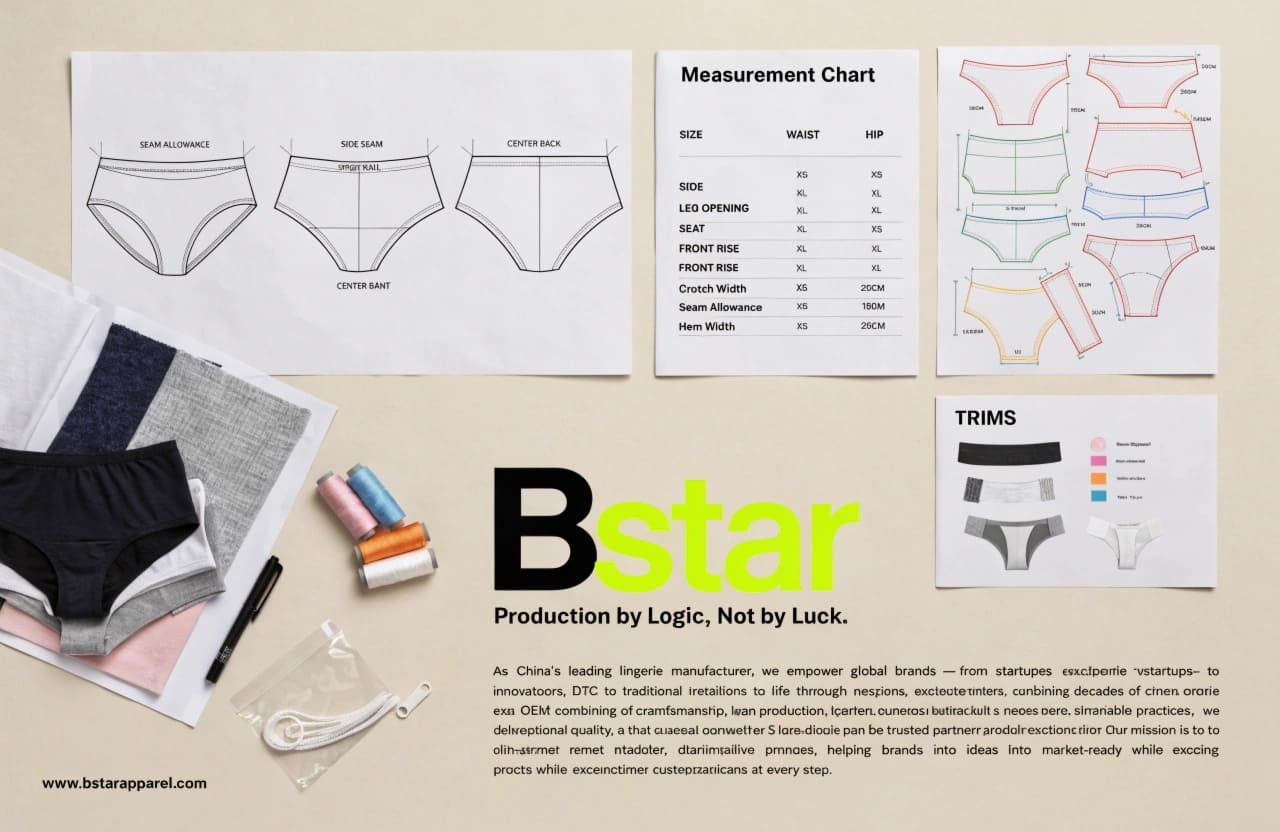
A professional underwear tech pack includes: a cover page, flat sketches with callouts, a size chart with measurement points, a bill of materials (BOM), construction notes, and seam/finish specifications. Every page answers a specific question the factory would otherwise have to ask you.
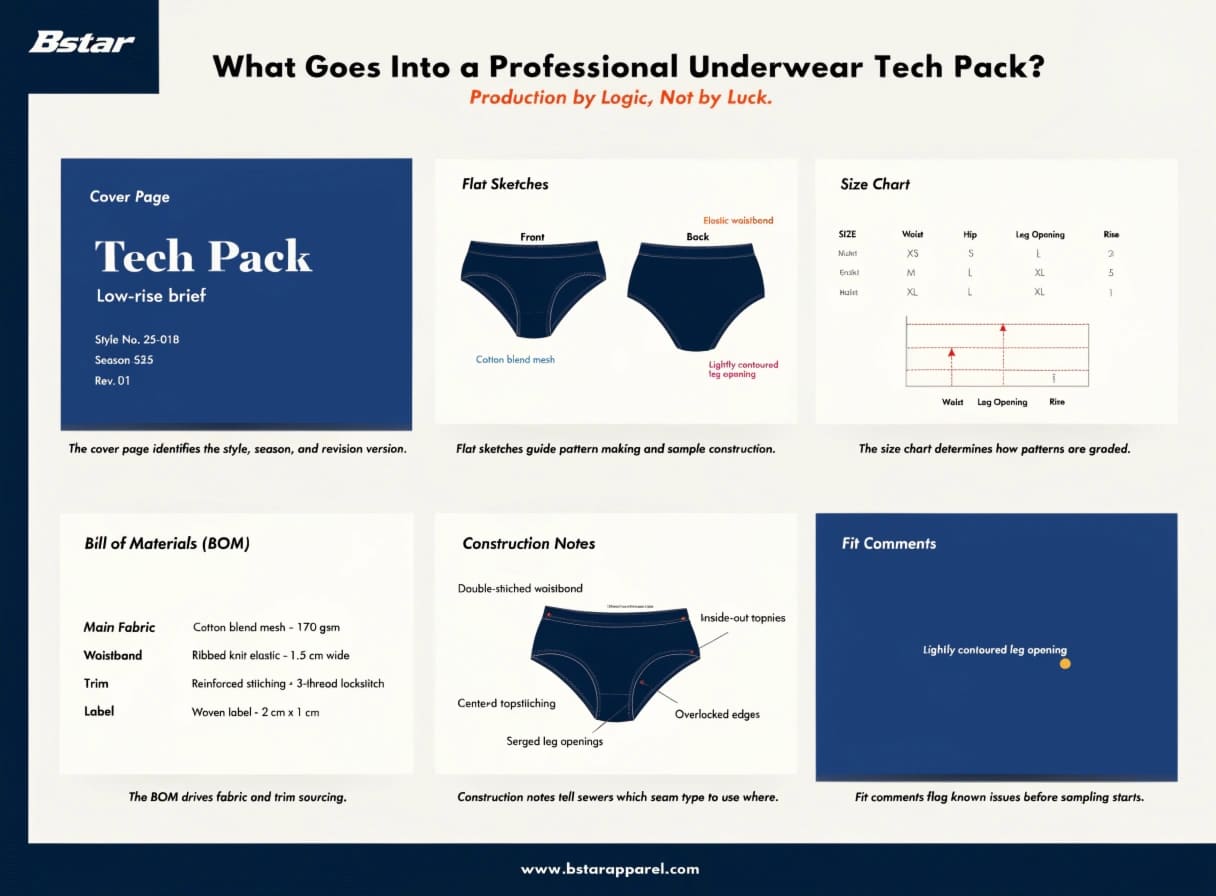
Think of your tech pack as a conversation you’re having with the factory before sampling starts. Every field you fill in is one less question they need to call you about. Every blank field is a decision they’ll make without you.
Here’s how each section maps to what actually happens on the factory floor:
| Tech Pack Section | What the Factory Does With It |
|---|---|
| Cover page | Identifies the style, season, and revision version |
| Flat sketches | Guides pattern making and sample construction |
| Size chart | Determines how patterns are graded |
| BOM (Bill of Materials) | Drives fabric and trim sourcing |
| Construction notes | Tells sewers which seam type to use where |
| Fit comments (if any) | Flags known issues before sampling starts |
Underwear is a category with very tight tolerances and direct skin contact. That makes every section more important here than it would be for a woven jacket or a t-shirt.
Precision in Design: How Do You Draw Flat Sketches for Underwear?
A flat sketch that works for a woven garment usually fails for underwear. Underwear has construction details that aren’t visible from the outside — and those details change how the garment fits, feels, and holds its shape.
Flat sketches for underwear must show front and back views, gusset construction, waistband attachment method, and seam placement. Each area should have a callout label that connects to a specific note in your construction section. Guesswork in the sketch means guesswork in the sample.
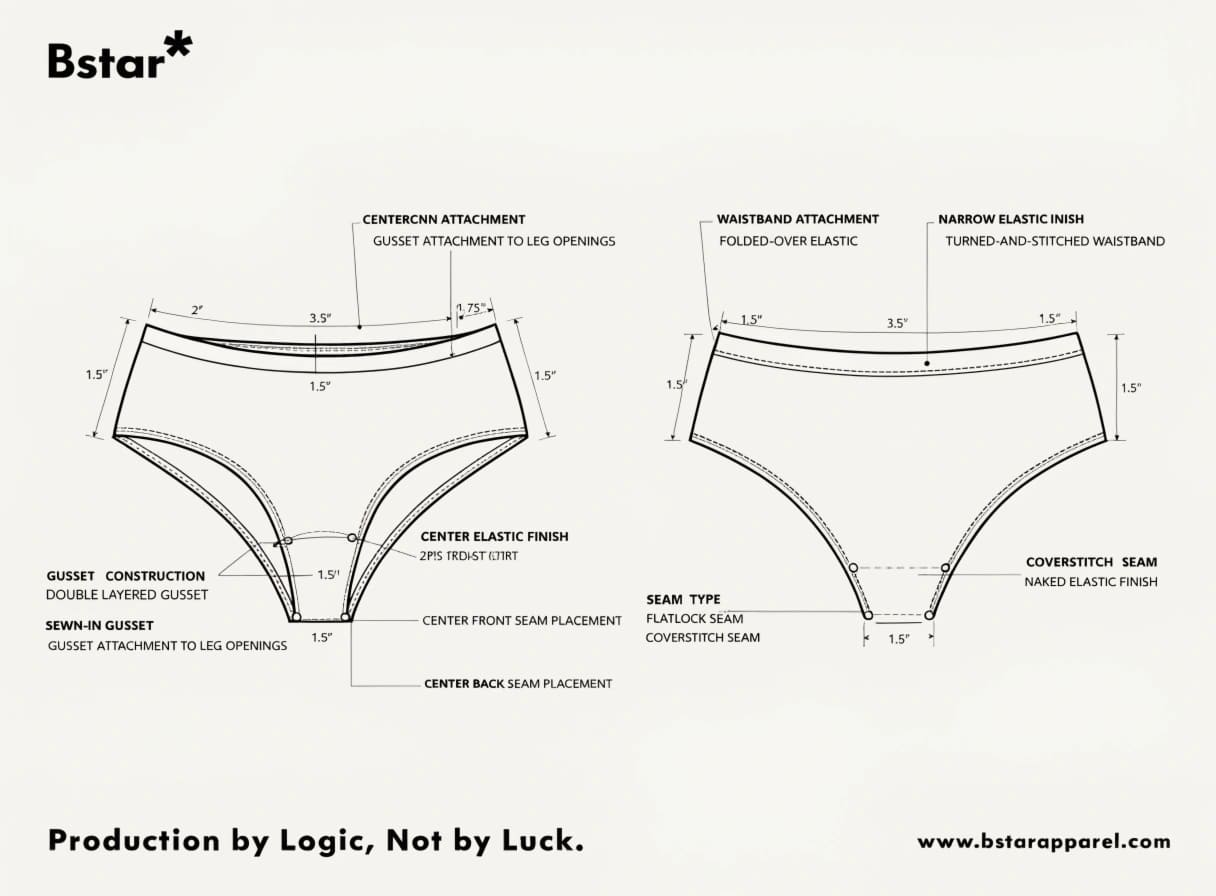
When I look at a sketch that comes in without a gusset detail, our team has to stop and ask: single layer or double layer? Sewn-in or bonded? What fabric? That’s not a small question — it affects comfort, hygiene, and cost. We always confirm before cutting, which adds two to three days before sampling even begins.
What Your Flat Sketch Needs to Show
Gusset construction is the most commonly missing detail. Show the shape, the layer count, and how it attaches to the leg openings.
Seam type matters more than most people realize. A flatlock seam, a coverstitch seam, and a naked elastic finish all look different, feel different, and cost different amounts to produce. If you don’t specify, the factory picks one.
Waistband attachment needs to show whether the elastic is folded-over, turned-and-stitched, or exposed. This is not a visual preference — it’s a construction instruction.
Callout Labels Should Be Functional
Don’t write "soft finish" on a callout. Write "flatlock seam, 3-thread, 6mm stitch width." The more specific the callout, the fewer questions come back to you.
Material Specifications: How Do You Define Fabrics, Trims, and BOM for Underwear?
This is the section where most tech packs fail — not because founders skip it, but because they treat it as a material description instead of a sourcing instruction.
Your fabric spec must include fiber content, weight in GSM, minimum stretch percentage, recovery standard, and surface finish. Your BOM must list every component — fabric, elastic, labels, packaging — with unit of measure and quantity per garment. Incomplete BOM means incomplete sourcing.
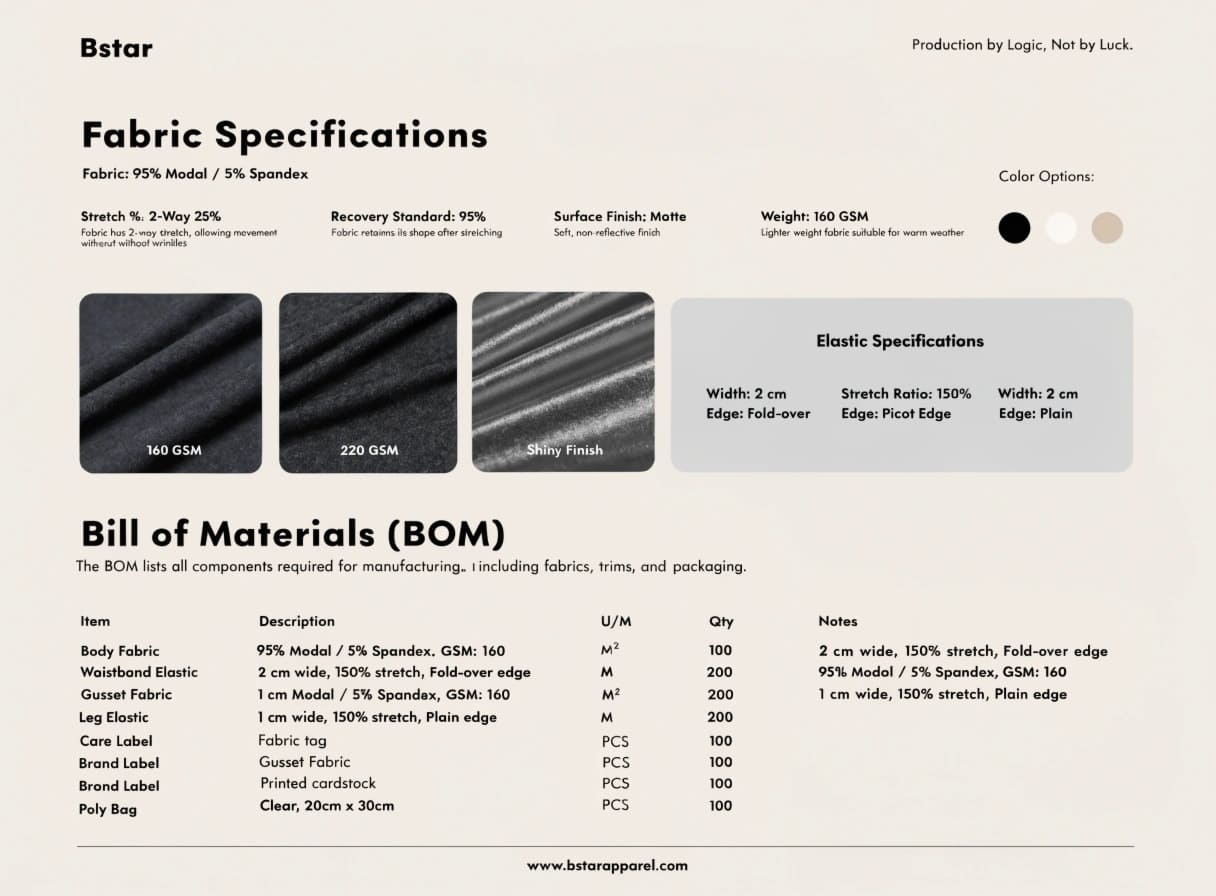
When a tech pack says "95% modal / 5% spandex," that tells us the fiber. It does not tell us the weight, the stretch ratio, or the finish. Modal comes in 160 GSM and 220 GSM. It comes in matte and shiny. It comes with different stretch recovery levels. If these are unspecified, fabric procurement proceeds on factory default — not your brand’s intent.
Fabric Spec: What Each Field Actually Does
| Spec Field | Why the Factory Needs It |
|---|---|
| Fiber content | Determines supplier pool |
| GSM (weight) | Affects drape, opacity, and cost |
| Stretch % (2-way or 4-way) | Sets pattern allowances |
| Recovery standard | Determines if the garment holds shape after wear |
| Surface finish | Matte vs. shiny changes the look of the finished piece |
Elastic Is a Separate Specification
Elastic is not a trim footnote. For underwear, the waistband elastic drives fit, feel, and recovery. You need to specify width, stretch ratio, and whether it’s fold-over, picot edge, or plain. If you have a hand feel reference, say so. If you don’t, we’ll source to standard, and you may not like the result.
Your BOM Should Cover Everything
A complete BOM for a basic brief includes: body fabric, gusset fabric (if different), waistband elastic, leg elastic (if applicable), care label, brand label, hangtag, and poly bag spec. Missing any of these means the factory has to chase you for information before they can place a sourcing order.
From Concept to Sample: How Does a Tech Pack Reduce Sampling Errors?
The first sample is the most expensive one — not in price, but in time. If it comes back wrong, you iterate. If you iterate twice, your launch timeline is already at risk. Most revision cycles trace back to one root cause: the factory had to guess.
A complete tech pack reduces sampling errors by removing guesswork from the factory floor. When measurements, seam types, fabric specs, and construction details are clearly defined, the first sample reflects your decisions — not the factory’s defaults.
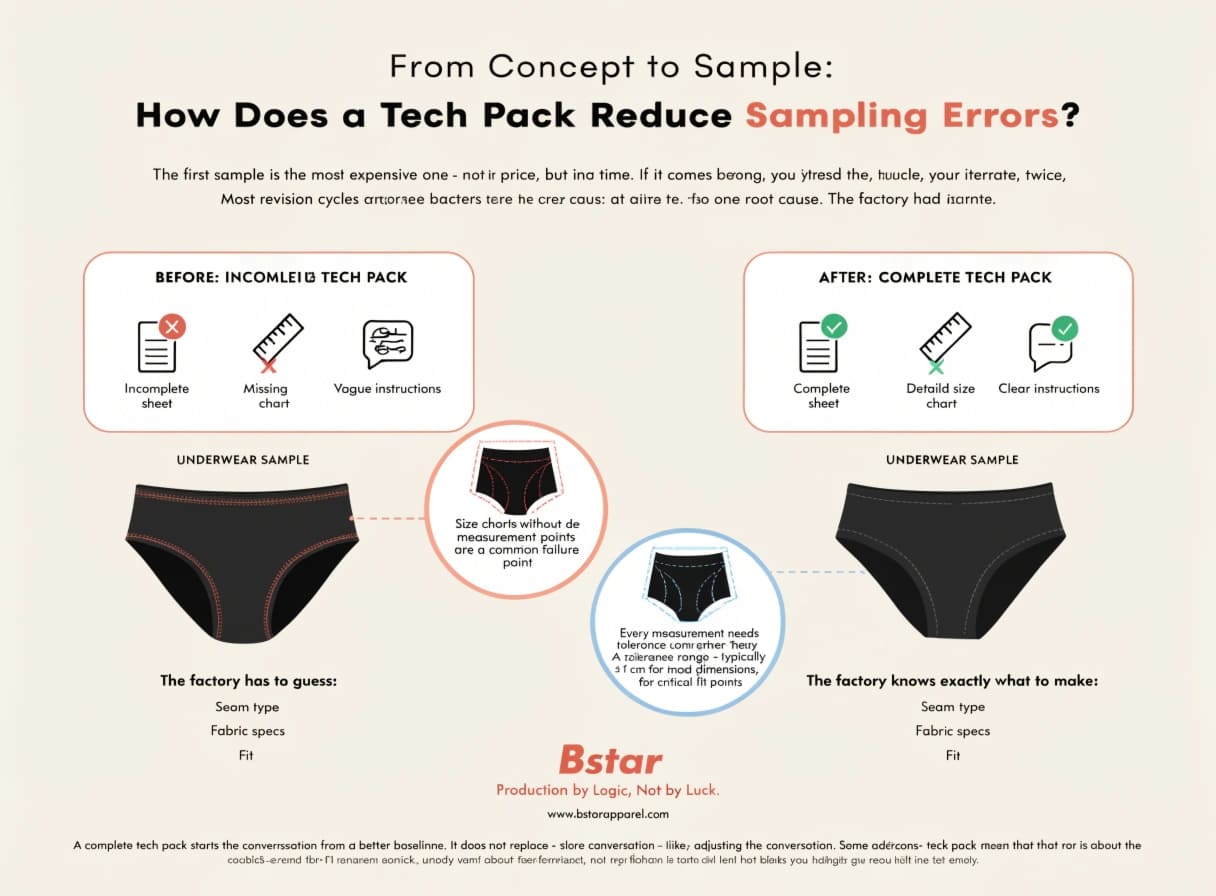
At BSTAR, we work with DTC founders who are doing their first production run. The ones who send a complete tech pack get a first sample that’s close. The ones who send a partial document get a sample that answers the questions we could answer and guesses at the rest.
Size Charts Are the #1 Failure Point
A size chart without defined measurement points is almost useless. You need to specify: is this measurement taken stretched or relaxed? Does it include seam allowance? For stretch fabrics especially, the same number means different things at different stretch ratios.
Tolerances Are Not Optional
Every measurement needs a tolerance range — typically ±1 cm for most dimensions, tighter for critical fit points. Without tolerances, the factory doesn’t know what pass/fail looks like. That creates QC problems later, not just sampling problems now.
What a Tech Pack Can’t Replace
A complete tech pack starts the conversation from a better baseline. It does not replace the conversation. Some decisions — like adjusting fit after you try on the sample — will always require back-and-forth. A good tech pack means that back-and-forth is about refinement, not about filling in the blanks you left empty.
Conclusion
A good underwear tech pack is a production instruction set, not a design document. Fill in every field as if the factory can’t ask you a single question — because every gap they find costs you time.