
How to Prototype Custom Underwear: Sampling Process Explained
Most founders think prototyping is just "making a sample." They send a photo, wait two weeks, and expect something wearable to show up. That is not how it works—and that gap in understanding is exactly where budgets and timelines fall apart.
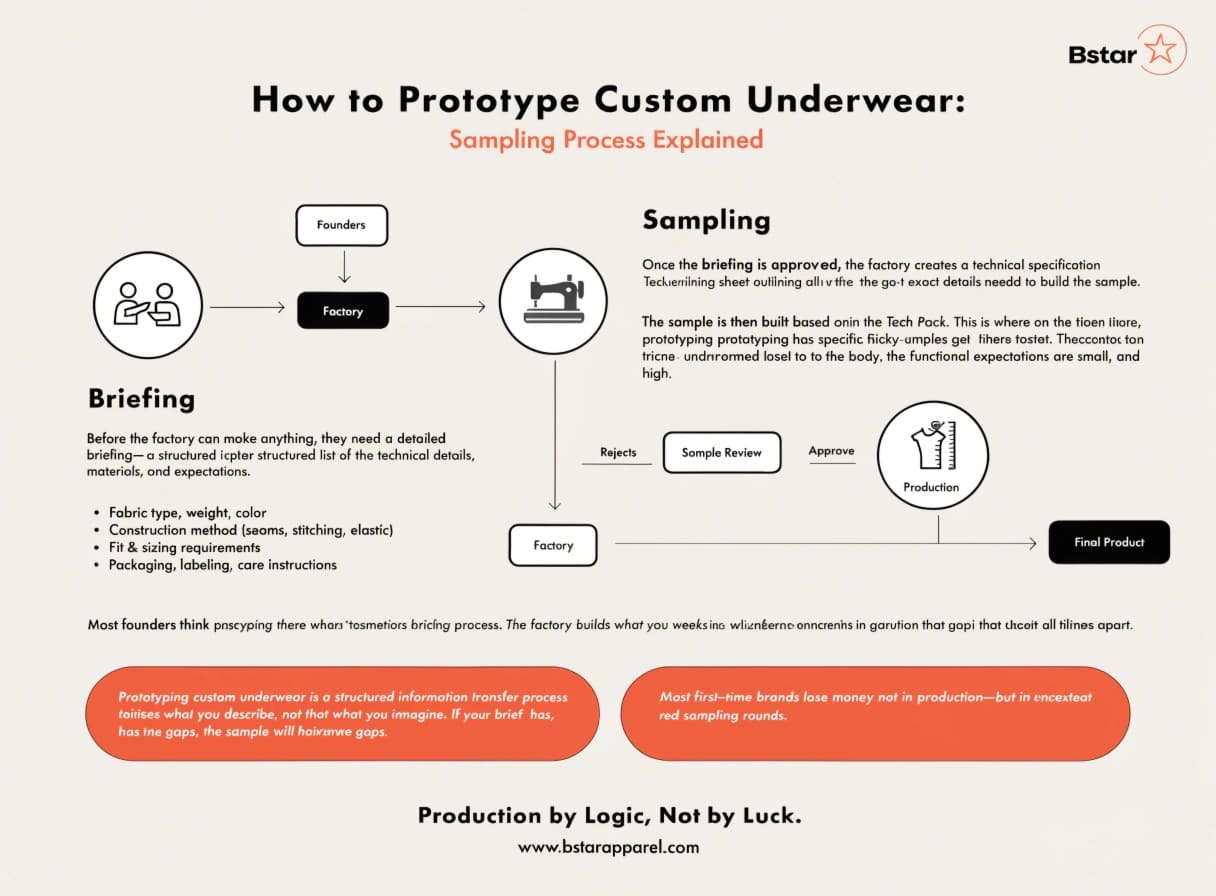
Prototyping custom underwear is a structured information transfer process. The factory builds what you describe, not what you imagine. If your brief has gaps, the sample will have gaps. Most first-time brands lose money not in production—but in unprepared sampling rounds.
Underwear prototyping has specific failure points that other garment categories do not. The construction is close to the body, the panels are small, and the functional expectations are high. Understanding the full process before you start will save you real money. Let me walk you through it from the beginning.
From Concept to Reality: What Are the Different Stages of Underwear Sampling?
A lot of founders treat sampling like a single step. You brief the factory once, get a sample back, and either approve it or ask for changes. That model leads to frustration—and usually three to five revision rounds that could have been two1.
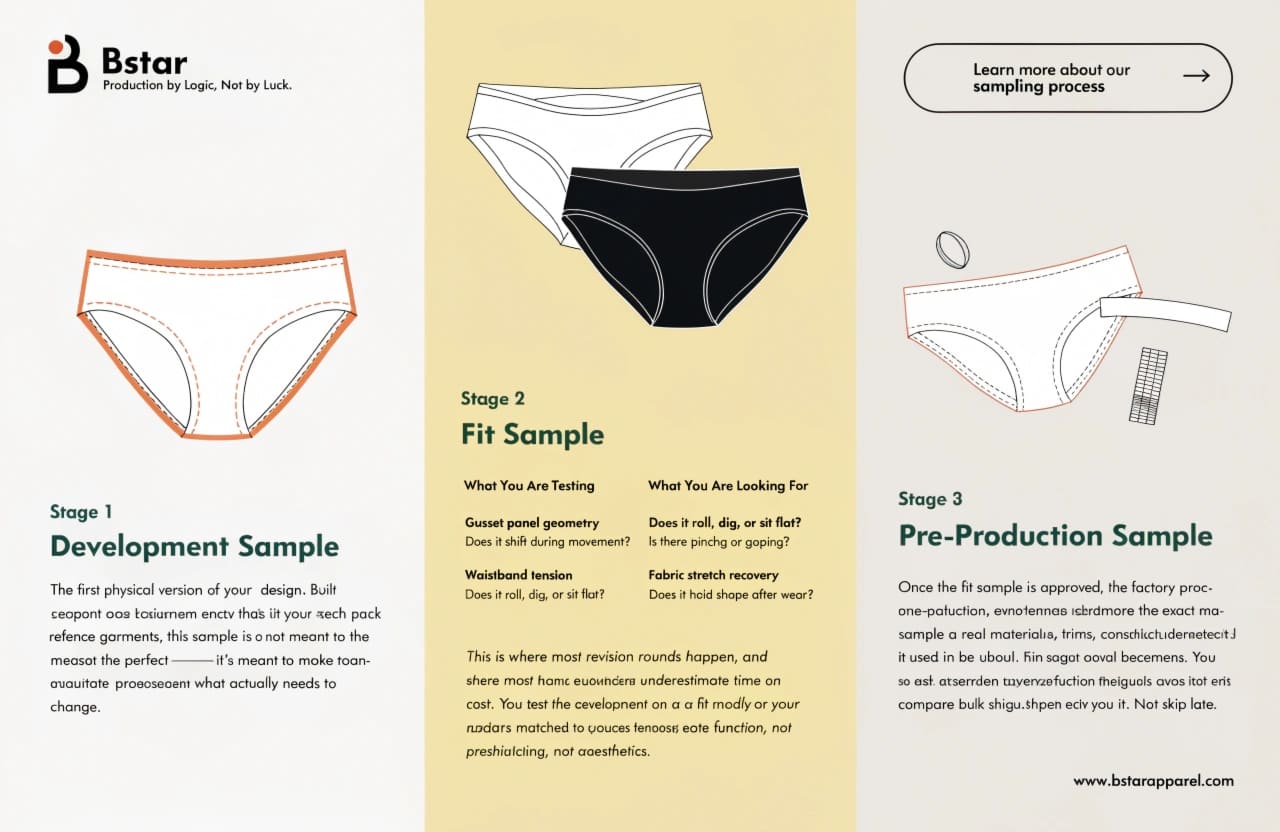
Underwear sampling typically moves through three stages: the development sample (first prototype built from your brief), the fit sample (adjusted for body movement and functional testing), and the pre-production sample (final approved version used to set production standards). Each stage answers a different question.
Stage 1: Development Sample
This is the first physical version of your design. The factory builds it based on your tech pack and any reference garments you provide. It is not meant to be perfect. It is meant to make the concept three-dimensional so you can evaluate what actually needs to change.
At this stage, we are looking at:
- Panel shape and construction logic
- Fabric behavior—does it move the way you expected?
- Seam placement relative to body contact points
Stage 2: Fit Sample
This is where most revision rounds happen, and where most founders underestimate time and cost. You test the development sample on a real body—or a fit model matched to your target size. You are evaluating function, not aesthetics.
| What You Are Testing | What You Are Looking For |
|---|---|
| Gusset panel geometry | Does it shift during movement? |
| Waistband tension | Does it roll, dig, or sit flat? |
| Leg opening elasticity | Is there pinching or gaping? |
| Fabric stretch recovery | Does it hold shape after wear? |
Stage 3: Pre-Production Sample
Once the fit sample is approved, the factory produces a pre-production sample using the exact materials, trims, and construction methods that will be used in bulk. This sample becomes the production standard. You compare every bulk shipment against it. Do not skip this stage—it protects you later.
Preparing for Success: What Documents and Tech Pack Information Do You Need Before Prototyping?
This is the stage where most first-time brands fail—before a single stitch is cut. In our experience working with overseas DTC brands, the number one cause of expensive revision rounds is an incomplete brief at the start. Not bad factories. Not difficult fabrics. Incomplete information.
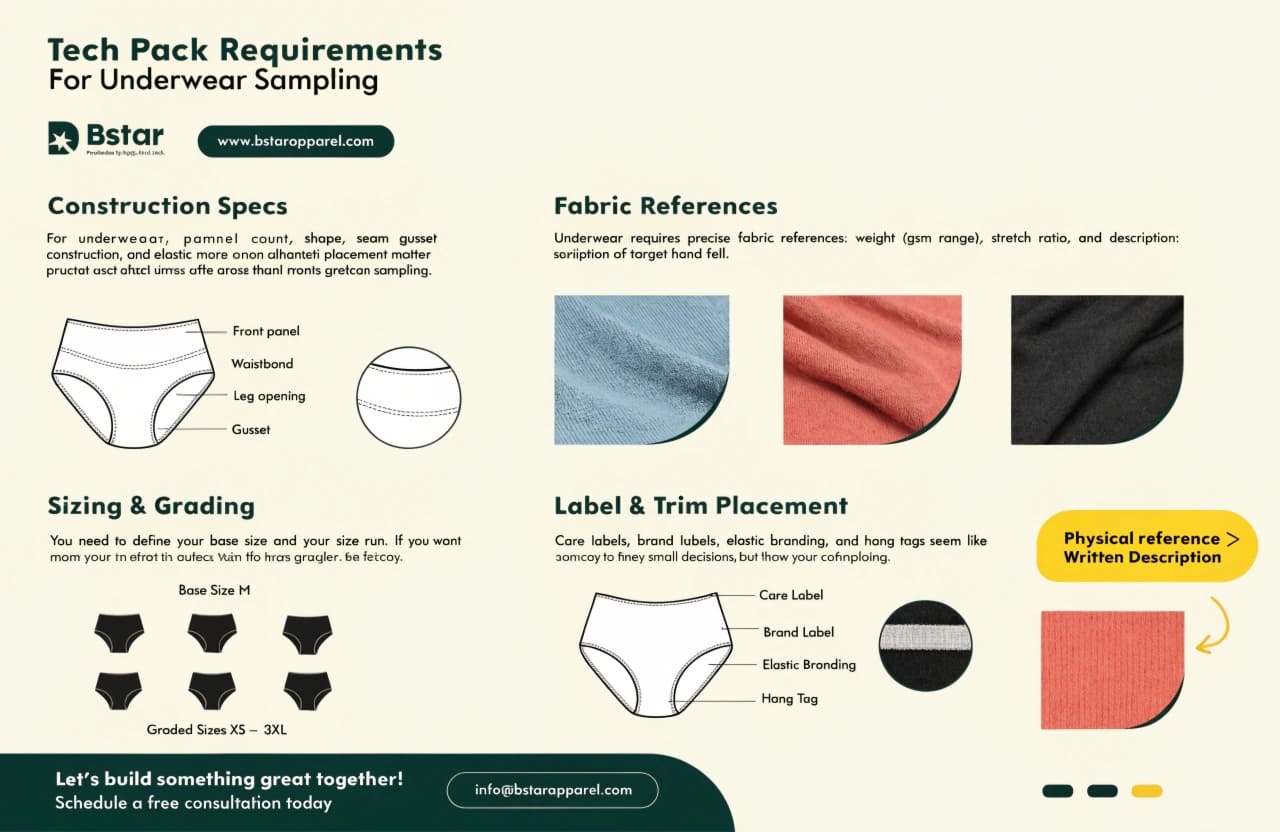
Before sampling begins, you need a tech pack that covers: construction specs, fabric references, sizing and grading, and label and trim placement. A mood board or rendered image is not a brief. It is a starting point. The factory needs specific, written instructions to build from.
What Your Tech Pack Must Include
Think of your tech pack as a letter to someone who has never seen your product and cannot ask you questions while they are building it.
Construction specs include panel count and shape, seam types, gusset construction, and elastic placement. For underwear, this matters more than almost any other garment category because small changes in geometry create large differences in how something fits2.
Fabric references should include weight (gsm range), stretch ratio, and a description of target hand feel. If you have a reference garment with the fabric you want, send it. A physical reference is worth more than a written description every time.
Sizing and grading means you need to define your base size and your size run. If you want to offer XS–3XL, the factory needs to know your grading increments. Do not assume they will use a standard grade—there is no universal standard3.
Label and trim placement covers care labels, brand labels, elastic branding, and any hang tags. These seem like small decisions, but they affect construction sequencing. If you add them late, it creates rework.
Here is a quick checklist you can use before sending your brief:
- Panel construction diagram (or annotated reference photo)
- Elastic type and placement specified
- Fabric weight and stretch ratio noted
- Reference garment or physical fabric swatch included
- Base size and size run defined
- Label placement marked on tech pack sketch
- Colorways listed with Pantone references or physical swatches
One of our Australian clients—STEP ONE—came to us with a well-documented brief from the very beginning. They had reference garments, a clear size run, and specific notes on waistband behavior. Their first prototype required minimal revision. That kind of preparation is not common, but it is achievable, and it changes the economics of sampling completely.
Evaluating Fit and Function: How Do You Conduct Fit Tests and Quality Checks?
Getting a sample back is exciting. It feels like progress. But this stage requires discipline. You are not looking at the sample to admire it—you are looking at it to find what does not work before it goes to production.
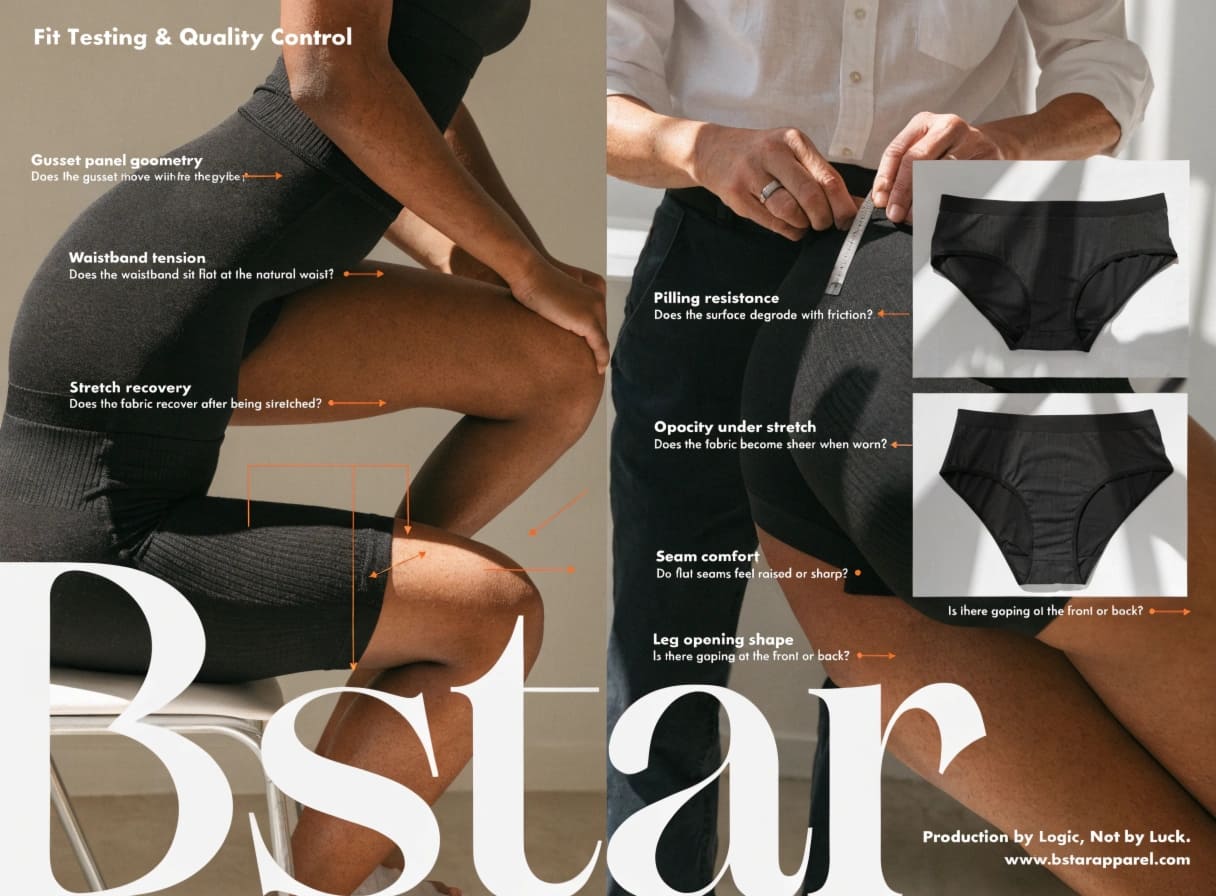
Underwear fit failures concentrate in two places: panel geometry and fabric behavior. Gusset shape and waistband tension affect body movement. Fabric stretch and recovery affect how the garment feels and holds up over time. Both must be evaluated on a real body, not on a hanger.
How to Evaluate Panel Geometry
Put the sample on a fit model whose measurements match your target customer—not whoever is convenient. Evaluate the following during movement, not just standing still:
- Gusset panel: Does it move with the body or shift out of position? A gusset that fits well standing still can bunch or pull during normal activity.
- Waistband: Does it sit flat at the natural waist or hip? Does it roll when the model sits or bends? Does the tension feel consistent around the full circumference?
- Leg opening: Is there gaping at the front or back? Does the elastic create red marks after ten minutes of wear?
How to Evaluate Fabric Behavior
Fabric behavior is harder to describe than panel geometry, which is why many brands underestimate it4. Ask your fit model to wear the sample for at least thirty minutes before giving feedback. Stretch recovery, heat response, and friction against skin all reveal themselves over time—not at first touch.
| Fabric Test | What to Look For |
|---|---|
| Stretch recovery | Does it return to original shape after being pulled? |
| [Pilling resistance | Does the surface degrade with friction?](https://begoodtex.com/blog/iso-12945-textile-pilling-and-fuzzing-test-standards/?srsltid=AfmBOooF41SZKHOspeVC6_sMZWdT465szE-J42NeiJTIeiWnzSQj51K8)[^5] |
| [Opacity under stretch | Does fabric become sheer when worn?](https://www.cpsc.gov/s3fs-public/Flammability%20of%20Clothing%20Textiles%20Test%20Manual_1610.pdf)[^6] |
| Seam comfort | Do flat seams feel raised or sharp against skin? |
Document your findings in writing with reference to specific panels. "The waistband rolls at the back" is useful feedback. "It feels a bit off" is not.
Refining the Prototype: How Do You Manage Feedback Rounds and Lock In Your Pre-Production Sample?
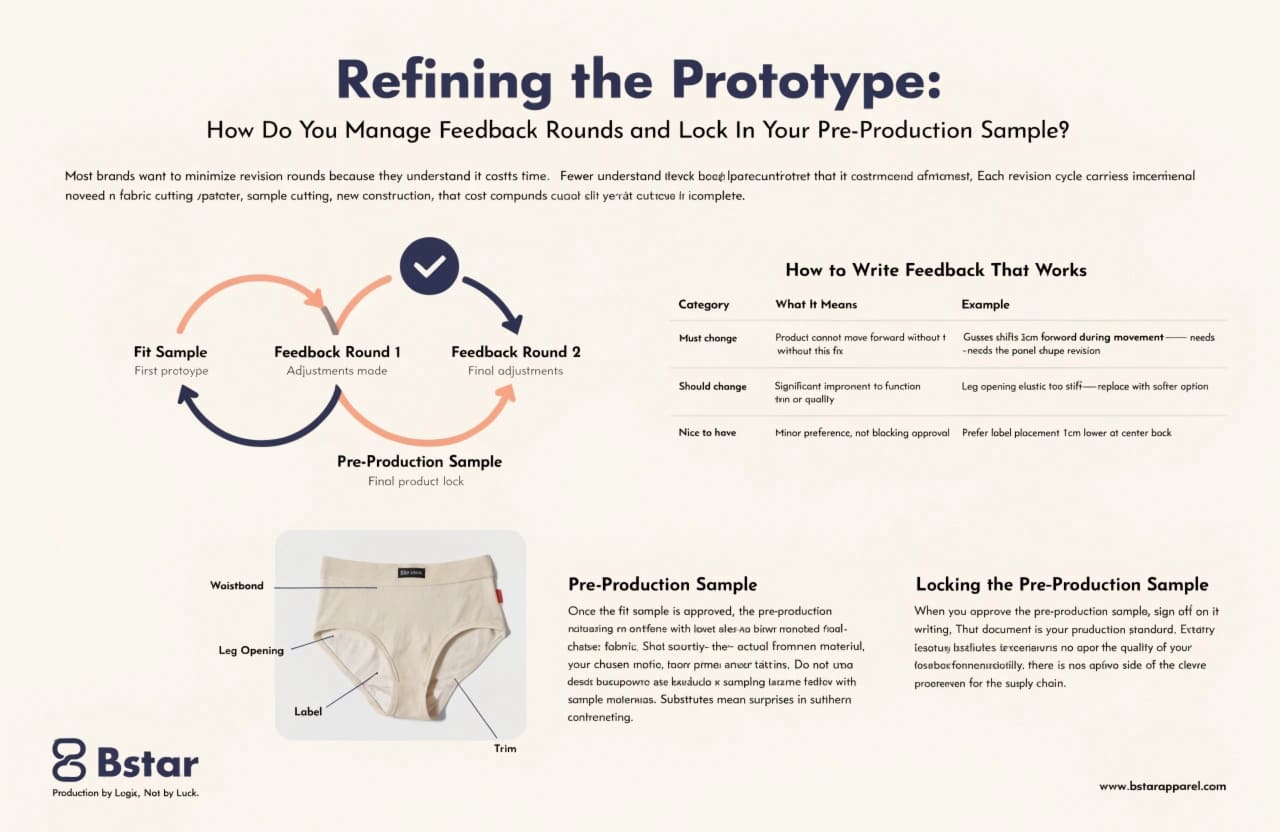
Most brands want to minimize revision rounds because they understand it costs time. Fewer understand that it also costs money. Each revision cycle carries incremental cost—pattern adjustment, new fabric cutting, sample construction, and shipping5. That cost compounds quickly if your feedback is vague or incomplete.
The way to reduce revision cost is not to rush the factory—it is to front-load information accuracy. Clear, specific, written feedback after each round shortens the next round. Vague feedback forces the factory to guess again, and guessing is how you end up in round four when you expected round two.
How to Write Feedback That Works
After each sample, write your comments against specific construction points—not general impressions. Use the same panel names and measurements your tech pack uses. If your waistband measurement needs to change, state the new target measurement in centimeters, not "make it a little tighter."
Structure your feedback in three categories:
| Category | What It Means | Example |
|---|---|---|
| Must change | Product cannot move forward without this fix | "Gusset shifts 2cm forward during movement—needs panel shape revision" |
| Should change | Significant improvement to function or quality | "Leg opening elastic too stiff—replace with softer option" |
| Nice to have | Minor preference, not blocking approval | "Prefer label placement 1cm lower at center back" |
This structure makes it easy for the factory to prioritize. It also makes it easy to decide when a round is worth doing versus when you are chasing diminishing returns.
Locking the Pre-Production Sample
Once the fit sample is approved, the pre-production sample should be built using the confirmed materials—the actual fabric from your chosen supplier, the confirmed elastic, the confirmed labels and trims. Do not approve a pre-production sample built with substitute materials. Substitutes in sampling mean surprises in production6.
When you approve the pre-production sample, sign off on it in writing. That document is your production standard.7 Every bulk unit is compared against it during quality inspection. Without a signed-off pre-production sample, there is no clear benchmark for either side of the supply chain.
Conclusion
Prototyping custom underwear takes preparation, structured feedback, and patience. Get your brief right before sampling starts, and most of the hard work is already done.
-
"Apparel Sampling Process Explained (2026) – Linenwind", https://www.linenwind.com/blog/Clothing-Sampling-Guide-Apparel-Sampling-Process-Explained-2026_b24560. Research on apparel product development processes documents that incomplete technical specifications at the brief stage are a primary driver of increased sampling iterations, with poorly documented briefs correlating with higher revision counts before production approval. Evidence role: statistic; source type: research. Supports: The typical number of revision cycles in apparel sampling and how incomplete briefs increase iteration counts. Scope note: Direct empirical data on average revision round counts specific to underwear or intimate apparel sampling is limited in published literature; general apparel development studies provide contextual support only. ↩
-
"Study on the Permeability and Absorption Performance … – PMC", https://pmc.ncbi.nlm.nih.gov/articles/PMC10935086/. Garment engineering research demonstrates that in close-fitting knitted garments, small deviations in panel dimensions—particularly in curved seam areas—produce non-linear changes in ease, pressure distribution, and body coverage due to the interaction between fabric stretch properties and three-dimensional body curvature. Evidence role: mechanism; source type: research. Supports: That small dimensional changes in garment panel geometry have significant effects on fit, particularly in close-fitting garments. Scope note: Published research on this mechanism is more developed for general knitwear and sportswear than for underwear specifically; the principle is supported by general garment engineering literature rather than underwear-specific studies. ↩
-
"Clothing sizes – Wikipedia", https://en.wikipedia.org/wiki/Clothing_sizes. ISO 8559 provides general guidelines for garment construction and anthropometric surveys, but the standard itself acknowledges significant variation in sizing conventions across national markets, and no single international standard mandates uniform grading increments for apparel. Evidence role: expert_consensus; source type: institution. Supports: The absence of a single universal apparel sizing standard and the variation in grading increments across markets and manufacturers. Scope note: ISO 8559 addresses measurement methodology rather than prescribing grading increments, so it supports the claim of fragmentation contextually rather than as direct proof of the absence of a universal standard. ↩
-
"Garment failure causes and solutions: Slowing the cycles for circular …", https://ui.adsabs.harvard.edu/abs/2022JCPro.35131394C/abstract. Product development literature in apparel engineering identifies fabric mechanical properties—including stretch, recovery, and surface behavior—as frequent sources of post-production quality failures when not systematically evaluated during prototype stages. Evidence role: general_support; source type: research. Supports: That fabric performance properties are a common source of product development failures and are frequently underweighted in early-stage evaluation. Scope note: Published research on this specific failure mode in DTC underwear brands is limited; broader apparel engineering literature provides general support rather than direct evidence for the claim as stated. ↩
-
"Apparel Sampling Costs Explained: What Brands Often Overlook", https://trisapparel.com/apparel-sampling-cost-breakdown/. Supply chain and product development literature in apparel manufacturing identifies sampling as a significant cost center, with each iteration incurring costs across pattern making, material consumption, labor, and logistics, and notes that front-loaded specification accuracy reduces total sampling expenditure. Evidence role: statistic; source type: research. Supports: That iterative sampling rounds generate compounding costs across multiple cost categories in apparel product development. Scope note: Specific per-cycle cost figures vary substantially by product category, factory location, and order volume; published data provides structural support for the cost compounding claim rather than precise figures applicable to underwear sampling specifically. ↩
-
"What Are The 13 Types of Garment Samples In Apparel Production?", https://sinofinetex.com/what-are-the-13-types-of-garment-samples-in-apparel-production/. Quality management literature in apparel manufacturing identifies material consistency between approved samples and bulk production as a foundational principle of quality control, noting that substitutions in fiber content, weight, or finish alter dimensional stability, color, and mechanical performance in ways that invalidate sample-based benchmarks. Evidence role: mechanism; source type: research. Supports: That material substitutions between sampling and production stages introduce quality variance that undermines the pre-production sample as a production standard. Scope note: This principle is well-established in general quality management literature; published studies documenting specific failure rates attributable to material substitution in underwear production are not widely available in the open literature. ↩
-
"Manufacturing Supply Agreement – SEC.gov", https://www.sec.gov/Archives/edgar/data/317093/000119312506252522/dex1037.htm. ISO 2859 (sampling procedures for inspection by attributes) and widely adopted apparel quality management frameworks identify an approved reference or ‘golden’ sample as the standard against which bulk production units are evaluated, with documented approval forming the basis for acceptance or rejection decisions during quality inspection. Evidence role: expert_consensus; source type: institution. Supports: That documented approval of a reference sample is a recognized quality management practice that establishes the production benchmark and defines acceptance criteria for bulk inspection. Scope note: ISO 2859 addresses statistical sampling inspection methodology rather than the contractual status of sample sign-off documents; the legal enforceability of written approval depends on jurisdiction and contract terms, which are outside the scope of quality management standards. ↩