
Common Underwear Design Mistakes and How to Avoid Them
Most underwear brands don’t fail at the factory. They fail at the desk, weeks before sampling even starts. Here’s what I see again and again.
The most common underwear design mistakes happen before production begins. They include ignoring size grading for diverse bodies, choosing fabric by feel instead of function, skipping structural checks on seams and elastic, and submitting incomplete tech packs. Each mistake adds sampling rounds and delays your launch.
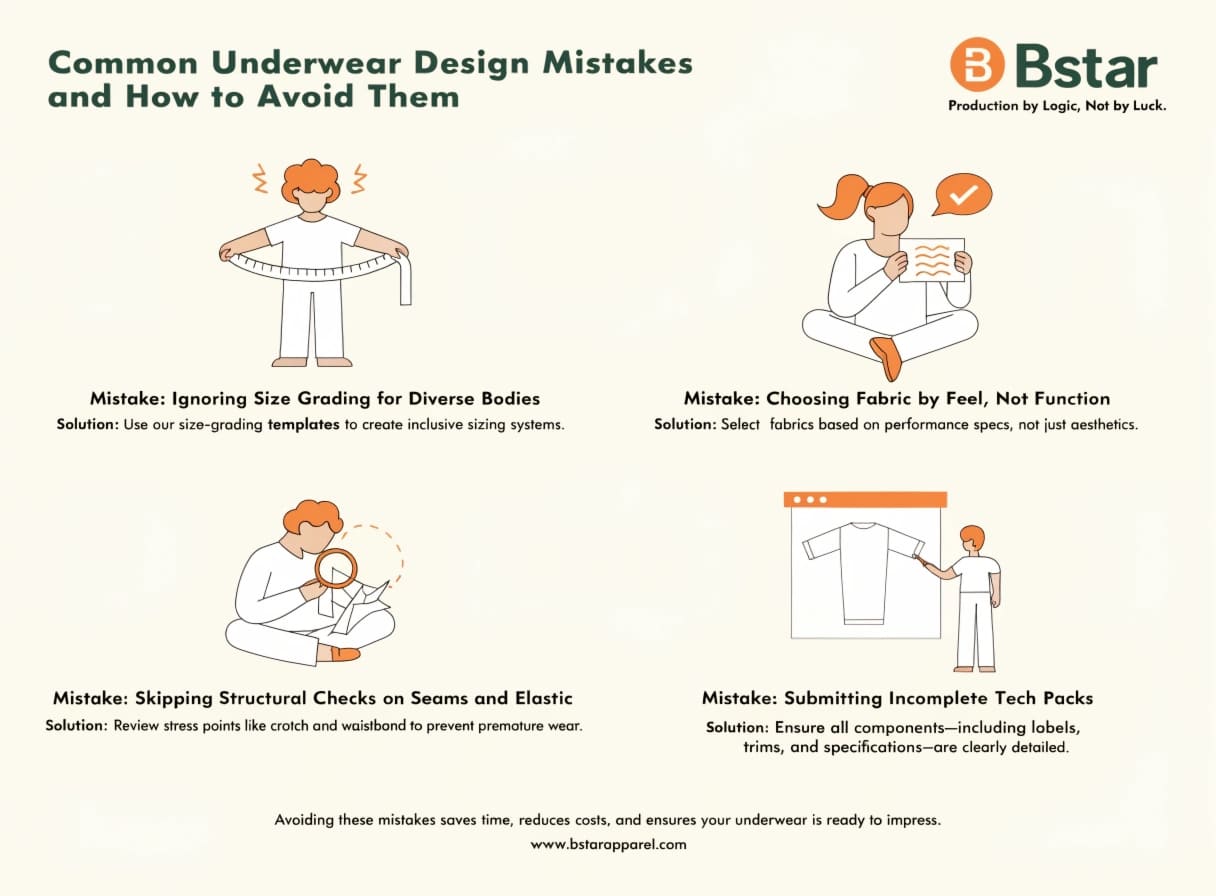
After 19 years of reviewing design files from DTC founders, e-commerce sellers, and first-time brand builders, I’ve seen the same errors show up in batches. The good news is that almost all of them are fixable — but only if you catch them before you send files to a factory. Let me walk you through each one.
Fit and Sizing Failures: Are You Actually Designing for Real Bodies?
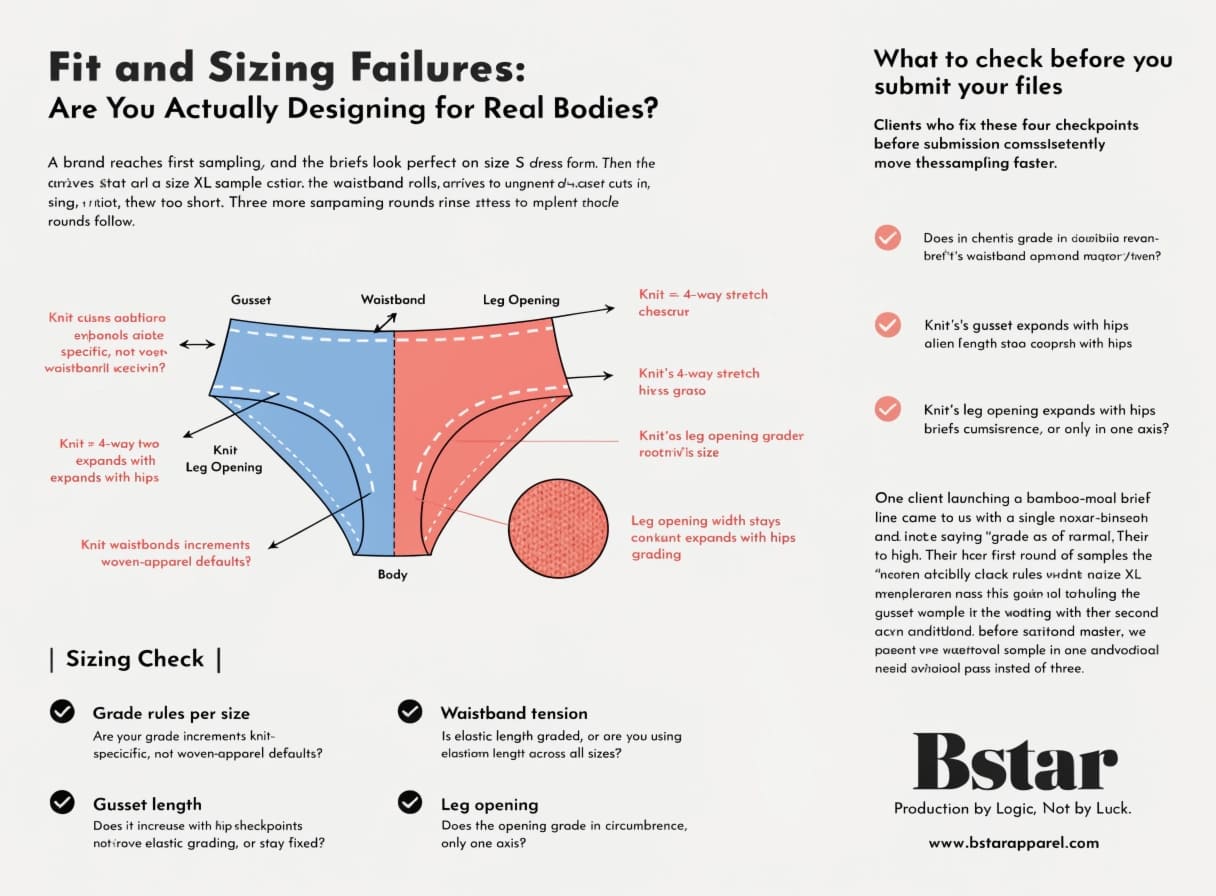
A brand reaches first sampling, and the briefs look perfect on a size S dress form. Then the size XL sample arrives, and the waistband rolls, the leg opening cuts in, and the gusset is too short. Three more sampling rounds follow.
Underwear fit failures at extended sizes almost always trace back to two root causes: using a single-point size pattern without proper grade rules, and designing around a single body type. Grading underwear is not the same as scaling a woven garment — stretch recovery changes at every size, and your grade rules must account for that.1
This is one of the most expensive mistakes I see, and it’s almost invisible at the sketch stage.
Here’s the core problem. Woven garments grade by adding seam allowance at predictable points. Knit underwear grades differently because the fabric itself is doing structural work.2 When you scale up a knit pattern the same way you’d scale a woven shirt, the proportions break. The waistband becomes too tight relative to the hip. The gusset doesn’t lengthen with the body. The leg opening digs in.3
What to check before you submit your files
| Sizing Check | What to Look For |
|---|---|
| Grade rules per size | Are your grade increments knit-specific, not woven-apparel defaults? |
| Gusset length | Does it increase with hip/inseam grading, or stay fixed? |
| Waistband tension | Is elastic length graded, or are you using the same elastic length across all sizes? |
| Leg opening | Does the opening grade in circumference, or only in one axis? |
Clients who fix these four checkpoints before submission consistently move through sampling faster. One client launching a bamboo-modal brief line came to us with a single base pattern and a note saying "grade as normal." Their first round of samples at size L and XL had gussets that were visibly too short and waistbands that sat too high. After rebuilding the grade rules with their pattern maker before the second round, we got to an approved sample in one additional pass instead of three.
Ask your pattern maker this specific question before submitting: "Are these grade rules built for a knit with 4-way stretch, or are they carried over from a woven or activewear base?" The answer will tell you a lot.
Material Missteps: Is Your Fabric Actually Right for This Silhouette?
You find a fabric that feels amazing in the hand. Soft, smooth, the right color. You approve it and move to sampling. Then the samples come back — and the briefs are see-through under light, or the bralette loses its shape after one wash.
Fabric selection for underwear must match the specific silhouette and coverage level of the design. GSM (grams per square meter) directly affects opacity, drape, and how the garment holds shape in motion.4 Choosing by touch or price alone — without checking GSM against your design requirements — is one of the leading causes of re-sampling.
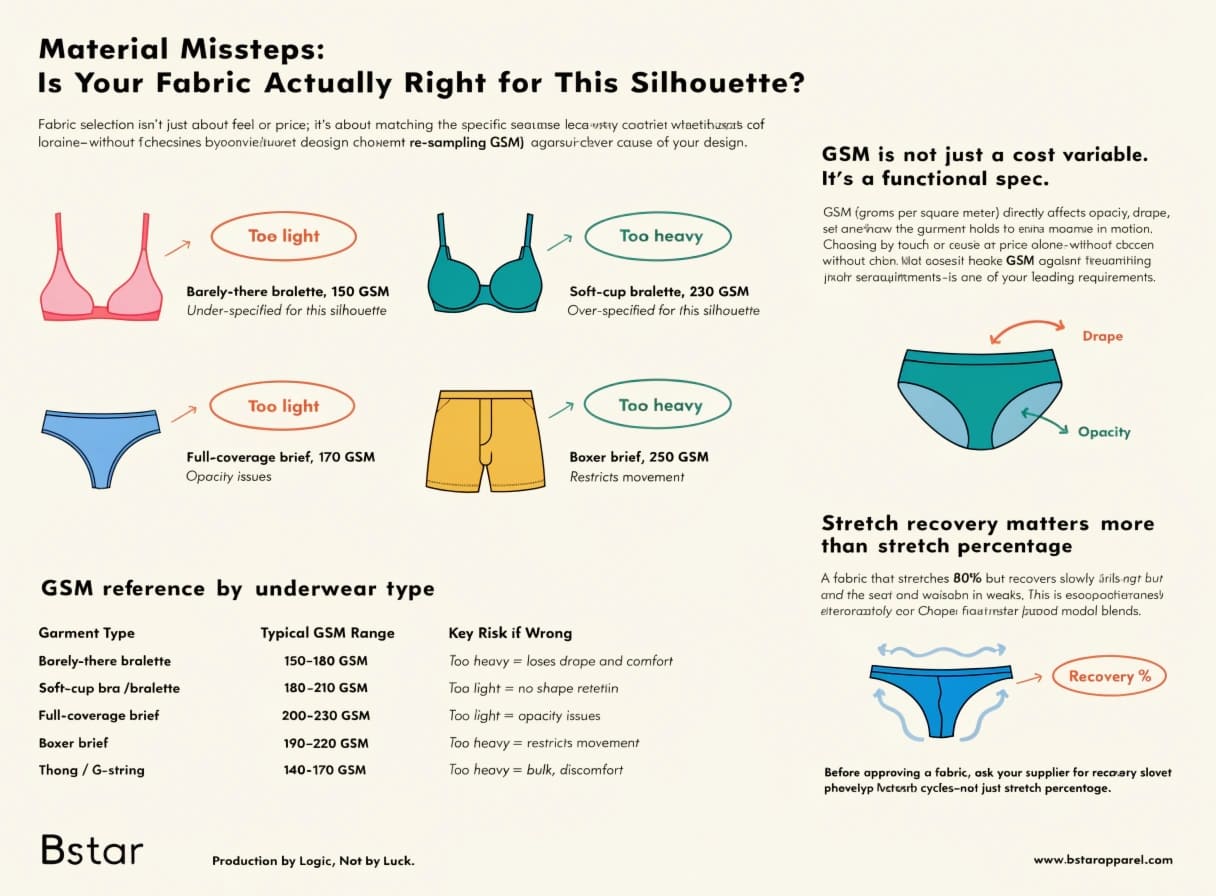
GSM is not just a cost variable. It’s a functional spec.
In our sampling process, we typically flag fabric submissions that are under-specified for their silhouette. A lightweight fabric in the 150–170 GSM range might work beautifully for a barely-there bralette but will be too sheer and too unstable for a high-coverage brief. A heavier fabric at 220+ GSM gives good opacity for a full brief but may be too stiff to drape properly around a soft cup or triangle bralette.
GSM reference by underwear type
| Garment Type | Typical GSM Range | Key Risk if Wrong |
|---|---|---|
| Barely-there bralette | 150–180 GSM | Too heavy = loses drape and comfort |
| Soft-cup bra / bralette | 180–210 GSM | Too light = no shape retention |
| Full-coverage brief | 200–230 GSM | Too light = opacity issues |
| Boxer brief | 190–220 GSM | Too heavy = restricts movement |
| Thong / G-string | 140–170 GSM | Too heavy = bulk, discomfort |
Beyond GSM, stretch recovery matters more than stretch percentage5. A fabric that stretches 80% but recovers slowly will sag at the seat and waistband within weeks. This is especially common with cheaper modal blends.6 Before approving a fabric, ask your supplier for the recovery percentage after 50 stretch cycles — not just the stretch percentage7.
Structural Flaws: Is Your Design Built to Move?
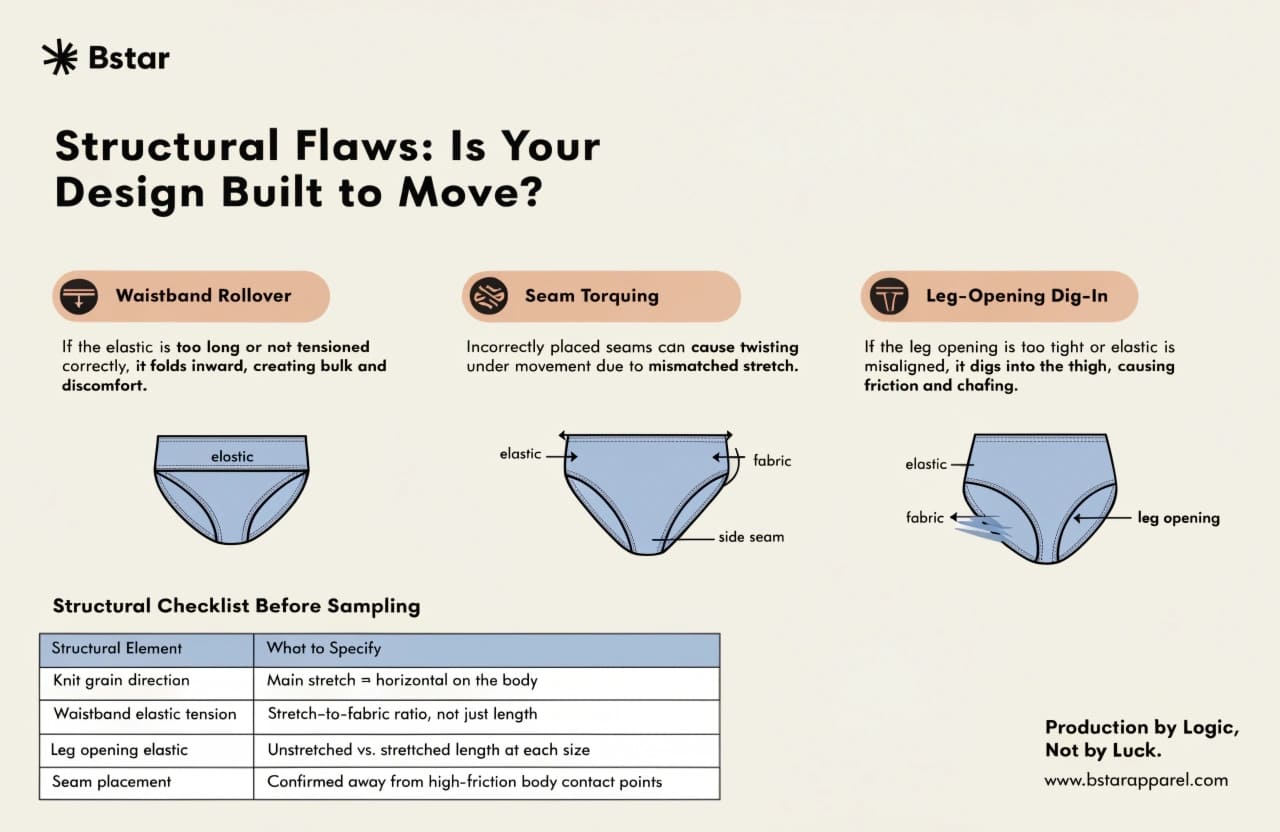
A sketch looks clean. Symmetrical, proportionate, exactly what the brand wants. But when the sample comes back, the waistband folds over on itself, the seam at the leg opening creates a pressure line, and the side seams twist toward the front after one wear.
The most common structural flaws in underwear — waistband rollover, seam torquing, and leg-opening dig-in — almost always trace back to decisions made in the design file, not at the factory floor. Gusset depth, elastic tension specs, and knit direction all need to be confirmed before sampling begins.
Here’s what I see most often in files that need structural rework.
Knit direction is skipped. Underwear patterns need to specify which direction the greatest stretch runs. If the fabric’s main stretch runs vertically instead of horizontally on the body, the garment will twist and the seams will torque.8 This is a one-line note in your tech pack, but missing it costs a full sampling round.
Elastic tension is listed as a length only. Saying "waistband elastic: 28 inches" is not enough. Elastic tension — how much the elastic is stretched relative to the fabric it’s sewn to — determines whether the waistband sits, folds, or rolls.9 In our sampling process, we ask clients to confirm this ratio before we cut. Clients who leave it to factory judgment get inconsistent results.
Gusset depth is not matched to the silhouette. A gusset that works for a mid-rise brief is too shallow for a high-cut leg opening. This is the single most common structural re-work we see — and it’s always caught at the first fitting, never earlier, because it doesn’t show up on a flat pattern.
Structural checklist before sampling
| Structural Element | What to Specify |
|---|---|
| Knit grain direction | Main stretch = horizontal on the body |
| Waistband elastic tension | Stretch-to-fabric ratio, not just length |
| Leg opening elastic | Unstretched vs. stretched length at each size |
| Gusset depth | Confirmed for the specific leg-opening height |
| Seam placement | Confirmed away from high-friction body contact points |
Overlooking Technical Details: Does Your Factory Actually Have What They Need?
The design looks finished. The mood board is locked. The fabric is approved. Then the factory comes back with twelve clarification questions, sampling takes six weeks instead of two, and the first sample still has three obvious problems.
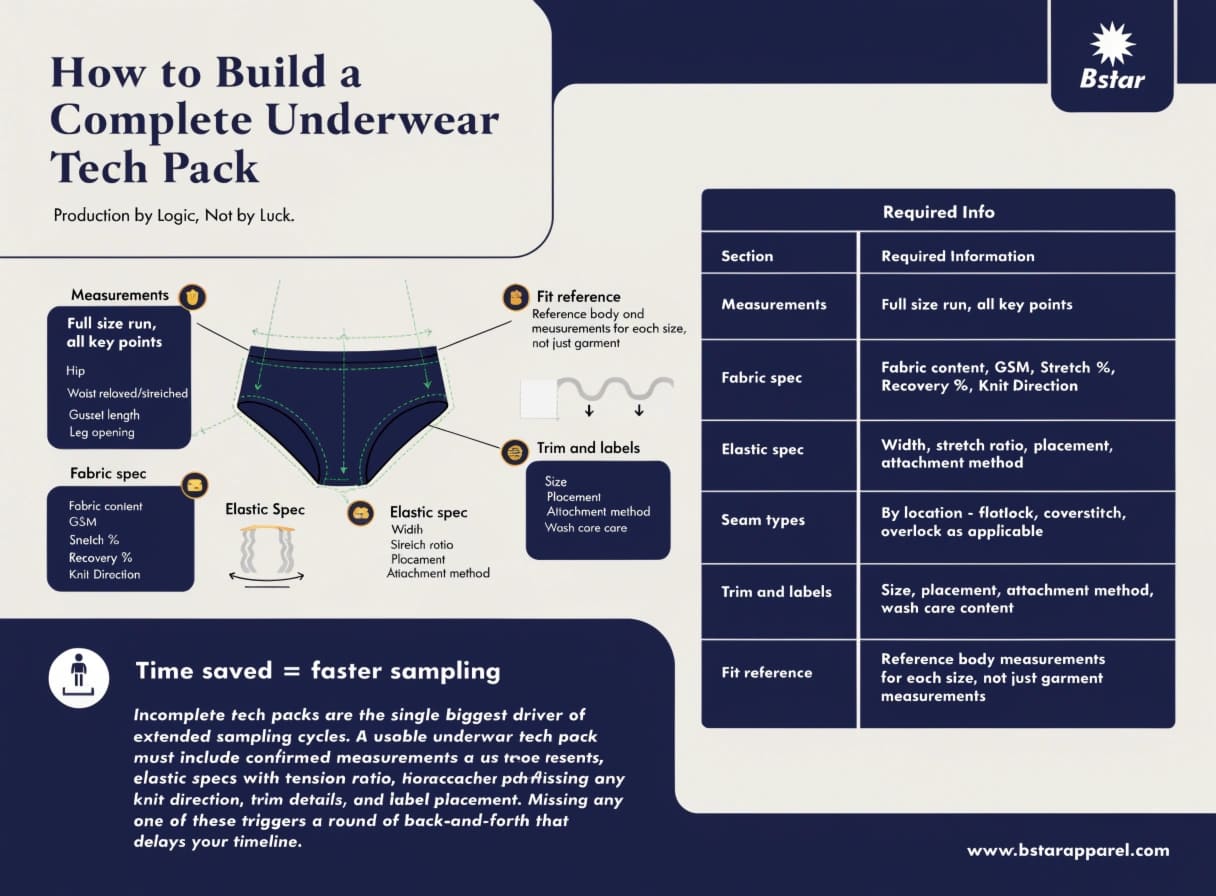
Incomplete tech packs are the single biggest driver of extended sampling cycles.10 A usable underwear tech pack must include confirmed measurements at every size, elastic specs with tension ratios, seam type and placement, knit direction, trim details, and label placement.11 Missing any one of these triggers a round of back-and-forth that delays your timeline.
The hidden cost here isn’t the re-sampling fee. It’s the calendar time.
In our experience reviewing files across DTC brands and e-commerce sellers, the clients who move fastest through sampling are almost never the ones with the most elaborate designs. They’re the ones whose tech packs are complete. A client launching a five-SKU underwear line came to us with design files that had fabric callouts but no GSM specs, elastic lengths but no tension ratios, and size charts that only went to L. Their first sampling round answered our clarification questions — not the actual fit. After rebuilding their tech pack before round two, they confirmed samples in one additional round.
What a complete underwear tech pack must include
| Section | Required Information |
|---|---|
| Measurements | Full size run, all key points (waist relaxed/stretched, hip, gusset length, leg opening) |
| Fabric spec | Fabric content, GSM, stretch %, recovery %, knit direction |
| Elastic spec | Width, stretch ratio, placement, attachment method |
| Seam types | By location — flatlock, coverstitch, overlock as applicable |
| Trim and labels | Size, placement, attachment method, wash care content |
| Fit reference | Reference body measurements for each size, not just garment measurements |
Before you submit your design files to any factory, ask yourself one question: Can this factory make a correct first sample using only what I’ve given them, with no follow-up questions? If the answer is no, find what’s missing and fill it in. That step alone will cut your sampling rounds.
Conclusion
Most underwear design mistakes are fixable — but only before sampling starts. Check your grading, confirm your GSM, specify your elastic tension, and complete your tech pack. Fix these four things first, and your launch timeline will thank you.
-
"Knits vs Woven. What’s the big deal? | Portland Fashion Institute", https://pfi.edu/knits-vs-woven-whats-the-big-deal/. Pattern-making literature distinguishes knit grading from woven grading on the basis that stretch fabrics perform structural functions; grade increments must therefore account for changes in elastic recovery across the size range rather than applying uniform seam-allowance additions. Evidence role: mechanism; source type: education. Supports: That knit fabric grading differs fundamentally from woven grading because the fabric’s elastic properties are load-bearing and change with scale. Scope note: Most academic sources address grading principles generally; direct empirical data on recovery-rate variation by size in underwear-specific knits may require manufacturer technical documentation. ↩
-
"[PDF] Properties of knit underwear fabrics of various constructions", https://nvlpubs.nist.gov/nistpubs/jres/13/jresv13n3p311_A2b.pdf. Apparel engineering literature distinguishes knit from woven construction on the basis that knit fabrics in close-fitting garments exert and resist elastic forces as part of the garment’s fit mechanism, whereas woven garments rely on cut and seam geometry for fit — a distinction that necessitates different grading logic for each fabric category. Evidence role: mechanism; source type: education. Supports: That knit fabrics in close-fitting garments contribute compressive and tensile structural forces that woven fabrics do not, requiring construction and grading approaches that account for these elastic mechanics. Scope note: The degree to which this distinction is formalized in grading standards versus treated as practitioner knowledge varies across educational and industry sources. ↩
-
"Why Your Underwear Brand’s Fit is Failing (and How to Fix It)", https://sinofinetex.com/why-your-underwear-brands-fit-is-failing-and-how-to-fix-it/. Pattern-making references for stretch garments identify waistband-to-hip proportion, gusset length, and leg-opening circumference as the primary fit points that diverge when woven-derived grade rules are applied to knit underwear, because these elements depend on elastic tension and body-contour relationships that do not scale linearly with standard seam-allowance grading. Evidence role: mechanism; source type: education. Supports: That applying non-knit-specific grade increments to stretch underwear patterns produces disproportionate tension at the waistband, insufficient gusset length at larger sizes, and circumferential constriction at leg openings. Scope note: Published pattern-making sources address these failure modes descriptively; controlled studies quantifying the magnitude of fit deviation per unit of grading error in underwear specifically are not widely available in the academic literature. ↩
-
"Understanding Fabric Weights", https://corefabricstore.com/blogs/tips-and-resources/fabric-weights-blog?srsltid=AfmBOoqDSkfaQvr0JDlGZZhRBgsR6uCIzvd9VxT0dYvK-XEHMOnsT2RL. Textile science research establishes that fabric areal density (GSM) is positively correlated with opacity and dimensional stability, and inversely correlated with drape flexibility, making it a functional specification rather than a cost variable alone. Evidence role: mechanism; source type: paper. Supports: That fabric weight measured in GSM correlates with optical density (opacity), drape coefficient, and dimensional stability under repeated stress. Scope note: Published studies typically address woven or general knit fabrics; underwear-specific GSM thresholds cited in the article represent industry practice rather than peer-reviewed benchmarks. ↩
-
"Impact of the Elastane Percentage on the Elastic Properties of … – PMC", https://pmc.ncbi.nlm.nih.gov/articles/PMC9570736/. Standard textile testing protocols, including ASTM D2594 and ISO 4921, measure elastic recovery as a distinct and primary performance characteristic of stretch fabrics, reflecting industry consensus that recovery rate governs long-term fit retention independently of maximum elongation. Evidence role: expert_consensus; source type: institution. Supports: That elastic recovery — the percentage of original dimension regained after stretching — is a primary performance indicator for stretch fabrics used in close-fitting garments. Scope note: Testing standards establish measurement methodology but do not explicitly rank recovery above stretch percentage as a design-selection criterion; that prioritization reflects practitioner judgment. ↩
-
"Impact of the Elastane Percentage on the Elastic Properties of … – PMC", https://pmc.ncbi.nlm.nih.gov/articles/PMC9570736/. Research on cellulosic knit fibers, including modal, indicates lower elastic recovery rates relative to elastane-blended synthetics, with residual elongation increasing after repeated stretch cycles — a property relevant to garment dimensional stability at stress points such as waistbands and seat panels. Evidence role: mechanism; source type: research. Supports: That modal and other cellulosic fiber blends exhibit lower elastic recovery compared to synthetic elastane-dominant fabrics, contributing to dimensional change after repeated stretch cycles. Scope note: Recovery degradation rates vary significantly by blend ratio and construction; the article’s claim of sagging ‘within weeks’ is a practical observation not directly quantified in published fiber studies. ↩
-
"ASTM D4964 Cyclic Stretch and Recovery Test – Textile Tester", https://darongtester.com/how-to-perform-astm-d4964-cyclic-stretch-and-recovery-test-using-a-tensile-tester/. Textile testing standards, including procedures referenced in ASTM and ISO frameworks for stretch and recovery of knitted fabrics, specify multi-cycle elongation and recovery protocols to simulate repeated wear stress; recovery percentage after a defined number of cycles is used as a comparative performance metric for elastic fabric selection. Evidence role: definition; source type: institution. Supports: That multi-cycle stretch recovery testing is a recognized method for evaluating the long-term elastic performance of knit fabrics used in close-fitting garments. Scope note: The specific threshold of 50 cycles cited in the article may reflect a supplier convention or internal specification rather than a universally mandated cycle count in published standards. ↩
-
"[PDF] Understanding Fabric Grain", https://fcs.mgcafe.uky.edu/sites/fcs.mgcafe.uky.edu/files/ct-mmb-210.pdf. Apparel construction literature identifies grain-line misalignment in knit fabrics as a primary cause of seam torque and garment twist, as differential tension across the fabric’s stretch axes creates rotational forces that concentrate at sewn seams during wear. Evidence role: mechanism; source type: education. Supports: That misalignment between the primary stretch axis of a knit fabric and the intended stretch direction on the body produces torsional stress at seams, resulting in garment rotation and seam distortion. Scope note: Published sources address grain-line principles broadly; underwear-specific empirical studies on torque magnitude by grain deviation angle are limited in the academic literature. ↩
-
"Impact of the Elastane Percentage on the Elastic Properties of … – PMC", https://pmc.ncbi.nlm.nih.gov/articles/PMC9570736/. Garment construction references describe the elastic-to-fabric application ratio as the primary variable controlling waistband tension; insufficient differential results in insufficient compression and rollover, while excessive differential produces folding and discomfort — a relationship governed by the elastic’s modulus and the fabric’s resistance to gathering. Evidence role: mechanism; source type: education. Supports: That the differential between elastic unstretched length and the fabric panel length to which it is attached governs the compressive force and positional stability of a waistband. Scope note: Quantitative ratio specifications vary by elastic type, fabric weight, and silhouette; the article’s framing reflects practitioner standards rather than a single published specification. ↩
-
"A missing tech pack caused 3 weeks of delay in sampling. We once …", https://www.instagram.com/p/DYwyWnKGxoZ/. Industry analyses of apparel product development identify incomplete or ambiguous technical specifications as a primary source of sampling iteration, as factories default to interpretation when specifications are absent, producing samples that answer documentation gaps rather than confirming fit and construction. Evidence role: general_support; source type: institution. Supports: That deficiencies in technical documentation are a leading contributor to extended product development timelines and increased sampling iterations in apparel manufacturing. Scope note: Quantitative studies ranking tech-pack incompleteness against other delay causes (e.g., material sourcing, communication lag) are limited; the ‘single biggest driver’ framing reflects practitioner consensus rather than controlled research findings. ↩
-
"The Ultimate Guide to Tech Packs in Clothing (2025)", https://www.white2labelmanufacturing.com/blog/tech-packs. Industry bodies and apparel product development frameworks define a technical package as the complete set of documents required for factory production without additional clarification, typically encompassing size specifications, material callouts, construction details, trim and label requirements, and fit references — components whose omission necessitates pre-production communication rounds. Evidence role: definition; source type: institution. Supports: That a complete apparel technical package includes measurement specifications across the full size run, material and trim specifications, construction details, and labeling requirements. Scope note: No single universal standard mandates a specific tech pack format; requirements vary by product category, factory capability, and brand protocol, making the article’s list a practitioner-derived checklist rather than a codified standard. ↩