
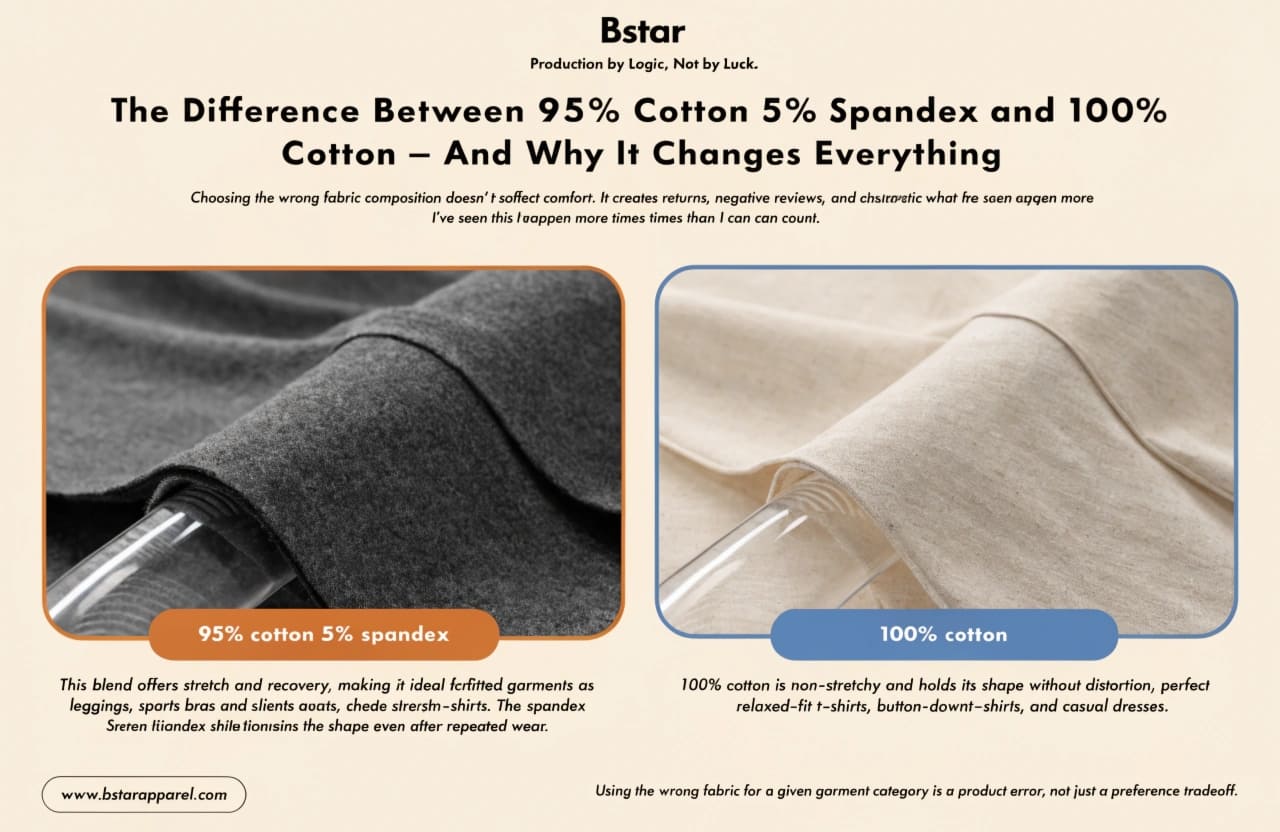
The Difference Between 95% Cotton 5% Spandex and 100% Cotton — And Why It Changes Everything
Choosing the wrong fabric composition doesn’t just affect comfort. It creates returns, negative reviews, and clients who don’t come back. I’ve seen this happen more times than I can count.
95% cotton 5% spandex is a stretch-recovery fabric designed for garments that need to hold their shape against body movement. 100% cotton is a stable, natural fiber best suited for relaxed cuts and drape-focused styles. The two fabrics are not interchangeable — using the wrong one for a given garment category is a product error, not just a preference tradeoff.
I run a knitwear manufacturing operation in Zhongshan, China. We’ve been producing OEM and ODM knit garments for overseas brands for 19 years. Every week, we handle both fabric types on the production floor — and I want to give you the practical breakdown that most fabric guides skip entirely.
Material Composition: What Are These Two Fabrics Actually Made Of?
Most buyers already know the label. But do you know what the difference actually looks like in a knit structure?
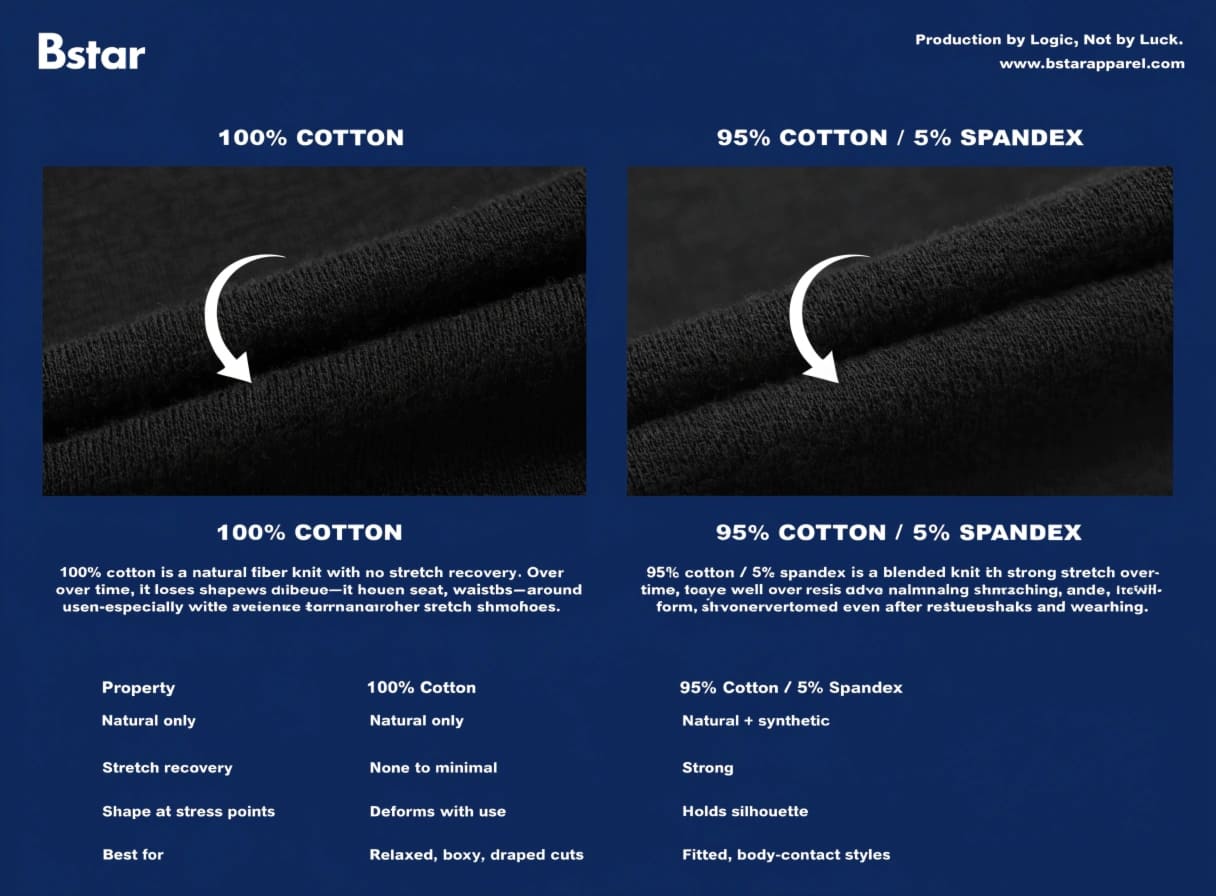
100% cotton fabric is made entirely from natural cotton fibers. It has no stretch recovery. 95% cotton 5% spandex is a blended knit where spandex (also called elastane or Lycra) is woven or knitted alongside cotton. The spandex component gives the fabric the ability to stretch and return to its original shape.
How the Fiber Mix Changes the Fabric Behavior
At 5% spandex content, the spandex fiber is not the dominant material — cotton still makes up 95% of the hand feel, weight, and surface texture. But that 5% completely changes how the fabric performs under tension.
In a 100% cotton jersey, if you pull the fabric and release it, it stretches slightly but does not fully return. Over time, and especially after washing, the areas that take the most tension — the seat of leggings, the neckline of a fitted tee, the elbows of a long-sleeve — permanently stretch out. The fiber simply has no memory.
In a 95/5 blend, the spandex acts like a physical return mechanism inside the knit structure. The fabric can stretch across the body and snap back after each wash and wear cycle.
| Property | 100% Cotton | 95% Cotton / 5% Spandex |
|---|---|---|
| Fiber type | Natural only | Natural + synthetic |
| Stretch recovery | None to minimal | Strong |
| Shape at stress points | Deforms with use | Holds silhouette |
| Best for | Relaxed, boxy, draped cuts | Fitted, body-contact styles |
This is not about which fabric is "better." It is about which fabric is structurally correct for the garment you’re building.
Performance & Comfort: Stretch, Breathability, and Moisture Management
Here’s where I hear the most misconceptions from overseas buyers. The most common one: "I want 100% cotton because it’s more breathable."
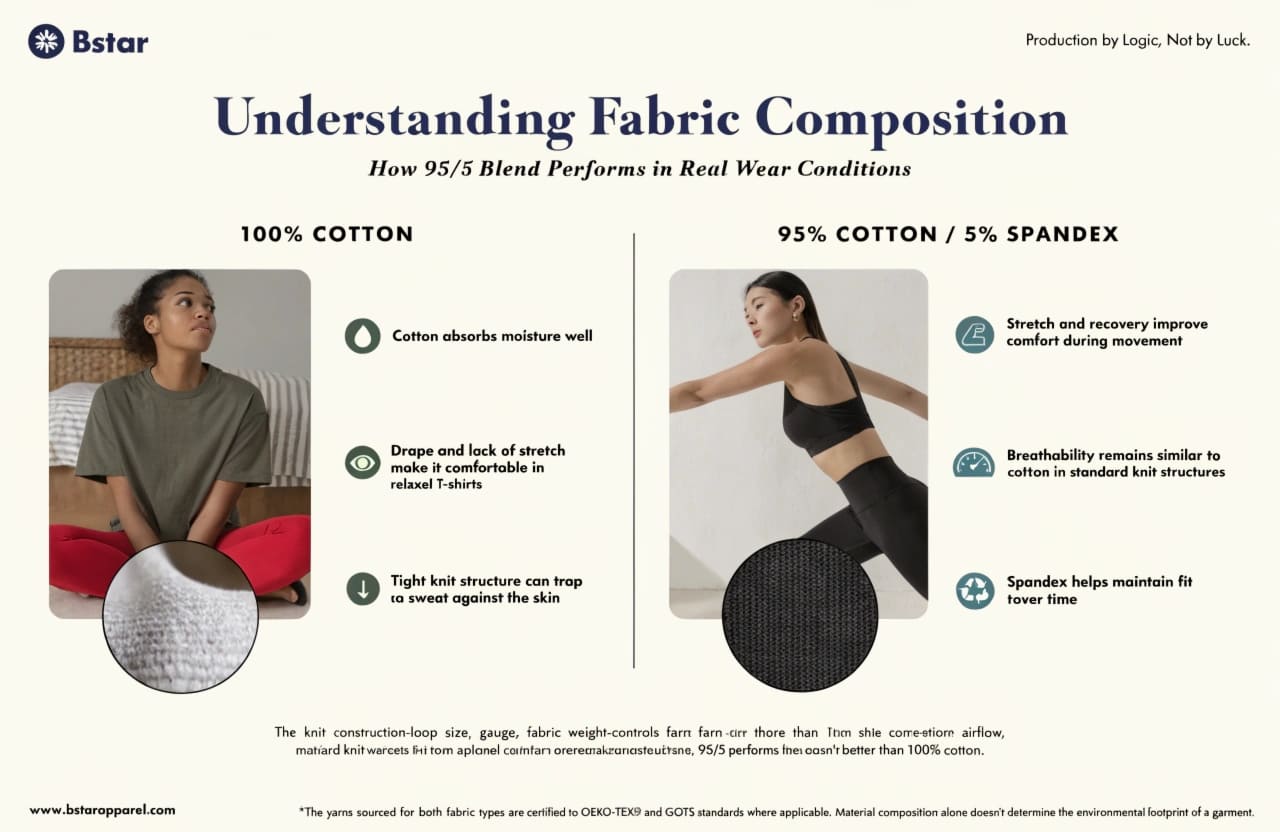
In a standard single-jersey or interlock knit structure, 5% spandex does not meaningfully reduce breathability compared to 100% cotton. The knit construction — the loop size, the gauge, and the fabric weight — controls airflow far more than a 5% spandex content does. For fitted activewear and leggings, the 95/5 blend actually performs better in real wear conditions.
Breaking Down the Performance Gap
I’ll be direct here. For relaxed-fit T-shirts worn in warm weather, 100% cotton is genuinely more comfortable. The fabric drapes away from the body and moves with gravity. There’s no resistance. That’s the right call for that use case.
But for leggings, fitted bodysuits, and form-fitting activewear, the comparison flips entirely.
Stretch and recovery: During movement — squatting, bending, reaching — a 95/5 blend fabric follows the body and returns. A 100% cotton fitted garment pulls at the seams and doesn’t return cleanly. This is what causes the "saggy seat" problem after just a few wears.
Moisture behavior: Cotton absorbs moisture well, but in a tight knit structure worn close to the skin, absorbed sweat sits against the body. The 95/5 blend, when knitted at a tighter gauge, manages body moisture more effectively in active use because the surface contact is more consistent.
Fit longevity: A fitted 100% cotton legging loses its silhouette faster than a 95/5 legging. We’ve had clients come to us after their customers reported that the leggings "looked worn out" after a handful of washes. In almost every case, the spec was 100% cotton on a body-skimming cut. The product wasn’t defective — it was the wrong fabric for the category.
One note on sustainability: buyers sometimes assume that 100% cotton is automatically more eco-friendly. The yarns we source for both fabric types are certified to OEKO-TEX® and GOTS standards where applicable. The material composition alone doesn’t determine the environmental footprint of a garment.
Durability & Care: Shape Retention, Shrinkage, and What Breaks First
This section is where factory-floor experience matters most. What I’m sharing here comes from handling both fabrics through full production runs, post-wash QC checks, and client complaints.
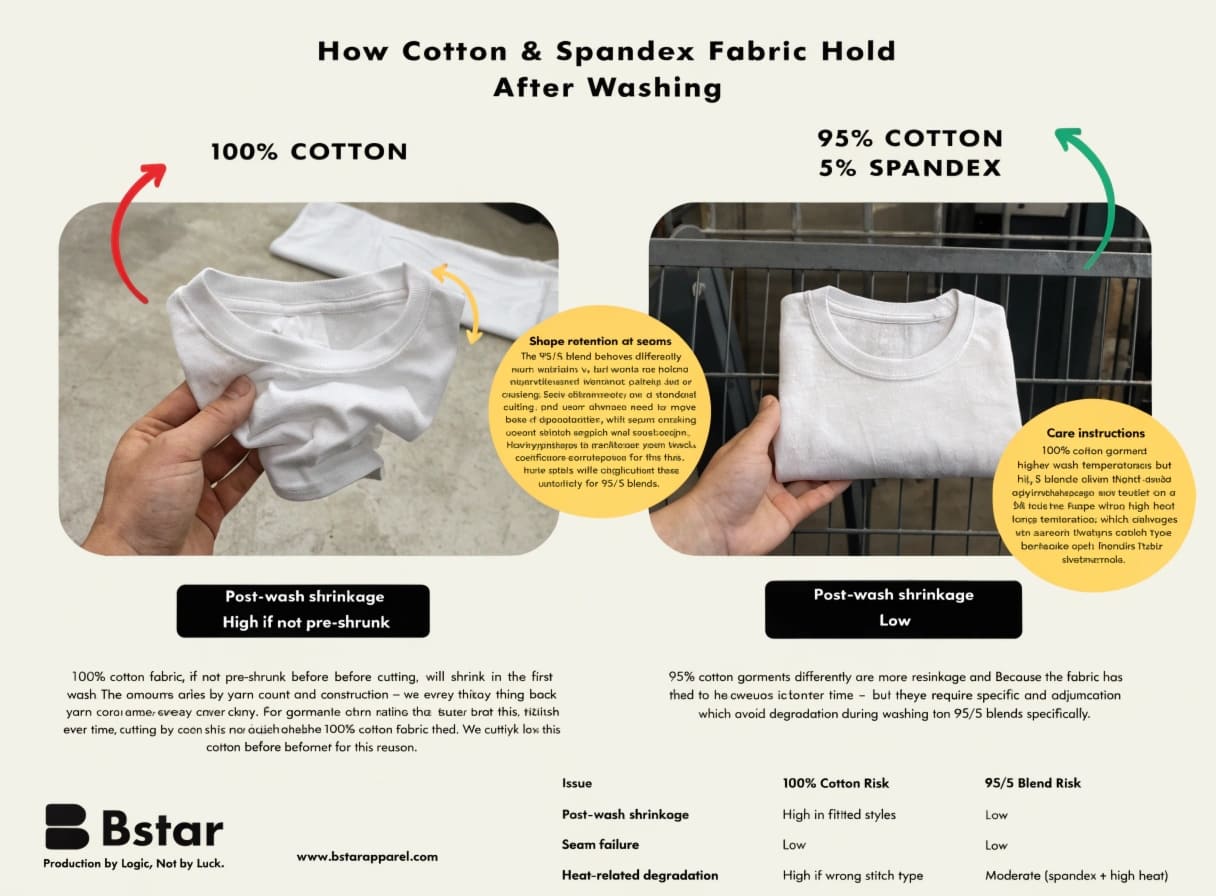
100% cotton garments are more prone to post-wash shrinkage and permanent deformation at stress points. 95% cotton 5% spandex garments are more resistant to shrinkage and hold their cut shape better over time — but they require specific handling during production and washing to avoid elastic degradation.
What We See in Production and Post-Wash QC
Shrinkage: 100% cotton fabric, if not pre-shrunk before cutting, will shrink in the first wash. The amount varies by yarn count and knit construction — we verify this internally on every new fabric roll. For clients who skip pre-shrinking to save time, the result is garments that come back undersized. We always pre-shrink 100% cotton fabric before cutting for this reason.
Shape retention at seams: The 95/5 blend behaves differently on the cutting table. Because the fabric has tension memory, it wants to move during cutting and sewing. Seam allowances need adjustment, and stitch type matters — a standard straight stitch on a stretch fabric causes seam cracking. We use overlock and cover stitch configurations for 95/5 blends specifically. If your manufacturer isn’t adjusting for this, the seams will fail in use.
Care instructions: 100% cotton garments tolerate higher wash temperatures but lose shape with aggressive agitation. 95/5 blends should be washed at lower temperatures and kept away from high-heat drying, which degrades the spandex fiber over repeated cycles.
| Issue | 100% Cotton Risk | 95/5 Blend Risk |
|---|---|---|
| Post-wash shrinkage | High if not pre-shrunk | Low |
| Stress point deformation | High in fitted styles | Low |
| Seam failure | Low | High if wrong stitch type |
| Heat-related degradation | Low | Moderate (spandex + high heat) |
These are real tradeoffs. Neither fabric is maintenance-free. The difference is that the failure modes are different — and the right production process for each fabric is different too.
Choosing the Right Fabric: A Clear Decision Framework by Garment Category
Buyers ask me this question in almost every new product development conversation: "Which should I use?" I’m going to give you a straight answer, not a hedge.
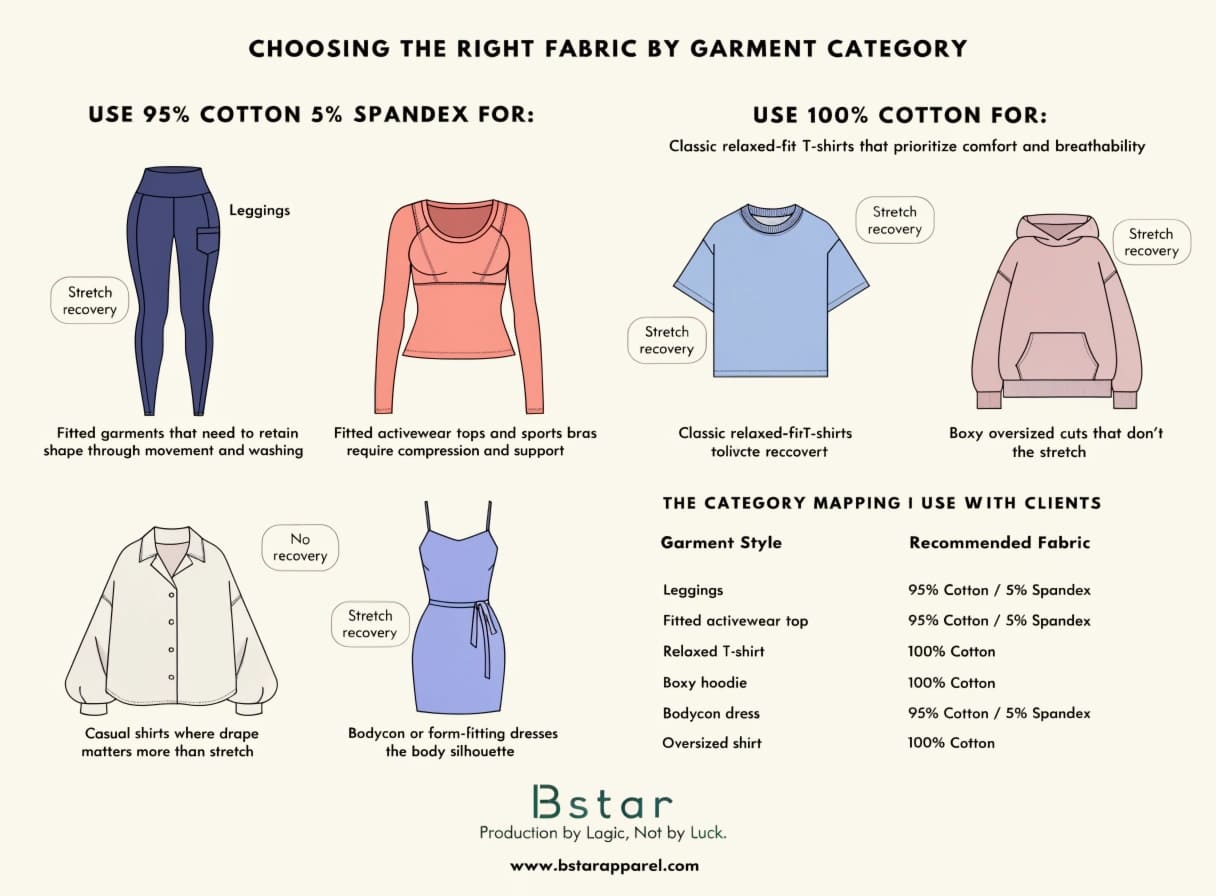
If your garment is fitted, body-contact, or relies on shape retention through movement and washing — use 95% cotton 5% spandex. If your garment is relaxed-fit, boxy, or drape-focused — use 100% cotton. The decision is driven by garment function and cut, not by which fabric sounds more premium.
The Category Mapping I Use With Clients
This is the framework I walk new clients through before we lock in fabric specs.
Use 95% cotton 5% spandex for:
- Leggings and yoga pants
- Fitted activewear tops and sports bras
- Bodycon or form-fitting dresses
- Fitted long-sleeve tops where elbow and shoulder deformation is a risk
- Any style where the garment is meant to follow the body silhouette
Use 100% cotton for:
- Classic relaxed-fit T-shirts
- Boxy oversized cuts
- Casual shirts where drape matters more than stretch
- Styles targeting markets where natural fiber positioning is a priority
- Garments where the cut provides structural shape rather than the fabric tension
| Garment Style | Recommended Fabric |
|---|---|
| Leggings | 95% Cotton / 5% Spandex |
| Fitted activewear top | 95% Cotton / 5% Spandex |
| Relaxed T-shirt | 100% Cotton |
| Boxy hoodie | 100% Cotton |
| Bodycon dress | 95% Cotton / 5% Spandex |
| Oversized shirt | 100% Cotton |
The category mapping above isn’t a suggestion — it’s a production risk reduction tool. Every client who has come to us with deformation complaints or post-wash return problems had specified the wrong fabric type for their garment category. Once they revised the spec, the problem stopped.
If you’re developing a new knit style and you’re not sure which category your garment falls into, send us the tech pack or a reference sample. We review it before production starts.
Conclusion
The choice between 95% cotton 5% spandex and 100% cotton comes down to garment function. Match the fabric to the cut, and most fit and durability problems disappear before they start.