
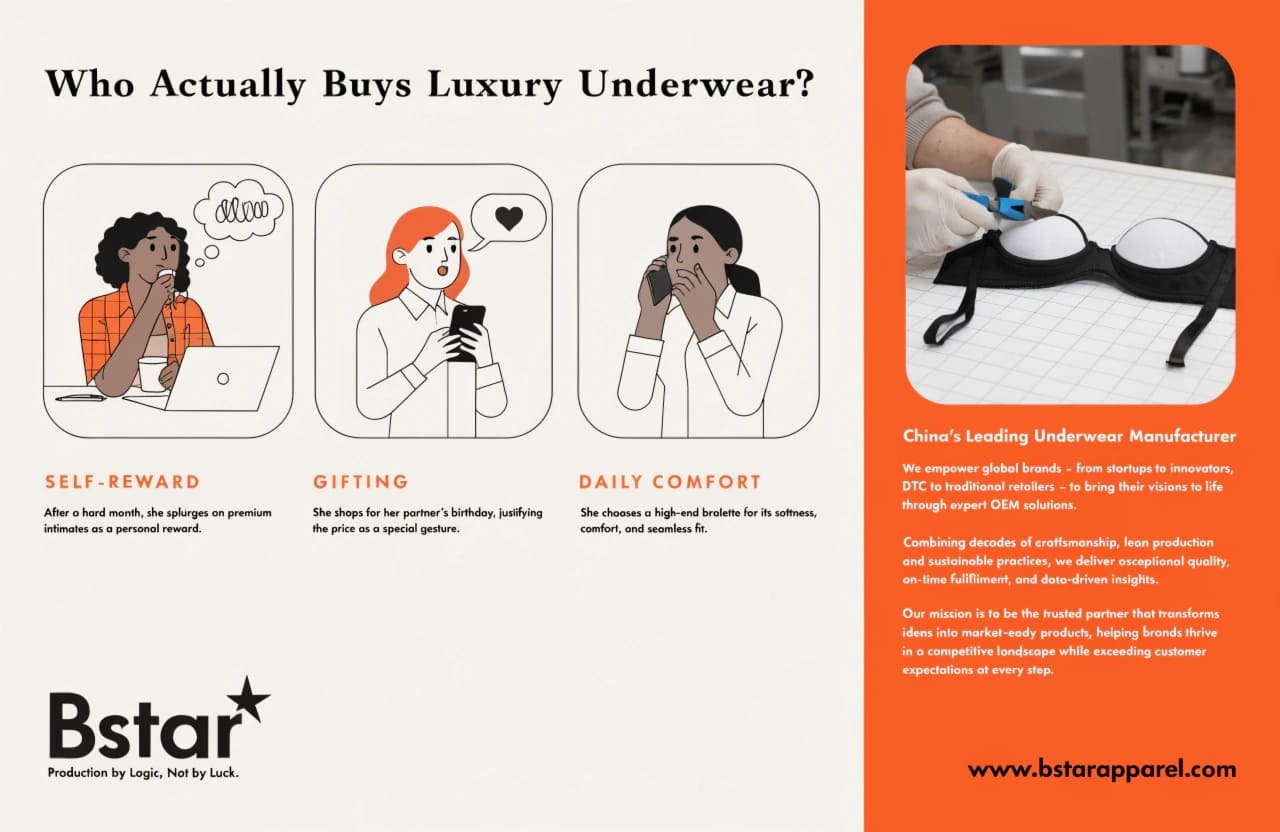
Who Actually Buys Luxury Underwear?
Most brands entering the luxury underwear space ask the wrong first question. They ask "who is my customer?" when they should be asking "why is my customer buying — right now, for this occasion?"
There is no single luxury underwear buyer. The same person buys premium intimates as a self-reward after a hard month, as a gift for a partner, and as a daily comfort decision — each time using completely different logic to justify the price. Brands that build product and messaging around a demographic profile, not a purchase motivation, will mismatch their offer no matter how good the fabric is.
I work with brand founders on the production side — scoping materials, certifications, sampling timelines, and construction specs. What I notice is that the brands who struggle most are not the ones with bad product ideas. They are the ones who built a beautiful product for a motivation their target customer does not have right now. The following is what I have observed across client briefs and real project conversations.
Who Is Actually Walking Into the Purchase? Decoding Luxury Consumer Personas — Are They Who You Think?
You might picture a high-net-worth professional in her mid-thirties with a preference for European brands. That person is real. But she is not one buyer — she is four, depending on the day.
Clients who come to us planning a luxury line often describe their customer in demographic terms: age range, income bracket, lifestyle markers. But the production spec that follows has to be built around motivation, not demographics. A gift buyer and a self-reward buyer can share the exact same demographic profile and still need completely different product signals to say "yes."
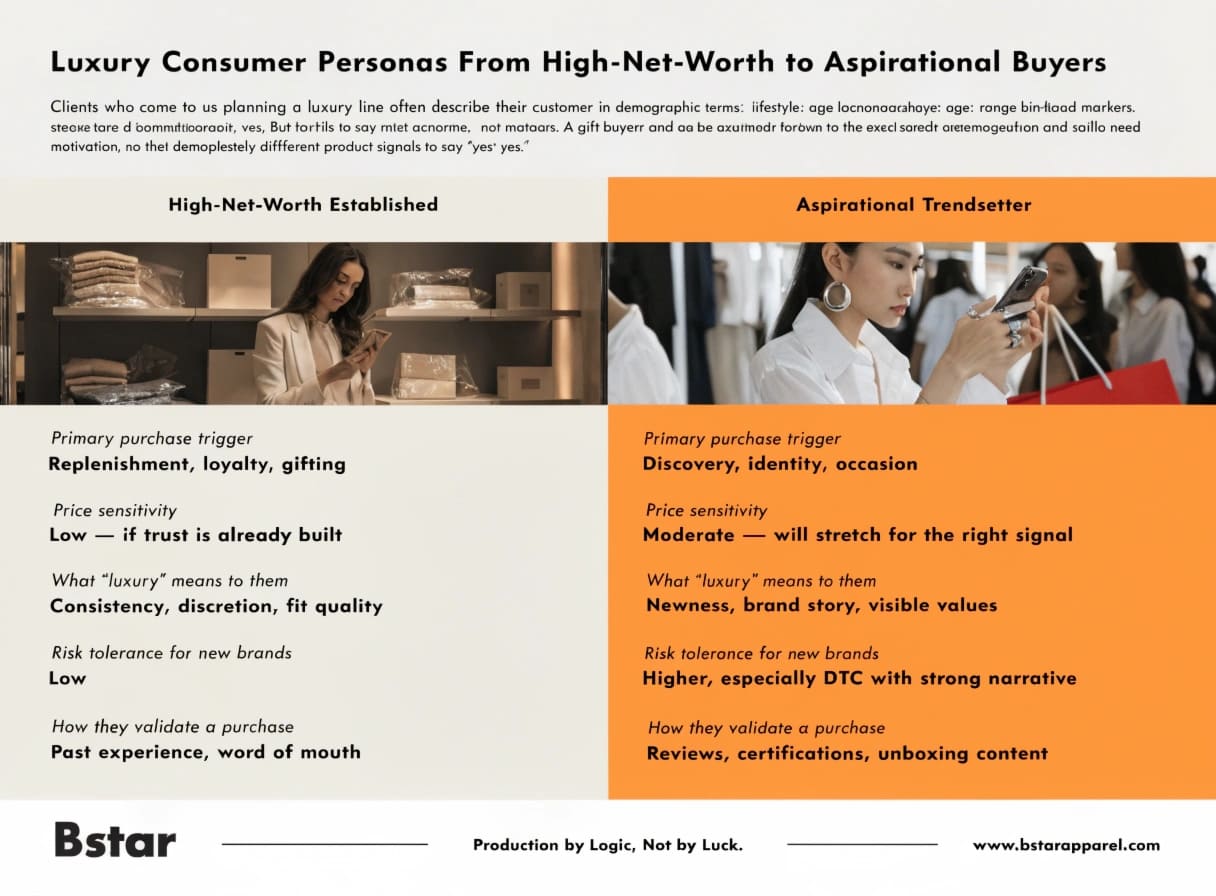
The two broad groups we see brands targeting most often are high-net-worth established buyers and aspirational buyers. These groups behave very differently at the point of purchase.
High-Net-Worth Established Buyers vs. Aspirational Trendsetters
| Dimension | High-Net-Worth Established | Aspirational Trendsetter |
|---|---|---|
| Primary purchase trigger | Replenishment, loyalty, gifting | Discovery, identity, occasion |
| Price sensitivity | Low — if trust is already built | Moderate — will stretch for the right signal |
| What "luxury" means to them | Consistency, discretion, fit quality | Newness, brand story, visible values |
| Risk tolerance for new brands | Low | Higher, especially DTC with strong narrative |
| How they validate a purchase | Past experience, word of mouth | Reviews, certifications, unboxing content |
The aspirational buyer is not a downgraded version of the high-net-worth buyer. They are a different motivation type entirely. Many DTC brands have scaled on aspirational buyers precisely because this group is reachable, vocal on social platforms, and responds well to transparent sourcing stories1 — which brings certification strategy directly into the conversation.
Why Do They Really Buy? The Psychology of Premium Intimates — What Is the Actual Motivation?
This is the question most product briefs do not answer clearly enough. When a brand tells me their customer "values quality," I always ask: quality that they feel, quality that they show, or quality that they believe in?
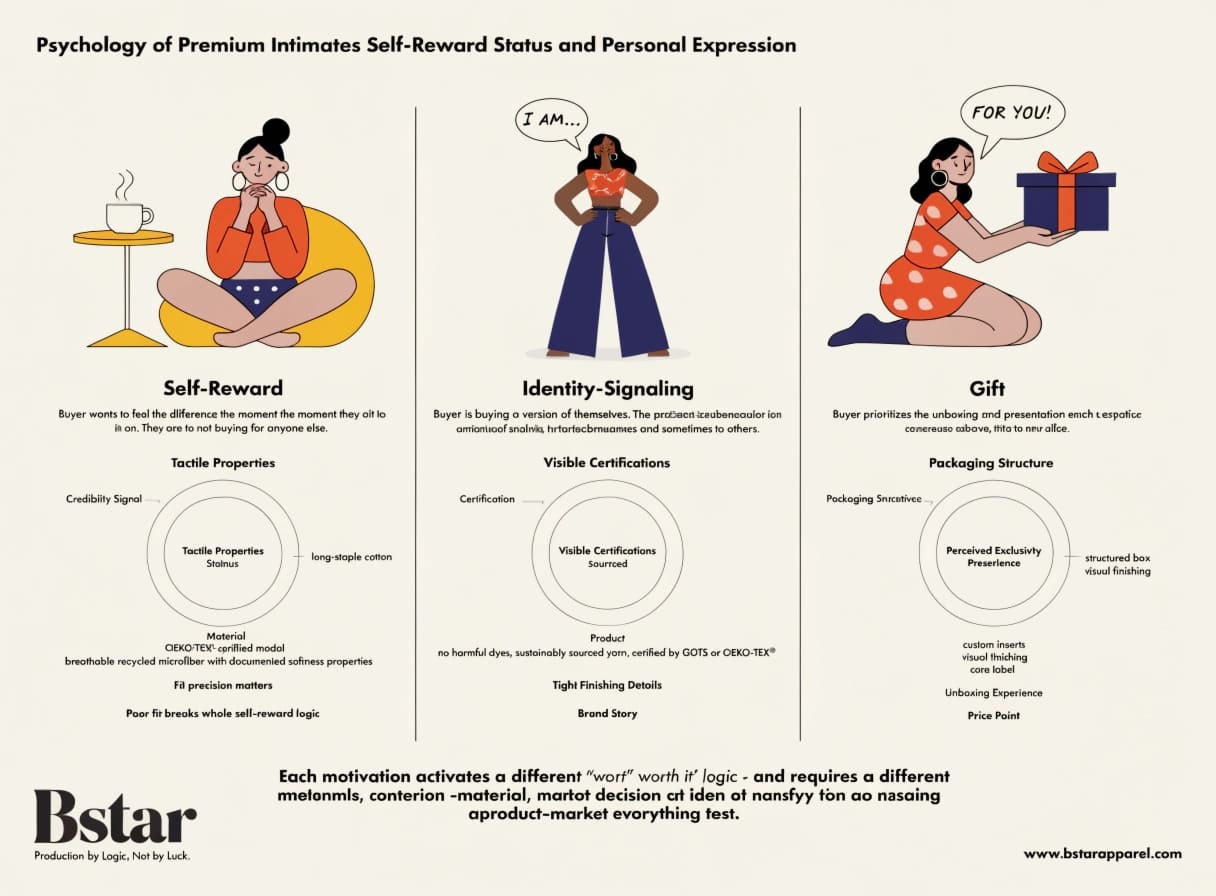
Purchase motivation for luxury intimates typically falls into three categories: tactile self-reward, identity signaling, and gift-giving. Each motivation activates a different "worth it" logic — and each requires a different combination of material, construction, and packaging to satisfy it. Treating these as the same buying decision leads to product-market mismatch.
Mapping Motivation to Product Spec
Self-reward buyers want to feel the difference the moment they put it on. They are not buying for anyone else. For this motivation type, tactile properties are the credibility signal. Materials associated with this occasion include OEKO-TEX®-certified modal, long-staple cotton, and breathable recycled microfiber with documented softness properties2. Fit precision matters here — a poor fit breaks the whole self-reward logic.
Identity-signal buyers are buying a version of themselves. The product is partly a statement — to themselves and sometimes to others. For this group, visible certifications, tight finishing details, and brand story carry real weight. When a brand can say "no harmful dyes, sustainably sourced yarn, certified by GOTS or OEKO-TEX®," that language converts directly into purchase permission for this buyer. Certifications are not just compliance for them — they are proof that the brand shares their values.
Gift buyers prioritize the unboxing and presentation experience above almost everything else. The receiver never sees the care label in the moment of unwrapping. Packaging structure, visual finishing, and perceived exclusivity carry most of the purchase decision3. This is why I often tell clients: for a gift-positioned SKU, your packaging brief is as important as your fabric brief.
Are Younger Buyers Changing the Rules? Generational Shifts — How Millennial and Gen Z Values Are Reshaping High-End Lingerie?
The short answer is yes. But not in the way most brand decks describe it.
Millennial and Gen Z luxury buyers do not reject premium pricing — they reject premium pricing that cannot be justified by values they care about4. Sustainability, transparency, and brand accountability are not optional features for this audience. They are entry requirements.5 Brands without a credible story on these dimensions will not compete in this segment, regardless of fabrication quality.
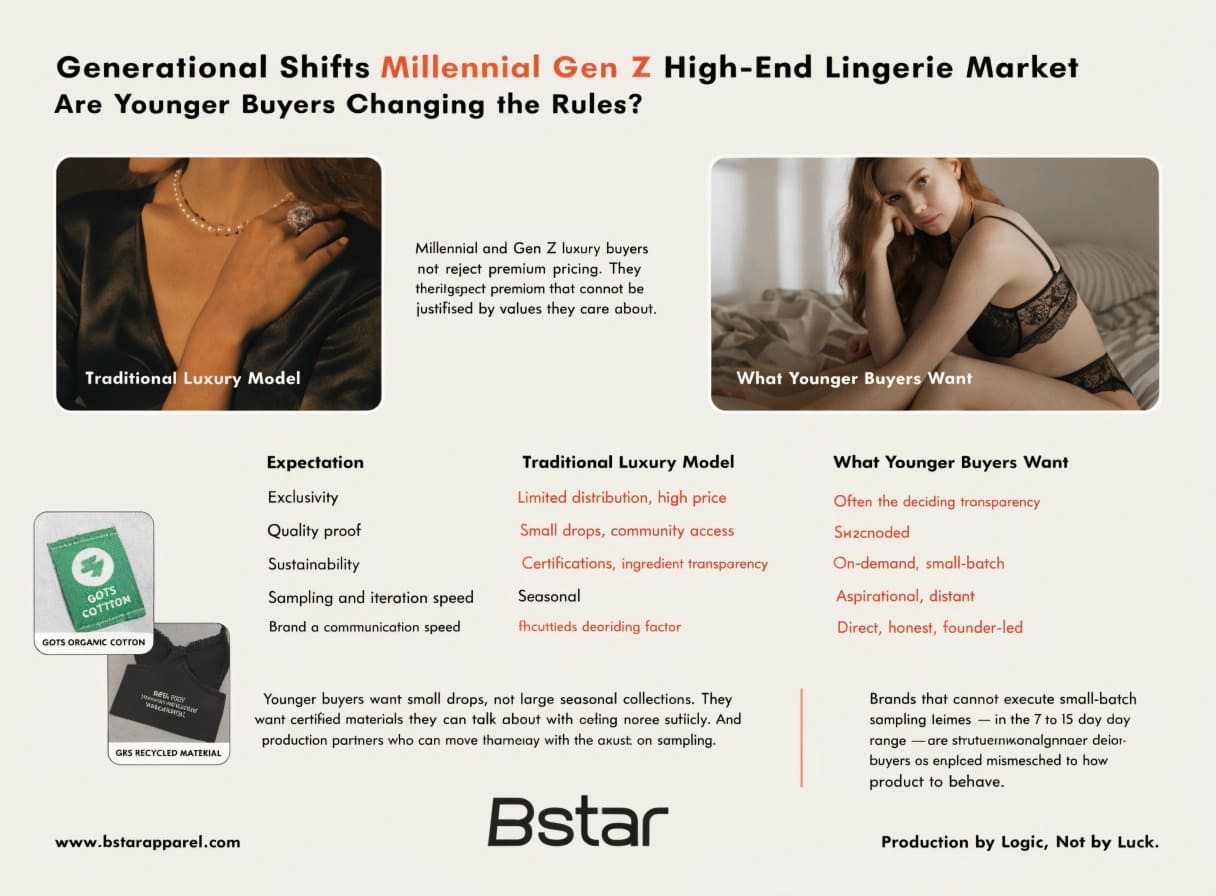
What I see in client briefs from founders targeting younger luxury buyers is a very specific request pattern. They want small drops, not large seasonal collections. They want certified materials they can talk about publicly — GOTS organic cotton, GRS recycled content6, OEKO-TEX® Standard 100. And they want production partners who can move fast on sampling without requiring large minimum orders.
What Younger Luxury Buyers Expect vs. What Traditional Luxury Delivered
| Expectation | Traditional Luxury Model | What Younger Buyers Want |
|---|---|---|
| Exclusivity | Limited distribution, high price | Small drops, community access |
| Quality proof | Brand heritage, country of origin | Certifications, ingredient transparency |
| Sustainability | Rarely a purchase factor | Often the deciding factor |
| Sampling and iteration speed | Seasonal | On-demand, small-batch |
| Brand communication | Aspirational, distant | Direct, honest, founder-led |
This generational shift has a direct production implication. Brands that cannot execute small-batch drops with short sampling lead times — in the 7 to 15 day range — are structurally mismatched to how younger luxury buyers expect new product to behave. This is not a marketing problem. It is a supply chain architecture problem.
Is Product Even Enough Anymore? The Rising Demand for Exclusive Experiences, Sustainability, and Brand Heritage — What Does Today’s Luxury Buyer Actually Expect?
No, product alone is not enough. This is one of the clearest patterns I see across client conversations.
Today’s luxury underwear buyer — across motivation types — expects more than a well-made garment. They expect a brand experience that holds together from the first touchpoint to the moment they open the box. Sustainability credentials, brand story, and post-purchase experience have become structural parts of the value proposition, not additions.
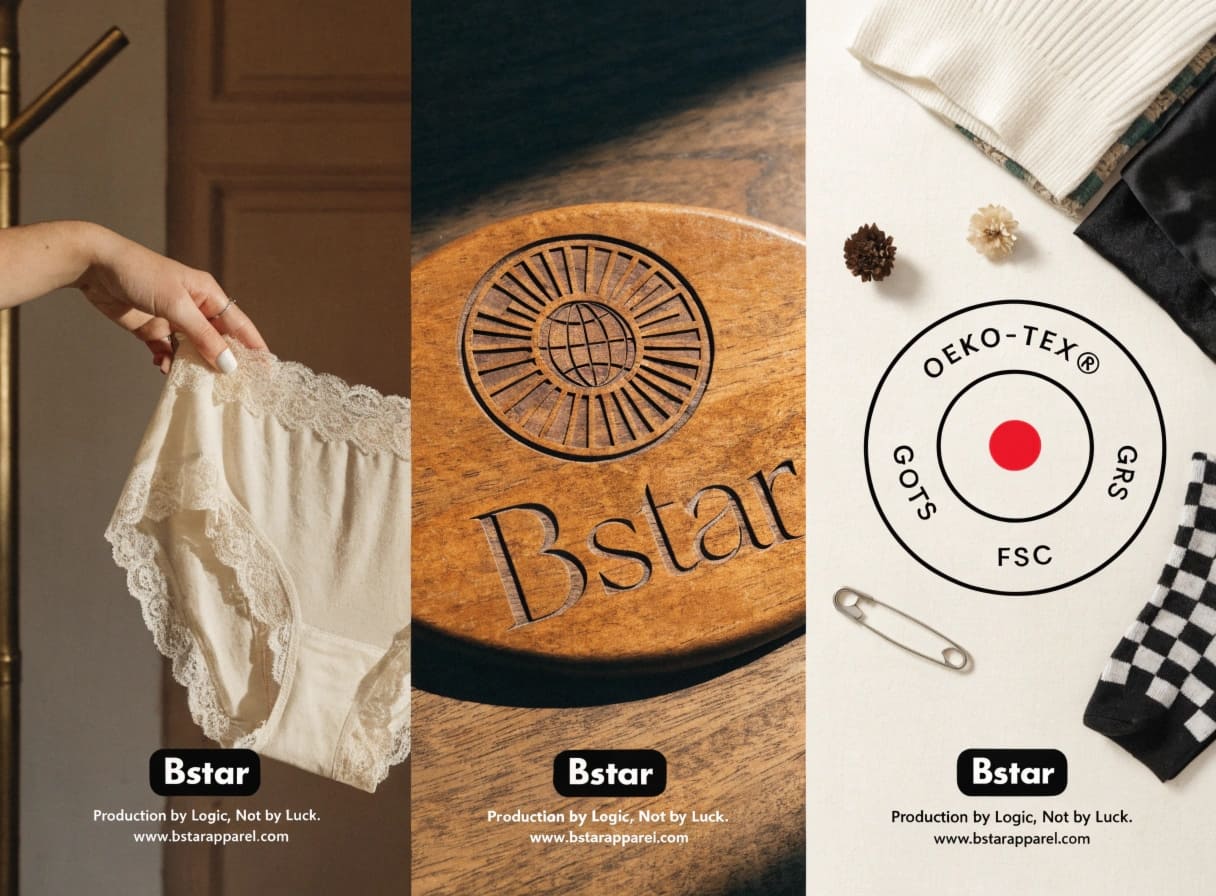
Clients who come to us with a clear brief on certifications — OEKO-TEX®, GOTS, GRS, FSC for packaging7 — are almost always building for an audience where these signals function as purchase triggers. They are not checking boxes. They are building audience-facing language: "made with certified organic cotton," "no harmful dyes," "recycled materials verified by GRS." That language is the product story for a large and growing segment of luxury buyers.
The Three Non-Product Pillars of Modern Luxury Intimates
Brand Heritage and Story
This does not mean a brand needs to be decades old. It means they need a coherent, honest origin narrative. Founders who can explain why they started the brand and what problem they are solving have a heritage substitute that works with younger buyers. Manufactured heritage feels hollow — a real founder story does not8.
Exclusive Experience Design
This covers everything from product photography to packaging structure to post-purchase communication. Identity-signal and gift buyers in particular will judge a brand on the experience architecture around the product, not just the product itself. A poorly designed unboxing experience from a brand with excellent fabrication is still a disappointment.
Sustainability as Trust Infrastructure
Across all motivation types I described earlier, sustainability credentials have moved from a differentiator to a baseline expectation in Western DTC markets9. A brand without a verified sourcing story is no longer "neutral" — they are a risk in the eyes of a conscious-luxury buyer. Working with a manufacturer that holds relevant certifications gives brands the raw material to build this trust story. Without it, the story cannot be told credibly.
One practical note: brands that treat MOQ strategy as a footnote often underestimate how closely it connects to positioning. Identity-driven buyers accept high prices but expect limited availability and fast iteration. A brand locked into high minimum orders cannot deliver tight drops or respond quickly to buyer feedback. That structural constraint is a positioning constraint, not just a logistics detail.
Conclusion
Luxury underwear has no single buyer profile. Build your product around the purchase motivation — self-reward, identity, gifting — and every other decision, from fabric to certification to MOQ strategy, follows from there.
-
"Consumer engagement with modern luxury direct-to … – UDSpace", https://udspace.udel.edu/items/b72d963e-33d4-42f4-8631-c14138def46a. Research on luxury consumer segmentation, including annual reports by Bain & Company in partnership with Altagamma, documents distinct behavioral profiles between aspirational and established luxury buyers, noting aspirational consumers’ higher digital engagement and sensitivity to brand narrative. Evidence role: general_support; source type: research. Supports: That aspirational luxury consumers exhibit higher social media engagement and respond to brand transparency compared to established high-net-worth buyers.. Scope note: Aggregate luxury market reports may not isolate intimates or underwear categories specifically; findings reflect broader luxury goods behavior. ↩
-
"OEKO-TEX® STANDARD 100", https://www.oeko-tex.com/en/our-standards/oeko-tex-standard-100/. According to the OEKO-TEX® Association, OEKO-TEX® Standard 100 certifies that every component of a textile article has been tested for harmful substances and that the article is therefore harmless in terms of human ecology; the standard covers a range of regulated and non-regulated substances including pesticides, heavy metals, and formaldehyde. Evidence role: definition; source type: institution. Supports: What OEKO-TEX® Standard 100 certification verifies and why it is relevant to consumer safety claims in textile products.. Scope note: The certification addresses chemical safety rather than tactile or softness properties directly; its role as a self-reward purchase signal is an interpretive claim by the article’s author. ↩
-
"The Impact of Visual Elements of Packaging Design on Purchase …", https://pmc.ncbi.nlm.nih.gov/articles/PMC11851823/. Consumer behavior research on luxury gifting, including studies published in the Journal of Retailing and the Journal of Business Research, finds that packaging aesthetics and unboxing experience function as proxies for product quality and brand prestige in gift purchase contexts, with recipients and givers both attributing higher value to well-packaged luxury items. Evidence role: mechanism; source type: paper. Supports: That packaging and presentation significantly influence purchase decisions for luxury gift products, sometimes outweighing product attributes.. Scope note: Published studies on luxury gifting psychology may not be specific to the intimates category; the claim that packaging carries ‘most’ of the decision is the author’s qualitative assessment. ↩
-
"[PDF] exploring generation z consumers’ motivations and behavioral", https://etd.ohiolink.edu/acprod/odb_etd/ws/send_file/send?accession=kent1714054787679954&disposition=inline. Consumer research by McKinsey & Company and Deloitte on generational purchasing behavior consistently finds that Millennial and Gen Z consumers place higher weight on brand ethics, sustainability credentials, and transparency when evaluating premium-priced goods compared to older cohorts. Evidence role: expert_consensus; source type: research. Supports: That younger consumers (Millennials and Gen Z) condition premium purchases on alignment with sustainability and brand values rather than rejecting premium pricing outright.. Scope note: Studies vary in how they define ‘luxury’ and may conflate premium with luxury; category-specific data on intimates is limited. ↩
-
"Sustainable luxury purchase behavior in the Post-Pandemic Era", https://pmc.ncbi.nlm.nih.gov/articles/PMC10613698/. Surveys including the Edelman Trust Barometer and Deloitte Global Millennial Survey document a progressive shift in which environmental and ethical accountability have moved from brand differentiators to baseline expectations among consumers under 40, with brands lacking credible sustainability narratives increasingly perceived as reputational risks. Evidence role: expert_consensus; source type: research. Supports: That sustainability has transitioned from a competitive differentiator to a minimum threshold expectation among younger luxury consumers.. Scope note: These surveys cover broad consumer populations and are not specific to the luxury intimates category; the ‘entry requirement’ threshold may vary by market and price point. ↩
-
"Recycled Claim Standard (RCS) + Global Recycled Standard (GRS)", https://textileexchange.org/recycled-claim-global-recycled-standard/. The Global Recycled Standard (GRS), administered by Textile Exchange, is an international, voluntary, full product standard that sets requirements for third-party certification of recycled content, chain of custody, social and environmental processing practices, and chemical restrictions; it applies to any product containing at least 20% recycled material. Evidence role: definition; source type: institution. Supports: What the Global Recycled Standard (GRS) certifies regarding recycled content in textile and apparel products.. Scope note: The standard’s definition of ‘recycled’ and minimum thresholds may not be universally understood by consumers; the article does not distinguish between pre- and post-consumer recycled content. ↩
-
"Forest Stewardship Council – Wikipedia", https://en.wikipedia.org/wiki/Forest_Stewardship_Council. The Forest Stewardship Council (FSC) is an international non-governmental organization that sets standards for responsible forest management; FSC certification for packaging materials indicates that the paper or cardboard used is sourced from forests managed according to FSC’s environmental, social, and economic standards, providing a verifiable chain-of-custody claim for brands using paper-based packaging. Evidence role: definition; source type: institution. Supports: What FSC certification verifies in the context of paper and packaging materials.. Scope note: FSC certification addresses sourcing of raw materials and does not cover the full environmental footprint of packaging production, including inks, coatings, or end-of-life recyclability. ↩
-
"An Insight Into the State of Luxury Branding Today", https://insights.ehl.edu/an-insight-into-the-state-of-luxury-branding-today. Research on brand authenticity in luxury markets, including studies by Beverland (2006) in the Journal of Management Studies and subsequent work on consumer perceptions of heritage brands, finds that consumers evaluate luxury brand authenticity through cues including consistency, sincerity, and origin narratives; newer brands can establish perceived authenticity through transparent founder stories when institutional heritage is absent, particularly among consumers who prioritize values alignment over legacy. Evidence role: mechanism; source type: paper. Supports: That perceived brand authenticity, including founder narratives, influences luxury purchase decisions among younger consumers and can substitute for institutional heritage.. Scope note: Academic studies on brand authenticity were largely conducted before the widespread adoption of social media and DTC channels, which have altered how authenticity signals are communicated and evaluated. ↩
-
"Sustainability Challenges and Opportunities in Luxury Fashion", https://luminousinsights.net/articles/JSM-2025-139. The 2023 Bain & Company Global Luxury Study and NielsenIQ sustainability consumer surveys document that a majority of consumers in North American and Western European markets report sustainability practices as a significant factor in luxury purchase decisions, with the proportion treating it as a non-negotiable criterion rising year-over-year since 2020. Evidence role: statistic; source type: research. Supports: That Western DTC luxury consumers increasingly treat sustainability as a baseline expectation rather than a premium feature.. Scope note: Aggregate market surveys may overstate stated versus revealed preferences; the distinction between ‘differentiator’ and ‘baseline expectation’ is a qualitative threshold that varies by consumer segment and price point. ↩