
How to Verify an Underwear Manufacturer’s License in China
Sourcing underwear from China sounds simple — until you wire a deposit and realize the "factory" you contacted was a broker all along.
Verifying a Chinese underwear manufacturer starts with three things: a business license with the right business scope, a registered address that matches the physical factory, and third-party certifications verified at their source. These three checks together tell you whether you are dealing with a real manufacturer.
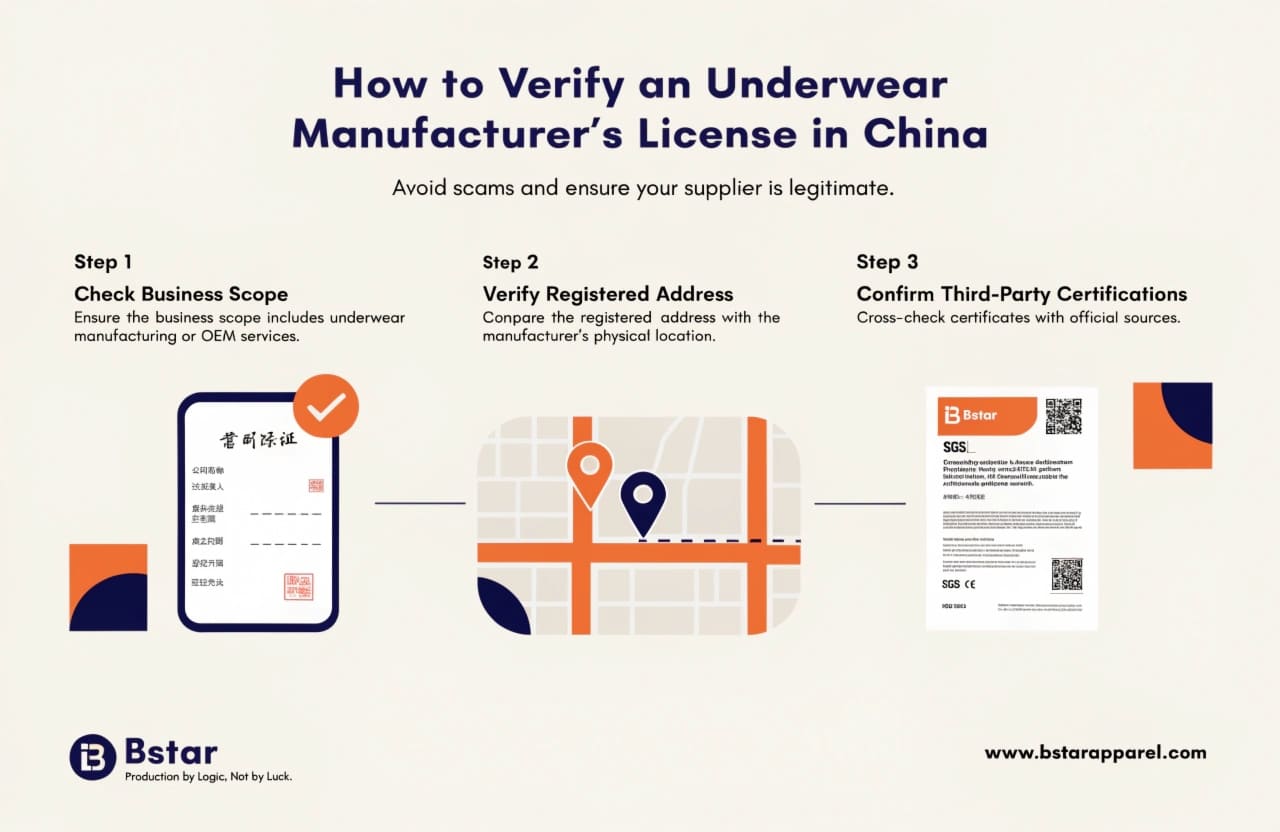
At BSTAR, we have been through buyer verification many times over 19 years. Clients ask us for documents, we provide them, and experienced buyers cross-reference every single one. I want to walk you through what that process actually looks like — so you can do the same before you sign anything.
Is a Business License Enough to Confirm a Manufacturer Is Legitimate?
Most buyers ask for a business license and stop there. That is a mistake that can cost you months and real money.
A Chinese business license only proves the company is legally registered. It does not prove the company manufactures anything. A trading company and a factory can both hold a valid business license. The difference is in the business scope field — and most buyers never check it.
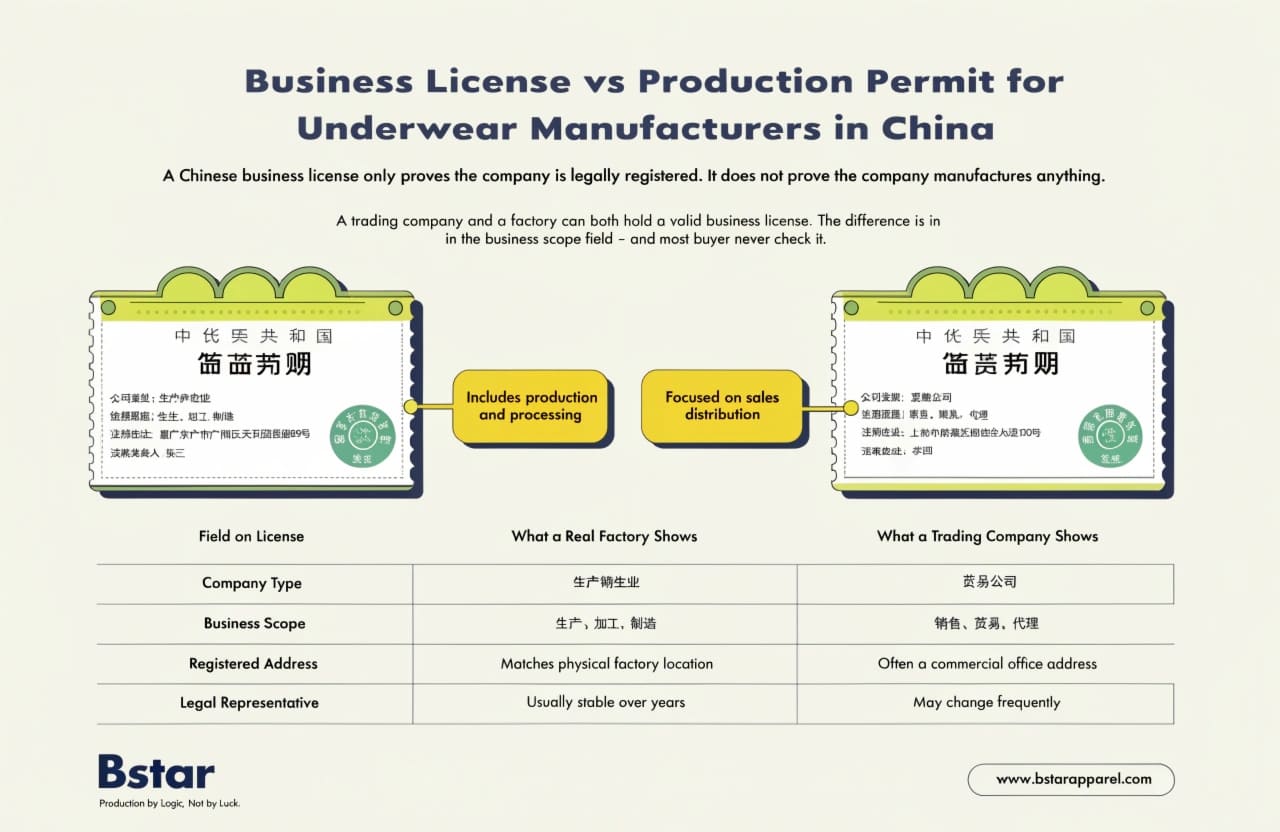
When clients verify our credentials at BSTAR, the first thing experienced buyers look at is the business scope listed on the license. This field tells you what the company is legally registered to do. A manufacturer’s scope will include language about production and processing. A trading company’s scope will focus on sales and distribution only.
What Exactly Should You Look for on the License?
There are two types of entities you will encounter: manufacturers and trading companies. Both can sell to you. Only one actually makes the product.
| Field on License | What a Real Factory Shows | What a Trading Company Shows |
|---|---|---|
| Company Type | (Manufacturing Entity) | (Trading Company) |
| Business Scope | Includes | Focused on |
| Registered Address | Matches physical factory location | Often a commercial office address |
| Legal Representative | Usually stable over years | May change frequently |
If the business scope on the license says nothing about production, you are not talking to a factory. This does not mean you cannot work with them — but you need to know who is actually making your product, because that person controls your quality and your timeline.
Beyond the license itself, also check whether the company holds any production-specific permits. For knitwear and underwear, this can include textile production permits beyond the generic business registration. Always check the issue date and the expiry date. A lapsed permit, or one issued to a differently named entity, is not transferable. If a supplier shows you a certificate with a different company name on it, ask why.
How Do You Actually Check a Factory’s Registration Online?
You have a business license in hand. Now what? The document itself can be faked or outdated. You need to verify it against a live government database.
China’s National Enterprise Credit Information Publicity System is the official government portal for business registration data. You can search any registered company name and compare the information directly against what the supplier has given you. Any mismatch is a red flag.
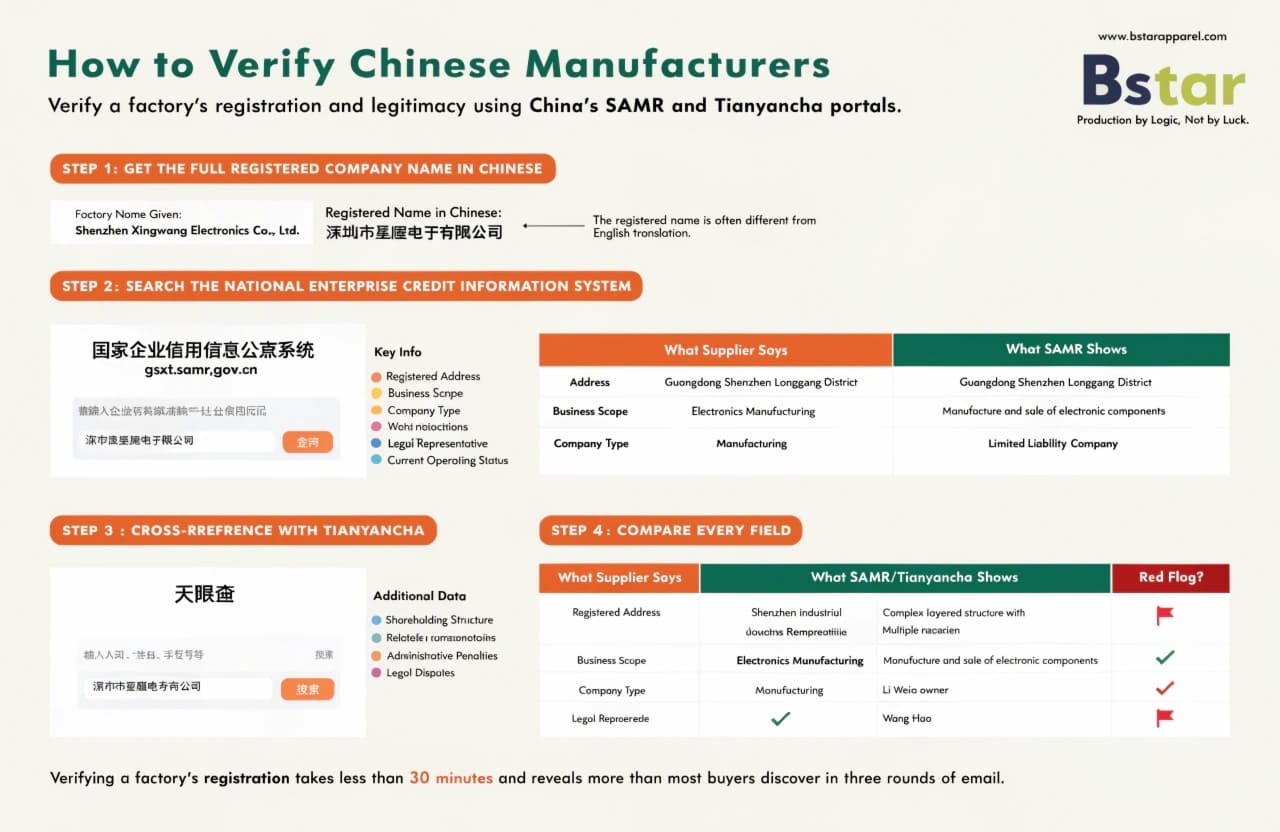
Here is the step-by-step process we see buyers use when they verify us.
Step-by-Step: Using the Official Portals
Step 1: Get the full registered company name in Chinese.
Ask your supplier for their registered name in Chinese characters. English translations vary and can be misleading. You need the exact Chinese name to search the databases accurately.
Step 2: Search the National Enterprise Credit Information System.
Go to zwfw.samr.gov.cn. Enter the Chinese company name. The result will show you the registered address, business scope, company type, registration date, legal representative, and current operating status.
Step 3: Cross-reference with Tianyancha.
Tianyancha is a third-party database that pulls from official sources. It gives you additional data like shareholding structure, related companies, and any administrative penalties or legal disputes on record. Look at the registered address and compare it with the physical address the supplier gave you. A different district, city, or street is a clear mismatch.
Step 4: Compare every field.
Check the registered address against the factory address. Check the company type. Check whether the business scope includes production. Check whether the legal representative name matches any person you have been in contact with.
| What to Check | Where to Check | Red Flag |
|---|---|---|
| Registered Address | SAMR portal | Different from physical factory address |
| Business Scope | SAMR portal | No mention of production or manufacturing |
| Company Type | SAMR portal / Tianyancha | Listed as trading company |
| Legal Disputes | Tianyancha | Frequent lawsuits or penalties |
| Shareholding | Tianyancha | Complex layered structure with no clear parent factory |
This process takes less than 30 minutes. It will tell you more than most buyers find out in three rounds of email.
What Quality Standards Should a Legitimate Underwear Manufacturer Meet?
A factory can have a valid license and still produce goods that fail at customs or get returned by customers. License verification and quality compliance are two different things — but you need both.
China’s mandatory national standard for basic safety of textile products is GB 18401. Any underwear manufactured in China and sold in or exported from China must meet this standard. Fiber content labeling is also legally required under GB/T 29862. Ask for test reports that reference these standards by name.
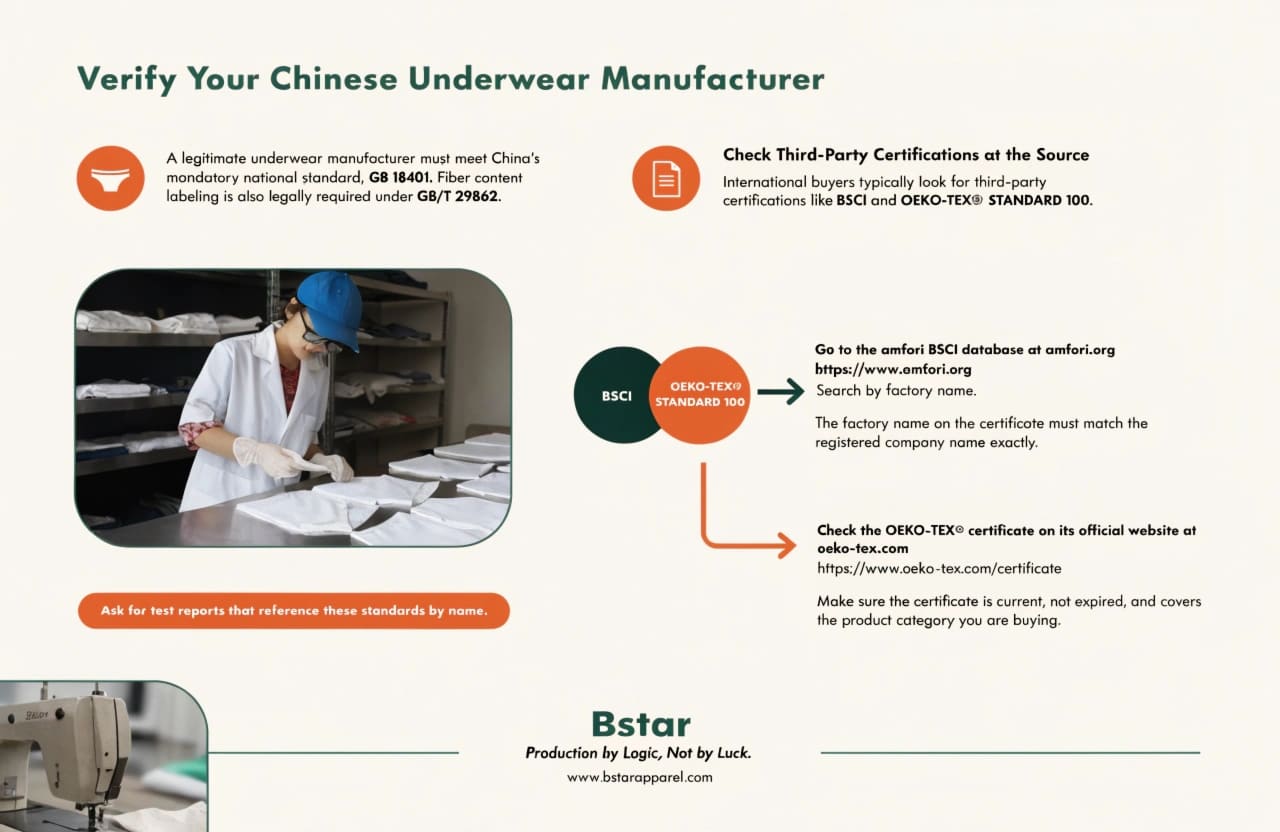
Beyond national standards, international buyers typically look for third-party certifications. The two most common ones we provide to clients are BSCI (social compliance) and OEKO-TEX® STANDARD 100 (chemical safety for materials). Here is the part most buyers miss: having a certificate is not the same as having a valid, current certificate that covers the right scope.
How to Verify Third-Party Certifications at the Source
Do not just look at the certificate PDF. Verify it directly.
BSCI: Go to the amfori BSCI database at amfori.org. Search by factory name. The result will show you the audit date, the audit result, and the scope of the audit. The factory name on the certificate must match the registered company name exactly. If they show you a BSCI report for "Company A" but their registered name is "Company B," that certificate does not belong to them.
OEKO-TEX® STANDARD 100: Verify at oeko-tex.com/certificate. Enter the certificate number from the document the supplier provided. Check that the certificate is current, not expired, and covers the product category you are buying.
| Certification | Verification Portal | Key Things to Check |
|---|---|---|
| BSCI | amfori.org | Audit date, result, factory name match |
| OEKO-TEX® STANDARD 100 | oeko-tex.com | Certificate number, expiry, product scope |
| GOTS | global-standard.org | Certificate holder name, product category |
| GRS | Control Union or SCS database | Chain of custody, product scope |
One more point: certifications confirm compliance at the time of the audit. They do not guarantee what happens on your production run. A factory visit or a third-party pre-shipment inspection adds a layer that documents simply cannot replace — especially for first-time orders.
How Do You Protect Yourself from Unlicensed or Non-Compliant Factories?
The real risk is not obvious fraud. It is working with a supplier who looks legitimate on paper but cannot actually control what happens on the production floor.
The most common sourcing mistake first-time buyers make is treating document collection as due diligence. Real due diligence means cross-referencing every document against an independent source — not just accepting what the supplier sends you.
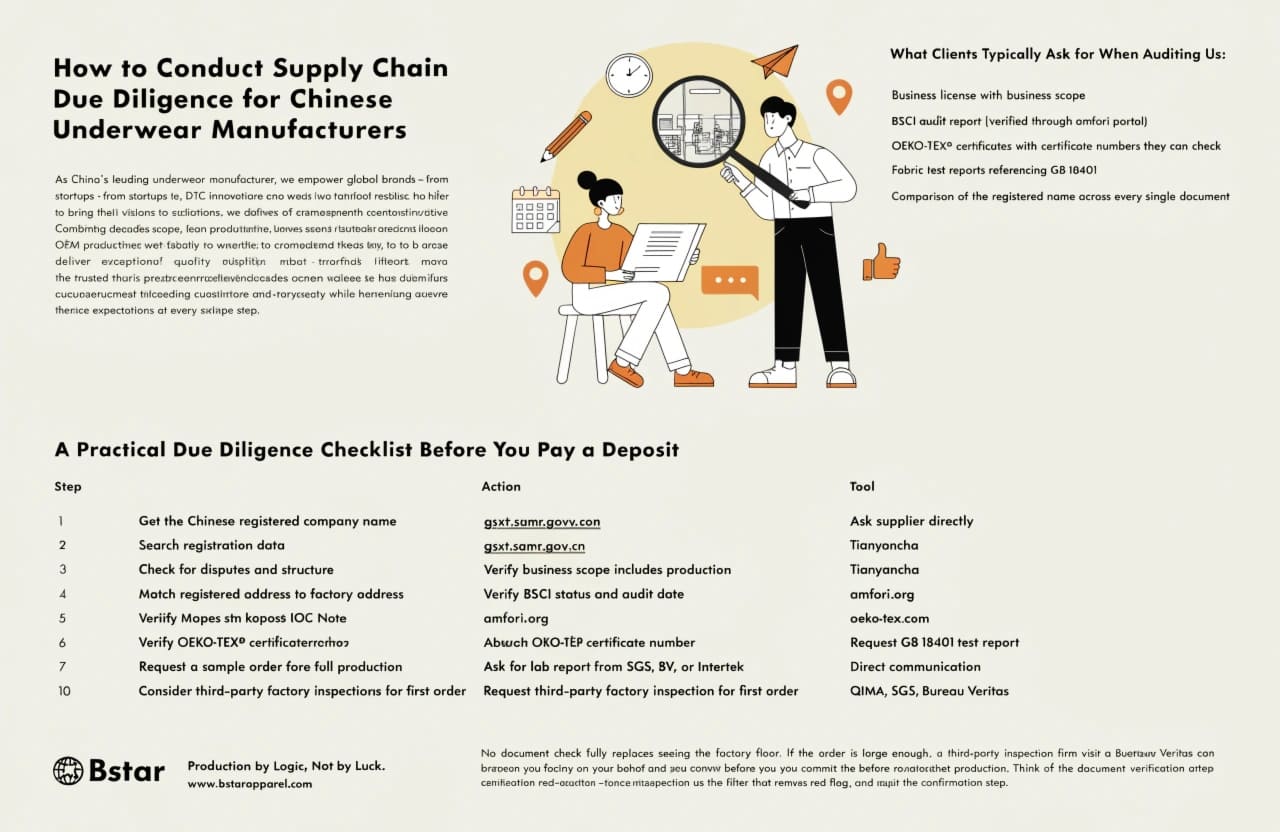
At BSTAR, when clients run a serious audit on us, they typically ask for: the business license with business scope, the BSCI audit report with verification through the amfori portal, OEKO-TEX® certificates with certificate numbers they can check themselves, and fabric test reports referencing GB 18401. Then they compare the registered name across every single document.
A Practical Due Diligence Checklist Before You Pay a Deposit
Here is how I would approach this if I were sourcing for the first time.
| Step | Action | Tool |
|---|---|---|
| 1 | Get the Chinese registered company name | Ask supplier directly |
| 2 | Search registration data | gsxt.samr.gov.cn |
| 3 | Check for disputes and structure | Tianyancha |
| 4 | Verify business scope includes production | SAMR portal |
| 5 | Match registered address to factory address | Google Maps + SAMR |
| 6 | Verify BSCI status and audit date | amfori.org |
| 7 | Verify OEKO-TEX® certificate number | oeko-tex.com |
| 8 | Request GB 18401 test report | Ask for lab report from SGS, BV, or Intertek |
| 9 | Request a sample order before full production | Direct communication |
| 10 | Consider third-party factory inspection for first order | QIMA, SGS, Bureau Veritas |
No document check fully replaces seeing the factory floor. If the order is large enough, a third-party inspection firm like QIMA or Bureau Veritas can visit the factory on your behalf and report back before you commit to full production. Think of document verification as the filter that removes obvious red flags — and on-site inspection as the confirmation step.
Conclusion
Verifying a Chinese underwear manufacturer takes more than collecting a business license. Cross-reference the registered address, business scope, and every certificate against independent sources — then you will know if you have a real factory.