
5 Red Flags When Sourcing Men’s Underwear Factories on Alibaba
Sourcing underwear on Alibaba feels easy — until your bulk order arrives and the fabric is wrong, the elastic is weak, and no one picks up the phone.
Alibaba has real factories on it. The problem is that it also has trading companies that look exactly like factories. If you can’t tell the difference before you wire your deposit, you are taking a risk you don’t need to take. This article covers five specific signals that separate reliable manufacturers from suppliers you should avoid.
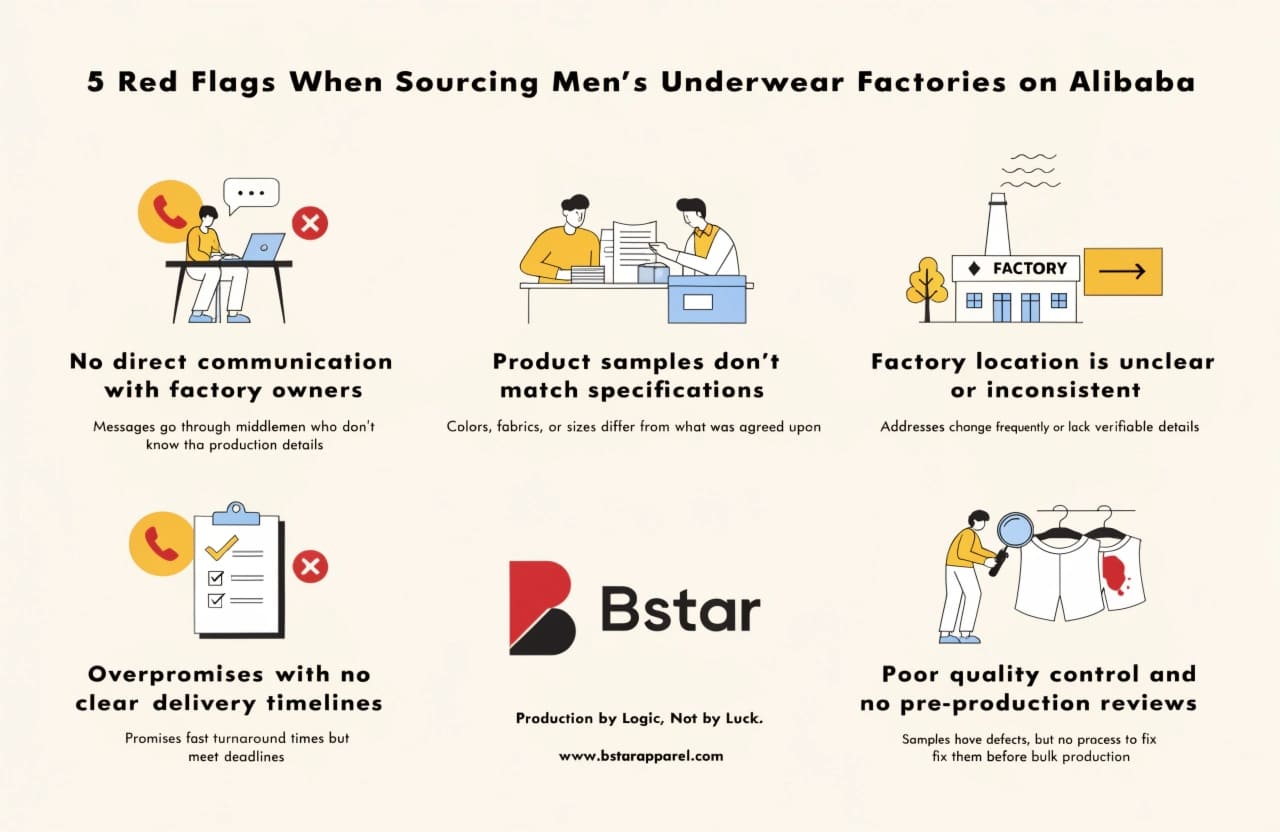
We have been manufacturing knitwear in Zhongshan, China for 19 years. When DTC brands come to us after a bad Alibaba experience, the problems almost always trace back to one or more of these five things. I want to walk you through each one so you know what to look for before you commit any money.
Are You Actually Looking at a Real Factory — or a Trading Company?
This is the question most buyers never think to ask. They land on a listing with good photos, fast replies, and low MOQ, and they assume that means "factory." It often doesn’t.
The fastest way to spot a trading company is to look at their product range. A store that lists men’s underwear, activewear, swimwear, and gym shorts at the same time is almost never running its own production line. Real underwear factories specialize because knitwear construction requires specific equipment, specific pattern expertise, and years of process refinement. Width of catalog is usually a sign of width of supply chain — meaning they source from multiple small factories and mark up the price.
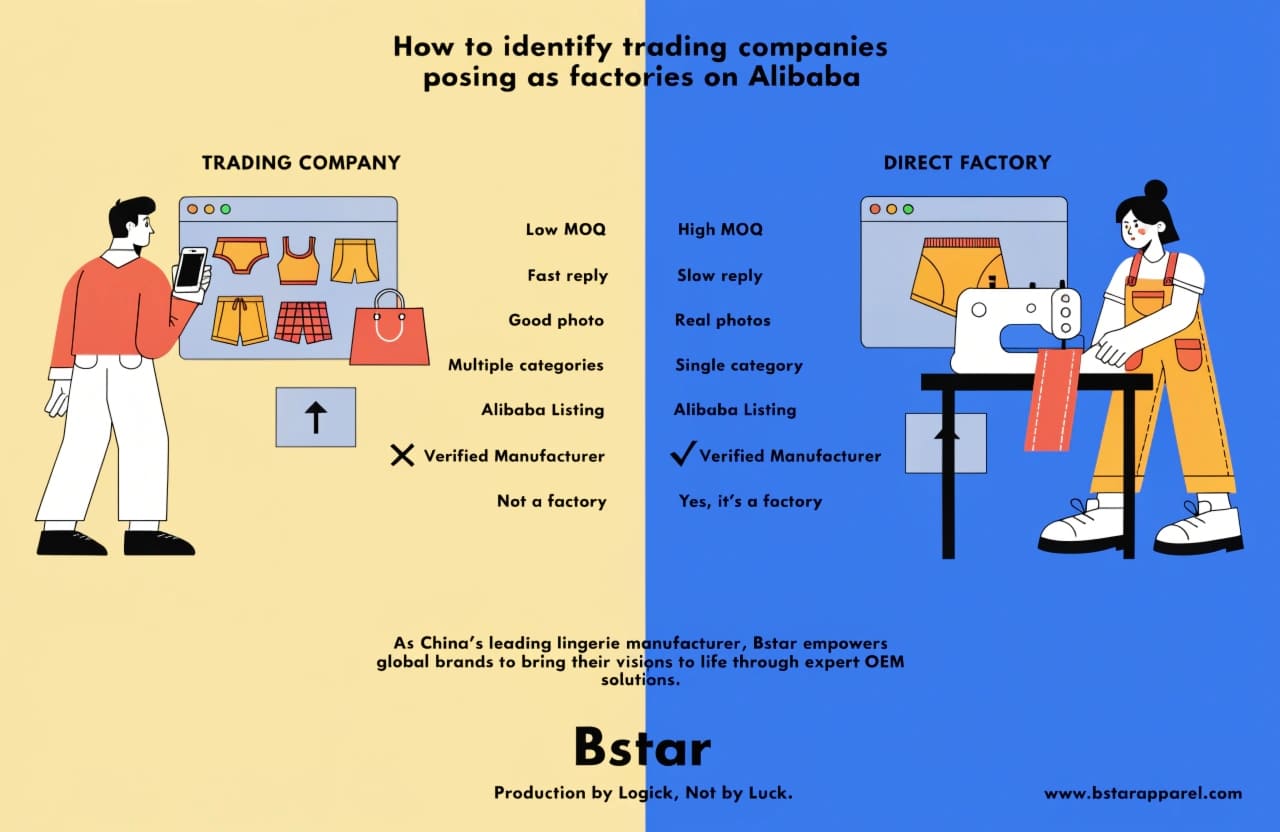
This matters more than buyers realize. When you work with a trading company, you lose direct control over the factory floor. You can’t confirm which factory actually made your order. You can’t speak to the pattern maker. You can’t solve a quality problem mid-production because you have no relationship with the people doing the work. And if something goes wrong, the trading company is a middleman with no real leverage over anyone.
Look for Alibaba’s "Verified Manufacturer" badge — but don’t stop there. Cross-check with the factory’s business license (you can request this directly) and look at whether their listed address and production claims match up. When we work with DTC brands from the Netherlands, Australia, and the US, one of the first things we do is invite them to verify our production setup — because a real factory has nothing to hide.
Does the Supplier Have Valid, Verifiable Certifications — or Just Logos?
Certifications on an Alibaba profile look reassuring. BSCI, OEKO-TEX, GOTS — these are real standards that matter. The problem is that logos alone mean nothing without a date.
Certifications expire. BSCI audits are typically valid for one to two years. OEKO-TEX certificates list an expiry date clearly. If a supplier is displaying certification logos without current, dated documents — or worse, showing expired certificates — that is a serious warning sign. It means either they failed to renew, or they are borrowing the credibility of a certificate that no longer applies to them.
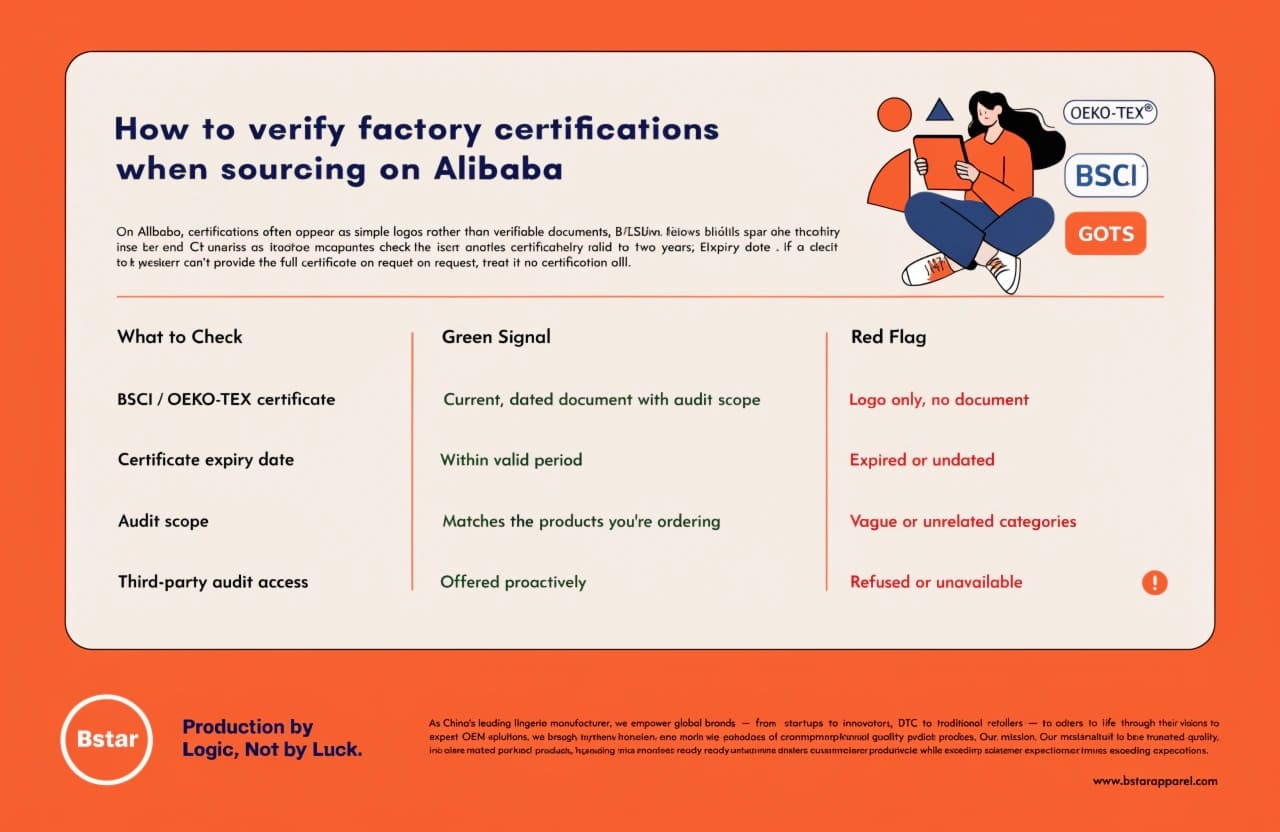
Here is what to actually do. When you see a certification logo, click through to the document. Check the issue date and the expiry date. If the supplier can’t provide the full certificate on request — not just a logo, but the actual document with audit scope and expiry — treat it as if there is no certification at all.
This is not about dismissing certifications. We hold current BSCI and OEKO-TEX certifications, and they cost real time and money to maintain. A supplier who has done that work will be happy to show you the documents. A supplier who hesitates or sends you a blurry logo image is telling you something.
| What to Check | Green Signal | Red Flag |
|---|---|---|
| BSCI / OEKO-TEX certificate | Current, dated document with scope | Logo only, no document |
| Certificate expiry date | Within valid period | Expired or undated |
| Audit scope | Matches the products you’re ordering | Vague or unrelated categories |
| Third-party audit access | Offered proactively | Refused or unavailable |
Does the Supplier Ask Real Questions Before Quoting — or Just Say "Send Design"?
This one is subtle but it matters a lot. When you reach out to a supplier about a men’s underwear order, pay close attention to what they ask you in return.
A factory with a real R&D team will ask about fabric weight (GSM), stretch recovery percentage, waistband construction, lining requirements, and your fit model size — before they quote you a price. A supplier that just replies "send your design, we can copy" has no pattern-making capability. They are a production-only or copy-only shop. That means if your spec has a problem, they will not catch it. You will find out at bulk.
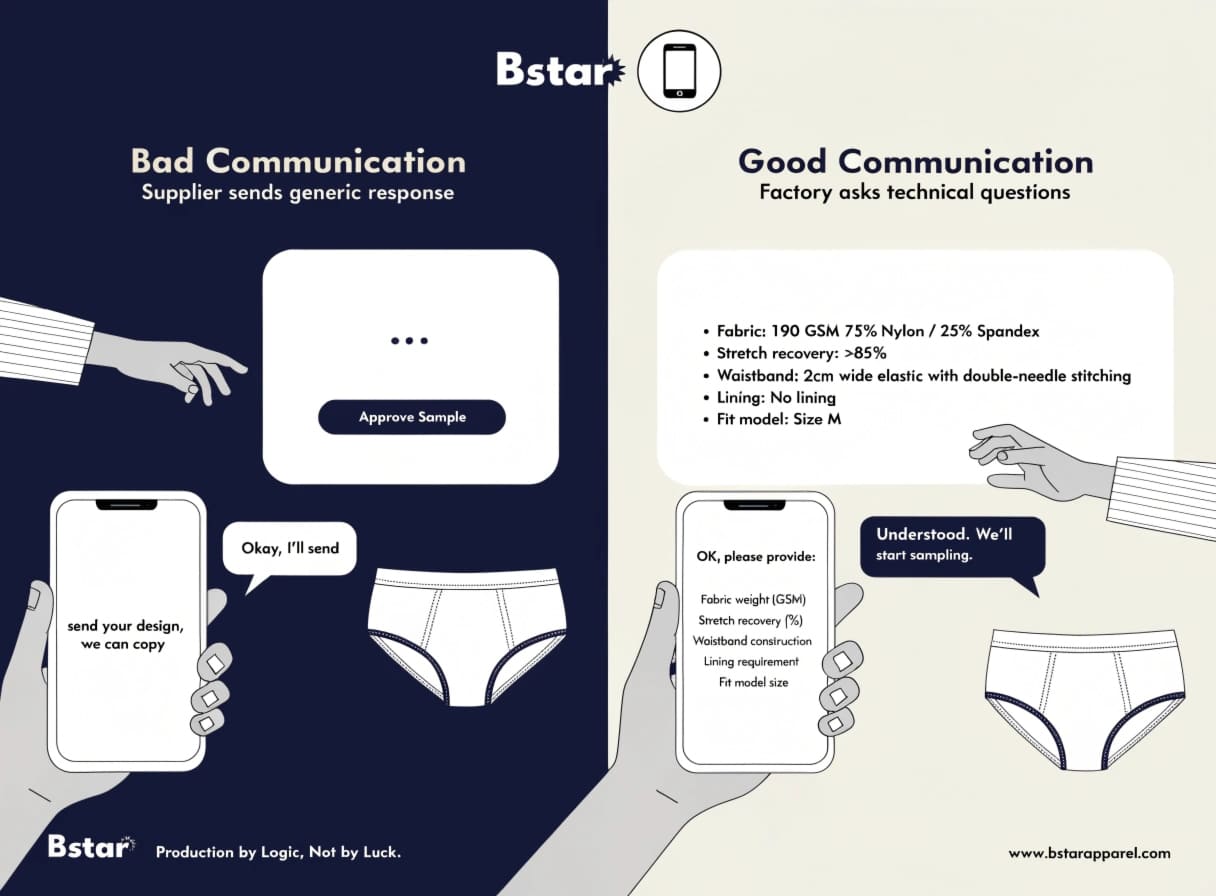
In our experience, this is where first-time buyers lose the most time. A supplier copies the design, bulk arrives, the waistband rolls, the fabric pills after two washes, or the pouch construction is wrong. The buyer sends photos and complaints. The supplier says "you approved the sample." And technically — if the buyer approved without knowing what to look for — that’s true.
A factory that asks detailed questions before sampling is doing two things. First, they are proving they understand the product category. Second, they are building a written record of what you agreed on. That record protects you. If a supplier can quote you a price without asking a single technical question, that is a red flag. The product has details that require decisions, and a real factory needs answers before they can price correctly.
Is the Supplier Pushing the Price Down Without Explaining Why It’s Possible?
Price negotiation is normal. Every buyer does it. But there is a version of low price that should make you nervous.
When a supplier drops their price significantly without being able to explain the cost breakdown — fabric GSM, labor cost allocation, trim and finishing costs — it means the margin has to come from somewhere. In our experience, when buyers negotiate to a price the factory genuinely can’t sustain, the factory finds the margin back in material swaps: thinner fabric, lower-grade elastic, skipped finishing steps, or reduced stitch density.
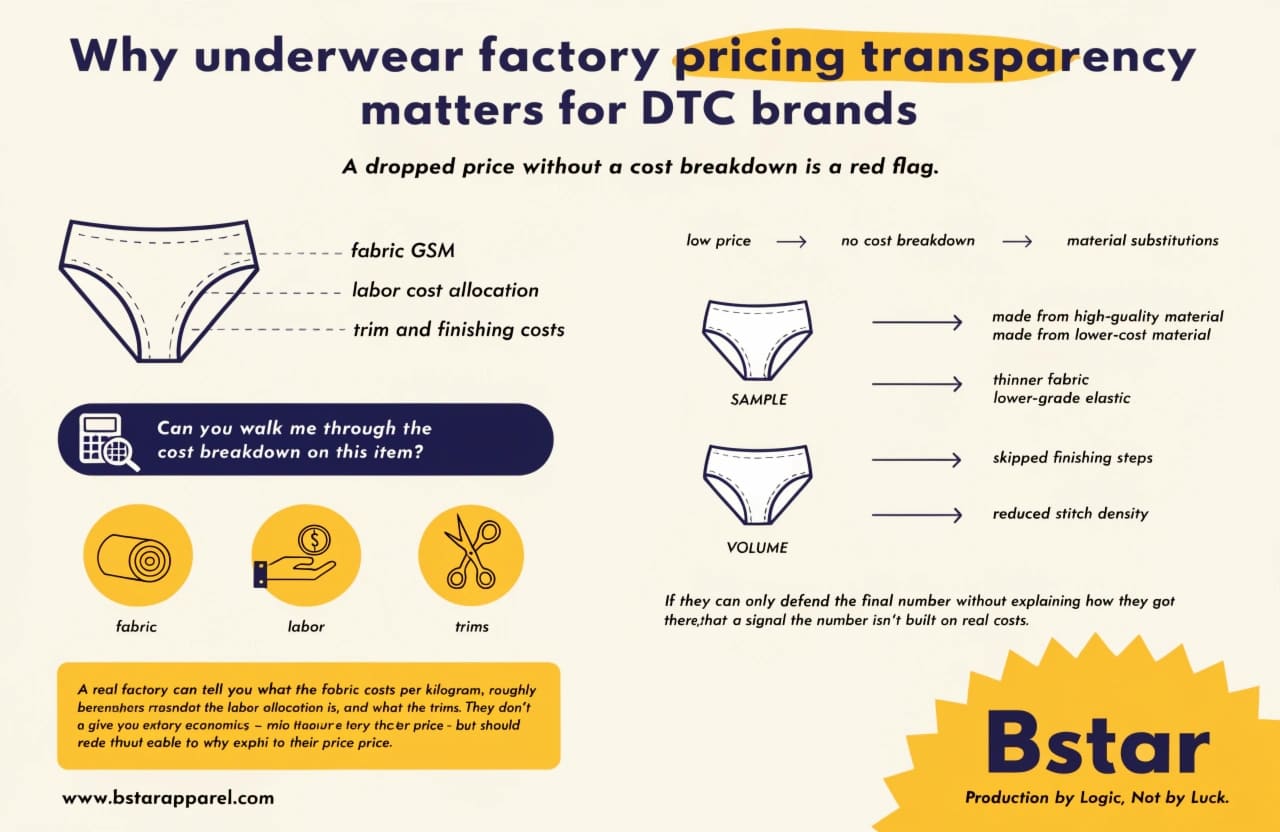
The damage here doesn’t show up at sampling. It shows up at bulk, because factories often produce samples from better material to win the order, then adjust the bill of materials when the volume order comes in. By then, you have already wired a deposit.
The question to ask any supplier is simple: "Can you walk me through the cost breakdown on this item?" A real factory can tell you what the fabric costs per kilogram, roughly what the labor allocation is, and what the trims cost. They don’t have to give you exact factory economics — but they should be able to explain why their price is their price. If they can only defend the final number without explaining how they got there, that’s a signal the number isn’t built on real costs.
Does the Supplier Have a Written Quality Standard — or Just Promises?
This is the one that hurts buyers the most, because it’s the easiest thing to overlook when everything else feels fine.
If a supplier cannot give you a written inspection standard before you pay a deposit, you have no recourse when bulk product fails. This means a documented AQL level, a defect classification list (critical, major, minor), and your right to re-inspect before shipment. Oral promises — "our quality is very good," "we have QC team" — are not contractual. You cannot use them when you are standing in a warehouse looking at 3,000 units you can’t sell.
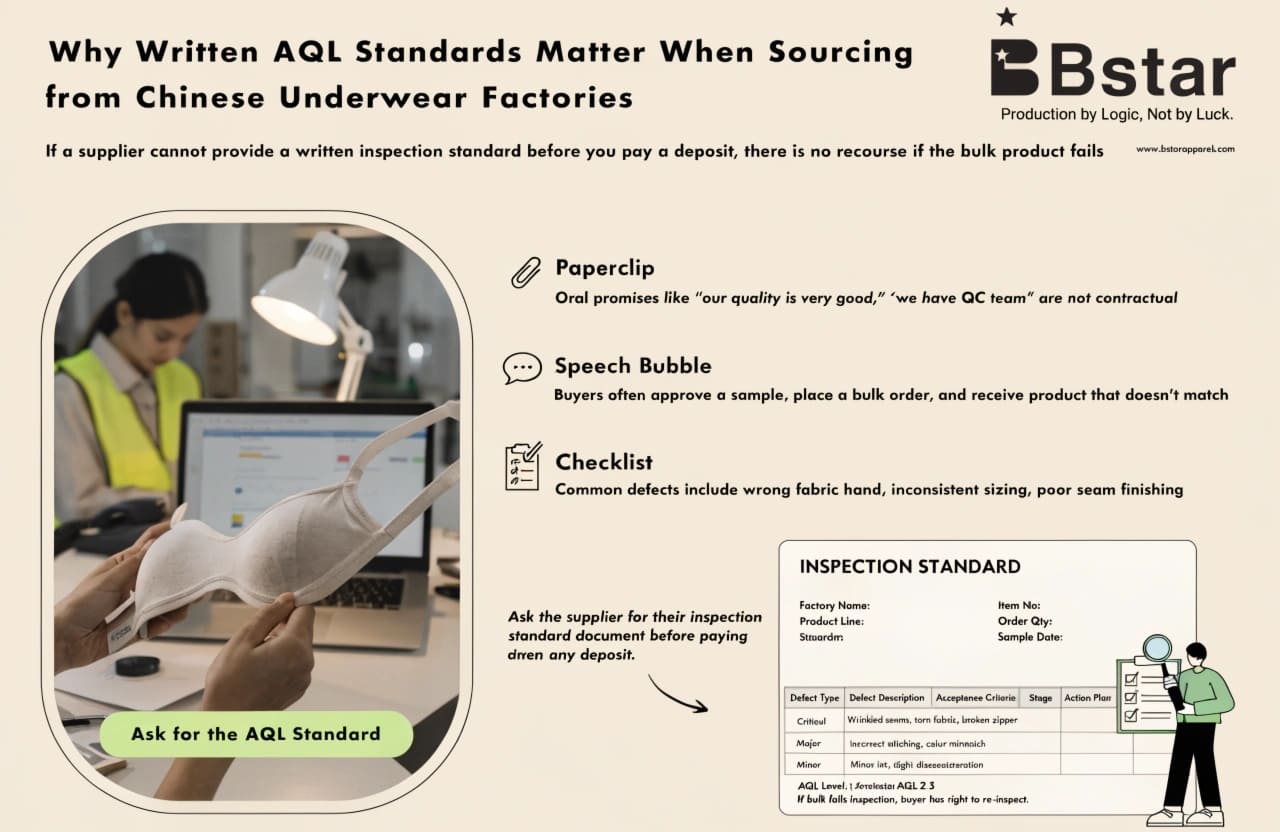
When buyers come to us after a failed Alibaba order, the absence of written quality standards is one of the most common issues we see. The buyer approved a sample, placed a bulk order, and received product that didn’t match — wrong fabric hand, inconsistent sizing, poor seam finishing. But because there was no written standard, there was nothing to point to. The supplier didn’t technically breach anything written down.
The fix is straightforward. Before you pay any deposit, ask the supplier for their inspection standard document. It should specify the AQL level they inspect to (commonly AQL 2.5 for general textiles), how defects are classified, at what production stage inspection happens, and what happens if bulk fails inspection. If the supplier says "we don’t have that in writing" or goes quiet, walk away. A factory that runs a real QC process has these documents because they use them every day.
Conclusion
Check credentials, verify the certificate dates, ask technical questions, understand the price, and get quality standards in writing — do these five things before you send any money.