
What Are the Real Benefits of Silver Ion Technology in Antibacterial Underwear?
Brands keep adding "antibacterial" to their underwear specs. But after fielding the same buyer questions for years, I know most people are asking the wrong question.
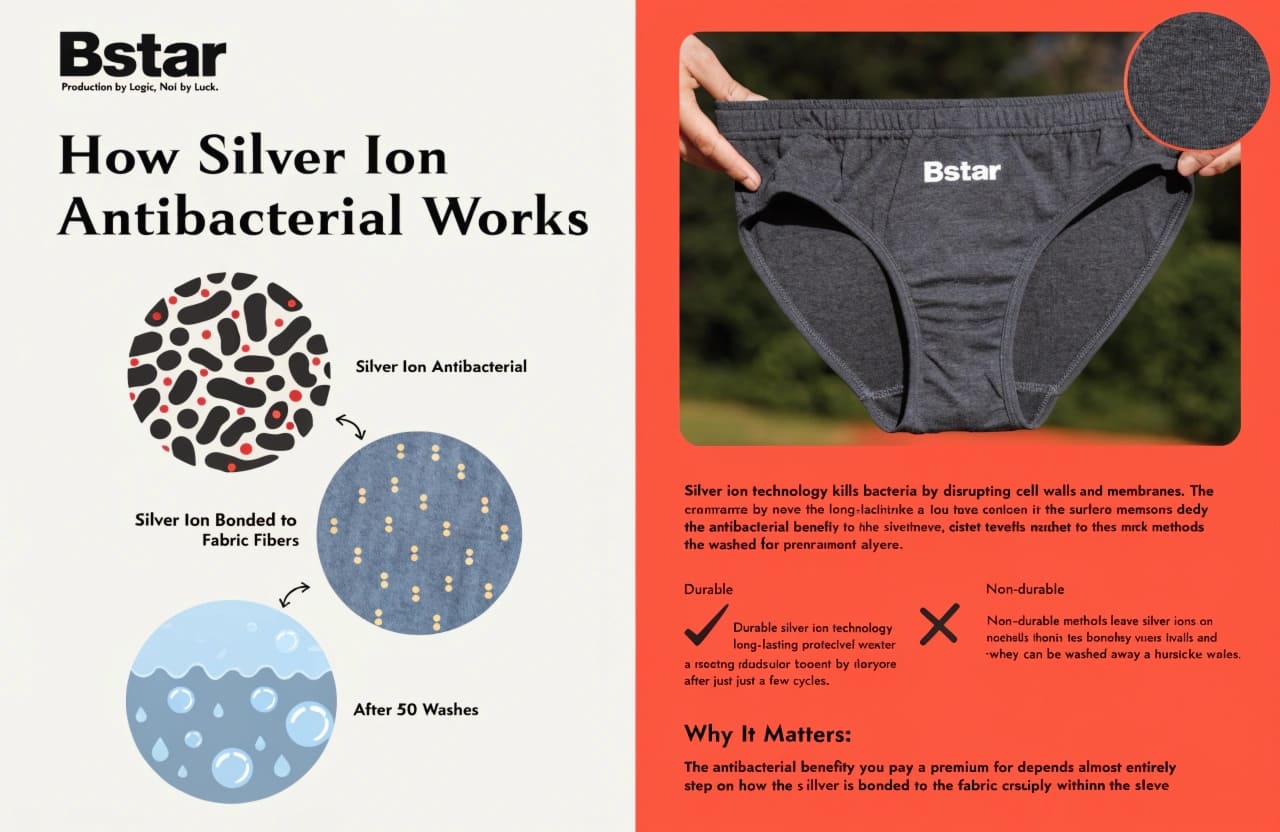
Silver ion technology does kill bacteria effectively, but the real question is: does it still work after 50 washes? The antibacterial benefit you pay a premium for depends almost entirely on how the silver is bonded to the fabric—not just whether it’s there.
There is a gap between what gets printed on a spec sheet and what ends up in a consumer’s drawer six months later. In buyer conversations we’ve had at BSTAR, the concern is almost never "does silver kill bacteria?"—everyone agrees it does. The concern is always "will this still work after my customer washes it 30 times?" That question is worth taking seriously, because the answer determines whether silver ion underwear is a genuine product advantage or a future customer service problem.
How Do Silver Ions Actually Disrupt Bacteria—and Why Does That Matter for Buyers?
Most fabric claims sound the same on paper. So when a supplier tells you their underwear is "antibacterial," it helps to know what that actually means at the material level.
Silver ions work by penetrating bacterial cell walls and interfering with the cell’s basic metabolic functions. This disrupts energy production and stops the bacteria from reproducing. The effect is broad-spectrum, meaning it works against multiple types of bacteria, not just one strain.
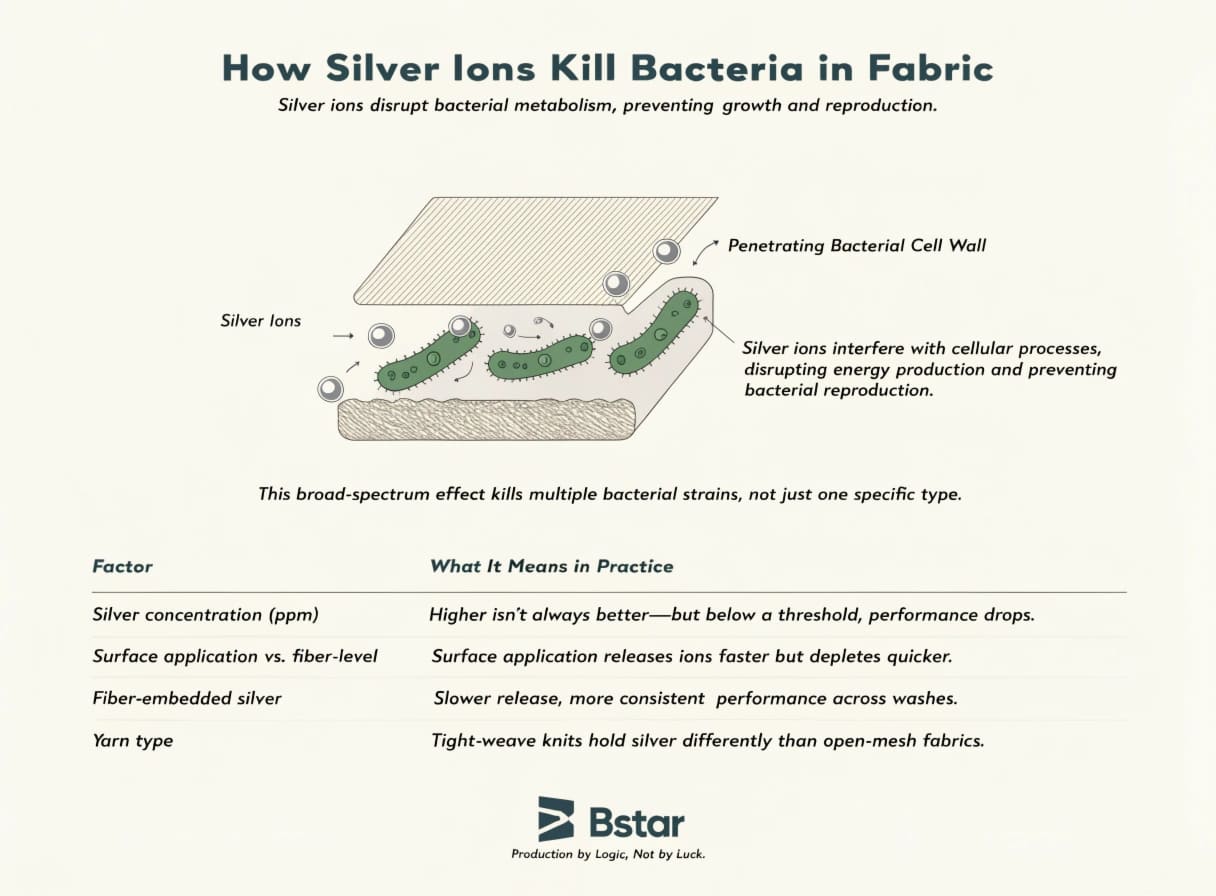
This mechanism is well-established and not particularly controversial. Where things get complicated is the delivery system—how those ions are held in the fabric and whether they can actually reach the bacteria when needed.
In sourcing, we see a lot of spec sheets that list silver ion content without specifying the release mechanism or concentration. That matters. A fabric needs a high enough silver concentration in the right location to produce a meaningful antibacterial effect. Too low, and the marketing claim outpaces the actual performance.
What concentration and placement actually tell you
| Factor | What It Means in Practice |
|---|---|
| Silver concentration (ppm) | Higher isn’t always better—but below a threshold, performance drops |
| Surface application vs. fiber-level | Surface application releases ions faster but depletes quicker |
| Fiber-embedded silver | Slower release, more consistent performance across washes |
| Yarn type | Tight-weave knits hold silver differently than open-mesh fabrics |
When you’re comparing supplier specs, ask specifically where the silver sits in the fabric construction—not just whether it’s there. That question alone filters out a lot of noise.
Surface Coating vs. Fiber Embedding: Which Integration Method Should You Actually Choose?
This is the question that separates buyers who understand silver ion underwear from those who are comparing labels.
Surface-coated silver washes off. Fiber-embedded silver—where silver particles or silver-salt compounds are bonded at the yarn level during production—survives far more wash cycles. If your supplier cannot tell you which method they use, assume it’s a coating.
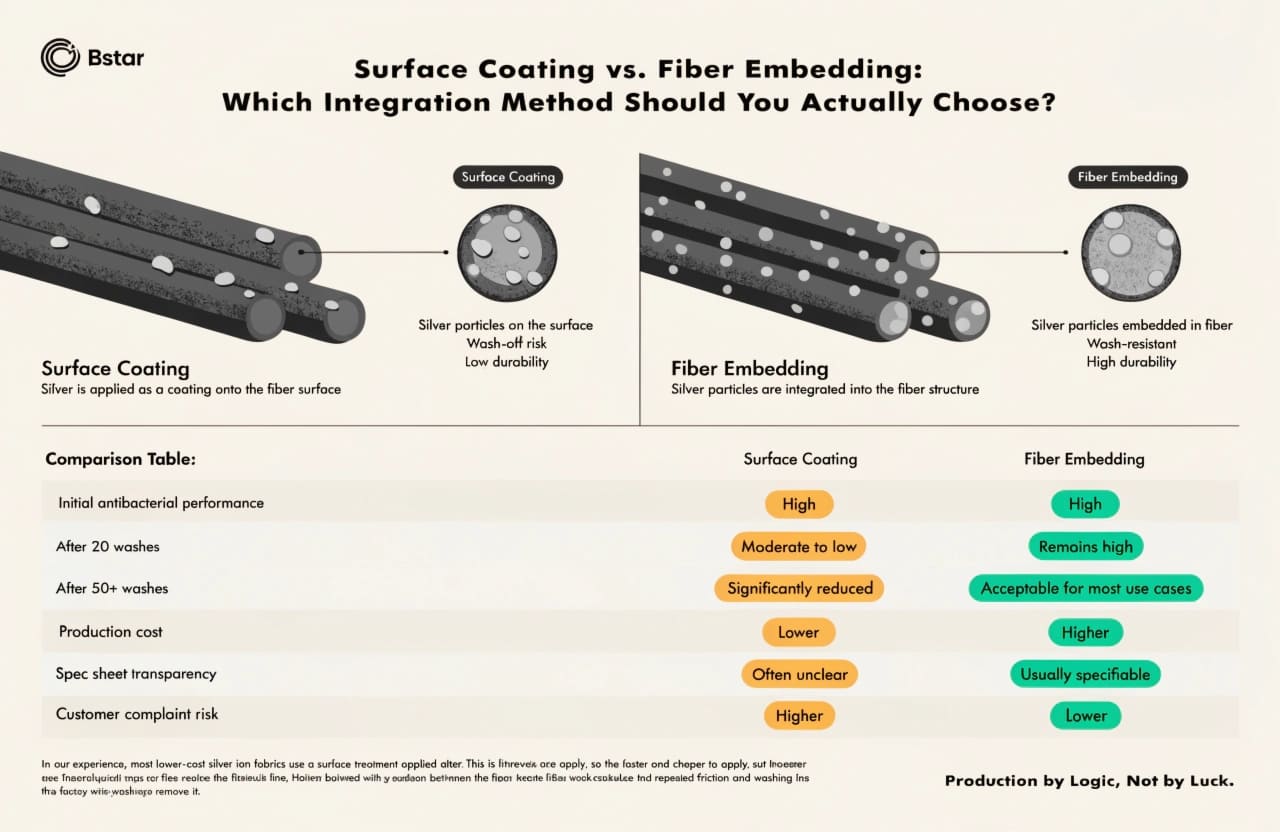
From what we see in production and supplier evaluation, most lower-cost silver ion fabrics use a surface treatment applied after knitting. It’s faster and cheaper to apply. The antibacterial test results right out of the factory look fine. But the bond between the silver and the fiber surface is weak, and repeated friction and washing physically removes it.
Fiber-embedded methods—where the silver compound is introduced during the spinning or yarn-dyeing stage—produce a much more stable bond. The silver becomes part of the fiber structure rather than sitting on top of it.
How the two methods compare across key buyer concerns
| Criteria | Surface Coating | Fiber Embedding |
|---|---|---|
| Initial antibacterial performance | High | High |
| After 20 washes | Moderate to low | Remains high |
| After 50+ washes | Significantly reduced | Acceptable for most use cases |
| Production cost | Lower | Higher |
| Spec sheet transparency | Often unclear | Usually specifiable |
| Customer complaint risk | Higher over product lifetime | Lower |
For DTC brands, the calculus is straightforward. A customer who buys antibacterial underwear at a premium expects the benefit to last. If it fades after a month of normal use, you get returns and negative reviews. The production cost difference between coating and fiber embedding is real, but it’s smaller than the cost of managing that customer service fallout.
When we work with brands at BSTAR, we ask early in the product development process: what’s the expected product lifetime claim? That answer drives the specification choice.
Does Silver Ion Underwear Actually Hold Up After Hundreds of Washes?
Wash resistance is where most "antibacterial" claims fall apart in practice.
Fiber-embedded silver ion fabrics can maintain meaningful antibacterial efficacy through 50 to 100 wash cycles under standard test conditions. Surface-coated fabrics typically show significant performance drop-off between washes 10 and 30. The method of integration is the single biggest predictor of wash durability.
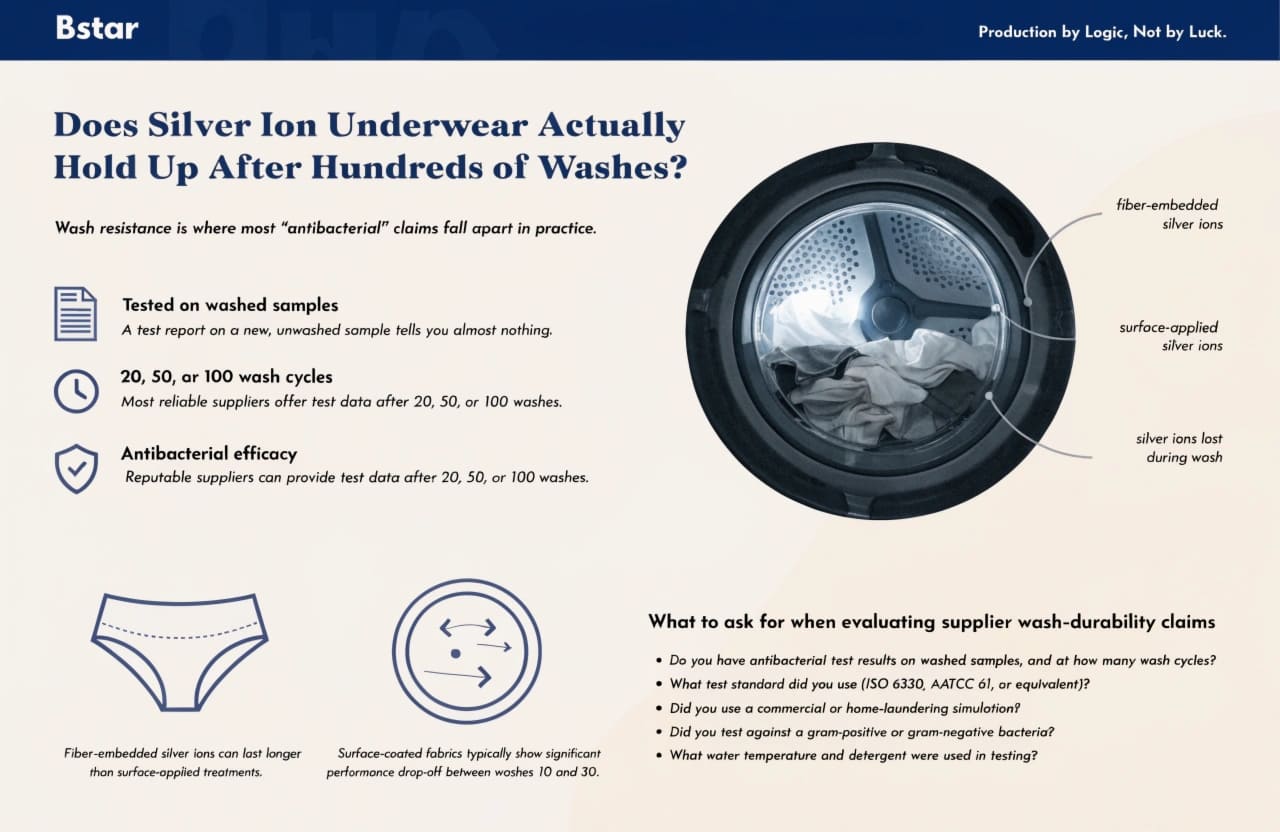
In sourcing conversations, this is where buyers often get caught. They receive a test report showing strong antibacterial performance—say, 99%+ bacterial reduction—but the test was conducted on a new, unwashed sample. That number tells you almost nothing about what the fabric does after a real consumer uses and washes it for three months.
What to ask for when evaluating supplier wash-durability claims
The right question is not "do you have an antibacterial test report?" It’s "do you have antibacterial test results on washed samples, and at how many wash cycles?"
Reputable fabric suppliers can provide test data after 20, 50, or 100 washes. If a supplier only has pre-wash data, that’s a signal. Not necessarily a disqualifier—but something to flag and negotiate around, especially if you’re making a durability claim on your product page.
Other things we check before production:
- Wash test standard used (ISO 6330, AATCC 61, or equivalent)
- Water temperature and detergent type in testing (consumer washing conditions vary)
- Whether test used a commercial or home-laundering simulation
- Bacterial strain tested (gram-positive vs. gram-negative coverage)
None of this requires a lab on your end. It requires asking your supplier the right questions and knowing what a credible answer looks like.
Is Silver Ion Underwear Safe for Skin—and What Do Certifications Actually Tell You?
Skin safety is a legitimate concern, especially for intimate apparel. But there’s a common misreading of what certifications mean here.
OEKO-TEX® Standard 100 and similar certifications confirm that a fabric does not contain harmful levels of regulated substances. They do not validate antibacterial performance or wash durability. A certified fabric can be safe and ineffective at the same time—these are separate things.
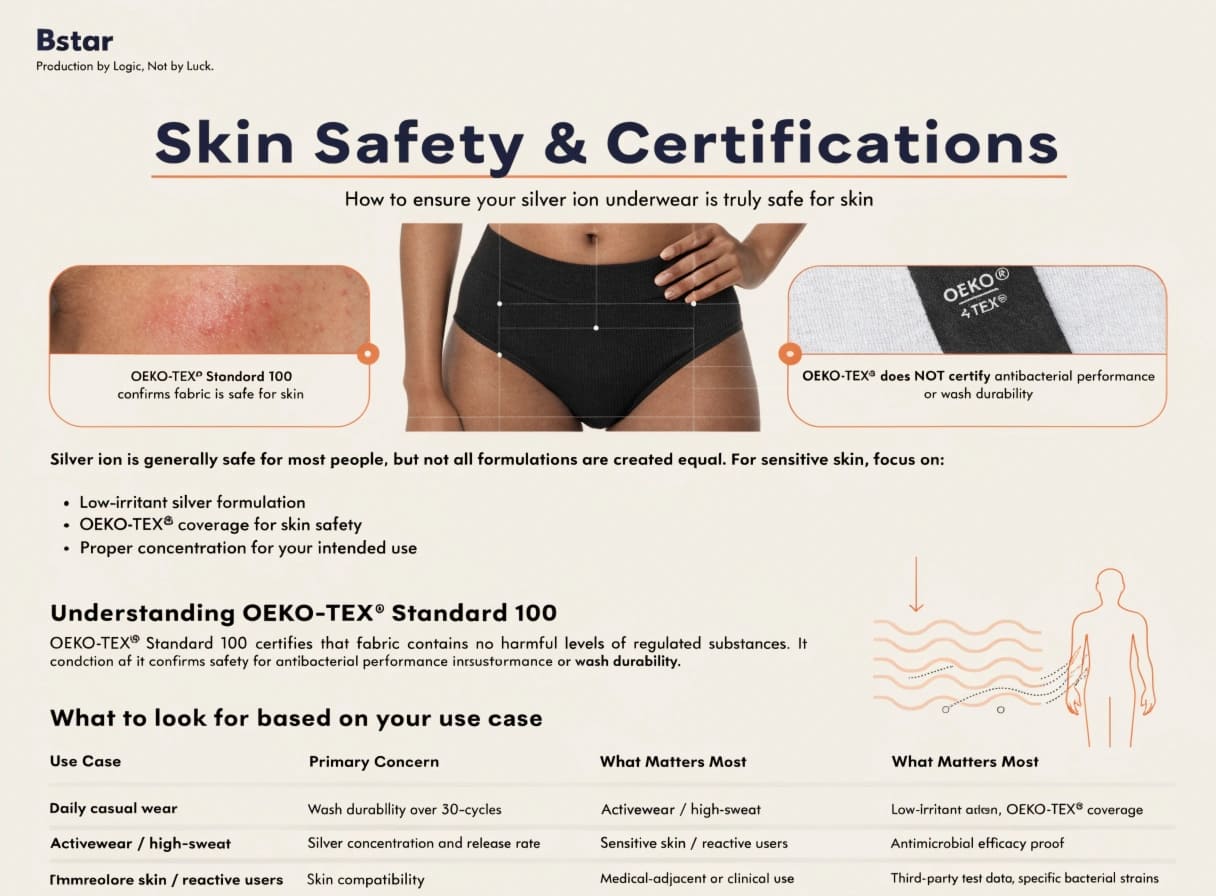
This distinction matters because buyers often use certification as a proxy for overall product quality. "It has OEKO-TEX® so it must be good" is a reasonable starting assumption for safety—but it says nothing about whether the antibacterial claim holds up.
For skin safety specifically, the silver concentrations used in textile applications are generally considered low-risk. In the buyer conversations we’ve had, genuine skin reactions to silver ion underwear are rarely the main concern. The more common issue is that brands make broad skin-benefit claims—"gentle," "hygienic," "ideal for sensitive skin"—and then source whatever silver ion fabric is cheapest, without checking whether the formulation is appropriate for that claim.
Matching the product to the use case
Different use cases have different priorities, and the right silver ion specification varies accordingly:
| Use Case | Primary Concern | What Matters Most |
|---|---|---|
| Daily casual wear | Long-term odor control | Wash durability over 50+ cycles |
| Activewear / high-sweat | Immediate odor suppression | Silver concentration and release rate |
| Sensitive skin / reactive users | Skin compatibility | Low-irritant silver formulation, OEKO-TEX® coverage |
| Medical-adjacent or clinical use | Antimicrobial efficacy proof | Third-party test data, specific bacterial strains |
A product built for post-gym odor control is not automatically the right choice for someone with reactive skin. And a fabric certified safe for sensitive skin may not deliver the wash durability an activewear brand needs. These are not interchangeable specs.
When brands come to us with a silver ion brief, we ask about the end consumer before we talk about materials. The use case shapes everything downstream.
Conclusion
Silver ion underwear works—but which version you source determines whether that benefit lasts. Focus on integration method, ask for post-wash test data, and don’t let certifications answer the wrong question.