
What Is the Average Lead Time for Underwear Production?
Most buyers ask us for a single number. "Just give me the lead time." I get it — you have a launch date, a retailer deadline, or a warehouse window to hit. But here’s the problem: there is no single number. Giving you one without explanation would set you up to miss your launch.
Underwear production lead time is not one clock — it’s at least three running in sequence. Sampling takes 7–15 days. Fabric sourcing takes 3–30 days depending on material type. Bulk production takes 20–60 days depending on order size. Until you know which phase you’re in, "lead time" is just a guess.
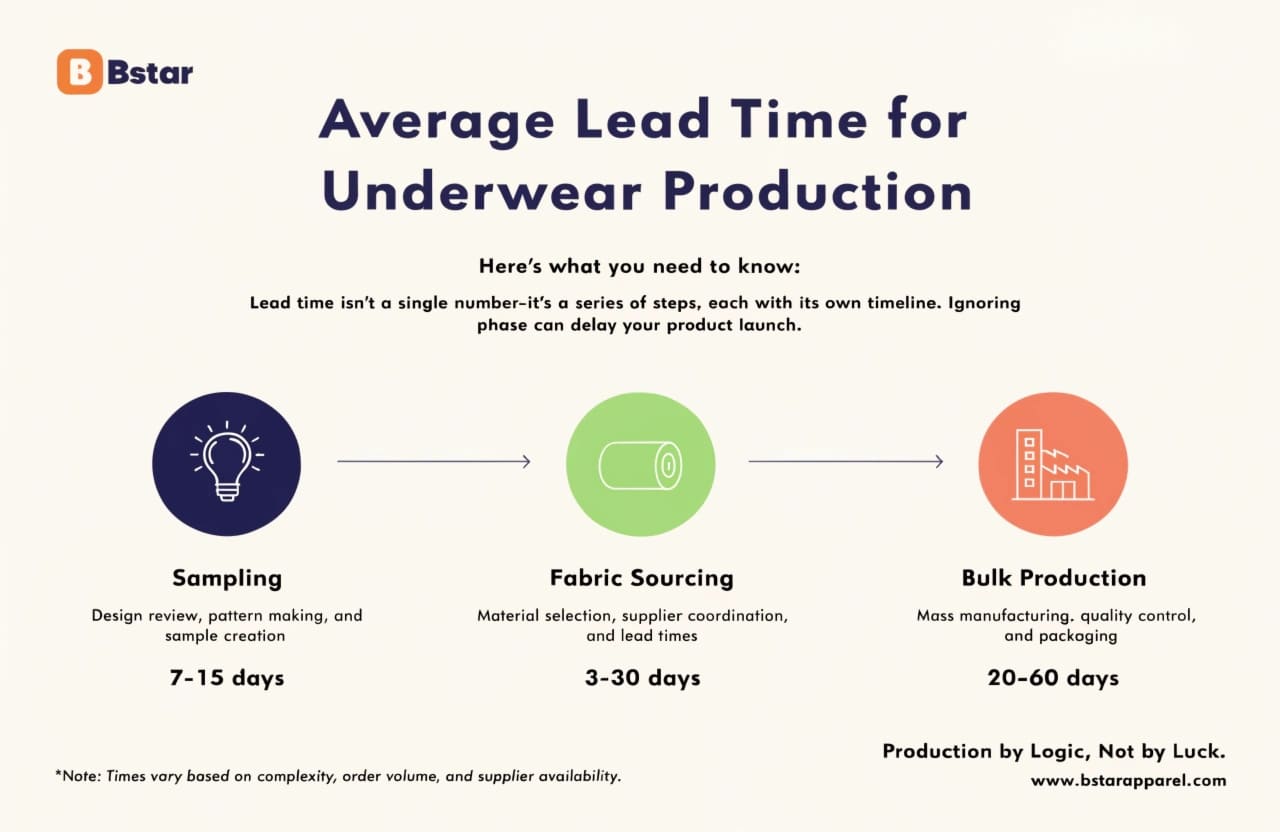
Every delayed order I’ve seen — from first-time DTC founders to established brands like STEP ONE in Australia — had the same root cause. The buyer built a timeline around production, and forgot to model sampling and fabric sourcing as separate phases. This article will fix that. By the end, you’ll have a real mental model for how underwear lead time actually works — and where your plan is probably short.
What Does the Standard 30 to 45-Day Production Cycle Actually Include?
You’ll see "30–45 days" quoted everywhere. But what does that number actually cover? I’ve watched buyers assume it means "from order placed to goods at my door." It doesn’t.
At our factory, the 30–45 day window refers to bulk production only1 — after your sample is approved and your fabric is already in-house. That means pre-production steps are not included. If you start the clock at "I want to place an order," the real timeline is longer.
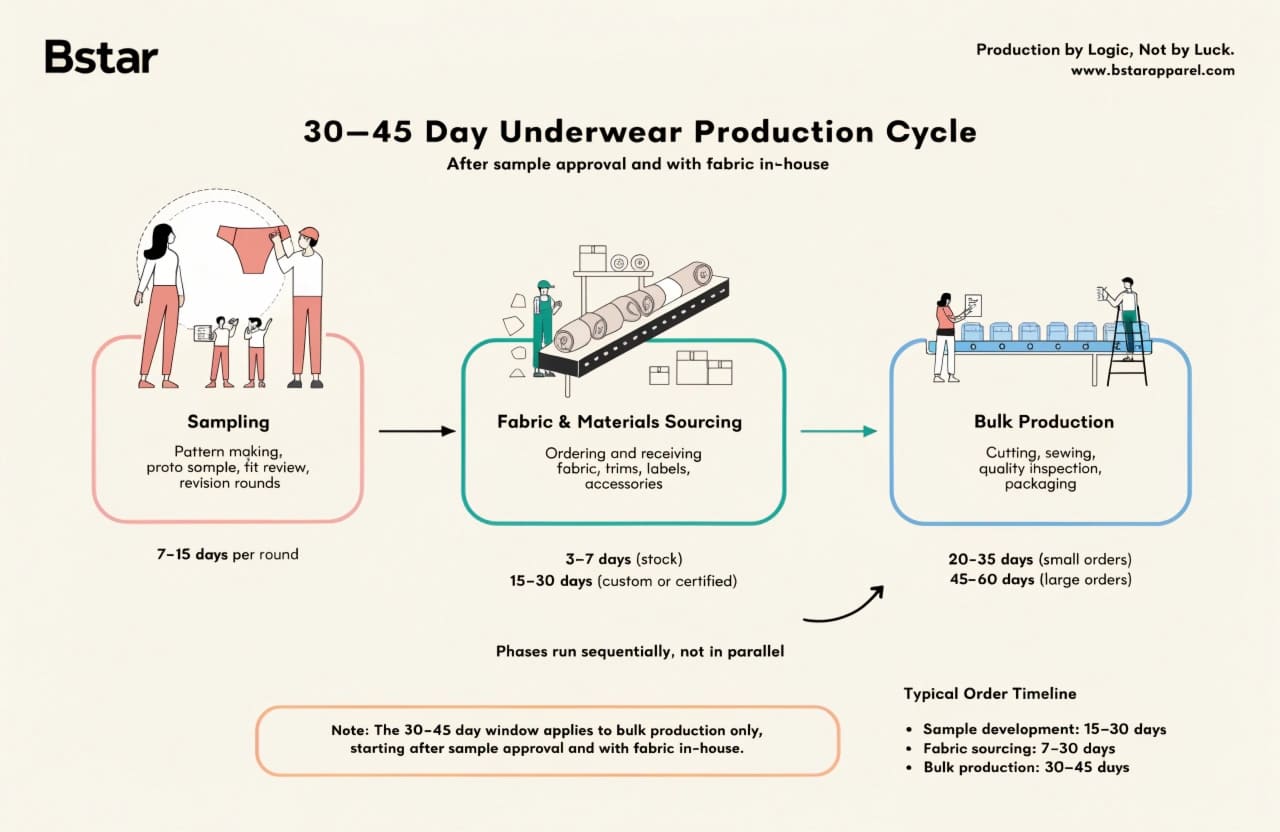
Let me break down what a typical order actually looks like from our end.
The Three Production Phases You Need to Model
Most buyers think in one phase. Experienced buyers think in three. Here’s how we break it down internally:
| Phase | What It Covers | Typical Duration |
|---|---|---|
| Sampling | Pattern making, proto sample, fit review, revision rounds | 7–15 days per round |
| Fabric & Materials Sourcing | Ordering and receiving fabric, trims, labels, accessories | 3–7 days (stock) / 15–30 days (custom or certified) |
| Bulk Production | Cutting, sewing, quality inspection, packaging | 20–35 days (small orders) / 45–60 days (large orders) |
These phases run in sequence, not in parallel2. You cannot start bulk production before sampling is approved. You cannot cut fabric you don’t have yet. Each phase has a minimum physics — and no factory can shortcut that without increasing your defect risk.
The 30–45 day number is real. It just only covers the last row in that table.
How Do Customization, Fabric Sourcing, and Order Volume Change the Timeline?
This is where most first-time buyers get surprised. They compare two quotes, both say "45 days," and assume they’re comparing the same thing. They’re usually not.
Customization level, fabric type, and order quantity each move your lead time in a concrete direction. A plain brief in stock fabric with a 500-piece order is a very different production object from a custom-printed waistband style in GOTS-certified cotton at 5,000 pieces.
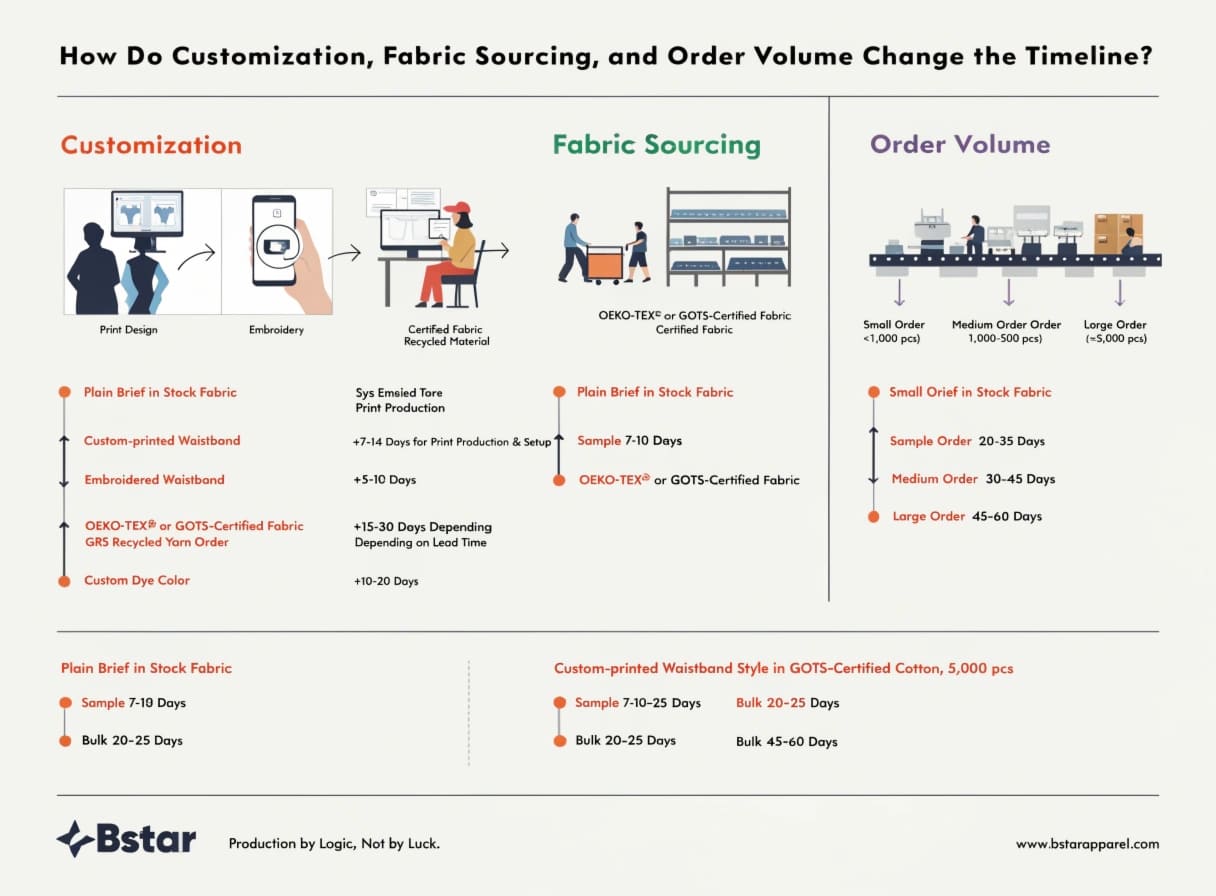
Let’s go through each variable directly.
Customization: The Silent Multiplier
Standard underwear — a basic brief or boxer with a stock fabric and a woven label — moves fast. We can sample it in 7–10 days and bulk-produce a small order in 20–25 days once fabric is confirmed.
Add any of the following, and the timeline shifts:
| Customization Type | Lead Time Impact |
|---|---|
| Custom-printed waistband or all-over print | +7–14 days for print production and setup |
| Embroidery on waistband or leg | +5–10 days |
| OEKO-TEX® or GOTS-certified fabric3 (not stocked) | +15–25 days fabric sourcing |
| GRS recycled yarn orders4 | +15–30 days depending on supplier lead time |
| Custom dye color (not in stock) | +10–20 days |
We carry OEKO-TEX®, GOTS, FSC5, and GRS-certified materials for this reason — our clients increasingly need certified supply chains. But certified fabrics have their own upstream sourcing lead times. If you want sustainability credentials on your product, you need to build that time into your plan from day one.
Order Volume: Bigger Orders Take Longer
This is simple but often ignored. At our factory:
- Small orders (under 1,000 pieces per style): bulk production runs 20–35 days
- Medium orders (1,000–5,000 pieces): 30–45 days
- Large orders (5,000+ pieces): 45–60 days
Volume affects machine scheduling, fabric procurement scale, and QC time. Our daily capacity runs around 50,000 pieces6, but that capacity is shared across all active orders. Booking earlier in our production schedule directly shortens your wait.
How Do Sampling, Approvals, and Pre-Payment Work Together?
Here’s the part nobody talks about clearly enough. Sampling is not part of bulk lead time7 — but buyers almost always assume it is. This one mismatch causes more first-order timeline failures than anything else we see.
Sampling, buyer approval, and pre-payment are all gates. Bulk production cannot start until each gate is cleared. If your sample takes three revision rounds, or your approval sign-off takes two weeks on your end, your bulk start date moves — and your delivery date moves with it.
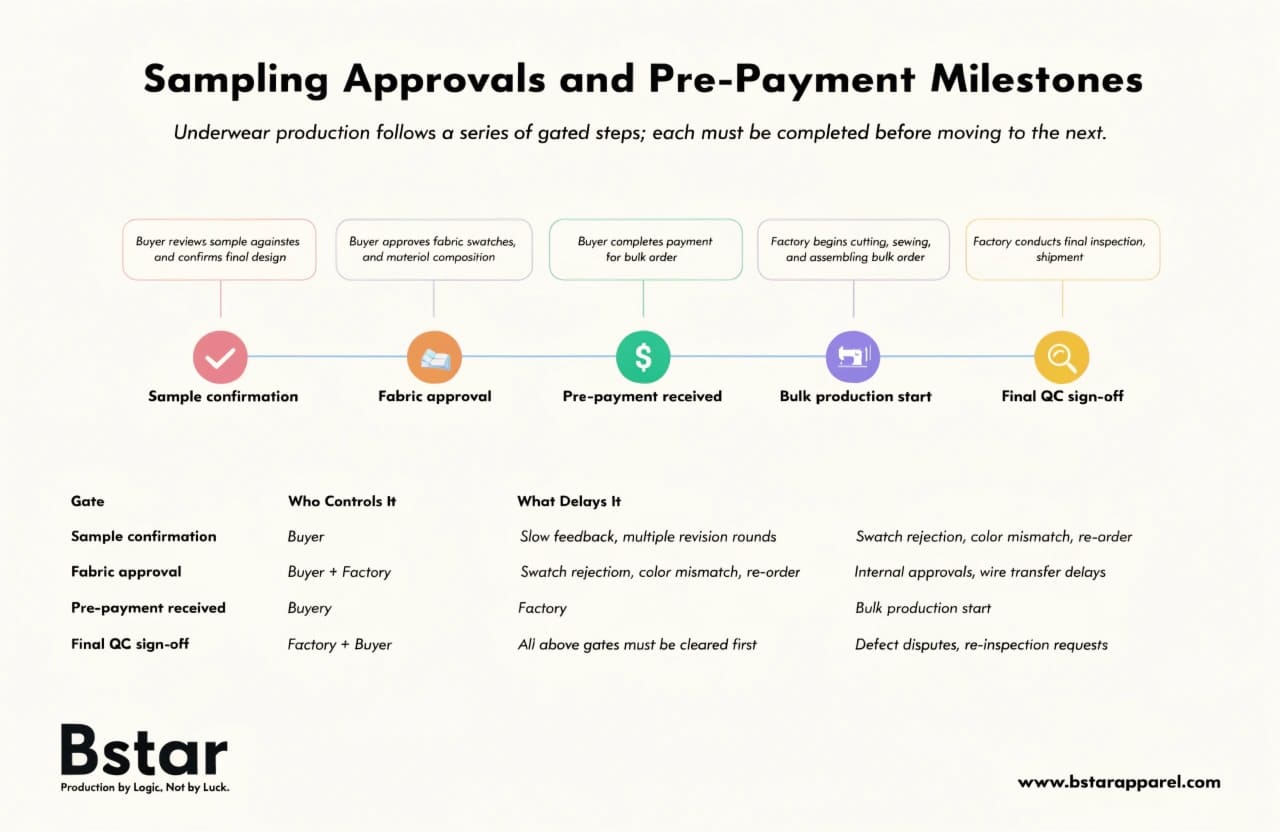
The Gate Model: Why Your Timeline Stops and Starts
Think of your production order as a series of locked doors. Each one needs a key before the next door opens.
| Gate | Who Controls It | What Delays It |
|---|---|---|
| Sample confirmation | Buyer | Slow feedback, multiple revision rounds |
| Fabric approval | Buyer + Factory | Swatch rejection, color mismatch, re-order |
| Pre-payment received | Buyer | Internal approvals, wire transfer delays |
| Bulk production start | Factory | All above gates must be cleared first |
| Final QC sign-off | Factory + Buyer | Defect disputes, re-inspection requests |
We process samples in 7–15 days from brief received. But if the buyer takes 10 days to review and requests two revision rounds, the real sample phase is 30+ days — and that’s before a single piece of bulk fabric is cut.
With clients like ONTHATASS in the Netherlands, what makes the process smooth is not that they skip any of these gates — it’s that they clear each gate fast. Clear brief, fast feedback, quick approval. That’s how a technically complex product ships on time.
We have a 24-hour response commitment from our English-speaking trade team8 for exactly this reason. Communication delays are lead time. Every day a question sits unanswered is a day you’re not making progress.
How Can You Speed Up Delivery or Handle Peak Season Crunches?
Rush orders are possible. But "rush" doesn’t mean "no phases" — it means compressing the phases that can be compressed, and being honest about the ones that can’t.
The most effective ways to cut lead time are: use stock fabrics, simplify your design, submit a complete brief the first time, and give fast approvals. These are all buyer-side actions — not factory-side ones.
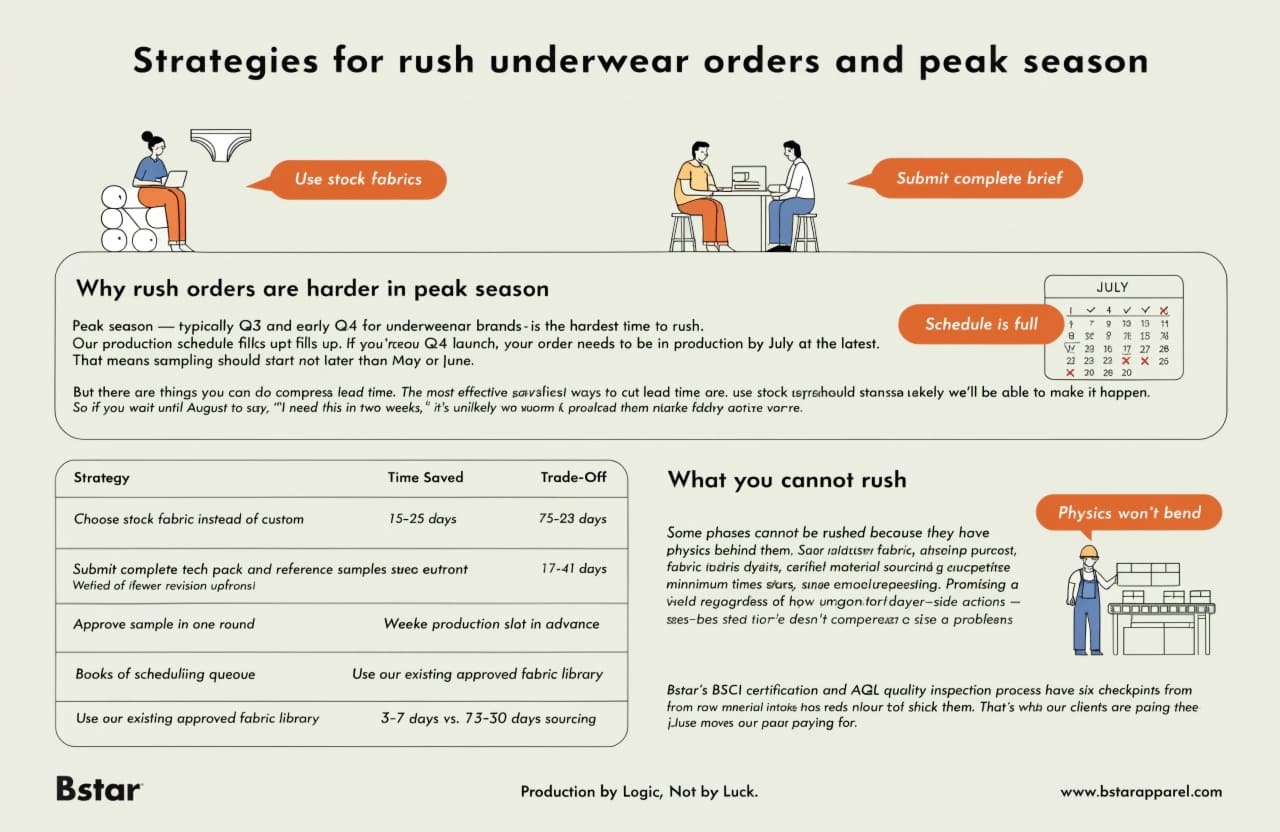
What You Can Control to Move Faster
Here’s what actually works when a buyer needs to compress the timeline:
| Strategy | Time Saved | Trade-Off |
|---|---|---|
| Choose stock fabric instead of custom | 15–25 days | Fewer material options |
| Submit complete tech pack and reference samples upfront | 5–10 days (fewer revision rounds) | Requires more prep work from buyer |
| Approve sample in one round | 7–14 days | Less design flexibility |
| Book production slot in advance | Weeks of scheduling queue | Requires earlier commitment |
| Use our existing approved fabric library | 3–7 days vs. 15–30 days sourcing | Limited to our current material range |
Peak season — typically Q3 and early Q4 for brands targeting holiday retail9 — is the hardest time to rush. Our production schedule fills up. If you’re planning a Q4 launch, your order needs to be in production by July at the latest. That means sampling should start no later than May or June.
We support 1-piece minimum for sample development. That exists specifically so buyers can start the sampling gate early — before they’re sure about order volume — and not lose time later.
What You Cannot Rush
Some phases have real physics behind them. Custom fabric dyeing, certified material sourcing, and embroidery setups have minimum processing times10 regardless of how urgent your order is. Promising a timeline that skips these steps doesn’t compress lead time — it just moves the problem to a quality issue later.
Our BSCI certification11 and AQL quality inspection process12 have six checkpoints from raw material intake to final packaging. We don’t skip them. That’s what our clients are paying for.
Conclusion
Underwear production lead time is three phases in sequence: sampling (7–15 days), fabric sourcing (3–30 days), and bulk production (20–60 days). Know which gate you’re at, clear it fast, and your timeline stays on track.
-
"Ways To Reduce Lead Time In Garment Manufacturing – TLD apparel", https://tld-apparel.com/news-inspired/lead-time-in-garment-manufacturing/. In apparel manufacturing, bulk production typically refers to the mass production phase after sample approval and material procurement, distinct from pre-production activities including sampling and sourcing. Evidence role: definition; source type: education. Supports: Standard definitions of bulk production phase in apparel manufacturing. Scope note: General industry practice rather than a universally codified standard ↩
-
"Textile manufacturing – Wikipedia", https://en.wikipedia.org/wiki/Textile_manufacturing. Garment manufacturing follows sequential process dependencies where fabric cutting cannot begin before materials arrive and bulk production requires approved samples, reflecting physical and quality control constraints in the production workflow. Evidence role: mechanism; source type: education. Supports: Sequential dependencies in garment manufacturing workflows. ↩
-
"Oeko-Tex – Wikipedia", https://en.wikipedia.org/wiki/Oeko-Tex. OEKO-TEX Standard 100 certifies textiles for harmful substances, while the Global Organic Textile Standard (GOTS) certifies organic fiber content and social/environmental production criteria throughout the textile supply chain. Evidence role: definition; source type: institution. Supports: Official definitions and scope of OEKO-TEX and GOTS textile certifications. ↩
-
"What is the Global Recycled Standard (GRS)? – Textile Exchange", https://textileexchange.org/faq/what-is-the-global-recycled-standard-grs/. The Global Recycled Standard (GRS), managed by Textile Exchange, verifies recycled content in products and tracks materials from source to final product while addressing environmental and social requirements in production. Evidence role: definition; source type: institution. Supports: Official definition and requirements of GRS certification. ↩
-
"Sustainable Fashion and Apparel Design: Standards | Certificates", https://guides.library.cornell.edu/c.php?g=662121&p=5277662. The Forest Stewardship Council (FSC) certifies responsibly sourced forest products, applicable to textiles through cellulosic fibers like viscose, rayon, and modal derived from wood pulp, ensuring sustainable forest management in the fiber supply chain. Evidence role: definition; source type: institution. Supports: FSC certification and its application to textile materials. Scope note: FSC certification applies to specific fiber types rather than all textile materials ↩
-
"Apparel Manufacturing: NAICS 315 : U.S. Bureau of Labor Statistics", https://www.bls.gov/iag/tgs/iag315.htm. Garment factory daily production capacity varies significantly based on product complexity, automation level, and workforce size, with medium to large facilities producing thousands to tens of thousands of units daily across multiple production lines. Evidence role: general_support; source type: research. Supports: Typical production capacity ranges for garment factories. Scope note: Capacity figures are highly variable and depend on specific factory configuration and product type ↩
-
"Lead time – Wikipedia", https://en.wikipedia.org/wiki/Lead_time. In apparel supply chain management, lead time typically measures the production phase from order confirmation to shipment, with pre-production activities like sampling, approvals, and material sourcing often tracked separately as they depend on buyer responsiveness. Evidence role: definition; source type: education. Supports: Standard practices for calculating manufacturing lead times. Scope note: Industry practice varies and some suppliers may include or exclude different phases in quoted lead times ↩
-
"Digital transformation and supply chain efficiency improvement – PMC", https://pmc.ncbi.nlm.nih.gov/articles/PMC11020941/. Supply chain research indicates that communication delays between buyers and suppliers contribute to extended lead times through decision bottlenecks, clarification cycles, and approval delays, with faster response times enabling more efficient progression through production milestones. Evidence role: general_support; source type: research. Supports: Impact of communication efficiency on supply chain performance. Scope note: Communication speed is one factor among many affecting total lead time ↩
-
"GARMENT INDUSTRY | Encyclopedia of Cleveland History", https://case.edu/ech/articles/g/garment-industry. Apparel manufacturers typically experience peak production demand in Q3 and early Q4 as retailers prepare inventory for holiday shopping seasons, requiring brands to place orders months in advance to secure production capacity and meet retail delivery deadlines. Evidence role: general_support; source type: research. Supports: Seasonal production patterns in apparel manufacturing. Scope note: Seasonal patterns vary by product category, geographic market, and retail channel ↩
-
"Dyeing – Wikipedia", https://en.wikipedia.org/wiki/Dyeing. Textile dyeing involves chemical processes with required reaction times, temperature cycles, and curing periods that cannot be significantly accelerated without compromising color fastness and fabric quality, while embroidery digitization and machine setup require technical preparation time. Evidence role: mechanism; source type: education. Supports: Technical requirements and time constraints in textile processing. Scope note: Specific time requirements vary by fabric type, dye method, and equipment ↩
-
"amfori BSCI – Business Social Compliance Initiative", https://www.amfori.org/amfori-bsci/. The Business Social Compliance Initiative (BSCI), managed by amfori, is a supply chain management system that supports companies in improving working conditions in their global supply chains through monitoring and capability building based on international labor standards. Evidence role: definition; source type: institution. Supports: Official definition and purpose of BSCI certification. ↩
-
"[PDF] ISO 2859-1 – UNT Chemistry", https://chemistry.unt.edu/~tgolden/courses/iso2859-1.pdf. Acceptable Quality Limit (AQL), defined in ISO 2859 standards, is a statistical sampling method that determines the maximum number of defective units acceptable in a production batch, widely used in garment manufacturing for quality control inspection. Evidence role: definition; source type: institution. Supports: Official definition and application of AQL inspection standards. ↩