
Do You Really Understand REACH Compliance Before Selling Underwear in Europe?
Brands fail EU customs not because they ignored compliance—but because they thought one certificate was enough. That false confidence is expensive, and it is very common.
REACH compliance for European underwear sales means continuously checking which restricted substances are in your materials, at what concentrations, and whether your supplier’s documentation reflects actual test results—not just declarations. Underwear’s constant skin contact raises the risk of every dye, softener, and finish in your supply chain.

We work with European DTC clients every week at BSTAR. The compliance conversation comes up early, and it almost always starts the same way: "Does your factory have REACH compliance?" That is the wrong first question—and this article explains why, and what to ask instead.
Do You Know What REACH Actually Requires From an Apparel Exporter?
Many brand founders assume REACH is a single pass/fail standard. It is not. So they keep looking for a shortcut that does not exist.
REACH (Registration, Evaluation, Authorisation and Restriction of Chemicals) places legal responsibility on the importer placing goods on the EU market.1 For apparel, the most immediate obligation is ensuring your products do not contain Substances of Very High Concern (SVHCs) above 0.1% by weight per article2. This threshold and the candidate list are updated regularly by ECHA.
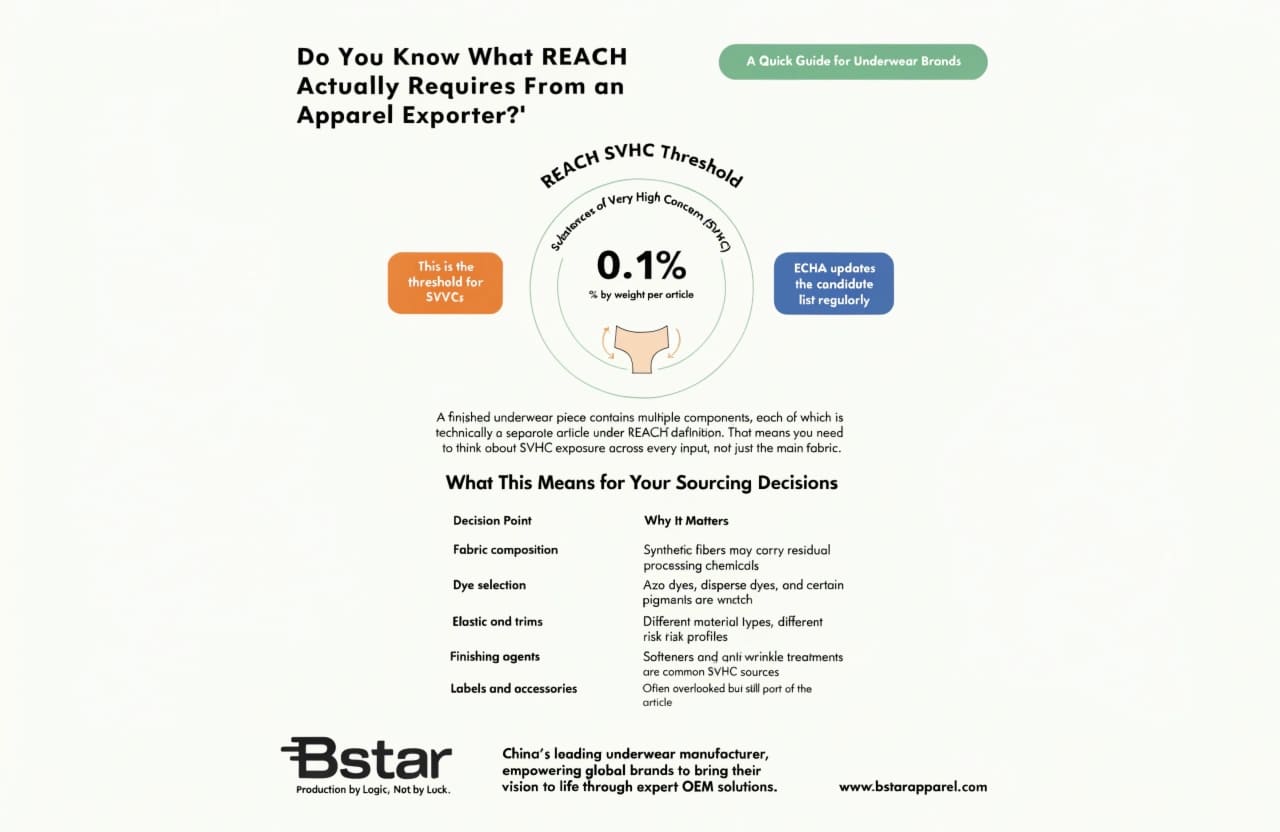
The 0.1% threshold sounds simple. But "per article" is the part that trips brands up. A finished underwear piece contains multiple components—fabric, elastic waistband, label, dye system, finishing chemical. Each component is technically a separate article under REACH’s definition.3 That means you need to think about SVHC exposure across every input, not just the main fabric.
What This Means for Your Sourcing Decisions
| Decision Point | Why It Matters |
|---|---|
| Fabric composition | Synthetic fibers may carry residual processing chemicals |
| Dye selection | Azo dyes, disperse dyes, and certain pigments are under watch |
| Elastic and trims | Different material types, different risk profiles |
| Finishing agents | Softeners and anti-wrinkle treatments are common SVHC sources |
| Labels and accessories | Often overlooked but still part of the article |
At BSTAR, when a European client asks about compliance, we walk through each of these inputs before production starts. Not after. A supplier declaration on the finished garment does not tell you which component failed. By then, it is too late to adjust without cost.
The real obligation is on you as the importer. Your factory’s job is to give you accurate material information. Your job—or your compliance consultant’s—is to verify it.
Are You Checking the Right Restricted Substances for Skin-Contact Underwear?
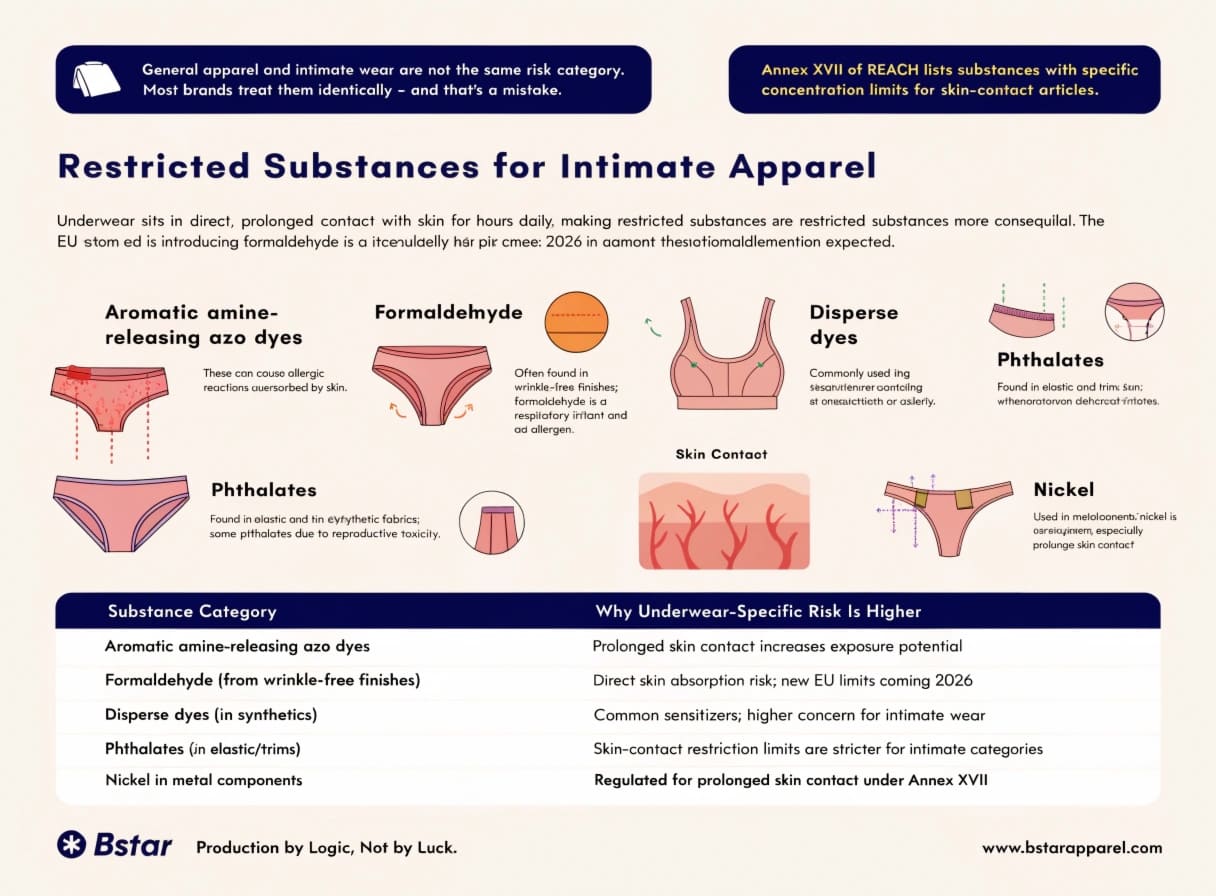
General apparel and intimate wear are not the same risk category. Most brands treat them identically, and that is a mistake.
Annex XVII of REACH lists substances with specific concentration limits for skin-contact articles.4 Underwear sits in direct, prolonged contact with skin for hours daily. This makes restricted substances like certain azo dyes, formaldehyde, and nickel in metal components far more consequential than they would be in outerwear. The EU is also introducing formaldehyde limits specifically for textiles, with 2026 implementation expected.5
Here is the practical issue we see in sourcing conversations: a fabric may be fully acceptable for a jacket, but the same dye chemistry applied to underwear crosses into a different risk zone because of the skin exposure duration and surface area. The regulatory framework reflects this, and so should your material selection process.
Substances That Matter Most for Underwear
| Substance Category | Why Underwear-Specific Risk Is Higher |
|---|---|
| Aromatic amine-releasing azo dyes6 | Prolonged skin contact increases exposure potential |
| Formaldehyde (from wrinkle-free finishes) | Direct skin absorption risk; new EU limits coming 2026 |
| Disperse dyes (in synthetics) | Common sensitizers; higher concern for intimate wear |
| Phthalates (in elastic/trims) | Skin-contact restriction limits are stricter for intimate categories |
| Nickel in metal closures | Regulated for prolonged skin contact under Annex XVII |
The 2026 formaldehyde limits deserve specific attention if you are planning a long-term EU product line. At the time of writing, the EU regulation is in the finalization process—confirm the current status with an EU compliance specialist, because implementation timelines shift. But if your underwear uses any finish that involves formaldehyde-releasing agents, your supplier needs to be able to test for this now, not when the regulation takes effect.
One more thing: your supplier saying "we don’t use formaldehyde" is not a test result. It is a statement. These are not the same thing.
Does OEKO-TEX STANDARD 100 Cover Your REACH Obligations?
Buyers often send an OEKO-TEX certificate and consider compliance done. We understand why—it is a credible certification and most major retailers accept it. But it is not a REACH compliance document.
OEKO-TEX STANDARD 100 tests for harmful substances in finished textiles and covers many of the same substances as REACH7, but it is a voluntary third-party certification—not a legal compliance framework. Its substance list and REACH’s SVHC candidate list overlap significantly, but they are updated on different schedules and by different bodies. Gaps exist and are real.
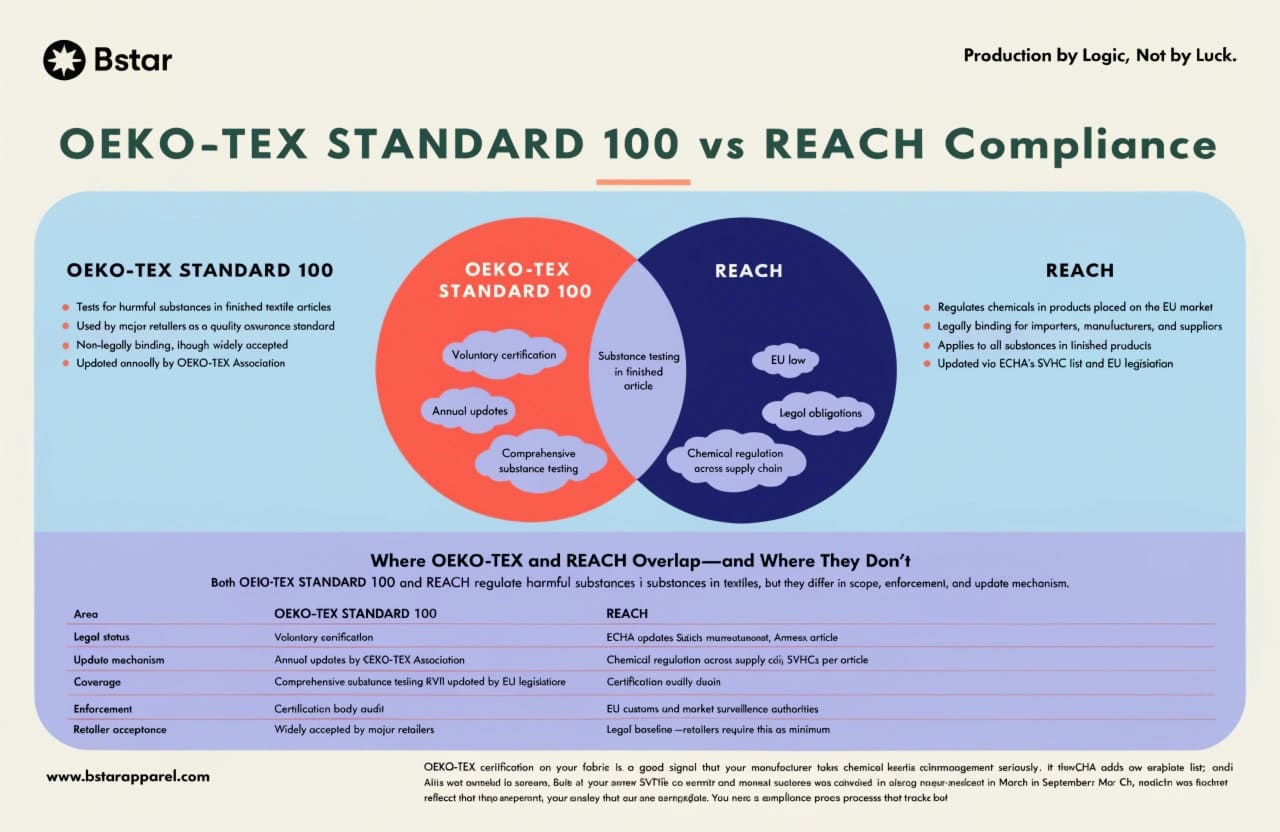
At BSTAR, our raw materials carry OEKO-TEX certification, and we treat this as a strong baseline. It matters to us and to our clients. But we do not tell clients it replaces independent testing for REACH purposes, because it does not.
Where OEKO-TEX and REACH Overlap—and Where They Don’t
| Area | OEKO-TEX STANDARD 100 | REACH |
|---|---|---|
| Legal status | Voluntary certification | EU law—legally binding on importers |
| Update mechanism | Annual updates by OEKO-TEX Association | ECHA updates SVHC list; Annex XVII updated by EU legislature |
| Coverage | Comprehensive substance testing in finished article | Chemical regulation across supply chain; SVHCs per article |
| Enforcement | Certification body audit | EU customs and market surveillance authorities |
| Retailer acceptance | Widely accepted by major retailers | Legal baseline—retailers require this as minimum |
The honest answer for your supply chain: OEKO-TEX certification on your fabric is a good signal that your manufacturer takes chemical management seriously. It simplifies retailer conversations. But if ECHA adds a new SVHC to the candidate list in September and your fabric was certified in March, your certificate does not reflect that update. You need a compliance process that tracks both.
For EU DTC brands, the practical minimum is: certified raw materials plus periodic independent lab testing plus a supplier who can produce actual test reports, not just declarations, when you ask.
Is Your Supply Chain Ready for SCIP Reporting and the Digital Product Passport?
Brands focused on the current compliance checklist are sometimes caught off guard by where compliance is heading. The infrastructure is shifting, and underwear is not exempt.
Under REACH Article 9, manufacturers and importers of articles containing SVHCs above 0.1% must submit information to ECHA’s SCIP database.8 The EU Digital Product Passport (DPP), being rolled out under the Ecodesign for Sustainable Products Regulation, will eventually require detailed material and chemical data to travel with each product—starting with textiles and apparel in the near term.9
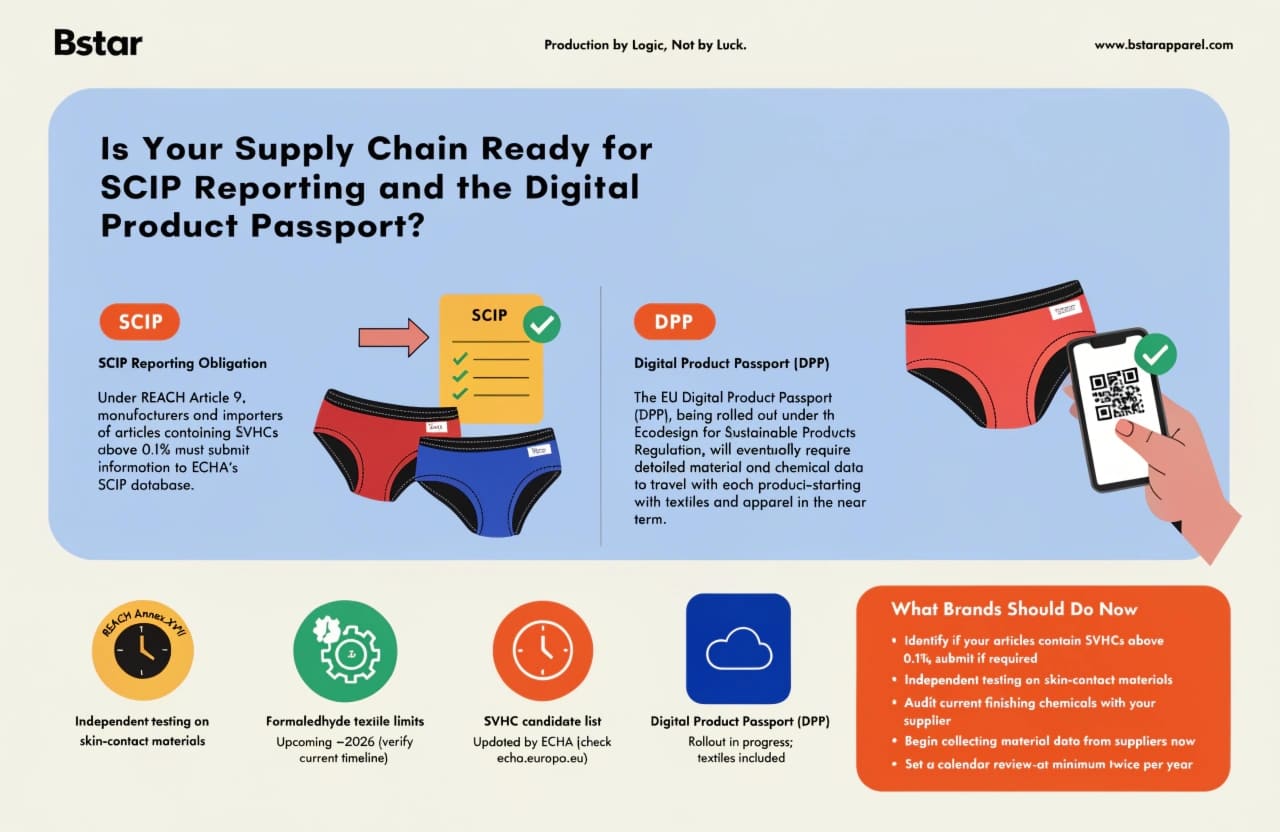
SCIP (Substances of Concern In Products) database reporting is already a legal requirement—not a future proposal. If your product contains an SVHC above threshold, you are obligated to report. Many smaller brands are not doing this, which is an exposure, not a loophole.
What to Prepare Now
| Requirement | Current Status | What Brands Should Do Now |
|---|---|---|
| SCIP database submission | Active legal obligation | Identify if your articles contain SVHCs above 0.1%; submit if required |
| REACH Annex XVII restrictions | Active | Independent testing on skin-contact materials |
| Formaldehyde textile limits | Upcoming ~2026 (verify current timeline) | Audit current finishing chemicals with your supplier |
| Digital Product Passport (DPP) | Rollout in progress; textiles included | Begin collecting material data from suppliers now |
| SVHC candidate list monitoring | Updated by ECHA (check echa.europa.eu) | Set a calendar review—at minimum twice per year |
The DPP changes the compliance dynamic fundamentally. Right now, compliance documentation lives in your files and your supplier’s files. Under DPP, material and chemical information needs to be structured, retrievable, and attached to the product in a machine-readable format. Brands that have not built supplier data collection habits will find this very hard to retrofit.
At BSTAR, we already provide clients with material traceability documentation as part of our standard process—certifications, fiber composition, and test reports. This is partly because our European clients started asking for it years ago. If your current manufacturer cannot easily produce this information, that is worth noting before you scale into EU distribution.
Conclusion
REACH compliance for EU underwear sales is material-specific, ongoing, and your legal responsibility as the importer—not your factory’s. Start with the right questions, not the wrong certificate.
-
"EU REACH – International Trade Administration", https://www.trade.gov/eu-reach. REACH Regulation (EC) No 1907/2006 establishes that importers placing articles on the EU market bear primary legal responsibility for compliance with chemical safety requirements, including SVHC notification and restriction adherence. Evidence role: definition; source type: government. Supports: that REACH regulation assigns legal responsibility to importers placing goods on the EU market. ↩
-
"What You Need to Know About the Ruling on REACH SVHC …", https://greensofttech.com/what-you-need-to-know-about-the-ruling-on-reach-svhc-thresholds/. Under REACH Article 7(2), suppliers must notify ECHA when articles contain substances on the Candidate List in concentrations above 0.1% weight by weight (w/w), a threshold established in ECHA guidance documents and confirmed through European Court of Justice rulings. Evidence role: statistic; source type: government. Supports: that the SVHC notification threshold under REACH is 0.1% by weight per article. ↩
-
"REACH Articles – Health and Safety Executive for Northern Ireland", https://www.hseni.gov.uk/reach-articles. The European Court of Justice clarified in Case C-106/14 that for complex objects, each component with a distinct function constitutes a separate article under REACH, meaning the 0.1% SVHC threshold applies to individual components rather than the assembled product. Evidence role: definition; source type: government. Supports: that REACH defines articles at the component level for complex objects. ↩
-
"Annex XVII – Restrictions on the Manufacture, Placing on the Market …", https://reachonline.eu/reach/en/annex-xvii.html. REACH Annex XVII contains restrictions on manufacturing, placing on market, and use of certain dangerous substances, including specific concentration limits for articles intended for prolonged skin contact such as textiles and clothing. Evidence role: general_support; source type: government. Supports: that Annex XVII establishes substance restrictions with concentration limits for articles in prolonged skin contact. ↩
-
"REACH Annex XVII Formaldehyde Restrictions 2026 – Certivo", https://www.certivo.com/blog-details/reach-annex-xvii-formaldehyde-restrictions-2026-complete-compliance-guide-for-manufacturers. The European Commission adopted amendments to REACH Annex XVII introducing formaldehyde release limits for textile articles placed on the EU market, with implementation timelines subject to the standard regulatory adoption process. Evidence role: historical_context; source type: government. Supports: that the EU has adopted or proposed formaldehyde restrictions for textiles. Scope note: Implementation dates for EU regulations can shift during the legislative process; verification of current status is recommended ↩
-
"Detection of azo dyes and aromatic amines in women under garment", https://pmc.ncbi.nlm.nih.gov/articles/PMC5991632/. REACH Annex XVII Entry 43 restricts azo dyes that can release certain aromatic amines classified as carcinogenic, as these substances can be absorbed through prolonged skin contact with textile articles and undergo metabolic activation. Evidence role: mechanism; source type: government. Supports: that certain azo dyes can release carcinogenic aromatic amines upon skin contact. ↩
-
"OEKO-TEX® STANDARD 100", https://www.oeko-tex.com/en/our-standards/oeko-tex-standard-100/. OEKO-TEX STANDARD 100 criteria include testing for numerous substances that overlap with REACH restrictions and SVHC candidates, including regulated azo dyes, formaldehyde, heavy metals, and phthalates, though the two systems operate on different legal bases and update schedules. Evidence role: general_support; source type: institution. Supports: that OEKO-TEX STANDARD 100 testing parameters include substances also regulated under REACH. Scope note: The extent of overlap varies as both lists are updated independently; OEKO-TEX is a voluntary certification while REACH is legally binding ↩
-
"Notifications to SCIP portal | Reach&CLP", https://www.reach.lu/en/supply-chain/notifications-to-scip-portal. Under the EU Waste Framework Directive Article 9(1)(i), as amended, suppliers of articles containing Candidate List substances above 0.1% w/w must submit information to ECHA’s SCIP (Substances of Concern In Products) database, a requirement that became enforceable in January 2021. Evidence role: definition; source type: government. Supports: that suppliers of articles containing SVHCs must submit information to the SCIP database. Scope note: The legal basis is the Waste Framework Directive rather than REACH Article 9 specifically, though the obligation relates to REACH SVHC identification ↩
-
"[PDF] Digital product passport for the textile sector – European Parliament", https://www.europarl.europa.eu/RegData/etudes/STUD/2024/757808/EPRS_STU(2024)757808_EN.pdf. The EU Ecodesign for Sustainable Products Regulation (ESPR) establishes a framework for Digital Product Passports that will require product-specific sustainability information, with textiles identified as a priority product category for early implementation, though specific data requirements and timelines are subject to delegated acts. Evidence role: historical_context; source type: government. Supports: that the EU is developing Digital Product Passport requirements for textiles under sustainability regulations. Scope note: Detailed technical requirements and implementation schedules for textile DPPs are still being developed through the regulatory process ↩