
What Is OEKO-TEX Standard 100 and Why Do You Need It?
You ask a supplier if they have OEKO-TEX. They say yes. You move on. That’s the moment things go wrong.
OEKO-TEX Standard 100 is a product-level certification. It confirms that a specific fabric or finished garment has been tested against 100+ harmful substances and passed. It does not certify a factory, a brand, or a general production process. If your supplier can’t tell you which article is certified, you don’t actually have coverage.
We hear this question constantly from DTC brand founders and sourcing managers, especially those in Europe and North America who are actively vetting suppliers. The question starts simple. The answer, unfortunately, is where most buyers get it wrong. Let me break it down in a way that actually helps you make better sourcing decisions.
What Does OEKO-TEX Standard 100 Actually Test and Certify?
Most buyers hear "OEKO-TEX" and think "eco-friendly." That’s the first mistake.
OEKO-TEX Standard 100 is a chemical safety certification. It tests textiles against a defined list of regulated substances — including pesticides, heavy metals, formaldehyde, pH levels, and dozens of other harmful chemicals. A product earns the certification when it passes all required limits for its product class. It says nothing about carbon footprint, water usage, or organic fiber content.
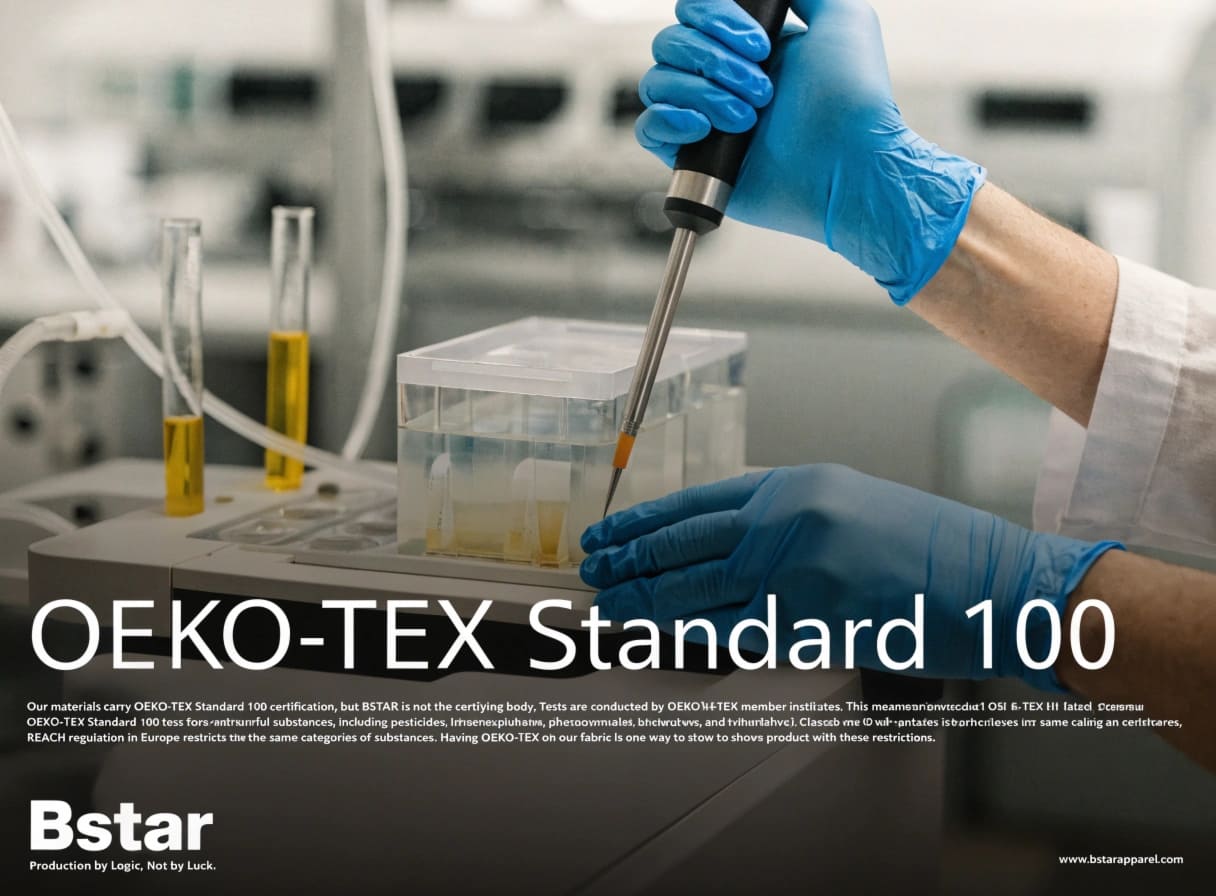
This distinction matters a lot in practice. When a buyer puts OEKO-TEX Standard 100 on their product page or hang tag, they are making a chemical safety claim — not an environmental one. If you’re selling into EU markets, that claim has regulatory teeth. REACH regulation in Europe restricts the same categories of substances1. Having OEKO-TEX Standard 100 on your fabric is one way to show your product aligns with those restrictions.
What Is Actually Tested?
According to OEKO-TEX’s official documentation, the standard tests for over 100 harmful substances2. Here’s a simplified breakdown:
| Substance Category | Why It Matters |
|---|---|
| Pesticides & herbicides | Residues from raw fiber production |
| Heavy metals (e.g., lead, cadmium) | Common in dyes and finishing agents |
| Formaldehyde | Used in wrinkle-resistant treatments |
| pH value | Skin irritation risk from extreme acidity/alkalinity |
| Allergenic dyes | Sensitization risk for end consumers |
| Plasticizers (e.g., phthalates) | Common in prints and coatings |
One thing we want to be clear about: BSTAR’s materials carry OEKO-TEX Standard 100 certification, but we are not the certifying body. The tests are done by accredited OEKO-TEX member institutes. What we can confirm is that the specific fabrics we use have passed those tests — and we can show you the certificate to prove it.
The important takeaway for sourcing decisions: when a supplier says "we have OEKO-TEX," your follow-up question should always be "which article, and what class?" Because the class changes everything.
What Are the Four Product Classes?
Here’s something most buyers don’t know until something goes wrong.
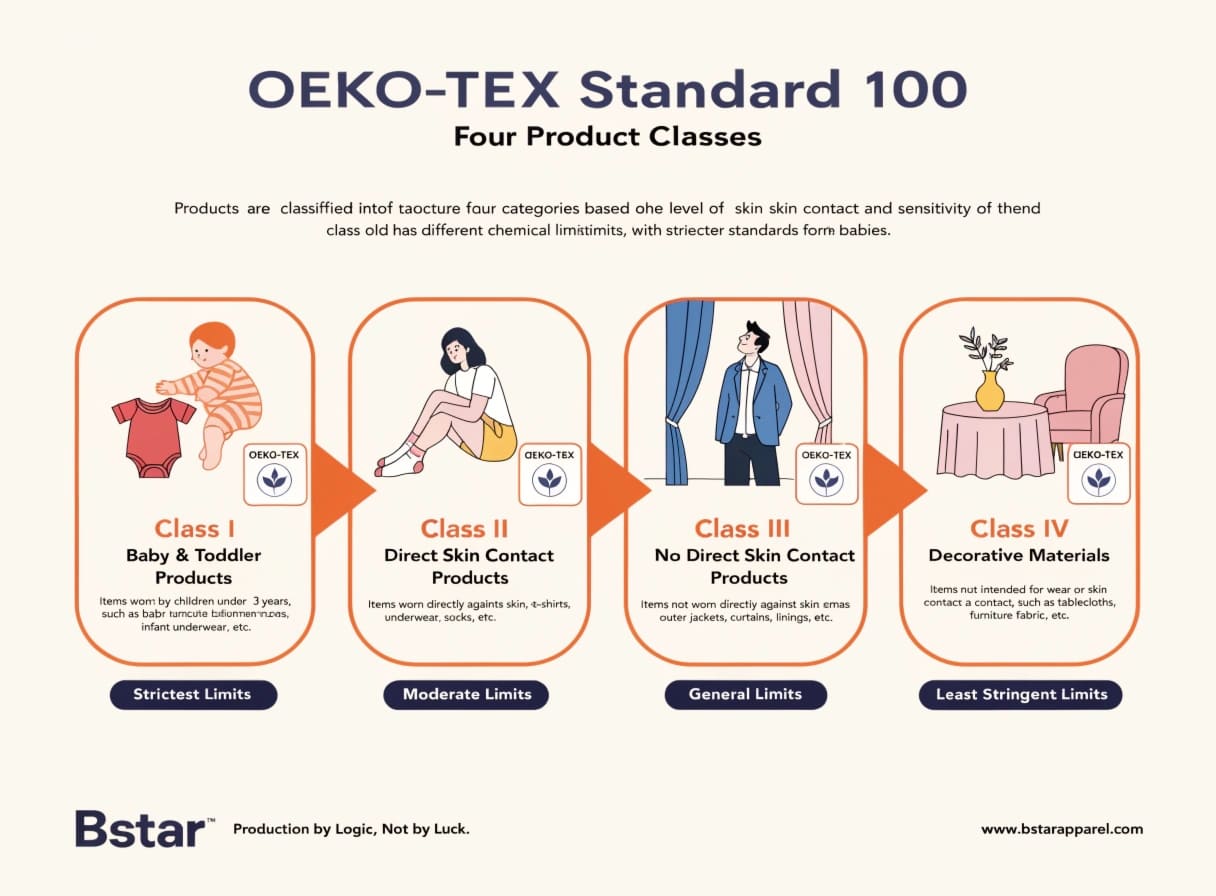
OEKO-TEX Standard 100 has four product classes, and the strictness of each depends on how much skin contact the product has and how sensitive the end user is. Baby products face the strictest limits. Products with no direct skin contact face the loosest. Buying Class IV fabric for a baby bodysuit is a compliance failure waiting to happen.
This is one of the most practical things to understand before you place an order.
The Four Classes at a Glance
| Class | Who It’s For | Example Products |
|---|---|---|
| Class I | Babies and toddlers under 36 months | Baby bodysuits, infant underwear |
| Class II | Products with direct skin contact | T-shirts, underwear, socks |
| Class III | Products with no direct skin contact | Outer jackets, curtains, linings |
| Class IV | Decorative materials | Tablecloths, furniture fabric |
The limits for Class I are significantly tighter than for Class III. For example, formaldehyde limits for baby products are far lower than for outerwear3.
When we work with DTC brands on new styles, this is one of the first questions we ask: who is the end user, and where on the body does this garment sit? That determines which class your material needs to be certified under. If your supplier doesn’t ask you this question — or if they just hand you a generic OEKO-TEX certificate without specifying the class — that’s a gap in your compliance coverage, not a green light.
A practical rule: always match the certified class to your product use case. Don’t assume that "OEKO-TEX certified" on any fabric covers any product.
What Changed in the 2025/2026 Updates?
Certifications don’t stay static, and OEKO-TEX Standard 100 updates its criteria every two years4. If you’re sourcing now, the 2025/2026 version is what applies.
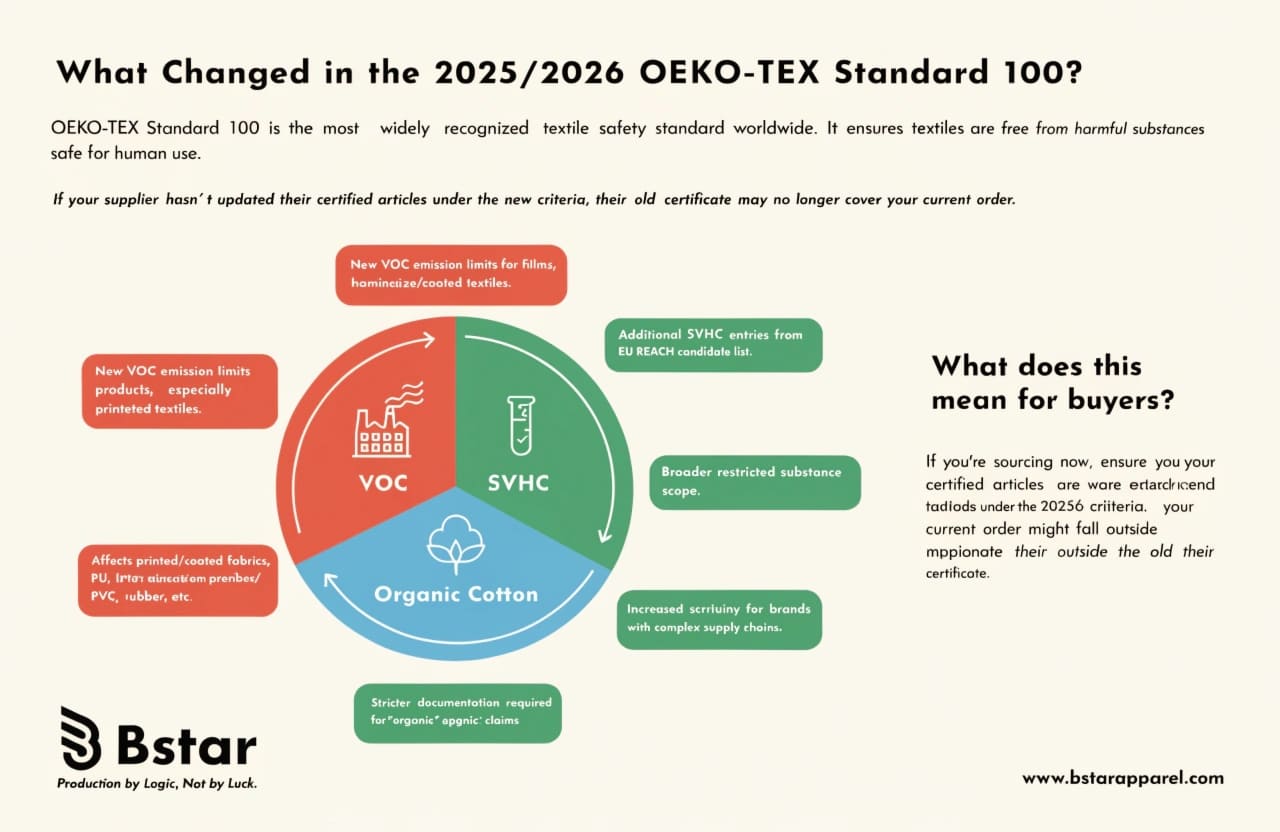
The 2025/2026 OEKO-TEX Standard 100 updates introduce new VOC (volatile organic compound) emission limits5, additional SVHC (substances of very high concern) entries from the EU REACH candidate list6, and revised requirements for products claiming organic cotton content. If your supplier hasn’t updated their certified articles under the new criteria, their old certificate may no longer cover your current order.
Here’s what that means for you practically:
Key 2025/2026 Changes Summary
| Update Area | What Changed | Buyer Impact |
|---|---|---|
| VOC limits | New emission thresholds added for finished products | Affects printed and coated fabrics |
| SVHC additions | New chemicals added from EU REACH candidate list | Broader restricted substance scope |
| Organic cotton claims | Stricter documentation required for "organic" labeling on certified products | Can’t just state organic content without supporting proof |
The organic cotton change is worth noting in particular. We’ve had buyers ask us to print "made with organic cotton" on their hang tags because the fabric has an OEKO-TEX Standard 100 certificate. That’s not the right move. OEKO-TEX Standard 100 certifies chemical safety. If you want to make an organic fiber claim, you need GOTS certification — which is a completely different standard that covers fiber origin and processing.
This brings up a confusion we see regularly: buyers conflating OEKO-TEX Standard 100 with GOTS or GRS. GOTS is for organic fiber content7. GRS is for recycled material content8. OEKO-TEX Standard 100 is for chemical safety — regardless of whether the fiber is organic, recycled, or conventional. A product can be all three or just one. Know which claim you’re making before you put it on your label.
How Does OEKO-TEX Standard 100 Help Your Business?
Let’s get to what actually matters for your sourcing decision.
For DTC brands and traditional buyers selling into EU or North American markets, OEKO-TEX Standard 100 on your product reduces your exposure to regulatory action, platform delistings, and consumer complaints related to chemical safety. It also gives you a verifiable claim — one that can be checked by your customers through the OEKO-TEX Label Check database.
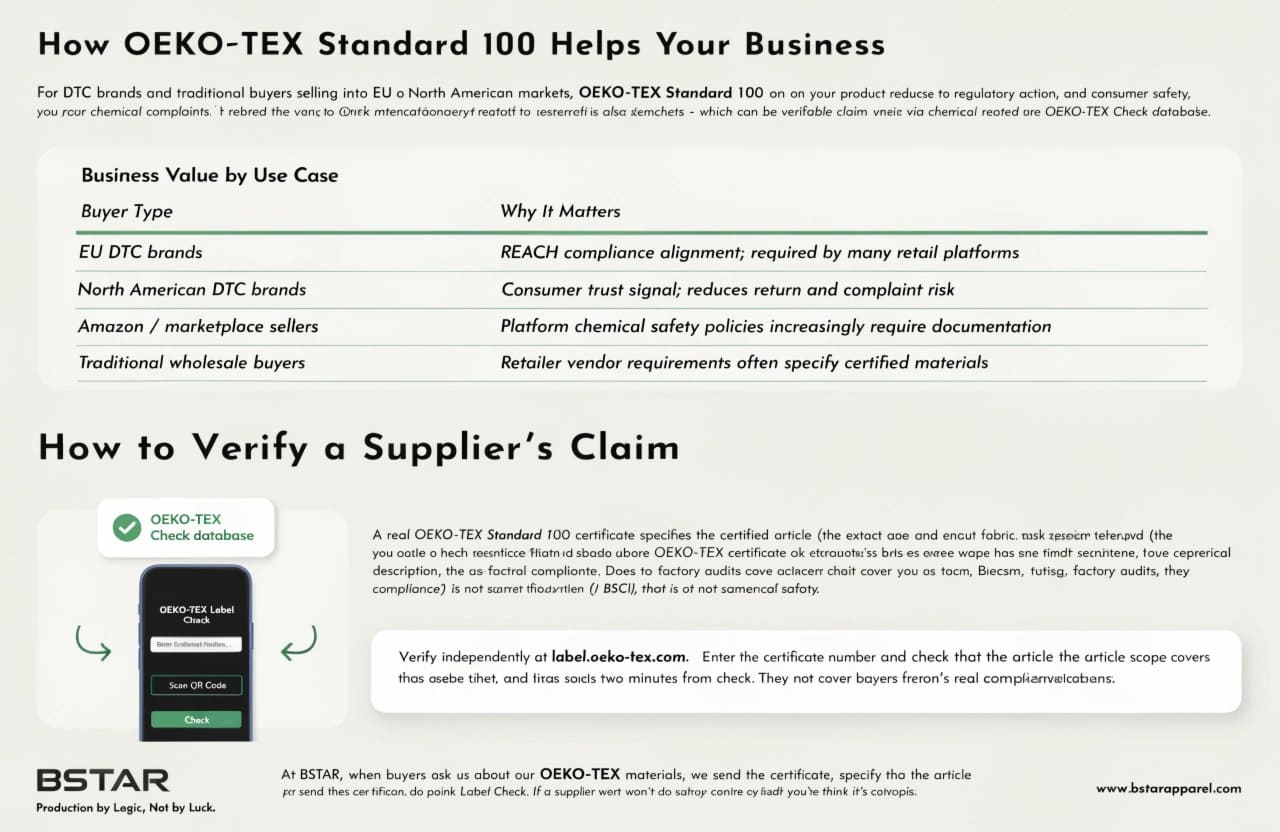
Here’s how we think about the business value from a supplier’s perspective:
Business Value by Use Case
| Buyer Type | Why It Matters |
|---|---|
| EU DTC brands | REACH compliance alignment; required by many retail platforms9 |
| North American DTC brands | Consumer trust signal; reduces return and complaint risk |
| Amazon / marketplace sellers | Platform chemical safety policies increasingly require documentation10 |
| Traditional wholesale buyers | Retailer vendor requirements often specify certified materials11 |
But the most important thing we want to leave you with is this: how to verify a supplier’s claim.
A real OEKO-TEX Standard 100 certificate specifies the certified article — meaning the exact fabric type or product category — and lists the certificate holder. When a supplier says they have OEKO-TEX certification, ask them to send the actual certificate. Look at the article description. Does it match what you’re ordering? If they show you a factory audit certificate — like a BSCI report — that is not the same thing. Factory audits cover social compliance. They do not cover fabric chemical safety.12
You can also verify independently at the OEKO-TEX Label Check database (label.oeko-tex.com). Enter the certificate number and check that the article scope covers your product. This takes two minutes and has saved buyers from real compliance problems.
At BSTAR, when buyers ask us about our OEKO-TEX materials, we send the certificate, specify the article, and point them to Label Check. If a supplier won’t do that, the certificate probably isn’t covering what you think it’s covering.
Conclusion
OEKO-TEX Standard 100 certifies chemical safety on specific materials — not factories, not brands. Know your product class, verify the certificate scope, and don’t confuse it with GOTS or GRS.
-
"EU REACH – International Trade Administration", https://www.trade.gov/eu-reach. The EU REACH regulation establishes restrictions on substances of very high concern (SVHC) including heavy metals, phthalates, and other chemical categories, though the specific testing protocols and limit values may differ from private certification standards. Evidence role: general_support; source type: government. Supports: REACH regulation’s scope of restricted substance categories. Scope note: This source confirms REACH’s substance categories but does not directly verify complete alignment with OEKO-TEX Standard 100’s testing scope ↩
-
"OEKO-TEX® STANDARD 100", https://www.oeko-tex.com/en/our-standards/oeko-tex-standard-100/. According to OEKO-TEX Association documentation, Standard 100 testing criteria encompass several hundred parameters across multiple substance classes, with the exact number varying by product class and annual updates. Evidence role: statistic; source type: institution. Supports: The number of substances tested under OEKO-TEX Standard 100. ↩
-
"[PDF] FORMALDEHYDE EXPOSURE RISK ASSESSMENT FOR", https://chemview.epa.gov/chemview/proxy?filename=09022526804d2203_50-00-0%20-%2017%20(Public).pdf. OEKO-TEX Standard 100 establishes product class-specific limit values, with Class I (baby products) requiring significantly lower formaldehyde content thresholds than Class III (non-skin-contact products), reflecting increased safety requirements for vulnerable populations. Evidence role: statistic; source type: institution. Supports: Differential formaldehyde limits across OEKO-TEX product classes. ↩
-
"OEKO-TEX® New Regulations 2026 – Hohenstein", https://www.hohenstein.us/en-us/oeko-tex/annual-updates. OEKO-TEX Association regularly updates Standard 100 criteria to incorporate new scientific findings and regulatory developments, with major revisions typically occurring on an annual or biennial basis. Evidence role: general_support; source type: institution. Supports: OEKO-TEX Standard 100’s regular update schedule. Scope note: This confirms regular updates but the exact cycle may vary based on regulatory changes and scientific developments ↩
-
"Standard updates per 06.10.2025 – Oeko-Tex", https://www.oeko-tex.com/en/news/infocenter/standard-updates-per-06102025/. Recent OEKO-TEX Standard 100 updates have incorporated expanded testing for volatile organic compounds and emissions, reflecting growing regulatory attention to indoor air quality and chemical emissions from textile products. Evidence role: general_support; source type: institution. Supports: VOC-related updates in recent OEKO-TEX Standard 100 revisions. Scope note: This confirms the general direction of updates but specific 2025/2026 version details should be verified from official release notes ↩
-
"Candidate List of substances of very high concern – ECHA CHEM", https://chem.echa.europa.eu/obligation-lists/candidateList. The European Chemicals Agency regularly updates the REACH candidate list of substances of very high concern, which serves as a reference for various product safety standards including textile certifications, though adoption timelines may vary by certification body. Evidence role: general_support; source type: government. Supports: REACH candidate list updates that inform textile testing standards. Scope note: This confirms REACH list updates but does not directly verify their incorporation into specific OEKO-TEX Standard 100 versions ↩
-
"Fibre Producers – Global Organic Textile Standard", https://global-standard.org/certification-and-labelling/audits?view=article&id=1284:fibre-producers&catid=84. The Global Organic Textile Standard (GOTS) certifies organic fiber content and processing methods throughout the textile supply chain, requiring minimum organic fiber thresholds and compliance with environmental and social criteria. Evidence role: definition; source type: institution. Supports: GOTS certification’s focus on organic fiber content and processing. ↩
-
"Recycled Claim Standard (RCS) + Global Recycled Standard (GRS)", https://textileexchange.org/recycled-claim-global-recycled-standard/. The Global Recycled Standard (GRS) verifies recycled content in products and tracks materials through the supply chain, requiring minimum recycled material thresholds and compliance with environmental and social processing criteria. Evidence role: definition; source type: institution. Supports: GRS certification’s focus on recycled material content. ↩
-
"Textile Safety in the EU & UK – Fibres & Apparel Compliance", https://euverify.com/resource/textile-safety-eu-uk-fibres-and-apparel/. Major e-commerce platforms and retailers increasingly require suppliers to demonstrate chemical safety compliance through recognized certifications or test reports, particularly for products sold in EU markets where REACH regulation applies. Evidence role: general_support; source type: other. Supports: Retail platform chemical safety requirements for textile products. Scope note: This confirms the general trend but specific platform requirements vary and should be verified individually ↩
-
"Online Sellers’ Safety Guide | CPSC.gov", https://www.cpsc.gov/Business–Manufacturing/Online-Sellers-Safety-Guide. E-commerce platforms have expanded product safety requirements in recent years, with several major marketplaces implementing policies requiring chemical safety documentation for textile and apparel products, particularly following regulatory developments in key markets. Evidence role: general_support; source type: other. Supports: Increasing chemical safety documentation requirements on e-commerce platforms. Scope note: This confirms the directional trend but specific requirements and implementation timelines vary by platform and product category ↩
-
"[PDF] Apparel and Household Textiles Compliance Requirements", https://nvlpubs.nist.gov/nistpubs/ir/2021/NIST.IR.8115r1-upd.pdf. Major apparel and textile retailers have established vendor compliance programs that often include requirements for chemical safety certifications or testing documentation, driven by regulatory obligations and corporate responsibility commitments. Evidence role: general_support; source type: other. Supports: Retailer vendor requirements for material certifications. Scope note: This confirms the general practice but specific requirements vary significantly by retailer, product category, and target market ↩
-
"amfori Business Social Compliance Initiative Social Audit Program …", https://www.ul.com/services/amfori-business-social-compliance-initiative-social-audit-program-ul-solutions. Social compliance audits such as BSCI assess factory working conditions, labor practices, and management systems, while product-level chemical safety requires separate testing and certification of materials against substance restrictions. Evidence role: definition; source type: other. Supports: The scope distinction between social compliance audits and product chemical testing. ↩