
Recycled Fabric Underwear: Should You Use RPET or Recycled Nylon?
Sustainable underwear sounds simple — until you’re staring at a fabric quote that’s 40% higher than expected and wondering if your launch margin still makes sense.
RPET and recycled nylon are both used in sustainable underwear, but they are not interchangeable. Recycled nylon delivers better stretch, softness, and durability for intimate apparel. RPET costs less but requires careful blend management to meet consumer comfort expectations. Your choice depends on which you’re optimizing for: margin or product experience.
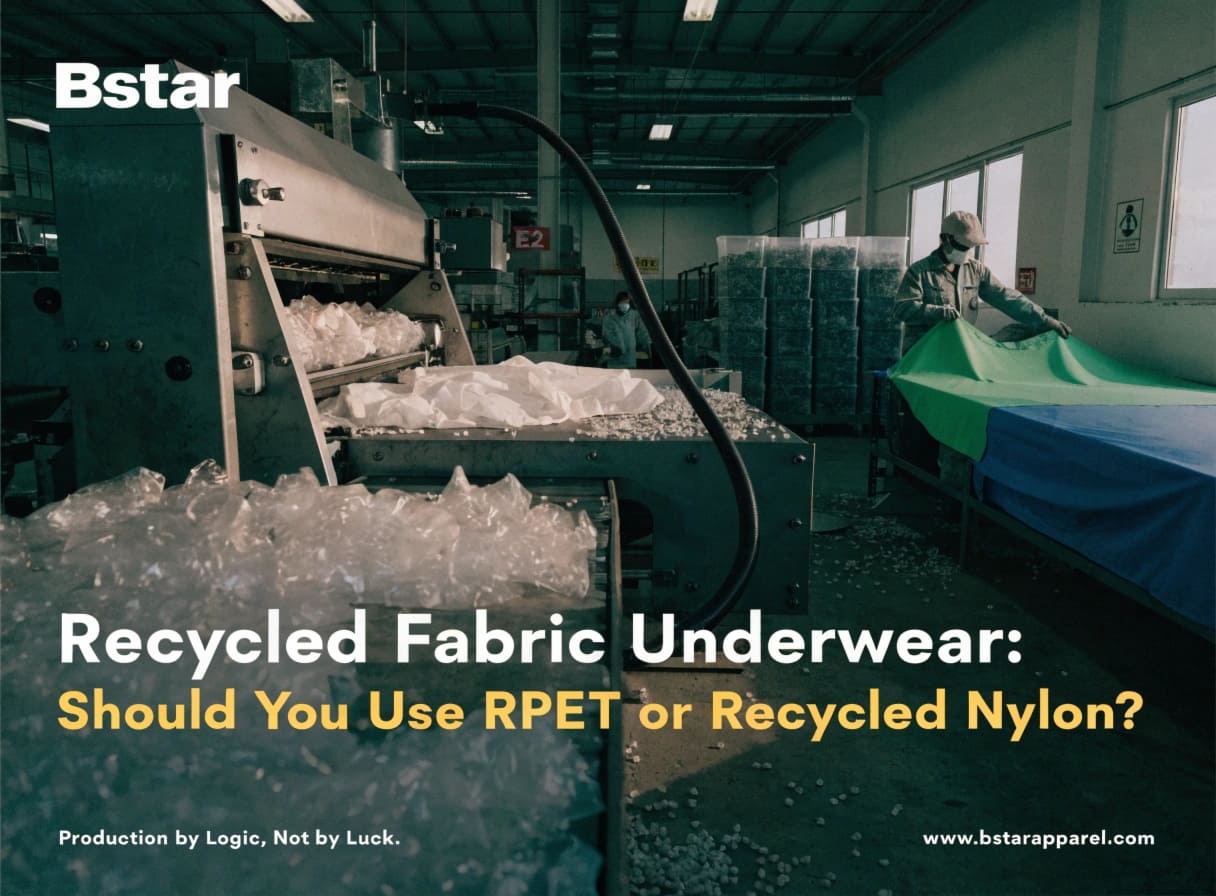
We’ve been producing knit underwear at our factory in Zhongshan for 19 years. In the last several years, recycled fabric briefs, boyshorts, and bralettes have become a real part of our production floor — not a niche request. What we see again and again is that DTC brands come in with good sustainability intentions but without a clear framework for making the actual sourcing decision. This article is that framework.
Sourcing Sustainable Fibers: What’s the Real Difference Between RPET and Recycled Nylon?
Most brand founders treat RPET and recycled nylon as two versions of the same thing. They’re not.
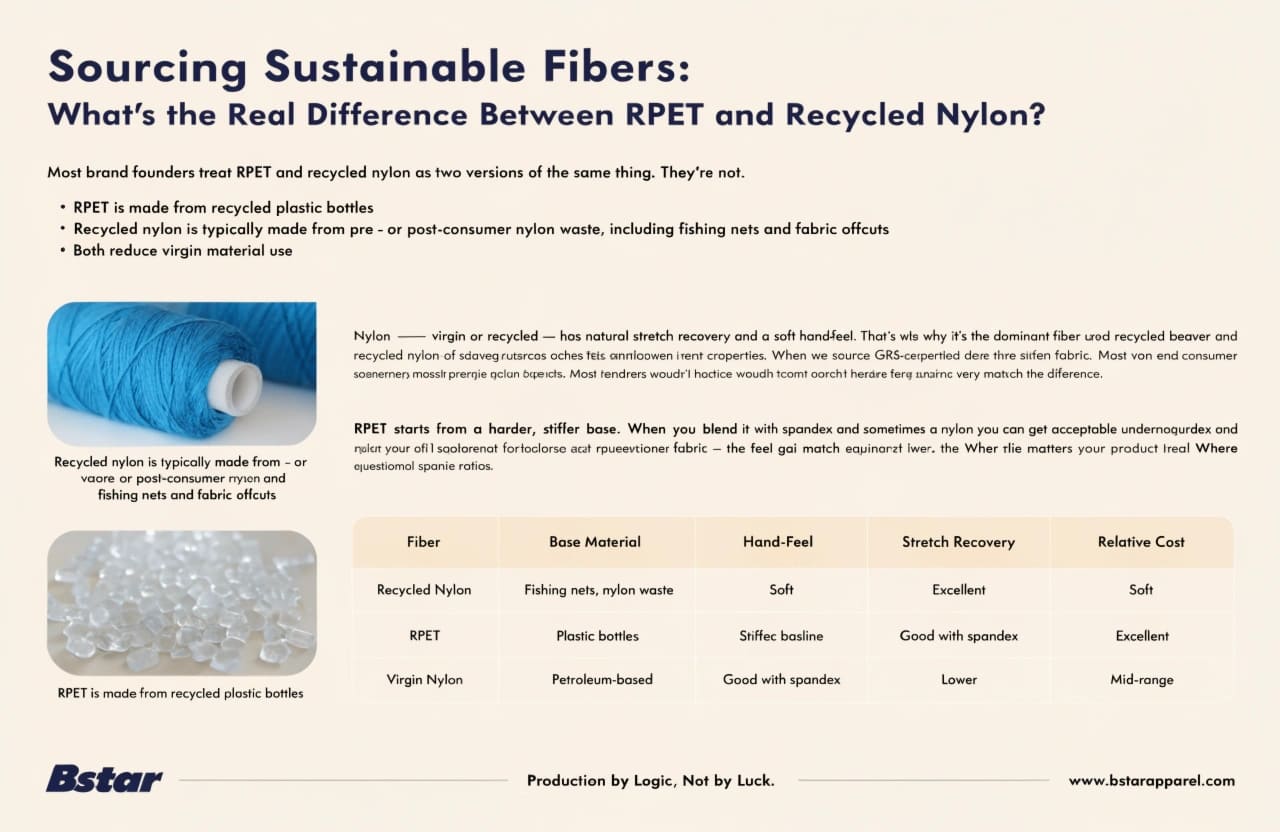
RPET is made from recycled plastic bottles.1 Recycled nylon is typically made from pre- or post-consumer nylon waste, including fishing nets and fabric offcuts.2 Both reduce virgin material use, but they behave very differently in underwear applications because the base fiber properties are fundamentally different.
Here’s what that means on the production floor.
Nylon — virgin or recycled — has natural stretch recovery and a soft hand-feel. That’s why it’s the dominant fiber in performance underwear and intimates.3 Recycled nylon preserves most of those properties. When we source GRS-certified recycled nylon yarn for clients, the finished fabric behaves very close to conventional nylon. Most end consumers wouldn’t notice the difference.
RPET starts from a harder, stiffer base.4 When you blend it with spandex and sometimes a share of nylon, you can get acceptable underwear fabric — but the softness and stretch recovery don’t match recycled nylon at equivalent spandex ratios. The feel gap is real. Whether it matters depends entirely on your product and your customer.
| Fiber | Base Material | Hand-Feel | Stretch Recovery | Relative Cost |
|---|---|---|---|---|
| Recycled Nylon | Fishing nets, nylon waste | Soft | Excellent | Higher |
| RPET | Plastic bottles | Stiffer baseline | Good with spandex | Lower |
| Virgin Nylon | Petroleum-based | Soft | Excellent | Mid-range |
The brands we work with who are selling into quality-focused European markets — the Netherlands, Germany, Scandinavia — almost always end up on recycled nylon once they’ve handled sample swatches. The brands with tighter retail price points or margin constraints often start with RPET blends. Both are valid starting points. Neither should be chosen by default.
Blend ratio is not a detail. It is the decision.
In recycled underwear fabric, the ratio of RPET or recycled nylon to spandex — and sometimes to each other — directly controls how the finished garment stretches, recovers, and feels against skin. A 40% RPET / 60% nylon blend performs very differently from an 80% RPET / 20% nylon blend. Brands must define their performance requirements before a manufacturer can recommend a ratio.
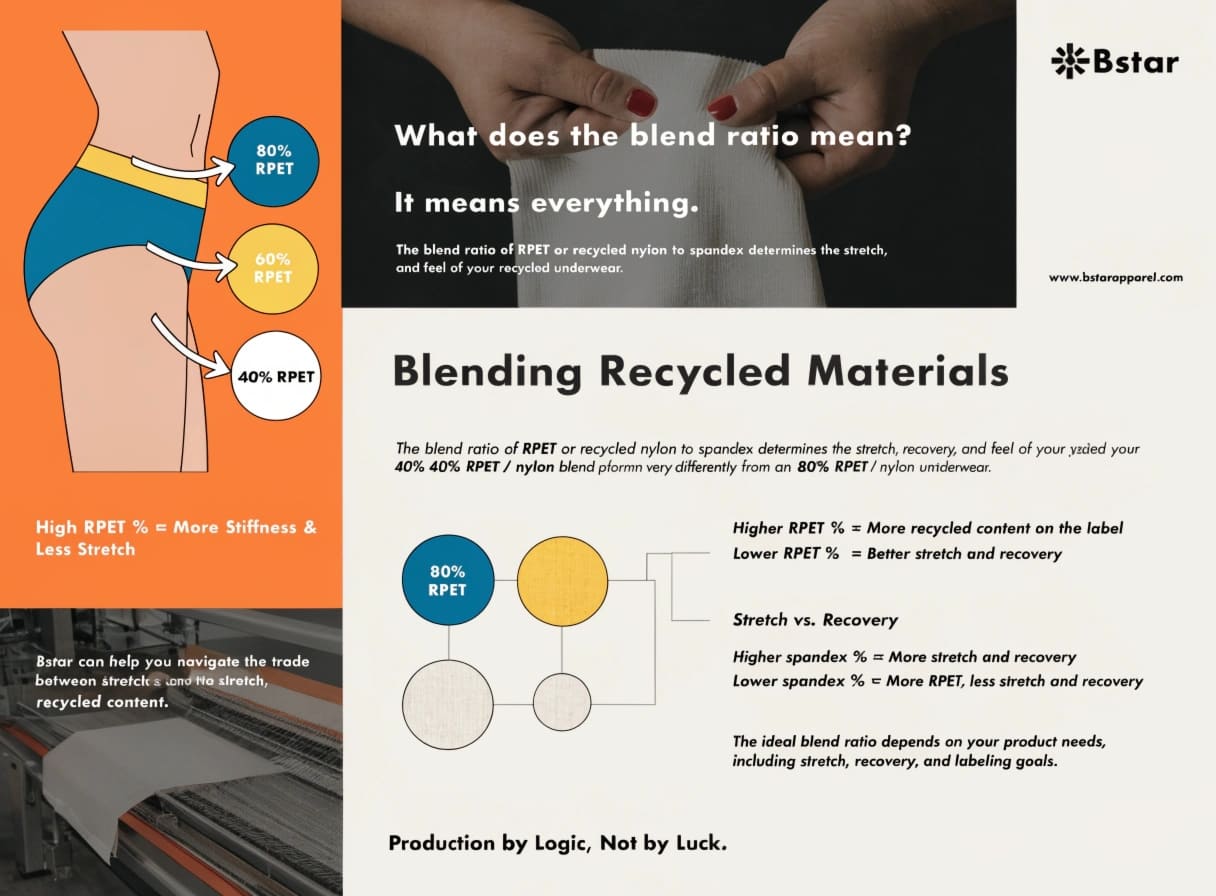
Think of the blend ratio as a dial, not a switch. The higher you push the RPET content, the more you’re trading softness and stretch for cost savings and a higher recycled material percentage on your hang tag.
Here’s where brands get into trouble. A founder decides they want "80% recycled content" because it sounds better in marketing copy. They brief the factory with that number. The factory produces samples. The samples come back and the stretch is noticeably stiffer. Then begins the back-and-forth that delays the launch by months.
We’ve adjusted blend ratios mid-sampling more times than I can count. A typical example: a client briefed us on a high-waist brief that needed four-way stretch for an active-to-casual positioning. Their initial brief called for high RPET content. After stretch testing, we recommended pulling the RPET ratio down and increasing nylon content to meet the recovery spec. The final fabric hit the performance target, but the recycled content percentage on the label dropped. The brand had to decide which number mattered more to their customer.
What to consider before choosing your blend:
- End use and fit: High-compression styles need better recovery. Looser-fit styles tolerate higher RPET ratios.
- Spandex percentage: Typically 10–20% in underwear. Higher spandex helps compensate for RPET stiffness, but adds cost and affects recyclability at end-of-life.
- Labeling intentions: If your marketing leads with recycled content percentage, your blend ratio locks in that claim. Know what you’re committing to before sampling.
Do not let the blend ratio be chosen by default. It is the most important single decision in recycled underwear development.
Overcoming Dyeing Challenges: Why Recycled Synthetics Are Harder to Color Than You Think?
Color is where many brands get their first surprise in recycled fabric production.
Recycled synthetic yarns — both RPET and recycled nylon — absorb dye less evenly than virgin fibers due to inconsistencies in the recycled input material.5 This makes achieving consistent, vibrant colors and strong colorfastness harder and sometimes more expensive than brands expect.
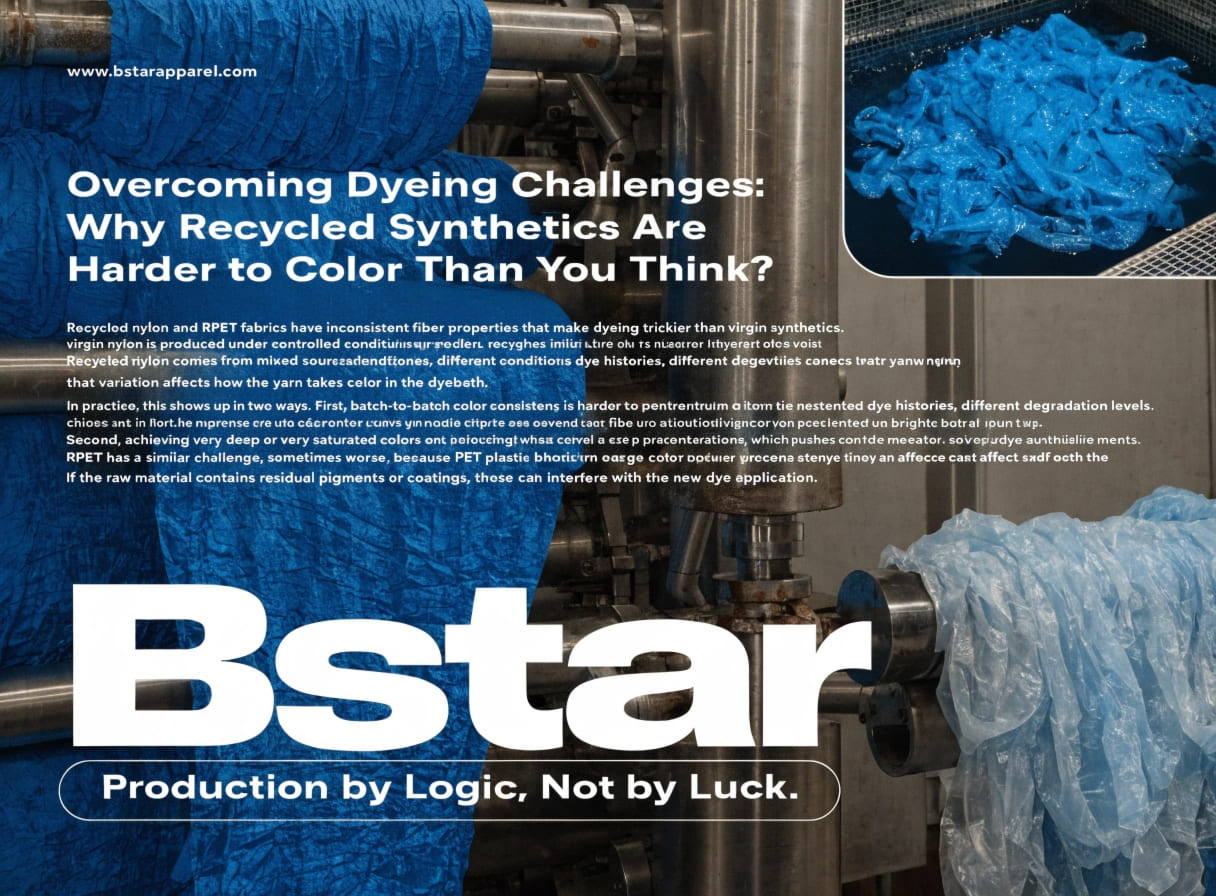
Virgin nylon is produced under controlled conditions. The fiber structure is uniform. Dye penetrates evenly. Recycled nylon comes from mixed sources — different grades, different previous dye histories, different degradation levels. That variation affects how the yarn takes color in the dyebath.
In practice, this shows up in two ways. First, batch-to-batch color consistency is harder to control6. A bright cobalt blue from one production run may come out slightly different in the next run if the recycled yarn input has shifted. Second, achieving very deep or very saturated colors often requires higher dye concentrations, which pushes up processing cost and can affect colorfastness ratings7.
RPET has a similar challenge, sometimes worse, because PET plastic bottles carry a range of colorants and surface treatments from their previous life.
How we manage this in production:
| Challenge | Our Approach |
|---|---|
| Batch color variation | Source yarn from consistent certified suppliers; require dye lot documentation |
| Low dye uptake | Adjust dyeing temperature and time protocols for recycled fiber specs |
| Colorfastness | Run additional wash and rub fastness testing before bulk approval |
| Deep color requests | Flag upfront that dark/saturated colors carry a higher rejection risk |
The practical advice for brands: if your line relies on a very specific, consistent color story — especially dark or bright tones — build extra sampling rounds into your timeline. And tell your factory the colorway plan before fabric is sourced, not after.
Verifying Authenticity: What Does GRS Certification Actually Tell You?
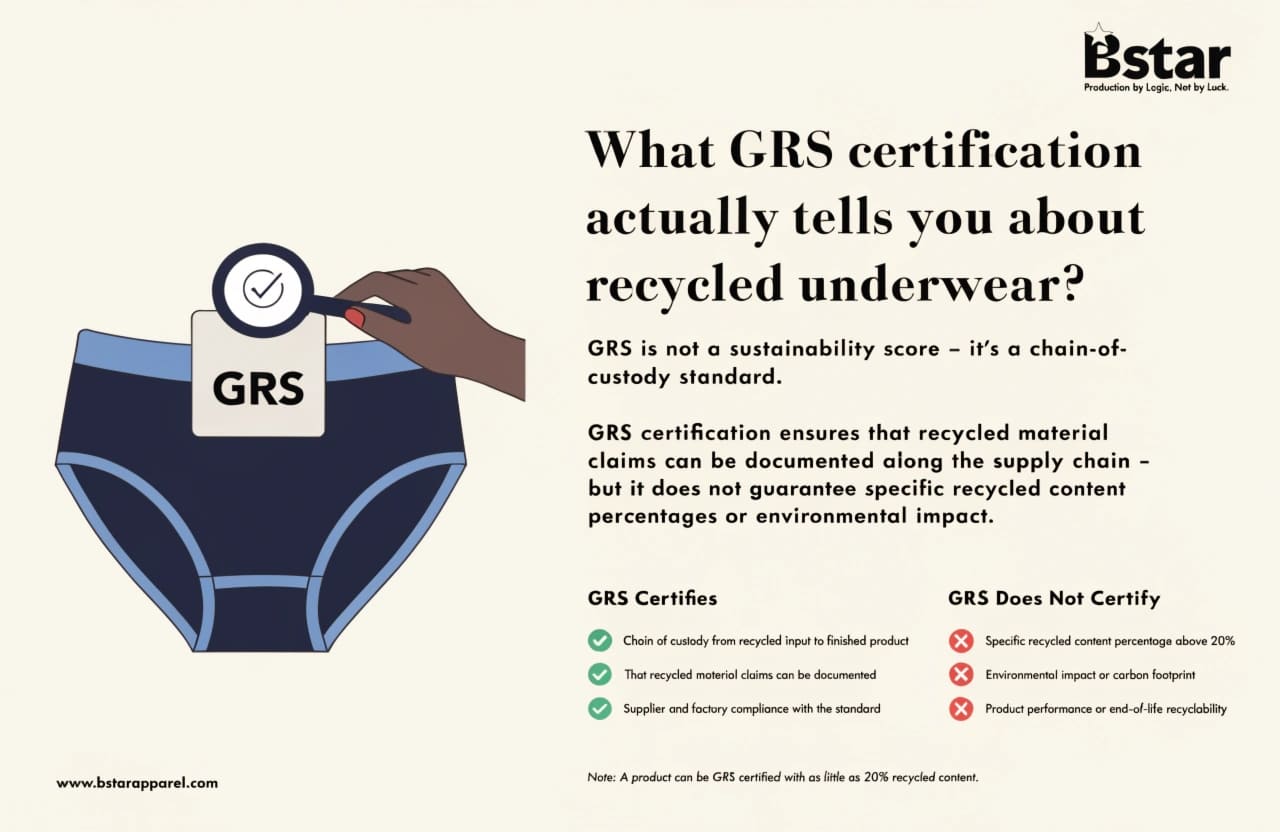
GRS is not a sustainability score. It is a chain-of-custody standard.
GRS (Global Recycled Standard) certifies that recycled content has been tracked through the supply chain from input material to finished product.8 It does not certify a minimum recycled content percentage beyond 20%, and it does not measure environmental impact. Brands should understand exactly what GRS communicates before using it as a primary marketing claim.
We hold GRS certification at our factory and we source GRS-certified yarn from our suppliers. I’m not saying GRS is meaningless — it isn’t. Proper chain-of-custody documentation is genuinely hard to maintain and genuinely valuable for import compliance and B2B credibility.
But here’s the part that surprises many of our European brand partners when we walk through it together: a product can carry GRS certification with only 20% recycled content9. A garment marketed as "GRS certified sustainable" might be 80% virgin fiber. That’s technically compliant. But in markets like the Netherlands or Germany, where regulatory scrutiny on green claims is increasing under the EU Green Claims Directive10, leading with "GRS certified" without qualifying it is a real reputational and compliance risk.
What GRS certifies vs. what it doesn’t:
| GRS Certifies | GRS Does Not Certify |
|---|---|
| Chain of custody from recycled input to finished product | Specific recycled content percentage above 20% |
| That recycled material claims can be documented | Environmental impact or carbon footprint |
| Supplier and factory compliance with the standard | Product performance or end-of-life recyclability |
Our recommendation to brands: use GRS as your supply chain verification baseline, not your consumer-facing headline. State your actual recycled content percentage clearly. That number — whether it’s 40% or 80% — is more honest and more defensible than the certification label alone.
Also: verify the recycled content percentage with your yarn supplier directly. Ask for the test reports behind the claim. We do this as standard practice when we source certified yarn. Brands should expect their manufacturers to do the same.
Conclusion
RPET and recycled nylon are not the same choice. Pick your fiber based on performance requirements, not sustainability optics — then verify every claim with documentation you can defend.
-
"PET bottle recycling – Wikipedia", https://en.wikipedia.org/wiki/PET_bottle_recycling. Post-consumer PET beverage bottles are the predominant feedstock for recycled polyester (RPET) fiber production; the process involves collection, sorting, cleaning, and either mechanical or chemical depolymerization of PET bottles into fiber or pellets suitable for textile manufacturing, as documented by organizations such as Textile Exchange in their Preferred Fiber and Materials Market Report. Evidence role: general_support; source type: institution. Supports: That RPET textile fiber is primarily produced by mechanically or chemically recycling post-consumer PET plastic bottles into polyester fiber.. ↩
-
"Challenges and Opportunities for Recycled Polyethylene Fishing Nets", https://pmc.ncbi.nlm.nih.gov/articles/PMC8470735/. Industry and lifecycle assessment sources confirm that discarded fishing nets and nylon fabric offcuts are among the primary feedstocks used in commercial recycled nylon (polyamide) yarn production, as documented by organizations such as the Aquafil Group and referenced in sustainability reports on ocean plastic recovery programs. Evidence role: general_support; source type: institution. Supports: That fishing nets and pre/post-consumer nylon waste are established feedstocks for recycled nylon yarn production.. Scope note: Proportional data on the share of fishing nets versus other nylon waste streams in total recycled nylon production is not consistently published and may vary by supplier. ↩
-
"Nylon Stretch – Brookwood Companies Inc", https://brookwoodcompanies.com/2022/05/nylon-stretch/?srsltid=AfmBOoqJxmOT_wX9CgLGEJZcNt4D4M-SJkOwhqYRnQXoTuxZYPmqve8l. Nylon (polyamide) fibers are widely documented for their high tensile strength, elasticity, and smooth texture, properties that have made them a standard material in hosiery, intimate apparel, and activewear; see, e.g., relevant entries in textile science references such as the Textile Institute’s fiber classification resources. Evidence role: general_support; source type: encyclopedia. Supports: Nylon’s mechanical properties, including elasticity and soft hand-feel, and its prevalence in intimate apparel and performance textiles.. Scope note: General fiber property sources may not quantify nylon’s specific market share in the underwear segment, making this general support rather than direct proof of market dominance. ↩
-
"Spinning and Tactile Hand/Wear Comfort Characteristics of PET/Co …", https://pmc.ncbi.nlm.nih.gov/articles/PMC12654387/. PET fibers exhibit a higher initial modulus than polyamide fibers, contributing to a stiffer hand-feel in fabrics; this distinction is documented in fiber science literature comparing synthetic polymer mechanical properties (see, e.g., Morton & Hearle, Physical Properties of Textile Fibres). Evidence role: mechanism; source type: paper. Supports: The comparative mechanical properties of PET (polyethylene terephthalate) and polyamide fibers, specifically differences in modulus and hand-feel.. Scope note: Most primary sources address virgin PET and virgin nylon; direct comparative data for recycled variants may be limited in published literature. ↩
-
"Analyzing different functional and dyeing performance of natural …", https://pmc.ncbi.nlm.nih.gov/articles/PMC11616555/. Research on the dyeing of recycled polyester and polyamide fibers indicates that heterogeneity in molecular weight distribution and surface morphology—resulting from varied feedstock histories—contributes to uneven dye diffusion and reduced reproducibility compared to virgin fiber dyeing (see textile chemistry literature on recycled fiber dyeing, e.g., Journal of Applied Polymer Science). Evidence role: mechanism; source type: paper. Supports: That variability in recycled synthetic fiber structure and prior processing history leads to less uniform dye uptake compared to virgin fibers produced under controlled conditions.. Scope note: Specific published studies on this effect vary in scope; findings may be feedstock- and process-specific rather than universally applicable to all recycled synthetic yarns. ↩
-
"Social Fabric: Land, Labor, and the World the Textile Industry Created", https://exhibits.library.cornell.edu/social-fabric-land-labor-and-the-world-the-textile-industry-created/feature/dyeing-production. Industry quality standards bodies, including the American Association of Textile Chemists and Colorists (AATCC) and ISO technical committees, have developed color consistency testing protocols that are particularly relevant for recycled fiber applications, where feedstock variability is a recognized source of inter-lot color deviation. Evidence role: general_support; source type: institution. Supports: That recycled synthetic fiber production introduces greater lot-to-lot color variation than virgin fiber production due to feedstock variability.. Scope note: This citation supports the existence of the problem through the existence of relevant testing standards rather than providing direct experimental data quantifying the magnitude of color variation in recycled versus virgin fiber production. ↩
-
"Dyeing Properties, Color Gamut, and Color Evaluation of Cotton …", https://pmc.ncbi.nlm.nih.gov/articles/PMC10005735/. In textile dyeing science, deep-shade dyeing at elevated dye concentrations is associated with increased surface dye deposition and aggregation, which can reduce wash and rub fastness performance; this phenomenon is documented in dye chemistry literature and is a recognized challenge in achieving ISO 105 colorfastness standards for dark colorways on synthetic substrates (see, e.g., Shore, Colorants and Auxiliaries, Society of Dyers and Colourists). Evidence role: mechanism; source type: paper. Supports: That applying higher dye concentrations to achieve deep or saturated shades can result in surface dye aggregation and reduced colorfastness in wash and rub fastness tests.. Scope note: The magnitude of the colorfastness reduction depends on the specific dye class, fiber type, and fixation process used, and may not apply uniformly across all recyc ↩
-
"Recycled Claim Standard (RCS) + Global Recycled Standard (GRS)", https://textileexchange.org/recycled-claim-global-recycled-standard/. The Global Recycled Standard (GRS), administered by Textile Exchange, is defined as a chain-of-custody certification standard that verifies the recycled content of products and tracks that content from the source material through each stage of production to the final product (Textile Exchange, Global Recycled Standard, current version). Evidence role: definition; source type: institution. Supports: The GRS is a chain-of-custody standard administered by Textile Exchange that tracks recycled input materials through the supply chain to the finished product.. ↩
-
"Recycled Claim Standard (RCS) + Global Recycled Standard (GRS)", https://textileexchange.org/recycled-claim-global-recycled-standard/. According to the Global Recycled Standard published by Textile Exchange, products must contain a minimum of 20% recycled input material to be eligible for GRS certification, meaning certified products may contain up to 80% virgin material (Textile Exchange, GRS Standard, current version). Evidence role: statistic; source type: institution. Supports: That the GRS standard sets a minimum recycled content threshold of 20% for certification eligibility.. ↩
-
"Green claims – Environment – European Commission", https://environment.ec.europa.eu/topics/circular-economy-topics/green-claims_en. The European Commission’s proposed Green Claims Directive (COM/2023/166) establishes requirements for businesses to substantiate and verify explicit environmental claims before use, with the aim of reducing greenwashing across EU markets; the proposal was under legislative review as of 2024 (European Commission, Proposal for a Directive on Green Claims, 2023). Evidence role: historical_context; source type: government. Supports: The EU Green Claims Directive is a legislative initiative that imposes substantiation and verification requirements on environmental marketing claims made by businesses in EU member states.. Scope note: The directive was still progressing through the EU legislative process as of the article’s publication context; its final adopted form and enforcement timeline may differ from the proposal. ↩