
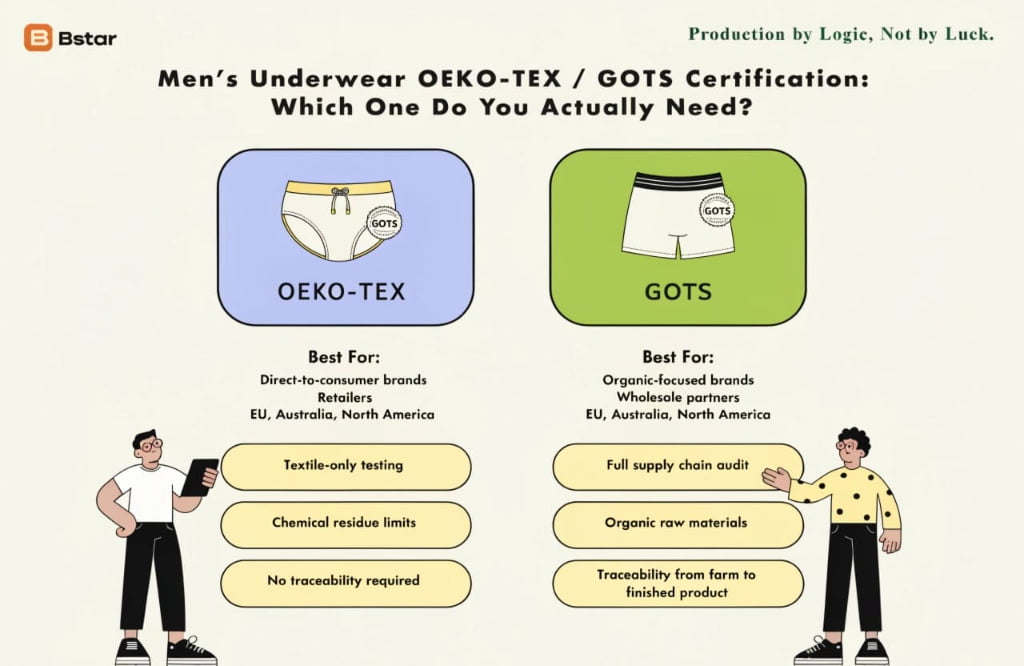
Men’s Underwear OEKO-TEX / GOTS Certification: Which One Do You Actually Need?
We talk to brand founders every week who come to us with the same question. They’ve decided to certify their men’s underwear line — but they’re not sure which certification to go after. Some have already picked one. A few have already ordered samples. And occasionally, someone has already printed packaging before realizing they chose the wrong path for their sales channel.
OEKO-TEX Standard 100 and GOTS are not interchangeable options. The right choice depends on two things before anything else: where you plan to sell, and what fiber you plan to use. Getting either of those wrong means wasted time and rework costs before your product ever reaches a customer.
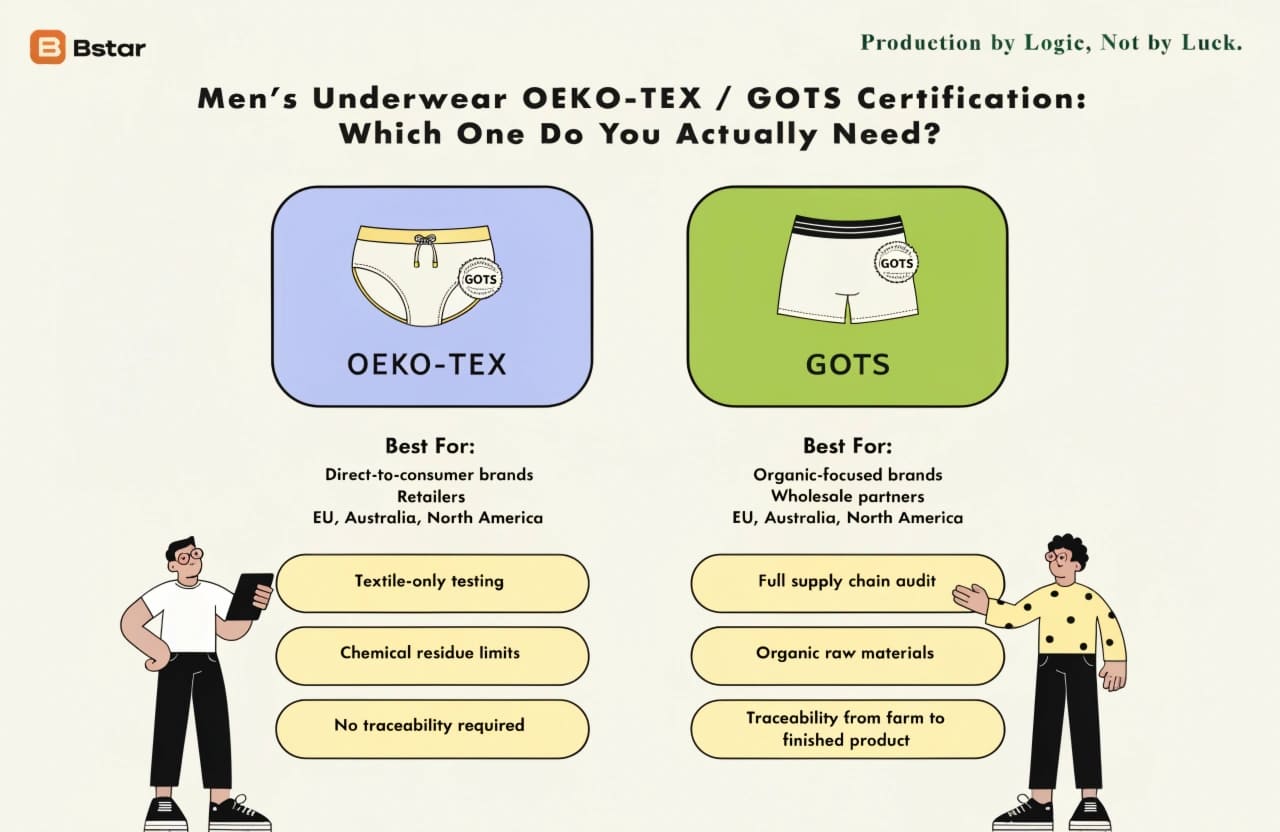
This post breaks down what each certification actually requires, where they differ structurally, and what you need to prepare if you’re manufacturing men’s underwear through a factory like ours. We work with DTC brands in the EU, Australia, and North America, and this question comes up in almost every certification conversation we have.
What Does OEKO-TEX Standard 100 Actually Test For?
A lot of buyers hear "OEKO-TEX" and assume it means the product is organic or sustainably made. It doesn’t. So what does it actually cover?
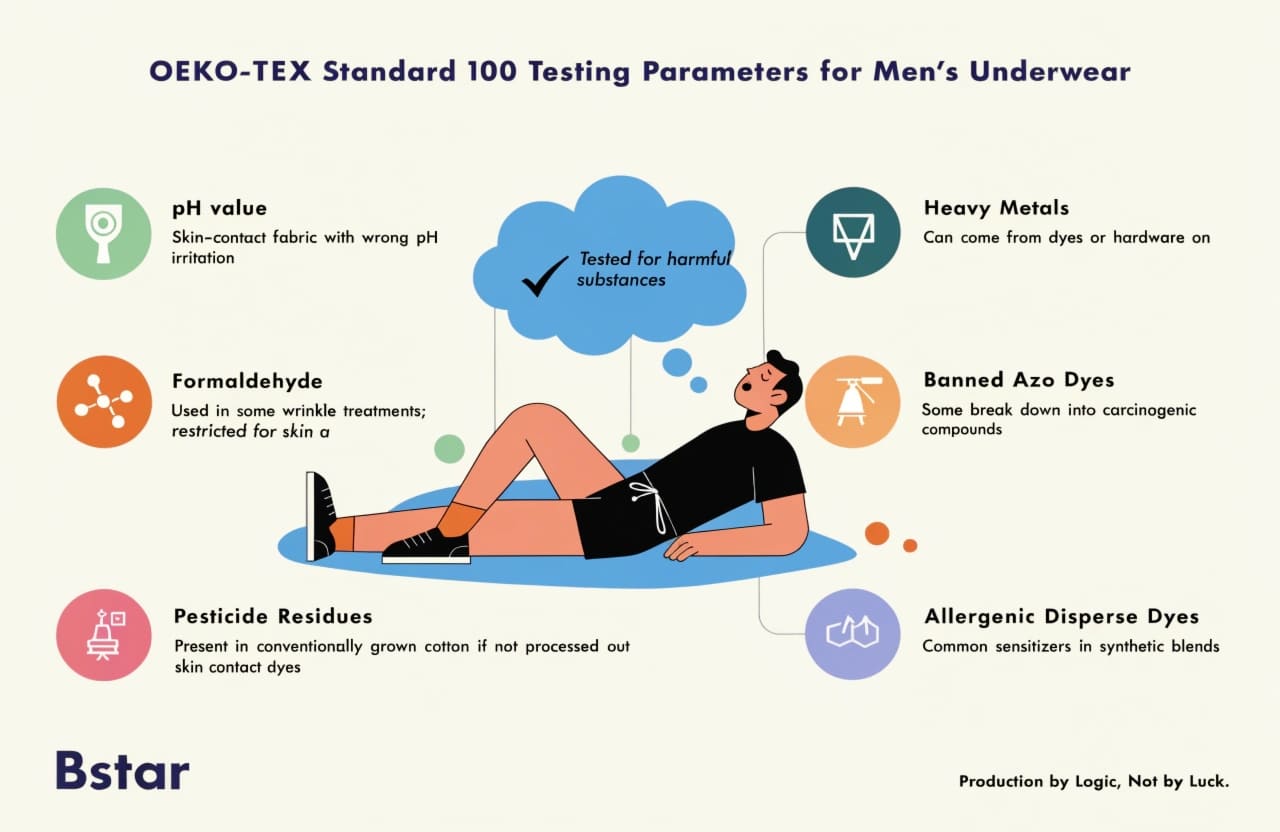
OEKO-TEX Standard 100 tests finished textile products for harmful substances. It covers over 100 parameters including pH value, formaldehyde, heavy metals, pesticide residues, and banned dyes.1 If a product passes, it can carry the label: "Tested for harmful substances."
For men’s underwear specifically, the certification applies Product Class I criteria — the strictest tier, because underwear sits directly against skin. This means the testing limits are tighter than for outerwear or home textiles.
What gets tested, and why does it matter for underwear?
Here’s what the testing covers in practical terms:
| Test Parameter | Why It Matters for Underwear |
|---|---|
| pH value | Skin-contact fabric with wrong pH causes irritation |
| Formaldehyde | Used in some wrinkle treatments; restricted for skin contact |
| Heavy metals (e.g., nickel, lead) | Can come from dyes or hardware on waistbands |
| Pesticide residues | Present in conventionally grown cotton if not processed out |
| Banned azo dyes | Some break down into carcinogenic compounds2 |
| Allergenic disperse dyes | Common sensitizers in synthetic blends |
The important thing to understand is this: OEKO-TEX Standard 100 is a product-level test. It tells your customer that the finished garment in their hands has been tested and meets safety thresholds. It says nothing about how or where the fiber was grown, or whether the supply chain meets any social or environmental standard.
If your buyer’s concern is: "Is this product safe to wear?" — OEKO-TEX Standard 100 is the answer. If their concern is: "Was this made from organic fiber, traceable from farm to finished product?" — that’s a different question, and OEKO-TEX Standard 100 doesn’t answer it.
One more thing we always clarify with clients: our factory holds OEKO-TEX certification at the material and production-process level. That supports your product’s application. But the finished product certification is separate — the brand needs to initiate that application. We can support the process, but we can’t transfer our certificate to your label.
How Does GOTS Certification Actually Work for a Finished Underwear Product?
GOTS stands for Global Organic Textile Standard. It’s administered by GOTS e.V.3 and it works very differently from OEKO-TEX Standard 100. Most buyers don’t realize this until they’re already deep into the sourcing process.
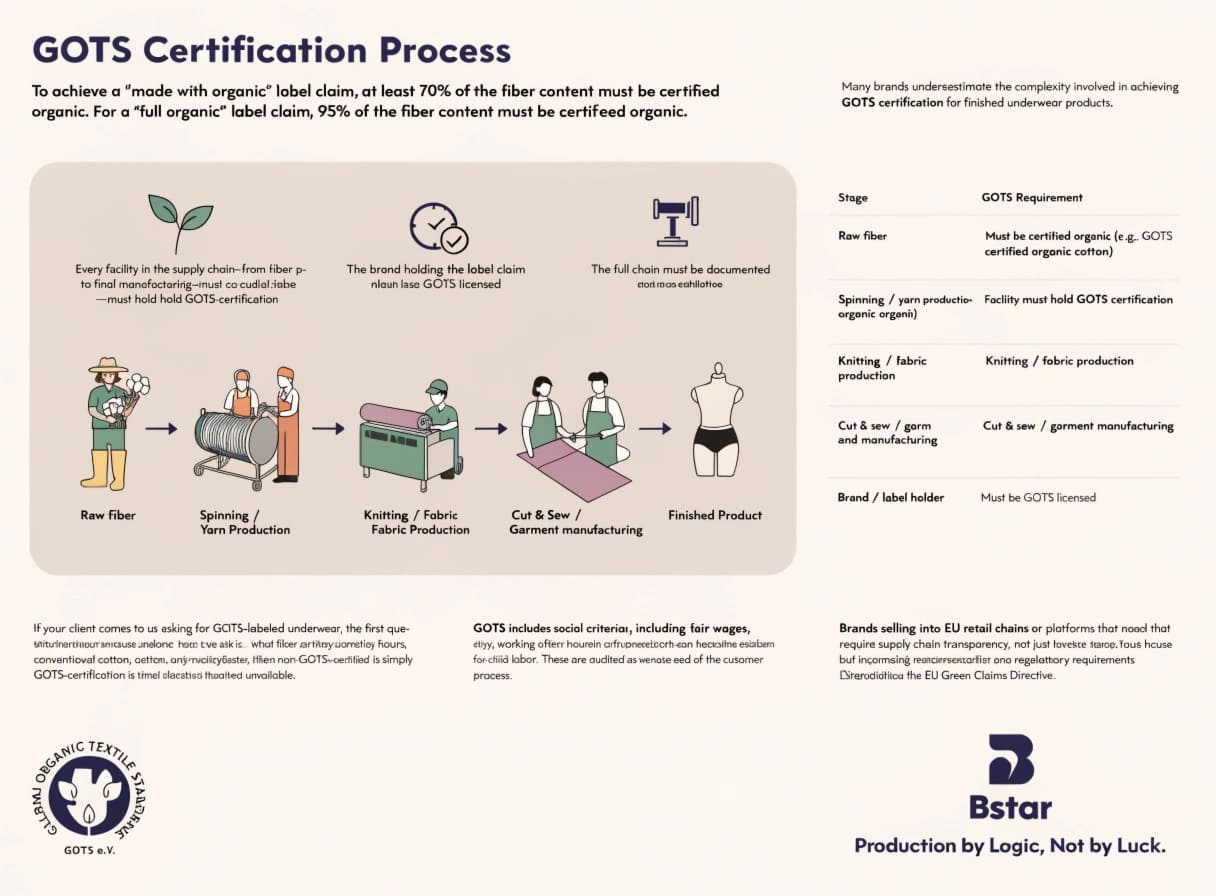
GOTS requires that at least 70% of the fiber content is certified organic (the "made with organic" tier), or 95% for the full "organic" label claim4. Every facility in the supply chain — from fiber processing to final manufacturing — must hold its own GOTS certification. The brand holding the label claim must also be licensed under GOTS.
This is the part that surprises most DTC founders. GOTS is not something you apply for at the end of the production process. It has to be built into the supply chain from the beginning.
What does that supply chain requirement look like in practice?
| Stage | GOTS Requirement |
|---|---|
| Raw fiber | Must be certified organic (e.g., GOTS-certified organic cotton) |
| Spinning / yarn production | Facility must hold GOTS certification |
| Knitting / fabric production | Facility must hold GOTS certification |
| Cut & sew / garment manufacturing | Facility must hold GOTS certification |
| Brand / label holder | Must be GOTS licensed |
This means if you come to us wanting GOTS-labeled men’s underwear, the first question we ask is: what fiber are you planning to use? If the answer is conventional cotton, recycled polyester, or any non-GOTS-certified fiber, GOTS is simply not available to you — regardless of how the rest of the production is handled.
We source from GOTS-certified yarn suppliers, and our production facility is GOTS-certified. That covers two critical links in the chain. But the brand must complete its own GOTS licensing, and the full chain must be documented and auditable. We help clients prepare for that, but we don’t hold that certification on their behalf.
GOTS also includes social criteria — things like fair wages, working hours, and prohibition of child labor. These are audited as part of the certification process.5 So GOTS is not just an organic fiber claim. It’s also a social compliance claim. Brands selling into EU retail chains or platforms that require supply chain transparency often need this, not just because of customer preference, but because of incoming regulatory requirements like the EU Green Claims Directive6.
Product Safety Testing vs. Full Supply Chain Compliance: Why These Are Not the Same Thing?
We see this confusion regularly. A brand founder will say: "You have GOTS and OEKO-TEX, so I’m covered, right?" The answer is no — and understanding why protects you from a very expensive mistake.
OEKO-TEX Standard 100 is a product safety certificate. It answers: "Is this product free of harmful substances?" GOTS is a supply chain integrity certificate. It answers: "Was this product made from certified organic fiber, under audited environmental and social conditions, throughout every stage of production?"
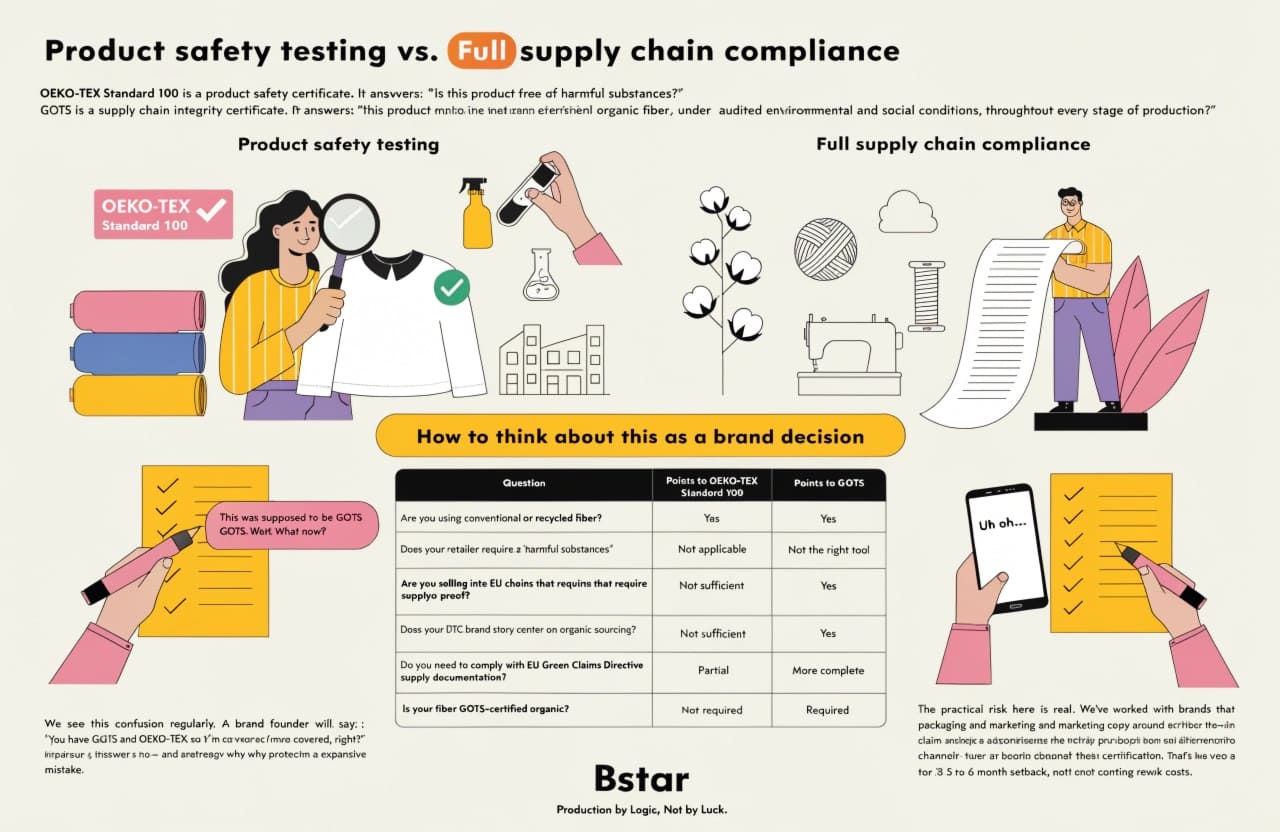
These two certifications serve two different brand promises. Choosing between them isn’t a matter of which one sounds better. It comes down to what your specific sales channel requires, and what your customer actually cares about.
How to think about this as a brand decision
| Question | Points to OEKO-TEX Standard 100 | Points to GOTS |
|---|---|---|
| Are you using conventional or recycled fiber? | Yes | Not applicable |
| Does your retailer require a "tested for harmful substances" label? | Yes | Not the right tool |
| Are you selling into EU chains that require organic supply chain proof? | Not sufficient | Yes |
| Does your DTC brand story center on organic sourcing? | Not sufficient | Yes |
| Do you need to comply with EU Green Claims Directive supply chain documentation? | Partial | More complete |
| Is your fiber GOTS-certified organic? | Not required | Required |
The practical risk here is real. We’ve worked with brands that locked in packaging and marketing copy around a certification claim — then discovered mid-production that either their fiber wasn’t GOTS-certified, or their selling channel required the other certification. That’s a 3 to 6 month setback, not counting rework costs.7
The decision should happen before you finalize fiber selection. Not after.
What Documentation and Audit Readiness Actually Looks Like for a Manufacturing Facility?
If you’re preparing to certify a men’s underwear product — whether through OEKO-TEX or GOTS — there’s groundwork to do before production starts. This is an area where working with a factory that already holds both certifications makes a real difference.
For OEKO-TEX Standard 100, the brand submits the finished product to an OEKO-TEX-authorized testing laboratory. The factory supports this by providing material composition data, supplier declarations, and processing records. For GOTS, the brand must be licensed, and the factory must supply transaction certificates (TCs) for every GOTS-certified input used.
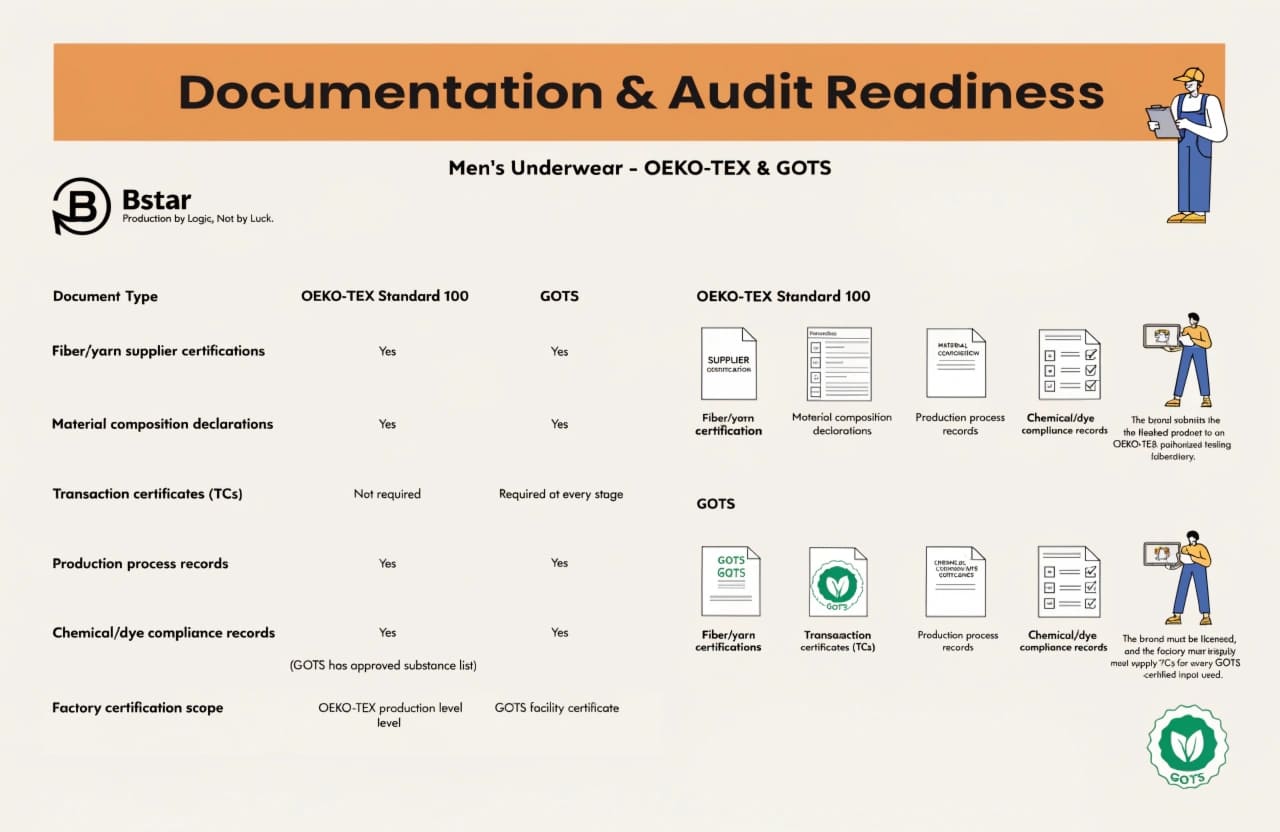
What we provide to support client applications
| Document Type | OEKO-TEX Standard 100 | GOTS |
|---|---|---|
| Fiber/yarn supplier certifications | Yes | Yes (must be GOTS-certified) |
| Material composition declarations | Yes | Yes |
| Transaction certificates (TCs) | Not required | Required at every stage |
| Production process records | Yes | Yes (audited) |
| Chemical/dye compliance records | Yes | Yes (GOTS has approved substance list) |
| Factory certification scope | OEKO-TEX production level | GOTS facility certificate |
For brands new to this process, the TC chain for GOTS is often the most unfamiliar part. Every transfer of GOTS-certified material — from yarn supplier to fabric mill to garment manufacturer — requires a transaction certificate.8 These need to be issued, collected, and stored. We handle our portion of that documentation, but the brand needs to set up their own GOTS account and track the full chain.
One practical step we recommend early: get your GOTS brand license application started before you finalize your production timeline. The licensing process takes time, and production can’t be counted toward your certified volume until your license is active.
For OEKO-TEX Standard 100, the timeline is shorter — typically a few weeks for lab testing once samples are submitted. But the sample needs to be the actual production fabric and construction, not a prototype made from a different batch.
-
"Oeko-Tex – Wikipedia", https://en.wikipedia.org/wiki/Oeko-Tex. According to OEKO-TEX Association documentation, OEKO-TEX Standard 100 tests for more than 100 individual substances and parameters, encompassing pH value, formaldehyde, heavy metals, pesticide residues, and prohibited colorants, among others. Evidence role: definition; source type: institution. Supports: The scope of OEKO-TEX Standard 100 testing, including the number of parameters and substance categories covered. Scope note: The exact parameter count is updated periodically; the figure cited should be verified against the most current edition of the standard. ↩
-
"Recent Advances in Azo Dye Degrading Enzyme Research", https://pmc.ncbi.nlm.nih.gov/articles/PMC5863238/. Research in textile toxicology has established that specific azo dyes can undergo reductive cleavage under conditions simulating skin contact, releasing aromatic amines that are classified as carcinogenic or suspected carcinogens under regulatory frameworks including EU Regulation (EC) No 1907/2006 (REACH). Evidence role: mechanism; source type: paper. Supports: That certain azo dyes can undergo reductive cleavage to release aromatic amines classified as carcinogenic or potentially carcinogenic. Scope note: The carcinogenic risk applies to a defined subset of azo dyes, not all azo colorants; the claim should not be generalised to the entire dye class. ↩
-
"GOTS – Wikipedia", https://en.wikipedia.org/wiki/GOTS. The Global Organic Textile Standard (GOTS) is owned and administered by Global Standard gGmbH, an international non-profit organisation, which sets the standard criteria, accredits certification bodies, and maintains the public database of licensed operators. Evidence role: definition; source type: institution. Supports: That the Global Organic Textile Standard is owned and administered by Global Standard gGmbH (formerly GOTS e.V.). Scope note: The organisation’s legal name has undergone changes; readers should verify the current registered name against the official GOTS website. ↩
-
"Organic Textiles | Agricultural Marketing Service – USDA", https://www.ams.usda.gov/grades-standards/organic-textiles. Under GOTS, products containing a minimum of 95% certified organic fibres may carry the label ‘organic,’ while products containing a minimum of 70% certified organic fibres may carry the label ‘made with x% organic materials’; both grades require full supply chain certification. Evidence role: definition; source type: institution. Supports: The two GOTS label grades and their respective minimum certified organic fibre content thresholds of 95% and 70%. Scope note: Percentage thresholds are defined in the versioned standard document; the applicable version should be confirmed as GOTS periodically releases updated editions. ↩
-
"Fact Sheet #43: Child Labor Provisions of the Fair Labor Standards …", https://www.dol.gov/agencies/whd/fact-sheets/43-child-labor-non-agriculture. GOTS Part IV sets out social criteria aligned with ILO core conventions, including prohibitions on child and forced labour, requirements for safe working conditions, and provisions relating to wages and working hours; compliance with these criteria is verified during the same certification audit as the environmental requirements. Evidence role: definition; source type: institution. Supports: That GOTS incorporates mandatory social criteria, including prohibitions on child labour and requirements relating to wages and working hours, which are verified through on-site audits. ↩
-
"Green claims – Environment – European Commission", https://environment.ec.europa.eu/topics/circular-economy-topics/green-claims_en. The proposed EU Directive on Green Claims (COM/2023/166) requires that explicit environmental claims made to consumers be substantiated by recognised scientific evidence and, where applicable, verified by an accredited third party prior to market communication, with particular relevance to supply chain-based claims in the textile and apparel sector. Evidence role: historical_context; source type: government. Supports: That the EU Green Claims Directive introduces substantiation and verification requirements for environmental claims, with implications for supply chain documentation in the textile sector. Scope note: As of the article’s publication, the Directive was still progressing through the EU legislative process; its final scope and transposition deadlines had not been fully confirmed. ↩
-
"Textile Supply Chain Management (Certificate) < North Carolina …", https://catalog.ncsu.edu/graduate/textiles/textile-engineering/textile-supply-chain-management-certificate/. GOTS documentation indicates that brand licensing, certified input sourcing, and transaction certificate chain establishment must be in place prior to production for goods to count toward certified volume; the cumulative lead time for these steps — including certification body engagement, organic fibre procurement, and licence issuance — typically spans several months, though the exact duration varies by operator readiness. Evidence role: general_support; source type: institution. Supports: That establishing GOTS supply chain compliance, including brand licensing and certified fibre sourcing, involves a multi-month process that cannot be completed retroactively after production has begun. Scope note: The specific ‘3 to 6 month’ figure cited in the article appears to reflect the author’s operational experience rather than a published industry benchmark; it should be treated as an illustrative estimate rather than a standardised timeline. ↩
-
"[PDF] POLICY FOR ISSUANCE OF TRANSACTION CERTIFICATES", https://global-standard.org/images/resource-library/documents/certificate-policies-and-templates/Policy_for_the_Issuance_of_Transaction_Certificates_v_3.0.pdf. Under GOTS, a transaction certificate (TC) must be issued by the selling certified operator and accepted by the purchasing certified operator for each commercial transaction involving GOTS-certified goods, thereby creating an auditable documentary chain from fibre to finished product. Evidence role: mechanism; source type: institution. Supports: That GOTS requires transaction certificates to be issued at each point of transfer of certified goods between supply chain operators, serving as the documentary link in the certified material chain. ↩
Discussion & questions 0 comments