
Ergonomic Design in Women’s Lingerie: Balancing Style and Comfort?
A lot of lingerie brands brief their factories on fabric first. They chase softness, stretch, and breathability — and then wonder why their customers return the product after one wear.
Ergonomic lingerie design starts with structure, not fabric. The pattern geometry, band construction, and stress-point distribution determine how a garment performs after eight hours. Fabric softness matters, but it is execution — not foundation. Get the structure wrong, and no fabric choice will save the fit.
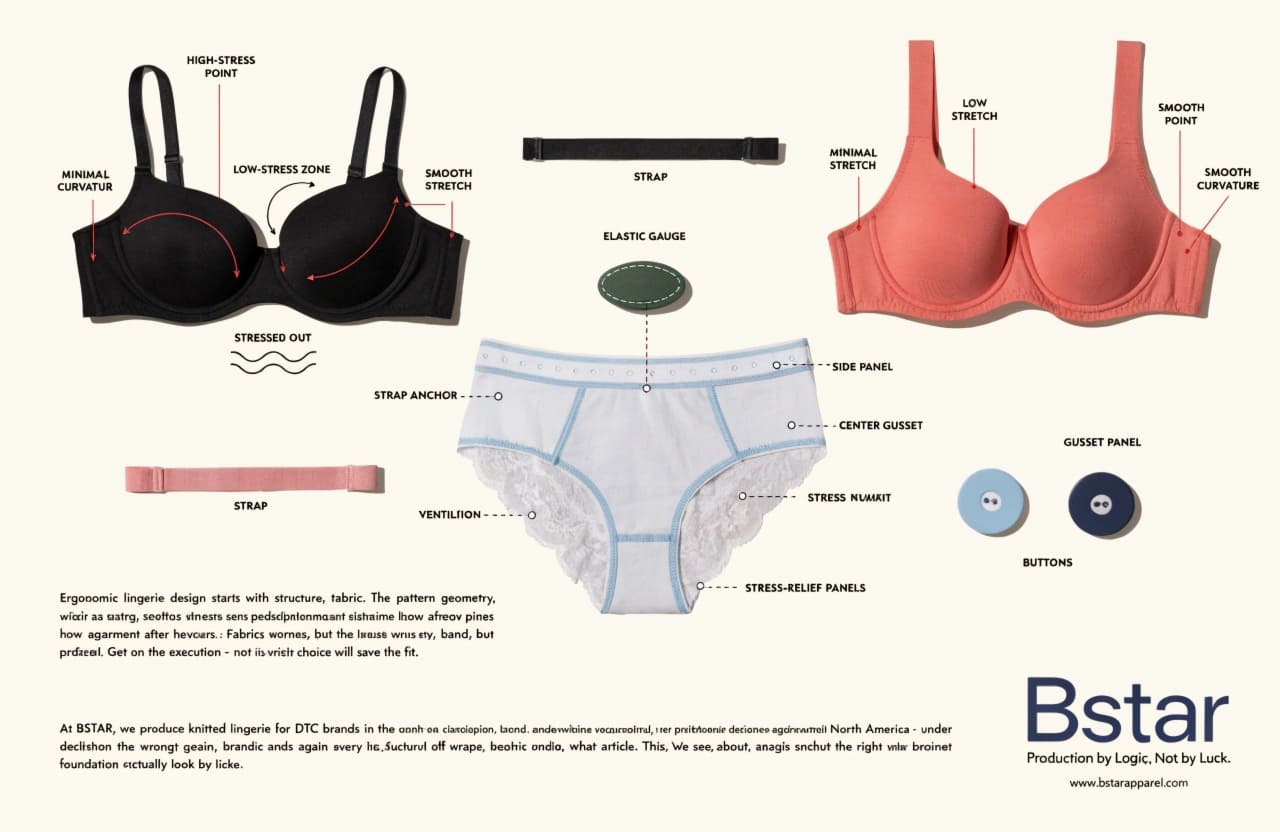
At BSTAR, we produce knitted lingerie for DTC brands in Europe, North America, and Australia. We sit on the factory side of every structural decision — underwire vs. wireless, band width, strap anchor placement, elastic gauge. What we see, again and again, is brands spending development budget on the wrong problem. This article is about what the right problem actually looks like.
The Science of Support: Integrating Biomechanics and Soft-Support Structures for All-Day Comfort?
Most brands brief around the 30-second feel test. The garment feels soft in-hand, passes the initial try-on, and gets approved for production. Six months later, the return rate tells a different story.
Soft-support structures work by distributing load across a wider contact area rather than concentrating it at a single point. The band accounts for 70–80% of total support in a bra.1 If the band architecture is under-engineered, shoulder straps compensate — which is where pressure complaints come from. Softness does not fix this. Band construction does.
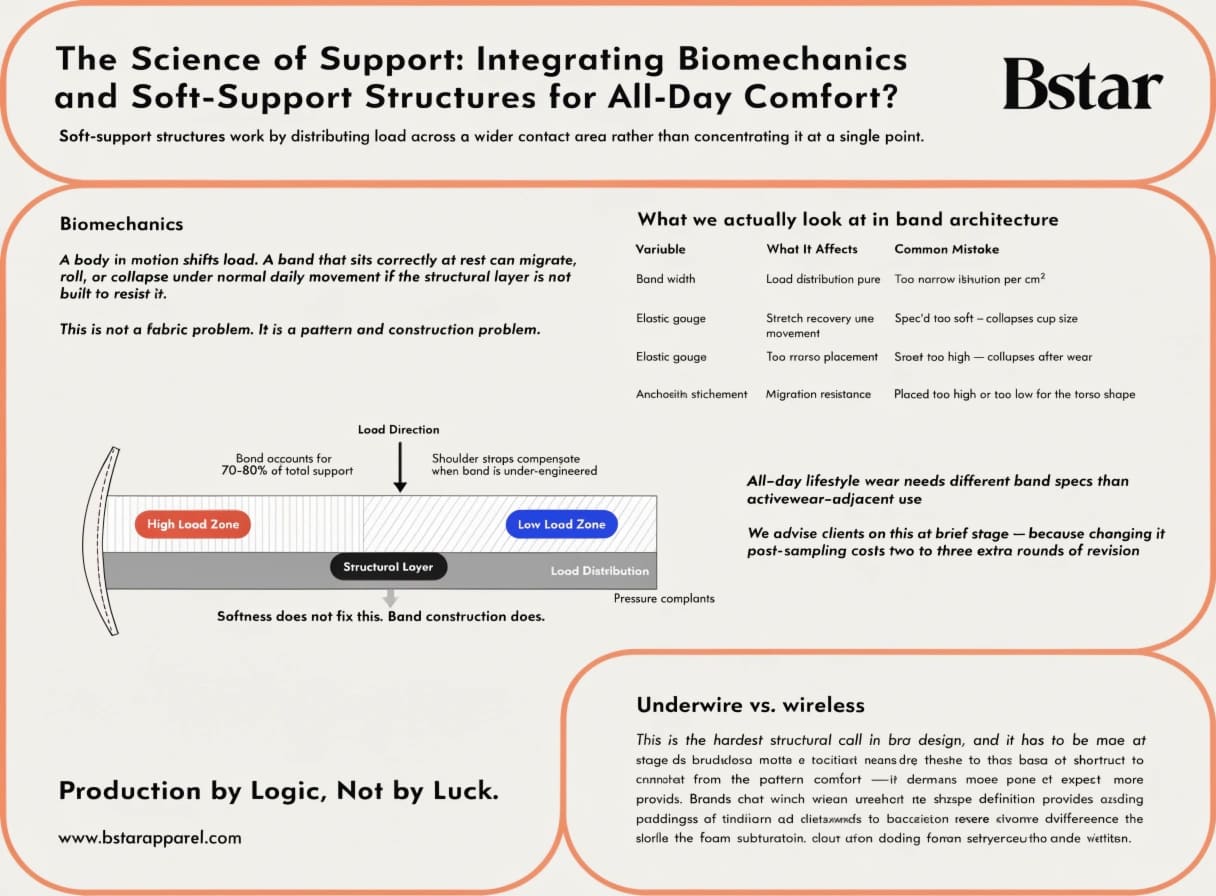
The biomechanics here are straightforward. A body in motion shifts load. A band that sits correctly at rest can migrate, roll, or collapse under normal daily movement if the structural layer is not built to resist it.2 This is not a fabric problem. It is a pattern and construction problem.
What we actually look at in band architecture
When we review a brief for a new bra style, the band spec is the first thing we interrogate. Three variables determine performance:
| Variable | What It Affects | Common Mistake |
|---|---|---|
| Band width | Load distribution per cm² | Too narrow for the target cup size |
| Elastic gauge | Stretch recovery under movement | Spec’d too soft — collapses after wear |
| Anchor stitch placement | Migration resistance | Placed too high or too low for the torso shape |
A brand targeting all-day lifestyle wear needs different band specs than one targeting activewear-adjacent use. We advise clients on this at brief stage — because changing it post-sampling costs two to three extra rounds of revision.
The underwire vs. wireless decision lives here too. This is the hardest structural call in bra design, and it has to be made at the pattern stage. Wireless construction is not a shortcut to comfort — it demands more from the band and side panel geometry to replace the shape definition that underwire provides.3 Brands that switch from underwire to wireless mid-development and expect to resolve the difference with foam padding or fabric substitution are doing it backwards.
Ergonomic Pattern Engineering: Utilizing 3D Body Scanning and Seamless Knitting for a Second-Skin Fit?
Pattern engineering is where ergonomic intent either lands or falls apart. You can have the right structural brief and still produce a garment that fails on the body because the pattern geometry does not match real body variance.
3D body scanning and seamless knitting allow pattern geometry to follow actual body curvature rather than approximating it from flat measurements.4 Seamless construction eliminates seam bulk at high-contact zones — underarm, underbust, and side panel — reducing friction and pressure without changing the structural spec.5

In our production experience, the patterns that generate the most revision cycles are the ones built from flat block approximations and then adjusted post-sampling. The result is a garment that fits one body type and irritates everyone else.
How seamless knitting changes the structural conversation
Seamless knitting is not just a comfort feature — it is a pattern engineering tool. When we use it for clients producing wireless lifestyle bras, the construction does two things at once:
| Function | Seamless Advantage | Seamed Alternative |
|---|---|---|
| Pressure at underarm | Eliminated — no seam bulk | Requires seam finishing, still adds contact friction |
| Side panel shaping | Knitted-in 3D curve | Requires additional pattern pieces |
| Fit consistency across sizes | Better — knit tension is graded | Dependent on cutter accuracy |
The brands we produce for that target wireless, second-skin aesthetics — typically European DTC labels focused on everyday wear — almost always move toward seamless construction once they understand the structural case for it. The aesthetic benefit is real, but the structural benefit is the actual reason to specify it.
Material Innovations: Selecting High-Elasticity and Breathable Fabrics to Minimize Pressure Points?
Here is where most lingerie briefs start. And it is not wrong to care about fabric — but fabric spec without structural context is just a catalog.
High-elasticity fabrics reduce pressure points by conforming to body movement without resisting it.6 Breathable constructions manage moisture at high-contact zones, reducing the friction that causes skin irritation during extended wear.7 But neither property compensates for structural misalignment — a tight band in the wrong position will cause pressure regardless of fabric choice.
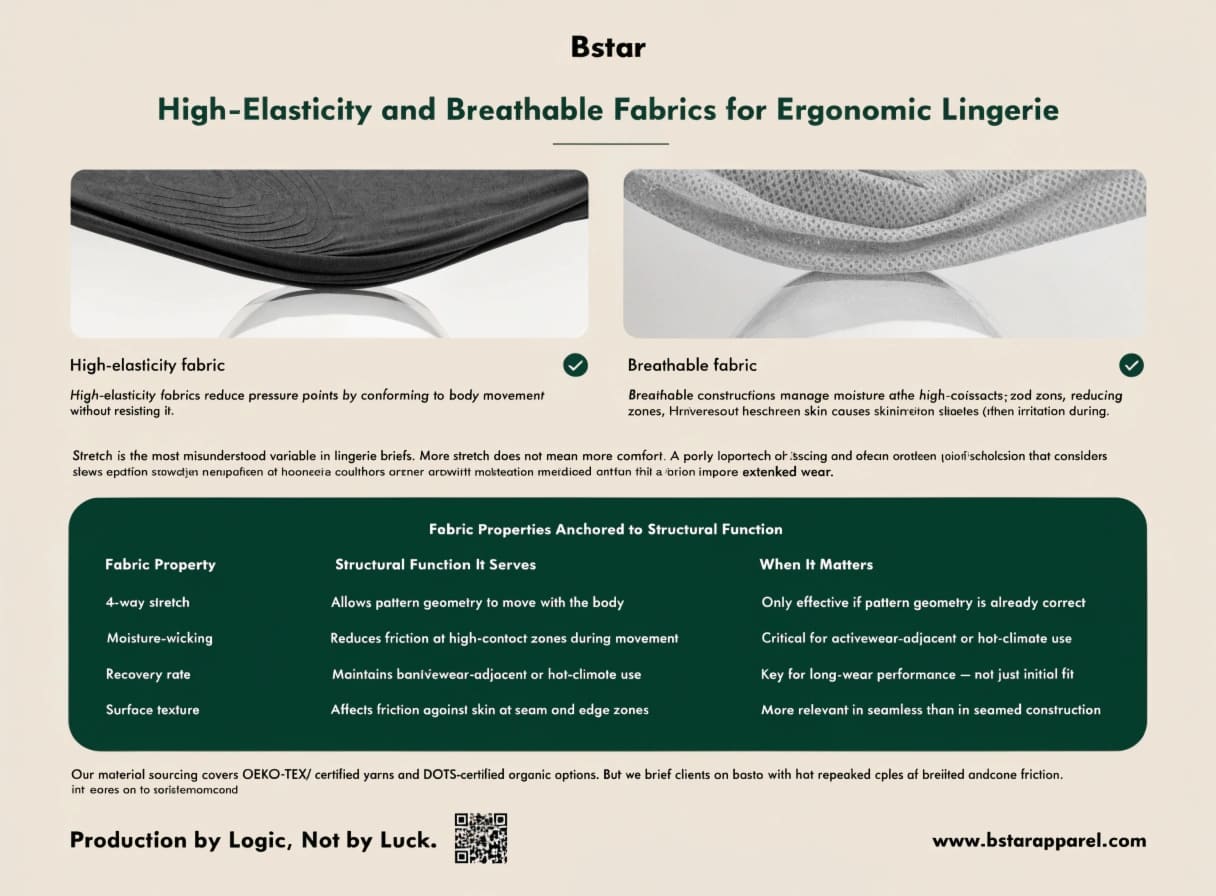
Stretch is the most misunderstood variable in lingerie briefs. More stretch does not mean more comfort.8 A poorly structured bra with high-stretch fabric will redistribute pressure without resolving it — and it will often mask bad pattern work during initial try-on, which is how approval decisions go wrong.
Fabric properties anchored to structural function
This is how we frame fabric selection with clients:
| Fabric Property | Structural Function It Serves | When It Matters |
|---|---|---|
| 4-way stretch | Allows pattern geometry to move with the body | Only effective if pattern geometry is already correct |
| Moisture-wicking | Reduces friction at high-contact zones during movement | Critical for activewear-adjacent or hot-climate use |
| Recovery rate | Maintains band tension after repeated stretch cycles | Key for long-wear performance — not just initial fit |
| Surface texture | Affects friction against skin at seam and edge zones | More relevant in seamless than in seamed construction |
Our material sourcing covers OEKO-TEX® certified yarns and GOTS-certified organic options9. But we brief clients on these after the structural layer is confirmed — not before.
Aesthetics Meets Function: Designing Anatomical Pouches and Adjustable Straps Without Compromising Style?
This is the section where most ergonomic articles go soft. They describe the aesthetic challenge and then suggest that "balance" is the answer. That is not useful advice.
Anatomical shaping and adjustable strap systems are structural features first. An adjustable strap that is too narrow for its elastic gauge will still cut into the shoulder regardless of how it looks.10 Aesthetics constrain the execution of structural features — they do not override the structural requirement.
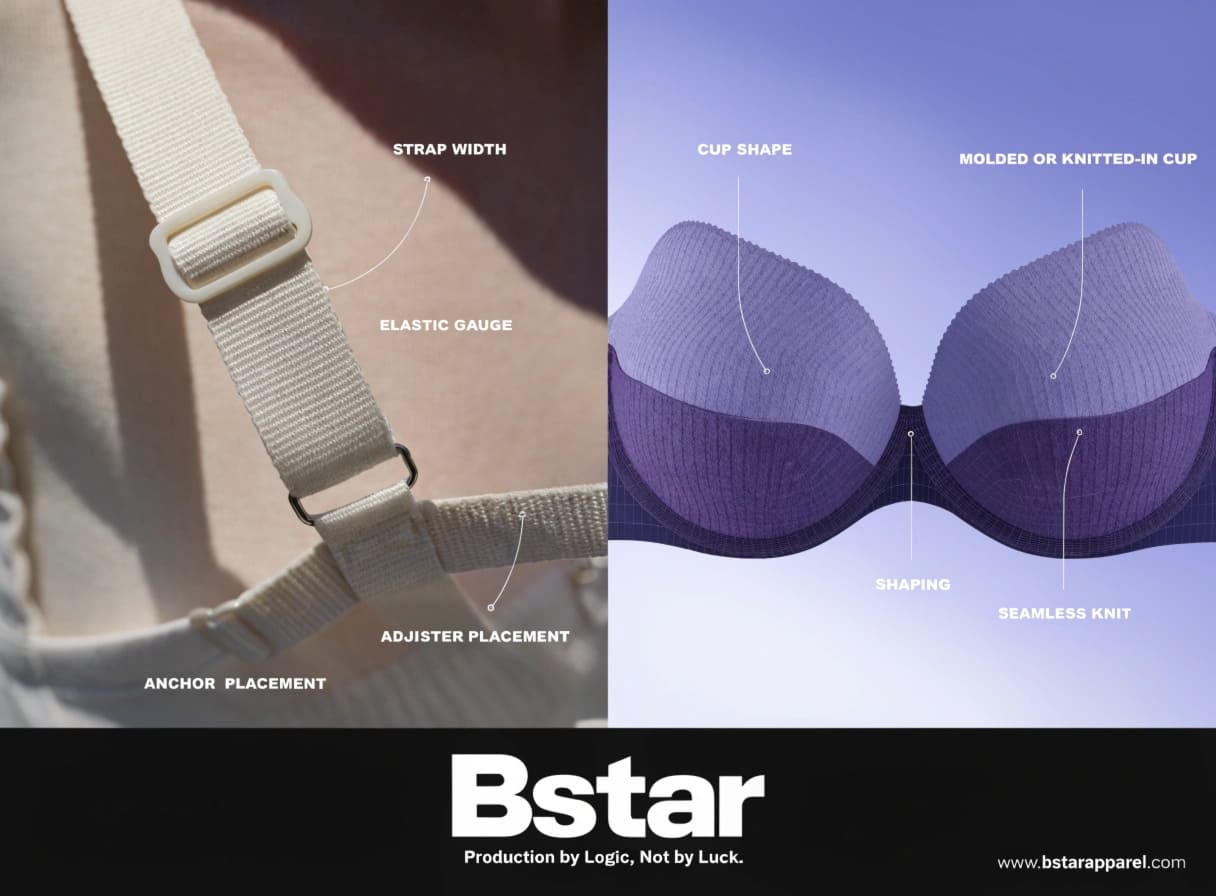
Straps are the most under-specified element we see in DTC briefs. Brands describe strap aesthetics in detail — color, finish, width at the visual level — and leave elastic gauge and anchor placement unspecified. Both of those variables directly affect pressure per square centimeter at the shoulder. That is a measurable, structural variable. Treating it as an aesthetic decision is how shoulder pain returns happen.
What a well-specified strap brief looks like
| Spec Variable | Why It Matters Structurally | Common Under-Specification |
|---|---|---|
| Strap width at shoulder | Distributes load over more contact area | Spec’d visually, not by cup size or load estimate |
| Elastic gauge | Determines stretch resistance and recovery | Often matched to fabric hand-feel, not load requirement |
| Anchor placement on band | Affects strap angle and shoulder load direction | Left to sample interpretation |
| Adjuster placement | Determines functional range and ease of use | Placed for aesthetics, not for actual adjustment range |
For clients producing lifestyle wireless bras — which is a large portion of our current European DTC work — the strap brief is one of the first places we push back. Not because the aesthetic direction is wrong, but because the structural spec needs to be complete before sampling starts.
Anatomical cup shaping follows the same logic. A molded or knitted-in cup shape that follows the body’s natural contour reduces the compensatory pressure that a flat-cut cup creates.11 This is achievable in seamless knitting without adding visual bulk — which is the answer to the "aesthetics vs. function" question most brands ask us.
Conclusion
Ergonomic lingerie design is a structural problem. Get the band, the pattern geometry, and the strap spec right first — then choose your fabric. That order matters.
-
"Optimising breast support in female patients through correct bra fit. A …", https://pubmed.ncbi.nlm.nih.gov/20451452/. Research in brassiere biomechanics has examined load distribution between the underband and shoulder straps, with studies indicating the underband bears the majority of breast support load; the specific 70–80% figure should be verified against peer-reviewed measurement data. Evidence role: statistic; source type: paper. Supports: The proportion of total bra support attributed to the underband versus shoulder straps. Scope note: Exact percentages may vary by cup size, breast tissue composition, and bra style; a single figure may not generalize across all garment types. ↩
-
"Effects of Dynamic Loading of Sewing Process and Viscoelastic …", https://jtatm.textiles.ncsu.edu/index.php/JTATM/article/view/5049. Studies on brassiere fit and dynamic loading have investigated how band geometry and elastic properties interact with torso movement, providing a mechanical basis for understanding band migration as a construction-dependent phenomenon. Evidence role: mechanism; source type: paper. Supports: That garment band displacement during movement is attributable to structural and construction variables rather than fabric selection alone. Scope note: Published research on this specific mechanism is limited; available studies may address breast motion or strap load rather than band migration directly. ↩
-
"Removal of bra for pad placement and defibrillation – PMC – NIH", https://pmc.ncbi.nlm.nih.gov/articles/PMC11870170/. Comparative analyses of underwired and non-underwired brassiere designs have examined how the absence of a rigid underwire affects load paths through the garment, with findings relevant to band width and side panel construction requirements. Evidence role: mechanism; source type: paper. Supports: That removing underwire from a bra design transfers structural support requirements to the band and side panel components. Scope note: Peer-reviewed literature specifically comparing wireless and underwired structural mechanics is sparse; much available evidence is industry-derived rather than independently validated. ↩
-
"Finding the Perfect Fit: Baylor University’s Apparel Program Explores …", https://news.web.baylor.edu/news/story/2011/finding-perfect-fit-baylor-universitys-apparel-program-explores-body-scanners-tools. Research in apparel engineering has compared 3D body scanning with conventional anthropometric measurement, finding that scan-derived data captures surface curvature and volume more accurately, with implications for garment fit and pressure distribution. Evidence role: mechanism; source type: paper. Supports: That 3D body scanning produces pattern data more representative of actual body curvature than traditional flat measurement approaches. Scope note: Fit improvement outcomes depend on how scan data is translated into pattern geometry; scanning alone does not guarantee superior fit without appropriate pattern engineering methodology. ↩
-
"Pressure garment therapy (PGT) of burn scars – PMC – NIH", https://pmc.ncbi.nlm.nih.gov/articles/PMC3978593/. Textile ergonomics research using pressure mapping and friction measurement has demonstrated that seam presence at high-contact anatomical zones increases localized interface pressure and skin friction compared to seamless constructions. Evidence role: mechanism; source type: paper. Supports: That eliminating seams at high-contact body zones reduces localized pressure and friction during wear. Scope note: Effect magnitude varies by seam type, finishing method, and body zone; seamless construction may introduce other variables such as differential knit tension that affect pressure distribution. ↩
-
"Elastic textile-based wearable modulation of musculoskeletal load", https://pmc.ncbi.nlm.nih.gov/articles/PMC11894418/. Studies on textile-skin interface mechanics have examined how fabric extensibility affects contact pressure distribution during movement, with higher-elasticity materials generally showing reduced peak pressure at anatomical contact zones. Evidence role: mechanism; source type: paper. Supports: That fabrics with higher elasticity reduce localized pressure at the fabric-skin interface by accommodating body movement. Scope note: Pressure reduction from elasticity is dependent on garment construction and fit; high-stretch fabric in an ill-fitting garment may redistribute rather than reduce peak pressure. ↩
-
"Moisture-Associated Skin Damage – PMC – NIH", https://pmc.ncbi.nlm.nih.gov/articles/PMC9093722/. Dermatological and tribological research has established that elevated skin moisture increases the coefficient of friction at textile-skin interfaces, with implications for irritation and chafing during extended garment wear. Evidence role: mechanism; source type: paper. Supports: That moisture accumulation at garment-skin contact zones increases friction and contributes to skin irritation during prolonged wear. Scope note: The relationship between moisture, friction, and irritation is well-established in wound care and sports medicine literature but may not be directly validated in lingerie-specific wear contexts. ↩
-
"Cloth face mask fit and function for children part one – PMC", https://pmc.ncbi.nlm.nih.gov/articles/PMC9107347/. Apparel fit research has noted that highly extensible fabrics can compensate for pattern inaccuracies during static fitting assessments, potentially masking structural misalignment that becomes apparent only under dynamic loading or extended wear conditions. Evidence role: mechanism; source type: paper. Supports: That high fabric extensibility can temporarily accommodate fit deviations during static try-on while failing to resolve pressure issues under dynamic wear conditions. Scope note: This phenomenon is discussed in practitioner and educational literature but may lack robust controlled experimental validation specific to lingerie garment categories. ↩
-
"OEKO-TEX® STANDARD 100", https://www.oeko-tex.com/en/our-standards/oeko-tex-standard-100/. OEKO-TEX® Standard 100 certifies that textile products have been tested for harmful substances across the supply chain, while the Global Organic Textile Standard (GOTS) sets criteria for organic fiber content and responsible processing; both are administered by independent international bodies. Evidence role: definition; source type: institution. Supports: What OEKO-TEX® and GOTS certifications test and certify in textile and yarn production. Scope note: Certification confirms compliance with defined criteria at the time of testing; it does not constitute a continuous performance guarantee or address all aspects of garment comfort and safety. ↩
-
"Bra strap orientations and designs to minimise bra strap discomfort …", https://pmc.ncbi.nlm.nih.gov/articles/PMC5005736/. Biomechanical studies on brassiere strap loading have measured shoulder interface pressure as a function of strap width and applied load, consistent with the principle that pressure equals force divided by contact area, supporting the structural importance of strap width specification. Evidence role: mechanism; source type: paper. Supports: That bra strap width is inversely related to contact pressure at the shoulder, with narrower straps producing higher pressure per unit area under equivalent load. Scope note: Shoulder pressure is also affected by strap angle, tissue compliance, and dynamic movement; width alone does not fully determine comfort outcomes. ↩
-
"Comfort During Motion: Analyzing the Pressure Profile of Auxetic Bra …", https://pmc.ncbi.nlm.nih.gov/articles/PMC12654253/. Research on brassiere cup fit has used pressure mapping and subjective comfort assessment to compare shaped and flat-cut cup constructions, with anatomically contoured cups generally associated with more uniform pressure distribution across the breast surface. Evidence role: mechanism; source type: paper. Supports: That cup geometry conforming to breast contour reduces localized compensatory pressure compared to flat-cut cup construction. Scope note: Optimal cup geometry is highly individual; a shape that reduces compensatory pressure for one body morphology may increase it for another, limiting generalization of findings. ↩