
How to Launch a Crowdfunding Campaign for Innovative Underwear?
Most founders think their crowdfunding campaign fails because of weak marketing. In most cases, the real problem started months earlier — before a single backer ever clicked "pledge."
A successful crowdfunding campaign for innovative underwear requires your supply chain to be planned in parallel with your campaign, not after it. That means confirming sampling feasibility, production timelines, and unit costs before you set your funding goal or delivery date.
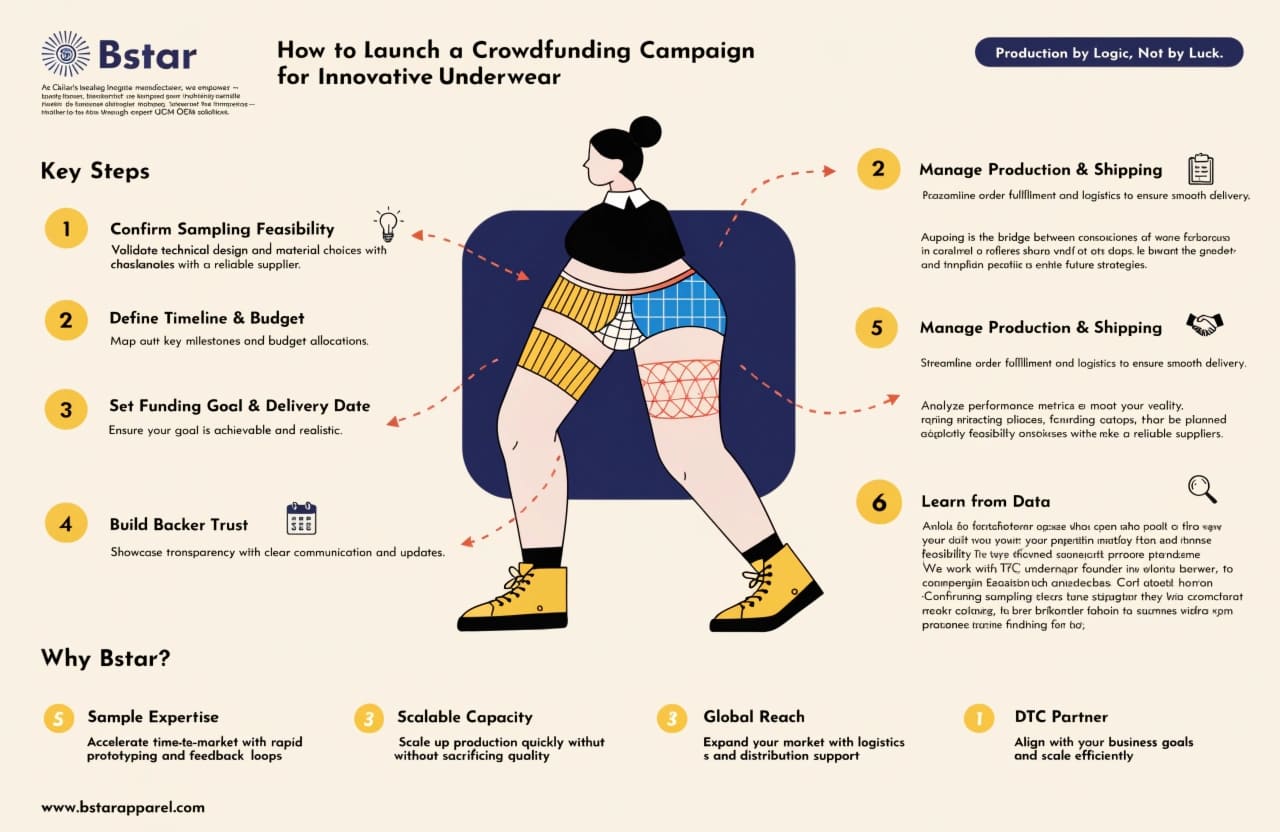
We work with DTC underwear founders who come to us at very different stages. Some come with a confirmed sampling brief before their campaign goes live. Others come to us after they’ve already hit their funding goal — with backers waiting and no factory relationship in place. The gap between those two groups is where campaigns succeed or fall apart.
Are You Sure Your "Innovative" Design Can Actually Be Made?
You’ve sketched the product. You’ve named the feature. Now you’re about to tell thousands of backers it’ll ship in six months. But have you actually confirmed it can be manufactured?
Functional underwear features — moisture-wicking structures, anti-odor layers, leak-proof panels1 — are achievable, but none of them are assumptions. Each feature needs to go through a physical sampling process before you can confirm feasibility, fit, and performance. That process typically takes 7 to 15 days, minimum.
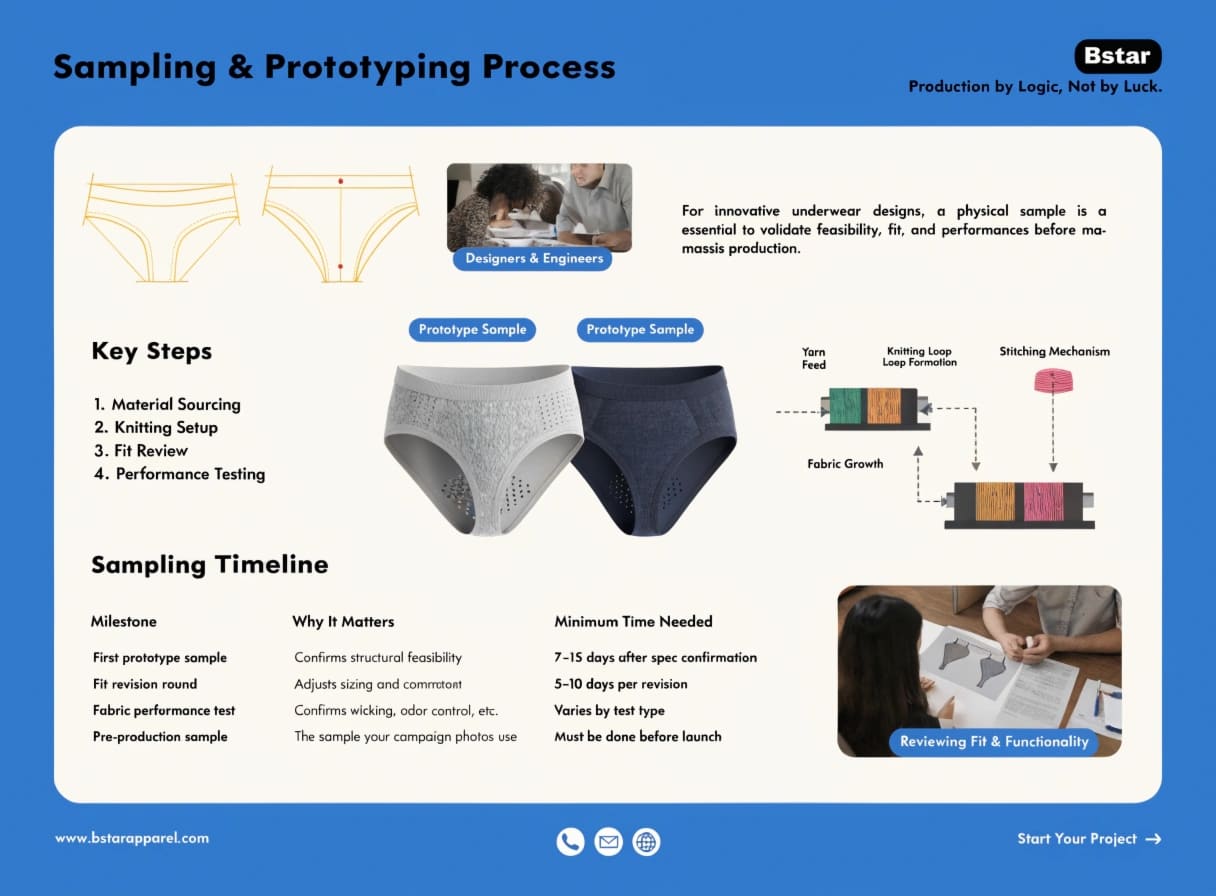
We’ve seen founders arrive with detailed spec sheets for a "four-way stretch, seamless, moisture-wicking brief with a reinforced gusset panel2." The concept is solid. But in our sampling process, the first thing we confirm is whether the yarn blend, the knitting structure, and the functional layer can all coexist in one garment without compromising fit or durability.
Sometimes the answer is yes. Sometimes the structure requires a different yarn weight, which changes the hand feel the founder promised. Sometimes the leak-proof panel adds a thickness that the size grading doesn’t account for3. These are not failures — they’re normal parts of development. But they take time to resolve.
Here’s what this means for your campaign timeline:
| Milestone | Why It Matters | Minimum Time Needed |
|---|---|---|
| First prototype sample | Confirms structural feasibility | 7–15 days after spec confirmation |
| Fit revision round | Adjusts sizing and comfort | 5–10 days per revision |
| Fabric performance test | Confirms wicking, odor control, etc. | Varies by test type |
| Pre-production sample | The sample your campaign photos use | Must be done before launch |
If you’re planning a campaign launch and haven’t started sampling yet, your delivery date is already at risk. The honest question to ask yourself before you write a single word of campaign copy is: have I held the actual product in my hands?
Does Your Campaign Story Match What You Can Actually Deliver?
A compelling campaign shows backers something real. But "real" doesn’t just mean good photos — it means the prototype in those photos is the product you’re actually going to manufacture.
Your campaign visuals and prototype should be based on a confirmed pre-production sample, not a concept render or an early-stage mock-up. The gap between a render and a real garment is where backer expectations get misaligned with what you can actually ship.
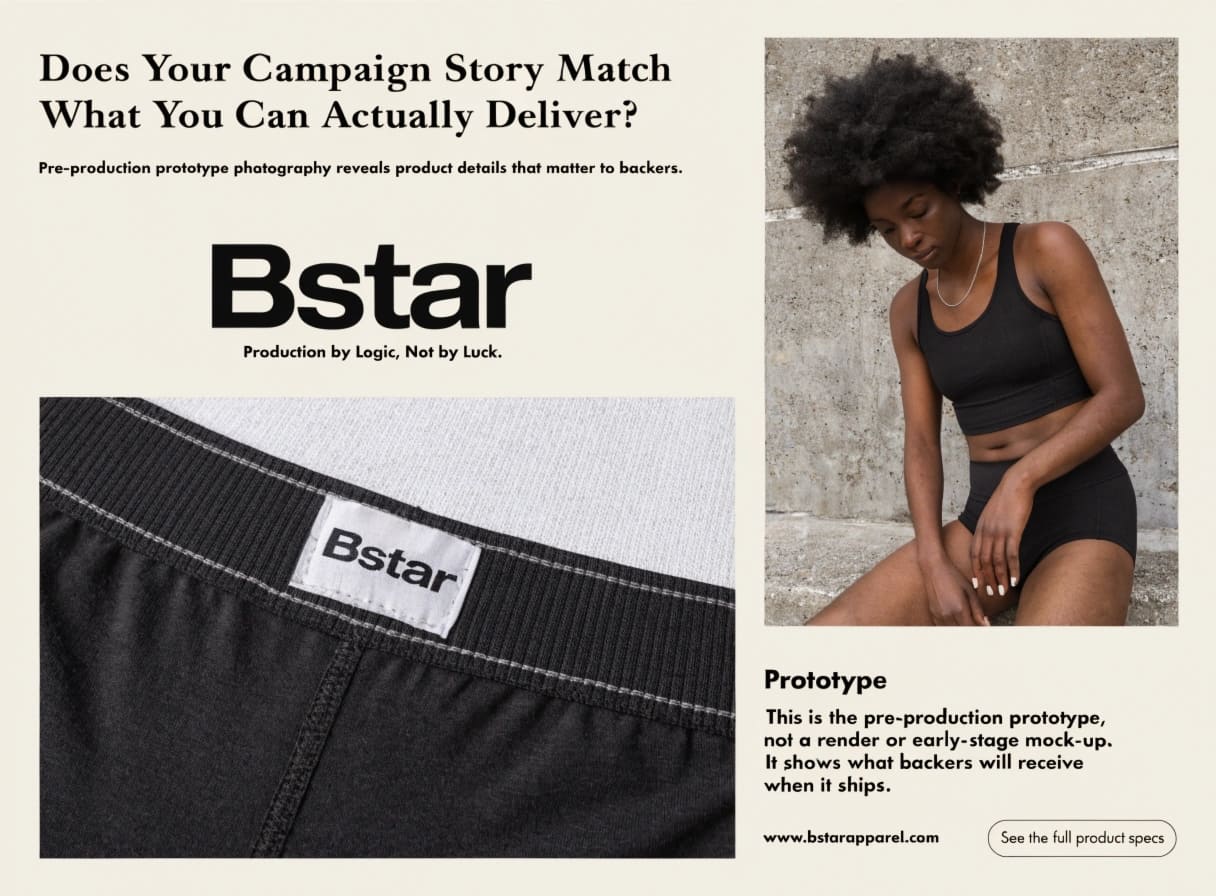
We’ve had clients photograph garments at the first-sample stage and use those images in their campaign. The problem is that first samples are not final samples. The color may shift after dyeing adjustments. The waistband width might change. The fabric surface can look different at production scale versus a hand-knit prototype4.
When backers see a product on a campaign page, they expect what ships to match what they saw. That’s a reasonable expectation. The way to meet it is simple: don’t launch your campaign until your pre-production sample is approved.
Beyond visuals, your campaign narrative should be grounded in what your product actually does differently — not in superlatives. If your underwear uses a specific yarn with documented moisture performance, say that. If it uses a structural design that reduces friction in a specific area, describe it plainly.
What makes a campaign story credible vs. vague?
| Vague Claim | Grounded Version |
|---|---|
| "Revolutionary comfort technology" | "Four-panel seamless construction that eliminates the center seam" |
| "Anti-odor fabric" | "Silver-ion yarn with [tested retention rate — to verify]5" |
| "Sustainable materials" | "OEKO-TEX certified yarn, GRS-certified recycled fiber content6" |
| "Designed for athletes" | "Tested for X hours of continuous movement without waistband roll" |
The grounded version is harder to write because it requires you to actually know your product at spec level. But it’s also the version that converts backers who are skeptical — and those are the backers who don’t file disputes when shipping is delayed7.
Are You Building Pre-Launch Momentum the Right Way?
Pre-launch matters. But most of the advice you’ll read about it focuses on tactics — email lists, social content, influencer outreach. Those things are outside what we do, so I’ll leave that to people with more authority on it.
What I will say is this: the most important pre-launch decision you can make is locking your factory relationship and confirming your production schedule before your campaign goes live. Your campaign end date and your factory start date need to be planned together.
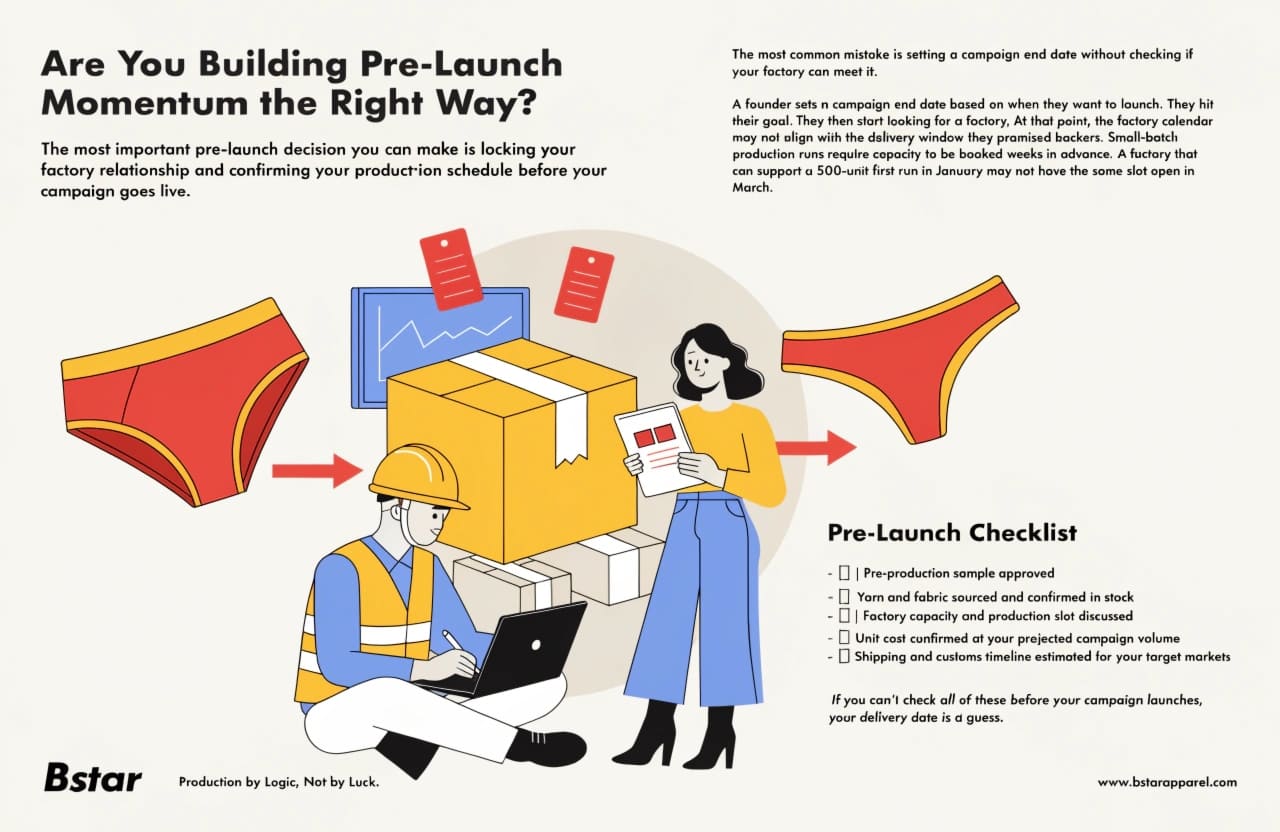
Here’s what we see in practice. A founder sets a campaign end date based on when they want to launch. They hit their goal. They then start looking for a factory. At that point, the factory calendar may not align with the delivery window they promised backers. Small-batch production runs require capacity to be booked weeks in advance8. A factory that can support a 500-unit first run in January may not have the same slot open in March.
The fix is not complicated. Before your campaign goes live, contact your manufacturer, confirm they can handle your spec, and get a written estimate of production lead time based on your projected order volume. Then build your backer delivery date from that number — not backwards from a date you picked for marketing reasons.
Pre-launch supply chain checklist
- Pre-production sample approved
- Yarn and fabric sourced and confirmed in stock
- Factory capacity and production slot discussed
- Unit cost confirmed at your projected campaign volume
- Shipping and customs timeline estimated for your target markets
If you can’t check all of these before your campaign launches, your delivery date is a guess.
What Happens After You Hit Your Goal — And Why Most Founders Aren’t Ready?
Hitting your funding goal feels like the finish line. It’s actually the starting gun for a set of problems that are much harder to solve if you haven’t prepared for them.
Post-campaign fulfillment requires you to immediately convert a campaign pledge number into a confirmed production order. That means having your factory relationship, your sample approval, and your size/color breakdown ready before your campaign closes — not after.
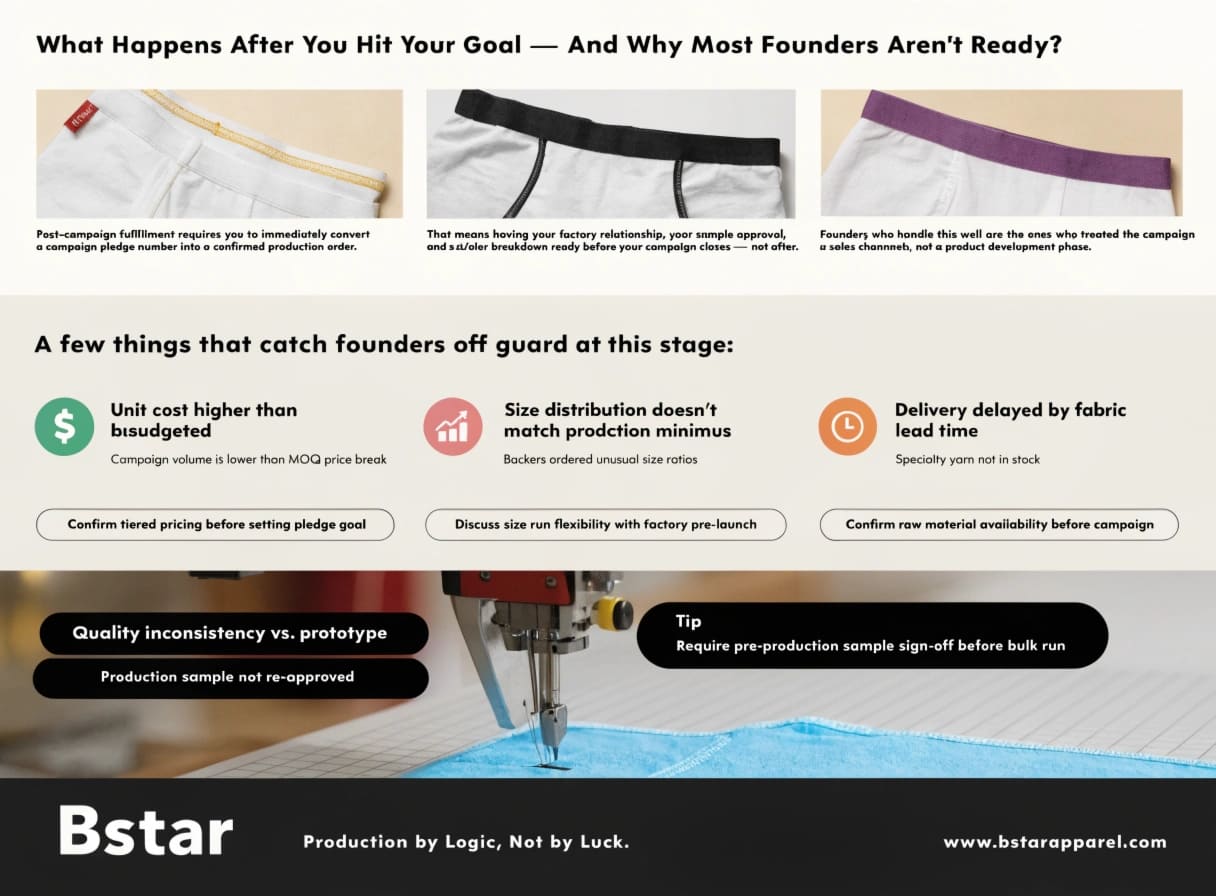
We’ve seen founders come to us after funding with a backer list, a delivery promise, and no confirmed spec. At that point, every day spent finalizing the product is a day of delay against a deadline backers are already counting down. The founders who handle this well are the ones who treated the campaign as a sales channel, not a product development phase.
A few things that catch founders off guard at this stage:
Common post-campaign surprises
| Surprise | Why It Happens | How to Prevent It |
|---|---|---|
| Unit cost higher than budgeted | Campaign volume is lower than MOQ price break | Confirm tiered pricing before setting pledge goal9 |
| Size distribution doesn’t match production minimums | Backers ordered unusual size ratios | Discuss size run flexibility with factory pre-launch |
| Delivery delayed by fabric lead time | Specialty yarn not in stock10 | Confirm raw material availability before campaign |
| Quality inconsistency vs. prototype | Production sample not re-approved | Require pre-production sample sign-off before bulk run |
One more thing worth saying directly: small-batch MOQ flexibility — like a factory that supports 1-piece sampling — is not the same as low unit cost at scale. These serve different purposes. Sampling tells you if the product is real. Production cost tells you if the business is viable11. Founders who conflate these two end up setting pledge prices that don’t cover real fulfillment.
If your campaign goal doesn’t account for actual production cost at your projected volume, you’re not underfunding a marketing budget. You’re underfunding your ability to ship.
Conclusion
Your crowdfunding campaign succeeds or fails before it launches — based on whether your product is real, your costs are confirmed, and your factory timeline is locked.
-
"Multifunctionality of Thermal Protective Layer Interchanging Double …", https://pmc.ncbi.nlm.nih.gov/articles/PMC9657682/. Textile engineering literature describes moisture-wicking performance as a function of fiber hydrophilicity, yarn twist, and capillary action; antimicrobial odor control via silver-ion or zinc-oxide treatments; and leak resistance through tightly woven or laminated barrier layers—each requiring distinct material and construction choices that must be validated through physical testing. Evidence role: mechanism; source type: paper. Supports: The technical mechanisms by which textile structures achieve moisture management, antimicrobial odor control, and liquid barrier properties. Scope note: Performance outcomes depend heavily on specific fiber blends, finishing treatments, and construction parameters, so general mechanisms do not guarantee results for any particular product specification. ↩
-
"Material and Structural Functionalization of Knitted Fabrics for … – PMC", https://pmc.ncbi.nlm.nih.gov/articles/PMC9104909/. Textile engineering literature on seamless knitting technology documents that yarn selection, stitch density, and loop structure must be balanced to achieve target stretch recovery and surface properties simultaneously; introducing reinforced panels or functional coatings can alter the mechanical behavior of adjacent zones, requiring iterative sampling to validate combined performance. Evidence role: mechanism; source type: paper. Supports: That integrating multiple functional textile properties—stretch, seamlessness, moisture management, and structural reinforcement—into a single knit garment involves material and construction trade-offs. Scope note: Published studies typically examine individual functional properties in isolation; research specifically addressing the interaction of all four cited features in a single underwear construction is sparse. ↩
-
"(PDF) What is Grading – Academia.edu", https://www.academia.edu/11267937/What_is_Grading. Apparel pattern-making and grading texts establish that grading rules are derived from body measurement increments and must be adjusted when construction details—such as multi-layer panels or structural inserts—alter the effective fit geometry; failure to account for panel bulk during grading can result in fit inconsistencies that worsen at the extremes of a size range. Evidence role: mechanism; source type: education. Supports: That size grading in apparel pattern-making must account for construction details such as added panel layers, which affect fit across the size range. Scope note: Grading standards are category-specific and vary by brand fit block; the general principle applies broadly, but specific grading adjustments for leak-proof underwear panels are not addressed in standard academic grading references. ↩
-
"Advancements in Sustainable Natural Dyes for Textile Applications", https://pmc.ncbi.nlm.nih.gov/articles/PMC10458907/. Textile science literature on dyeing and finishing documents that dye uptake is influenced by liquor ratio, temperature uniformity, and batch size, causing measurable color variation between lab-scale and production-scale dyeing; similarly, dimensional properties of knit fabrics are sensitive to machine tension and finishing conditions that differ between prototype and bulk production environments. Evidence role: mechanism; source type: paper. Supports: That color, dimensional, and surface properties of knit garments can differ between small-scale prototypes and bulk production runs. Scope note: The magnitude of variation depends on specific fiber types, dye classes, and manufacturing equipment; the cited phenomena are well-established in principle but not quantified for the specific garment category discussed. ↩
-
"Exposure assessment and risks associated with wearing silver …", https://pmc.ncbi.nlm.nih.gov/articles/PMC11617820/. Research on silver-ion antimicrobial textiles documents that ionic silver disrupts bacterial cell membranes to inhibit odor-causing microorganisms; however, studies also note that silver content diminishes with repeated laundering, making wash-cycle retention rate a critical performance metric that manufacturers are expected to test and disclose. Evidence role: mechanism; source type: paper. Supports: The antimicrobial mechanism of silver-ion treatments in textiles and the role of wash durability in performance retention. Scope note: Retention rates vary substantially across silver application methods (ion exchange, nanoparticle coating, fiber-embedded), so a single cited figure would not apply universally. ↩
-
"OEKO-TEX® STANDARD 100", https://www.oeko-tex.com/en/our-standards/oeko-tex-standard-100/. OEKO-TEX Standard 100 is an independent testing and certification system for textile materials that verifies the absence of harmful substances at each production stage; the Global Recycled Standard (GRS), administered by Textile Exchange, certifies the recycled content of a product and tracks chain of custody from source to final product. Evidence role: definition; source type: institution. Supports: What OEKO-TEX Standard 100 and the Global Recycled Standard (GRS) certify in the context of textile and apparel products. Scope note: Neither certification directly verifies environmental impact claims such as carbon footprint or water use reduction; they address substance safety and material traceability respectively. ↩
-
"Investigating potential backers’ reactions to fundraiser misconduct in …", https://pmc.ncbi.nlm.nih.gov/articles/PMC13049068/. Research on crowdfunding campaign outcomes suggests that detailed, credible product descriptions and proactive communication are positively associated with backer trust and satisfaction, with studies noting that perceived transparency reduces the severity of negative reactions to delays—though direct empirical data on dispute filing rates as a function of campaign specificity is limited. Evidence role: general_support; source type: paper. Supports: That transparent, specific product communication in crowdfunding campaigns is associated with higher backer trust and lower conflict rates during fulfillment delays. Scope note: Most crowdfunding research measures pledge conversion or campaign success rather than post-campaign dispute rates specifically, so this citation provides contextual rather than direct support. ↩
-
"a study on lead time management in garments industry", https://www.academia.edu/145106488/A_STUDY_ON_LEAD_TIME_MANAGEMENT_IN_GARMENTS_INDUSTRY. Supply chain management literature on apparel manufacturing notes that factory capacity allocation is planned on rolling schedules, and small-volume orders—which offer lower revenue per machine hour—are often accommodated only when booked well in advance of the production window, with lead times ranging from several weeks to multiple months depending on factory size and order complexity. Evidence role: general_support; source type: research. Supports: That apparel manufacturers typically require advance booking of production capacity, particularly for small-batch orders. Scope note: Specific advance-booking requirements vary considerably by factory type, geographic region, and order volume; the claim reflects a general industry pattern rather than a universal rule. ↩
-
"Production Quantity MOQ for Cost-Effective Manufacturing on …", https://seller.alibaba.com/blogs/2026/southeast-asia/apparel/production-quantity-moq-cost-effective-manufacturing-guide-alibaba-b2b. Operations management literature on apparel supply chains documents that per-unit manufacturing costs decline with order volume as fixed setup costs—including sampling, pattern digitization, and machine changeover—are amortized across larger runs; minimum order quantities represent the threshold at which a factory’s cost structure becomes viable, and price breaks at volume tiers are a standard feature of supplier quotations. Evidence role: mechanism; source type: research. Supports: That apparel manufacturing unit costs decrease at higher order volumes due to economies of scale, and that MOQ thresholds define price break points relevant to crowdfunding pledge pricing. Scope note: The specific relationship between volume and unit cost is highly factory- and product-specific; general economic principles apply, but founders require direct quotations from their manufacturer rather than published benchmarks. ↩
-
"Strategic Sourcing in Yarn: A Game-Changer for the Textile Industry", https://www.linkedin.com/posts/deval-sharma-76999825_strategic-sourcing-in-yarn-a-game-changer-activity-7349273130781003779-fFnC. Apparel supply chain research identifies raw material procurement as a primary source of production lead-time variability, with specialty fibers—including performance yarns incorporating silver, recycled content, or proprietary blends—subject to longer and less predictable sourcing timelines than commodity materials due to limited supplier bases and smaller production volumes. Evidence role: general_support; source type: research. Supports: That specialty or functional yarn sourcing lead times represent a supply chain risk that can delay garment production schedules. Scope note: Lead-time data for specific yarn categories is not consistently published in academic literature; the general supply chain risk principle is well-supported, but quantitative estimates require direct supplier inquiry. ↩
-
"[PDF] Committed Costs vs. Uncertainty in New Product Development By", https://repositories.lib.utexas.edu/bitstreams/8b2939e7-4409-4ebb-a176-c47eedc50e0d/download. New product development and entrepreneurial finance literature consistently distinguishes between non-recurring engineering and sampling costs—incurred once during development—and variable production costs that determine unit economics at scale; crowdfunding campaigns that price rewards based on prototype-stage costs rather than production-scale quotations are documented as a common source of fulfillment failure in hardware and consumer goods campaigns. Evidence role: expert_consensus; source type: research. Supports: That prototype and sampling costs are categorically distinct from production unit costs, and that new product ventures must model production-scale economics separately when setting prices. Scope note: Academic literature on crowdfunding fulfillment failure rates is growing but not yet comprehensive; the principle is well-established in product development theory, though empirical data specific to apparel crowdfunding is limited. ↩