
How to Price Your Custom Underwear for Retail Profit?
Most DTC founders get a factory quote, multiply it by five, and call it a retail price. Then they launch, sell out, and still lose money.
Pricing custom underwear for retail profit starts with one thing: knowing your true cost floor before you pick a number. That means stacking every cost from factory gate to customer doorstep — freight, duties, packaging, fees, and returns — so your retail price is built on real math, not a guess.
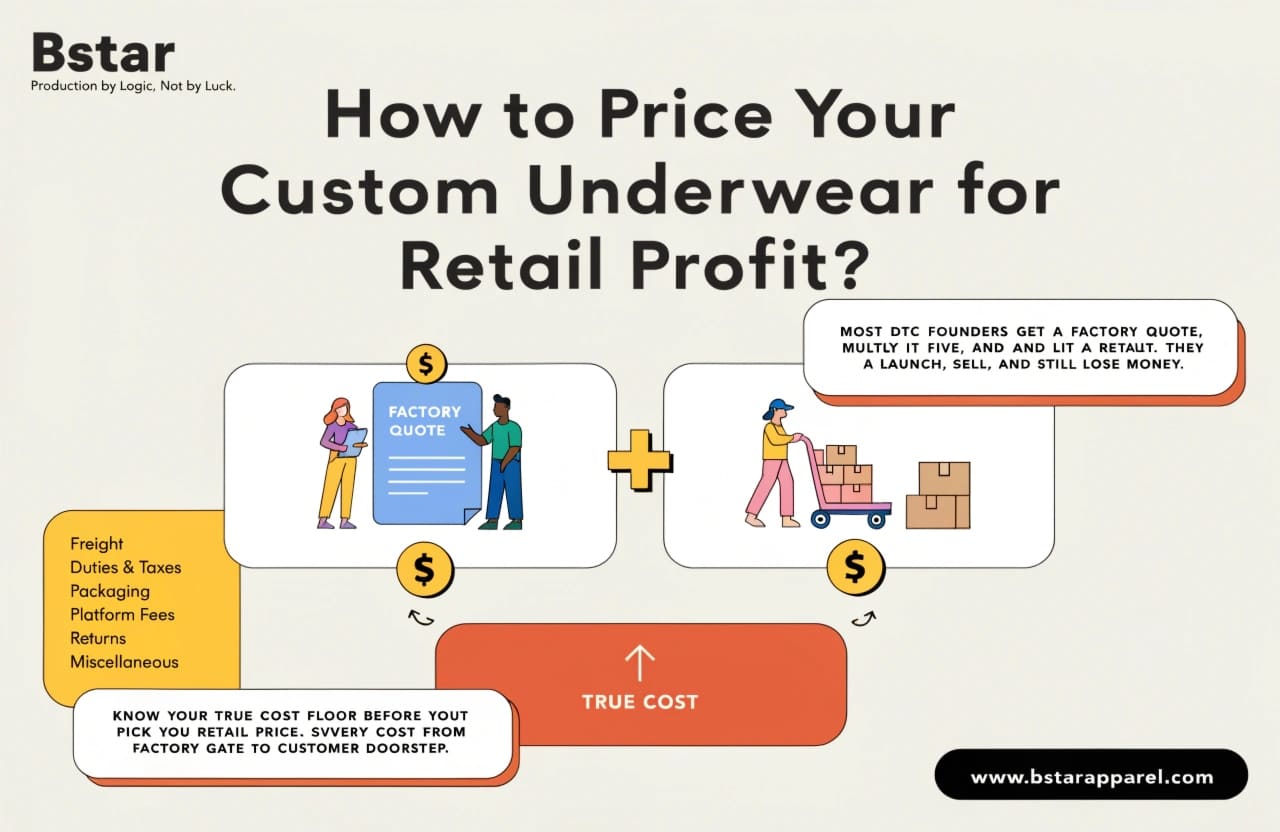
I talk to DTC founders every week who are shocked when their margins disappear after launch. The factory quote looked fine. The multiplier looked fine. But somewhere between the factory and the customer, the money went somewhere else. This article is about finding exactly where that is — before you commit to a price.
Calculating the True Cost: Are You Accounting for Everything?
A lot of founders treat the factory price as the cost. It isn’t. It’s the starting line.
Your real cost base is the factory unit price plus every expense that touches that unit before it reaches your customer. In Chinese knitwear OEM, that stack typically includes inbound freight, import duties, individual packaging, labeling compliance fees, and platform or payment processing charges1. Miss any of these and your margin math is wrong from the start.
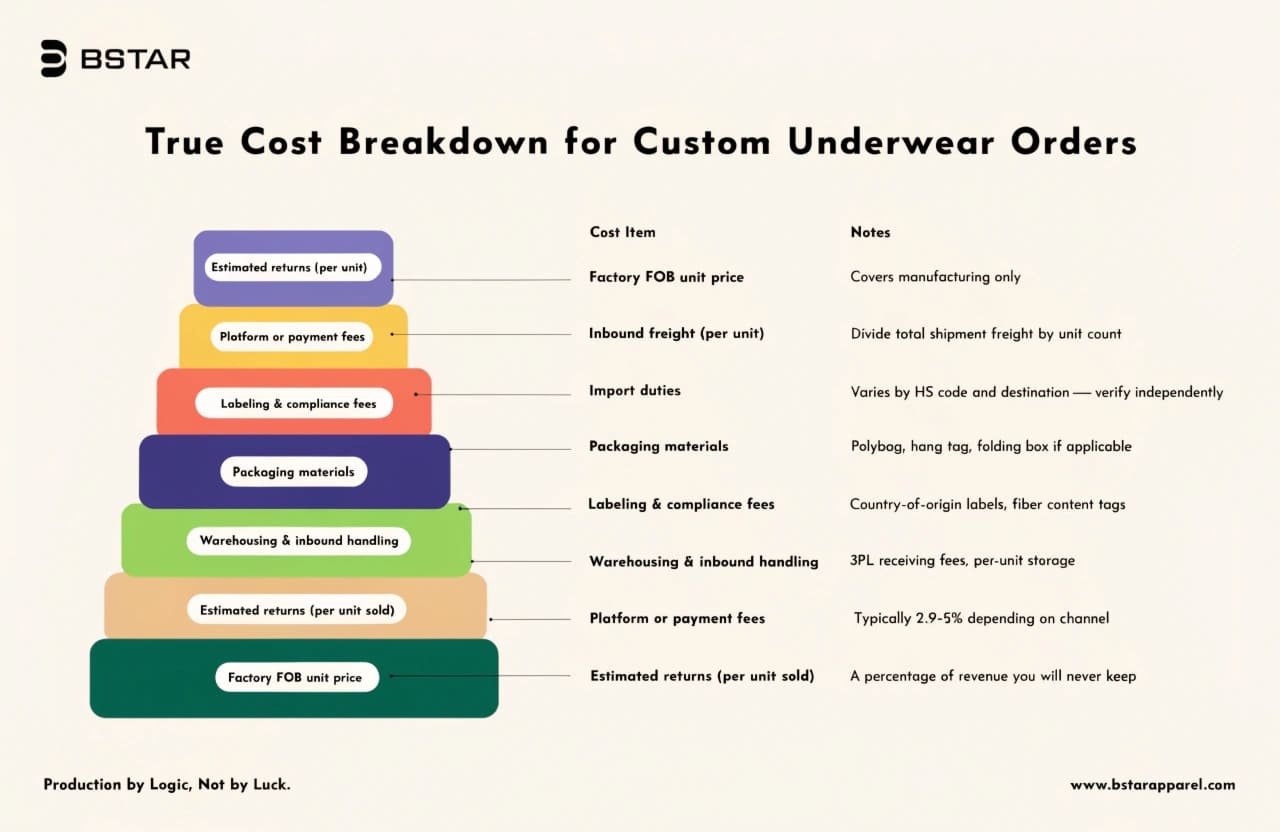
Based on consultations with our clients at BSTAR, the items that get missed most often are not the big ones. Everyone remembers freight. What they forget is the small stuff that adds up: polybags, hang tags, individual folding boxes if the brand uses them, barcode sticker processing, and the 3–4% payment processing fee on every transaction.
Here’s how I suggest building your cost stack:
The Full Landed Cost Checklist
| Cost Item | Notes |
|---|---|
| Factory FOB unit price | Covers manufacturing only |
| Inbound freight (per unit) | Divide total shipment freight by unit count |
| Import duties | Varies by HS code and destination — verify independently |
| Packaging materials | Polybag, hang tag, folding box if applicable |
| Labeling & compliance fees | Country-of-origin labels, fiber content tags2 |
| Warehousing & inbound handling | 3PL receiving fees, per-unit storage |
| Platform or payment fees | Typically 2.9–5% depending on channel |
| Estimated returns (per unit sold) | A percentage of revenue you will never keep |
The returns line is one founders consistently leave out. Underwear return rates vary by channel and customer demographic, but some portion of every order comes back3. That cost gets distributed across all units sold. If you don’t build it in, it will eat into your margin later — and you won’t see it coming until it’s already gone.
Once you have this stack, you have your cost floor. That is the number your retail price must clear. Everything below it is a loss.
Mastering the Markup: Do You Know the Difference Between Margin and Markup?
This one trips up more founders than almost anything else. Margin and markup are not the same number, and confusing them will give you a retail price that looks profitable but isn’t.
Markup is what you add on top of cost. Margin is profit as a percentage of the retail price.4 If your landed cost is $10 and you mark it up 100%, you sell at $20 — but your margin is 50%, not 100%. Using the wrong formula means you think you’re making more than you are.
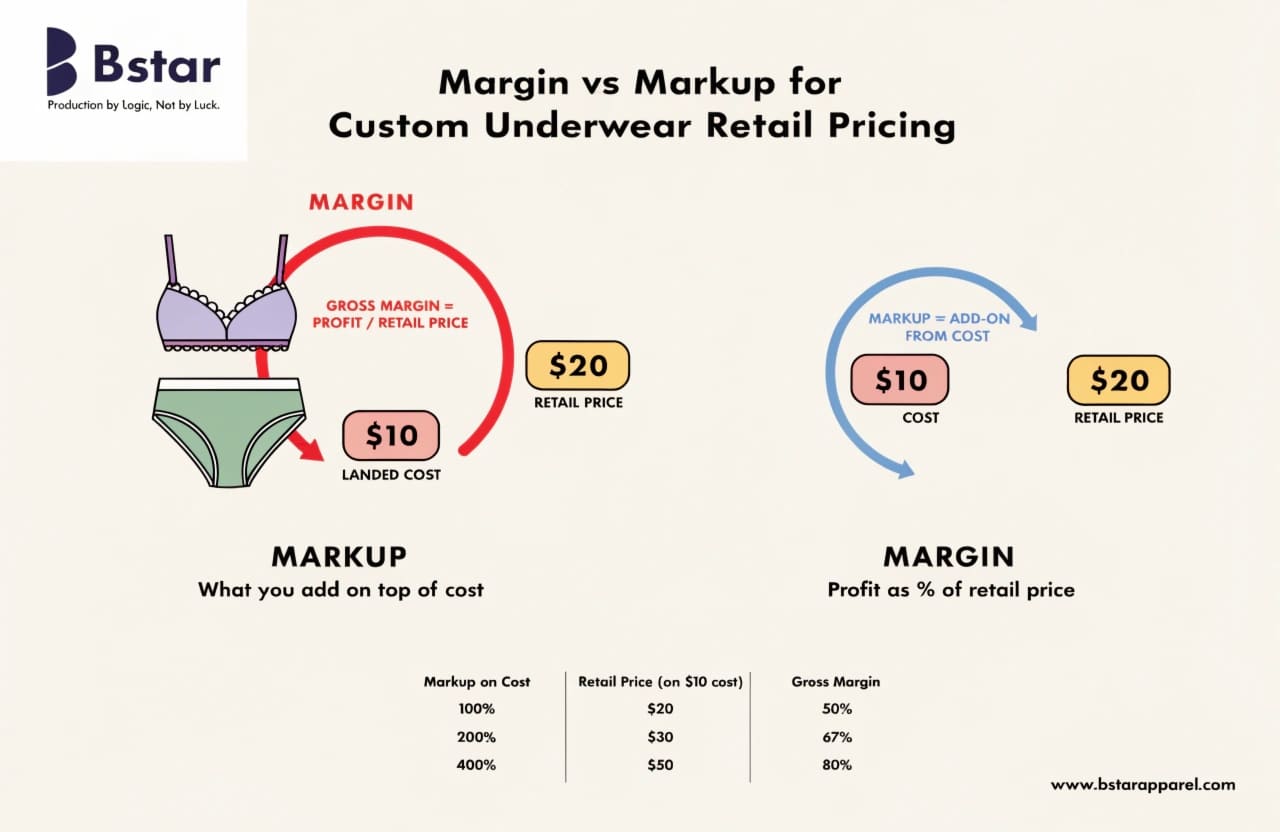
A recurring question I hear from DTC founders is: "I’m using a 3x or 5x multiplier, isn’t that enough?" The honest answer is: it depends on what’s in your cost base. A multiplier applied to an incomplete cost stack is just multiplying the wrong number.
Markup vs. Margin: A Simple Reference
| Markup on Cost | Retail Price (on $10 cost) | Gross Margin |
|---|---|---|
| 100% | $20 | 50% |
| 200% | $30 | 67% |
| 400% | $50 | 80% |
The point is not to tell you which margin to target — that depends on your channel, your overhead, and your business model. The point is to make sure you’re calculating from the right base and using the right formula. Run your numbers using margin (profit ÷ retail price), not just markup on cost, so you actually know what you’re keeping per unit sold.
One more thing worth flagging here: small MOQ orders carry a structural cost penalty in Chinese knitwear OEM5. Based on our client negotiations, the per-unit price difference between a sampling run and a bulk production order is real and significant. If you build your retail price using sample-run unit costs, and then discover that your bulk price doesn’t drop enough to recover that gap, your entire margin model breaks. Run the math on your expected reorder quantity, not just your first order.
Strategic Positioning: Does Your Price Match Your Brand and Your Market?
Your cost floor tells you the minimum. But where you sit above that floor is a strategic question.
Your retail price needs to make sense to three groups at once: your target customer (is it worth it to them?), your competitors (are you positioned correctly?), and your brand story (does the price reflect the value you’re claiming?). A price that satisfies your cost floor but misreads any of these three will still cause problems.
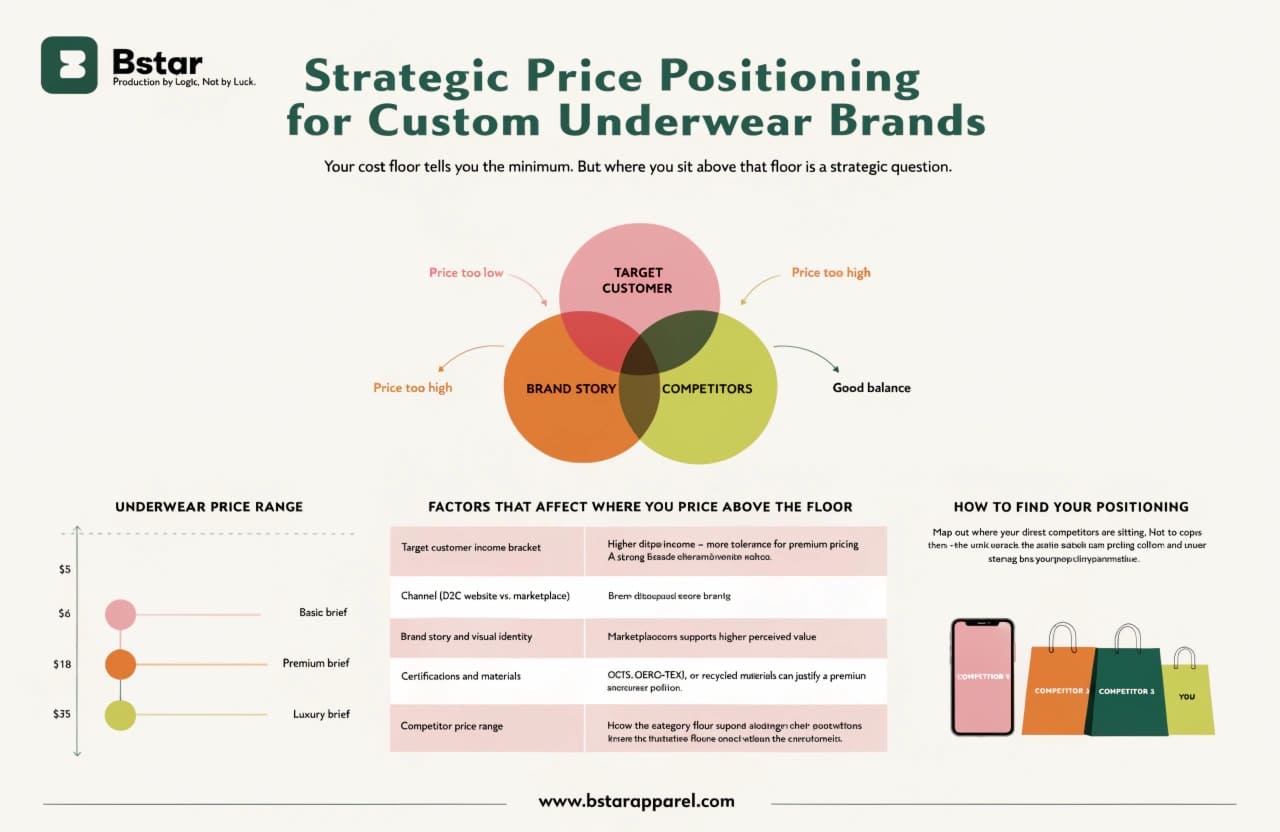
I’ve seen this play out in two directions. Some founders price too low because they’re scared of pushback, and they end up attracting customers who are extremely price-sensitive and hard to retain. Others price high to signal quality, but their brand story and product presentation don’t support it — and conversion suffers.
Positioning Factors That Affect Where You Price Above the Floor
| Factor | What It Means for Your Price |
|---|---|
| Target customer income bracket | Higher disposable income = more tolerance for premium pricing |
| Channel (D2C website vs. marketplace) | Marketplace customers comparison-shop harder6 |
| Brand story and visual identity | A strong brand story supports higher perceived value7 |
| Certifications and materials | GOTS, OEKO-TEX®, or recycled materials can justify a premium8 |
| Competitor price range | Know the category floor and ceiling before you pick your position |
Before you finalize a price, map out where your direct competitors are sitting. Not to copy them — but to understand the category ceiling and floor so you’re making a deliberate positioning choice, not a random one.
The Psychology of Pricing: Can Your Price Structure Do More Work for You?
Once you know your cost floor and your strategic position, how you present the price matters too.
Tiered pricing and charm pricing are not tricks. They are structural decisions that influence how customers perceive value. A $29 price point reads differently than $309. A three-pack at $59 makes the per-unit math feel better than three singles at $21 each, even when the math is identical.
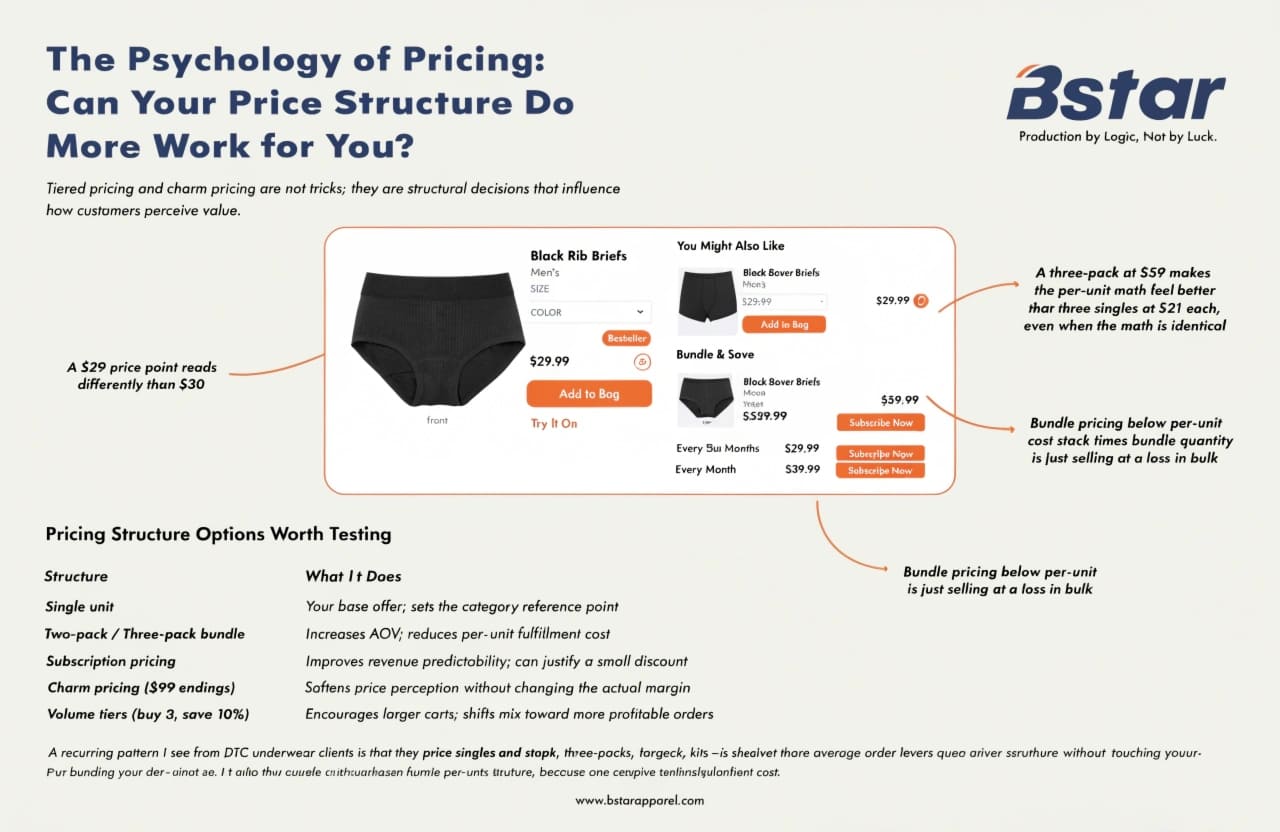
A recurring pattern I see from DTC underwear clients is that they price singles and stop there. But bundling — two-packs, three-packs, starter kits — is one of the most effective levers for improving average order value10 without touching your per-unit cost structure. It also reduces your effective per-order fulfillment cost, because one shipment covers multiple units.
Pricing Structure Options Worth Testing
| Structure | What It Does |
|---|---|
| Single unit | Your base offer; sets the category reference point |
| Two-pack / Three-pack bundle | Increases AOV; reduces per-unit fulfillment cost |
| Subscription pricing | Improves revenue predictability; can justify a small discount |
| Charm pricing ($X9 endings) | Softens price perception without changing the actual margin |
| Volume tiers (buy 3, save 10%) | Encourages larger carts; shifts mix toward more profitable orders |
The key is to design these structures after you know your cost floor — not before. A bundle priced below your per-unit cost stack times the bundle quantity is just selling at a loss in bulk. Run the cost math on each SKU and each bundle configuration separately before you launch any of them.
Conclusion
Know your full cost floor first. Then set your price. In that order, not the other way around.
-
"Pricing & Fees – Stripe", https://stripe.com/pricing. Major payment processors and e-commerce platforms publicly disclose per-transaction fees that typically range from approximately 2.9% plus a fixed amount for standard card transactions, with higher rates applicable on certain marketplace channels (see, e.g., Stripe and Shopify published merchant fee schedules). Evidence role: statistic; source type: other. Supports: That payment processing fees for e-commerce transactions commonly fall within the 2.9–5% range depending on the platform and payment method used.. Scope note: Published fee schedules are subject to change and vary by merchant account tier, transaction volume, and geography; the cited range is illustrative rather than exhaustive. ↩
-
"Threading Your Way Through the Labeling Requirements Under the …", https://www.ftc.gov/business-guidance/resources/threading-your-way-through-labeling-requirements-under-textile-wool-acts. In the United States, the Textile Fiber Products Identification Act (administered by the Federal Trade Commission) requires that textile apparel products bear labels disclosing fiber content, country of manufacture, and manufacturer identity; analogous requirements exist under EU Regulation No 1007/2011 on textile fiber names and labeling (U.S. FTC; European Parliament and Council). Evidence role: historical_context; source type: government. Supports: That apparel imported into major consumer markets such as the United States is subject to mandatory labeling requirements including country-of-origin disclosure and fiber content identification.. ↩
-
"Average Ecommerce Return Rate 2026: 14% DTC, 19% Overall (Up …", https://eightx.co/blog/average-ecommerce-return-rate. Industry research on e-commerce return rates consistently identifies apparel as a high-return category, with online return rates for clothing reported in multiple studies as substantially higher than the cross-category average (see, e.g., National Retail Federation return rate reports or academic studies on e-commerce returns). Evidence role: statistic; source type: research. Supports: That e-commerce apparel products experience meaningful return rates that vary by channel, and that these returns represent a quantifiable cost that should be factored into unit economics.. Scope note: Aggregate apparel return rate data may not reflect underwear specifically, as hygiene policies on many platforms restrict returns of intimate apparel, potentially making published apparel return benchmarks an imperfect proxy. ↩
-
"Profit Margin vs. Markup: Key Differences Explained – Investopedia", https://www.investopedia.com/ask/answers/102714/whats-difference-between-profit-margin-and-markup.asp. In standard accounting terminology, markup refers to the amount added to cost to arrive at a selling price and is expressed as a percentage of cost, whereas gross margin (or gross profit margin) is expressed as a percentage of revenue; the two metrics yield different numerical values for the same transaction (see, e.g., Investopedia or standard managerial accounting references). Evidence role: definition; source type: encyclopedia. Supports: That markup and gross margin are distinct financial metrics: markup is calculated as a percentage of cost, while gross margin is calculated as a percentage of revenue (selling price).. ↩
-
"Minimum Order Quantity (MOQ): Formula, Tips, & Benefits | NetSuite", https://www.netsuite.com/portal/resource/articles/inventory-management/minimum-order-quantity-moq.shtml. Operations management and supply chain literature documents that per-unit production costs decline with increasing order volume due to the amortization of fixed setup costs and efficiency gains from longer production runs, a principle that underlies MOQ requirements in contract manufacturing (see, e.g., standard operations management textbooks on economies of scale in production). Evidence role: mechanism; source type: paper. Supports: That per-unit manufacturing costs decrease as order quantities increase due to fixed cost amortization and production efficiency gains, a principle underlying minimum order quantity requirements in contract manufacturing.. ↩
-
"The Influence of Price on Purchase Intentions – PMC", https://pmc.ncbi.nlm.nih.gov/articles/PMC7911682/. Consumer behavior research on online shopping channels has found that marketplace environments, by aggregating competing sellers on a single interface, facilitate price comparison and are associated with higher price sensitivity among shoppers relative to brand-owned direct channels (see, e.g., research on search costs and price competition in online marketplaces). Evidence role: expert_consensus; source type: paper. Supports: That consumers shopping on third-party marketplace platforms exhibit higher price sensitivity and comparison-shopping behavior than consumers on brand-owned direct channels.. Scope note: The degree of price sensitivity difference between channels varies by product category, brand strength, and marketplace design; the claim is directionally supported but not universally quantified. ↩
-
"An Examination of Loyalty Subcomponents, Product Price Range …", https://pmc.ncbi.nlm.nih.gov/articles/PMC11851547/. Brand equity research documents that strong brand associations, including narrative and identity elements, contribute to consumer perceived value and are associated with greater price tolerance; this relationship is formalized in brand equity frameworks such as those proposed by Keller (1993) in the Journal of Marketing and subsequent empirical work on brand premium pricing. Evidence role: mechanism; source type: paper. Supports: That brand narrative and identity contribute to consumer perceived value, which in turn supports higher willingness to pay, a relationship documented in brand equity and consumer psychology research.. Scope note: The magnitude of the brand story effect on willingness to pay is highly context-dependent and difficult to isolate from product quality, distribution, and marketing spend variables. ↩
-
"Experimental evidence on consumers’ willingness to pay in … – PMC", https://pmc.ncbi.nlm.nih.gov/articles/PMC12589573/. The Global Organic Textile Standard (GOTS) and OEKO-TEX® Standard 100 are internationally recognized certification systems for textile products; both organizations publish documentation describing the standards’ scope and market recognition (Global Organic Textile Standard; OEKO-TEX Association). Evidence role: general_support; source type: institution. Supports: That GOTS and OEKO-TEX® are internationally recognized textile certifications associated with environmental and safety standards that brands use to differentiate products and support premium positioning.. Scope note: Certification body documentation establishes the standards’ existence and scope but does not directly quantify the price premium consumers will pay, which varies by market segment and consumer demographic. ↩
-
"If You Think 9-Ending Prices Are Low, Think Again", https://www.journals.uchicago.edu/doi/abs/10.1086/710241. Research in behavioral economics and consumer psychology has documented that prices ending in 9 are systematically perceived as lower than marginally higher round-number prices, an effect attributed to left-digit anchoring in numerical cognition (see, e.g., Thomas and Morwitz, ‘Penny Wise and Pound Foolish,’ Journal of Consumer Research, 2005). Evidence role: mechanism; source type: paper. Supports: That prices ending in 9 (charm prices) are perceived differently by consumers than round-number prices, a phenomenon documented in consumer psychology and behavioral economics research.. ↩
-
"Utilizing Bundling Strategies to Increase Sales Revenue", https://www.udel.edu/content/dam/udelImages/canr/pdfs/extension/factsheets/Direct-to-Consumer-Product-Bundling.pdf. Marketing literature on bundle pricing documents that offering products in multi-unit configurations can increase average transaction value by shifting consumer reference points and improving perceived value per unit (see, e.g., Stremersch and Tellis, ‘Strategic Bundling of Products and Prices,’ Journal of Marketing, 2002). Evidence role: mechanism; source type: paper. Supports: That product bundling strategies are associated with higher average transaction values and are a recognized pricing tactic in marketing and retail research.. Scope note: Academic bundling research is conducted across diverse product categories; effects specific to intimate apparel DTC channels may differ from general findings. ↩