
How to Sell Custom Underwear on Amazon: Requirements and Tips
Selling custom underwear on Amazon sounds simple. Pick a product, find a supplier, list it. But most sellers who try this hit a wall fast—and it usually costs them money before they figure out why.
To sell custom underwear on Amazon, you need to clear three things before you source a single unit: category access approval, compliant product labeling from your supplier, and verified material certifications. Get any one of these wrong and your listing gets suppressed, or worse, removed after you’ve already shipped inventory.
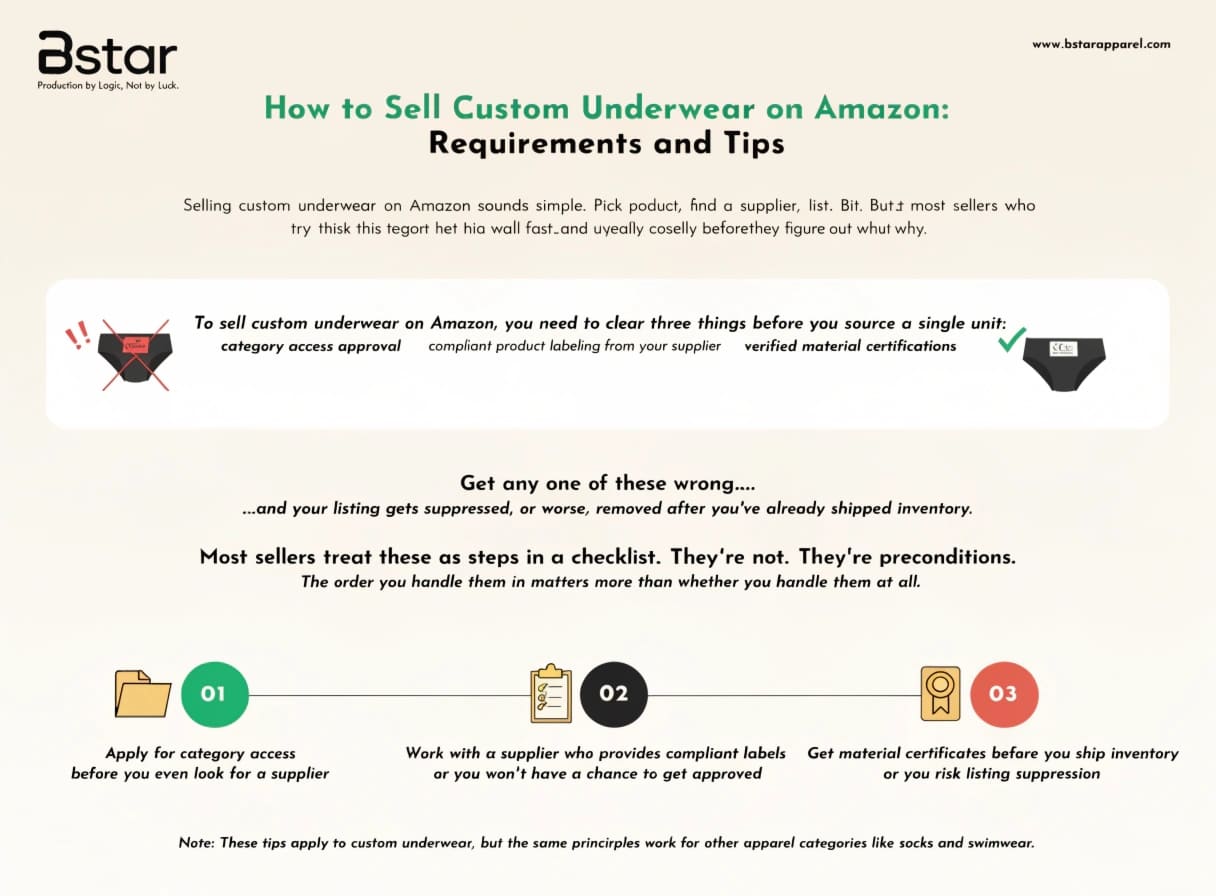
Most sellers treat these as steps in a checklist. They’re not. They’re preconditions. The order you handle them in matters more than whether you handle them at all. I’ll walk you through each one—and explain what actually goes wrong when sellers skip ahead.
You find a great supplier. You design the product. You go to create the listing—and Amazon tells you the category is restricted. Now what?
Amazon gates the intimate apparel category. To list underwear, you typically need prior sales history on the platform, compliance documentation, and in some cases, brand registry.1 As of current policy, requirements vary by marketplace and product type—always verify your specific situation directly in Seller Central before committing to a product.
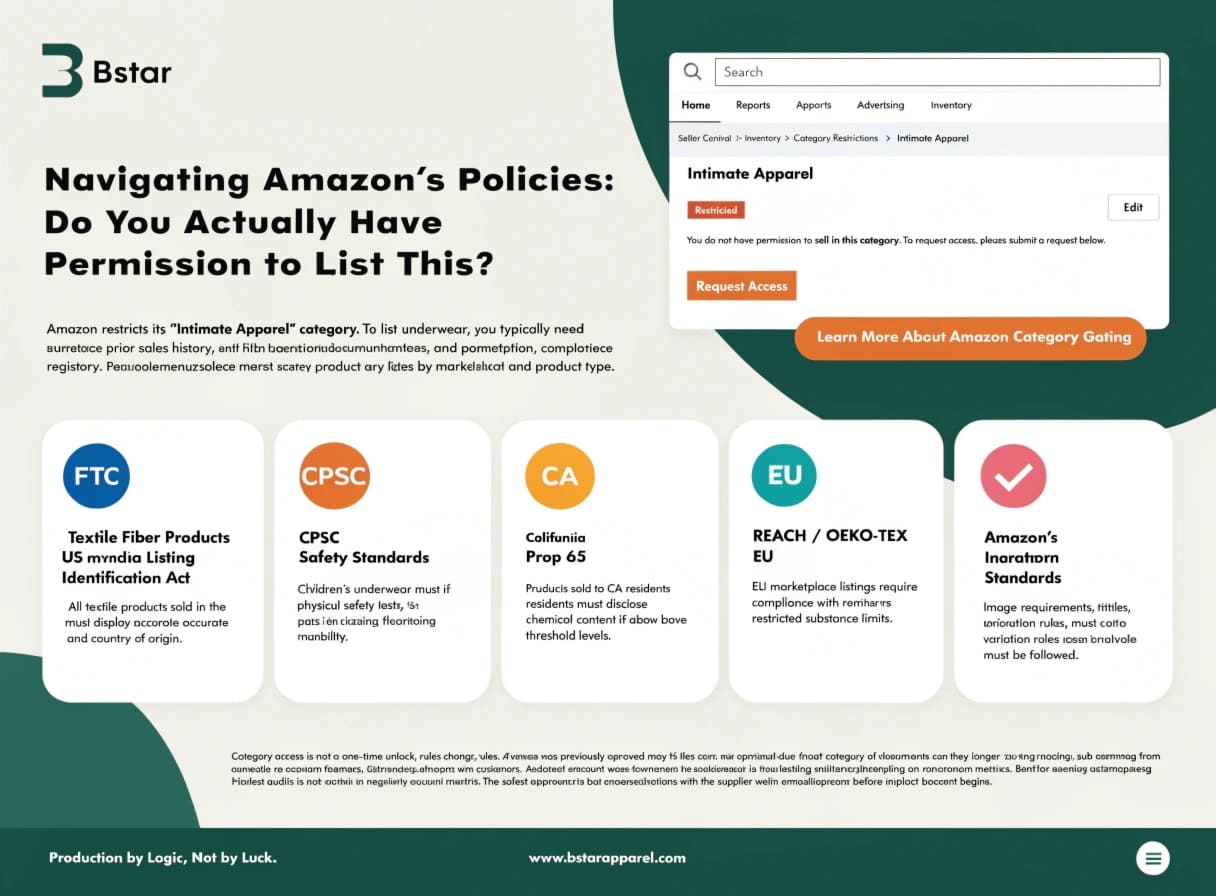
Here’s what makes this harder than it sounds. Category access is not a one-time unlock. Amazon’s gating rules change. A seller who got approved twelve months ago may find that new sub-category rules now apply to their SKUs. If you treat approval as a checkbox you ticked once during setup, you’re exposed to sudden de-listing—even on products that have been live for months.
What does "compliant" actually mean for intimate apparel?
The word "compliant" does a lot of heavy lifting in this category. Let’s break it down.
| Requirement | What It Covers | Who It Applies To |
|---|---|---|
| FTC Textile Fiber Products Identification Act2 | Fiber content labeling, country of origin | All textile products sold in the US |
| CPSC Safety Standards3 | Physical safety testing, flammability | Children’s underwear specifically |
| California Prop 654 | Chemical content disclosure | Products sold to California residents |
| EU REACH / OEKO-TEX5 | Restricted substance limits | EU marketplace listings |
| Amazon’s own listing standards | Image requirements, title format, variation rules | All Amazon sellers globally |
A seller without verified fiber content labeling may find their product flagged during a listing audit or, worse, receive a return wave from customers who notice the label doesn’t match the listing copy. Both outcomes hit your account health metrics. The safest move is to confirm every label specification with your supplier before sampling begins—not after the bulk order ships.
One thing buyers who’ve worked with us at BSTAR often ask early in the consultation is: "Can you put our label spec in the tech pack?" That question tells me the seller is thinking the right way. Label compliance is a production spec, not a packaging afterthought.
Leveraging Amazon Custom: Can You Actually Offer Personalization on This Platform?
You want to sell underwear with custom text, monograms, or unique configurations. Amazon Custom is the program that makes this possible—but it comes with its own setup requirements.
Amazon Custom lets sellers offer personalized products through text input, image upload, or product configuration options. To use it, you need Brand Registry enrollment, a professional seller account, and product listings that meet the program’s content guidelines.6 Custom intimate apparel listings face the same category restrictions as standard listings.
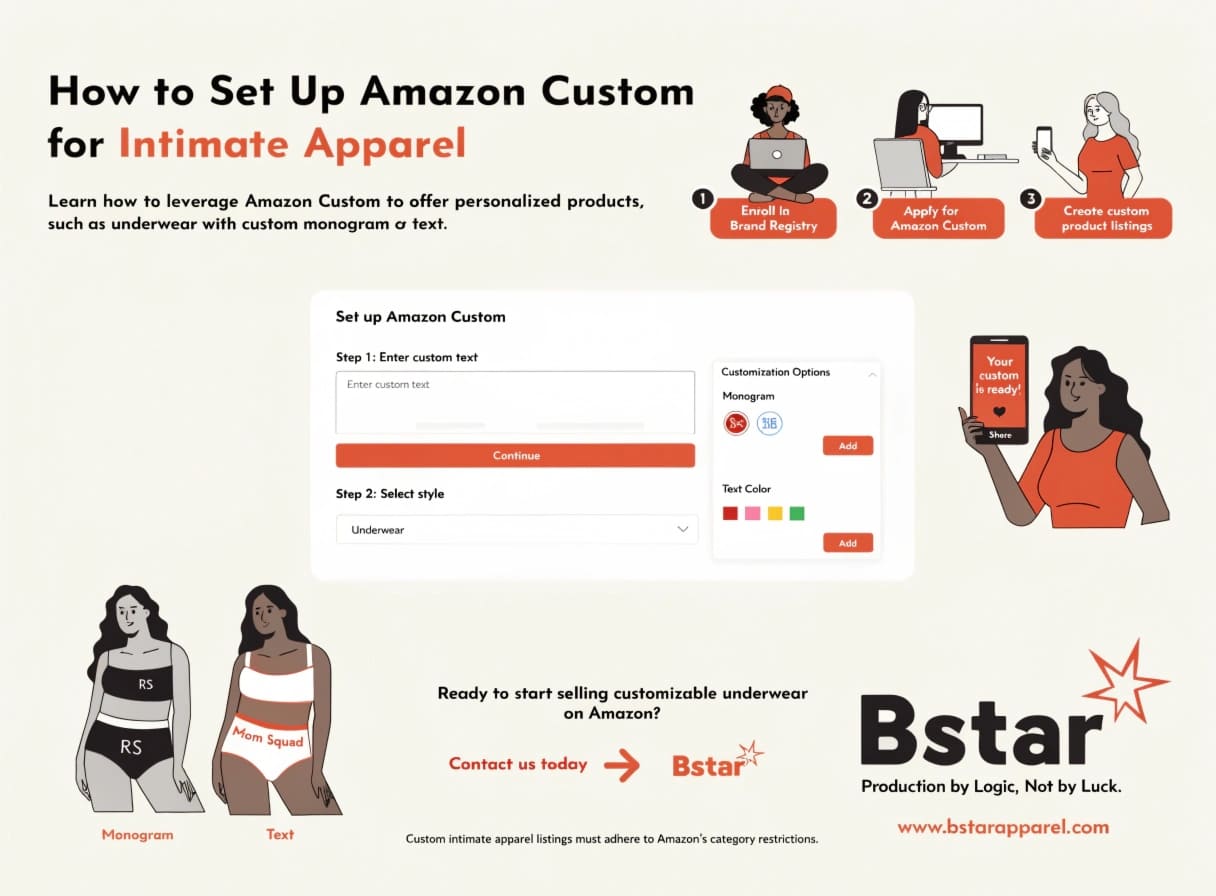
The practical challenge here is production lead time. Standard Amazon customer expectations are built around fast fulfillment. Custom products take longer to produce.7 If your supplier needs 15 days to produce a personalized unit, and your listing sets a 5-day delivery promise, you have a problem before the first order comes in.
Matching your production timeline to Amazon Custom’s requirements
This is where your supplier relationship directly affects your listing performance.
| Production Variable | Impact on Amazon Custom Listing |
|---|---|
| Sampling lead time | Affects how fast you can test new custom options |
| Per-unit customization capability | Determines which personalization types you can offer |
| MOQ for custom runs | Affects whether you can offer true 1-unit customization |
| Certification documentation at SKU level | Required for listing claims and dispute defense |
At BSTAR, we support small-batch development starting from one piece, with sampling completed in 7 to 15 days. When buyers ask whether we can support Amazon Custom workflows, the honest answer is: yes, but your listing’s promised lead time needs to match what we actually produce. Sellers who misalign these two things end up with late shipment metrics that Amazon penalizes directly.
If you’re offering custom underwear through Amazon Custom, build your fulfillment promise around your supplier’s real production window—not the window you wish existed.
Optimizing for Discovery: How Do You Get Found in a Competitive Category?
Underwear is one of the most competitive apparel categories on Amazon. Custom underwear is a narrower niche—but you still need to compete for search visibility.
Amazon SEO for custom underwear depends on keyword-specific titles, backend search terms that match real buyer intent, and main images that meet Amazon’s white-background requirements. Listings that include verified material claims—such as OEKO-TEX or organic cotton certification—tend to perform better in both conversion and A-to-z claim defense.
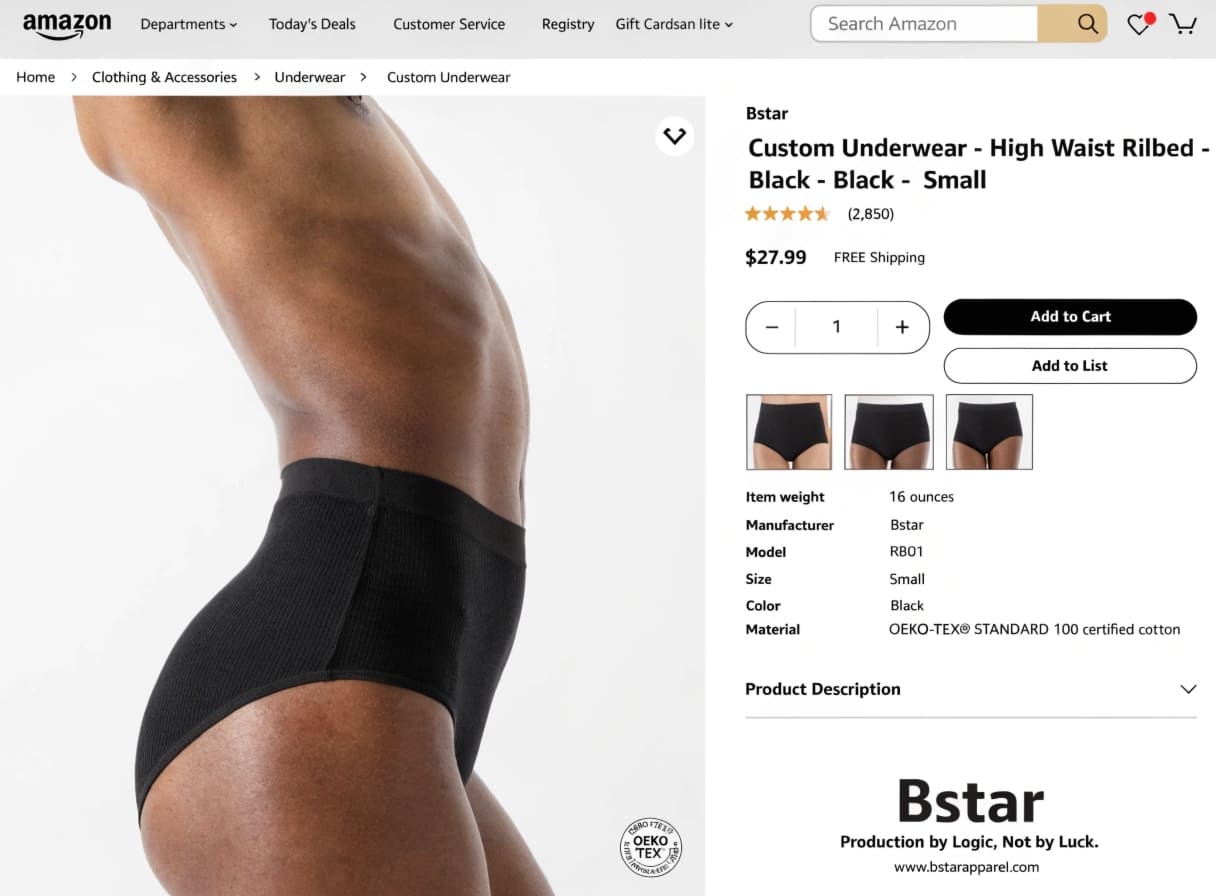
Here’s where certifications stop being a compliance topic and start being a marketing asset.
Why material certifications improve listing performance
Many sellers think of OEKO-TEX, GOTS, or GRS certifications as documents you keep on file in case Amazon asks. That’s too narrow a view. These certifications give you listing copy you can stand behind—and they reduce your exposure to buyer disputes about material safety.
| Certification | What It Verifies | Listing Benefit |
|---|---|---|
| OEKO-TEX Standard 1008 | No harmful substances in finished product | Supports "skin-safe" and "tested for harmful substances" claims |
| GOTS (Global Organic Textile Standard)9 | Organic fiber content and processing | Supports "certified organic cotton" claims |
| GRS (Global Recycled Standard)10 | Recycled material content | Supports sustainability claims in listing copy |
| BSCI | Supplier social compliance | Not a listing claim, but relevant for brand reputation |
The key word in that table is "supports." Amazon’s advertising policies and A-to-z guarantee process increasingly scrutinize unverified product claims.11 A listing that says "organic cotton underwear" without documentation behind it is a liability. A listing that says the same thing with a GOTS certificate at the SKU level from your supplier is defensible.
When I’m in production consultations with buyers sourcing for Amazon, I always ask: do you need the certification documents in a format you can submit to Amazon’s verification process? The answer is almost always yes—but they didn’t know to ask until that moment.
Streamlining Operations: How Do You Actually Fulfill Custom Underwear on Amazon?
Getting approved and getting listed is one problem. Running the operation after launch is a different problem entirely.
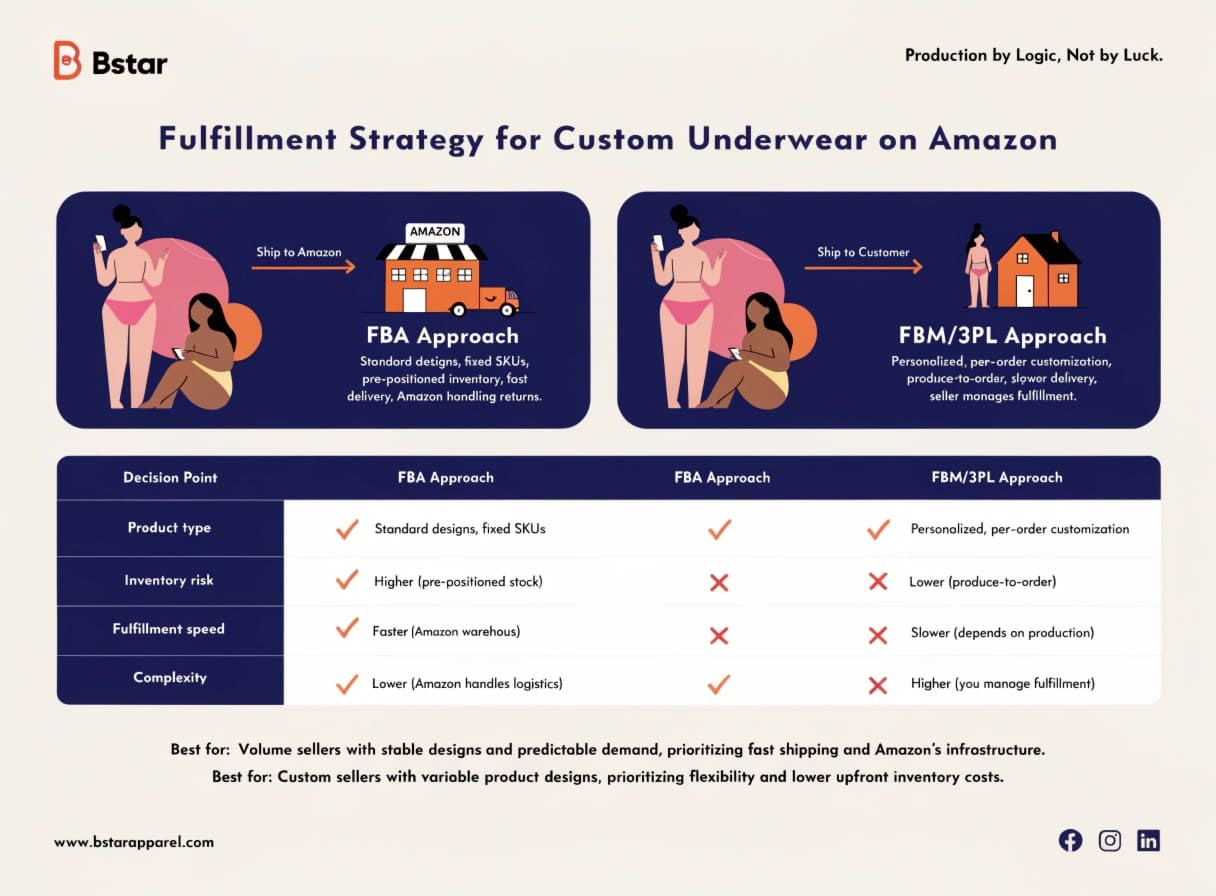
For custom underwear on Amazon, fulfillment strategy depends on your customization type. Standard designs can use FBA with pre-positioned inventory. Truly personalized items—with unique text or images per order—typically require FBM or a third-party logistics partner who can handle per-unit customization before shipment.
The operational risk that most early-stage sellers underestimate is return management. Underwear has specific return policy nuances on Amazon—and custom underwear adds another layer because personalized items are typically non-returnable. Setting customer expectations clearly in your listing is not optional.
Building an operation that matches what you promised
| Decision Point | FBA Approach | FBM/3PL Approach |
|---|---|---|
| Product type | Standard designs, fixed SKUs | Personalized, per-order customization |
| Inventory risk | Higher (pre-positioned stock) | Lower (produce-to-order) |
| Fulfillment speed | Faster (Amazon warehouse) | Slower (depends on production) |
| Complexity | Lower (Amazon handles logistics) | Higher (you manage fulfillment) |
| Best for | Volume sellers with stable designs | Custom sellers with variable output |
One thing that consistently comes up in conversations with buyers preparing for Amazon launch is reorder lead time. If you’re running FBA, you need to restock before you run out—and with a supplier overseas, that means planning 45 to 60 days ahead on popular SKUs.12 Sellers who wait until they’re nearly out of stock pay rush fees or lose the Buy Box during a stockout.
The practical fix is simple: build a reorder trigger into your inventory management, and confirm your supplier’s standard production lead time before your first bulk order—not during your second.
Conclusion
Sell custom underwear on Amazon the right way: verify category access first, lock in compliant specs with your supplier second, then build your listing and fulfillment around what you can actually deliver.
-
"Condition guidelines: Intimate apparel – Amazon Seller Central", https://sellercentral.amazon.com/help/hub/reference/external/GW7MDHNEC3U8Q6V6?locale=en-US. Amazon’s Seller Central help documentation outlines category-specific approval requirements, including the submission of invoices, compliance certificates, and in some cases demonstrated sales history, for restricted categories such as intimate apparel. Evidence role: definition; source type: institution. Supports: That Amazon restricts certain product categories and requires sellers to meet specific criteria—such as sales history and documentation—before listing in those categories.. Scope note: Exact requirements vary by marketplace and are subject to change; the source reflects policy at a specific point in time and may not capture the most current gating criteria. ↩
-
"The Textile Products Identification Act | Federal Trade Commission", https://www.ftc.gov/legal-library/browse/rules/textile-products-identification-act-text. The Federal Trade Commission’s Textile Fiber Products Identification Act (15 U.S.C. § 70 et seq.) requires that textile products sold in the United States bear labels disclosing fiber content by percentage and country of origin, among other requirements. Evidence role: definition; source type: government. Supports: That the FTC Textile Fiber Products Identification Act mandates fiber content labeling and country of origin disclosure on textile products sold in the United States.. ↩
-
"Children’s Sleepwear Regulations | CPSC.gov", https://www.cpsc.gov/Business–Manufacturing/Business-Education/Business-Guidance/Childrens-Sleepwear-Regulations-OLD. The Consumer Product Safety Commission (CPSC) enforces flammability standards for children’s sleepwear and apparel under 16 C.F.R. Parts 1615 and 1616, with testing and labeling requirements that may apply to certain children’s underwear depending on product classification. Evidence role: definition; source type: government. Supports: That the Consumer Product Safety Commission enforces flammability and physical safety standards applicable to children’s textile products, including underwear.. Scope note: The applicability of specific CPSC standards to children’s underwear versus sleepwear depends on product classification; sellers should consult CPSC guidance directly to determine which standards apply to their specific SKUs. ↩
-
"About Proposition 65 – OEHHA – CA.gov", https://oehha.ca.gov/proposition-65/about-proposition-65. California’s Safe Drinking Water and Toxic Enforcement Act of 1986 (Proposition 65), administered by the Office of Environmental Health Hazard Assessment (OEHHA), requires businesses to provide clear and reasonable warnings before knowingly exposing any individual to chemicals listed as known to cause cancer or reproductive harm, a requirement that extends to consumer products including apparel. Evidence role: definition; source type: government. Supports: That California’s Safe Drinking Water and Toxic Enforcement Act (Proposition 65) requires businesses to provide warnings before knowingly exposing individuals to listed chemicals, including those that may be present in textile products.. Scope note: Warning obligations under Prop 65 are triggered by specific chemical exposure thresholds; the article’s characterization as a general ‘chemical content disclosure’ requirement is a simplification of a more nuanced regulatory framework. ↩
-
"REACH Compliance in Textiles: A Guide", https://blog.qima.com/textile/reach-compliance-for-textiles. The European Chemicals Agency (ECHA) administers REACH (Registration, Evaluation, Authorisation and Restriction of Chemicals, Regulation EC No 1907/2006), which imposes legally binding restrictions on hazardous substances in articles including textiles sold in the EU; OEKO-TEX Standard 100, by contrast, is a voluntary third-party certification issued by the OEKO-TEX Association that tests finished textile products against a defined list of harmful substances. Evidence role: definition; source type: institution. Supports: That EU REACH is a binding regulation restricting hazardous substances in textile products sold in the EU, while OEKO-TEX Standard 100 is a voluntary certification that tests for harmful substances.. Scope note: The article groups these two requirements together, which may obscure the distinction between mandatory regulatory compliance (REACH) and voluntary certification (OEKO-TEX); sellers should treat these as separate obligations. ↩
-
"Amazon Brand Registry", https://sell.amazon.com/brand-registry. Amazon’s Amazon Custom program documentation specifies that sellers must hold a professional selling account and be enrolled in Amazon Brand Registry to access personalization features including text customization, image upload, and product configuration options. Evidence role: definition; source type: institution. Supports: That participation in Amazon Custom requires Brand Registry enrollment and a professional selling account, in addition to meeting content guidelines.. Scope note: Program requirements are subject to change; sellers should verify current eligibility criteria directly in Seller Central, as the article notes requirements may vary by marketplace. ↩
-
"Amazon may promise fast package delivery, but research shows that …", https://www.hks.harvard.edu/faculty-research/policy-topics/education-training-labor/amazon-may-promise-fast-package-delivery. Research on e-commerce consumer behavior consistently documents that delivery speed is a primary driver of customer satisfaction and purchase decisions on marketplace platforms, with studies noting that Amazon Prime’s two-day delivery standard has materially shifted baseline consumer expectations across online retail. Evidence role: statistic; source type: research. Supports: That online shoppers, particularly on Amazon, have developed expectations for rapid order fulfillment that may conflict with the production timelines required for made-to-order or customized products.. Scope note: General e-commerce delivery expectation research may not directly measure Amazon Custom buyer behavior specifically; the claim is supported contextually rather than by direct evidence about custom product categories. ↩
-
"OEKO-TEX® STANDARD 100", https://www.oeko-tex.com/en/our-standards/oeko-tex-standard-100/. The OEKO-TEX Association’s Standard 100 certification tests every component of a finished textile article—including threads, buttons, and prints—against a list of over 100 substances harmful to human health, with stricter limits applied to products intended for direct skin contact such as underwear. Evidence role: definition; source type: institution. Supports: That OEKO-TEX Standard 100 is a third-party certification that tests every component of a finished textile product for harmful substances against a defined list of criteria.. ↩
-
"Certification – GOTS – Global Organic Textile Standard", https://global-standard.org/certification-and-labelling/certification. The Global Organic Textile Standard (GOTS), administered by the Global Standard gGmbH, requires that textile products contain a minimum percentage of certified organic fibers and that all processing stages meet defined environmental and social criteria; products meeting the highest threshold may be labeled ‘organic’ while those meeting a lower threshold may be labeled ‘made with organic’ materials. Evidence role: definition; source type: institution. Supports: That the Global Organic Textile Standard (GOTS) certifies both the organic status of fiber content and the environmental and social criteria met throughout the textile processing chain.. Scope note: GOTS certification applies to the supply chain and processing stages, not only to fiber content; the article’s description as covering ‘organic fiber content and processing’ is accurate but simplified. ↩
-
"Global Recycled Standard (GRS) Certification – SCS Global Services", https://www.scsglobalservices.com/services/global-recycled-standard. The Global Recycled Standard (GRS), administered by Textile Exchange, is an international, voluntary standard that sets requirements for third-party certification of recycled content, chain of custody, social and environmental processing practices, and chemical restrictions in textile and apparel products. Evidence role: definition; source type: institution. Supports: That the Global Recycled Standard (GRS) is a third-party certification that verifies recycled material content in products and supply chains.. ↩
-
"Misleading and prohibited claims – Amazon Seller Central", https://sellercentral.amazon.com/help/hub/reference/external/G202024200?locale=en-US. Amazon’s Seller Central policies prohibit listings that contain false, misleading, or unsubstantiated claims, and the Amazon A-to-z Guarantee allows buyers to file claims when a product does not match its listing description; sellers found in violation may face listing removal or account suspension. Evidence role: general_support; source type: institution. Supports: That Amazon maintains policies requiring sellers to substantiate product claims in listings and that the A-to-z Guarantee process can be triggered by disputes over product accuracy.. Scope note: The article’s characterization of ‘increasing’ scrutiny implies a documented trend; this citation supports the existence of the policy framework but does not independently verify that enforcement intensity has increased over a specific period. ↩
-
"Amazon FBA Inventory Management: Restock Timing, Fees & Limits …", https://upzonehq.com/academy/amazon/amazon-fba-inventory-management/. Supply chain research on apparel importing indicates that total lead times from overseas manufacturers—encompassing production, quality control, ocean freight, customs clearance, and warehouse receiving—commonly range from 30 to 90 days depending on origin country, shipping method, and seasonal demand, supporting the article’s recommendation to initiate reorders well in advance of projected stockout dates. Evidence role: general_support; source type: research. Supports: That importing goods from overseas manufacturers to Amazon FBA fulfillment centers involves multi-week lead times encompassing production, quality inspection, freight, customs clearance, and inbound processing.. Scope note: The specific 45-to-60-day figure cited in the article is a general estimate; actual lead times vary significantly based on supplier location, production complexity, shipping mode, and port congestion, and should be confirmed with the specific supplier before use in inventory planning. ↩