
Wholesale vs. Direct-to-Consumer: Which Model Should Your Underwear Brand Actually Choose?
Most founders frame this as a margin question. It isn’t. The real question is whether your supply chain can support the operational rhythm that each model demands.
Wholesale and DTC are both viable channels for underwear brands. Wholesale gives you volume and retail reach at compressed margins. DTC gives you higher margins and customer data, but higher operational overhead. The right choice depends less on profit math and more on how your inventory and production are set up.
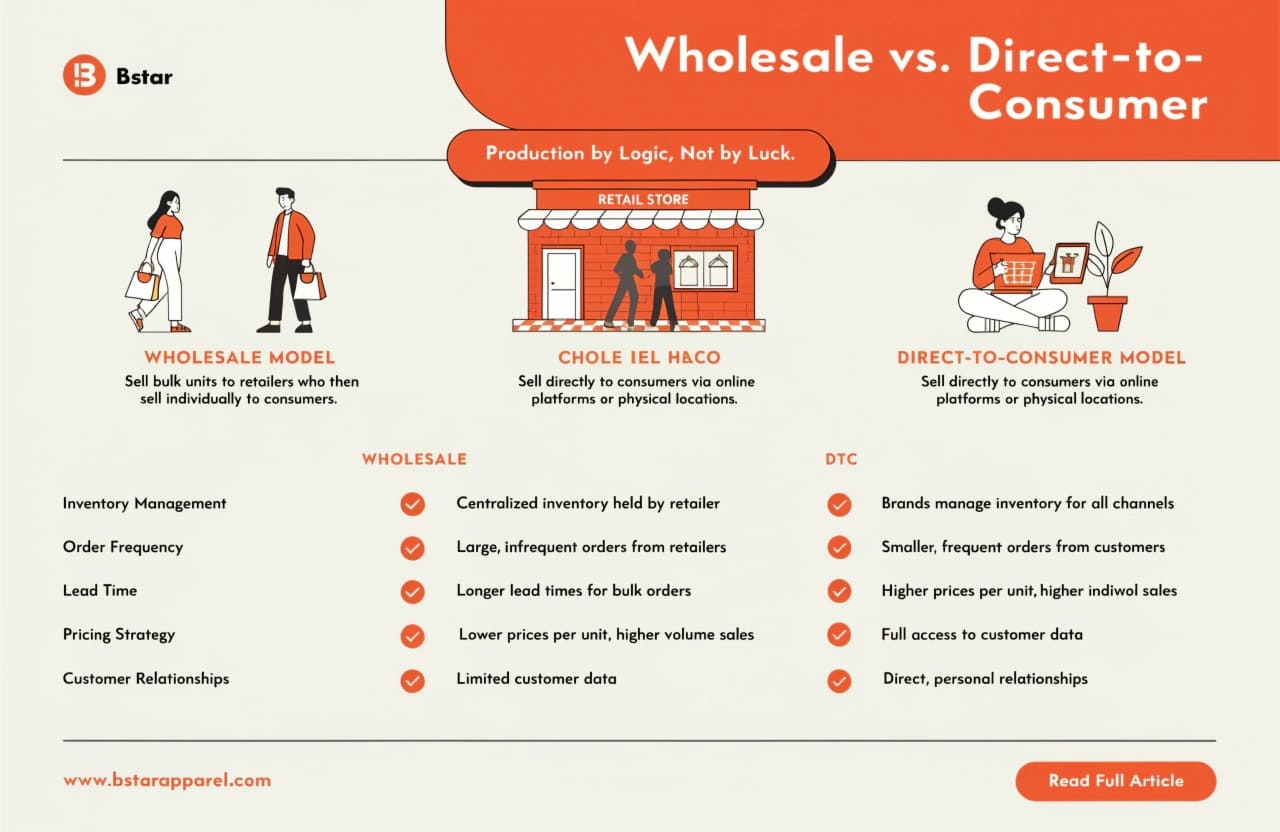
We manufacture for brands on both sides of this split. Some clients sell through retail partners. Others sell entirely through their own online stores. The channel decision they make changes everything about how we work with them — MOQ requirements, reorder windows, sampling speed. This article breaks down what actually differs between the two models, from a production and supply chain standpoint.
What Are Wholesale and DTC, Really?
Founders sometimes mix up the terms, so let’s be clear before going further.
Wholesale means you sell inventory to a retailer at a lower per-unit price. The retailer marks it up and sells to the end customer. DTC means you sell directly to the end customer, usually through your own website, and keep the full retail margin yourself.
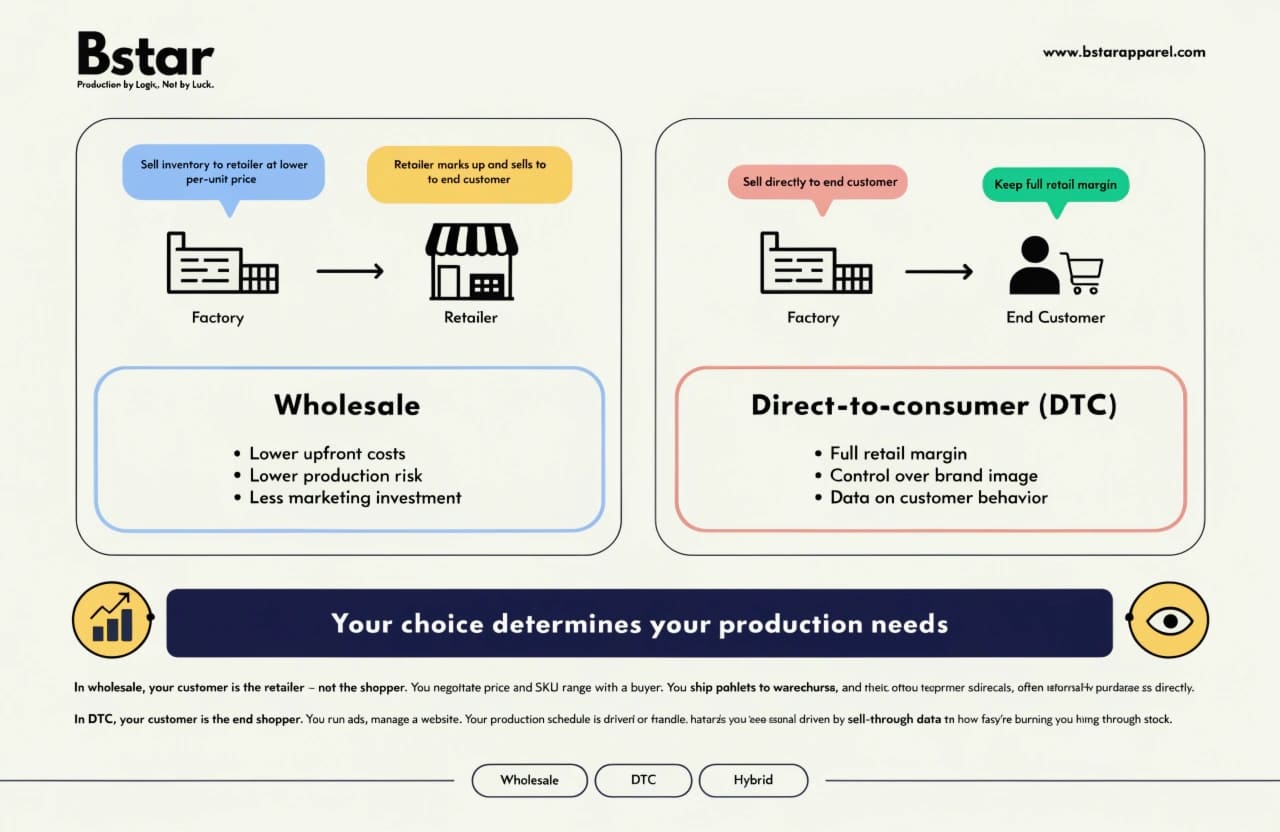
These aren’t just different pricing structures. They’re different operating systems for your entire business.
How the two models actually work in practice
In wholesale, your customer is the retailer — not the shopper. You negotiate price and SKU range with a buyer.1 You ship pallets to a warehouse or store. Your production schedule is driven by purchase orders, often seasonal.2
In DTC, your customer is the end shopper. You run ads, manage a website, handle returns, and talk to customers directly. Your production schedule is driven by sell-through data and how fast you’re burning through stock.
Here’s a simple side-by-side:
| Factor | Wholesale | DTC |
|---|---|---|
| Who you sell to | Retailer | End customer |
| Price control | Low (retailer sets retail price) | High (you set the price) |
| Order predictability | Higher | Lower |
| Relationship with end customer | None | Direct |
| Production planning | Seasonal | Continuous |
The model you choose shapes everything downstream — and it shapes what you need from your manufacturer.
Margins and Profitability: Is DTC Actually More Profitable?
On paper, DTC looks like the obvious winner. You keep the full retail margin instead of splitting it with a retailer.
Wholesale margins typically run 40–60% of retail price. DTC margins can reach 65–75%.3 But DTC brands carry costs that wholesale brands don’t — customer acquisition, returns logistics, and customer service. When those are added back, the real margin gap closes fast.
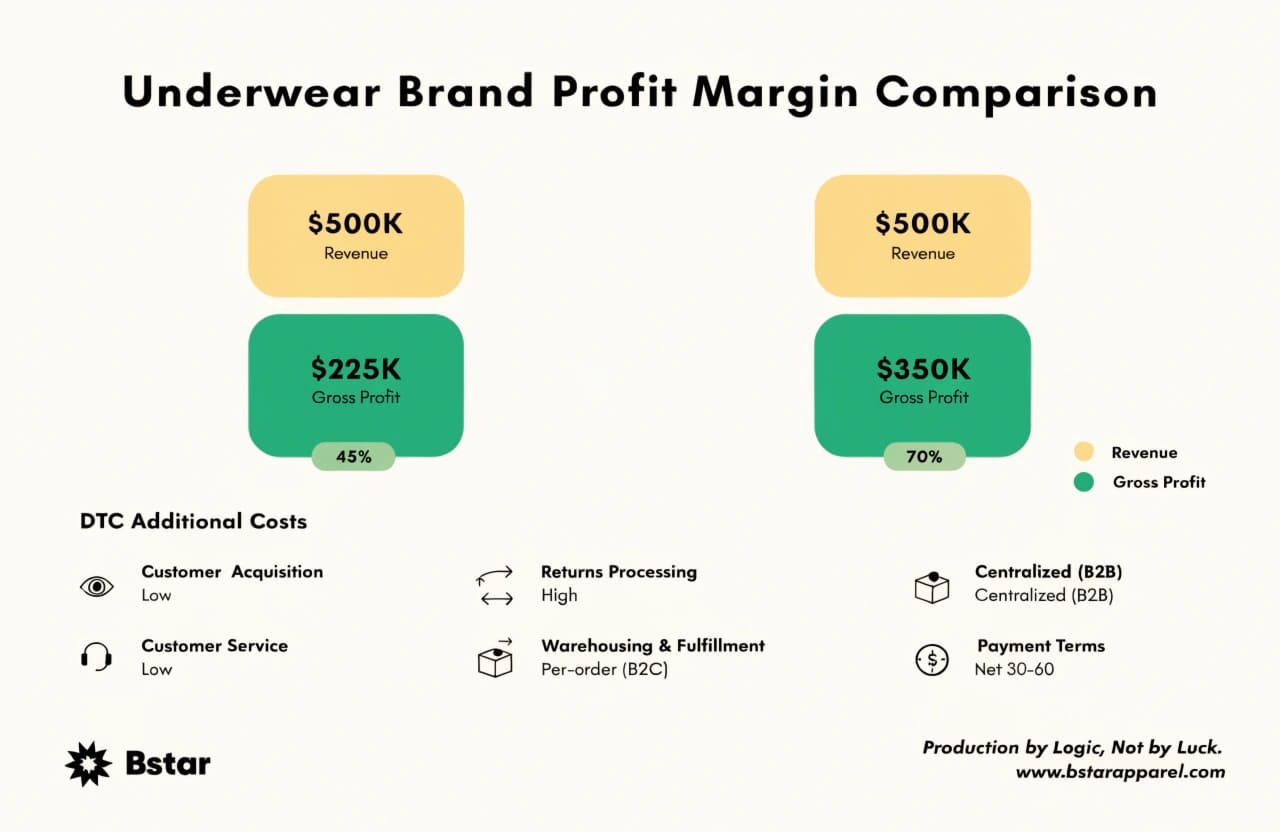
Brands we’ve worked with have found that the DTC margin advantage is real at scale — but fragile in the early stages. Here’s why.
The full cost of selling direct
A wholesale brand ships a large order and gets paid. A DTC brand has to earn every customer individually.
| Cost Category | Wholesale | DTC |
|---|---|---|
| Customer acquisition (ads, content) | Low | High |
| Returns processing | Low | High |
| Customer service | Low | High |
| Warehousing and fulfillment | Centralized (B2B) | Per-order (B2C) |
| [Payment terms | Net 30–60 | Immediate](https://www.jpmorgan.com/insights/banking/commercial-banking/net-payment-terms-benefits-of-net-30-60-90-terms)[^4] |
A DTC brand spending $15 to acquire a customer who spends $40 on a single pair of underwear is not running a profitable business — even at 70% gross margin.4 Wholesale at 45% margin with a $50,000 purchase order and no CAC can generate more actual cash.
The honest answer is: DTC has better unit economics only if your customer acquisition cost is under control and your return rate is low. For most early-stage brands, neither of those is guaranteed.
Brand Control and Customer Data: What You Gain and What You Give Up
This is where DTC has a genuine, structural advantage that wholesale can’t match.
DTC brands own their customer relationship. They collect purchase data, email addresses, and behavioral data. Wholesale brands hand that relationship to the retailer.5 Over time, this data gap becomes a competitive disadvantage — DTC brands can remarket, retain, and upsell in ways wholesale brands simply can’t.6
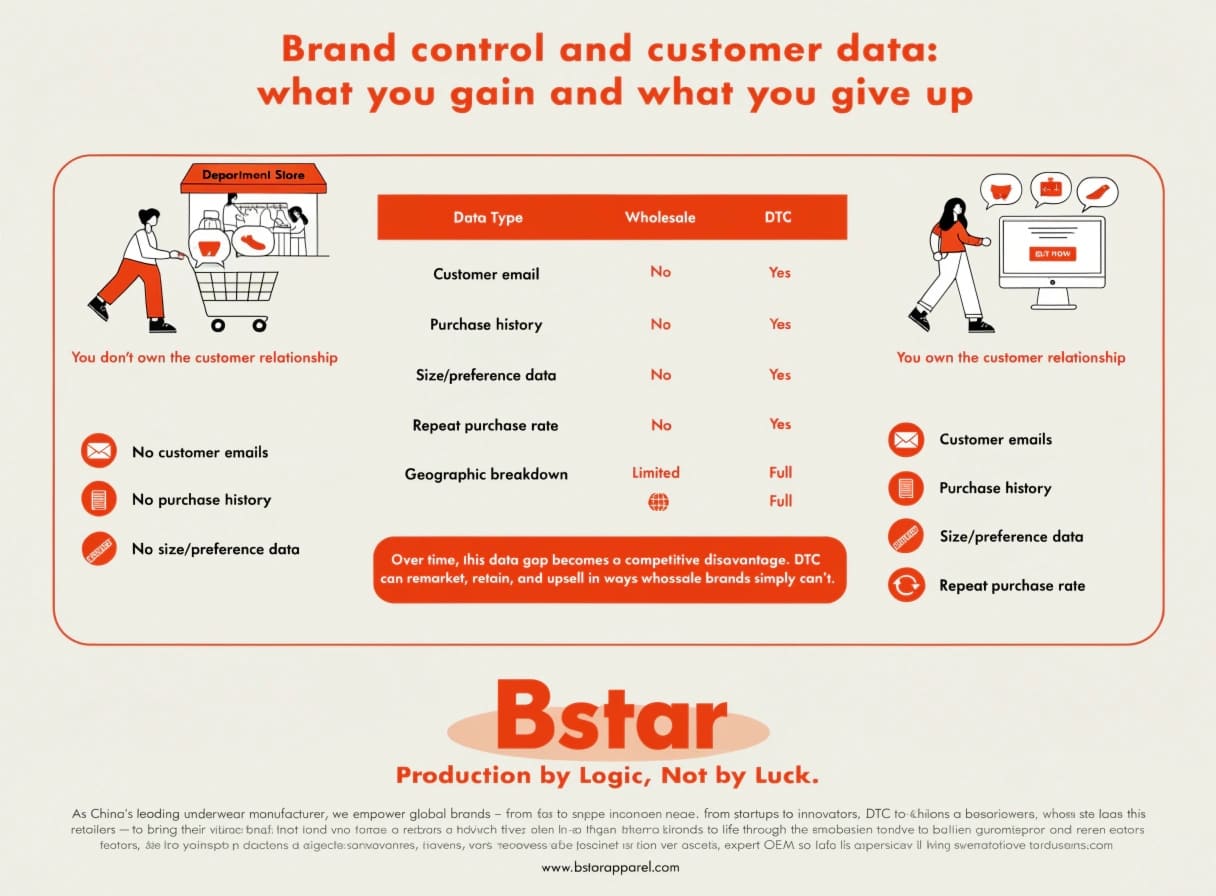
What data ownership actually means for an underwear brand
When a customer buys your underwear from a department store, you know nothing about them. You don’t know their size preferences, how often they reorder, or whether they bought one pair or five. The retailer has that data. You don’t.
When a customer buys from your website, you know everything — and you can use it.
| Data Type | Wholesale | DTC |
|---|---|---|
| Customer email | No | Yes |
| Purchase history | No | Yes |
| Size/preference data | No | Yes |
| Repeat purchase rate | No | Yes |
| Geographic breakdown | Limited | Full |
But there’s a trade-off. Wholesale gives you retail shelf presence and the retailer’s existing customer base. A brand that lands a placement in a major sportswear chain gets exposure that would cost a DTC brand millions in ad spend to replicate.7
ONTHATASS, one of the Dutch brands we produce for, built its presence largely through DTC. STEP ONE in Australia has also grown with a strong direct channel. Both models work. But both required supply chains that could respond to their specific operational rhythm — which brings us to the most overlooked part of this decision.
Operations: Inventory, Logistics, and What Your Manufacturer Needs to Deliver
This is where most founders hit a wall they didn’t see coming.
The operational demands of wholesale and DTC diverge most sharply at the reorder stage. Wholesale reorders can be planned seasonally. DTC reorders are driven by real-time sell-through and can’t wait on a 90-day production window.8 If your manufacturer can’t turn around small replenishment orders quickly, your DTC operation will hit stockouts before your next production run arrives.
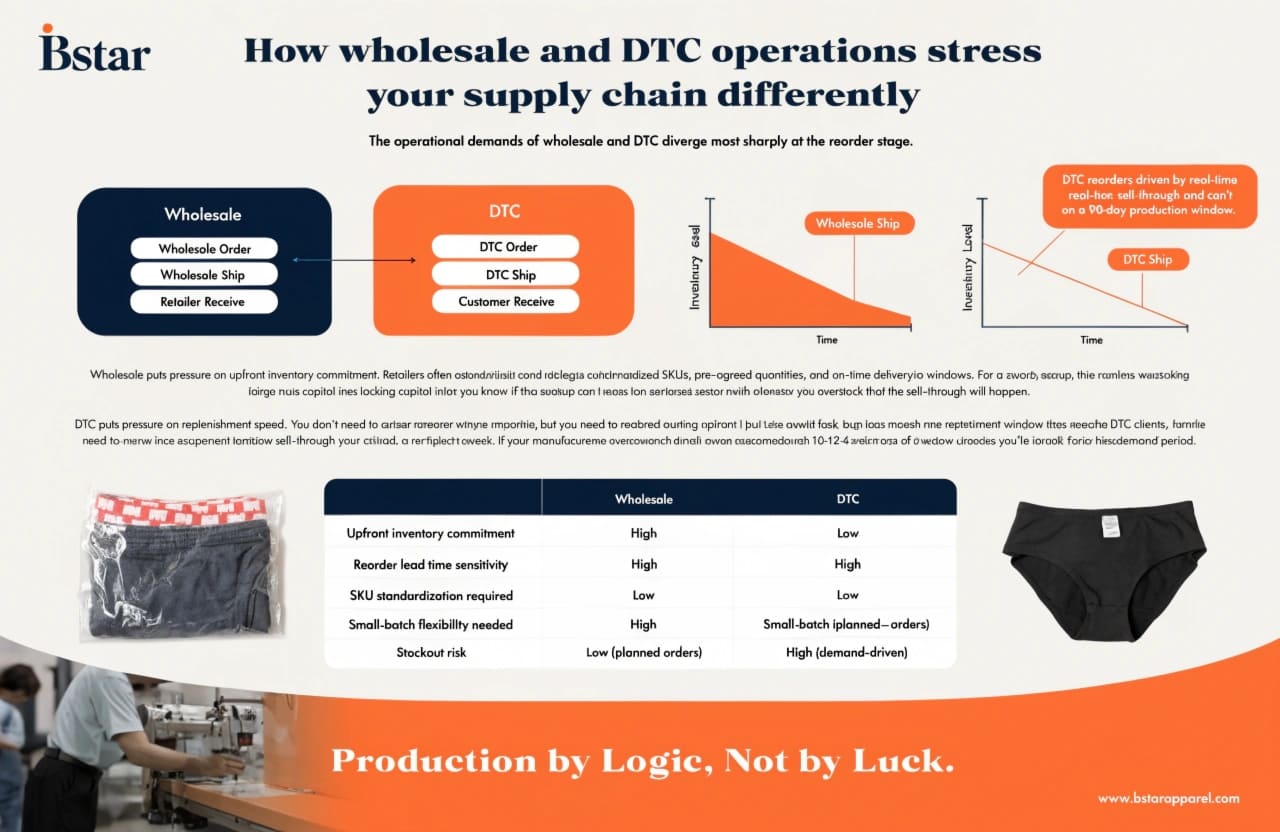
How each model stresses your supply chain differently
Wholesale puts pressure on upfront inventory commitment. Retailers often require standardized SKUs, pre-agreed quantities, and on-time delivery windows.9 For a startup, this means locking capital into stock before you know if the sell-through will happen. One slow season can leave you with overstock that ties up cash for months.10
DTC puts pressure on replenishment speed. You don’t need to order large quantities upfront, but you need to reorder fast when a SKU starts moving. In our experience supporting DTC clients, the replenishment window becomes critical around week 6–8 of a new product launch11. If your manufacturer needs 10–12 weeks for a reorder, you’ll be out of stock during your highest-demand period.
| Supply Chain Pressure Point | Wholesale | DTC |
|---|---|---|
| Upfront inventory commitment | High | Low |
| Reorder lead time sensitivity | Low | High |
| SKU standardization required | High | Low |
| Small-batch flexibility needed | Low | High |
| Stockout risk | Low (planned orders) | High (demand-driven) |
At BSTAR, we support both models because we support small MOQs and 7–15 day sample turnarounds. A DTC brand needs a manufacturer that can react — not one that requires 5,000-unit minimums and 90-day lead times. A wholesale brand needs a manufacturer that can hit quality and delivery consistency at volume. These are different things to ask for, and not every factory can do both.
The decision you make about your channel model should be made with your production setup in mind. If you’re pitching retailers but your factory needs 60 days and 3,000 units minimum, you may not be able to restock mid-season when a retailer reorders. If you’re going DTC but your factory can’t do small reorders quickly, your best-performing SKUs will go out of stock at the worst possible time.
Conclusion
Neither wholesale nor DTC is the smarter choice by default. The right model is the one your supply chain can actually support — and your manufacturer is a bigger part of that decision than most founders expect.
-
"[PDF] Brand Purchasing Practices and Labor Outcomes in Apparel and …", https://www.ilr.cornell.edu/sites/default/files-d8/2025-07/brand-purchasing-practices-gli-report.pdf. Supply chain and retail management literature has characterized the wholesale channel as a two-stage distribution structure in which the manufacturer or brand negotiates terms, pricing, and assortment with a retail buyer, with the retailer subsequently managing the consumer-facing transaction independently. Evidence role: definition; source type: paper. Supports: The structure of the wholesale channel relationship in which brands negotiate directly with retail buyers rather than end consumers. Scope note: This description reflects the standard wholesale model; variations such as consignment, vendor-managed inventory, or shop-in-shop arrangements alter the nature of the brand-retailer relationship. ↩
-
"Apparel Wholesale Order Management by Season – AIMS360", https://www.aims360.com/fashion-business-resources/apparel-wholesale-order-management-by-season-strategies-reports-and-core-style-optimization. Fashion supply chain research has documented that traditional wholesale apparel production is organized around biannual or quarterly seasonal buying calendars, in which retail buyers commit to purchase orders months in advance of the selling season, with brand production schedules aligned to these forward commitments. Evidence role: historical_context; source type: paper. Supports: The seasonal, purchase-order-driven production planning model characteristic of traditional wholesale apparel supply chains. Scope note: The shift toward more frequent micro-seasons and fast-fashion replenishment models has compressed some wholesale buying cycles, meaning the strictly seasonal characterization applies more fully to traditional wholesale than to all contemporary wholesale arrangements. ↩
-
"Wholesale & Retail Pricing in Fashion + Margin Calculator – AIMS360", https://www.aims360.com/fashion-business-resources/apparel-industry-pricing-margin-calculator-wholesale-retail-erp. Industry analyses of apparel brand economics have documented gross margin differentials between wholesale and DTC channels, with DTC brands generally retaining a larger share of retail price due to the absence of retailer markup, though reported ranges vary by product category and brand scale. Evidence role: statistic; source type: research. Supports: Typical gross margin ranges for wholesale and DTC apparel brands. Scope note: Margin figures vary significantly by product category, brand maturity, and cost structure; a single benchmark may not reflect the underwear segment specifically. ↩
-
"Average eCommerce Customer Acquisition Cost 2025 by Industry", https://www.upcounting.com/blog/average-ecommerce-customer-acquisition-cost. Research on DTC brand economics has highlighted customer acquisition cost as a primary driver of profitability, with studies noting that CAC in apparel ecommerce can range widely and that sustainable unit economics require a favorable ratio of customer lifetime value to acquisition cost. Evidence role: statistic; source type: research. Supports: Average customer acquisition costs for DTC apparel brands and their impact on unit economics. Scope note: Published CAC benchmarks aggregate across categories and brand sizes; figures for early-stage underwear brands specifically may differ from reported averages. ↩
-
"Analysing the Data Behind Direct-to-Consumer Growth", https://www.bettercommerce.io/blog/data-behind-direct-to-consumer-growth. Marketing and supply chain literature has documented that brands selling through retail intermediaries typically lack access to end-consumer purchase data, which remains proprietary to the retailer, whereas DTC channels enable brands to accumulate first-party data that supports retention and personalization strategies. Evidence role: mechanism; source type: paper. Supports: The structural difference in customer data access between DTC and wholesale distribution channels. Scope note: Some large wholesale brands negotiate data-sharing agreements with major retailers, meaning the data gap described is not absolute in all wholesale relationships. ↩
-
"The impact of characteristic factors of the direct-to-consumer … – PMC", https://pmc.ncbi.nlm.nih.gov/articles/PMC10944917/. Marketing science literature on customer relationship management has established that access to individual-level purchase and behavioral data enables more effective retention targeting and personalized upsell strategies, with the value of such data assets increasing as longitudinal records accumulate over time. Evidence role: mechanism; source type: paper. Supports: The compounding competitive advantage of first-party customer data for DTC brands in retention and upselling. Scope note: The magnitude of the competitive disadvantage for wholesale brands depends on whether they pursue alternative data strategies such as retail media partnerships or loyalty program integrations. ↩
-
"Cross Channel Effects of Search Engine Advertising on …", https://research.chicagobooth.edu/~/media/b340618e9e9f4253bb24bd32095e7629.pd. Marketing research on omnichannel brand building has noted that physical retail presence contributes to brand awareness through passive consumer exposure, though direct monetary equivalence to digital advertising spend is difficult to quantify and depends heavily on retailer traffic, shelf positioning, and product category. Evidence role: general_support; source type: paper. Supports: The brand awareness value of physical retail distribution relative to digital advertising expenditure. Scope note: The claim that retail placement is worth ‘millions’ in equivalent ad spend is illustrative rather than empirically derived; no standardized methodology exists for this equivalence calculation. ↩
-
"The impact of characteristic factors of the direct-to-consumer … – PMC", https://pmc.ncbi.nlm.nih.gov/articles/PMC10944917/. Operations management literature on apparel supply chains has contrasted the predictable, season-ahead ordering characteristic of traditional wholesale with the shorter, more frequent replenishment cycles required by DTC and fast-fashion models, noting that the latter places greater demands on supplier flexibility and lead time compression. Evidence role: mechanism; source type: paper. Supports: The difference in production planning cadence between wholesale seasonal ordering and DTC demand-driven replenishment. Scope note: Research in this area often focuses on fast fashion rather than DTC specifically; the operational distinction described is directionally supported but may not map precisely onto all wholesale or DTC configurations. ↩
-
"Purchase Order Terms and Conditions – Finance & Administration", https://financeadmin.lehigh.edu/unimarket-procurement-payment/purchase-order-terms-and-conditions. Retail industry documentation and trade association materials have described vendor compliance programs through which major retailers specify packaging, labeling, quantity, and delivery window requirements for wholesale suppliers, with financial chargebacks applied for non-compliance. Evidence role: general_support; source type: institution. Supports: Standard retailer requirements imposed on wholesale apparel suppliers regarding SKUs, quantities, and delivery compliance. Scope note: Compliance requirements vary substantially by retailer size and type; requirements from large national chains differ from those of independent or specialty retailers. ↩
-
"What to Do with Excess Inventory: The Wholesale Action Plan – JOOR", https://www.joor.com/insights/what-to-do-with-excess-inventory-the-wholesale-action-plan. Operations and finance literature on apparel retail has documented inventory holding costs and their effect on brand working capital, noting that seasonal demand uncertainty in wholesale channels creates overstock risk that can constrain cash available for subsequent production cycles. Evidence role: mechanism; source type: paper. Supports: The working capital impact of unsold wholesale inventory on apparel brand cash flow. Scope note: The severity of overstock impact depends on a brand’s financing structure, inventory turnover targets, and liquidation options, making generalization across all wholesale brands approximate. ↩
-
"Inventory management in DTC: step up your game plan", https://deposco.com/blog/dtc-inventory-management-step-up-your-game-plan/. Supply chain management research on DTC ecommerce operations has identified the post-launch demand ramp as a period of elevated stockout risk, with replenishment lead times relative to initial sell-through velocity being a key determinant of whether brands can sustain momentum after launch. Evidence role: general_support; source type: research. Supports: The timing sensitivity of inventory replenishment during early DTC product launch periods. Scope note: The specific 6–8 week window cited in the article reflects practitioner experience; published research typically discusses replenishment timing in broader terms rather than a precise week range. ↩