
Does Moisture-Wicking Technology Actually Work in Athletic Underwear?
Sweat-soaked underwear during a workout is miserable. You’ve probably seen "moisture-wicking" on every athletic underwear label — but does it actually mean anything?
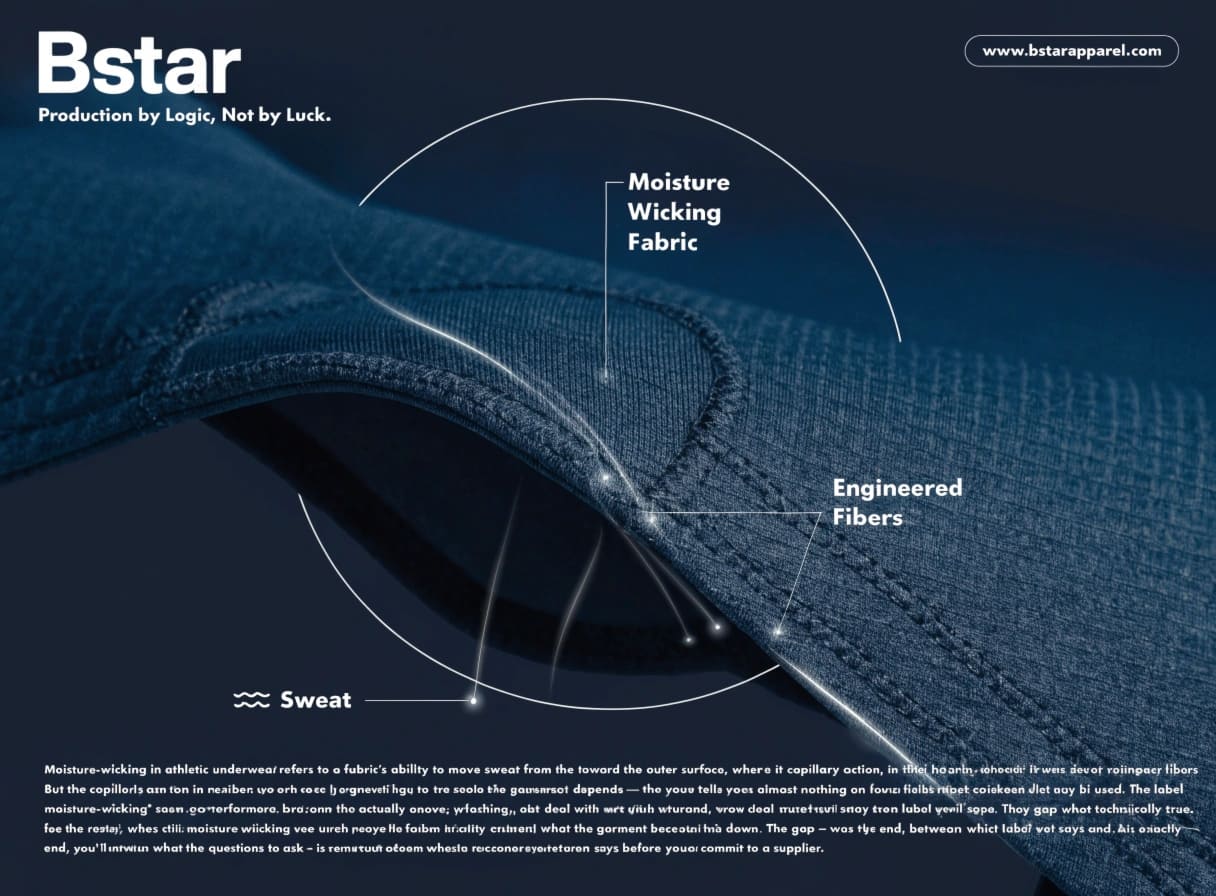
Moisture-wicking in athletic underwear refers to a fabric’s ability to move sweat away from the skin toward the outer surface, where it can evaporate. It works through capillary action in engineered fibers. But the label alone tells you almost nothing — real performance depends on fiber type, fabric construction, and how the garment will actually be used.
Here’s the problem most buyers run into: they source a product based on a "moisture-wicking" claim, get it to market, and then deal with returns because customers say it feels wet and clingy. The label was technically true. The product still failed. That gap — between what the label says and what the garment does — is exactly what we want to break down here. By the end of this, you’ll know which questions to ask before you commit to a supplier.
The Science of Capillary Action: How Do Fiber Cross-Sections Actually Move Sweat?
Most people know that moisture-wicking "pulls sweat away from the skin." But how does that actually happen, and why does it matter when you’re talking to a supplier?
The mechanism is capillary action — the same force that pulls water up a paper towel. In performance fabrics, this works through the physical shape of the fiber itself. Fibers with a round cross-section hold moisture in droplets. Fibers with a grooved, star-shaped, or multi-channel cross-section create narrow pathways that pull moisture along and spread it across a larger surface area for evaporation.
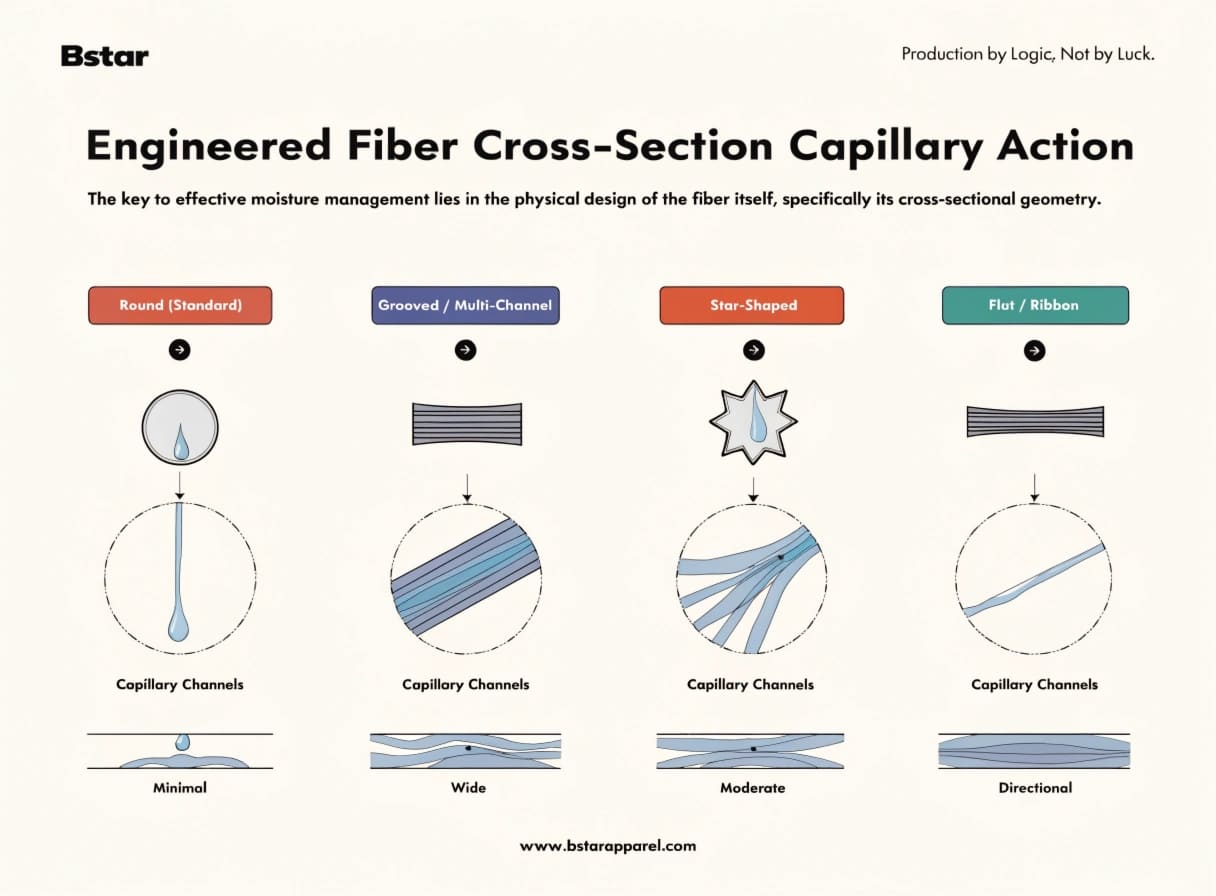
This is why two products can both say "100% polyester, moisture-wicking" and perform completely differently. The fiber shape — not just the fiber type — determines how fast sweat moves and how far it spreads before it evaporates.
Why This Matters When You’re Sourcing
When we talk to buyers during the sampling process, we often ask one simple question: has your supplier told you what fiber cross-section they’re using? Most buyers have never been asked this before. Most suppliers never bring it up.
Here’s a quick breakdown of how fiber geometry affects performance:
| Fiber Cross-Section | Capillary Channels | Moisture Spread | Best Use Case |
|---|---|---|---|
| Round (standard) | None | Minimal | Basic comfort wear |
| Grooved / Multi-channel | High | Wide | High-intensity training |
| Star-shaped | Medium-High | Moderate | General activewear |
| Flat / Ribbon | Low-Medium | Directional | Layering / base layers |
A supplier who can explain this to you — without prompting — is a meaningful signal. It tells you they understand what they’re making, not just what they’re selling. A supplier who defaults to "it’s polyester, so it wicks" is giving you a label, not a product spec.
The real procurement risk here isn’t that suppliers use bad fibers. It’s that they can’t — or won’t — tell you which fibers they use and why. Ask for a fiber spec sheet before you approve a sample.
Fiber Modifications and Treatments: Are Physical Grooves Better Than Chemical Finishes?
So the fiber cross-section matters. But there’s another layer to this — some fabrics wick because of their physical structure, and some wick because of a chemical treatment applied after knitting. These are not the same thing.
Physical moisture-wicking comes from the fiber’s permanent shape — grooves or channels built into the fiber during manufacturing. Chemical wicking comes from hydrophilic finishes applied to the fabric surface after production. Physical modifications last the life of the garment. Chemical finishes degrade with repeated washing, often within 20–30 wash cycles.
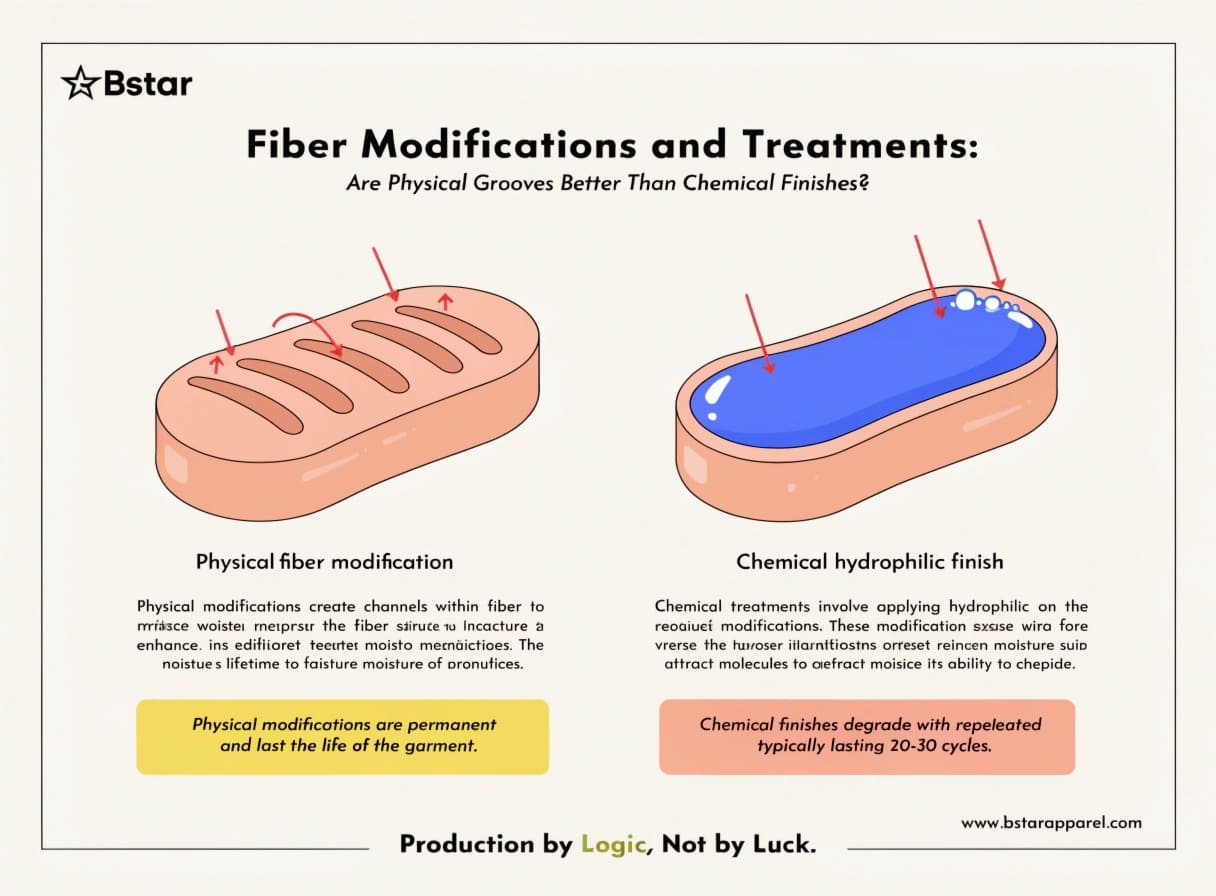
This distinction matters a lot for your end customer’s experience — and for your return rate.
What to Ask Your Supplier
In our experience, buyers sourcing for DTC brands rarely ask whether the wicking function is structural or applied. This is one of the most common gaps we see in pre-order consultations.
Here’s how to think about it:
Physical modifications (grooved fibers, engineered cross-sections):
- Permanent — performance holds across wash cycles
- More expensive at the fiber level
- Requires the supplier to source the correct yarn from the start
- Better for premium athletic products with repeat buyers
Chemical hydrophilic finishes:
- Lower cost
- Effective short-term
- Performance degrades with washing
- Acceptable for lower-price-point or single-use applications
If your product is positioned as performance activewear, and your customer buys expecting long-term wicking function, you need structural wicking — not a finish. A supplier offering you a low price on "moisture-wicking" fabric should trigger the question: is this structural or treated?
We hold OEKO-TEX® and GOTS certifications for the materials we use — not because that’s a performance guarantee, but because it means our fiber sourcing is documented and traceable. When you ask us what’s in the fabric, we can tell you exactly. That traceability is what gives you confidence the spec sheet matches the garment.
Advanced Fabric Architectures: Does the Knit Structure Change How Wicking Works?
Fiber choice is just the starting point. The way those fibers are knit together — the actual fabric construction — has an enormous effect on how moisture moves through the garment.
Fabric construction determines the direction and speed of moisture transfer. A flat jersey knit spreads moisture evenly in all directions. A honeycomb or mesh structure creates air channels that speed evaporation. Unidirectional knit architectures — where the inner and outer layers behave differently — push moisture one way: outward.
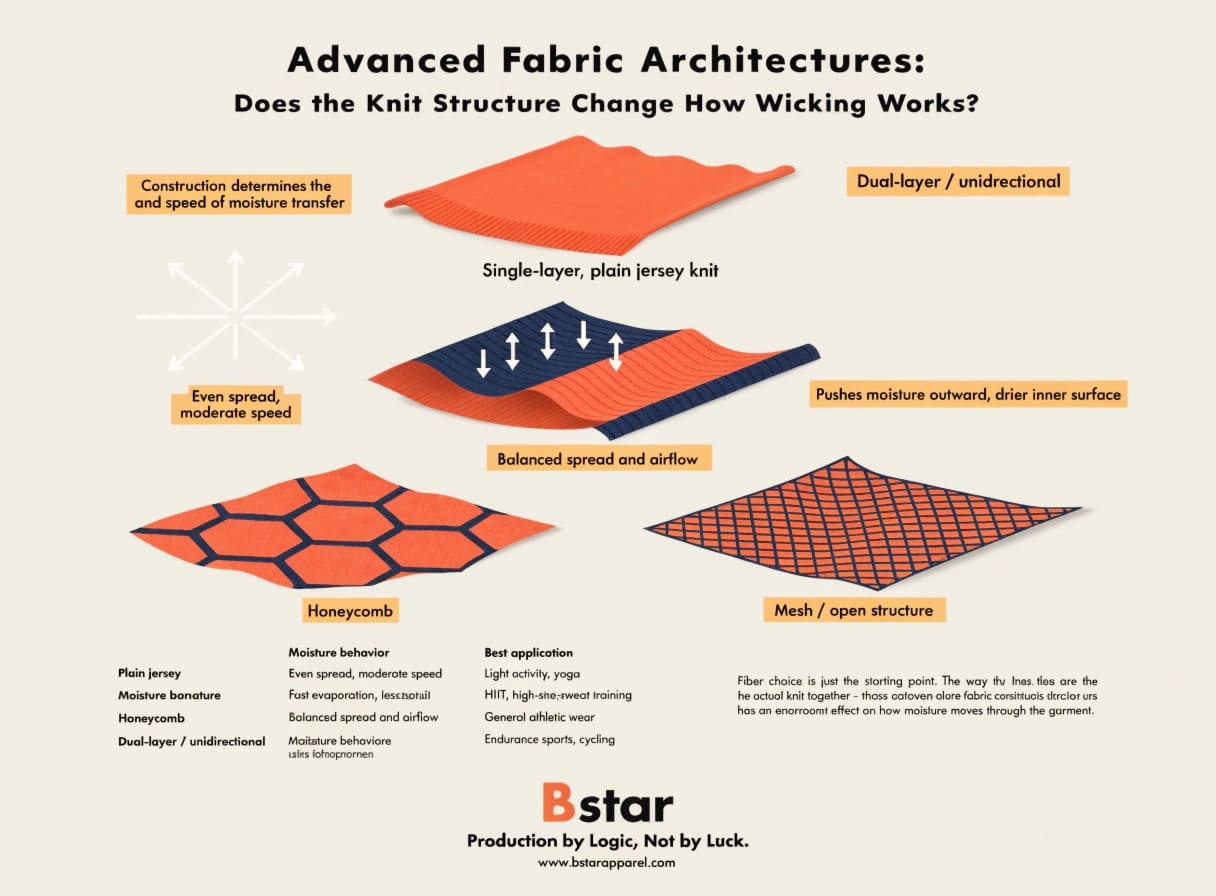
Single-Layer vs. Multi-Layer Construction
This is where a lot of buyers get lost. They focus entirely on fiber content and ignore construction — and then wonder why a "better" fabric doesn’t perform better in wear.
| Construction Type | Moisture Behavior | Best Application |
|---|---|---|
| Plain jersey | Even spread, moderate speed | Light activity, yoga |
| Mesh / open structure | Fast evaporation, less buffering | HIIT, high-sweat training |
| Honeycomb knit | Balanced spread and airflow | General athletic wear |
| Dual-layer / unidirectional | Pushes moisture outward, drier inner surface | Endurance sports, cycling |
Here’s what this means in practice. A buyer sourcing HIIT shorts needs fast evaporation — they want sweat gone quickly. A buyer sourcing cycling base layers may need moisture buffering — the garment should manage a sustained sweat output over hours, not just spike performance. These are different requirements. A supplier pitching the same fabric for both is either not asking the right questions or not listening to your answers.
When clients come to us with a new SKU, we typically ask about the intended use scenario before we recommend a construction. Yoga wear, HIIT shorts, and endurance base layers all live under "athletic underwear" — but they have genuinely different wicking specs. A loop-density decision that’s right for one is wrong for another.
Performance Metrics and Testing: How Do You Actually Know If It Works?
You can understand all the theory — fiber cross-sections, knit structures, chemical vs. physical treatments — and still end up with a product that fails in real wear. Testing is where claims get verified.
Standard performance metrics for moisture-wicking fabrics include moisture absorption rate (how fast the fabric picks up sweat), spreading speed (how far moisture distributes), drying time (how fast it evaporates), and residual moisture content after a set period. These are measurable — and a qualified supplier should be able to provide third-party test data or direct you to standard test methods like AATCC 195.
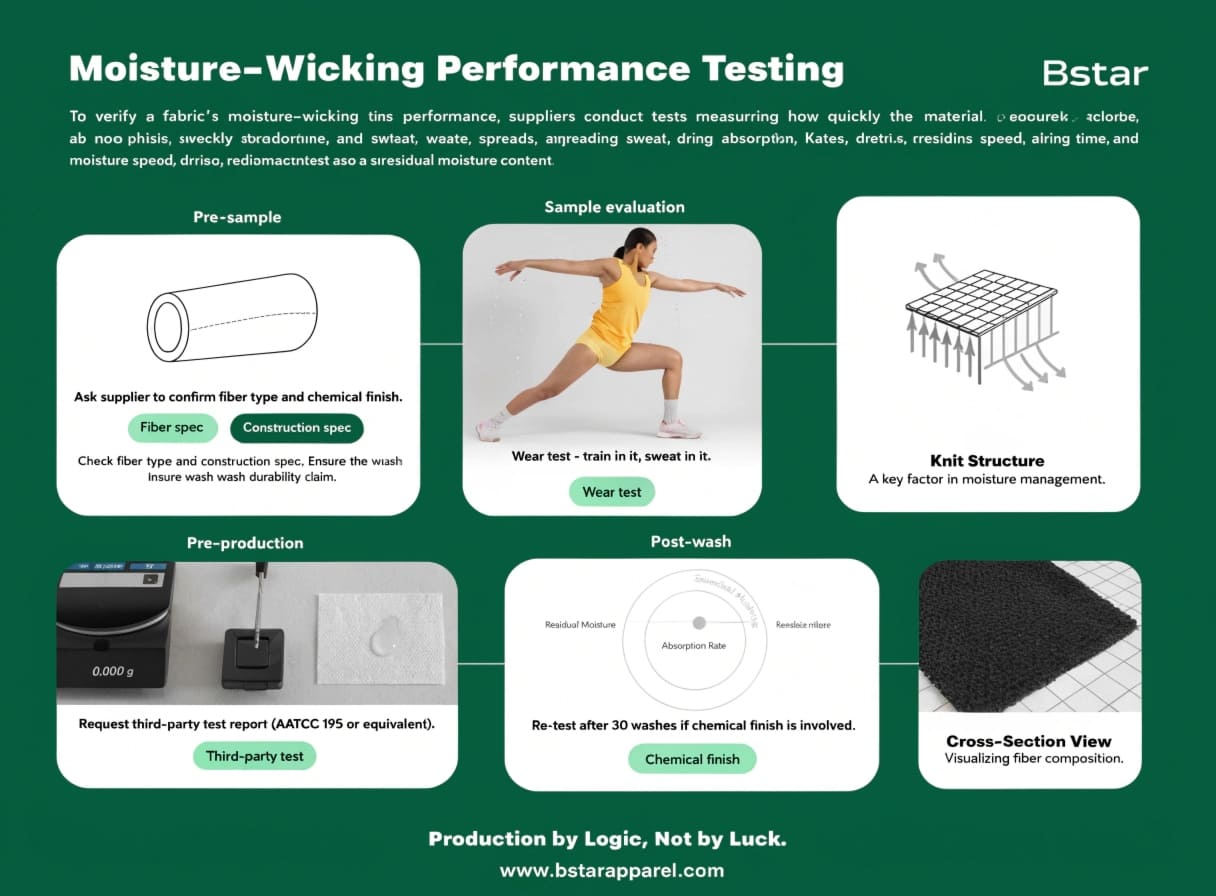
What Testing Actually Looks Like in a Sourcing Process
In practice, most DTC buyers aren’t running lab tests. They’re relying on samples and supplier claims. That gap is where products fail.
Here’s what a more rigorous sourcing process looks like:
| Testing Stage | What to Check | Who Does It |
|---|---|---|
| Pre-sample | Fiber spec, construction spec, wash durability claim | Ask supplier directly |
| Sample evaluation | Wear test — train in it, sweat in it | You or your team |
| Pre-production | Request third-party test report (AATCC 195 or equivalent) | Supplier or accredited lab |
| Post-wash | Re-test after 30 washes if chemical finish is involved | You or third-party lab |
The honest truth is this: we’re not a laboratory. We don’t position ourselves as one. But we do tell clients — during the sampling stage — what spec we’re building to, what test methods apply, and what to check when the sample arrives. If a supplier can’t give you that conversation, that’s the red flag. It’s not about whether the fabric wicks. It’s about whether the supplier can prove it, explain it, and stand behind it through production.
Conclusion
"Moisture-wicking" means nothing without knowing the fiber, the construction, and the use case. Ask better questions before you approve a sample — your return rate depends on it.