
Packaging Design for Premium Men’s Underwear Brands: Where Should Your Budget Actually Go?
Founders waste thousands on packaging that looks expensive but feels wrong. The product is solid. The brand has a story. But something is off — and sales don’t justify the price point.
Premium packaging for DTC men’s underwear is not a design problem. It is a budget allocation problem. The question is not "what looks high-end?" The question is "which packaging decisions actually change how a customer perceives your product — and which ones just add cost?"
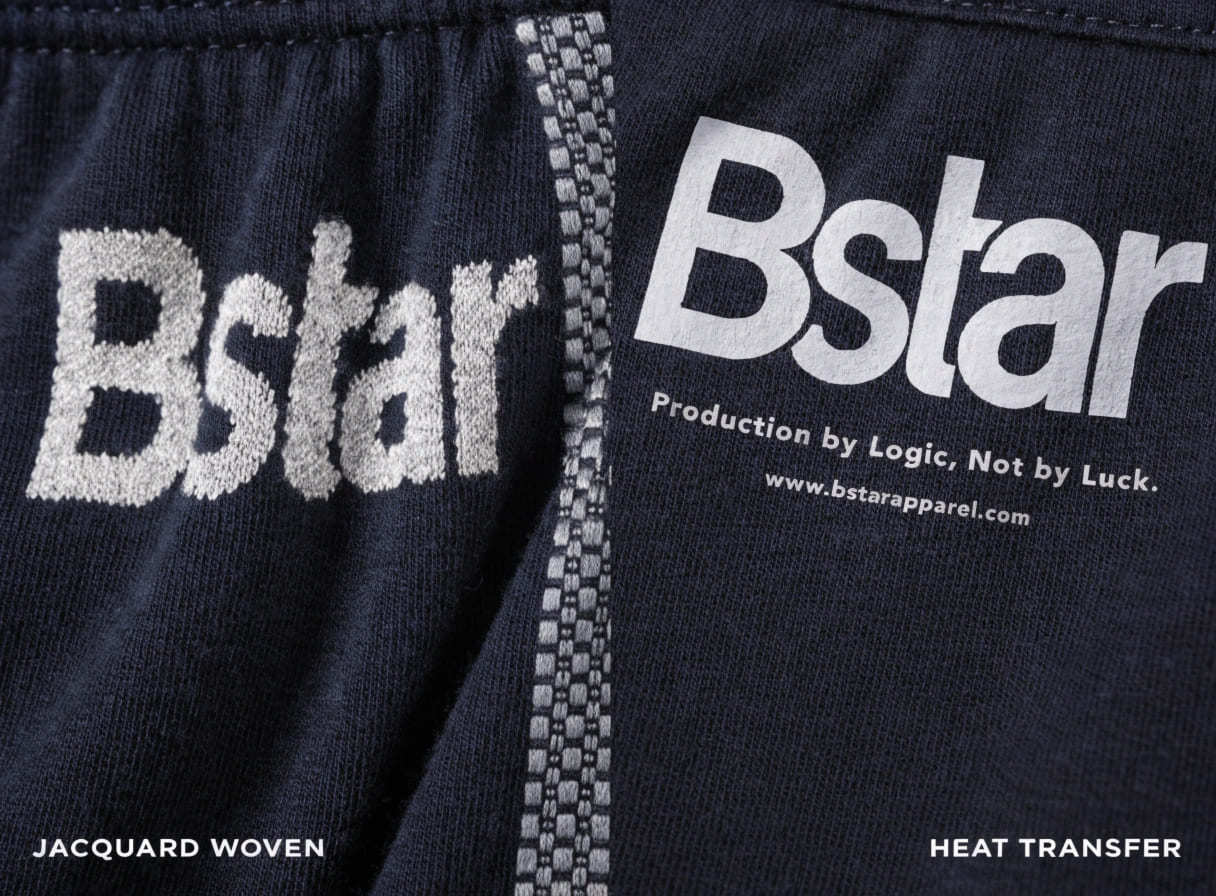
I work on the factory side. At BSTAR, we manufacture knitwear OEM/ODM for international DTC brands, and we are often the last stop before a packaging spec becomes a physical product. We have sat in on briefs, received half-finished specs, and watched well-intentioned packaging choices become expensive mistakes. This article is written from that seat — not from a branding consultant’s desk.
Visual Identity and Brand Storytelling: Does Your Packaging Actually Speak the Same Language as Your Brand?
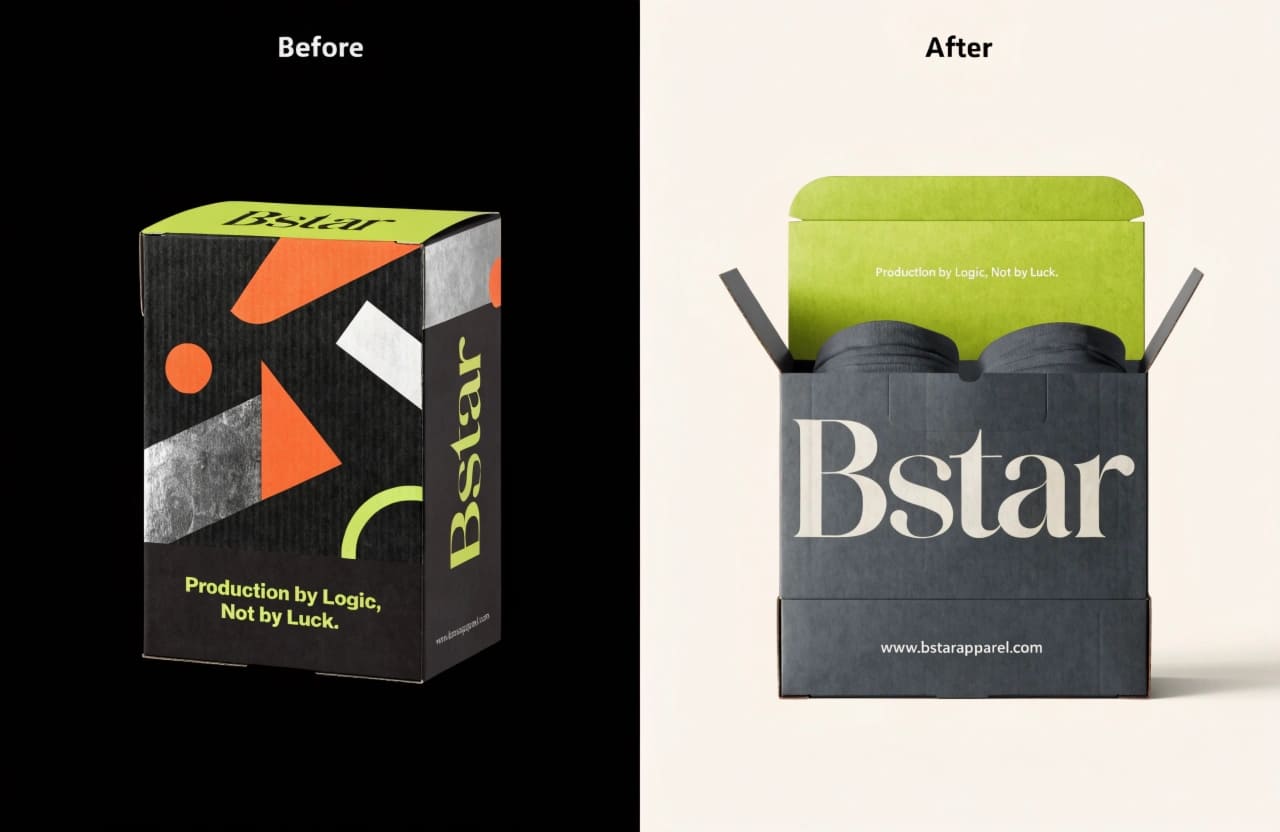
The most common mistake I see is brands treating packaging as a separate project. A founder spends months on a brand identity — the logo, the color palette, the tone of voice — then hands packaging to a different vendor with a loose brief and a mood board. The result rarely matches.
Visual coherence is what makes packaging read as premium. A single well-executed color, a clean typeface, and a consistent finish hierarchy will outperform a box covered in expensive effects that do not belong together. Packaging signals premium when it is consistent — not when it is costly.
What Goes Wrong When the Brief Gets Separated From the Brand
From the factory floor, we see a very specific failure pattern. The brand identity is developed by one team. The packaging spec is written by another. By the time the brief reaches us, someone has already made decisions — ink colors, finish types, structural dimensions — without fully understanding what the product looks like inside or how the garment is folded and presented.
Color matching is a good example. A brand might specify a Pantone reference on their packaging brief. But if the printer is working from a different substrate or finish, the output drifts. We flag this. But not every factory will.
| Packaging Element | What Brands Often Spec | What Actually Needs Matching |
|---|---|---|
| Print color | Pantone number | Pantone + substrate + finish type |
| Logo placement | Centered on front panel | Scaled for fold exposure when boxed |
| Typography | Font name | Font weight, tracking, print size minimum |
| Finish type | "Matte" or "glossy" | Specific lamination spec by panel |
The fix is simple but not easy. The person writing the packaging spec needs to understand both the garment and the brand mark. If those two things live in different vendor conversations, the execution will almost always drift.
Tactile Luxury and Material Selection: Which Finishes Are Worth Paying For?
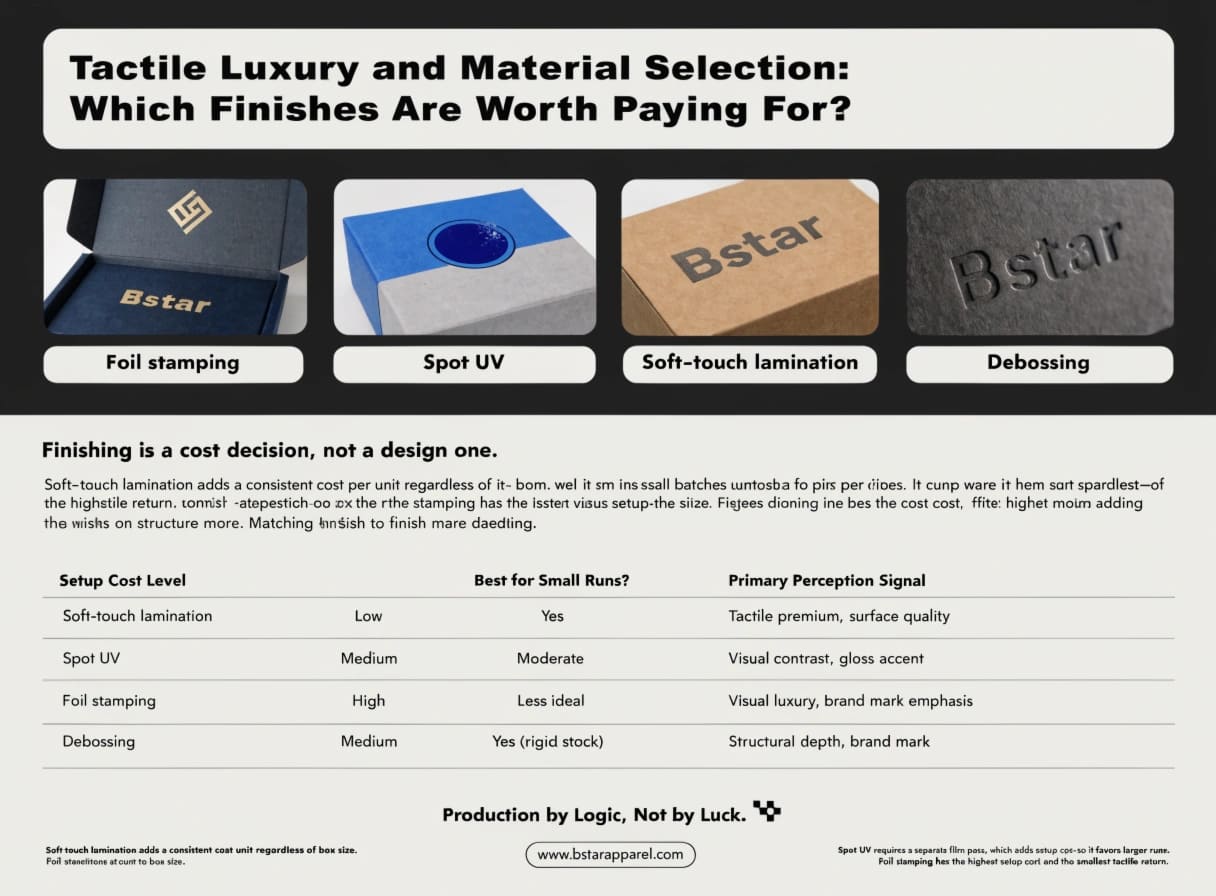
Foil stamping. Spot UV. Soft-touch lamination. Debossing. These are all real options, and they are all available at reasonable MOQs if you know where to look. But they are not all equal in what they communicate — or what they cost at small quantities.
The finishes that actually signal quality to a customer’s hands are soft-touch lamination and spot UV. Foil stamping reads as premium visually, but the tactile return is low. Debossing works best on rigid stock. Matching the finish to the structure matters more than adding multiple finishes.
Finish Selection as a Cost Decision, Not an Aesthetic One
Here is how I would think through this as a production decision, not a design one.
Soft-touch lamination adds a consistent cost per unit regardless of box size. It runs well in small batches and is one of the highest-return finishes for price-to-perception. Spot UV requires a separate film pass, which adds setup cost — so it favors larger runs. Foil stamping has the highest setup cost and the smallest tactile return.
| Finish Type | Setup Cost Level | Best for Small Runs? | Primary Perception Signal |
|---|---|---|---|
| Soft-touch lamination | Low | Yes | Tactile premium, surface quality |
| Spot UV | Medium | Moderate | Visual contrast, gloss accent |
| Foil stamping | High | Less ideal | Visual luxury, brand mark emphasis |
| Debossing | Medium | Yes (rigid stock) | Structural depth, brand mark |
If your run is under 500 units, the math on foil stamping often does not work unless you are absorbing setup costs on a longer-term commitment. Soft-touch lamination is almost always the better starting point.
Structural Engineering and Unboxing Rituals: Is a Magnetic Closure Box Actually Worth It?
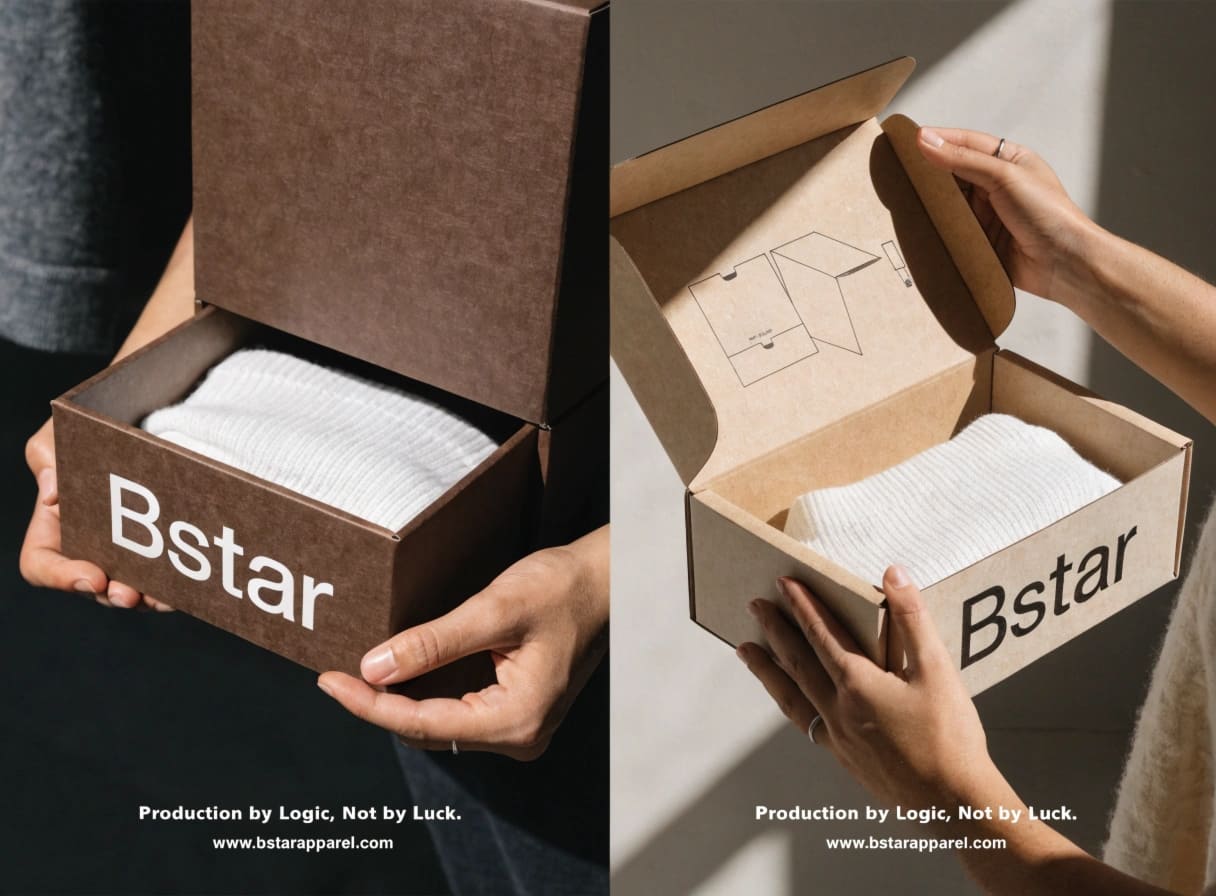
Drawer-style boxes and magnetic closure boxes photograph well. They show up in unboxing videos. They feel intentional when a customer opens them. But they also cost more per unit, require more storage volume, and are harder to fulfill efficiently.
Magnetic closure and drawer-style boxes add real value for DTC brands selling at higher price points because the unboxing moment is part of the product experience. But the structural decision should be driven by your price point and fulfillment model — not by what looks best on Instagram.
Structure, Price Point, and Fulfillment — The Three-Way Decision
At BSTAR, when brands ask us about packaging structure during onboarding, we ask three questions back: What is your retail price? Are you shipping DTC direct or through retail? What is your tolerance for per-unit packaging cost?
A brand selling a two-pack at $30 USD has a very different packaging equation than a brand selling a single pair at $80. That sounds obvious, but many founders do not apply it. They see premium brands using rigid boxes and assume that is the standard. It is not the standard. It is a decision that was made at a specific price point for a specific channel.
| Structure Type | Suitable Price Point | DTC Friendly? | Fulfillment Risk |
|---|---|---|---|
| Polybag + hang tag | Entry to mid | High | Low |
| Flat-fold kraft box | Mid | High | Low |
| Drawer-style rigid box | Mid to premium | Moderate | Moderate |
| Magnetic closure box | Premium | Moderate | Higher (volume, weight) |
One thing we do see with small DTC brands: they go straight to a rigid box because they want the premium signal, then discover the dimensional weight adds meaningful cost to every shipment. That conversation is easier to have before the packaging is tooled.
Functional Elegance and Sustainability: Can Your Packaging Earn a Second Life?
Sustainability in packaging gets talked about a lot. Not all of it is honest. There is real consumer preference for eco-friendly materials — especially in European and Australian markets where some of our clients operate — but there is also a lot of greenwashing that adds cost without adding credibility.
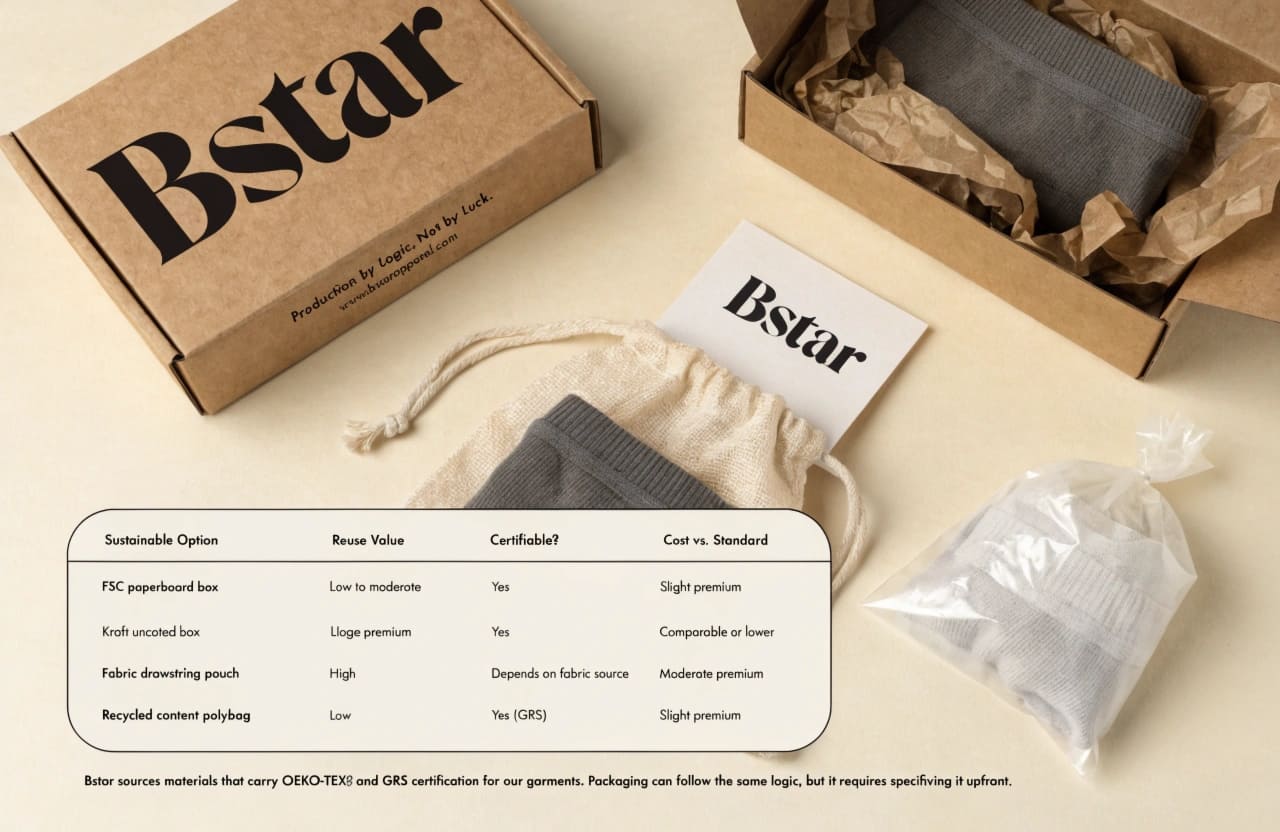
The most defensible sustainability move for a DTC underwear brand is choosing materials that are genuinely reusable or recyclable, then saying so clearly on the packaging. A well-made kraft box or a fabric pouch adds storage utility after purchase. That reuse value is real and communicates premium more cleanly than a vague "eco" claim.
What "Sustainable Packaging" Actually Costs and What It Gets You
From a sourcing standpoint, FSC-certified paperboard, soy-based inks, and recycled content materials are available and do not always carry a large premium over standard options — especially at moderate run sizes. The real cost is in verification: getting material certificates, confirming chain of custody, and making sure your claims are accurate.
BSTAR sources materials that carry OEKO-TEX® and GRS certification for our garments. Packaging can follow the same logic, but it requires specifying it upfront. If you hand us a brief that says "eco-friendly box" without a material spec, we will ask for clarification. Many factories will not.
| Sustainable Option | Reuse Value | Certifiable? | Cost vs. Standard |
|---|---|---|---|
| FSC paperboard box | Low to moderate | Yes | Slight premium |
| Kraft uncoated box | Low | Yes | Comparable or lower |
| Fabric drawstring pouch | High | Depends on fabric source | Moderate premium |
| Recycled content polybag | Low | Yes (GRS) | Slight premium |
The brands that do this well are the ones who treat sustainability as a spec requirement, not a marketing afterthought. Write it into the brief. Ask for the certificate. Then you have something real to say on your packaging copy.
Conclusion
Premium packaging comes down to three decisions: where your budget goes, whether your brief is coherent, and whether the structure matches your price point and channel. Get those three right, and the rest follows.