
Custom Waistband Printing: Heat Transfer vs Jacquard Weave?
Brands waste thousands of dollars every year on waistband rework. Not because they chose the wrong logo. Because they chose the wrong process before they understood what the process actually does to the product.
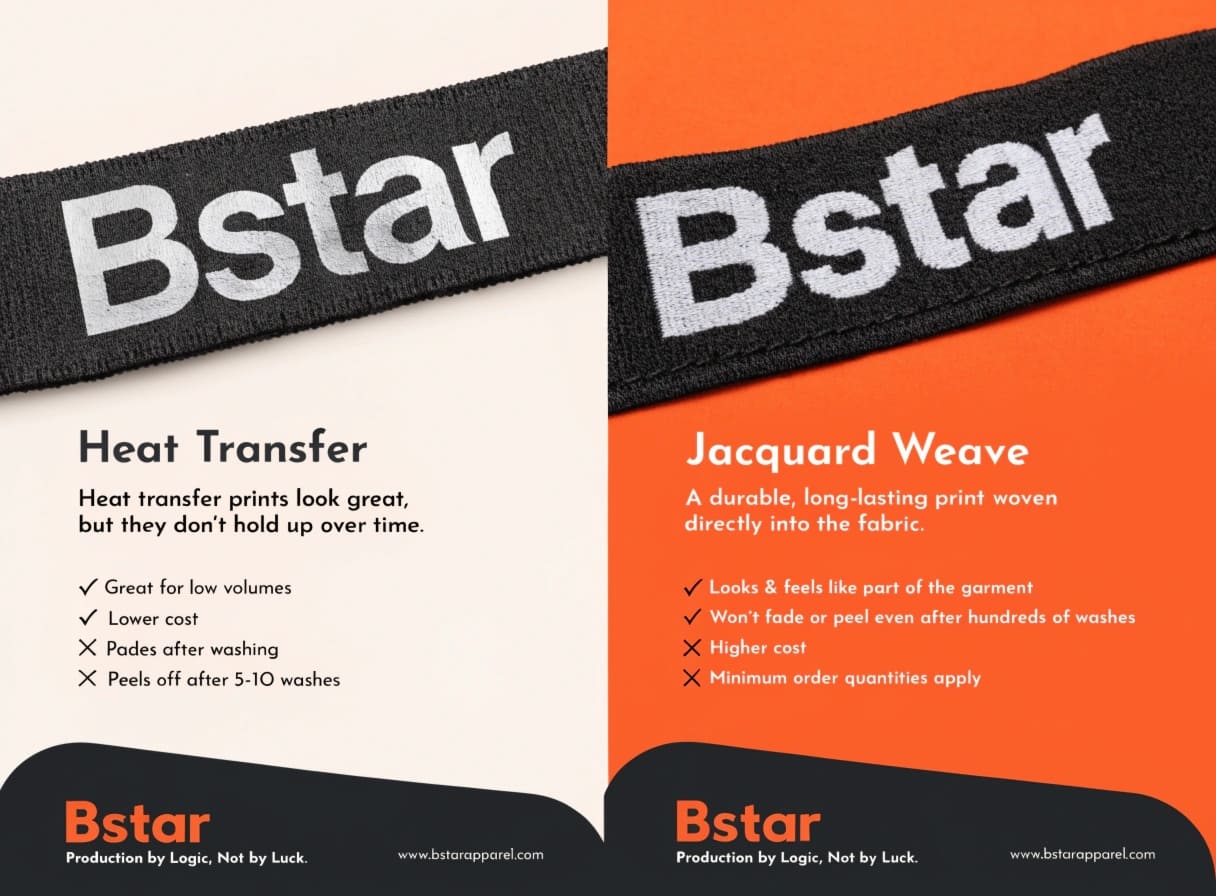
The short answer: heat transfer works well for low-volume launches and test runs. Jacquard weave is the right call for high-frequency-wash products like underwear and activewear. The decision comes down to two things — how often the product gets washed and how many units you’re ordering at launch.
Most brands come to us thinking this is a budget question. It isn’t. It’s a risk question. And the risk becomes very real at the moment your customer puts the garment through its tenth wash.
Manufacturing Mechanics: How Are These Two Processes Actually Different?
Most clients I talk to have seen both types of waistbands. Very few understand what it takes to produce them. And that gap is where the problems start.
Heat transfer printing applies a pre-printed film onto the waistband surface using heat and pressure. Jacquard weaving builds the logo directly into the fabric structure on a programmable loom during the manufacturing of the elastic band itself1.
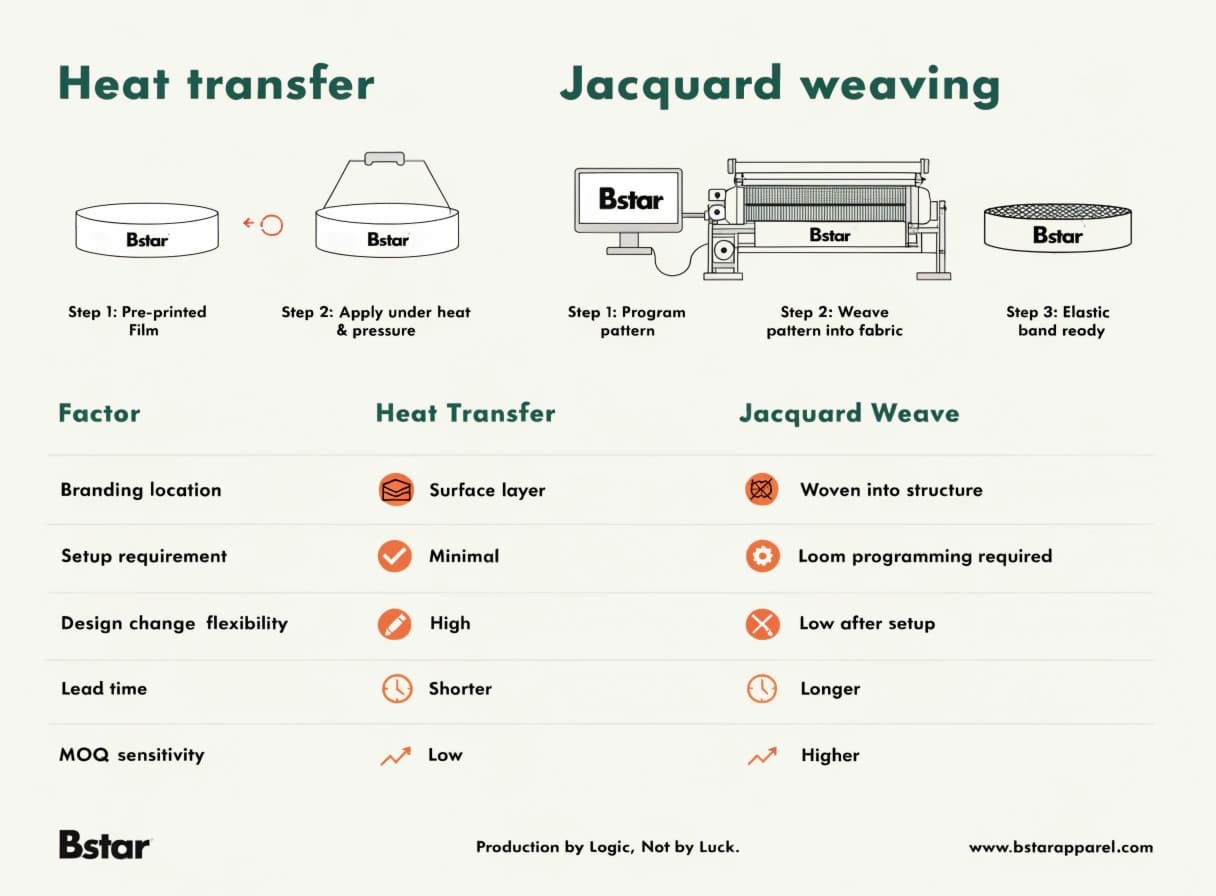
These are not two versions of the same thing. They are fundamentally different processes, and that difference matters long before you get to cost.
Heat Transfer: What the Process Actually Involves
With heat transfer, we start with a finished elastic waistband. The branding is added afterward — a printed film is pressed onto the surface. The setup is fast. We don’t need to program a loom or set up a weaving pattern. That’s why turnaround is shorter and why it works well for small quantities.
But "added afterward" is the key phrase. The branding sits on top of the fabric. It is not part of it.
Jacquard Weaving: What the Process Actually Involves
With jacquard, we program the logo pattern directly into the loom. The yarn itself carries the design. When the elastic band comes off the machine, the branding is already built into the structure — not applied to it.
This takes more time. It requires a minimum run to justify the loom setup cost. And it requires the brand to finalize their design before production starts, because changes after setup are expensive.
| Factor | Heat Transfer | Jacquard Weave |
|---|---|---|
| Branding location | Surface layer | Woven into structure |
| Setup requirement | Minimal | Loom programming required |
| Design change flexibility | High | Low after setup |
| Lead time | Shorter | Longer |
| MOQ sensitivity | Low | Higher |
The process you choose locks in certain outcomes. That’s why we ask clients about their product type and order volume before we ever talk about what the logo looks like.
Aesthetics and Tactile Experience: Does the End Result Actually Look Different?
This is usually the first question brands ask us. It shouldn’t be — but I understand why it is. The waistband is visible. It carries the brand identity. Of course it matters how it looks.
Heat transfer can reproduce fine detail, gradients, and multi-color logos with high precision. Jacquard produces a textured, woven finish that reads as premium but has limitations on color complexity and fine detail. Neither is objectively better — they produce different visual languages.
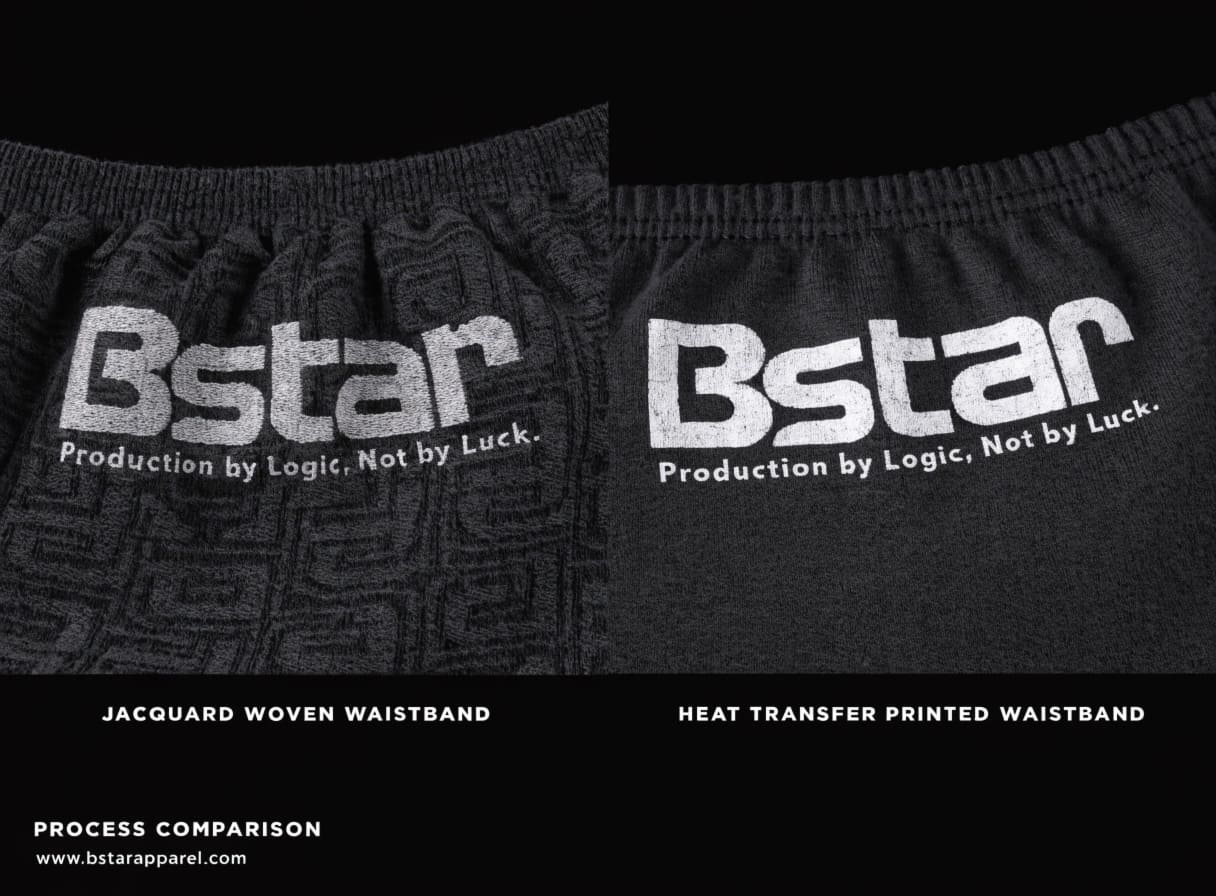
Here’s what I actually tell clients when they ask which one looks better.
Heat Transfer: Where It Wins on Visuals
If your logo has gradients, fine lines, or more than three colors, heat transfer is going to reproduce it more faithfully. The print is sharp. It’s flat against the surface. It reads clean on a product photo.
For brands that are testing a new colorway or haven’t finalized their visual identity, heat transfer also gives you flexibility. We can adjust the artwork between runs without a significant cost penalty.
Jacquard: What "Premium" Actually Means Here
Jacquard doesn’t just look woven — it feels woven. There’s a texture to it that customers notice when they handle the product. For positioned brands in the underwear or loungewear space, that tactile quality is part of the brand experience.
But jacquard has real constraints on detail. Very fine lines can lose definition. Complex multi-color logos don’t always translate well to a woven structure. If a client comes to us with a logo that has four colors and a lot of fine detail, we’ll tell them directly: jacquard may not reproduce this the way you’re expecting.
The Practical Decision on Aesthetics
| Design Type | Better Process |
|---|---|
| Gradient or photographic logo | Heat transfer |
| Simple wordmark or icon | Either works |
| Bold, 1–3 color logo | Jacquard |
| Fine line detail | Heat transfer |
| Brand identity centered on texture | Jacquard |
Aesthetics matter. But they should be the last variable you optimize, not the first.
Durability and Wearability: What Happens After the First Twenty Washes?
This is where the real decision lives. And this is the conversation that most brands don’t have early enough.
For products that get washed frequently — underwear, boxer briefs, activewear — heat transfer printing degrades over time. The film layer can crack, peel, or fade. Jacquard, because the logo is part of the structure, maintains its appearance through repeated washing. For high-frequency-wash categories, jacquard is not a premium option. It’s the baseline.
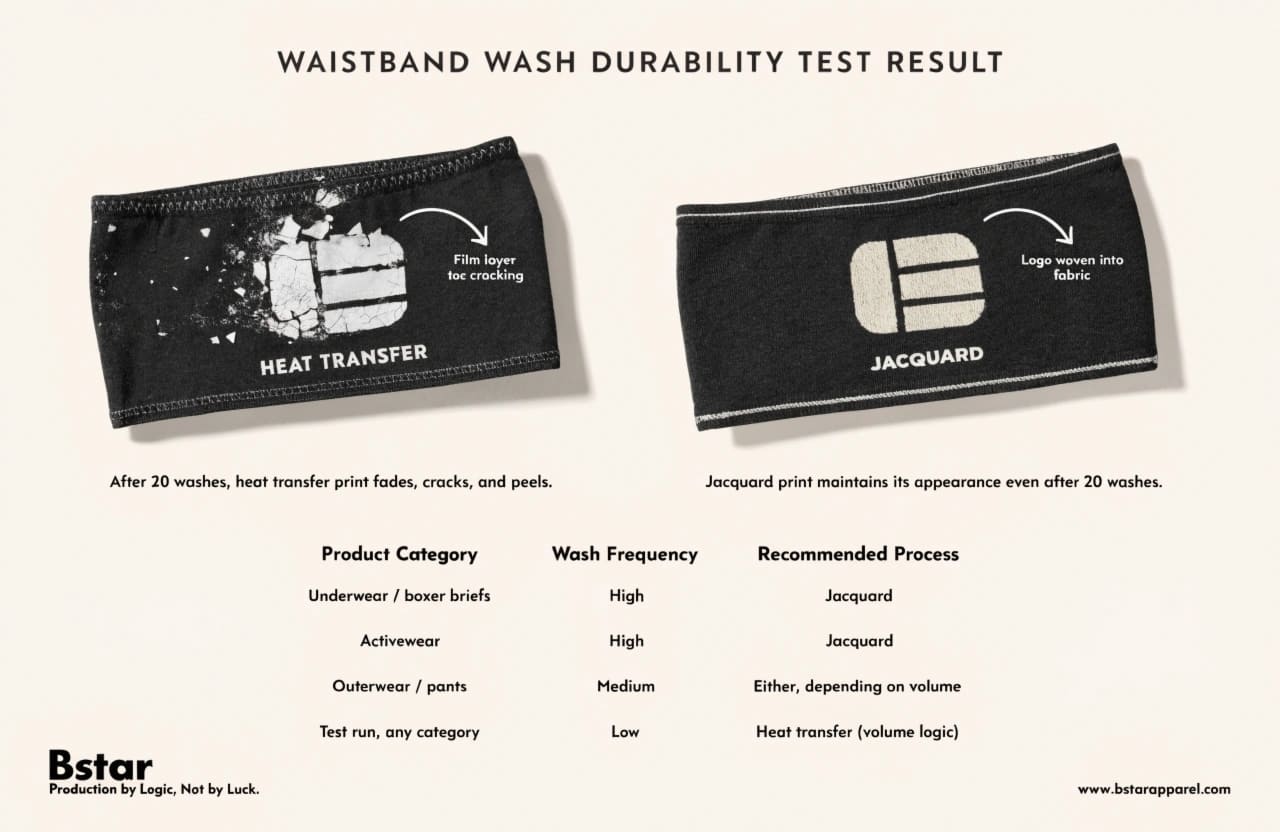
I’ve had this conversation with clients more times than I can count. A brand comes to us to sample a new boxer brief line. They want to keep costs down on the first run. They choose heat transfer. The samples look great. They place the order. And then three months after delivery, their customers are posting photos of peeling waistbands.
That’s not a manufacturing defect. That’s a process mismatch.
The Wash Frequency Test
The question we ask before recommending a process is simple: how often will this product be washed?
If it’s a product worn close to the skin — underwear, boxer briefs, athletic shorts — it’s going to be washed multiple times per week. In our experience, heat transfer on waistbands for these categories shows visible degradation within weeks of regular use2.
If it’s a product washed less frequently — outerwear, pants, loungewear worn over other layers — heat transfer holds up significantly better.
Skin Comfort Is a Separate Factor
One thing clients don’t always think about: jacquard weave sits flush with the elastic. There’s no raised surface layer. For products worn directly against skin, that matters3. Heat transfer adds a layer on top of the fabric surface. On some garments, especially in repeated contact with the skin, that can create discomfort.
This isn’t true for every customer. But for underwear specifically, it’s a factor worth considering.
| Product Category | Wash Frequency | Recommended Process |
|---|---|---|
| Underwear / boxer briefs | High | Jacquard |
| Activewear | High | Jacquard |
| Loungewear | Medium | Either, depending on volume |
| Outerwear / pants | Low | Heat transfer viable |
| Test run, any category | Varies | Heat transfer (volume logic) |
Cost Efficiency and MOQ Strategy: Which One Makes Sense for Where You Are Right Now?
Let me be direct here. Heat transfer is not the cheap option for brands that can’t afford quality. It is the correct option for brands that are at a specific stage in their product lifecycle.
If you are sampling a new style, testing a market, or launching your first run under a few hundred units, heat transfer may be the right process — not because it costs less, but because the jacquard minimum run isn’t justified yet4. When volume grows and the product is proven, switching to jacquard is a natural next step.
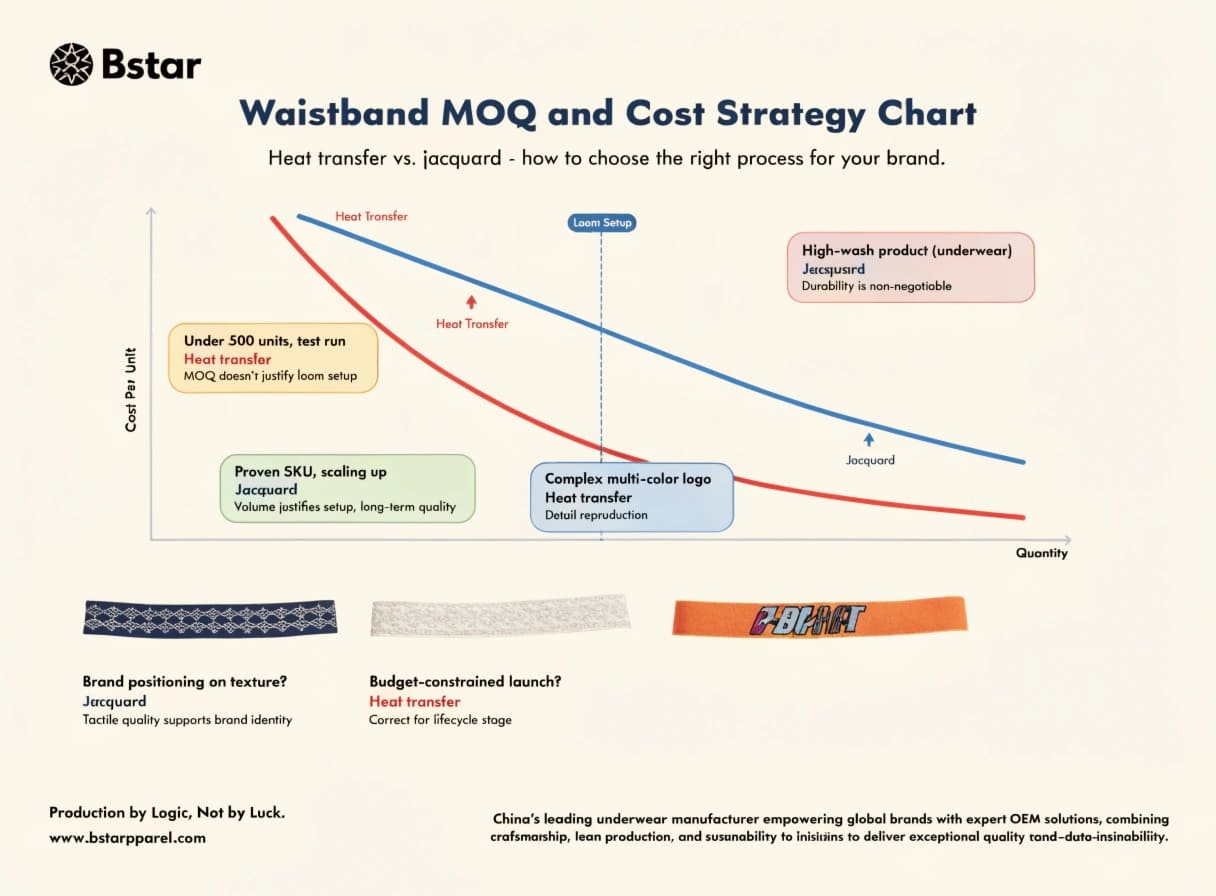
Jacquard requires a loom setup. That setup has a cost, and it only makes financial sense when you’re spreading it across enough units. For a first-run DTC brand ordering 200 to 300 pieces to test a new SKU, forcing jacquard into that equation adds cost without a proportional return.
The Two Questions That Drive the Decision
Before we recommend anything, we ask clients two questions:
- How many times per week will this product be washed?
- How many units are you committing to at launch?
These two variables — not logo size, not color preference — are what the decision should be based on.
| Situation | Right Process | Reason |
|---|---|---|
| Under 500 units, test run | Heat transfer | MOQ doesn’t justify loom setup |
| High-wash product (underwear) | Jacquard | Durability is non-negotiable |
| Proven SKU, scaling up | Jacquard | Volume justifies setup, long-term quality |
| Complex multi-color logo | Heat transfer | Detail reproduction |
| Brand positioning on texture | Jacquard | Tactile quality supports brand identity |
| Budget-constrained launch | Heat transfer | Correct for lifecycle stage |
The Mistake We See Most Often
The most expensive mistake is treating the two processes as interchangeable except in price. Clients who do this often discover the problem after delivery. By that point, the cost isn’t the waistband — it’s the customer returns, the brand perception damage, and the reorder5.
We can help you avoid that. But only if the conversation happens before sampling, not after.
Conclusion
Choose based on wash frequency and order volume — not aesthetics or price alone. Get that decision right before sampling, and everything downstream gets easier.
-
"Jacquard machine – Wikipedia", https://en.wikipedia.org/wiki/Jacquard_machine. The Jacquard loom, developed in the early nineteenth century, uses a system of punched cards or, in modern variants, electronic controls to independently manipulate individual warp threads, enabling complex patterns to be woven directly into the fabric structure during production (see Jacquard machine, Wikipedia). Evidence role: definition; source type: encyclopedia. Supports: That Jacquard weaving uses a programmable loom to integrate patterns directly into the fabric structure during production. ↩
-
"How Long Do DTF Prints Last? DTF Durability Explained", https://dtfsatx.com/blogs/news/how-long-do-dtf-prints-last?srsltid=AfmBOoqVsMt8Byf_UjVqX-0mC5hR1YQQdtXfvdfDnYPaJsa_-ihVq83R. Industry wash-fastness standards, such as those published by the American Association of Textile Chemists and Colorists (AATCC) or ISO, assess the resistance of applied surface treatments to repeated laundering; these frameworks document that surface-applied films are generally more susceptible to degradation than structurally integrated designs under repeated wash conditions. Evidence role: mechanism; source type: institution. Supports: That heat transfer printed surfaces on textiles degrade — cracking, peeling, or fading — under repeated washing cycles. Scope note: Standardized wash-fastness tests measure color or adhesion loss under controlled conditions and may not directly replicate the specific degradation timeline described in the article for waistband applications. ↩
-
"A Brief Review on Factors Affecting the Tribological Interaction …", https://pmc.ncbi.nlm.nih.gov/articles/PMC8948776/. Dermatological and textile comfort research has documented that surface irregularities, raised seams, and applied layers in garments worn in direct skin contact can contribute to mechanical irritation and reduced wear comfort, particularly in sensitive areas; this principle supports the claim that flush woven surfaces may be preferable to raised applied films in underwear applications. Evidence role: general_support; source type: research. Supports: That raised or applied surface layers on textiles worn against skin can contribute to discomfort or irritation compared to flush woven surfaces. Scope note: Available literature addresses textile surface irritation broadly; studies specifically comparing heat transfer waistband films to woven waistbands on skin comfort outcomes were not identified. ↩
-
"How Is Jacquard Elastic Webbing Made? – Anmyda", https://anmyda.com/how-jacquard-elastic-webbing-made/. In textile manufacturing, programmable loom setup — including pattern programming, warp preparation, and trial weaving — constitutes a fixed cost that is amortized across the production run; industry sourcing literature notes that woven label and elastic band manufacturers typically impose minimum order quantities to ensure that per-unit setup costs remain economically viable for both producer and buyer. Evidence role: mechanism; source type: institution. Supports: That Jacquard loom setup involves fixed costs that must be amortized across a production run, creating an effective minimum order quantity threshold. Scope note: Specific MOQ thresholds vary by manufacturer, loom type, and design complexity; the article’s implied threshold of several hundred units is illustrative rather than a universal industry standard. ↩
-
"Consumer Satisfaction/Dissatisfaction in Apparel Online Shopping …", https://vtechworks.lib.vt.edu/items/ebb56f68-e8ba-4a15-b1f1-3eda3d61c8fc. Consumer behavior research and supply chain quality management literature document that product quality failures in apparel generate costs beyond the defective unit itself, including return logistics, customer service, and measurable negative effects on repeat purchase rates and brand perception; these findings support the article’s contention that process mismatch costs extend well beyond the manufacturing price differential. Evidence role: general_support; source type: research. Supports: That quality failures in consumer apparel generate downstream costs — including returns processing, customer acquisition loss, and brand equity damage — that can substantially exceed the initial cost savings from lower-quality production choices. Scope note: Available research addresses apparel returns and brand perception broadly; studies isolating the specific cost impact of waistband branding failure were not identified. ↩