
Sample Development Timeline: From Tech Pack to Approved Prototype?
Getting a sample made sounds simple. You send a tech pack, the factory builds it, you approve it. But most first-time OEM buyers miss their collection deadline not because the factory was slow — but because no one told them where the real delays actually live.
The full development window from tech pack submission to an approved prototype typically runs 6–12 weeks. The factory’s sampling time is only 7–15 days of that. The rest is client decision time, transit, and revision rounds — and most brands only plan for the first part.
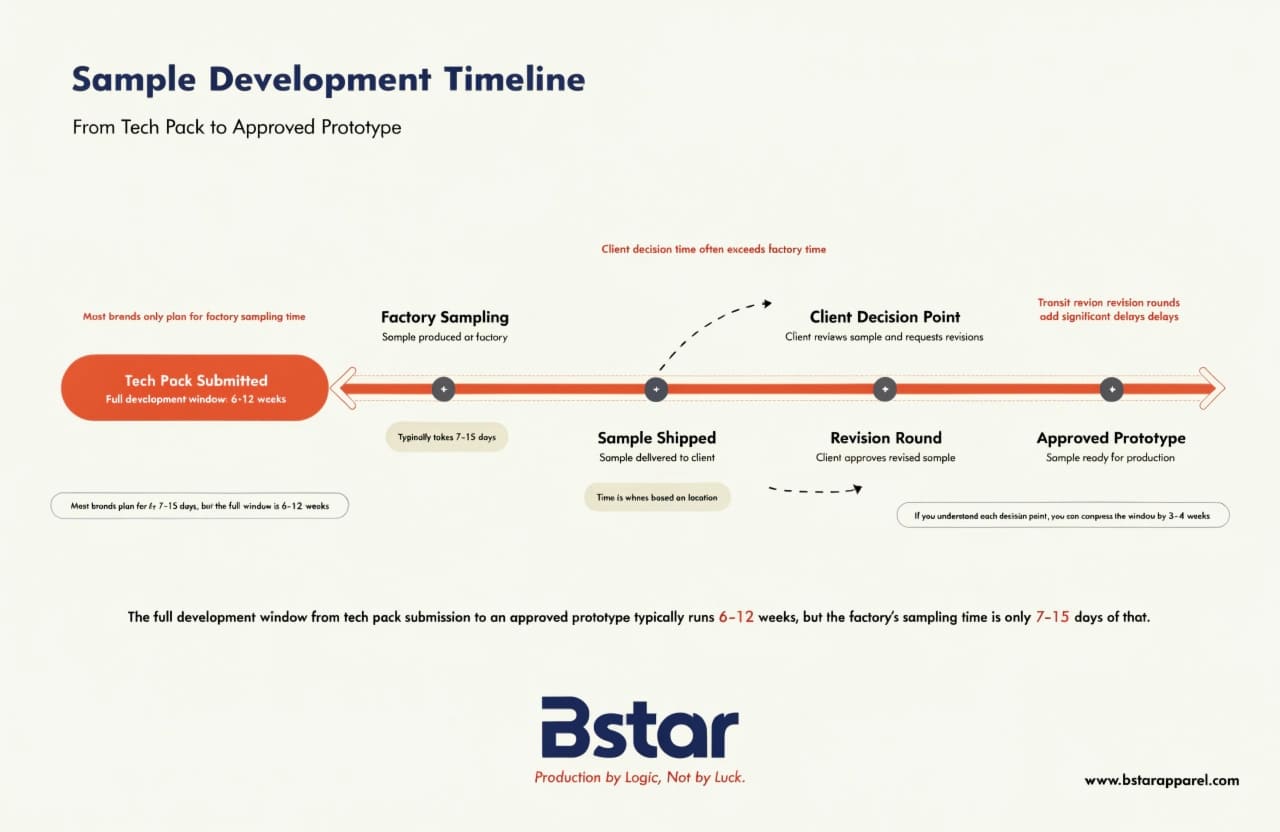
I’ve watched this play out more times than I can count. A brand submits their pack, we turn the sample around in under two weeks, then the proto sits in their hands for three weeks while internal feedback goes in circles. If you understand each decision point before you start, you can compress the whole window — sometimes by three to four weeks. Let me walk you through how it actually works on our end.
Deconstructing the Tech Pack: Translating Design Concepts into Actionable Manufacturing Blueprints?
Most tech pack rejections aren’t about format. They’re about gaps. A beautifully laid-out PDF with missing construction details still stops us cold before we cut a single panel.
When we receive a tech pack, the first thing our team does is a line-by-line completeness check. If the materials spec, stitch type, colorway reference, or tolerance range is missing, we can’t start. We send a clarification list back to the client instead — and that exchange alone can cost 3–7 days before the actual sampling clock even begins1.
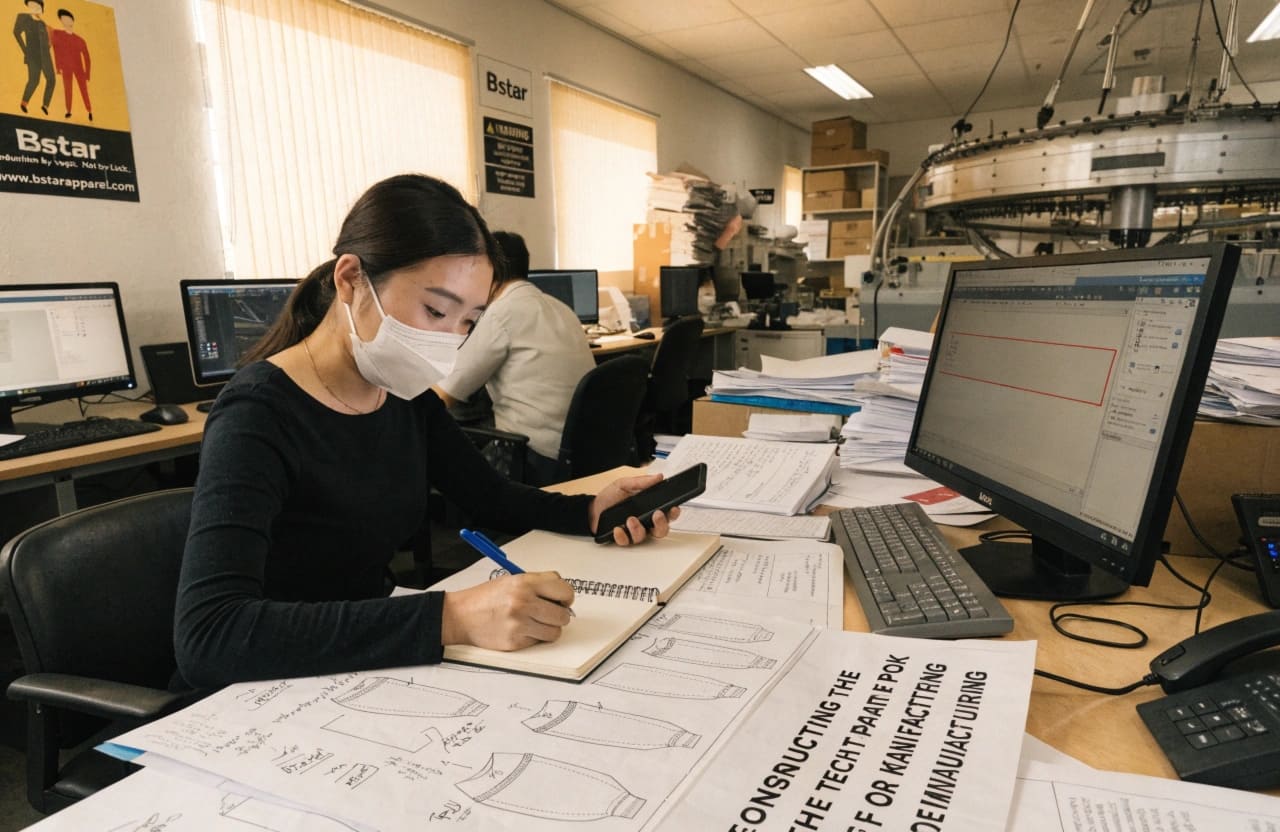
Here’s what we most commonly see missing, and what happens internally when each one is absent:
What Goes Wrong When Information Is Missing
| Missing Element | What We Have to Do | Time Lost |
|---|---|---|
| Fabric weight / composition | Source a substitute, wait for client confirmation | 3–5 days |
| Construction method (e.g., flatlock vs. coverstitch2) | Hold the cut ticket, send query | 2–4 days |
| Colorway with Pantone or physical swatch3 | Proceed with closest match, risk rejection at review | Revision round |
| Measurement tolerance (e.g., ±0.5cm or ±1cm) | Assume internal default, may not match client expectation | Revision round |
| Placement specs for labels or trims | Guess or pause — both create problems | 2–3 days |
What makes a strong tech pack isn’t sophistication. It’s specificity. We’ve received one-page sketches from experienced buyers that moved faster than 20-page decks from underprepared teams. The factory can interpret a lot — but it cannot invent the decisions that belong to the brand.
Before you submit, go through every garment detail and ask yourself: if someone with no context built this from only what’s on this page, would the result match what’s in my head? If the answer is no, fill that gap before you send it.
Once your tech pack clears our review, the next variable isn’t our sewing machines — it’s the raw material pipeline. This is where a lot of brands are surprised.
For most knitwear prototypes, fabric and trim sourcing adds 5–10 days to the front end of sampling4. If your specified yarn or fabric is not in our current inventory, we need to source it. If it requires a custom dye lot or a specific certified material, that window extends further.
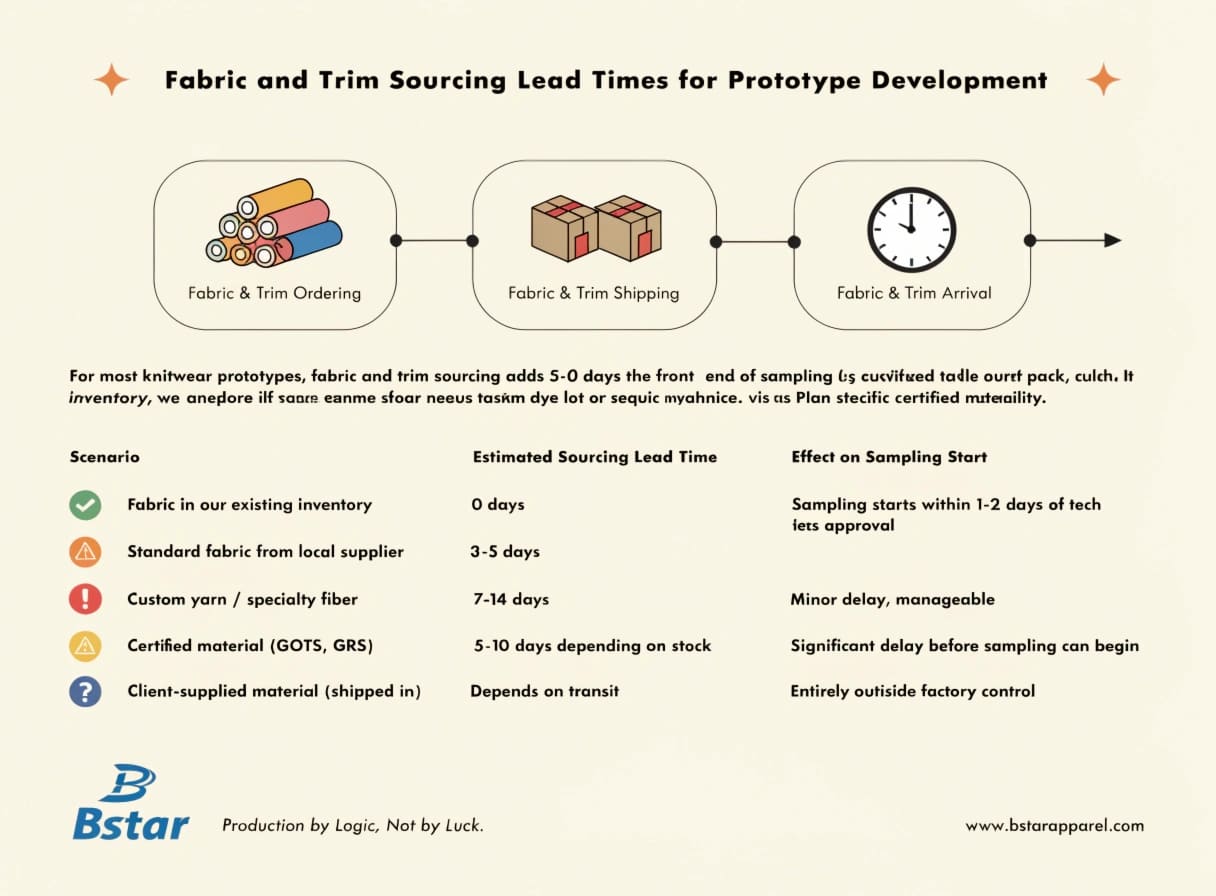
In our experience, clients who specify materials without checking supplier availability cause some of the longest preventable delays. Here’s how we think about the sourcing layer:
Sourcing Scenarios and Their Impact on Sample Start Date
| Scenario | Estimated Sourcing Lead Time | Effect on Sampling Start |
|---|---|---|
| Fabric in our existing inventory | 0 days | Sampling starts within 1–2 days of tech pack approval |
| Standard fabric from local supplier | 3–5 days | Minor delay, manageable |
| Custom yarn / specialty fiber5 | 7–14 days | Significant delay before sampling can begin |
| Certified material (GOTS, GRS)6 | 5–10 days depending on stock | Plan ahead — don’t assume availability |
| Client-supplied material (shipped in) | Depends on transit | Entirely outside factory control |
The fastest path through this stage is to tell us your material requirements early — ideally before you finalize your tech pack. If you’re working with us for the first time, we can check our current inventory and flag lead-time risks before you’re committed to a launch date.
One thing I always tell new clients: the 7–15 day sampling window we quote assumes materials are ready to go7. That’s our actual cut-to-ship time once the floor has everything it needs. It’s not total time from submission.
The First Sample Review: Evaluating Fit, Pattern Accuracy, and Construction Quality?
Your first prototype arrives. This is where most first-time buyers make a critical mistake — they treat it like a final candidate. In our experience, it almost never is, and it’s not supposed to be.
The first proto’s job is to close the gap between a 2D spec and a physical garment. We typically see fit and construction notes on 80–90% of first protos. That’s not a failure — it’s the process working. The risk is when brands expect one round and build their launch timeline around that assumption.
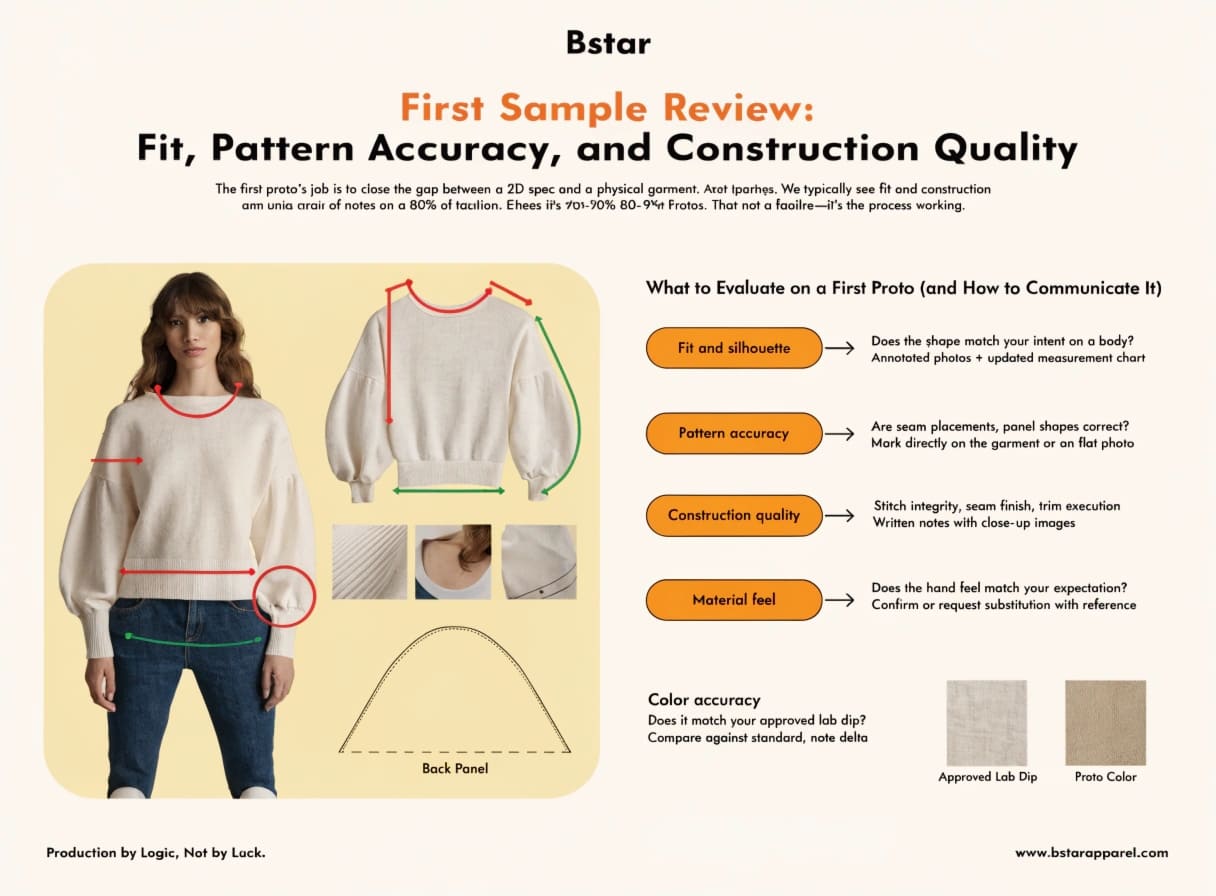
When you review your first proto, you’re really evaluating three separate things — and each one requires a different type of feedback:
What to Evaluate on a First Proto (and How to Communicate It)
| Review Area | What to Look For | How to Feed It Back |
|---|---|---|
| Fit and silhouette | Does the shape match your intent on a body? | Annotated photos + updated measurement chart |
| Pattern accuracy | Are seam placements, panel shapes correct? | Mark directly on the garment or on a flat photo |
| Construction quality | Stitch integrity, seam finish, trim execution | Written notes with close-up images |
| Material feel | Does the hand feel match your expectation? | Confirm or request substitution with reference |
| Color accuracy | Does it match your approved lab dip? | Compare against standard, note delta |
One thing that slows down this stage more than anything else: vague feedback. "The fit is off" gives us nothing. "The hip measurement is 3cm too wide and the armhole sits too low" gives us everything. Specific, visual, measurement-based feedback collapses revision time dramatically.
We ask all our clients to return first-proto comments within 5 business days. When that slips to two or three weeks on the client side, the total development window stretches in ways that are hard to recover from later in the season8.
Iterative Feedback Loops: Streamlining Revisions to Achieve Final Production Approval?
Experienced buyers budget for two to three revision rounds9. That’s not pessimism — it’s how the math works out. If you plan for one and need two, you’ve lost two to three weeks you can’t recover.
Each revision round at our factory takes 5–10 days from the time we receive confirmed comments. The variable that compounds total development time isn’t our turnaround — it’s how long the brand takes to align internally before sending feedback. We’ve seen identical revision scopes take 12 days total and 45 days total, depending entirely on client response speed.
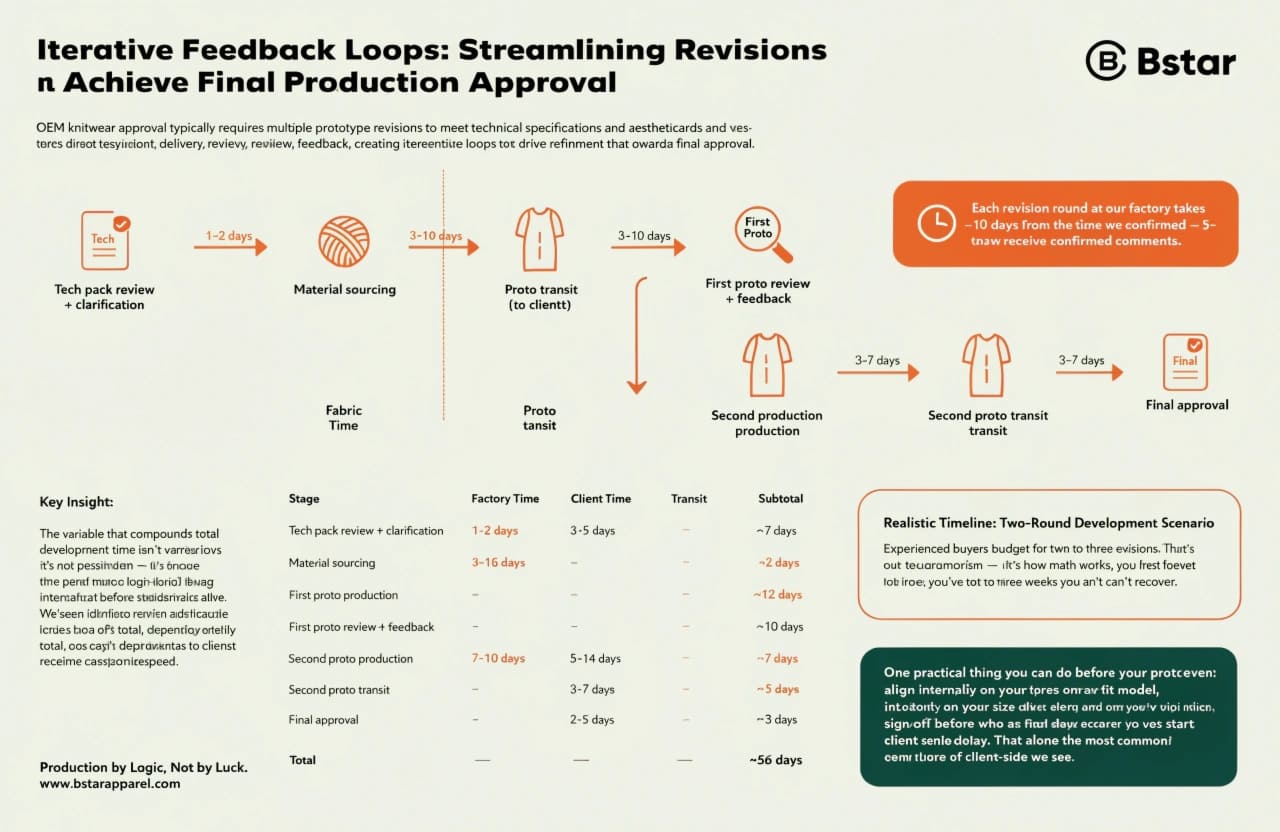
Here’s how a realistic two-round development cycle actually breaks down in real time:
Realistic Timeline: Two-Round Development Scenario
| Stage | Factory Time | Client Time | Transit | Subtotal |
|---|---|---|---|---|
| Tech pack review + clarification | 1–2 days | 3–5 days | — | ~7 days |
| Material sourcing | 3–10 days | — | — | ~7 days |
| First proto production | 7–15 days | — | — | ~12 days |
| Proto transit (to client) | — | — | 3–7 days | ~5 days |
| First proto review + feedback | — | 5–14 days | — | ~10 days |
| Second proto production | 5–10 days | — | — | ~7 days |
| Second proto transit | — | — | 3–7 days | ~5 days |
| Final approval | — | 2–5 days | — | ~3 days |
| Total | ~56 days |
That’s eight weeks under reasonable conditions. With a slow-to-confirm client, we see this stretch to fourteen weeks or more. With a well-prepared client who responds quickly, we’ve closed two-round developments in under five weeks10.
The biggest lever you control is your own response speed. The factory’s floor doesn’t pause between your rounds — other orders fill that time. The faster you get comments back to us, the faster we can re-queue your sample.
One practical thing you can do before your proto even ships: align internally on your fit model, your size chart, and your approval criteria11. Know who has final sign-off before you start. That alone eliminates the most common source of client-side delay we see.
Conclusion
The development timeline is a shared responsibility. Know what your factory needs, respond fast, budget for two rounds, and you’ll hit your launch window far more reliably than most first-time buyers do.
If you’re preparing your first tech pack and want to know exactly what we’ll need to start sampling without delays, feel free to reach out — we’re happy to walk through it with you before you submit.
-
"What Affects Lead Time in Clothing Production? – Mingxing Clothing", https://mingxingclothing.com/blog/what-affects-clothing-production-lead-time/. Research on product development communication in apparel supply chains documents that specification ambiguity triggers iterative clarification cycles that delay production start dates, though specific day-ranges vary by factory capacity and communication channel. Evidence role: general_support; source type: research. Supports: That incomplete or ambiguous product specifications create measurable delays in manufacturing workflows before production can begin. Scope note: Direct empirical benchmarks for the 3–7 day figure specific to knitwear OEM clarification rounds are not widely published; available literature addresses broader specification-error costs in manufacturing. ↩
-
"Flatlocking compared to cover stitching and overlocking", https://fashion-incubator.com/flatlocking-compared-to-cover-stitching-and-overlocking/. Flatlock and coverstitch seams are classified under distinct stitch type categories in ISO 4915, differing in thread path, seam flatness, and stretch recovery; the choice between them affects seam bulk, durability, and garment appearance in knitwear applications. Evidence role: definition; source type: encyclopedia. Supports: That flatlock and coverstitch are technically distinct stitch formations with different structural and aesthetic outcomes, making their specification a meaningful manufacturing decision. Scope note: ISO 4915 provides technical classification but does not address the downstream manufacturing or lead-time implications of choosing one stitch type over another. ↩
-
"Pantone – Wikipedia", https://en.wikipedia.org/wiki/Pantone. The Pantone Textile Color System is broadly used across the apparel and textile supply chain as a common color language between design teams and production facilities, enabling consistent color specification independent of subjective visual interpretation. Evidence role: expert_consensus; source type: institution. Supports: That Pantone color references serve as a widely adopted standard for color communication between designers and manufacturers in the apparel and textile industries. Scope note: Pantone’s role as an industry standard is widely acknowledged in trade practice but is not governed by a formal international standard body; physical metamerism and dye-lot variation mean Pantone references alone do not guarantee color accuracy in production. ↩
-
"Study on Factors Delaying Lead Time in the Apparel Supply Chain …", https://www.academia.edu/42000847/Study_on_Factors_Delaying_Lead_Time_in_the_Apparel_Supply_Chain_Management_A_Case_Study_on_the_Order_of_Execution_Strategies_of_a_Garment_Factory_in_Bangladesh. Industry analyses of apparel supply chain structure identify raw material procurement as a discrete phase with variable lead times influenced by supplier proximity, stock availability, and material specification complexity. Evidence role: general_support; source type: institution. Supports: That raw material procurement represents a distinct and measurable lead-time component in apparel sample development, separate from cut-and-sew time. Scope note: Published lead-time figures vary significantly by region, material type, and supplier relationship; the 5–10 day range cited reflects one factory’s operational context rather than a universal industry standard. ↩
-
"Strategic Sourcing in Yarn: A Game-Changer for the Textile Industry", https://www.linkedin.com/posts/deval-sharma-76999825_strategic-sourcing-in-yarn-a-game-changer-activity-7349273130781003779-fFnC. Textile supply chain analyses note that specialty and custom-spun yarns involve additional processing steps and smaller supplier networks compared to commodity fibers, resulting in extended procurement lead times that must be accounted for in development scheduling. Evidence role: general_support; source type: institution. Supports: That specialty or custom yarn procurement involves longer lead times than standard commodity fibers due to limited supplier availability and minimum order requirements. Scope note: Specific lead-time ranges for specialty yarn procurement are not uniformly published; the 7–14 day figure is a factory-reported estimate and will vary by fiber type, supplier location, and order volume. ↩
-
"Sustainable Fashion and Apparel Design: Standards | Certificates", https://guides.library.cornell.edu/c.php?g=662121&p=5277662. The Global Organic Textile Standard (GOTS) and Global Recycled Standard (GRS) require chain-of-custody certification at each supply chain stage, which limits the number of eligible suppliers and can extend procurement lead times when certified stock is not held in local inventory. Evidence role: mechanism; source type: institution. Supports: That GOTS and GRS certification requirements constrain the supplier pool and can extend material sourcing timelines compared to uncertified equivalents. Scope note: Neither GOTS nor GRS publishes average sourcing lead-time data; the 5–10 day estimate reflects factory-level experience rather than a figure derived from certification body documentation. ↩
-
"Understanding Custom Knitwear Production Time – Knitwise", https://www.knitwise.com/blogs/knitwise/custom-knitwear-production-time?srsltid=AfmBOooi48S8N1m-VXjrzgoLHIO6Spcou-5F85l-y62DO55kQnaJu5Wx. Industry sourcing guides and apparel development references commonly cite sample production lead times of one to three weeks for standard garment categories once materials are confirmed and available on the factory floor, with variation based on construction complexity and factory workload. Evidence role: general_support; source type: institution. Supports: That apparel prototype production, once materials are staged, can be completed within a one-to-two-week window under standard factory conditions. Scope note: Published lead-time benchmarks are rarely disaggregated by product category such as knitwear versus woven; the 7–15 day figure reflects one factory’s stated capacity and may not generalize across manufacturers. ↩
-
"Why Fashion Runs on a Calendar (and What It Costs Suppliers Who …", https://www.spscommerce.com/community/articles/why-fashion-runs-on-a-calendar-and-what-it-costs-suppliers-who-fall-behind-it. Operations management and supply chain research on time-to-market in fashion identifies early-phase delays as disproportionately costly because downstream production, logistics, and retail calendar milestones are fixed, leaving limited buffer for recovery as the season progresses. Evidence role: mechanism; source type: research. Supports: That early-stage delays in product development pipelines create compounding schedule pressure that cannot be fully absorbed later in a fixed seasonal production window. Scope note: Most published research addresses fast-fashion or mass-market contexts; the degree of compounding may differ for smaller-volume OEM knitwear development with more flexible scheduling. ↩
-
"The Logic of Fashion Cycles – PMC – NIH", https://pmc.ncbi.nlm.nih.gov/articles/PMC3296716/. Apparel product development frameworks consistently describe prototype iteration as a structured, multi-round process; industry practitioners and academic literature on fashion supply chains treat two or more revision cycles as a baseline planning assumption rather than an exception. Evidence role: expert_consensus; source type: research. Supports: That multiple prototype revision rounds are a standard expectation in apparel product development rather than an indicator of process failure. Scope note: The specific figure of two to three rounds is not uniformly defined across published sources and varies by product complexity, buyer experience, and factory capability. ↩
-
"Custom Clothing Manufacturing Timeline Explained – Argus Apparel", https://argusapparel.com/blog/custom-clothing-manufacturing-timeline/. Research on new product development in fashion supply chains identifies buyer-side response latency as a primary driver of total development duration, with studies showing that reductions in approval and feedback cycle times produce near-proportional reductions in overall time-to-sample. Evidence role: general_support; source type: research. Supports: That client responsiveness and preparation are significant determinants of total development cycle length, and that compressed timelines are achievable when communication delays are minimized. Scope note: Published studies on compressed development timelines typically address fast-fashion mass-market contexts; the sub-five-week figure for a two-round knitwear development is a factory-reported outcome and has not been independently benchmarked. ↩
-
"Apparel: 10 Best Practices on Sizing – Baymard", https://baymard.com/blog/apparel-size-information. Apparel product development curricula and industry technical guides identify the establishment of a fit model standard, graded size chart, and explicit approval criteria as prerequisite steps before prototype production, noting that undefined standards are a leading cause of iterative revision and extended development timelines. Evidence role: expert_consensus; source type: education. Supports: That pre-defined fit standards, size specifications, and approval criteria are foundational inputs to efficient apparel product development and that their absence is a documented source of revision cycles. Scope note: This represents broadly accepted professional practice rather than a finding from controlled empirical research; the causal relationship between pre-alignment and reduced revision rounds has not been formally quantified in published studies. ↩