
Ergonomic Pouch Design: Engineering Comfort & Support?
Getting a pouch design wrong costs you more than a failed sample. It costs you customer returns, brand trust, and a second round of tooling fees.
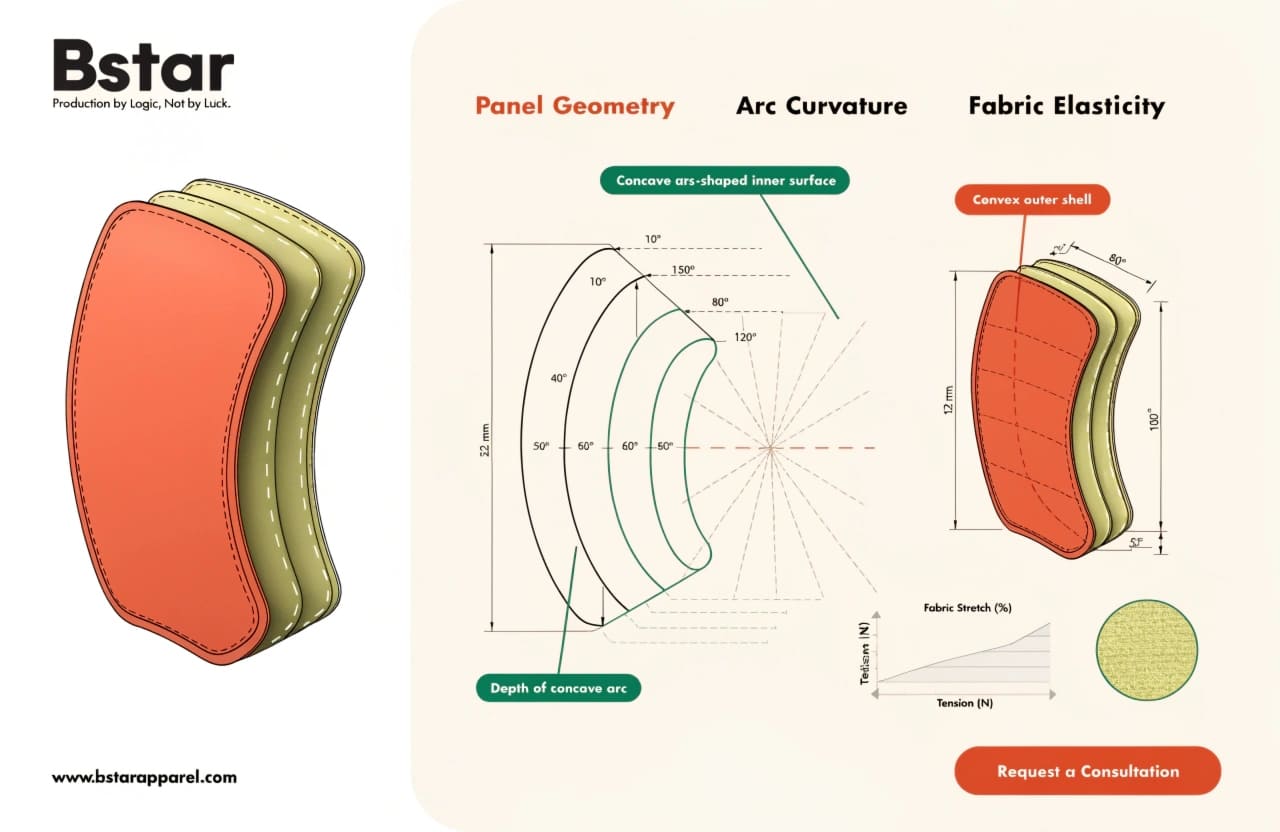
An ergonomic pouch works because of three things working together: panel geometry, arc curvature, and fabric elasticity. Change any one of them without adjusting the others, and the support collapses. This article gives you a framework to specify all three before you brief your manufacturer.
Most brands come to us after a sample fails. The pouch looks fine flat. It measures out correctly. But the wearer says it bags, shifts, or just feels wrong. Nine times out of ten, the root cause is not the stitching. It is a mismatch between the panel shape, the arc depth, and the fabric spec. The good news is that all three of these are controllable—if you know what to ask for upfront.
Anatomical 3D Patterning: Translating Human Physiology into Precision Garment Architecture?
More fabric does not mean more support. That is the mistake most briefs make when a client says "make the pouch bigger."
A pouch creates lift and containment through panel arc geometry—how the curved seam lines follow the body’s natural contour1. Adding volume without adjusting the arc radius just creates a loose pocket. The shape has to be cut to match how the body actually sits, not scaled up from a flat template.
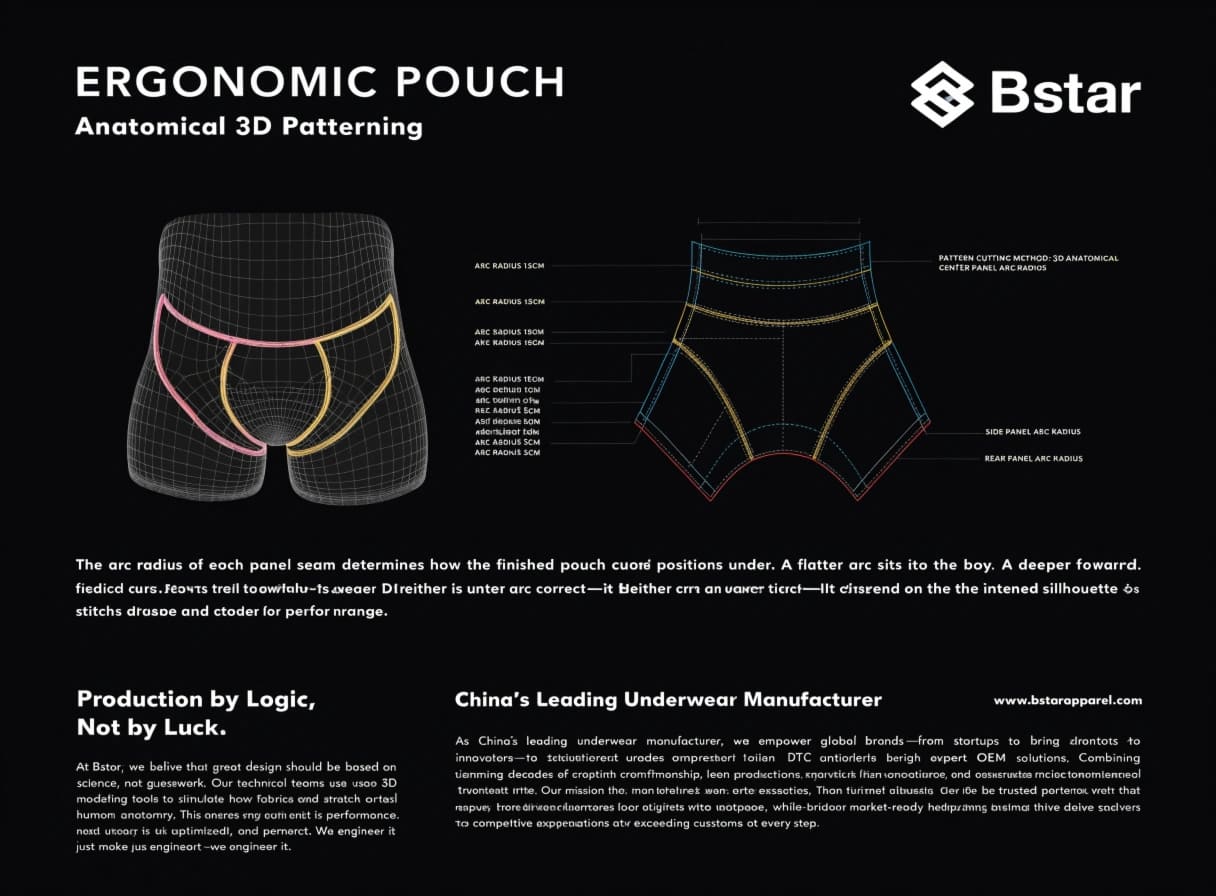
In our sampling process, the most common revision request we get from DTC brand clients is: "adjust the arc on the center panel." That one sentence tells us a lot. It usually means the original brief specified volume but did not specify curvature. The cutter followed the spec correctly, but the spec was incomplete.
What Arc Geometry Actually Controls
The arc radius of each panel seam determines how the finished pouch cups and positions under wear. A flatter arc sits closer to the body. A deeper arc creates forward projection2. Neither is universally correct—it depends on the intended silhouette and the target size range.
| Arc Type | Effect on Fit | Common Use Case |
|---|---|---|
| Shallow arc | Lower projection, closer fit | Briefs, trunks with minimal volume |
| Medium arc | Balanced lift and containment | Most DTC everyday underwear |
| Deep arc | Maximum forward projection | Performance or anatomical styles |
One thing brands often miss: a single arc solution is not size-inclusive. The arc geometry that works at a medium size will under-perform at the size extremes unless it is re-graded3. When you brief your manufacturer, ask them specifically how they grade the arc radius across the size range—not just how they grade the overall dimensions.
Strategic Fabric Engineering: Balancing Stretch, Recovery, and Targeted Support Zones?
Choosing the wrong fabric for a pouch is not just a feel issue. It is a structural failure.
Fabric elasticity grade is a load-bearing decision. The recovery rate and four-way stretch percentage of your chosen fabric determine whether the pouch holds its engineered shape under wear4. A pattern cut for mid-elasticity fabric will lose support performance if you switch to a higher- or lower-stretch option during cost optimization.
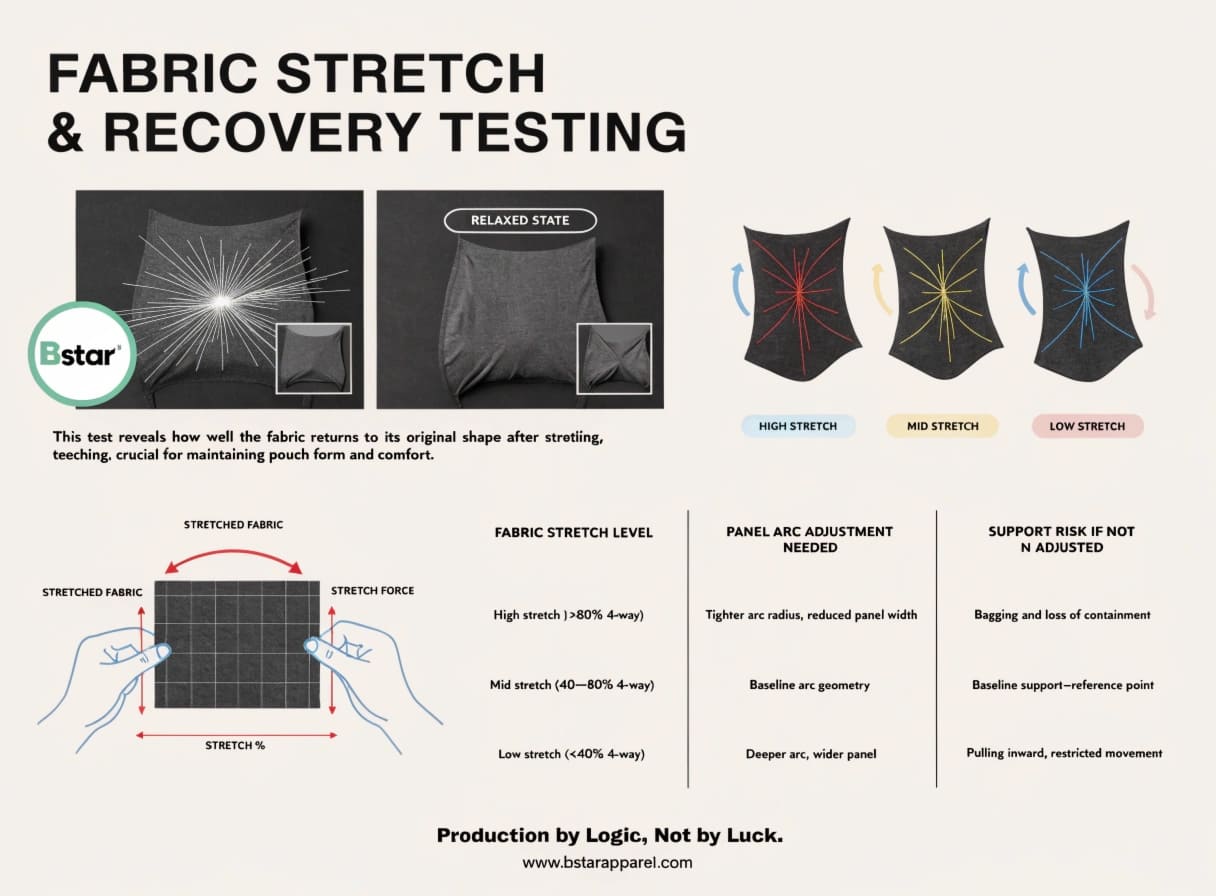
We see this happen regularly. A brand approves a sample in one fabric, then asks to switch to a cost-optimized alternative before production. The alternative has a slightly different stretch percentage. The pattern is not adjusted. The first production run comes back, and the pouch feels loose or pulls inward depending on which direction the substitution went.
How Elasticity Interacts with Panel Shape
The relationship between fabric stretch and panel geometry is direct. A higher-stretch fabric will deform more under body weight, which means the panel arc needs to be cut tighter to compensate5. A lower-stretch fabric holds its shape more rigidly, which means a deeper arc is needed to achieve the same forward position.
| Fabric Stretch Level | Panel Arc Adjustment Needed | Support Risk if Ignored |
|---|---|---|
| High stretch (>80% 4-way) | Tighter arc radius, reduced panel width | Bagging and loss of containment |
| Mid stretch (40–80% 4-way) | Baseline arc geometry | Baseline support—reference point |
| Low stretch (<40% 4-way) | Deeper arc, wider panel | Pulling inward, restricted movement |
When you brief your manufacturer, give them the fabric spec first—before discussing panel geometry. The pattern cannot be finalized without knowing the elasticity grade. If you are comparing fabric options, ask your manufacturer to show you how the arc geometry changes between them. If they say it does not change, push back.
Seamless Integration and Ergonomic Bonding: Eliminating Friction Points for Ultimate Comfort?
A pouch can be perfectly shaped and still fail if the seams create pressure points.
Where and how panels are joined determines whether the pouch sits smoothly against the body or creates friction under movement. Flatlock stitching, bonded edges, and seamless knitting each handle differently at the join6—and each requires a different approach to panel placement and edge finishing.
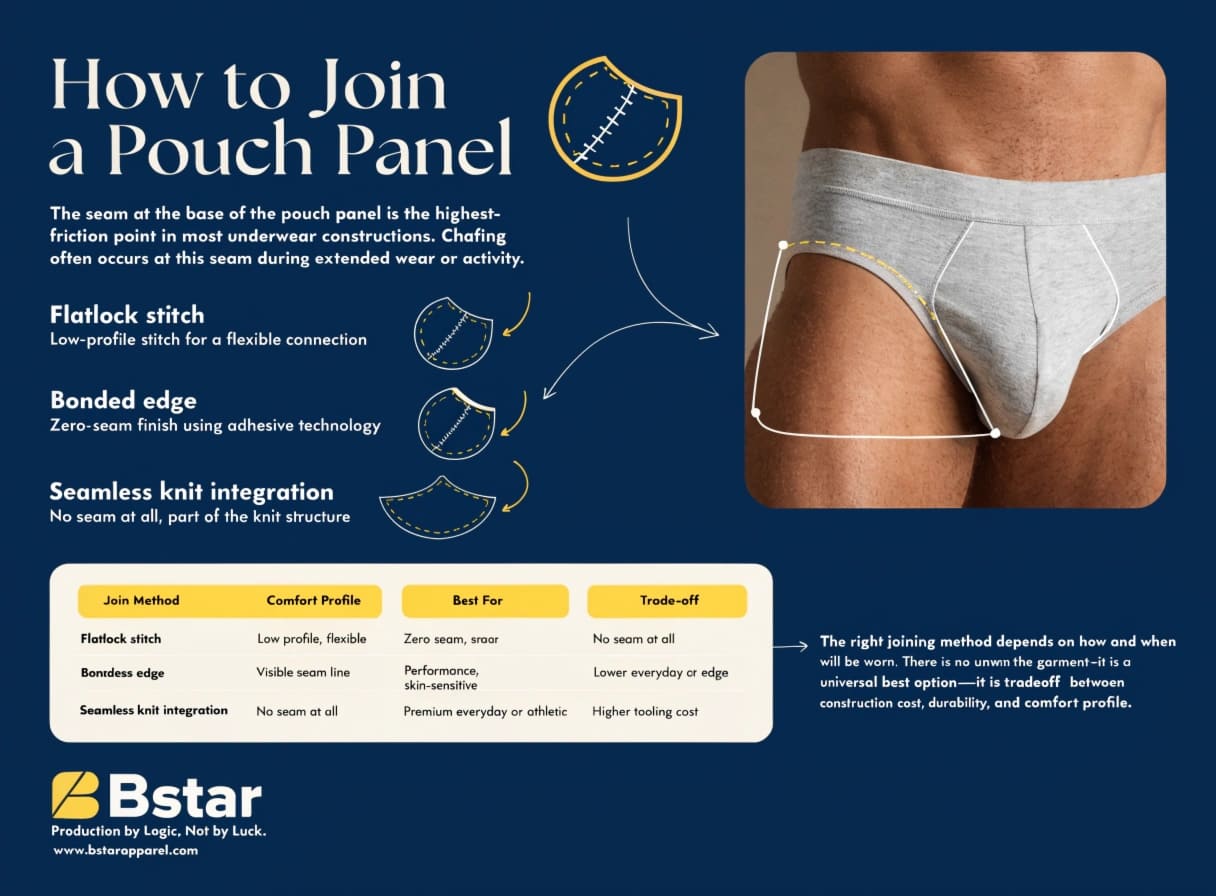
The seam at the base of the pouch panel is the highest-friction point in most underwear constructions7. It is where the pouch transitions from the body of the garment, and it is where most wearers report chafing during extended wear or activity.
Joining Method vs. Wear Context
The right joining method depends on how and when the garment will be worn. There is no universal best option—it is a tradeoff between construction cost, durability, and comfort profile.
| Join Method | Comfort Profile | Best For | Trade-off |
|---|---|---|---|
| Flatlock stitch | Low profile, flexible | Everyday wear | Visible seam line |
| Bonded edge | Zero seam, smooth | Performance, skin-sensitive | Lower durability at edge |
| Seamless knit integration | No seam at all | Premium everyday or athletic | Higher tooling cost |
When briefing your manufacturer, specify the wear context first. If your customer is sedentary, a flatlock seam at the panel join is fine. If your customer is active, ask your manufacturer how they handle the base-panel transition—and ask to see a wear-test result, not just a flat sample.
Also ask where the seam allowance falls on each panel join. A seam that sits directly under the natural crease line will create pressure even if the stitch type is correct. Panel placement and seam placement are separate decisions, and both need to be in your brief.
Biomechanical Testing and Fit Validation: Ensuring Dynamic Support During Movement and Rest?
A pouch that fits well on a mannequin is not the same as a pouch that works on a moving body.
Static fit approval is not enough. Ergonomic pouch performance must be validated across a range of body positions—standing, sitting, and in motion8. A panel geometry that holds shape at rest can shift, collapse, or rotate under movement if the arc and fabric spec are not co-designed for dynamic load9.
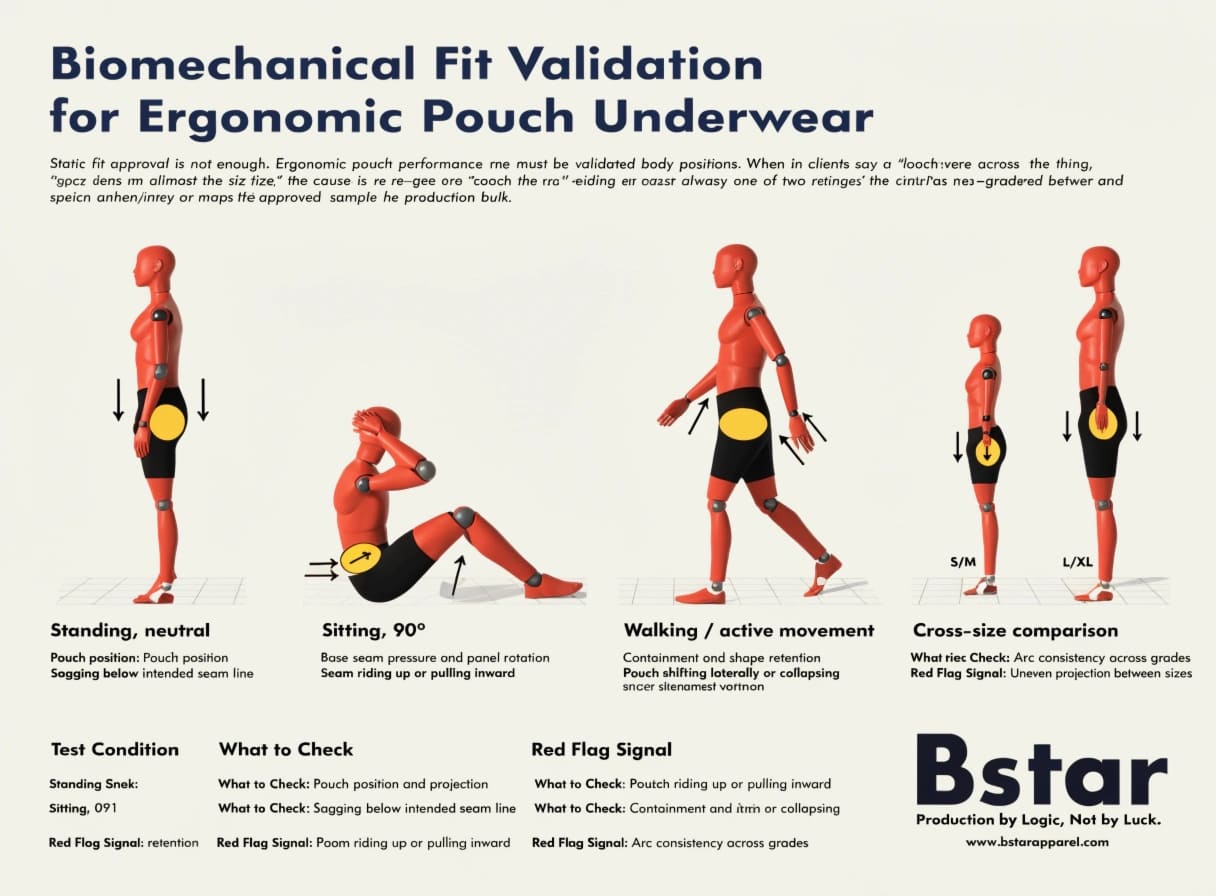
When a client tells us a pouch "looks uneven across the size range," the cause is almost always one of two things: the arc was not re-graded per size, or the fabric spec changed between the approved sample and the production bulk. Both of these are diagnosable before production if you have the right checkpoints in your approval process.
A Simple Validation Framework
You do not need a lab to validate pouch fit. You need a structured wear trial with clear feedback prompts.
| Test Condition | What to Check | Red Flag Signal |
|---|---|---|
| Standing, neutral | Pouch position and projection | Sagging below intended seam line |
| Sitting, 90° | Base seam pressure and panel rotation | Seam riding up or pulling inward |
| Walking / active movement | Containment and shape retention | Pouch shifting laterally or collapsing |
| Cross-size comparison | Arc consistency across grades | Uneven projection between sizes |
Ask your manufacturer to include a dynamic fit report with the pre-production sample—not just a measurement sheet. If they do not have a standard format for this, provide one. It takes five minutes to fill out and it surfaces problems before they become a production run.
Also check: when the wear tester sits down, does the base seam stay in place or does it migrate? Migration is a sign that the arc depth is too shallow for the fabric’s stretch level10. That is a pattern fix, not a fit model issue.
Conclusion
Ergonomic pouch design comes down to three variables: panel arc geometry, fabric elasticity grade, and seam placement. Get these co-designed and validated before production, and your sample will hold up under real wear.
-
"Parametric design of garment pattern based on body dimensions", https://www.sciencedirect.com/science/article/abs/pii/S0169814119300368. Foundational pattern-making texts establish that seam curvature determines how flat fabric panels resolve into three-dimensional shapes that follow body contours; the arc radius of a seam controls the degree of cup or projection in the finished garment. Evidence role: mechanism; source type: education. Supports: That curved seam geometry in garment panels governs how a finished garment conforms to and supports body contours. Scope note: Most pattern-making literature addresses general garment construction; direct application to anatomical pouch underwear may require inference from broader principles ↩
-
"Single View Garment Reconstruction Using Diffusion Mapping Via …", https://arxiv.org/html/2504.08353v1. Garment construction and pattern geometry texts establish that the depth of curvature in a seam line directly controls the degree of three-dimensional projection in the finished panel: a deeper arc forces the fabric to cup outward from the body plane, while a shallower arc produces a flatter, closer-fitting result. Evidence role: definition; source type: education. Supports: That increasing the arc depth of a curved seam causes the joined panels to project further away from the body plane in the finished garment. Scope note: This principle is well established in general pattern-making literature but is typically illustrated with reference to bust or seat shaping rather than anatomical pouch panels specifically ↩
-
"How to Grade Between Pattern Sizes for a Better Fit – YouTube", https://www.youtube.com/watch?v=2d3o_3xpFz0. Apparel grading literature distinguishes between linear dimensional grading and the geometric adjustment of curved seams, noting that failure to re-grade arc radii across a size range results in fit degradation at size extremes. Evidence role: mechanism; source type: education. Supports: That grading curved seam lines requires geometric adjustment of arc radii, not merely proportional scaling of linear dimensions. Scope note: Published grading references may address outerwear or womenswear curves rather than intimate apparel pouch panels specifically ↩
-
"D2594 Standard Test Method for Stretch Properties of Knitted …", https://store.astm.org/d2594-20.html. ASTM and ISO textile testing standards define stretch percentage and recovery rate as primary mechanical properties of elastic fabrics, with recovery rate specifically measuring the degree to which a fabric returns to its original dimensions after a defined elongation cycle. Evidence role: mechanism; source type: institution. Supports: That stretch percentage and elastic recovery rate of a fabric govern its ability to return to its original dimensions after deformation under body load. Scope note: Standardized test methods measure fabric properties in isolation; the interaction between fabric recovery and three-dimensional panel geometry in a finished garment involves additional variables not captured by flat-fabric tests ↩
-
"How To Size Any Sewing Pattern For Knit Fabric With ANY Stretch!", https://www.youtube.com/watch?v=RgFPTD8bDz4. Pattern-making references for stretch fabrics document that the degree of fabric elongation under load must be factored into panel geometry, with higher-stretch materials requiring tighter curves or reduced dimensions to achieve the intended three-dimensional form in the worn garment. Evidence role: mechanism; source type: education. Supports: That pattern pieces for higher-stretch fabrics require geometric compensation—such as reduced arc radius—to achieve the same finished shape as a lower-stretch fabric cut to a wider arc. Scope note: Published guidance typically addresses general stretch garment categories; specific quantitative relationships between stretch percentage and arc radius adjustment are not widely standardized in public literature ↩
-
"Advancements in functional smart and wearable textiles for … – PMC", https://pmc.ncbi.nlm.nih.gov/articles/PMC12716241/. Research on apparel comfort and seam engineering documents that seam construction method affects pressure distribution, friction, and flexibility at panel joins, with bonded and seamless constructions generally reducing mechanical irritation compared to conventional stitched seams in skin-contact garments. Evidence role: expert_consensus; source type: paper. Supports: That different seam construction methods—flatlock, bonded, and seamless—produce distinct mechanical and comfort profiles at garment panel joins. Scope note: Published studies often focus on athletic or medical compression garments; direct comparative data for intimate apparel pouch panel joins is limited in peer-reviewed literature ↩
-
"Influence of epidermal hydration on the friction of human skin … – PMC", https://pmc.ncbi.nlm.nih.gov/articles/PMC2607440/. Studies on textile-skin friction and garment-related skin irritation identify seam placement at anatomical flexion or transition zones as a primary contributor to chafing, as repeated movement causes the seam edge to exert cyclical mechanical stress on the skin surface. Evidence role: general_support; source type: paper. Supports: That seam placement at anatomical transition points in close-fitting garments concentrates friction and pressure, increasing the likelihood of skin irritation during wear. Scope note: Available research addresses seam-related skin irritation broadly; studies specifically quantifying friction at pouch base seams in men’s underwear are not widely available in public literature ↩
-
"Does the fit of personal protective equipment affect functional … – PMC", https://pmc.ncbi.nlm.nih.gov/articles/PMC9710848/. Ergonomics and apparel fit research consistently distinguishes between static and dynamic fit, noting that garment panels may shift, rotate, or lose structural integrity during movement in ways not detectable through static mannequin or standing assessment alone. Evidence role: expert_consensus; source type: paper. Supports: That static garment fit assessment does not reliably predict fit performance during dynamic body movement, and that wear trials incorporating multiple body positions are necessary for ergonomic validation. Scope note: Most published dynamic fit research addresses workwear, sportswear, or medical garments; peer-reviewed studies specifically on dynamic fit validation for intimate apparel are limited ↩
-
"[PDF] Mechanical Behavior of Woven Fabrics – DSpace@MIT", https://dspace.mit.edu/bitstream/handle/1721.1/89902/53282217-MIT.pdf?sequence=2&isAllowed=y. Biomechanical and textile engineering research on close-fitting garments demonstrates that panel shape retention under dynamic load is a function of both geometric design and fabric elastic properties, with mismatches between the two producing deformation, rotation, or collapse during movement. Evidence role: mechanism; source type: paper. Supports: That the structural performance of a garment panel under dynamic body movement depends on the interaction between panel geometry and fabric mechanical properties, and that optimizing either variable in isolation is insufficient. Scope note: Published research on this interaction tends to focus on compression garments or sportswear; direct evidence for intimate apparel pouch panels under dynamic load is not widely available in peer-reviewed sources ↩
-
"Pattern Alteration1 – BE BOLD. Shape the Future.", https://pubs.nmsu.edu/_c/C228/index.html. Pattern-making literature on fitted garments identifies seam migration during postural change as a geometric fit fault attributable to inadequate ease or curvature in the panel design, with the fabric’s stretch properties determining the degree of displacement when the body moves from one position to another. Evidence role: mechanism; source type: education. Supports: That seam displacement during postural change results from insufficient geometric accommodation in the panel pattern for the fabric’s elongation under load, rather than from fit model variation. Scope note: Published pattern-making references address seam migration in general garment categories; specific guidance on arc depth and seam stability in pouch underwear panels is not widely documented in public academic sources ↩