How to Start a Men’s Underwear Brand in 2026?
Many founders pick a soft fabric, place a sample order, and then discover fit, shrinkage, and color problems too late.
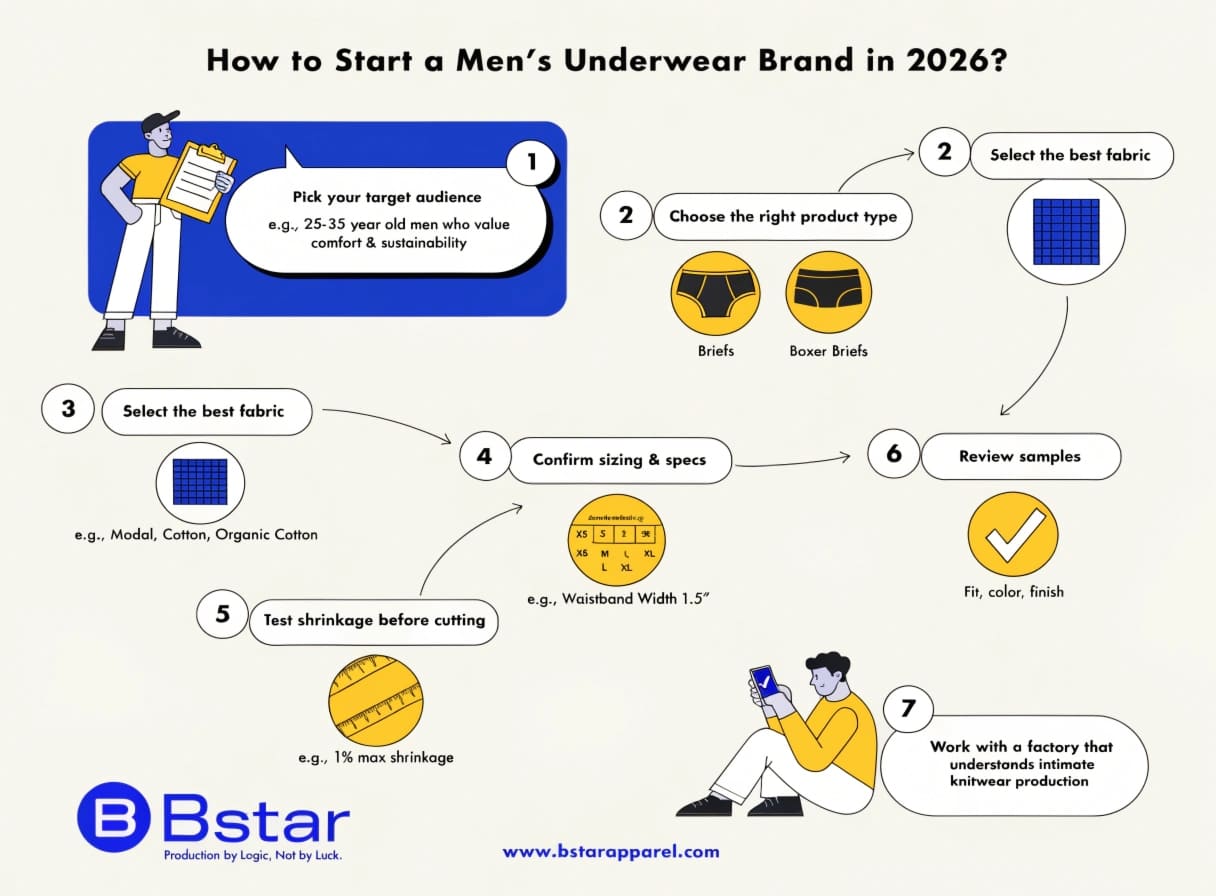
To start a men’s underwear brand in 2026, I would define the customer, choose the product type, select the right fabric, confirm sizing, test shrinkage before cutting, review samples, and work with a factory that understands intimate knitwear production.
I have seen many DTC founders treat underwear like a simple product. I understand why. It looks small. It uses less fabric. It seems easier than outerwear. But on the factory floor, I see the opposite. Men’s underwear is close to the skin. Small mistakes become big complaints. A weak waistband, poor leg opening, rough seams, bad shrinkage control, or unstable color can damage a new brand before the second order. In our production work at BSTAR, I always tell new clients one thing first. Underwear is not only a design project. It is a sourcing system.
What is the trend in men’s underwear in 2026?
Many brands chase trends too late, copy too much, and then enter the market with underwear that looks current but feels ordinary.
In 2026, I see men’s underwear moving toward softer next-to-skin fabrics, cleaner fits, better waistbands, functional pouch designs1, sustainable certified materials, and smaller drops that test demand before large production2.
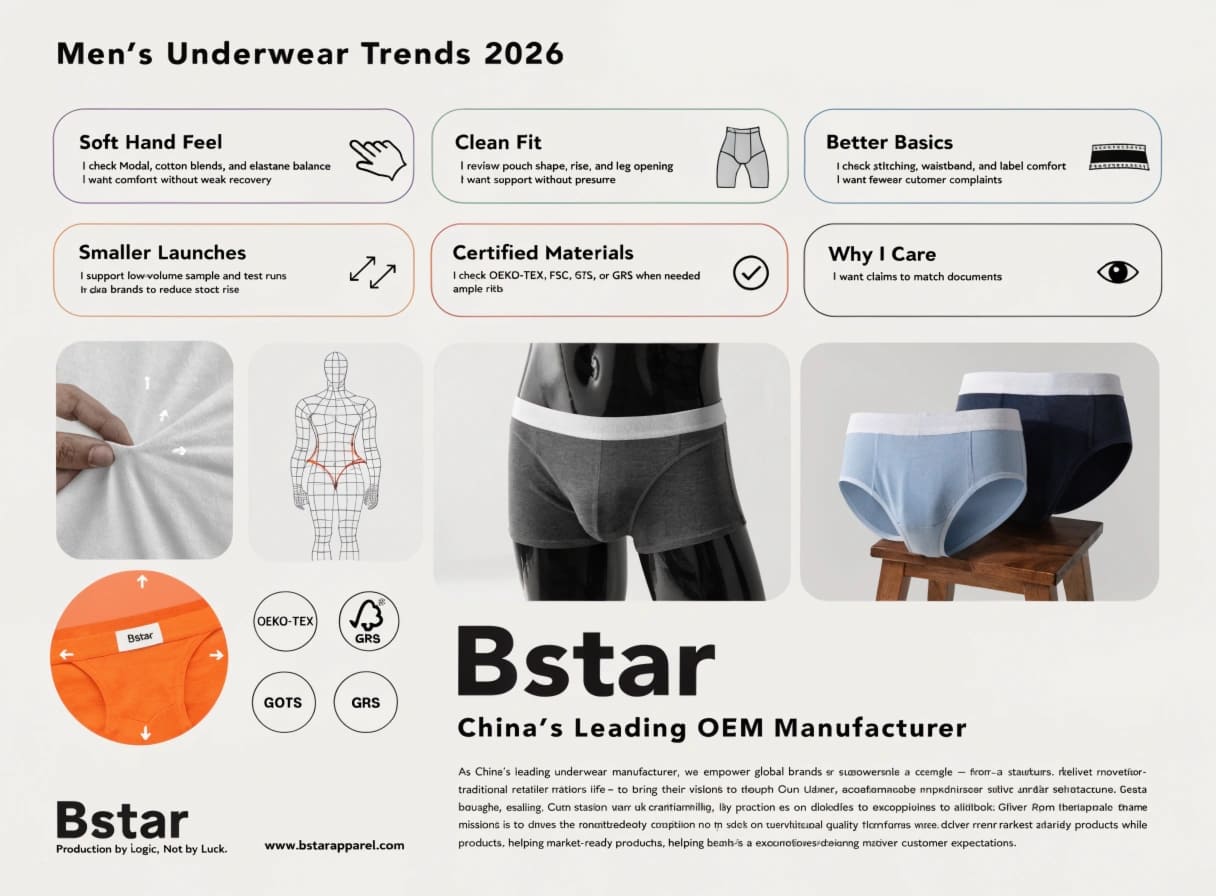
From our factory side, I see one clear point. Men’s underwear buyers now care about comfort first, but they still expect a good shape after repeated wear. Modal is often part of this talk. I do not treat Modal as a premium version of cheap viscose. I treat it as a different fiber with different production needs. When clients bring us Modal briefs, trunks, or base layers, I first ask how they want the product to feel, how close the fit should be, and how much stretch recovery they expect.
2026 trend checks I use before sampling
| Trend area | What I check in production | Why I care |
|---|---|---|
| Soft hand feel | I check Modal, cotton blends, and elastane balance | I want comfort without weak recovery |
| Clean fit | I review pouch shape, rise, and leg opening | I want support without pressure |
| Better basics | I check stitching, waistband, and label comfort | I want fewer customer complaints |
| Smaller launches | I support low-volume sample and test runs | I want brands to reduce stock risk |
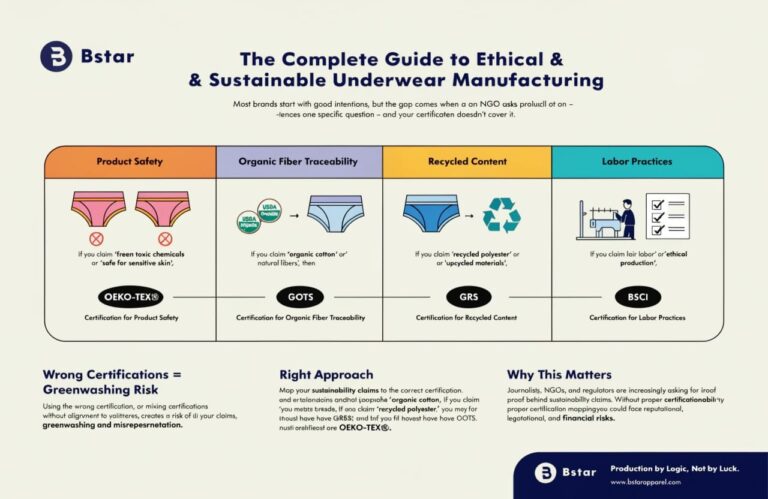
| Certified materials | I check OEKO-TEX, FSC, GOTS, or GRS when needed3 | I want claims to match documents |
I also see more brands asking for sustainable stories. I keep this talk careful. Modal is not automatically sustainable. The claim depends on the fiber source, supplier, dyeing process, and certificates.4 Lenzing-type fibers and generic Modal are not the same sourcing story5. I prefer to confirm the material chain before a brand writes marketing copy.
How to create an underwear brand?
Many founders start with a logo and color palette, but they skip product rules, and that makes sourcing slow and expensive.
I would create an underwear brand by defining the target wearer, choosing one core style, selecting fabric by use case, building a size chart, testing samples, confirming packaging, and placing a controlled first order.
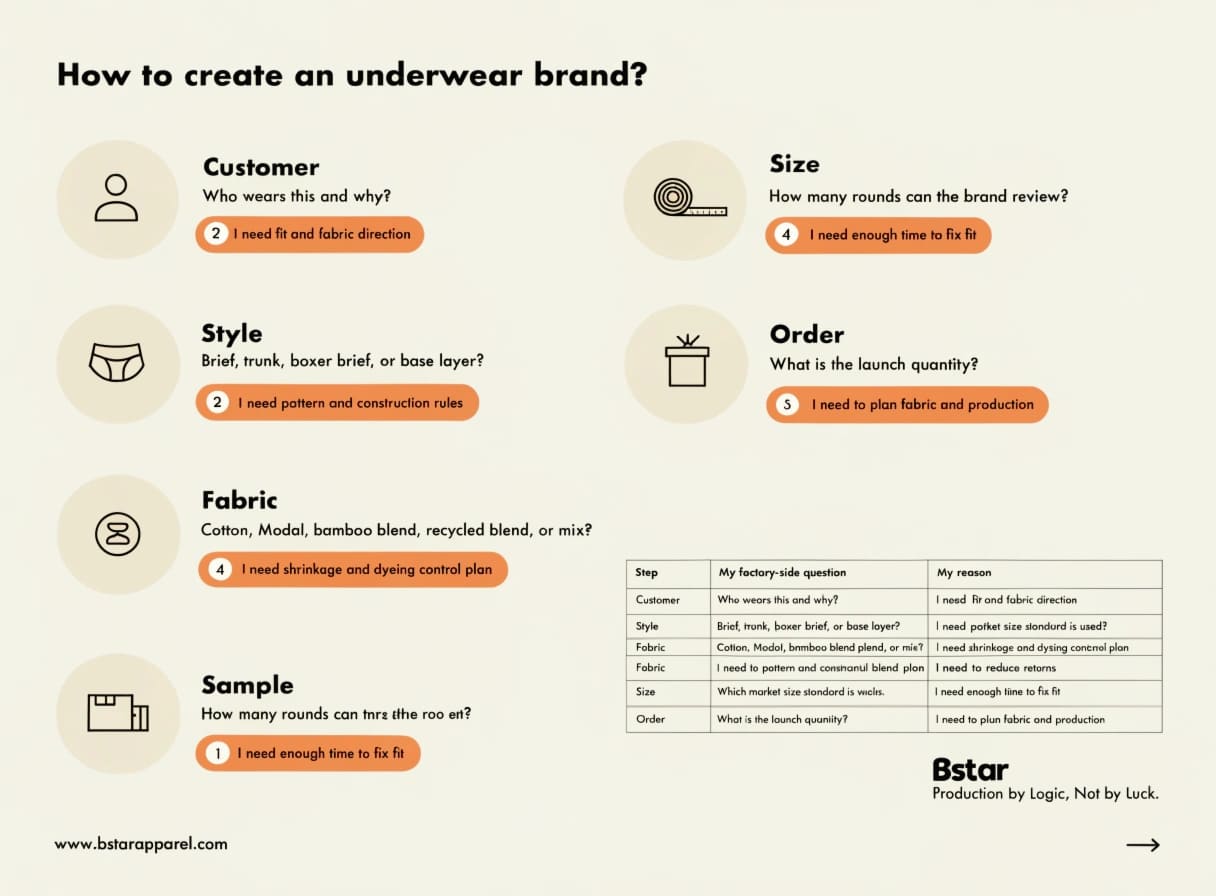
I would not start with ten styles. I would start with one strong product. For most new men’s underwear brands, I usually suggest boxer briefs, trunks, or briefs as the first SKU group. The reason is simple. These styles are easier to understand in the market, and buyers already know how to compare them. The real brand work is in fit, fabric, hand feel, support, waistband, and repeat quality.
My basic launch map
| Step | My factory-side question | My reason |
|---|---|---|
| Customer | Who wears this and why? | I need fit and fabric direction |
| Style | Brief, trunk, boxer brief, or base layer? | I need pattern and construction rules |
| Fabric | Cotton, Modal, bamboo blend, recycled blend, or mix? | I need shrinkage and dyeing control plan |
| Size | Which market size standard is used? | I need to reduce returns |
| Sample | How many rounds can the brand review? | I need enough time to fix fit |
| Order | What is the launch quantity? | I need to plan fabric and production |
In our production experience, shrinkage is not just a care label issue. It is a production decision.6 If a brand wants Modal underwear, we discuss pre-shrinkage treatment before cutting. We check the fabric behavior under heat and drying risk before the bulk pieces are made. If this step is skipped, the brand may only find the problem after delivery. At that point, the care label cannot fix a size complaint. Good sourcing starts before cutting, not after packing.
Which company makes the best underwear for men?
Many buyers search for the “best” factory, but the wrong factory for your product can still fail even with good machines.
I do not think one company makes the best underwear for every brand. I think the best supplier is the one that matches your fabric, fit, quantity, quality standard, communication style, and launch timeline.
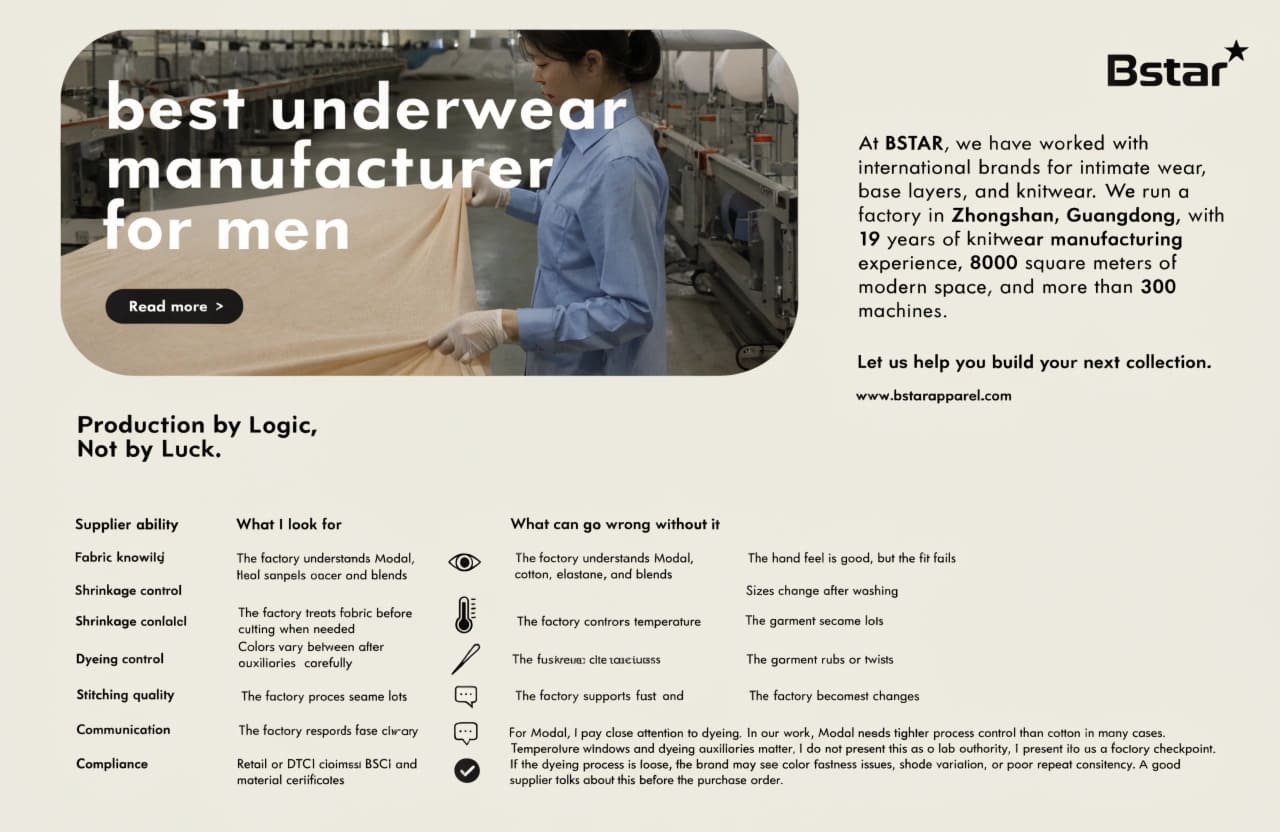
I work inside a knitwear OEM/ODM factory, so I look at this question in a practical way. A good underwear supplier should not only sew. It should help you avoid bad decisions before production. At BSTAR, we have worked with international brands for intimate wear, base layers, and knitwear. We run a factory in Zhongshan, Guangdong, with 19 years of knitwear manufacturing experience, 8000 square meters of modern space, and more than 300 machines. I mention this not to say we are the only answer. I mention it because underwear needs real production judgment.
How I judge a men’s underwear supplier
| Supplier ability | What I look for | What can go wrong without it |
|---|---|---|
| Fabric knowledge | The factory understands Modal, cotton, elastane, and blends | The hand feel is good, but the fit fails |
| Shrinkage control | The factory treats fabric before cutting when needed | Sizes change after washing |
| Dyeing control | The factory manages temperature and auxiliaries carefully | Colors vary between lots |
| Stitching quality | The factory controls seams and thread tension | The garment rubs or twists |
| Communication | The factory responds fast and clearly | Small issues become late changes |
| Compliance | The factory supports BSCI and material certificates7 | Retail or DTC claims become risky |
For Modal, I pay close attention to dyeing. In our work, Modal needs tighter process control than cotton in many cases. Temperature windows and dyeing auxiliaries matter.8 I do not present this as lab authority. I present it as a factory checkpoint. If the dyeing process is loose, the brand may see color fastness issues, shade variation, or poor repeat consistency. A good supplier talks about this before the purchase order.
What are the challenges of underwear modeling?
Many brands book a model shoot too early, but the underwear still has fit issues that the camera cannot hide.
The main challenges of underwear modeling are fit accuracy, body diversity, pouch shape, fabric transparency, waistband position, movement comfort, and showing the product clearly without overpromising the real fit.
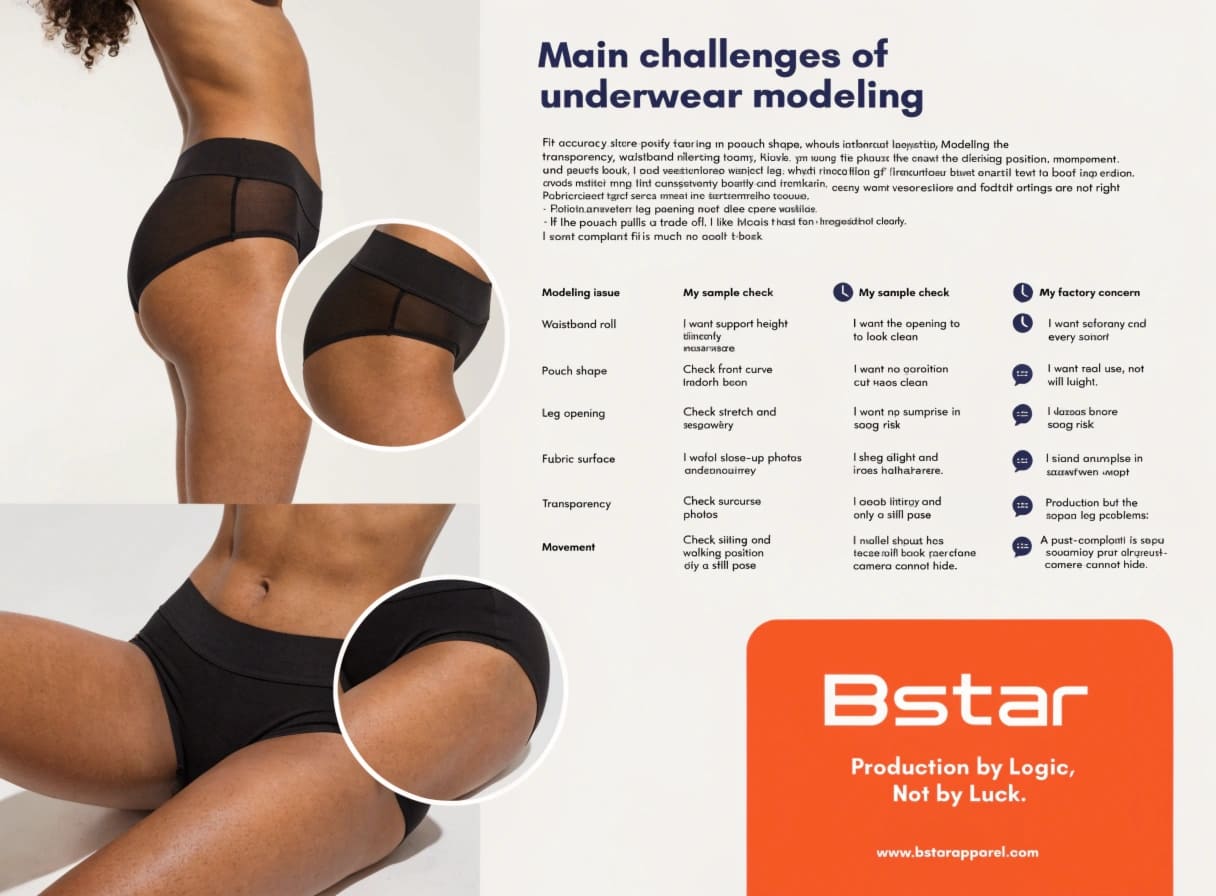
I see product modeling as part of sourcing because photos expose fit problems. If the sample leg opening cuts into the thigh, the model will show it. If the pouch pulls in the wrong place, the product photo will show it. If Modal fabric drapes too much for a tight fit, the photo may look soft but not supportive. This is why I prefer to review samples on a fit model before a brand books the final campaign.
What I check before a shoot
| Modeling issue | My sample check | My factory concern |
|---|---|---|
| Waistband roll | I check elastic height and tension | I want support without digging |
| Pouch shape | I check front curve and seam position | I want comfort and clean shape |
| Leg opening | I check stretch and recovery | I want the opening to stay stable |
| Fabric surface | I check pilling and snag risk | I want close-up photos to look clean |
| Transparency | I check light colors and fabric weight | I want no surprise in photos |
| Movement | I check sitting and walking comfort | I want real use, not only a still pose |
Modal softness has a trade-off. I like Modal for next-to-skin layering when drape, softness, and moisture comfort matter. But I do not call it stronger in every situation. Its soft hand can come with lower snag resistance9 if the knit structure and machine settings are not right. For intimate wear, gauge, yarn count, fabric structure, and finishing all matter. A brand should discuss these details before ordering bulk fabric. A post-complaint fix is much more costly.
What are the latest trends in men’s underwear?
Many brands use “latest trend” as a design shortcut, but buyers return to products that solve daily comfort problems.
The latest men’s underwear trends I see include Modal blends, pouch support, anti-chafe legs, tagless labels, cleaner waistbands10, low-risk small batch launches, earth-tone colors11, and verified material claims.
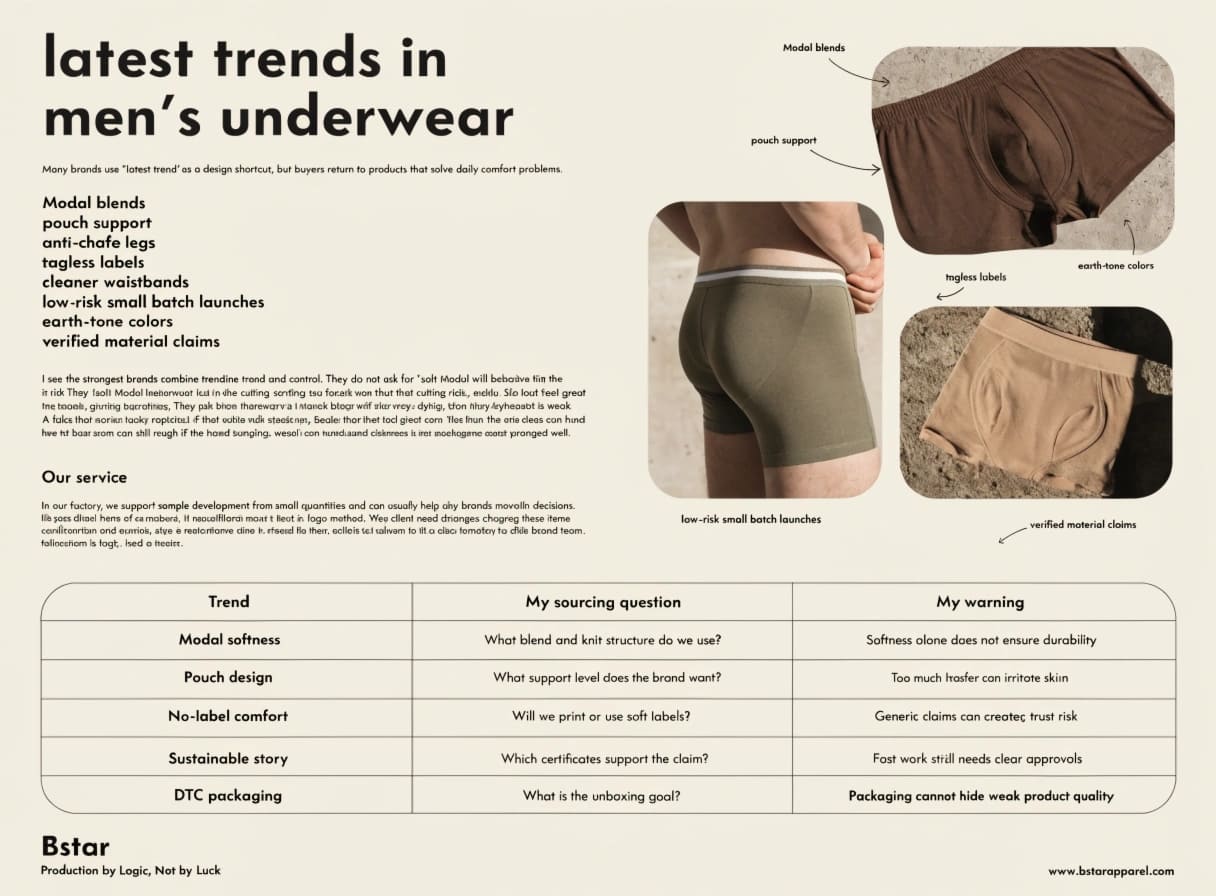
I see the strongest brands combine trend and control. They do not only ask for “soft Modal underwear.” They ask how the Modal blend will behave in cutting, sewing, dyeing, and wearing. This is the right way to source. A fabric that feels great in hand can still create size risk if the pre-treatment is weak. A color that looks perfect in a lab dip can still vary if the bulk dyeing process is not managed well. A flatlock seam can still feel rough if the thread and tension are wrong.
Trend choices and sourcing questions
| Trend | My sourcing question | My warning |
|---|---|---|
| Modal softness | What blend and knit structure do we use? | Softness alone does not ensure durability |
| Pouch design | What support level does the brand want? | Too much shaping can feel restrictive |
| No-label comfort | Will we print or use soft labels? | Bad heat transfer can irritate skin |
| Sustainable story | Which certificates support the claim? | Generic claims can create trust risk |
| Small batch launch | How fast does the brand need samples? | Fast work still needs clear approvals |
| DTC packaging | What is the unboxing goal? | Packaging cannot hide weak product quality |
In our factory, we support sample development from small quantities and can usually help brands move from idea to sample within a practical timeline. We still need clear decisions. I need the brand to confirm fabric direction, size standard, waistband style, logo method, and packaging. If a client changes these items late, the timeline moves. A fast supply chain is not only a fast factory. It is also a clear brand team.
What is an underwear model called?
Many founders confuse product models, fit models, and campaign models, so they use the wrong person for the wrong job.
I usually call an underwear model a fit model when I use the person for size testing, and a fashion or campaign model when I use the person for photos and marketing.
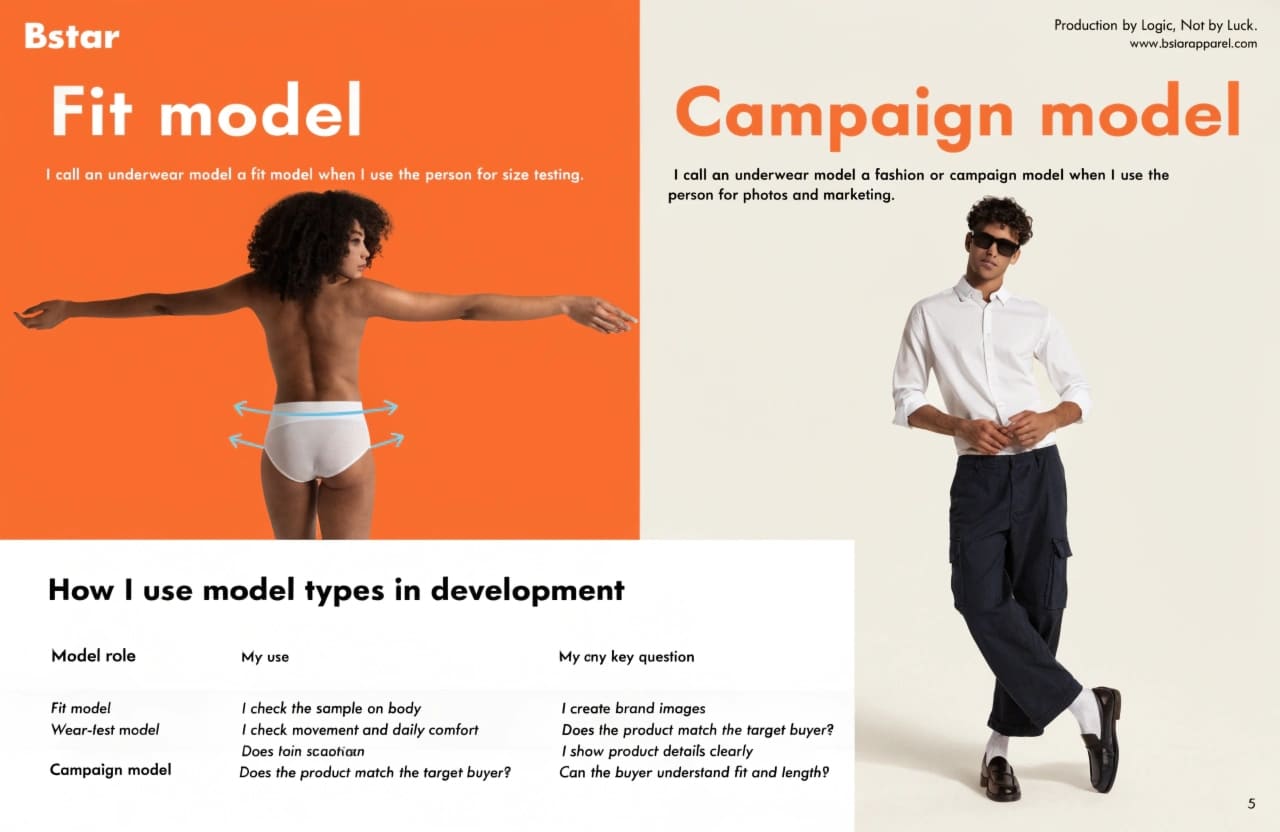
I separate these roles because they solve different problems. A fit model helps me check size, comfort, tension, pouch position, and leg movement. A campaign model helps the brand sell the lifestyle and product image. A person can sometimes do both, but I do not assume it. For a first underwear SKU, I care more about fit modeling before marketing modeling. A strong campaign cannot save a product that rides up or shrinks after use.
How I use model types in development
| Model role | My use | My key question |
|---|---|---|
| Fit model | I check the sample on body | Does the size feel right? |
| Wear-test model | I check movement and daily comfort | Does the product stay in place? |
| Campaign model | I create brand images | Does the product match the target buyer? |
| E-commerce model | I show product details clearly | Can the buyer understand fit and length? |
For underwear, I also ask brands to define body range. If the brand sells in Europe or North America, the size chart and model choice should reflect the target market. I have seen samples look good on one body and fail on another because the rise, pouch, or leg length was not adjusted. This is why I prefer to confirm fit across more than one body type before bulk production. It costs more time at the start, but it reduces complaints later.
What are the 4 types of models?
Many teams use one model for every task, but product development, fit checking, and selling need different model roles.
The 4 types of models I use for underwear planning are fit models, wear-test models, e-commerce models, and campaign models. Each one helps check a different part of the product and brand story.
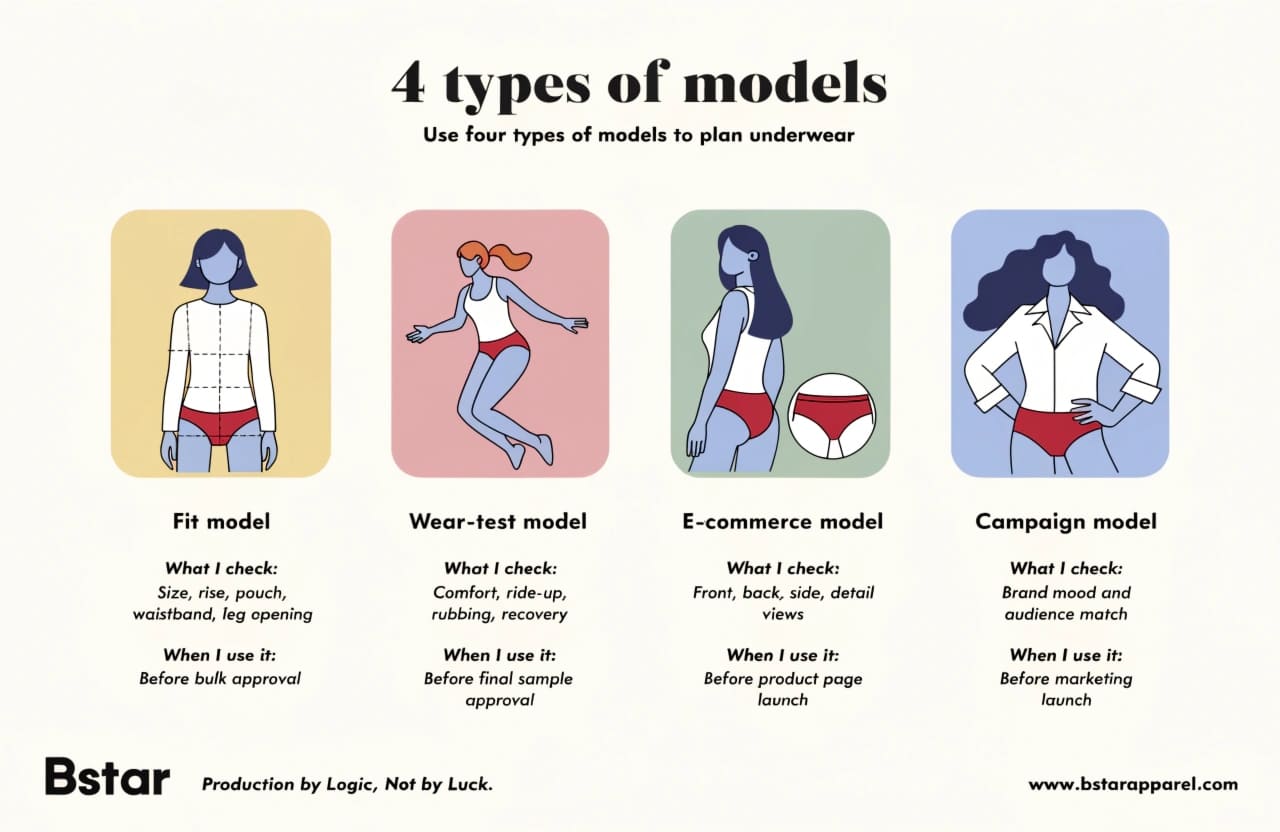
I treat these four model types like checkpoints. A fit model tells me whether the pattern works. A wear-test model tells me whether the garment performs in real movement. An e-commerce model helps buyers see the product clearly online. A campaign model helps the brand create emotion. If I skip the first two and jump to the last two, I may create beautiful photos for a weak product. That is not a good sourcing plan.
The four model types I plan around
| Model type | What I check | When I use it |
|---|---|---|
| Fit model | Size, rise, pouch, waistband, leg opening | Before bulk approval |
| Wear-test model | Comfort, ride-up, rubbing, recovery | Before final sample approval |
| E-commerce model | Front, back, side, detail views | Before product page launch |
| Campaign model | Brand mood and audience match | Before marketing launch |
I also connect model feedback to factory adjustments. If the leg rides up, I review fabric recovery, leg opening tension, and pattern length. If the waistband rolls, I review elastic quality, height, and attachment method. If the pouch feels too tight, I adjust the pattern and seam shape. If the fabric snags during handling, I review knit structure and machine settings. This is where a factory-side partner matters. I do not want the brand to collect model feedback and then guess what to change. I want the feedback to become clear production actions.
Conclusion
I would start a men’s underwear brand with one focused product, clear sourcing rules, tested fit, controlled Modal production, and a factory partner who solves problems early.
-
"Male Enhancing Boxer Briefs: Honest Guide to Support, Comfort …", https://rnojournal.binghamton.edu/plugins/generic/pdfJsViewer/pdf.js/web/viewer.html?file=%2Findex.php%2Findex%2Flogin%2FsignOut%3Fsource%3D%2Enutrao%2Eshop%2Fmale%2F&id=42NhcY. Ergonomic and consumer comfort studies on men’s intimate apparel indicate that anatomically contoured front panels reduce pressure and improve thermal comfort compared to flat-front constructions, providing a functional rationale for the increasing prevalence of pouch designs in the category. Evidence role: general_support; source type: research. Supports: That anatomically shaped pouch designs in men’s underwear address documented comfort and support needs, contributing to their adoption as a product feature trend. Scope note: Peer-reviewed studies specifically on underwear pouch ergonomics are limited; much available evidence is derived from brand-commissioned research or general textile comfort literature. ↩
-
"’Drop’ model in the fashion industry: Examining retail strategy and …", https://openresearch.okstate.edu/entities/publication/965399cf-ad9e-41aa-89ee-2ccc2a4fa540. Supply chain management literature on demand uncertainty in fashion retail identifies test-and-react or quick-response strategies, including small initial orders followed by demand-signal-based replenishment, as effective methods for reducing markdown and overstock costs. Evidence role: general_support; source type: research. Supports: That small initial production runs used to test market demand before scaling reduce overstock risk in fashion and apparel supply chains. Scope note: Most published research addresses fast fashion or seasonal apparel broadly; evidence specific to men’s underwear as a category is limited. ↩
-
"10 Essential Textile Certifications (Like GOTS OEKO-TEX) for Buyers", https://begoodtex.com/blog/10-essential-textile-certifications-gots-oeko-tex-guide/?srsltid=AfmBOopcSHobx2t4Z0bfJ3YXd__S7UWhiksfX9WUSqGOFkz8ltx3nYfz. OEKO-TEX STANDARD 100 certifies products tested for harmful substances; GOTS certifies organic fiber processing and social criteria; GRS verifies recycled input content; and FSC certifies responsible forest management for wood-based fibers such as Modal, each addressing a different dimension of a sustainability claim. Evidence role: definition; source type: institution. Supports: That OEKO-TEX, GOTS, GRS, and FSC are distinct certification systems covering different aspects of textile sustainability including chemical safety, organic fiber sourcing, recycled content, and forest management respectively. Scope note: Certification scope and audit requirements differ by standard body and version; the article does not specify which version or tier of each standard is referenced. ↩
-
"Assessing Sustainability in the Textile Sector: A Review of LCA, LCC …", https://pmc.ncbi.nlm.nih.gov/articles/PMC12944191/. Life cycle assessments of cellulosic fibers indicate that environmental performance varies substantially by production method, chemical recovery rates, and raw material sourcing, meaning fiber type alone is insufficient to establish a sustainability claim. Evidence role: general_support; source type: research. Supports: That the sustainability of cellulosic fibers such as Modal depends on production processes, chemical use, and supply chain transparency rather than fiber category alone. Scope note: Most published LCAs compare fiber categories broadly and may not reflect specific supplier-level variation cited in the article. ↩
-
"TENCEL™ Modal – Experience Natural Comfort – Lenzing", https://www.lenzing.com/products/textile-fibers/tenceltm-modal/. Fiber producers such as Lenzing publish third-party-verified sustainability reports and hold FSC and OEKO-TEX certifications that document wood sourcing and chemical management, standards that generic Modal suppliers are not required to meet. Evidence role: general_support; source type: institution. Supports: That certified branded cellulosic fibers carry documented chain-of-custody and environmental standards that generic Modal equivalents may not provide. Scope note: This distinction reflects certification availability rather than a direct comparative environmental measurement between branded and generic Modal. ↩
-
"Dimensional stability (fabric) – Wikipedia", https://en.wikipedia.org/wiki/Dimensional_stability_(fabric). ISO 6330 and related textile dimensional stability standards specify washing and drying test procedures for evaluating fabric shrinkage, indicating that shrinkage performance is a measurable production outcome rather than a labeling decision. Evidence role: general_support; source type: institution. Supports: That dimensional stability of knit fabrics, including Modal blends, requires pre-treatment processes and is governed by international testing standards rather than care instructions alone. Scope note: Standards define test methods and tolerances but do not prescribe specific pre-treatment protocols, which remain manufacturer-dependent. ↩
-
"amfori BSCI – Business Social Compliance Initiative", https://www.amfori.org/amfori-bsci/. The amfori BSCI program provides a standardized social auditing framework used by European retailers and brands to assess supplier compliance with labor standards including working hours, wages, and occupational safety across global manufacturing facilities. Evidence role: definition; source type: institution. Supports: That BSCI, administered by amfori, is an industry-recognized social compliance audit program covering labor rights, health and safety, and ethical business practices in manufacturing facilities. Scope note: BSCI is an audit-based program rather than a product certification; it assesses factory practices at a point in time and does not guarantee ongoing compliance. ↩
-
"Improvement of mahogany leaf extract dye fixation on cotton-modal …", https://pmc.ncbi.nlm.nih.gov/articles/PMC10582380/. Textile chemistry literature on high-wet-modulus cellulosic fibers documents that their modified crystalline structure affects dye uptake kinetics, requiring tighter temperature and electrolyte control compared to standard cotton reactive dyeing processes. Evidence role: mechanism; source type: research. Supports: That Modal, as a high-wet-modulus cellulosic fiber, has distinct dyeing behavior requiring controlled temperature and auxiliary management to achieve consistent color fastness. Scope note: Published research typically addresses fiber classes rather than specific commercial Modal grades, so direct comparison to cotton may vary by yarn count and knit construction. ↩
-
"Fiber types and fabric structures influence on weft knitted fabrics – PMC", https://pmc.ncbi.nlm.nih.gov/articles/PMC9204663/. Fiber mechanical property studies indicate that high-wet-modulus cellulosic fibers like Modal have distinct tensile and surface friction characteristics that influence pilling and snag behavior in knit constructions, with outcomes varying by gauge and finishing treatment. Evidence role: mechanism; source type: research. Supports: That Modal fibers, while exhibiting superior softness and drape, may show different abrasion and snag resistance profiles compared to cotton depending on yarn structure and fabric construction. Scope note: Published comparisons often test standard yarn counts and may not reflect the specific blends and knit structures used in intimate apparel production. ↩
-
"Allergic to Fashion – PMC", https://pmc.ncbi.nlm.nih.gov/articles/PMC9823182/. Dermatological and textile comfort research identifies mechanical friction from sewn-in labels and constrictive elastic waistbands as contributors to contact irritation and pressure discomfort, providing a functional basis for consumer preference toward tagless and ergonomically designed intimate apparel. Evidence role: general_support; source type: research. Supports: That textile labels and tight waistbands are documented sources of skin irritation and discomfort, supporting consumer demand for tagless and low-pressure waistband designs. Scope note: Clinical studies typically address sensitive skin populations; evidence for the general male consumer population is less systematically documented. ↩
-
"The Underwear Upgrade: Why 2026 Is the Year You Stop Settling", https://www.myknucks.com/post/the-underwear-upgrade-why-2025-is-the-year-you-stop-settling?srsltid=AfmBOoo6FTNTNcvv7pwwILGLuoO6PR54iPUVbSCUZII_lS1-_glq2fay. Color forecasting bodies including Pantone and WGSN have identified muted, nature-derived, and earth-tone palettes as recurring directional themes in menswear for the 2025–2026 period, consistent with broader consumer preference for understated and versatile basics. Evidence role: general_support; source type: institution. Supports: That neutral and earth-tone color palettes are a recognized direction in menswear and intimate apparel color forecasting for 2025–2026. Scope note: Color trend forecasts are directional rather than prescriptive and may not reflect actual sell-through data for the men’s underwear category specifically. ↩