
Underwear Reorder Checklist: What Brands Should Confirm with Their Manufacturer
You’ve already done a successful production run. The styles sold well, customers are reordering, and now you need more inventory. So you send your manufacturer the same PO as last time — and assume the rest takes care of itself. That assumption is exactly where reorder problems start.
A reorder is not a duplicate order. It’s a new production event. Fabric batches change. Dye lots rotate. Elastic recovery rates shift. If you don’t re-confirm the key variables before production locks in, you’re essentially hoping the factory reproduces your original specs from memory — and that rarely goes as smoothly as it sounds. This checklist covers the five areas every brand should confirm with their manufacturer before approving a repeat production run of men’s underwear or other knitted styles.
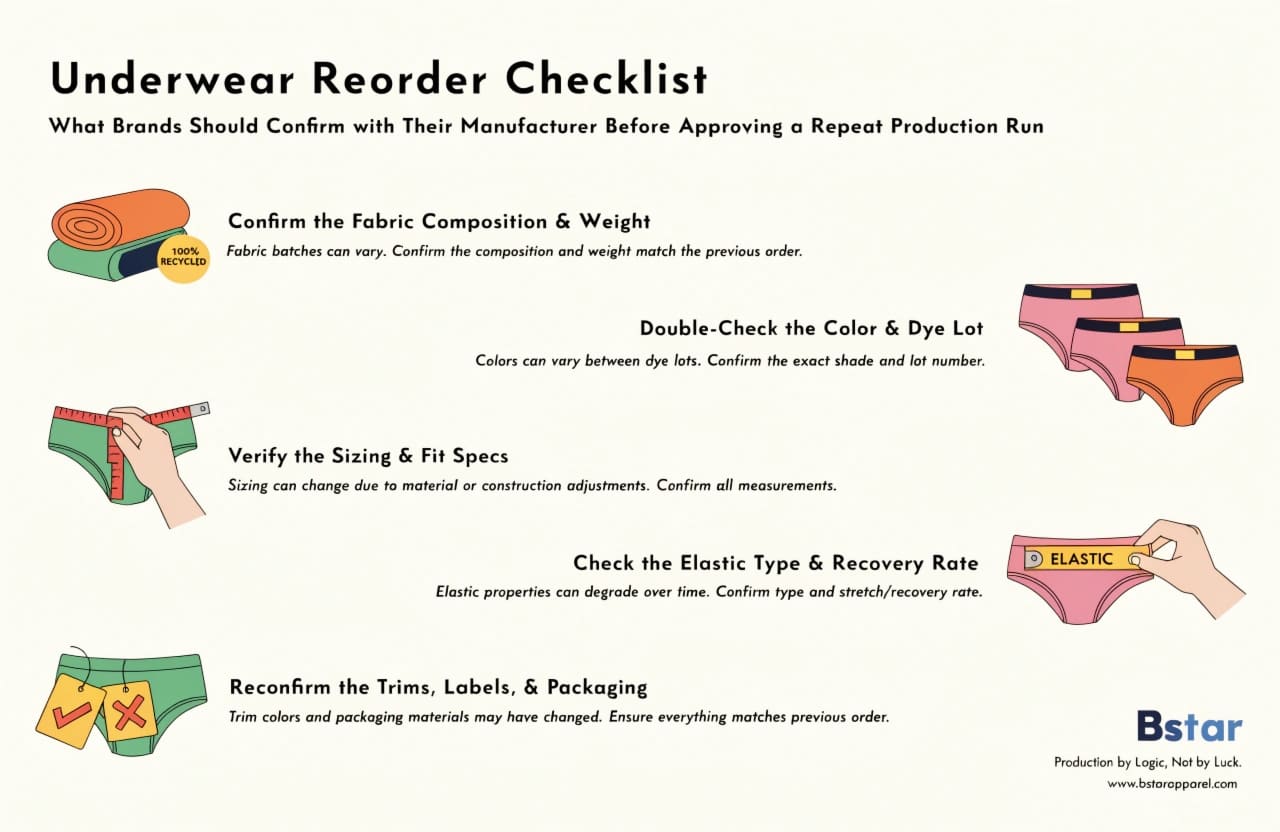
Diagrams illustrate the confirmation process. Numbers and material, label, or company claims shown are examples, not test results, certification evidence, or agreed order terms.
In our experience, the brands who get surprised at delivery are almost always the ones who treated their reorder as automatic. The ones who don’t get surprised have a short, structured confirmation conversation before production starts. Here’s what that conversation should cover.
Fabric & Fit Consistency: Verifying Material Specs and Size Grading Before Reordering
Your original spec sheet exists. Your tech pack is filed. You’re confident the fabric composition is identical. And yet, something feels different when the new shipment arrives.
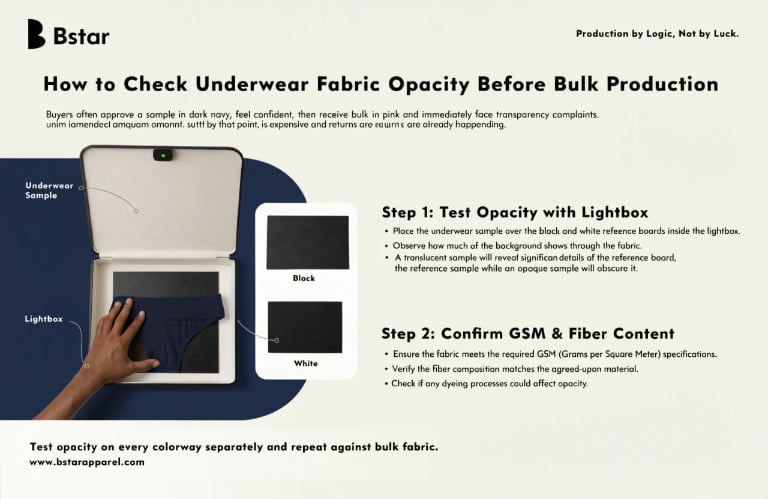
Fabric spec drift is invisible until it lands. Even when the fiber composition stays the same — say, 95% cotton / 5% spandex — the GSM, yarn lot, and elastic recovery rate can shift between production cycles. These shifts may not get flagged automatically. Ask whether a new swatch, lab dip, or other material confirmation is needed before approving the reorder.
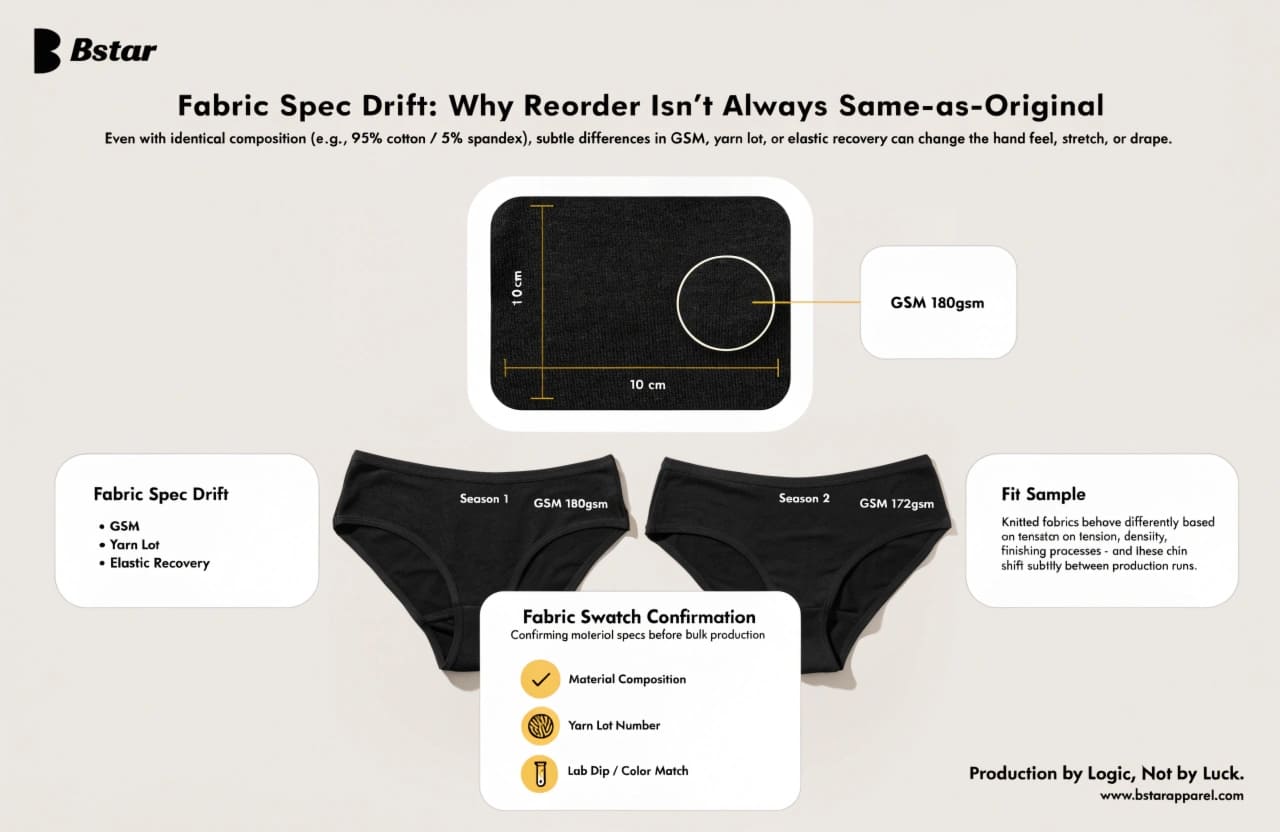
Here’s what makes this tricky: the spec sheet you approved in Season 1 records the target specification, while the approved swatch represents a particular fabric batch. By the time you reorder, the raw material supplier may have changed, the yarn lot number is different, or the mill has slightly adjusted their knitting parameters. These changes may not be communicated automatically. They may not show up on the composition label. You may first notice them when the garment feels different, fits differently, or washes differently.
What We Ask Clients to Confirm on Fabric
Before we lock in a reorder, we typically ask clients to re-confirm the following:
- GSM (grams per square meter): Re-confirm the target weight, agreed measurement method, and permitted variation for this style.1 For underwear — especially fitted briefs and thermal wear — a GSM change can affect hand feel and opacity. Do not assume that one percentage tolerance suits every fabric.
- Yarn lot number: Not always visible to the buyer, but worth requesting. A new yarn lot is a signal to request a new swatch.
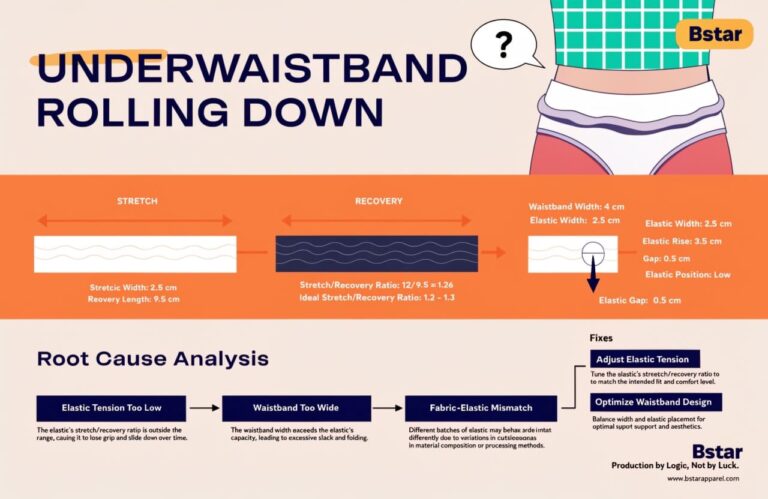
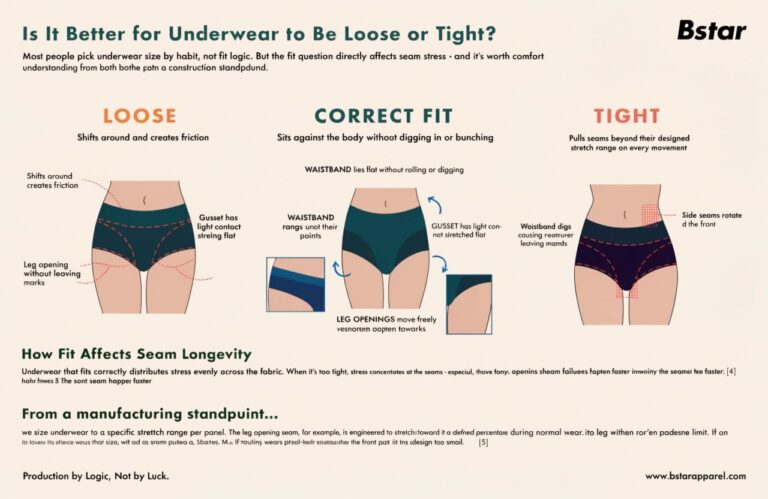
- Elastic recovery rate: This matters particularly for waistbands and leg bands. If the elastic spec has shifted, the fit at these points can change. Confirm waistband stretch recovery against the approved reference using the same agreed method.
- Wash shrinkage tolerance: Confirm the acceptable lengthwise and widthwise change for the specific style, together with the washing and drying conditions.2 The result needs to stay within the agreed sizing requirements; there is no single shrinkage percentage that suits every knit underwear program.
The Fit Sample Question
Fit is its own variable. Knitted fabric dimensions can be affected by knitting conditions and mechanical finishing — details worth rechecking between production runs.3 If more than one season has passed since your last order, we recommend requesting a fit confirmation sample before bulk production starts. This is especially important if your brand has received any customer feedback about sizing inconsistency. A fit sample is worth considering before committing to the full reorder; agree the sampling and prototyping scope before production starts.
MOQs, Lead Times, and Production Slots: Aligning Schedules with Your Retail Calendar
This one catches brands off guard more often than almost anything else — especially traditional retail buyers working with fixed sell-in dates.
MOQ and lead time terms are not fixed. Factories adjust minimums and production schedules based on current capacity, raw material availability, and order book load. A brand that plans a restock campaign based on last season’s 45-day lead time and 500-piece MOQ may find that neither figure is still accurate.
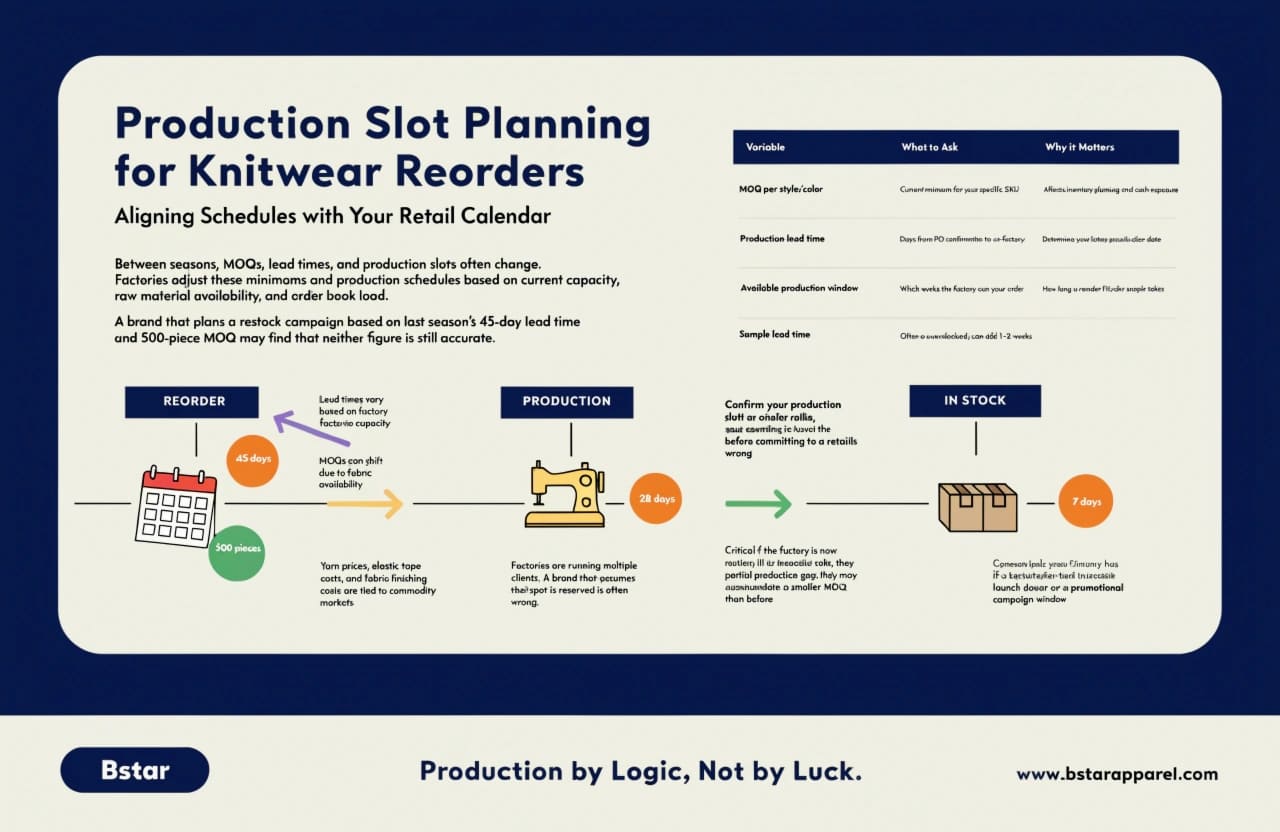
Scheduling example only—not a BSTAR MOQ or lead-time commitment. Confirm the material, sample, production, and delivery schedule for the specific reorder.
We say this directly to clients: do not commit to a retail launch date or a promotional campaign window before you’ve confirmed your production slot. This is not a formality. It’s a real constraint that can change every cycle. Reconfirm MOQ and order planning for the current style, colors, materials, and size mix.
Why Terms Change Between Orders
Here’s the honest picture of why this happens:
- Raw material costs fluctuate. Yarn prices, elastic tape costs, and fabric finishing costs are tied to commodity markets. A reorder that hits during a supply chain crunch may have a higher per-unit cost — not because the factory changed anything, but because their input costs did.
- Capacity gets allocated in real time. Your previous production slot doesn’t hold unless you’ve confirmed it. Factories are running multiple clients. A brand that assumes their spot is reserved is often wrong.
- MOQs can go up or down. If a key fabric is now only available in larger rolls, the minimum buy shifts. Conversely, if the factory has a partial production gap, they may accommodate a smaller MOQ than before.
What to Confirm Before You Commit to Dates
| Variable | What to Ask | Why It Matters |
|---|---|---|
| MOQ per style/color | Current minimum for your specific SKU | Affects inventory planning and cash exposure |
| Production lead time | Agreed start conditions, production duration, and ex-factory date | Determines your latest possible order date |
| Available production window | Which weeks the factory can take your order | Critical for holiday or seasonal launches |
| Sample lead time | How long a reorder fit/color sample takes | Include sourcing, sample making, review, and any revisions |
For DTC brands with campaign-driven restocks, work backward from the target in-stock date using the confirmed material, sample, production, freight, and receiving schedule. Start this conversation before announcing the campaign, and agree a buffer for unresolved approvals or shipping delays.
Quality Control Checkpoints: Defining Inline Inspections and Compliance Standards for Repeat Orders
Brands sometimes assume that because a factory produced acceptable quality once, the same standard is the default going forward. That’s not how it works.
QC standards for a reorder should be explicitly re-confirmed — not assumed to carry over. This includes inline inspection frequency, the defect classification criteria your brand uses, and any compliance certifications (such as OEKO-TEX® or GOTS) that affect production material choices.
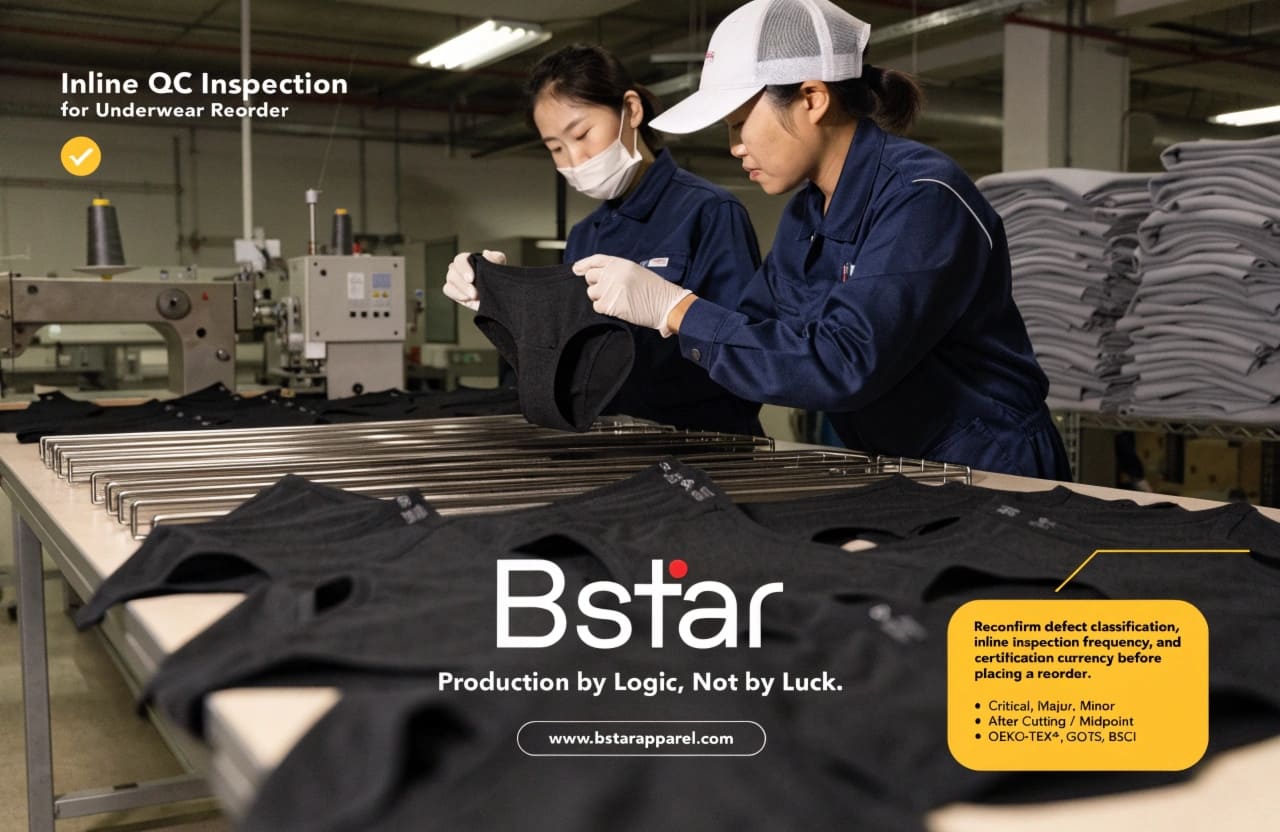
In our experience, the most common QC gap on reorders isn’t a factory getting careless — it’s that the buyer and factory have different mental models of what "same as last time" means. The buyer remembers the final product. The factory remembers the process. When something deviates, the gap between those two memories is where disputes happen.
What QC Confirmation Should Cover
Defect classification. Confirm the buyer-approved definitions of critical, major, and minor defects. For underwear, seam failures, faulty elastic, fabric holes, visible shading, stitching skips, and mislabeling need to be classified according to their safety, functional, or appearance impact. A thread tail or light crease may be minor, but severity depends on the actual defect and the approved criteria. If these classifications aren’t written down and re-confirmed for the reorder, "acceptable quality" is a matter of opinion.
Inline inspection points. These are QC checks during production — not just a final inspection before shipment. For a knitwear reorder, we typically recommend at least two inline checkpoints: one after cutting and one at the midpoint of sewing. Catching a shading issue earlier can limit the amount affected and leave more options for correction. The remedy still depends on the defect and how much production has already been completed.
Certification currency. If your buyer or product program requires OEKO-TEX® STANDARD 100 or GOTS, verify the holder, validity, and scope relevant to the reorder. Review BSCI social audit documentation separately; it is not a product or fabric certificate. Fabric substitutions can affect what is covered. Don’t assume the document you saw on the factory’s profile page is still valid or sufficient for this order.
AQL level agreement. If your quality acceptance is based on an AQL (acceptance quality limit) sampling plan, confirm the agreed standard and edition, inspection level, sample size, and acceptance/rejection numbers for each defect class. AQL 2.5 and AQL 4.0 can lead to different acceptance thresholds, but they do not automatically produce different decisions on every batch.4
Packaging and Labeling Updates: Confirming Branding, Tags, and Regulatory Requirements
This section looks administrative. It isn’t.
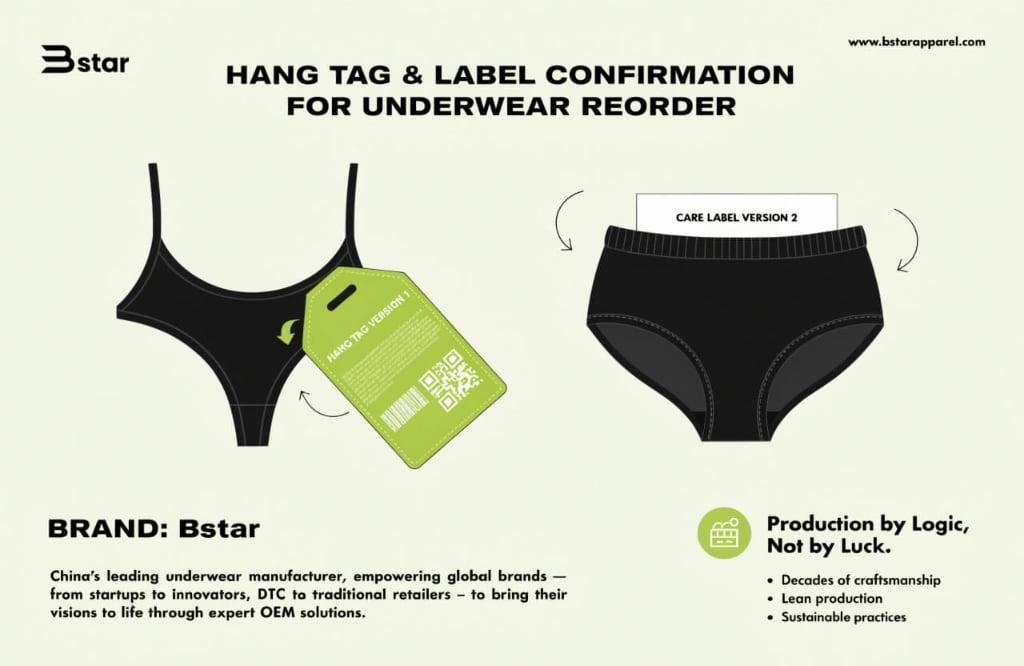
Packaging and labeling errors on reorders are one of the most common causes of receiving delays, customs holds, and retail buyer chargebacks. Before a reorder goes into production, brands should re-confirm hang tag content, care label requirements, country-of-origin declarations, fiber content accuracy, and any market-specific regulatory labeling.
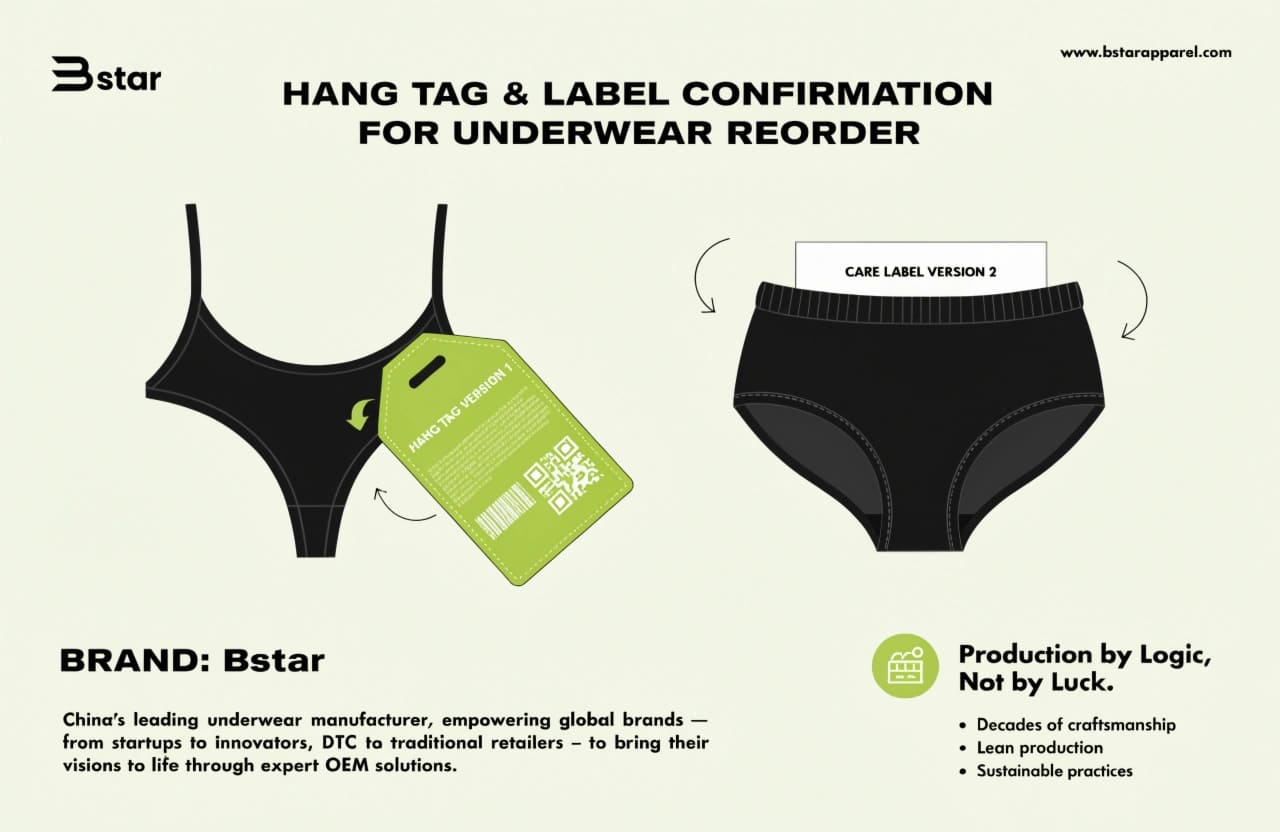
Here’s why this trips up even experienced brands: labeling requirements change. EU and US textile labeling requirements differ, and the applicable fiber-content, care, language, and origin information should be checked for the destination market.5 If your brand has expanded into a new market since your last order, the label that was correct for your original market may be non-compliant for the new one.
Common Labeling Variables to Reconfirm
- Fiber content accuracy: Check that the declared composition remains accurate for this reorder and meets the destination market’s requirements; do not simply reuse last season’s label artwork.
- Care instruction symbols: Confirm the care wording or symbol system accepted in the destination market, together with instructions supported by the actual garment and its components.
- Country of origin: Verify this is current and accurate for your production location.
- Size labeling standards: Confirm the buyer-approved size designations and any required conversions for each sales channel, rather than assuming one EU-to-US conversion works for every brand.
- Hang tag artwork versions: Brands update logos, add certifications, or change colorways seasonally. Confirm which version is current before printing.
A brief packaging and labeling confirmation document — even a simple email checklist — is worth the 30 minutes it takes to prepare.
Cost Drivers and Payment Terms: Reviewing Price Changes, Freight Options, and Contract Clauses
The commercial terms from your first order are a reference point; check whether your current supply agreement carries any of those terms forward to repeat orders.
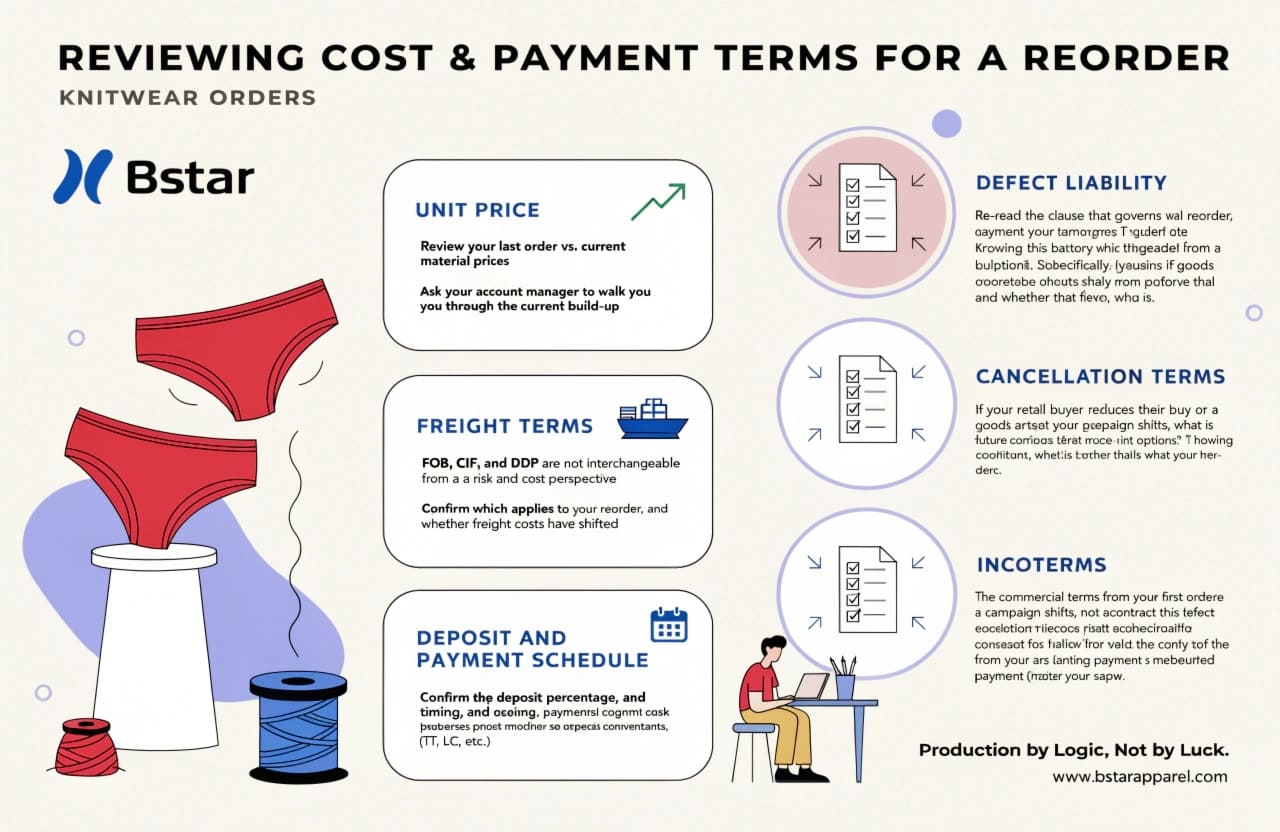
Before confirming a reorder, brands should review the unit price against current raw material costs, confirm freight terms and Incoterms, and re-read any contract clauses that govern defect liability, cancellation rights, and deposit structure. Price and terms drift between orders — often without anyone explicitly renegotiating them.
We’ve seen brands surprised to find that a unit price they locked in 18 months ago no longer reflects current yarn and elastic costs. We’ve also seen brands assume 30% deposit / 70% against shipping documents is standard — only to find the factory requires a higher deposit for the reorder due to the raw material pre-purchase needed for their specific fabric spec.
What to Review on the Commercial Side
Unit price drivers. The main variables that affect price between reorders are: yarn/fabric cost changes, changes in order quantity (more volume usually means lower unit cost, less volume the opposite), and any updates to labor or finishing processes. Ask your account manager to walk you through the current build-up if the price has changed.
Freight terms and Incoterms. FOB, CIF, and DDP are not interchangeable from a risk and cost perspective.6 Confirm which applies to your reorder, and check whether freight costs have shifted. Ocean freight rates in particular are volatile.7
Deposit and payment schedule. Confirm the deposit percentage, payment timing, and whether the factory accepts your preferred payment method (T/T, LC, etc.).
Defect liability clause. Re-read the clause that governs what happens if goods arrive with quality issues. Specifically: what is the defect threshold that triggers a remedy, what remedies are available (rework, replacement, credit), and what is the claim window?
Cancellation terms. If your retail buyer reduces their buy or a campaign shifts, what are your options? Knowing this before production starts is far better than finding out after fabric is cut.
Frequently Asked Questions
How far in advance should I start the reorder confirmation process?
Start early enough to confirm materials, any required samples, the available production slot, and delivery to your warehouse. Work backward from your target in-stock date using the manufacturer’s current schedule, then allow time for buyer review, revisions, freight, and receiving. The right buffer depends on the specific reorder; do not assume that a previous order’s production lead time still applies.
Do I need a new sample for every reorder?
Not always — but we recommend confirming the current fabric and color against an approved reference, using a swatch, lab dip, or print strike-off where appropriate. If more than one season has passed, or if you’ve received any customer feedback about fit or color inconsistency, a full fit sample is worth the lead time.
What certifications should I verify before a reorder?
Verify the documents your buyer or product program actually requires. For OEKO-TEX® STANDARD 100, check the certificate holder, validity, and covered articles. For a GOTS claim, check the relevant scope and transaction documentation; purchasing certified fabric alone does not establish that the finished garment is GOTS-certified. BSCI is a social audit system, so review the applicable audit documentation separately.8 Always request current, order-relevant records rather than assuming last season’s documents still apply.
Can I change colorways on a reorder without a new lab dip?
Confirm the approval route before proceeding. A new dyed shade will normally need a lab dip; printed colors may need a strike-off, while a stock fabric may be approved against a current swatch. Agree the color reference, viewing conditions, tolerance, and who can approve it.9 The reference may be a specified Pantone standard or an approved physical sample. Reusing an old approval for a changed color reference can lead to reorder color complaints.
What’s the most common mistake brands make on reorders?
Assuming "same as last time" is a complete instruction. A reorder is a new production event. The most consistent brands we work with treat each reorder as a structured confirmation process, not an automatic repeat — and that discipline is the single biggest factor in delivery consistency.
Conclusion
An underwear reorder checklist isn’t about bureaucracy — it’s about closing the gaps where assumptions live. Fabric specs drift. Color references need re-anchoring. MOQs and lead times need reconfirmation for each order. QC standards need to be restated, not inherited. Packaging requirements change with markets. And commercial terms deserve a fresh read before you commit. Brands that confirm these five areas before production locks in don’t eliminate all risk — but in our experience, they significantly reduce the surprises that show up at delivery. If you’re preparing a reorder, contact our team to run through these checkpoints together.
-
ASTM International, ASTM D3776/D3776M, Standard Test Methods for Mass Per Unit Area (Weight) of Fabric. This is a measurement-method reference. The target GSM and permitted variation remain part of the buyer–manufacturer specification; the method does not establish a universal ±5% acceptance limit. ↩
-
ISO, ISO 5077:2007, Determination of dimensional change in washing and drying, and ISO 6330:2021, Domestic washing and drying procedures for textile testing. ISO 5077 addresses dimensional-change measurement, while ISO 6330 specifies washing and drying procedures. Agree the applicable procedure and acceptance limits for the product; these references do not establish a universal ±3% limit for underwear. ↩
-
Priti Sarker et al., “Effect of Mechanical Finishing on Dimensional Stability of Cotton Knitted Fabric”, Journal of Science and Technology, 6(1 & 2), 21–32, December 2016. The study examines mechanical finishing of single jersey, rib, and pique cotton fabrics. It supports the importance of finishing conditions, rather than predicting the amount of variation in a particular commercial reorder. ↩
-
ISO, ISO 2859-1:2026, Sampling schemes indexed by acceptance quality limit (AQL) for lot-by-lot inspection. Agree the standard and edition used for the order, together with the inspection level, sample size, and acceptance/rejection criteria. Different AQLs do not guarantee a different pass/fail decision for every actual batch. ↩
-
European Union, Textile label guidance, covering EU fiber-composition labeling; US Federal Trade Commission, Threading Your Way Through the Labeling Requirements Under the Textile and Wool Acts, and Clothes Captioning: Complying with the Care Labeling Rule. These sources address different requirements and jurisdictions; confirm the current rules applicable to the product and destination market. ↩
-
International Trade Administration, US Department of Commerce, “Know Your Incoterms”. Incoterms® clarify delivery-related tasks, costs, and risk allocation. State the chosen rule, named place or port, and edition in the contract; payment terms and title transfer need separate agreement. ↩
-
United States International Trade Commission, “The Impact of the COVID-19 Pandemic on Freight Transportation Services and U.S. Merchandise Imports”, Trade Shifts 2020. This historical analysis documents disruption and freight-rate volatility during the pandemic. It is not a current freight quotation or evidence of a specific rate for the next reorder. ↩
-
OEKO-TEX® STANDARD 100, official program information; Global Standards, official questions and answers on certification and scope/transaction documentation; and UL Solutions, amfori BSCI Social Audit Program. These schemes have different purposes and coverage. BSCI is not a product certification scheme, and a material supplier’s certificate alone does not establish finished-garment certification. ↩
-
Datacolor, “How to Build an Effective Color Program”. This manufacturer-authored technical guidance supports shared color standards, consistent light sources, tolerances, and documented approval responsibilities. It does not prescribe one universal Pantone reference or one approval route for all fabrics and color changes. ↩
Discussion & questions 0 comments