How to Check Underwear Fabric Opacity Before Bulk Production
Fabric opacity is a quality issue worth settling before an underwear order reaches bulk production. Buyers approve a sample in dark navy, feel confident, then receive bulk in soft pink and immediately face transparency complaints. By that point, rework is expensive and returns are already happening. This article walks you through how to catch opacity problems before they reach your customer.
To check underwear fabric opacity before bulk production, compare identified samples with an approved coverage reference under agreed lighting, background and stretch conditions. Review each colorway and confirm how bulk material will be checked. GSM and fiber content help identify the material, but neither replaces an opacity review. Record the conditions, observations and approval decision; use a suitable laboratory method when an instrumented result is required.
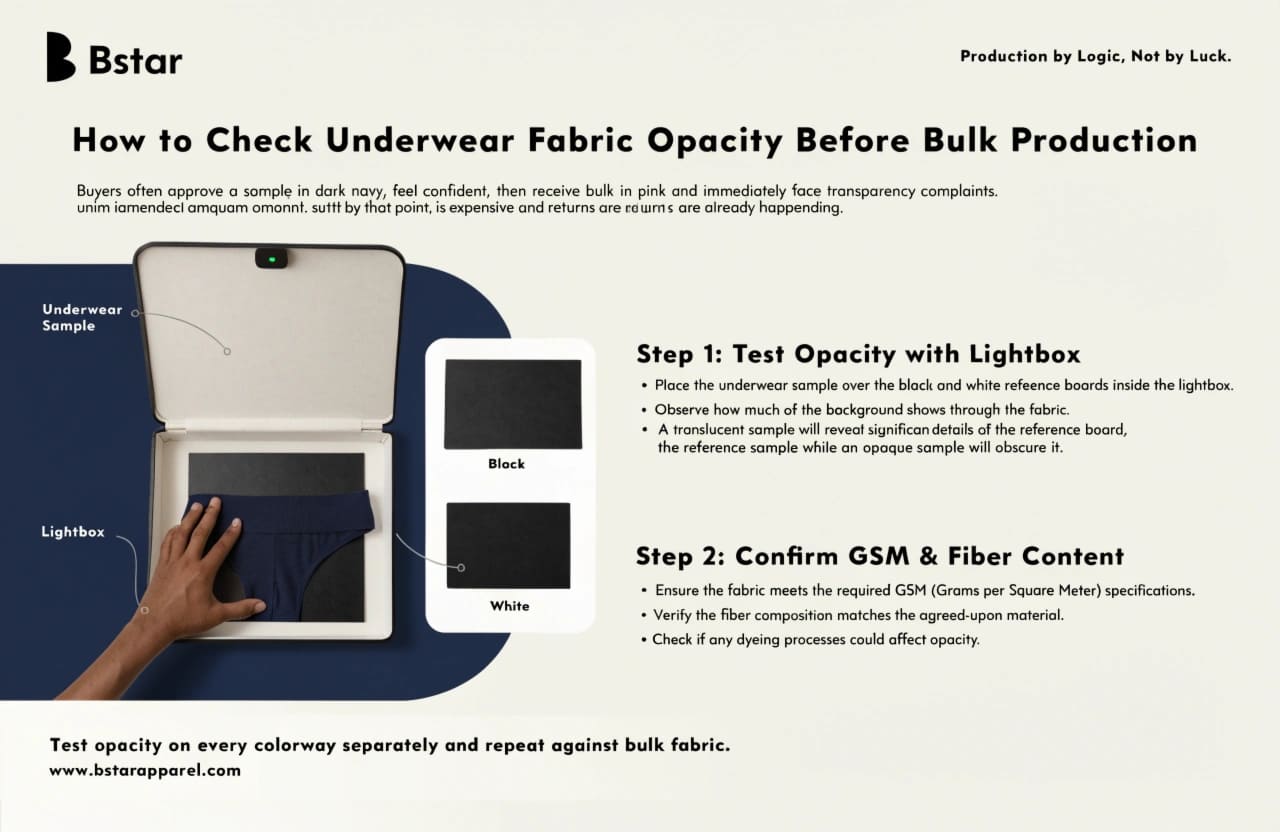
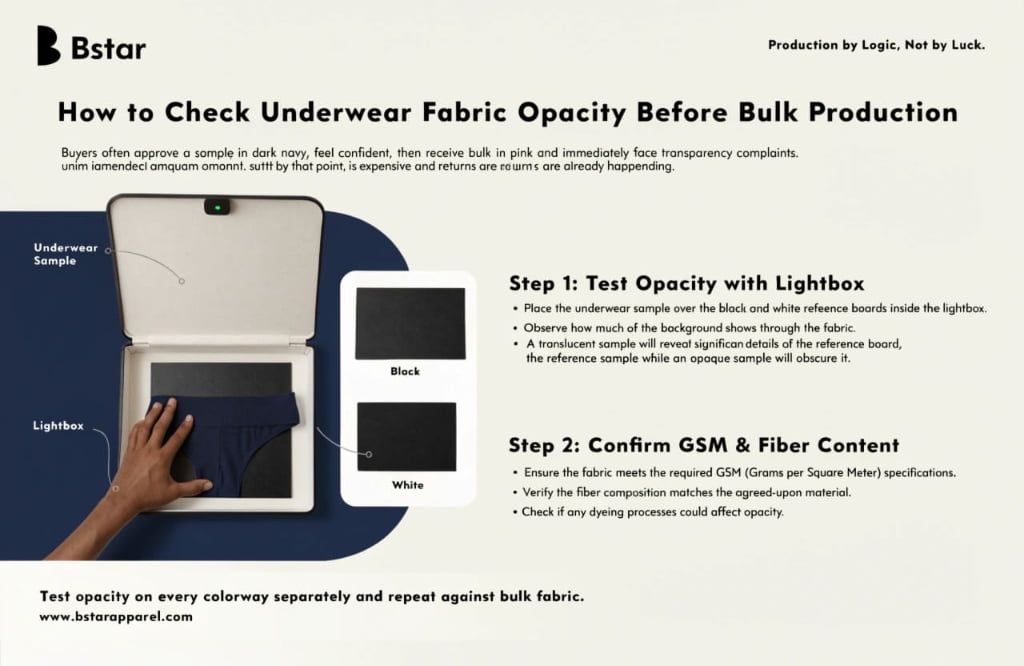
Concept illustration only. The depicted equipment and board colors do not define a test method or show a measured result. Use physically identified backgrounds and the written review conditions.
A sample approval is useful only when it identifies what was approved. Opacity can be included in that approval alongside silhouette, fit and color; it should not be assumed from those other checks. The BSTAR Underwear Lab places this review within a wider sample-testing and evidence framework. Here’s what you need to know to verify it properly.
How Are Fabric Safety and Opacity Different?
Fabric health claims are everywhere, but most of them are oversimplified. For an underwear buyer, harmful-substance documentation, comfort and visual coverage belong to separate checks. A fabric looking opaque does not establish its chemical safety, and a relevant safety certificate does not approve its coverage.
OEKO-TEX® STANDARD 100 concerns harmful-substance testing for the certified textile article, which may be a material, component or finished product. Verify the certificate holder, number, scope, product class and validity for the article being purchased.1 It is not an opacity test or a blanket certification of everything a factory makes.
The honest answer is: fiber type is a starting point, not the full story. Avoid calling polyester, nylon or any other entire fiber family the “unhealthiest” choice on the basis of its name.
Which Questions Should Buyers Keep Separate?
Clients raise questions about finishes, moisture handling and surface feel as well as coverage. Keep the evidence matched to the question:
| Check | What It Means for the Buyer |
|---|---|
| Harmful-substance documentation | Confirm the applicable report or certificate and the textile article it covers |
| Moisture handling and skin-contact feel | Review the intended use and actual sample; do not infer comfort from opacity |
| Fiber composition | Match the material identity to the specification and appropriate verification |
| Visual coverage | Compare the identified fabric or garment with the agreed reference under recorded conditions |
Our OEKO-TEX® documentation checklist explains the certificate checks separately. For opacity, first decide what appearance the product should have. A deliberately sheer style and a full-coverage brief need different approval references.
How to Test Fabric for Fiber Content?
Fiber content is part of material identification, alongside yarn, construction, color and finish. If you’re evaluating a new supplier or questioning whether bulk fabric matches your approved sample, verify that identity before treating the two samples as equivalent. Composition testing answers a different question from how much the fabric shows through.
For a documented composition result, ask a qualified laboratory to select a method suited to the actual fiber combination. AATCC TM20A-2025 covers quantitative fiber analysis using applicable mechanical, chemical and microscopical procedures.2 A burn observation is a preliminary qualitative clue, not a blend-percentage result and not an opacity test.
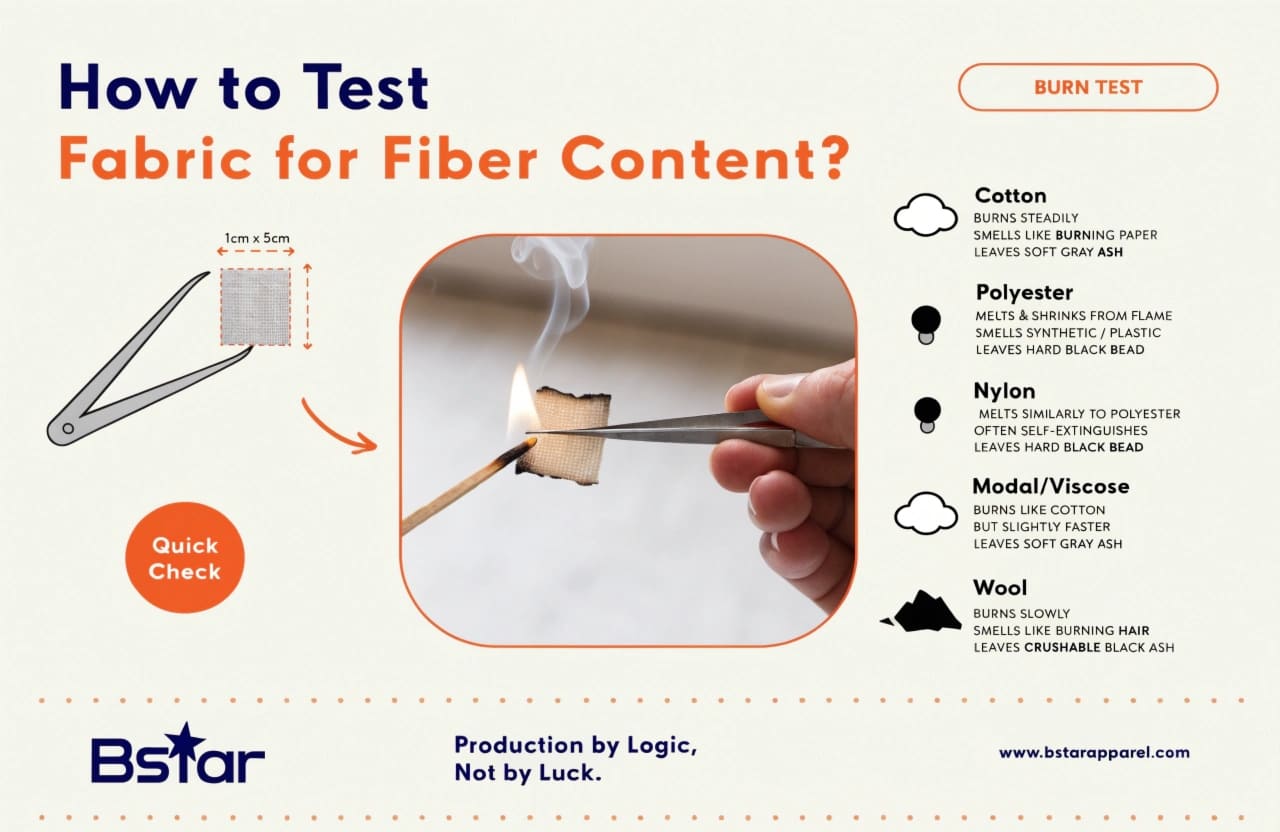
Generic burning-behavior labels are preliminary clues only. This illustration does not identify a production lot, determine blend percentages or show opacity.
In our experience, most buyers don’t run their own fiber tests — but they should at least know what to request from their supplier and what to ask a third-party lab to confirm.
The Burn Test: Practical and Fast, but Limited
A burn observation can suggest a broad fiber family. For example, a first-hand sewing demonstration shows cellulosic fabrics leaving an ashy residue and some synthetic fabrics melting under heat.3 Similar behavior across different fibers, plus the effects of blends and finishes, limits what can be concluded.
The problem is blends. A 60/40 cotton-polyester blend behaves differently from both pure fibers, and interpreting it takes experience. If you’re checking a blend and need to verify the actual ratio, a burn test won’t give you a number. Nor can it prove an organic or recycled claim. Do not use an informal observation to release a production lot or approve its opacity.
When to Use Lab Testing Instead
When composition is a purchase requirement or there is a mismatch to investigate, agree on the required fiber content test report before production approval. Base the sampling and report coverage on the material and order risks, rather than an undefined “moderate volume.”
Ask the laboratory to state the applicable method, sample identity, result and limitations. Compare that report with the fabric specification your supplier submitted at sampling; a general report for another material does not identify the fabric being delivered.
What to ask your supplier to provide before bulk cut:
- Material specification and declared composition from the yarn mill or fabric manufacturer
- An appropriate test report with enough traceability to relate it to the fabric being purchased
- Confirmation that the fabric code and composition matches the approved sample
This is especially important for blended fabrics marketed as sustainable or premium (like cotton-modal, cotton-bamboo, or recycled polyester blends), where substitution is harder to detect visually.
Why Does GSM Alone Not Guarantee Underwear Opacity?
GSM — grams per square meter — is the most commonly referenced fabric weight specification in sourcing conversations. Buyers use it to compare fabrics and set expectations. But in underwear production, misunderstanding GSM leads to real problems, including opacity surprises.
400 GSM means the fabric has a mass of 400 grams per square meter. That number does not, by itself, specify density, thickness or how much a particular garment will show through. GSM is a material specification; coverage needs its own sample review.
This is where I’ve seen buyers make a consistent mistake: they specify a GSM range and assume opacity will follow. It doesn’t work that way.
Why GSM Is Not an Opacity Guarantee
Let me explain with a concrete example. Two fabrics can both be 180 GSM:
- Fabric A: 95% cotton, 5% elastane, single jersey knit, compact yarn
- Fabric B: 50% cotton, 50% modal, French terry loop structure, soft-spun yarn
Those descriptions show that the samples differ in several variables. They do not establish a measured winner. Compare the actual specimens under the same conditions before attributing an observed difference to one ingredient. Research on light penetration through transparent woven fabrics illustrates the role of pore structure; it does not rank these two knitted examples or set an underwear threshold.4
The variables that actually determine opacity at a given GSM are:
- Yarn and construction — record the yarn reference and knit structure, rather than assuming the same GSM gives the same coverage.
- Color and finish — identify the actual colorway and finishing version being compared.
- Extension and garment shape — check the relevant panel in its agreed state, not only as a loose swatch.
- Layering and sample history — identify single or multiple layers, new or washed condition, and the production reference.
How to Use GSM in an Opacity Approval
| Material Information | What It Helps You Confirm | What Still Needs Reviewing |
|---|---|---|
| Agreed GSM and tolerance | Whether material mass is within the written specification | Coverage against the approved reference |
| Knit structure and yarn reference | Whether the intended construction has been supplied | Appearance under the defined extension |
| Colorway and finishing version | Which version the approval relates to | Other colors and any changed finish |
| Production lot and specimen identity | How the result relates to the delivered material | The agreed bulk sampling and comparison plan |
| Wash or other pretreatment history | Which specimen state was reviewed | Any other condition required for the product |
The takeaway: use GSM as a starting filter, not a final answer. Always follow up with a check on the physical fabric. Our underwear fabric GSM guide explains the weight specification in more detail; this review supplies the separate coverage decision.
Is 50% Cotton 50% Polyester Better Than 100% Cotton?
This is one of the most common questions I get from buyers designing their first private-label underwear line. The honest answer is: it depends on what you’re optimizing for — and for underwear specifically, the tradeoffs are worth understanding before you lock in your fabric spec.
Whether 50/50 cotton-polyester is better than 100% cotton depends on the end use and the actual fabrics. Fiber composition alone does not establish which is more opaque, softer or more breathable. For a coverage decision, compare the identified samples in the intended color, construction and state.
From an opacity standpoint, fiber blend is one of the key variables. Let me break this down.
How Fiber Blend Affects Opacity
- 100% cotton: review the identified yarn, knit, finish and color. The fiber name is not a coverage pass.
- Cotton-polyester: confirm the declared ratio and the actual sample. Do not infer transparency or comfort from polyester content alone.
- Modal and bamboo-derived viscose blends: specify the actual fiber names, ratio and construction. Softness language does not tell you whether the garment meets the intended coverage.
For custom men’s underwear, connect this comparison to the style: a boxer brief, brief or intentionally sheer design can have different requirements.
The Practical Tradeoffs
| Property | What to Compare on the Actual Fabrics | Approval Basis |
|---|---|---|
| Softness | Hand feel and skin-contact surface | Agreed reference and wearer feedback |
| Breathability | The requested air or moisture-related property | Suitable method and intended use |
| Shape retention | Response after the specified extension and recovery | Recorded sample conditions |
| Shrinkage after washing | Before/after dimensions under the agreed care procedure | Project-specific limits |
| Moisture handling | The required wetting, transport or drying behavior | The relevant test, not fiber name alone |
| Opacity | Coverage in the identified color and garment state | Approved reference or agreed laboratory result |
| Environmental claims | Documentation supporting the exact claim | Applicable scope and traceability |
| Price | Quote for the fully specified material and product | Comparable specification and terms |
Among buyers we work with in European and North American markets, organic cotton and GOTS-related material requests also arise in sourcing discussions. Keep that request separate from opacity. Buying material from a certified supplier does not, by itself, establish that the finished BSTAR garment can be labeled GOTS-certified; verify the applicable certification chain and claim before using it.5
A 95% cotton / 5% elastane fabric can be one starting candidate for a stretch-underwear brief. I would still ask to see its actual coverage and fit rather than treating that ratio as an automatic approval. Keep other blends in the comparison when they suit the product.
How Should Buyers Run and Record an Opacity Check?
The useful question is whether the sample meets the appearance the brand intends to approve. Decide that before choosing a setup or asking someone to send a photograph.
Hohenstein distinguishes optical measurement from garment-coverage assessment, with different specimen conditions and ways of interpreting results.6 If you request a laboratory test, agree on what it measures, the applicable sample state and the acceptance basis. Do not assume that a percentage, a visual grade and a pass/fail decision mean the same thing.
A Practical Check in Seven Steps
The following is a buyer/supplier comparison workflow to agree for the project, not a published standardized test or a claim about BSTAR’s equipment:
- Define the intended coverage. Identify the style, wearer, panel and design requirement. An intentionally sheer panel should be assessed against its own brief.
- Identify the specimens and reference. Record fabric code, composition, GSM, color, lot, garment size and sample version. Keep the approved reference available for the comparison.
- Fix the viewing conditions. Agree on illumination, identified backgrounds, viewing position and specimen placement. If you use black, white or skin-tone references, record what they are. Decide whether the review uses reflected lighting, backlighting or another arrangement; do not switch between them and treat the observations as equivalent.
- Define the extension. Review the relaxed specimen and any extension relevant to the product. Record the direction, starting dimensions and agreed extension or garment position. “Stretch it a little” is not a repeatable instruction.
- Compare the relevant garment areas. Review the intended layer count, pouch, seat and other applicable panels. Keep the specimen state identified. Include wet or washed conditions only where the product’s use and test plan require them.
- Record observations and evidence. Describe the visible difference against the reference, the location and the conditions. Use consistent photographs as supporting evidence, with the original files identified; camera processing and display settings can change apparent contrast, so unresolved decisions need physical comparison or an agreed laboratory result.
- Decide, then verify the revision and bulk plan. Record approval, revision or further investigation. If the material, color, finish or fit changes, decide what must be reviewed again. Agree how the production material will be sampled and compared before release.
Where washed condition is relevant, connect this review with the underwear wash test checklist so that the care procedure and specimen history are recorded.
Record the Decision Before Bulk Cutting
| Record | Minimum Information to Agree | What It Connects |
|---|---|---|
| Sample and reference | IDs, version, material, color, lot and size | The decision to the actual specimens |
| Setup | Lighting, background, viewing and placement | Comparisons made by different people |
| Specimen state | Relaxed/extended dimensions, layers and care history | The observation to its conditions |
| Observation | Location, description, images or report reference | The evidence to the requirement |
| Revision and recheck | What changed and which conditions were repeated | The revised sample to the original issue |
| Approval | Reviewer, date, decision and bulk-check plan | The approved reference to production release |
If coverage is unsuitable, discuss the relevant yarn, knit, finish, color, layer or fit variable with the supplier. Increasing GSM, adding a layer or changing a fiber may affect other product requirements; confirm the revised sample rather than assuming the proposed fix works. Put those comments through the Sampling & Prototyping review and identify exactly which version is approved.
Frequently Asked Questions
How many GSM is ideal for underwear fabric?
There is no single GSM that approves every underwear style or color. Select the material for its intended fit, comfort and construction, then review coverage on the actual sample. A pale color should not be approved solely because it meets a chosen weight.
Can I rely on my approved sample to confirm fabric opacity for bulk production?
An approved sample can establish the coverage reference if the specimen and review conditions are documented. It does not establish that every later lot matches it. In our experience, receiving checks are worth agreeing before bulk fabric arrives, especially for light colorways. Define the sampling, comparison and response to a mismatch in the order requirements.
What is the simplest opacity test I can do without lab equipment?
A side-by-side visual comparison with an approved reference can be useful when lighting, background, sample placement and extension are agreed. A controlled viewing cabinet may help keep conditions consistent, but a cabinet alone does not make the check a standardized test. Record the conditions and escalate to an appropriate laboratory method when the decision needs instrumented evidence.
Do fabric certifications like OEKO-TEX® cover opacity?
OEKO-TEX® STANDARD 100 addresses harmful substances within the certified article and scope.1 It is not a coverage approval and does not replace the separately agreed opacity, GSM or composition verification. Check the actual certificate rather than treating the logo as a full product-performance report.
Should I test every colorway for opacity, or just the base fabric?
Review each colorway against its intended coverage requirement rather than transferring a dark-color approval automatically. In our experience, pale or muted tones have raised opacity questions even when a dark sample looked acceptable. Agree the specimen selection and any laboratory testing with the supplier; a visual colorway review and a full laboratory test are different activities.
Conclusion
Fabric opacity can be reviewed against clear, documented requirements. The main things to carry away: GSM and fiber content identify the material but do not approve its coverage; a sample approval needs a defined reference; and a dark color should not stand in for every colorway. Agree the viewing and specimen conditions, record the decision, and connect the approved reference with the bulk-check plan.
If you’re placing an underwear bulk order, contact the BSTAR team with the style, fabric reference, colorways and coverage question. We can review the requirement and discuss the appropriate sample, comparison and documentation before the production decision.
-
OEKO-TEX®. “OEKO-TEX® STANDARD 100.” https://www.oeko-tex.com/en/our-standards/oeko-tex-standard-100. Official description of harmful-substance certification, covered textile articles and product classes. Confirm the actual certificate’s scope and validity; it is not an opacity result. ↩ ↩
-
AATCC. “TM20A-2025: Test Method for Fiber Analysis: Quantitative.” https://members.aatcc.org/store/tm20a/486/. The official public scope includes mechanical, chemical and microscopical procedures for quantitative textile analysis. A laboratory must select the procedure appropriate to the actual fiber combination; the public summary is not the full method. ↩
-
Elisalex de Castro Peake. “The Burn Test — how to identify the fibres in your mystery fabric.” By Hand London, February 19, 2021. https://byhandlondon.com/blogs/by-hand-london/the-burn-test-how-to-identify-the-fibres-in-your-mystery-fabric. First-hand qualitative demonstrations, retained for general burning-behavior observations only. This is not a laboratory method, blend-percentage measurement or opacity test. ↩
-
Klara Kostajnšek, Živa Zupin, Aleš Hladnik and Krste Dimitrovski. “Optical Assessment of Porosity Parameters in Transparent Woven Fabrics.” Polymers 13(3), 408 (2021). https://pmc.ncbi.nlm.nih.gov/articles/PMC7865968/. DOI: 10.3390/polym13030408. The study concerns optical assessment of pores in transparent woven fabrics. It does not establish a knitted-underwear GSM threshold or rank cotton against polyester or Modal. ↩
-
Global Standards gGmbH. “Global Organic Textile Standard (GOTS).” https://global-standards.org/our-standards/gots. Official description of certification across the textile processing chain and requirements for a finished-product GOTS claim. A supplier’s material certificate is not automatic certification of the finished garment. ↩
-
Hohenstein. “Opaqueness and Opacity.” Factsheet, February 2020. https://www.hohenstein.com/fileadmin/user_upload/Downloads/Factsheets/Factsheet_Opaqueness_and_Opacity_EN.pdf. Describes separate optical and clothing-coverage assessments with different conditions and interpretation. Confirm the current service, applicable procedure and required specimen state with the laboratory; this guide does not reproduce a standard test method. ↩
Discussion & questions 0 comments