
OEKO-TEX Standard 100 Certification: Compliance Checklist for Intimate Apparel
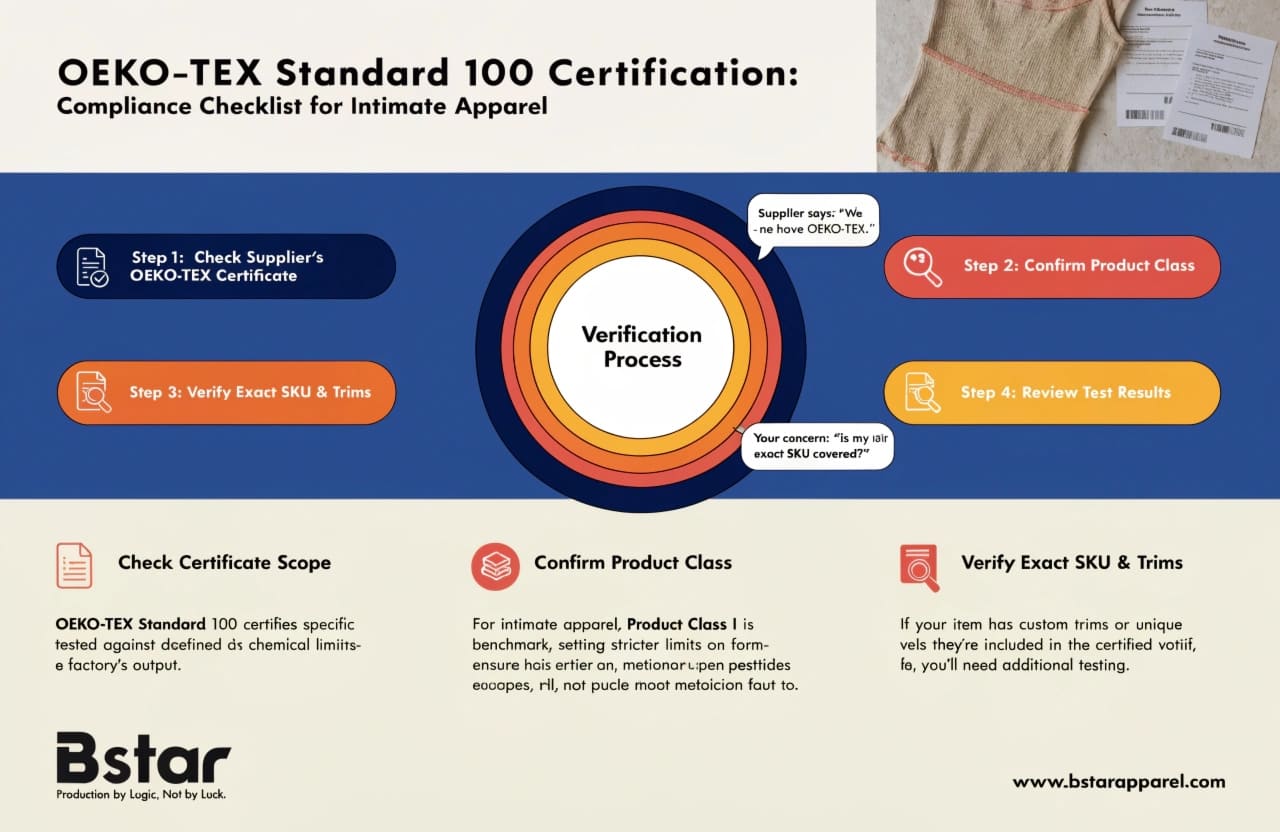
If your supplier says "we have OEKO-TEX," that is not the same as "your intimate apparel is OEKO-TEX compliant." That gap is where brands get burned.
OEKO-TEX Standard 100 certifies specific articles tested against defined chemical limits — not an entire factory’s output. For intimate apparel, the relevant benchmark is Product Class I, which sets stricter limits on formaldehyde, heavy metals, pH, and pesticides than the classes most suppliers default to. Before you approve a supplier, you need to know which class their certificate covers, and whether your exact SKU — including trims — falls inside that scope.
We have gone through the OEKO-TEX Standard 100 certification application process at our factory, and we run Product Class I verification internally for intimate apparel orders. What I’ve seen is that most brands don’t know what questions to ask. This guide gives you the checklist — and the reason each point actually matters to your business.
Why Does Intimate Apparel Typically Fall Under Strict Product Class II — Wait, Actually Class I?
Most brands hear "OEKO-TEX certified" and stop there. They don’t ask which product class the certificate covers. That is a mistake.
OEKO-TEX Standard 100 divides products into four classes based on skin contact level. Intimate apparel — underwear, bras, bodysuits, leggings worn against skin — sits in Product Class I, not Class II. Class I is for articles with large-area, prolonged skin contact in adults. The chemical limits are meaningfully lower than those in Class II, which covers outer garments with less direct contact.
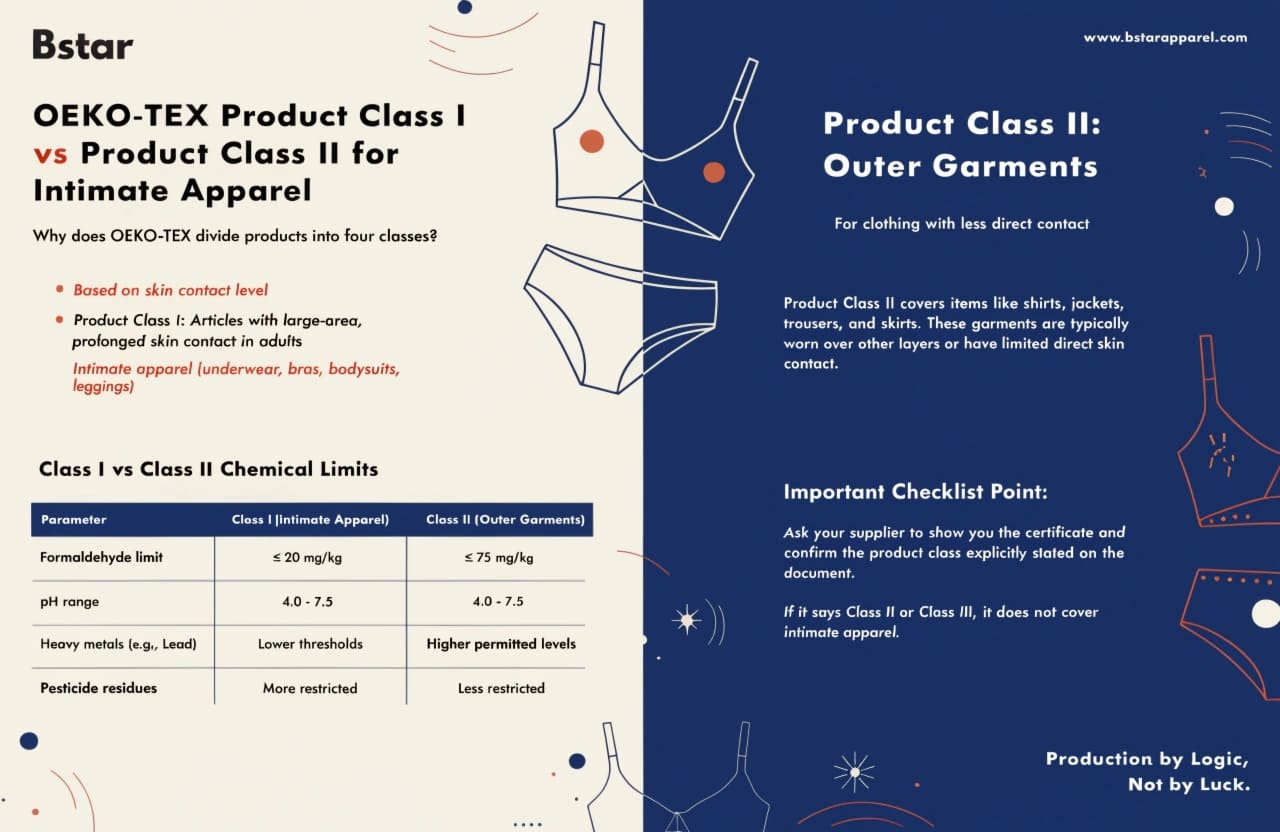
Here is what the class distinction means in practice. A factory might hold a valid OEKO-TEX certificate for a Class II product — say, a hoodie fabric. That same certificate does not cover your underwear SKU. The test limits are different. The article under test is different. The certificate is different.
When we apply for certification on intimate apparel orders, we submit the finished article — including all components — specifically for Class I evaluation. We don’t assume a fabric certificate carries over.
Class I vs. Class II: What Changes?
| Parameter | Class I (Intimate Apparel) | Class II (Outer Garments) |
|---|---|---|
| Formaldehyde limit | ≤ 20 mg/kg (fact-check against current annex) | ≤ 75 mg/kg |
| pH range | 4.0 – 7.5 | 4.0 – 7.5 (same, but fabric finish matters more at skin contact) |
| Heavy metals (e.g., Lead) | Lower thresholds | Higher permitted levels |
| Pesticide residues | More restricted | Less restricted |
Checklist point: Ask your supplier to show you the certificate and confirm the product class explicitly stated on the document. If it says Class II or Class III, it does not cover intimate apparel. That’s your business risk — not theirs.
What Harmful Substances Are You Actually Screening For?
The word "harmful substances" sounds technical, but the business risk is simple: if restricted chemicals show up in a finished garment during a retail audit or customs check, the product gets pulled. Your brand takes the hit, not the factory.
OEKO-TEX Standard 100 screens for a broad list of restricted substances including formaldehyde, heavy metals (lead, cadmium, chromium), allergenic dyes, pesticide residues, pH deviation, and color fastness failures. For Class I products, the permitted levels for several of these are at the lowest thresholds in the standard.
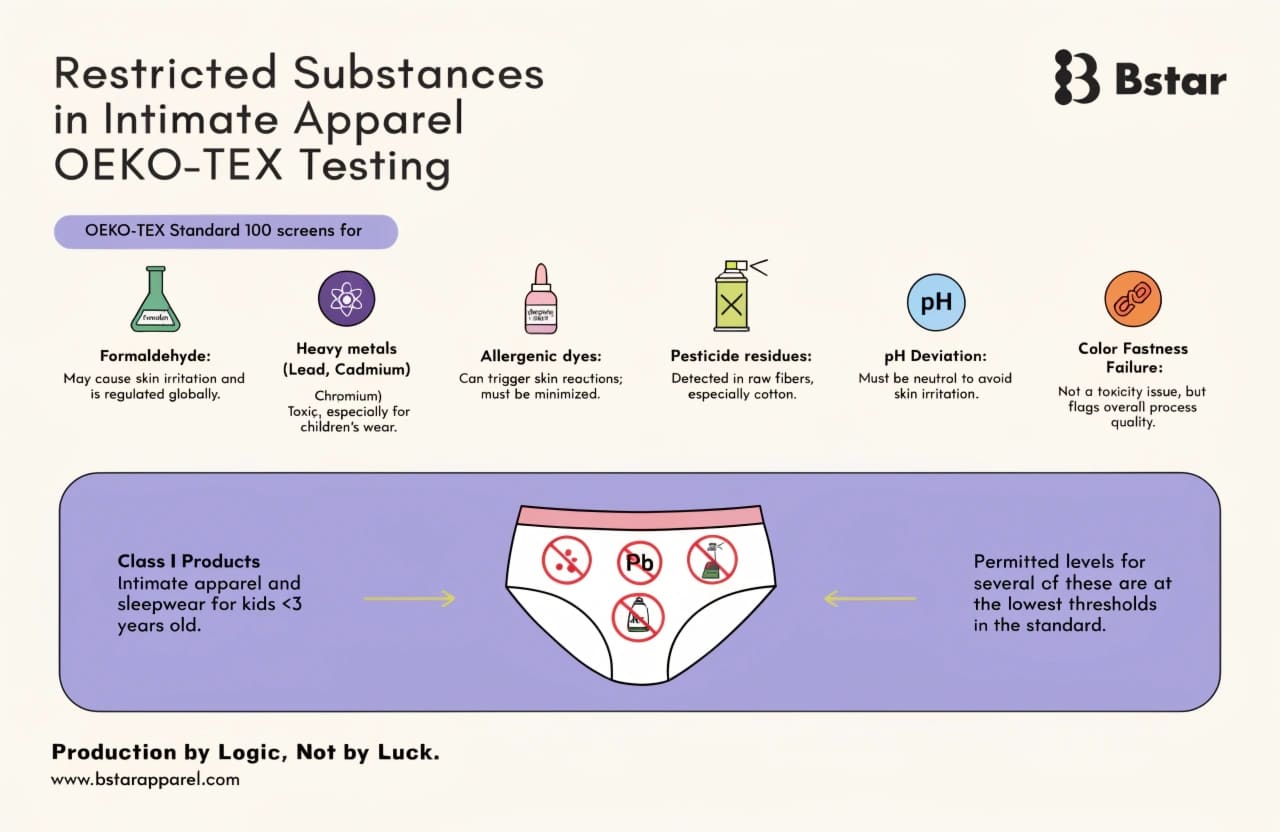
In our experience running Class I verification, formaldehyde and pH are the two parameters that come up most in fabric treatment. Finishing agents — used to add softness, stretch recovery, or wrinkle resistance — are a common source of formaldehyde residues. Dyes are where heavy metals and allergenic compounds show up most.
Key Substances to Screen: Risk Rationale for Each
| Substance | Source in Intimate Apparel | Brand Risk if Exceeded |
|---|---|---|
| Formaldehyde | Fabric finish, anti-shrink treatments | Skin sensitization; retail delisting in EU/US |
| Heavy metals (Pb, Cd, Cr VI) | Dyes, hardware accessories, prints | Regulatory non-compliance; customs seizure |
| Allergenic dyes (e.g., azo dyes releasing amines) | Fabric and trim dyeing | Consumer health claims; legal liability |
| pH deviation | Dyeing and finishing process | Skin irritation; returns and complaints |
| Pesticide residues | Raw fiber (cotton, natural fiber blends) | Detected in fiber-level audits; brand credibility risk |
| Color fastness failure | Dye lot quality | Not a toxicity issue, but flags overall process quality |
Checklist point: When reviewing a supplier’s certificate, don’t just confirm it exists — ask for the test report. The test report shows which substances were screened and the recorded values. A certificate without a readable test report attached tells you very little.
Appendix 4 vs. Appendix 6: Which Testing Scope Do You Actually Need?
This is where most brand-side compliance managers get lost, because the OEKO-TEX annexes are not light reading.
OEKO-TEX Standard 100 includes multiple appendices that define testing requirements. Appendix 4 covers the human ecology requirements — the chemical limits that protect the wearer. Appendix 6 covers the STeP by OEKO-TEX production facility requirements, which focus on environmental and social standards at the manufacturing level. For product labeling purposes, Appendix 4 is the primary scope for Standard 100 certification.
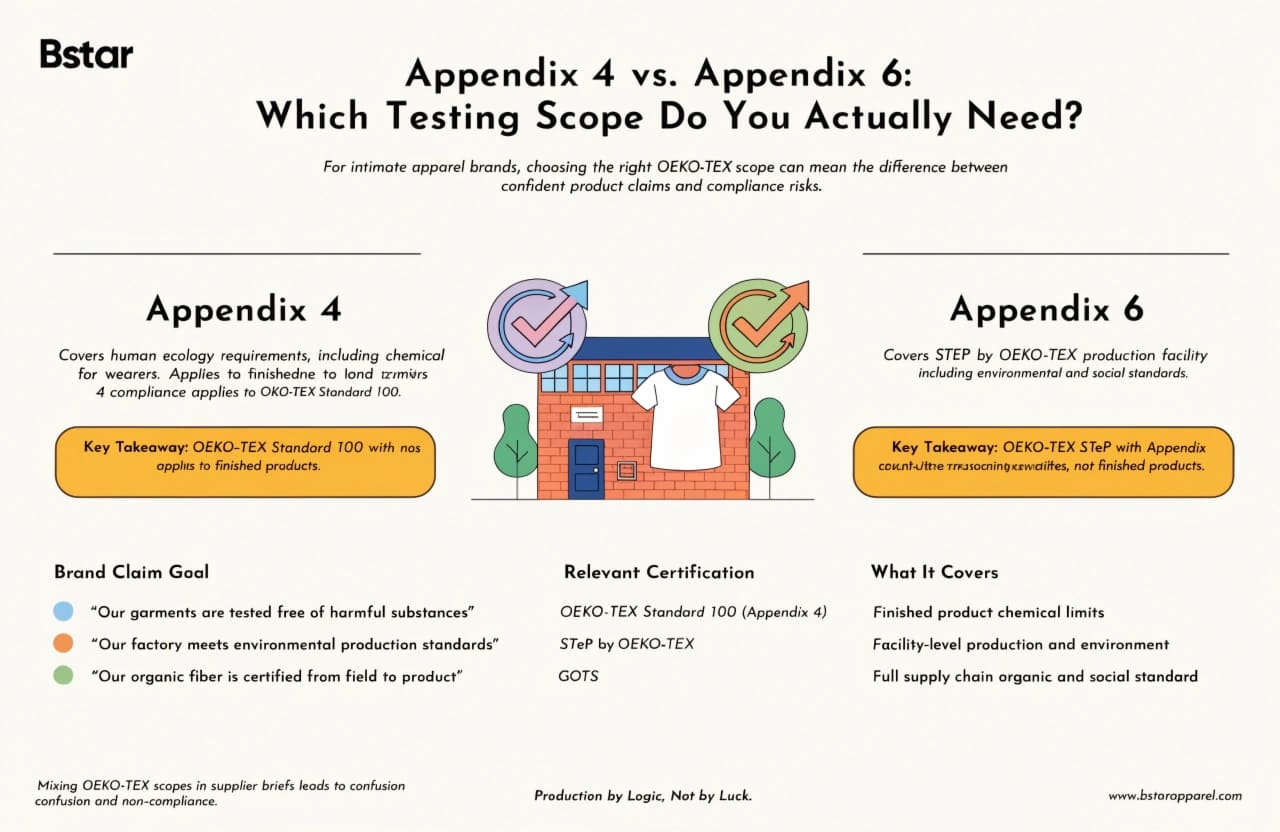
Here is the practical distinction. Standard 100 with Appendix 4 compliance means the finished product was tested and meets human ecology limits — that is what the OEKO-TEX label on a garment claims. It does not make claims about the factory’s wastewater treatment, chemical storage, or worker safety. Those are covered by STeP, which is a separate certification.
I see brands conflate these two all the time. They ask if a factory is "OEKO-TEX certified" meaning they want both product safety and factory sustainability — but those are two different certifications with two different scopes. Mixing them in your supplier brief creates confusion and, worse, gives you false assurance.
Decision Framework: What Scope Do You Need?
| Brand Claim Goal | Relevant Certification | What It Covers |
|---|---|---|
| "Our garments are tested free of harmful substances" | OEKO-TEX Standard 100 (Appendix 4) | Finished product chemical limits |
| "Our factory meets environmental production standards" | STeP by OEKO-TEX | Facility-level production and environment |
| "Our organic fiber is certified from field to product" | GOTS | Full supply chain organic and social standard |
Checklist point: Confirm in writing which OEKO-TEX scope your supplier holds. For product labeling, you need Standard 100 with a valid, class-specific test scope. Do not accept a STeP certificate as evidence of product compliance — they are not interchangeable.
How Do You Actually Manage Certificates, Documentation, and Annual Renewals Without Getting Caught Out?
A certificate on a factory office wall means nothing if it expired six months ago, or if the dye supplier changed after the test was submitted.
OEKO-TEX Standard 100 certificates are valid for one year and must be renewed through re-testing. More critically, any change in raw material source, dye batch, or trim component can break compliance for the specific article — even within the certificate’s validity period. Brands that don’t build material change controls into their supplier agreements carry that risk silently.
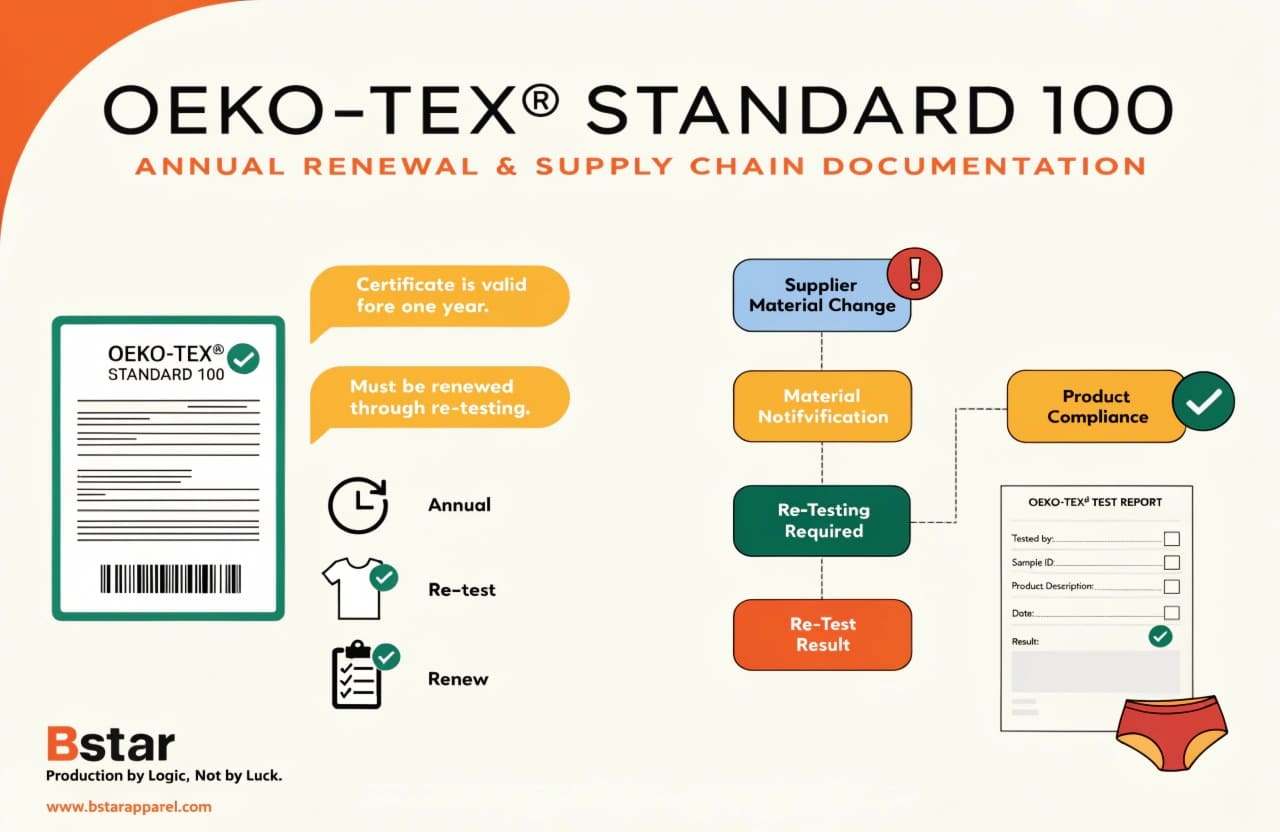
In our certification process, the scope covers the finished product: shell fabric combined with all trim components — elastic bands, labels, thread, and other accessories. This is the correct approach. A fabric-only test with untested trims does not give you a compliant finished product. The elastic at the waistband of an underwear SKU has prolonged, direct skin contact. It needs to be inside the tested scope.
What I’ve seen go wrong: a supplier tests the fabric, gets the certificate, then sources a different elastic from a new vendor to cut costs. The certificate is still on the wall. The finished garment is no longer compliant. Nobody told the brand.
Your Supplier Audit Checklist: Four Non-Negotiables
| Checklist Item | Why It Matters to Your Brand |
|---|---|
| Certificate scope explicitly states Product Class I | Lower chemical limits apply to intimate apparel — Class II coverage leaves you exposed |
| Certificate covers finished article, not just shell fabric | Trims with skin contact must be inside the tested scope, or the label claim is inaccurate |
| Test report is available and shows recorded values, not just pass/fail | A pass with values near the limit signals higher reformulation risk at next dye batch |
| Supplier has a documented material change control process | Certificate validity does not survive a supplier swap in dye or trims — you need a change trigger protocol in place |
Checklist point: Add a contract clause that requires your supplier to notify you within a set window — we use 30 days internally — of any raw material source change for certified articles. Without that clause, you’re relying on trust, not process.
Conclusion
Having OEKO-TEX and being OEKO-TEX compliant for your intimate apparel SKUs are not the same thing. Check the class, check the scope, check the trims, and check the renewal date — every time.