
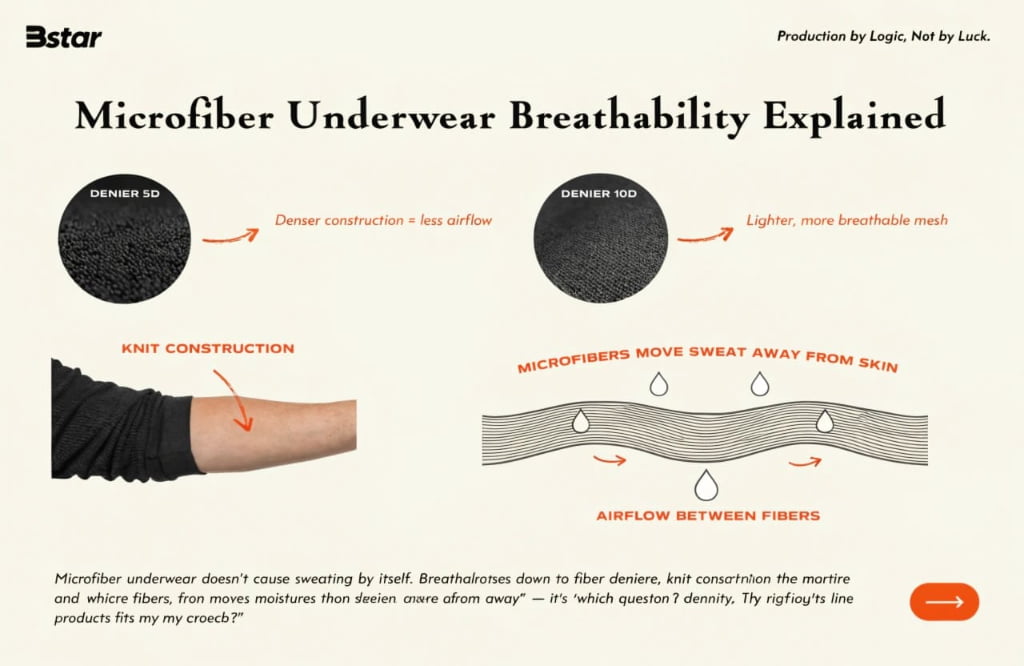
You’ve heard the complaints. "Too hot." "Feels sweaty." "Doesn’t breathe." And now you’re second-guessing whether microfiber is the right call for your next underwear line.
Microfiber underwear doesn’t cause sweating by itself. Breathability comes down to fiber denier, knit construction density, and how the fabric moves moisture away from skin. The right question isn’t "is microfiber breathable?" — it’s "which microfiber construction fits my product’s end use?"
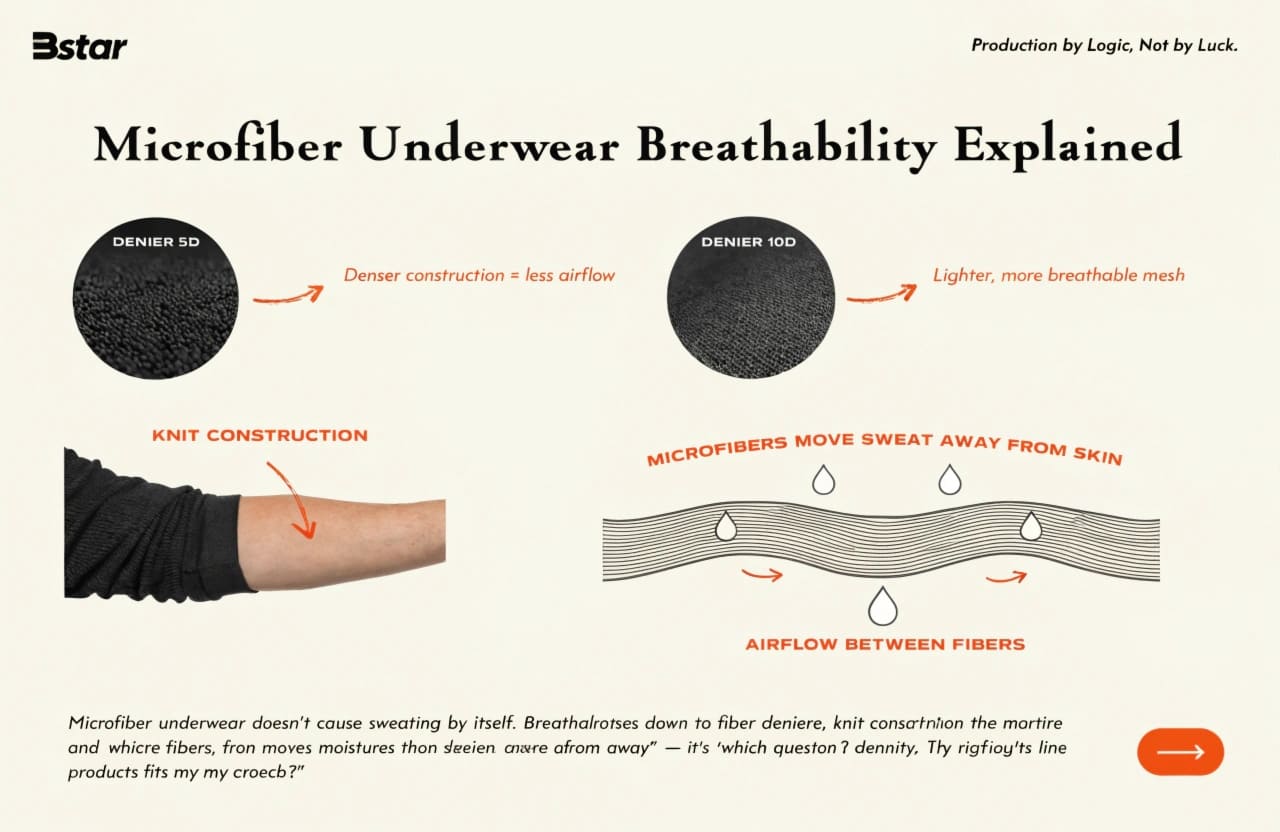
Most buyers I talk to have already made up their mind about microfiber before they contact us. They’ve read something online, or had a bad experience with one product, and now they’re treating all microfiber as the same thing. That’s where the confusion starts — and where bad fabric decisions get made.
Is All Microfiber the Same Material?
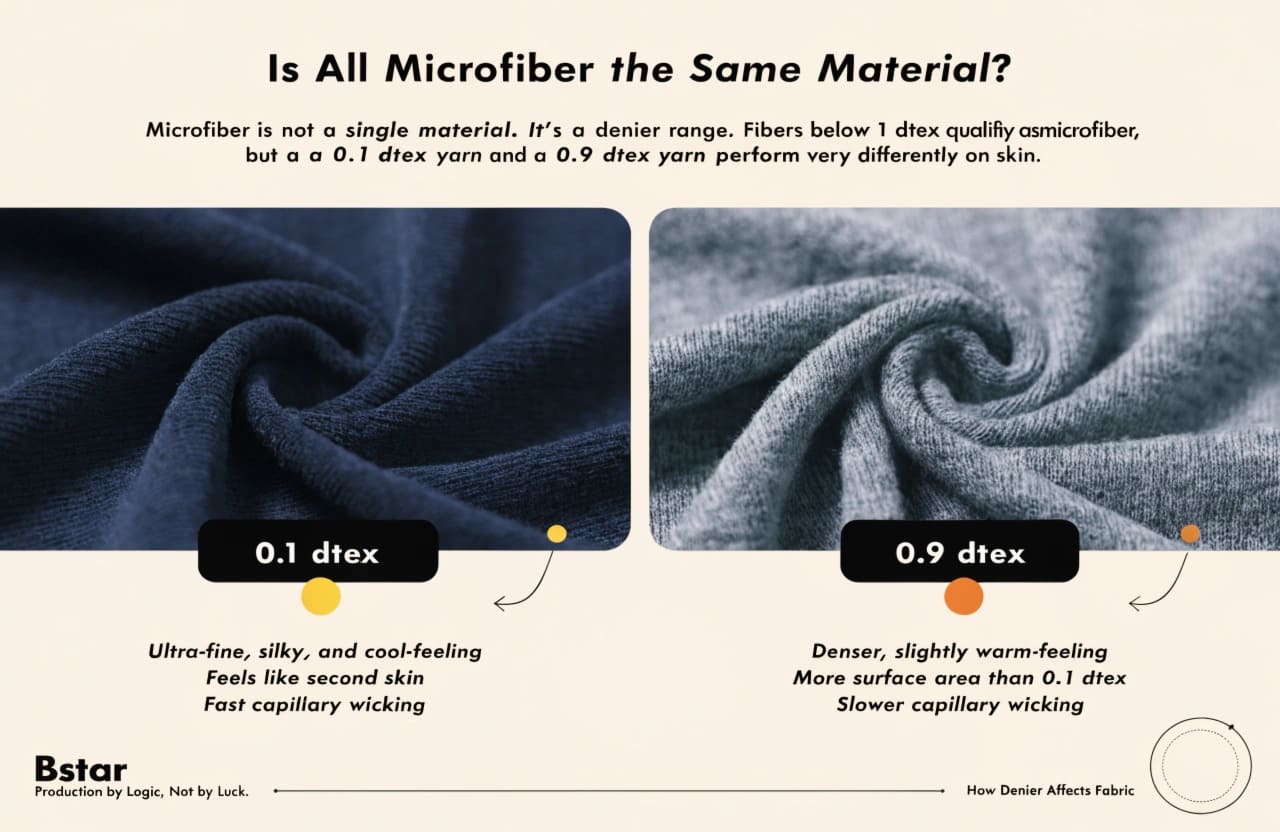
You pick up two fabric swatches. Both are labeled "microfiber." One feels silky and cool. The other feels dense and slightly warm. Same category, completely different behavior. Why?
Microfiber is not a single material. It’s a denier range. Fibers below 1 dtex qualify as microfiber, but a 0.1 dtex yarn and a 0.9 dtex yarn perform very differently on skin. Denier controls softness, surface contact area, and how the fiber interacts with moisture — so the label "microfiber" alone tells you almost nothing useful.
In our sourcing work, we see this misunderstanding come up constantly. A buyer asks for "microfiber underwear" and assumes any microfiber fabric will behave the same way. But when we’re selecting yarn specs for a client’s brief, we’re looking at denier, filament count, cross-section shape, and whether the fiber has been texturized or left flat. Each of those variables changes how the final fabric feels and performs.
Why Denier Matters More Than the Fiber Name
Here’s a simple way to think about it. Finer denier means more filaments packed into the same yarn. More filaments mean more surface area. More surface area means the fabric can spread and move moisture faster — but it also means the fabric sits closer to skin, which can feel warmer if the construction traps air poorly.
| Denier Range | Typical Feel | Moisture Behavior | Common Use |
|---|---|---|---|
| 0.1–0.3 dtex | Ultra-soft, smooth | Fast capillary wicking | Premium innerwear, second skin styles |
| 0.4–0.7 dtex | Soft, slightly structured | Good wicking, moderate airflow | Everyday underwear, light activewear |
| 0.8–1.0 dtex | Firmer hand | Slower wicking, more body | Shapewear, structured briefs |
When clients come to us asking why their microfiber product got heat complaints, nine times out of ten the issue isn’t the fiber type. It’s that someone picked a mid-range denier yarn and then knitted it tight. You end up with a dense, low-airflow fabric that holds moisture at the skin surface instead of moving it away.
Does Microfiber Actually Wick Sweat, or Just Trap It?
Here’s something I hear often from DTC buyers sourcing for warmer climates: "I thought microfiber was supposed to wick moisture, but my customers say they feel sweaty." That’s a real complaint, and it’s worth unpacking carefully.
Moisture wicking in microfiber works through capillary action — the fine filaments create tiny channels that pull liquid away from skin and spread it across the fabric surface for evaporation. But this only works well when the knit structure allows airflow. A dense construction blocks evaporation even if wicking is fast.
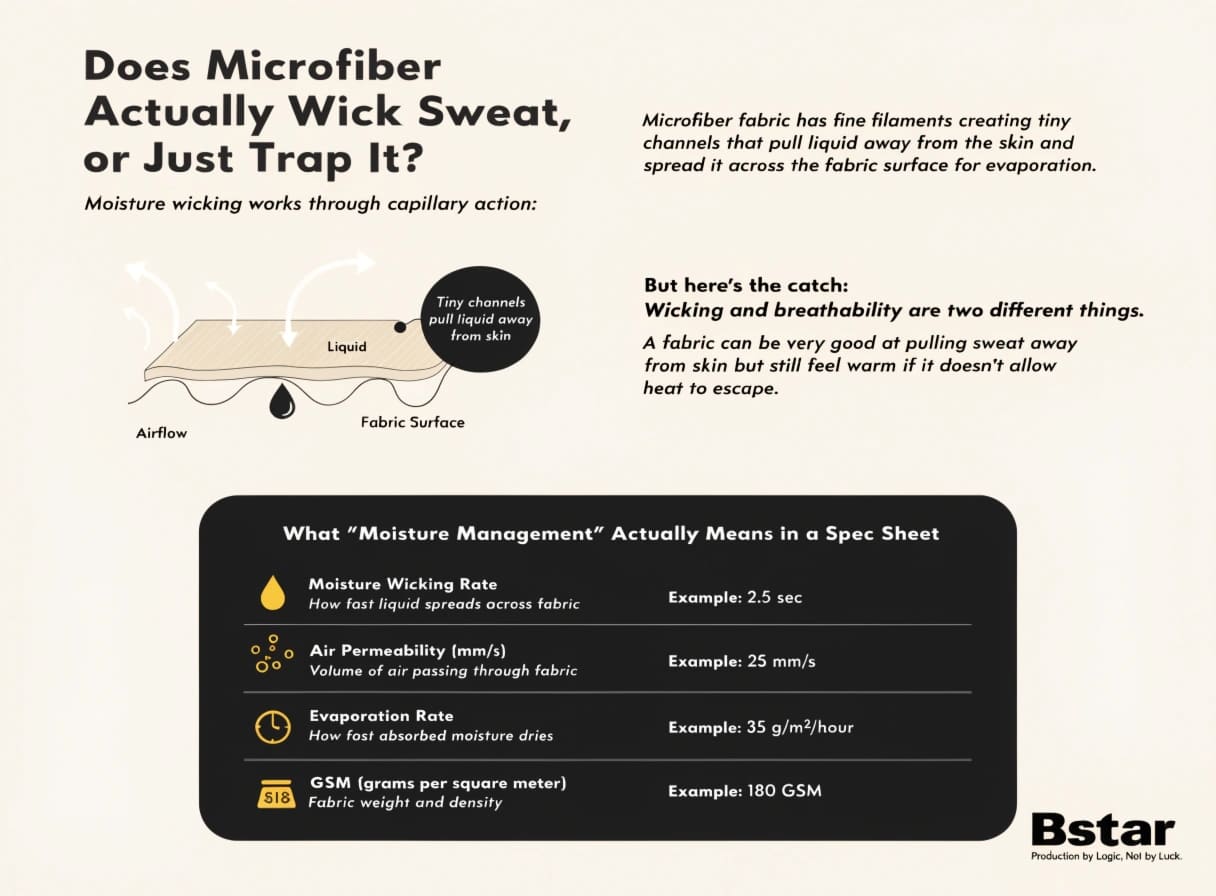
Wicking and breathability are two different things. A fabric can be very good at pulling sweat away from skin and still feel warm if it doesn’t allow heat to escape. I’ve seen this play out with clients who spec a high-performance wicking yarn but pair it with a tight single-jersey construction. The moisture moves, but the heat stays.
What "Moisture Management" Actually Means in a Spec Sheet
When a fabric supplier shows you a "moisture management" rating, check what it’s actually measuring. Most standard tests — like AATCC 195 — measure how fast liquid spreads across fabric. They don’t measure heat dissipation or air permeability directly. Those are separate specs.
| Spec | What It Measures | Why It Matters for Underwear |
|---|---|---|
| Moisture Wicking Rate | Speed of liquid spreading | Keeps skin surface dry |
| Air Permeability (mm/s) | Volume of air passing through fabric | Controls heat build-up |
| Evaporation Rate | How fast absorbed moisture dries | Reduces clamminess after exercise |
| GSM (grams per square meter) | Fabric weight and density | Heavier = less airflow in most constructions |
A good supplier should be able to give you numbers for all four. If they can only talk about wicking, push harder. The evaporation and air permeability specs are what actually separate a breathable microfiber from a sweaty one.
Does Fabric Construction Change How Breathable Microfiber Is?
Two products. Same polyester microfiber yarn. One gets good reviews for comfort in summer. One gets heat complaints within the first month of launch. The fiber didn’t change. The construction did.
Knit structure controls airflow more than fiber content alone. Open-loop knits, mesh zones, and lower-GSM constructions create physical air channels that allow heat to escape. A well-engineered microfiber mesh can outperform a tightly woven natural fiber on practical breathability.
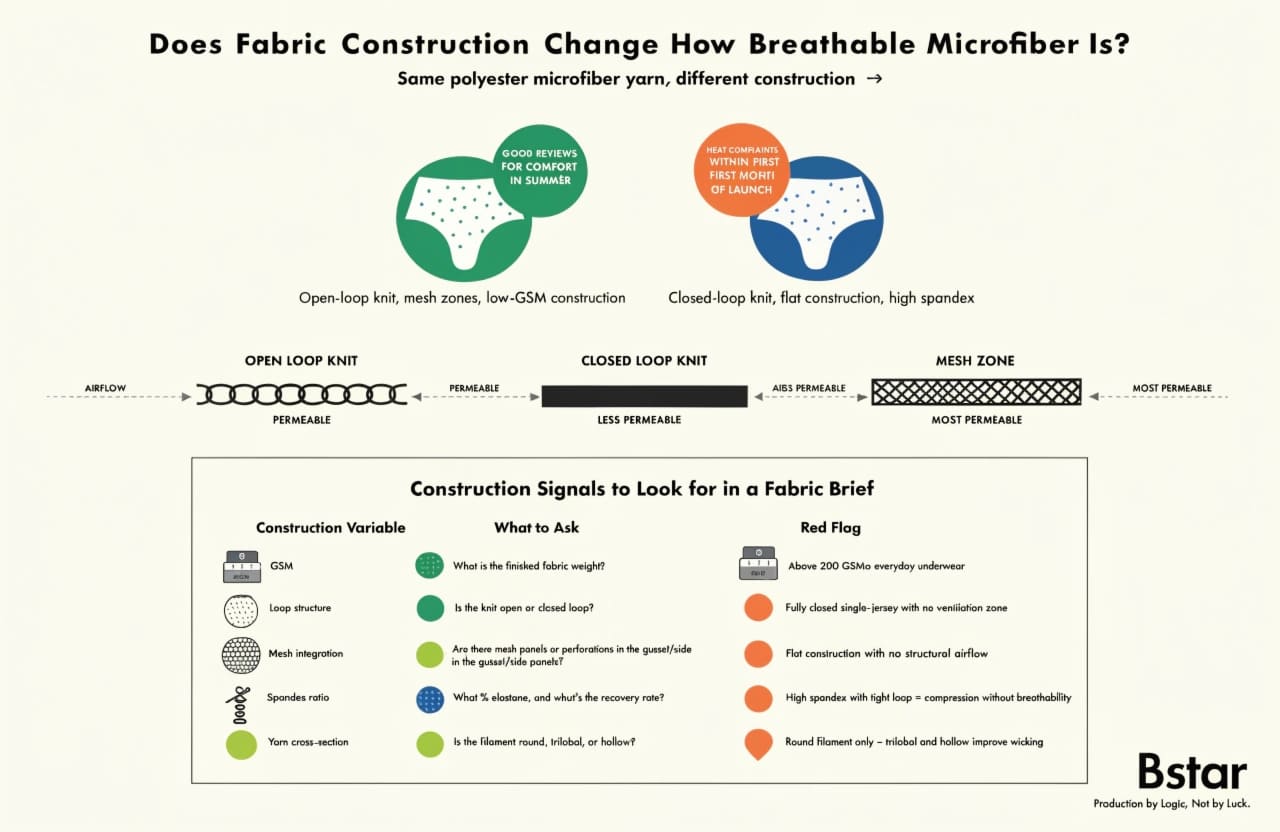
In our production experience, the constructions that perform best for warm-climate or active-use underwear share a few common traits. They use lower GSM — typically in the 140–180 range for everyday wear. They incorporate some degree of open structure, either through a mesh panel or an engineered loop pattern. And they usually include a small percentage of spandex — around 10–15% — which keeps the fabric against skin without compressing it tightly enough to block airflow.
Construction Signals to Look for in a Fabric Brief
When you’re evaluating a microfiber fabric for a new underwear line, here’s what to actually check beyond the fiber content label.
| Construction Variable | What to Ask | Red Flag |
|---|---|---|
| GSM | What is the finished fabric weight? | Above 200 GSM for everyday underwear |
| Loop structure | Is the knit open or closed loop? | Fully closed single-jersey with no ventilation zone |
| Mesh integration | Are there mesh panels or perforations in the gusset/side panels? | Flat construction with no structural airflow |
| Spandex ratio | What % elastane, and what’s the recovery rate? | High spandex with tight loop = compression without breathability |
| Yarn cross-section | Is the filament round, trilobal, or hollow? | Round filament only — trilobal and hollow improve wicking |
Trilobal or cross-shaped fiber cross-sections create more capillary channels per yarn than round filaments. Hollow-core fibers are lighter and carry moisture faster. These aren’t exotic specs — they’re standard options in any serious yarn range, and a supplier who can’t discuss them may not be sourcing at the right tier.
Should You Choose Microfiber for Active Wear or Just Everyday Underwear?
This is the practical question most buyers are actually trying to answer. And the honest answer is: microfiber can work well for both — but the spec you need for each is different, and mixing them up is how you get consumer complaints.
For activewear, prioritize air permeability and evaporation rate. For everyday all-day wear, prioritize low GSM, soft hand, and moisture wicking without compression. Both can use microfiber — but they need different construction specs. Picking one fabric and using it for both is a common sourcing mistake.
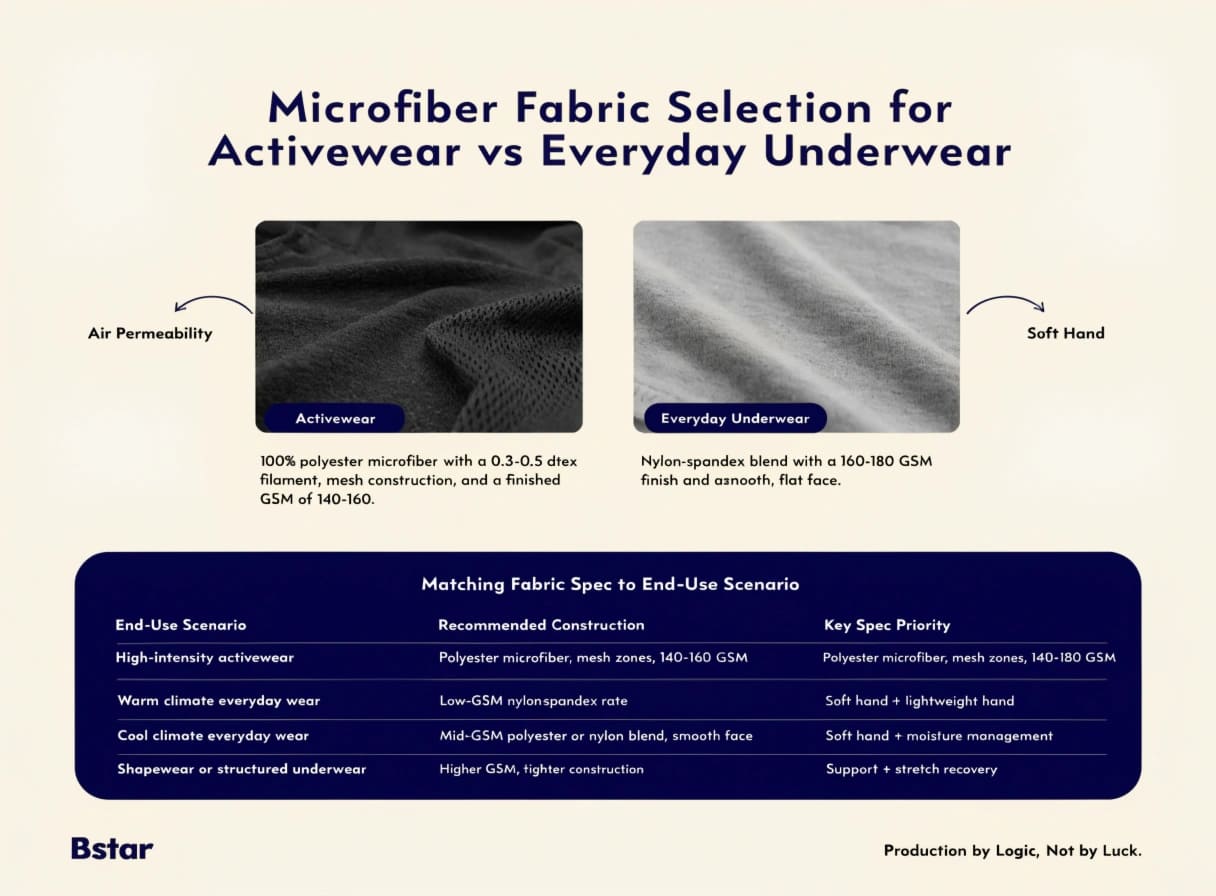
Clients sourcing for activewear have asked us specifically about fabrics that perform well in high-sweat conditions. For those use cases, we typically look at 100% polyester microfiber in the 0.3–0.5 dtex range, with a mesh or open-knit structure, and a finished GSM between 140–160. That combination wicks fast, dries fast, and allows enough air movement that heat doesn’t build up under waistbands or in the gusset area.
For everyday innerwear — the kind that gets worn through a full office day or long commute — soft hand matters as much as technical performance. A nylon-spandex blend in the 160–180 GSM range, with a smooth flat face, tends to perform better for that use case. Nylon has slightly better moisture absorption than polyester at the fiber level, which helps with the minor perspiration that happens through a normal day rather than intense exercise.
Matching Fabric Spec to End-Use Scenario
| End-Use Scenario | Recommended Construction | Key Spec Priority |
|---|---|---|
| High-intensity activewear | Polyester microfiber, mesh zones, 140–160 GSM | Air permeability + evaporation rate |
| Warm climate everyday wear | Low-GSM nylon-spandex, open loop knit | Wicking + lightweight hand |
| Cool climate everyday wear | Mid-GSM polyester or nylon blend, smooth face | Soft hand + moisture management |
| Shapewear or structured underwear | Higher GSM, tighter construction | Support + stretch recovery |
The sourcing mistake I see most often is buyers choosing fabric by material category — "I want microfiber" or "I want natural fiber" — without anchoring that choice to the end-use scenario first. Start with where and how the product gets worn. Then select the fiber and construction that fits that scenario. That’s the order that produces good reviews and low return rates.
Conclusion
Microfiber doesn’t cause sweat — poor construction does. Check denier, knit structure, GSM, and end-use fit before you spec any fabric. Those four variables decide whether your product earns comfort reviews or heat complaints.
Discussion & questions 0 comments