
How to Handle Defective Goods from Your Underwear Supplier?
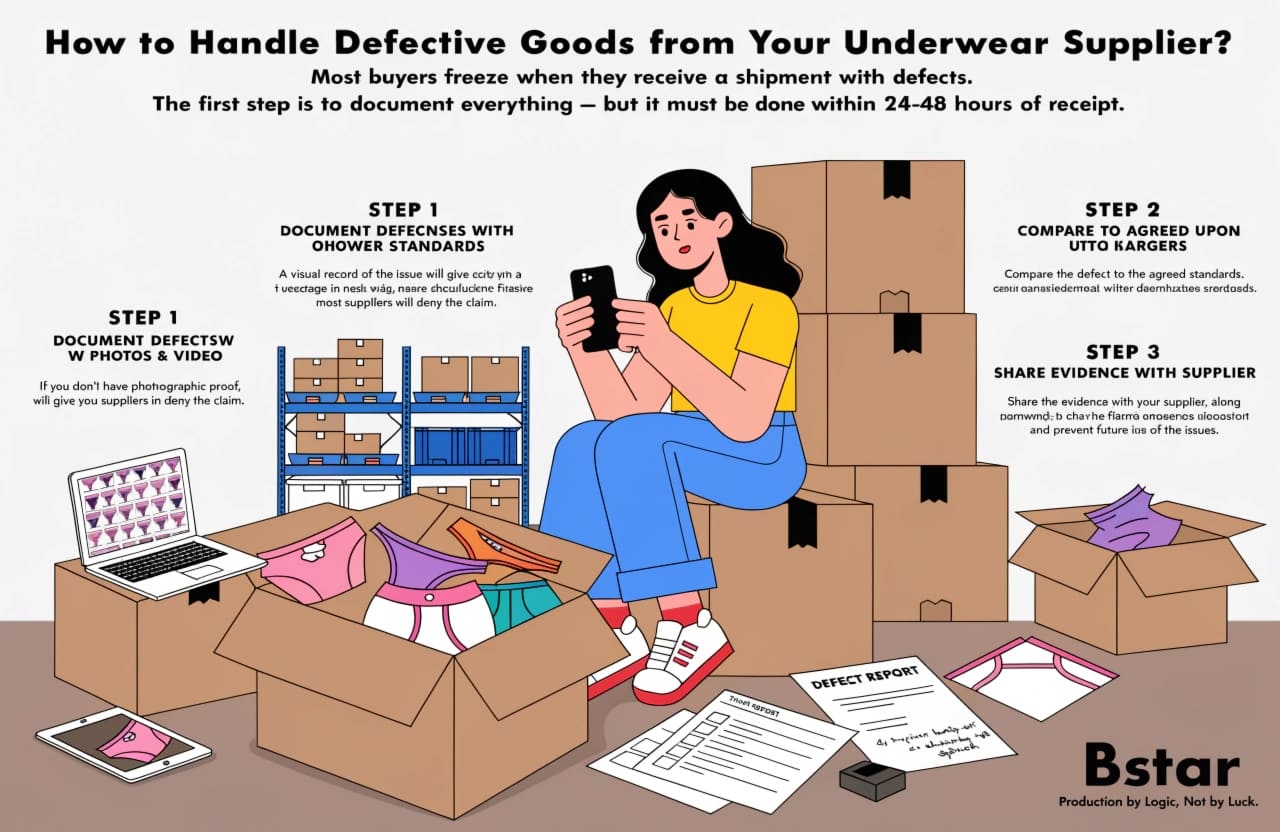
You received a shipment. Something is wrong. Now what? Most buyers freeze here — and that hesitation costs them.
When you find defects in a garment shipment, your first move is documentation, not confrontation. Timestamped photos and video of random units — taken within 24–48 hours of receipt — are the foundation of any credible claim. Without them, most suppliers will push back, and you will have little leverage.
I’ve seen both sides of this. At BSTAR, our QC team receives defect claims from overseas DTC brands regularly. What separates a claim that gets resolved from one that goes nowhere almost always comes down to the same two things: evidence quality and whether the defect standard was agreed on before production started. This article walks you through both.
Immediate Response and Evidence Collection: Documenting Defects with Photos, Videos, and Third-Party Inspections?
You open the boxes and something looks off. The worst thing you can do right now is set the bad pieces aside and email your supplier a complaint with no attachments.
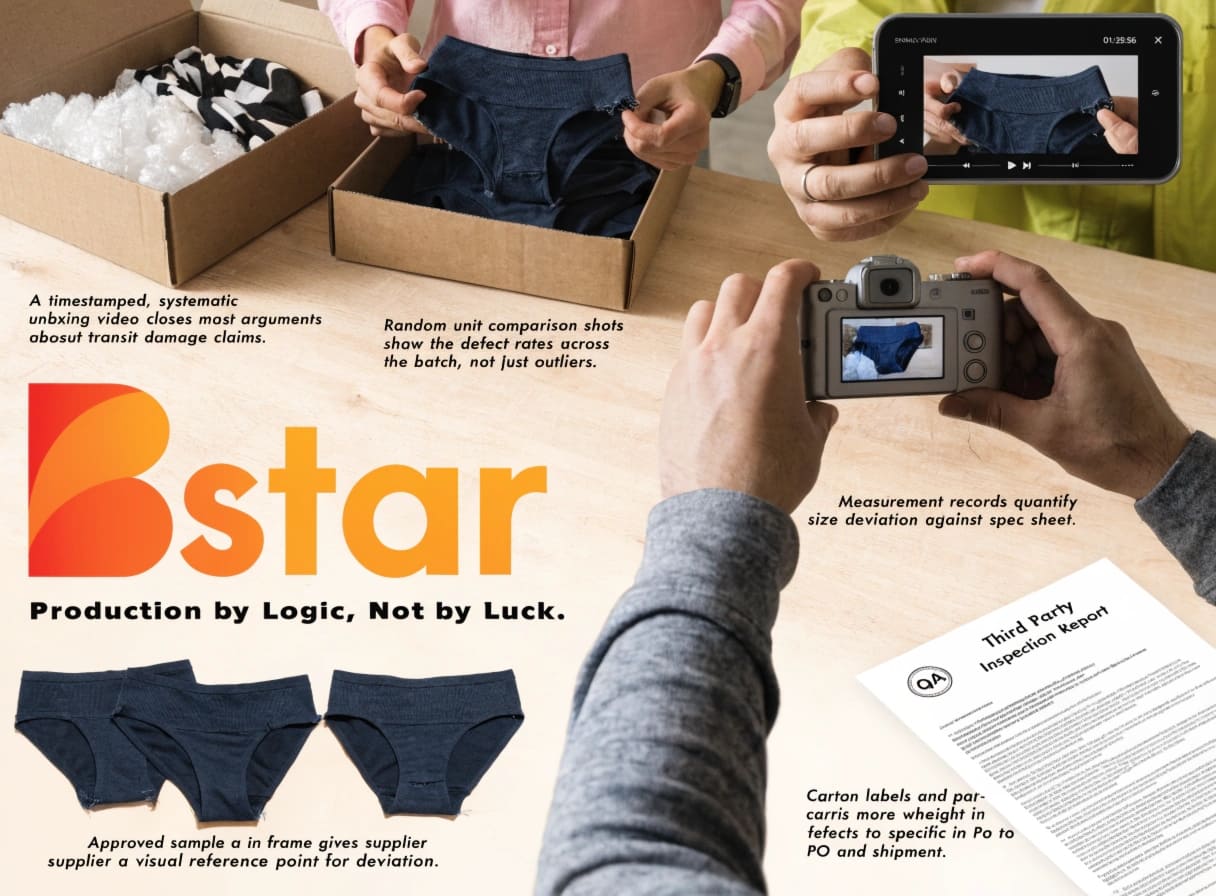
The first 24–48 hours after you receive a shipment are your highest-leverage window1. Suppliers can dispute undocumented claims by pointing to transit handling, customs inspection, or storage conditions2. A timestamped, systematic unboxing video closes most of those arguments before they start.
Here is what to capture and how to organize it.
What to Film and Photograph
Don’t only photograph the worst pieces. That’s the most common mistake I see from buyers. When a claim shows only extreme examples, suppliers read it as cherry-picking. Instead, open several cartons on camera and pull random units. Show the carton labels, the packing condition, and then the individual pieces side by side with the approved sample.
What Evidence Actually Holds Up
| Evidence Type | Why It Matters | Common Mistake |
|---|---|---|
| Timestamped unboxing video | Proves condition at receipt, rules out transit damage claims | Filming only defective pieces |
| Random unit comparison shots | Shows the defect rate across the batch, not just outliers | Only photographing worst cases |
| Approved sample in frame | Gives the supplier a visual reference point | Claiming deviation with no baseline in the photo |
| Carton labels and packing list | Links the defects to a specific PO and shipment | Forgetting to document which shipment the claim belongs to |
| Measurement records | Quantifies size deviation against spec sheet | Describing fit issues without numbers |
If the defect rate looks significant — say above 5% of the units you’ve checked — consider hiring a third-party inspection company to do a formal AQL count on the full shipment3. A third-party report carries more weight in negotiation than your own count. It also removes the "you only checked a few pieces" argument from the table.
Root Cause Analysis and Responsibility Assessment: Distinguishing Manufacturing Flaws from Transit Damage or Misuse?
Not every defect is the factory’s fault. That sounds like I’m defending suppliers, but it’s actually the framing that helps you get a fair resolution faster.
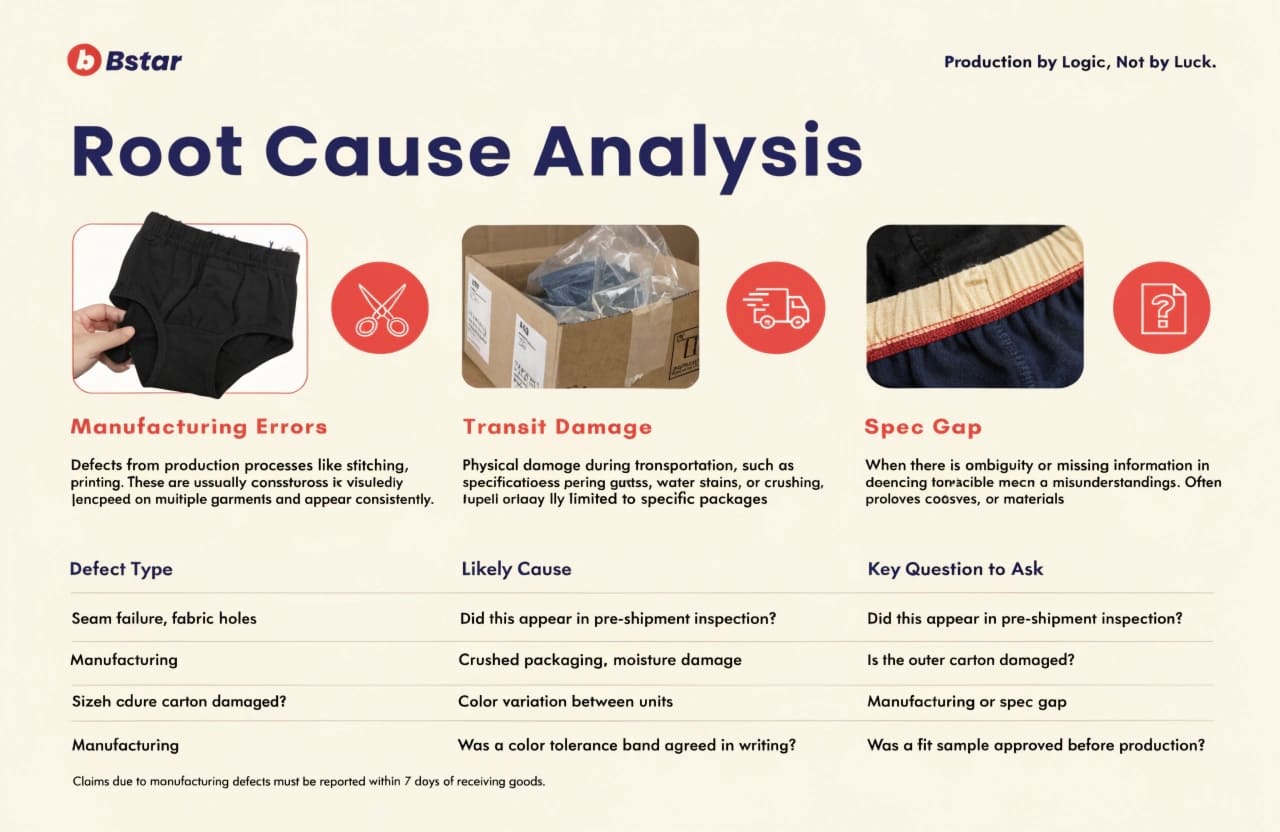
Defects fall into three categories: manufacturing errors (the factory’s responsibility), transit damage (a shipping or packaging issue), and spec gaps4 (a standard that was never agreed on). Identifying the category early changes your entire negotiation strategy — because each one requires a different response.
Size and Color Are the Two You’ll See Most
From the claims we review at BSTAR, size deviation and color or print shift are the two most frequent defect types5. They’re also the two most argued over. Here’s why.
Size issues almost always connect to one upstream decision: did you approve the pre-production fit sample? If you approved it, and the production units match that sample within the tolerance on your spec sheet, the factory has a strong defense6. If no fit sample was approved, or the tolerance was never written down, the dispute becomes a subjective argument about what "correct" looks like. That’s a difficult place to negotiate from.
Color and print shift follow the same logic. If your PO referenced a Pantone number or included a physical strike-off as the color standard, deviation from that standard is documentable7. If the color was described as "navy blue" with no physical reference, you’re arguing about perception. Suppliers will point to their approved strike-off; you’ll point to your expectation. Neither side wins cleanly.
Manufacturing vs. Transit: How to Tell the Difference
| Defect Type | Likely Cause | Key Question to Ask |
|---|---|---|
| Seam failure, fabric holes | Manufacturing | Did this appear in pre-shipment inspection? |
| Crushed packaging, moisture damage | Transit / warehouse | Is the outer carton damaged? |
| Color variation between units | Manufacturing (dye lot inconsistency) | Was a color tolerance band agreed in writing? |
| Size deviation across the batch | Manufacturing or spec gap | Was a fit sample approved before production? |
| Print misalignment | Manufacturing | Was a print placement guide included in the tech pack? |
This analysis is not about assigning blame to make yourself feel better. It’s about knowing which argument you can actually win.
Strategic Negotiation and Compensation: Executing Refunds, Replacements, or Future Order Credits Based on Defect Severity?
Once you have evidence and a clear root cause, you’re ready to negotiate. But the outcome you want and the outcome you can realistically get are often different things.
The resolution a supplier will accept depends on defect rate, production timeline, and their capacity to respond — not just on what the buyer requests. Understanding the supplier’s options makes your negotiation faster and more likely to reach a real outcome.
Here is how to think about each option.
Refund, Replacement, Credit, or Rework?
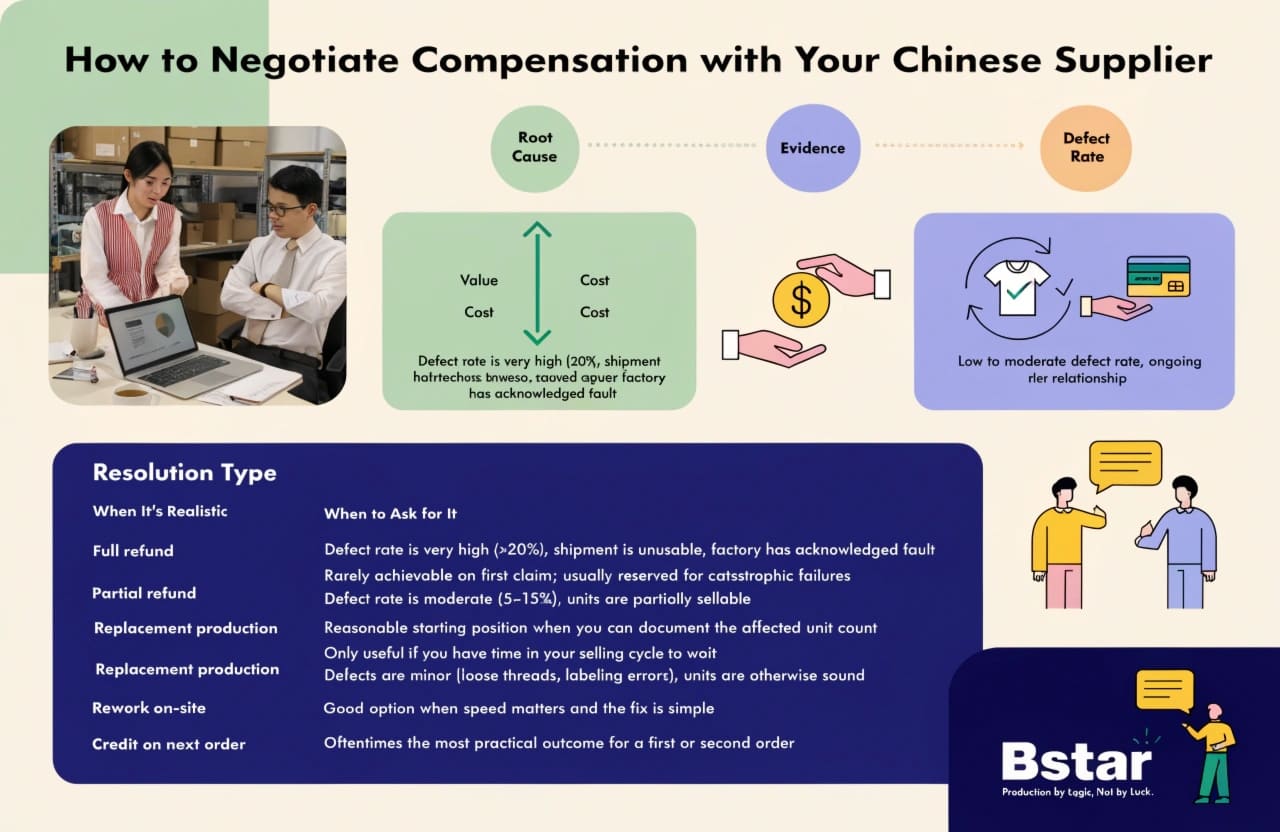
| Resolution Type | When It’s Realistic | When to Ask for It |
|---|---|---|
| Full refund | Defect rate is very high (>20%), shipment is unusable, factory has acknowledged fault | Rarely achievable on first claim; usually reserved for catastrophic failures |
| Partial refund | Defect rate is moderate (5–15%), units are partially sellable | Reasonable starting position when you can document the affected unit count |
| Replacement production | Defect rate is high but timeline allows it, factory confirms root cause is fixed | Only useful if you have time in your selling cycle to wait |
| Rework on-site | Defects are minor (loose threads, labeling errors), units are otherwise sound | Good option when speed matters and the fix is simple |
| Credit on next order | Low to moderate defect rate, ongoing supplier relationship | Often the most practical outcome for a first or second order |
One thing I’ll be direct about: most factories — including ours — will negotiate, not simply hand back your money. A full cash refund requires the factory to absorb a complete loss on labor, materials, and production time8. For a disputed claim where root cause isn’t clear-cut, that rarely happens without a long fight. A partial credit or discount on the next order is often the most recoverable outcome, and accepting it doesn’t mean you lost.
What matters more is documenting the resolution in writing, and using the experience to set tighter standards on the next order.
Preventative Quality Assurance: Implementing Strict Pre-Shipment Inspections and Clear Contractual Tolerances?
The most reliable way to handle defective goods is to catch them before they ship. That sounds obvious, but most DTC brands skip this step until after they’ve had a bad shipment9.
Pre-shipment inspection and written quality tolerances — set before production starts — are the two controls that make defect claims straightforward to resolve. Without them, every dispute becomes a negotiation about what the standard should have been, which no one wins cleanly.
What AQL Means for Small DTC Orders
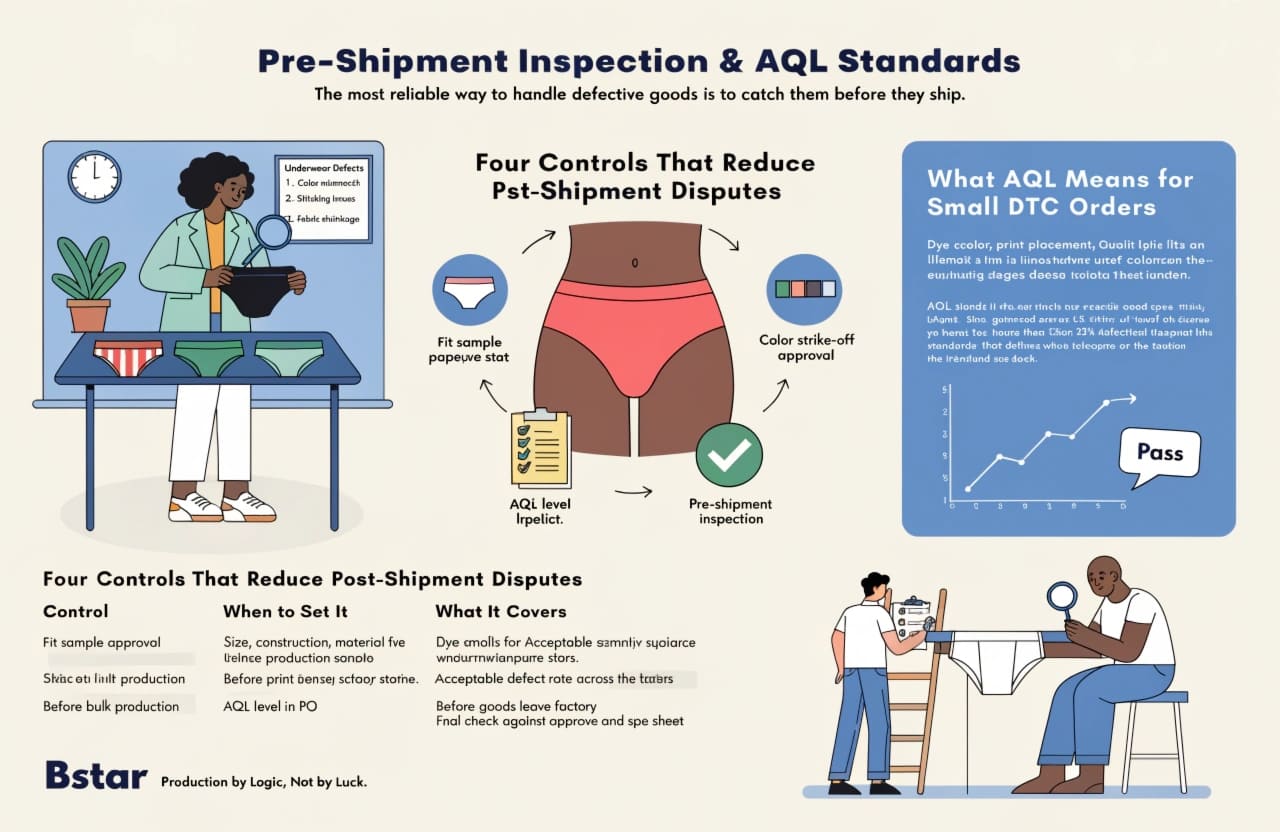
AQL stands for Acceptable Quality Limit. It’s an international sampling standard10 that defines what defect rate is tolerable across a batch. AQL 2.5 — which is commonly used in apparel — means that if random sampling finds more than 2.5% defective units, the shipment fails inspection11.
For small DTC orders, the practical implication is this: you need to agree on the AQL level with your supplier before production, and write it into your purchase order. If you don’t, the supplier will apply their own standard, which may be more lenient than yours.
The Four Controls That Reduce Post-Shipment Disputes
| Control | When to Set It | What It Covers |
|---|---|---|
| Fit sample approval | Before bulk production | Size, construction, material feel |
| Color strike-off approval | Before bulk production | Dye color, print placement, shade tolerance |
| AQL level in PO | Before production start | Acceptable defect rate across the batch |
| Pre-shipment inspection | Before goods leave factory | Final check against approved sample and spec sheet |
At BSTAR, we run six QC checkpoints from raw material intake through final packing. We do this because catching a problem at the fabric stage costs a fraction of what it costs to rework finished goods12 — or worse, lose a client. Not every factory operates this way, so when you’re evaluating a new supplier, ask them to walk you through their QC process specifically. Vague answers are a signal.
The honest truth is this: documentation and negotiation skills help you recover from a bad shipment. But the more durable fix is choosing a supplier whose quality process means you rarely need to use those skills.
Conclusion
Handle defect claims with evidence, not emotion. Set standards before production, document on arrival, and negotiate based on defect rate — not frustration. That’s what actually gets resolved.
-
"§ 2-602. Manner and Effect of Rightful Rejection. | US Law", https://www.law.cornell.edu/ucc/2/2-602. Under the Uniform Commercial Code § 2-607, a buyer who fails to notify the seller of a breach within a reasonable time after discovery is barred from any remedy; legal commentary generally treats prompt post-receipt inspection as foundational to preserving claims. Evidence role: mechanism; source type: education. Supports: That prompt notification of defects upon receipt is a legal and commercial requirement in goods disputes, and delay can weaken a buyer’s claim. Scope note: The UCC applies to U.S. domestic transactions; international trade disputes are typically governed by CISG or contract terms, which may set different notification standards ↩
-
"Know Your Incoterms – International Trade Administration", https://www.trade.gov/know-your-incoterms. Under Incoterms 2020 (ICC), risk of loss or damage to goods transfers from seller to buyer at a defined delivery point; this transfer of risk provides a contractual basis for suppliers to attribute post-transfer defects to handling, customs examination, or storage, underscoring the importance of condition documentation at the point of receipt. Evidence role: mechanism; source type: institution. Supports: That risk of damage or deterioration transfers between parties at defined points under international trade terms, and that post-transfer damage is a recognized defense in goods quality disputes. Scope note: Incoterms govern risk transfer but do not address quality defects originating in manufacturing; the defense is only applicable where the defect could plausibly have arisen after the risk transfer point ↩
-
"New York State Vehicle Safety/Emissions Inspection Program", https://dmv.ny.gov/new-york-state-vehicle-safetyemissions-inspection-program. Industry bodies such as the International Federation of Inspection Agencies (IFIA) note that accredited third-party inspection reports are widely accepted in trade dispute resolution as neutral evidence of goods condition at a defined point in time. Evidence role: expert_consensus; source type: institution. Supports: That independent third-party inspection findings are treated as more objective evidence in commercial quality disputes than buyer-conducted assessments. Scope note: Acceptance of third-party reports in negotiations is context-dependent and not uniformly mandated; their weight varies by contract terms and jurisdiction ↩
-
"Explaining the 3 Types of Quality Defects in Manufacturing (AQL …", https://www.hqts.com/aql-quality-defects/. Quality management literature, including frameworks derived from ISO 9000, distinguishes defect origins as process-related (manufacturing), handling-related (logistics), and design-related (specification); this classification underpins root cause analysis methodologies such as fishbone diagrams and FMEA. Evidence role: definition; source type: encyclopedia. Supports: That product defects in manufacturing supply chains are broadly classified by root cause origin, distinguishing production faults, handling damage, and design or specification failures. Scope note: Formal quality standards do not use the exact three-category framing presented; the taxonomy in the article is a practical simplification of broader root cause analysis frameworks ↩
-
"[PDF] A survey of standards for the U.S. Fiber/Textile/Apparel Industry", https://nvlpubs.nist.gov/nistpubs/Legacy/IR/nistir5823.pdf. Industry quality inspection reports and textile engineering literature consistently identify dimensional non-conformance and color variation as leading defect categories in apparel production, attributed to variability in cutting, sewing tolerances, and dye lot consistency across production runs. Evidence role: statistic; source type: research. Supports: That dimensional (size) and color deviations are among the most frequently reported defect categories in apparel manufacturing quality inspections. Scope note: Defect frequency rankings vary by product category, production region, and inspection methodology; no single authoritative dataset covers all apparel manufacturing contexts ↩
-
"Purchase Orders | Law School Services", https://finance-admin.law.columbia.edu/content/purchase-orders. In apparel manufacturing contracts, the approved pre-production or ‘golden’ sample functions as the agreed quality reference; legal and commercial practice treats buyer sign-off on this sample as acceptance of the defined standard, limiting subsequent claims to deviations from that approved reference rather than from an unarticulated expectation. Evidence role: mechanism; source type: education. Supports: That formal approval of a pre-production sample creates a documented quality baseline against which production conformance is measured, and that deviation from an approved sample is the standard basis for defect claims in apparel contracts. Scope note: The legal enforceability of sample approval as a contractual baseline depends on how the purchase order and any governing law define the quality standard; this note reflects common commercial practice rather than a universal legal rule ↩
-
"Pantone Color Systems – For Textiles", https://www.pantone.com/color-systems/for-textiles?srsltid=AfmBOooKgNfUpuY-YA7c9JCJhq8u3qjOVYKLK1SWgFpXz6WKiSU3POdh. Pantone LLC’s Matching System (PMS) is an industry-standard color communication tool widely used in textile and apparel manufacturing to specify colorways; its use in purchase orders provides a numeric reference that can be measured against physical output using spectrophotometry. Evidence role: mechanism; source type: institution. Supports: That the Pantone Matching System provides a standardized, reproducible color reference used in apparel manufacturing to define color specifications in production contracts. Scope note: Pantone references define a target color but do not themselves specify tolerance bands; enforceable deviation limits require additional contractual language defining acceptable Delta E or shade variation ↩
-
"The Effect of Negotiation Practices on the Relationship between …", https://direct.mit.edu/ngtn/article/22/1/47/122138/The-Effect-of-Negotiation-Practices-on-the. Research on buyer-supplier dispute resolution in global apparel supply chains indicates that negotiated partial remedies — including credits, rework, or price adjustments — are more common outcomes than full refunds, reflecting the shared cost exposure and ongoing relationship dynamics between parties. Evidence role: general_support; source type: research. Supports: That full monetary refunds are uncommon outcomes in manufacturing defect disputes due to the cost structure of production and the negotiated nature of supplier-buyer relationships. Scope note: Quantitative data on refund versus credit resolution rates in apparel manufacturing disputes is limited in published literature; this note reflects general supply chain negotiation research rather than apparel-specific statistics ↩
-
"[PDF] Brand Purchasing Practices and Labor Outcomes in Apparel and …", https://www.ilr.cornell.edu/sites/default/files-d8/2025-07/brand-purchasing-practices-gli-report.pdf. Research on small and medium enterprise sourcing practices in apparel supply chains suggests that formal quality assurance protocols, including pre-shipment inspection, are less consistently implemented among smaller buyers, who may lack the purchasing volume or supplier leverage to mandate third-party inspection. Evidence role: general_support; source type: research. Supports: That smaller or newer apparel brands frequently lack formal pre-shipment quality control processes, often implementing them reactively after experiencing quality failures. Scope note: Quantitative data specifically on DTC brand pre-shipment inspection adoption rates is limited; this note reflects general SME sourcing research rather than DTC-specific empirical findings ↩
-
"6.2.3.1. Choosing a Sampling Plan: MIL Standard 105D", https://www.itl.nist.gov/div898/handbook/pmc/section2/pmc231.htm. The Acceptable Quality Limit concept is formalized in ISO 2859-1:1999 (‘Sampling procedures for inspection by attributes — Part 1: Sampling schemes indexed by acceptance quality limit (AQL) for lot-by-lot inspection’), which superseded the U.S. military standard MIL-STD-105E and is recognized by national standards bodies worldwide. Evidence role: historical_context; source type: institution. Supports: That AQL is codified in ISO 2859-1, an internationally adopted standard for acceptance sampling by attributes, with origins in U.S. military standard MIL-STD-105. ↩
-
"[PDF] ISO 2859-1 – UNT Chemistry", https://chemistry.unt.edu/~tgolden/courses/iso2859-1.pdf. ISO 2859-1 (‘Sampling procedures for inspection by attributes’) establishes the statistical framework for AQL-based sampling; AQL 2.5 is frequently cited in apparel quality control literature as a standard threshold for general inspection levels. Evidence role: definition; source type: institution. Supports: That AQL 2.5 is a widely referenced acceptance quality limit in apparel and textile inspection, derived from ISO 2859-1 statistical sampling procedures. Scope note: ISO 2859-1 defines the sampling methodology but does not prescribe AQL 2.5 specifically for apparel; industry adoption of this level is conventional rather than formally mandated ↩
-
"[PDF] Managing Quality: Modeling the Cost of Quality Improvement", https://www.cameron.edu/storage/departments/business/Journals/Vol-12-Managing-Quality.pdf. The ‘rule of ten’ in quality management holds that the cost of correcting a defect multiplies by approximately a factor of ten at each successive stage of production; this principle, associated with quality economics literature including work by Juran and Crosby, supports early-stage inspection as a cost-reduction strategy. Evidence role: mechanism; source type: education. Supports: That the cost of correcting a defect increases substantially the later in the production process it is detected, a principle formalized in quality management as the ‘cost of quality’ or ‘rule of ten’. Scope note: The specific cost multiplier varies by industry and product type; the ‘rule of ten’ is a heuristic rather than a precisely measured ratio for apparel manufacturing specifically ↩