
Is Bamboo Viscose Really Eco-Friendly? The Truth for Brands
Brands are putting "bamboo" on their labels and calling it sustainable. But that claim might be costing them more than they think — in legal exposure and consumer trust.
Bamboo viscose can be a responsible fiber choice, but only if your supplier controls the chemical process and holds the right certifications. The bamboo plant itself does not make the final fabric eco-friendly. The manufacturing process does — and that part is invisible on most product tags.
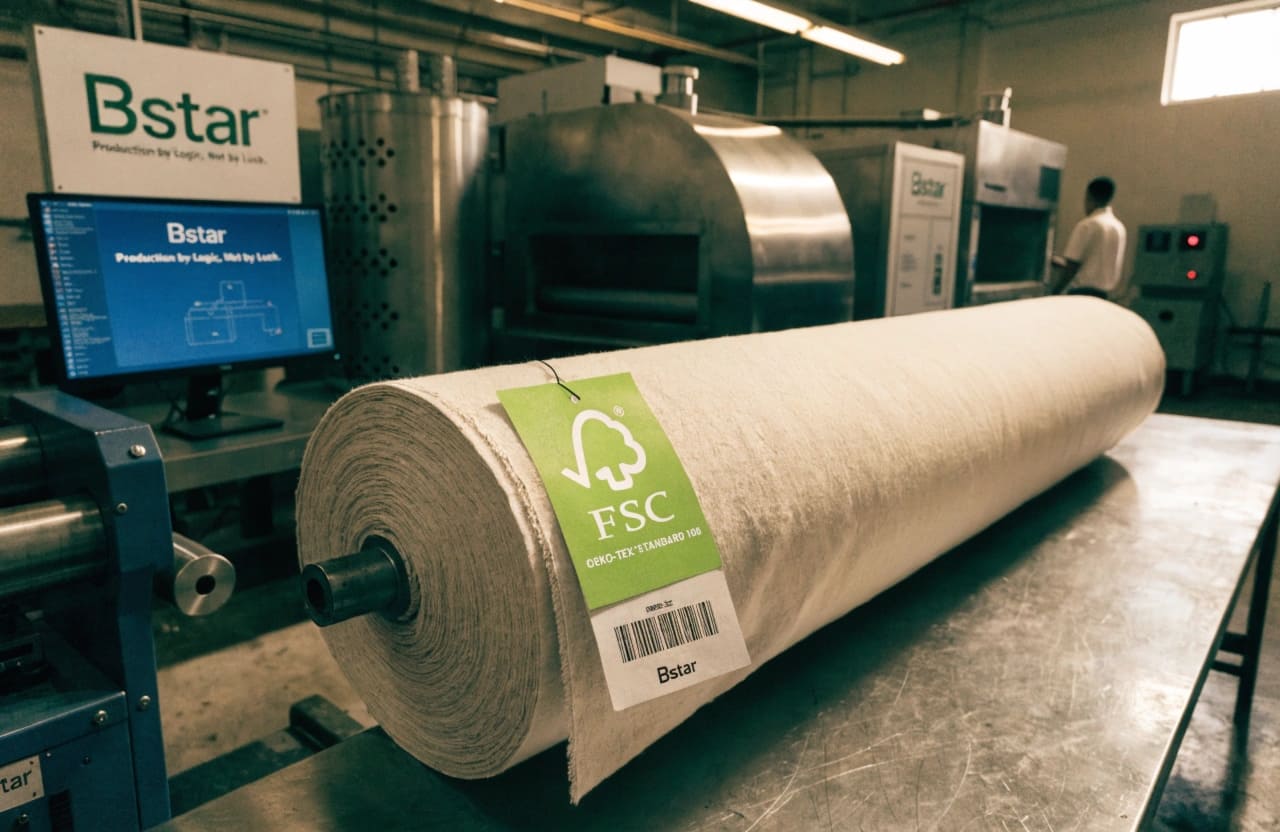
We’ve been sourcing and producing bamboo viscose knitwear at BSTAR for years. We hold FSC and OEKO-TEX® STANDARD 100 certifications on our yarn. And that supplier-side experience is exactly why I want to be direct with you: "bamboo" as a label does not automatically mean what most brands think it means. Let me break this down properly.
The Chemical Reality: Is the Viscose Process Actually Clean?
Most brands don’t know this, and it surprises them when they find out.
Bamboo viscose is made using the same heavy chemical process as regular wood-pulp viscose. The raw material is bamboo, yes — but the conversion from bamboo pulp to soft, wearable fiber requires solvents like carbon disulfide1. That’s the part the "bamboo" label doesn’t tell you.
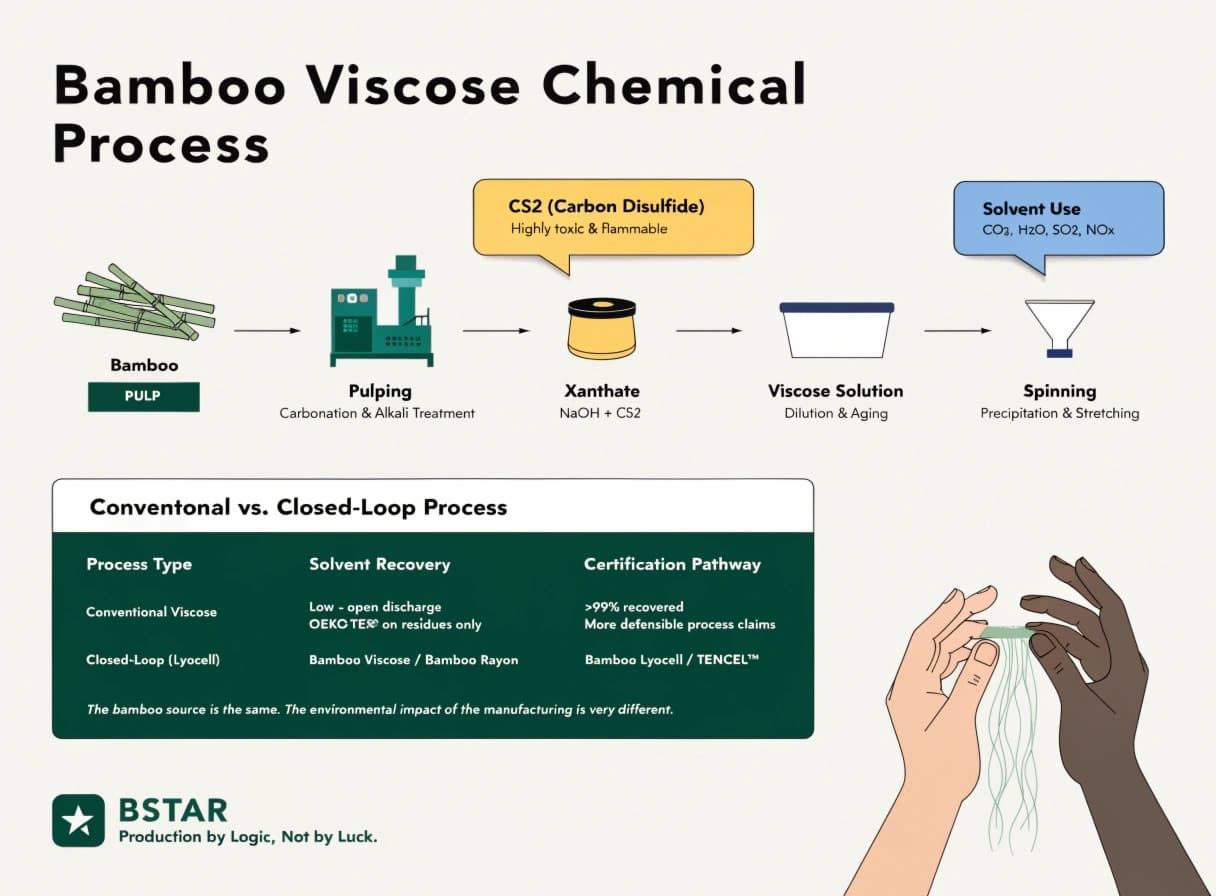
This is where brands need to stop and ask a real question. The bamboo plant is genuinely impressive as a raw material — it grows fast, needs no pesticides, and requires very little water2. But once you put bamboo pulp into a conventional viscose production line, those natural advantages get complicated by the chemistry involved.
The meaningful differentiator here is whether your supplier uses a closed-loop solvent recovery system. The Lyocell process — used in fibers like TENCEL™ — recovers more than 99% of its solvent in a closed loop3, which dramatically reduces chemical emissions. Conventional bamboo viscose does not use this process.
At BSTAR, our current production uses bamboo viscose, not bamboo Lyocell. I’m telling you this directly because I think that transparency is exactly what brands need from their suppliers. If process-level sustainability credentials are a priority for your product line, you should be asking your supplier a very specific question: Are you using a closed-loop manufacturing process, or a conventional viscose process?
Here’s a simple way to think about the difference:
| Process Type | Solvent Recovery | Certification Pathway | Common Fiber Name |
|---|---|---|---|
| Conventional Viscose | Low — open discharge | OEKO-TEX® on residues only | Bamboo Viscose / Bamboo Rayon |
| Closed-Loop (Lyocell) | >99% recovered | More defensible process claims | Bamboo Lyocell / TENCEL™ |
The bamboo source is the same. The environmental impact of the manufacturing is very different. Your marketing copy needs to reflect which one you’re actually selling.
Greenwashing vs. Genuine Sustainability: What Do the Certifications Actually Cover?
Here’s something I see brands get wrong all the time — and it’s a real liability.
FSC and OEKO-TEX® STANDARD 100 are legitimate, respected certifications. But they each cover a specific, limited scope. Using either one to make a broad "eco-friendly" claim is inaccurate — and in some markets, it’s already illegal.
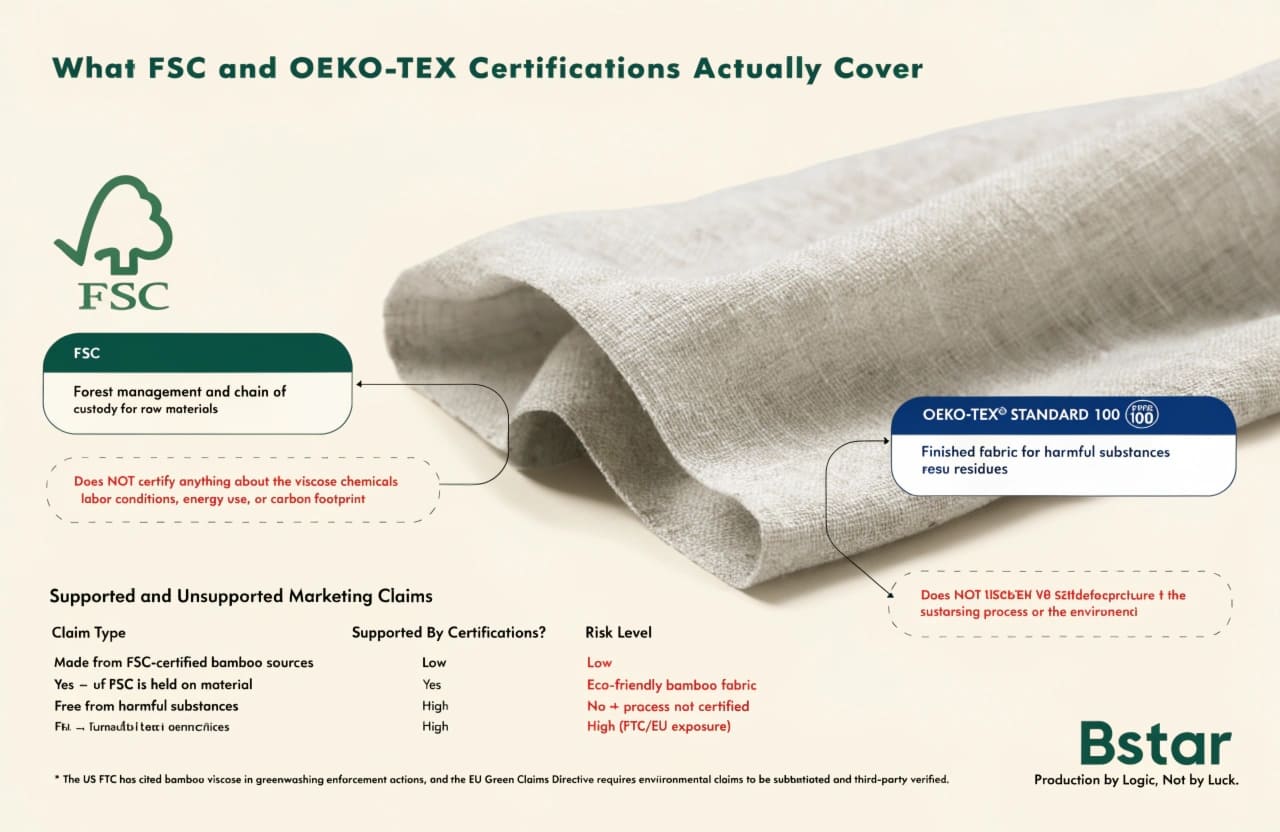
Let me tell you exactly what our certifications cover at BSTAR — because I think this is more useful than a general explanation.
Our FSC certification covers forest management and chain of custody for the raw material source. It tells you that the bamboo or wood pulp we source comes from responsibly managed forests. It does not certify anything about the viscose chemical process, labor conditions, energy use, or carbon footprint.
Our OEKO-TEX® STANDARD 100 certification covers the finished fabric for harmful substance residues. It tells you that the yarn we produce has been tested and meets safety thresholds for chemicals that could harm the end user. It does not certify the sustainability of the manufacturing process or the environmental impact of production.
Holding both is better than holding neither. And we do hold both. But I would never tell a brand that these two certifications together authorize a "fully eco" or "100% sustainable" marketing claim — because they don’t.
Here’s a quick reference for what to say and what to avoid:
| Claim Type | Supported By Certifications? | Risk Level |
|---|---|---|
| "Made from FSC-certified bamboo sources" | Yes — if FSC is held on material | Low |
| "Free from harmful substances" | Yes — if OEKO-TEX® STANDARD 100 is held | Low |
| "Eco-friendly bamboo fabric" | No — process not certified | High (FTC/EU exposure) |
| "Natural bamboo fiber" | No — viscose is a chemically processed fiber | High |
| "Sustainable closed-loop manufacturing" | Only if Lyocell process is verified | Depends on supplier |
The US FTC has specifically cited bamboo viscose in greenwashing enforcement actions4 — [writer to verify specific case references before publishing]. The EU Green Claims Directive, which is coming into force, requires environmental claims to be substantiated and third-party verified5. If you’re selling into EU or US markets, this is not a tone-of-voice question. It’s a compliance question.
The Lifecycle Assessment: Is Bamboo Still Better Than Cotton Overall?
Even with the chemistry in the picture, is bamboo still a better choice than traditional cotton? The honest answer is: it depends on how you measure it.
Bamboo as a plant uses significantly less water than conventional cotton and grows without pesticides. But lifecycle impact depends on what happens after harvest. The chemical conversion process can offset some of those upstream advantages if solvent management is poor.
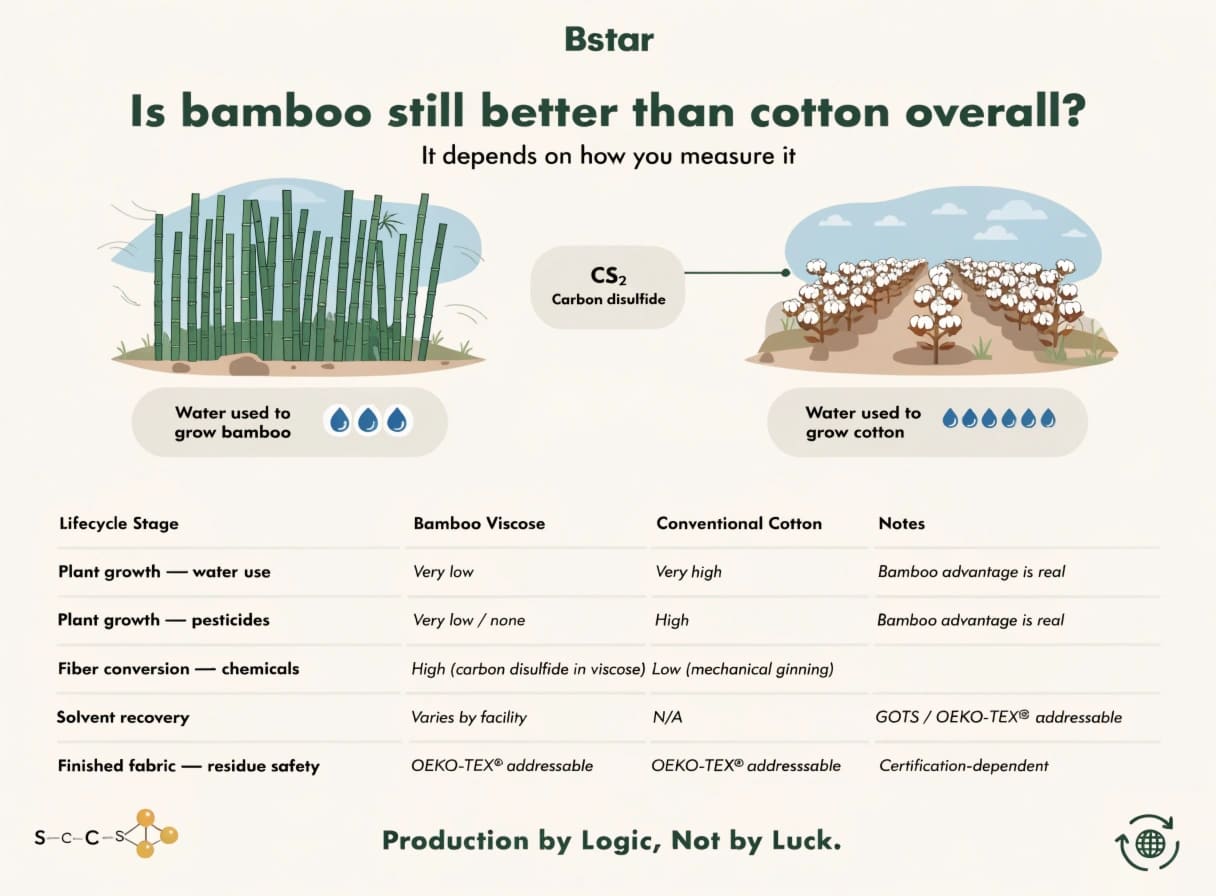
In our sourcing experience, bamboo viscose still comes out ahead of conventional cotton on several important dimensions — particularly water consumption and pesticide use at the raw material stage6. That’s real. The bamboo plant genuinely earns those claims.
The problem is that most brands stop the comparison there. They put "bamboo" on the label and treat the rest of the supply chain as a black box. A full picture requires asking what happens inside that box.
| Lifecycle Stage | Bamboo Viscose | Conventional Cotton | Notes |
|---|---|---|---|
| Plant growth — water use | Very low | Very high | Bamboo advantage is real |
| Plant growth — pesticides | Very low / none | High | Bamboo advantage is real |
| Fiber conversion — chemicals | High (carbon disulfide7 in viscose) | Low (mechanical ginning) | Cotton advantage here |
| Solvent recovery | Varies by facility | N/A | Key variable for bamboo |
| Finished fabric — residue safety | OEKO-TEX® addressable | GOTS / OEKO-TEX® addressable | Certification-dependent |
The takeaway is not that bamboo is bad. It’s that the comparison is more nuanced than a hang tag can communicate. Brands that understand this nuance can make more defensible claims — and avoid the ones that get them into trouble.
Strategic Sourcing for Brands: How to Ask the Right Questions
So what does this mean for you as a brand building a product line around bamboo?
The brands that get this right are not the ones with the best marketing copy. They’re the ones who asked their supplier specific questions before writing a single word of sustainability messaging.
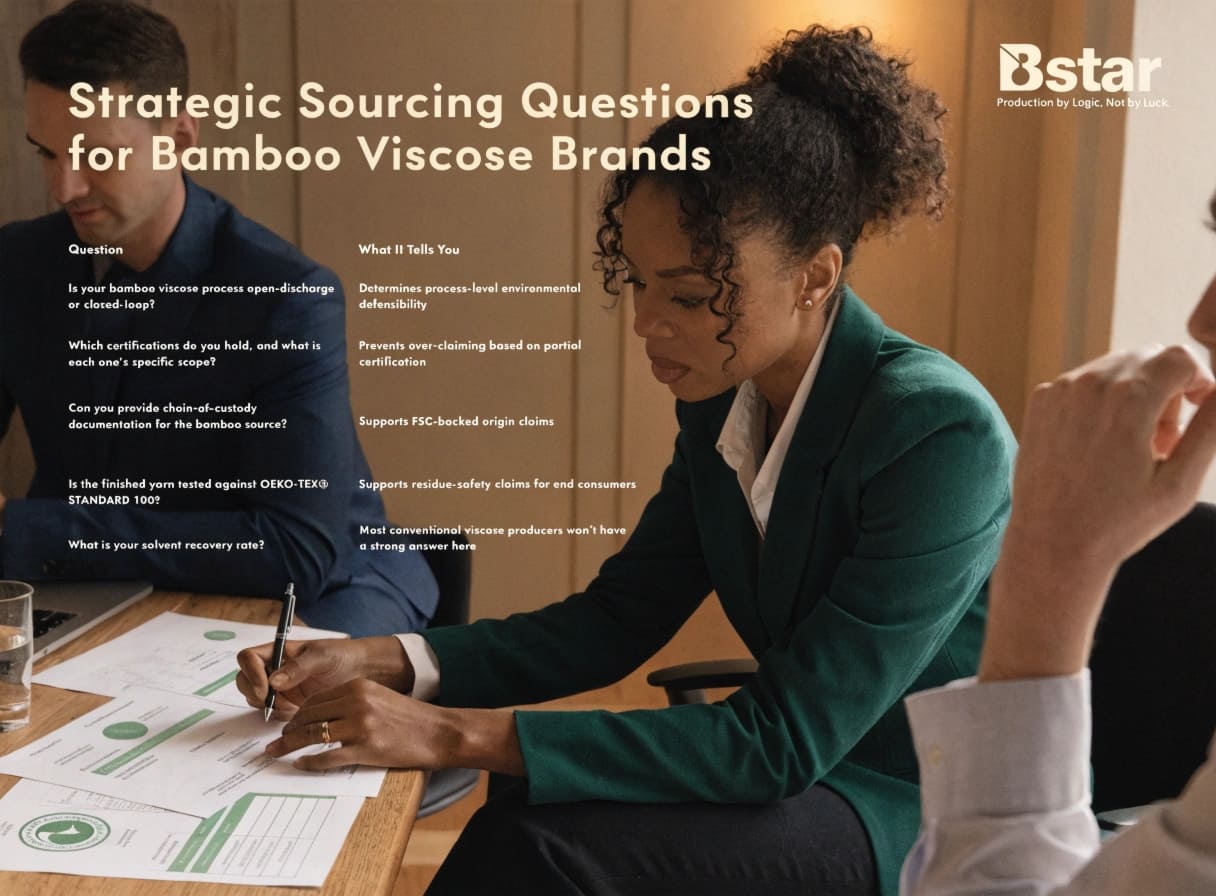
In conversations with brands we work with at BSTAR, the ones who come in with informed questions always end up in a better position — both for compliance and for authentic storytelling. Here are the questions that actually matter:
Questions to ask your supplier:
| Question | What It Tells You |
|---|---|
| Is your bamboo viscose process open-discharge or closed-loop? | Determines process-level environmental defensibility |
| Which certifications do you hold, and what is each one’s specific scope? | Prevents over-claiming based on partial certification |
| Can you provide chain-of-custody documentation for the bamboo source? | Supports FSC-backed origin claims |
| Is the finished yarn tested against OEKO-TEX® STANDARD 100? | Supports residue-safety claims for end consumers |
| What is your solvent recovery rate? | Most conventional viscose producers won’t have a strong answer here |
Once you have honest answers to these questions, you can build marketing claims that match what you can actually prove. "Made from FSC-certified bamboo sources, tested to OEKO-TEX® STANDARD 100" is a clean, defensible claim. "Eco-friendly bamboo fabric" is not.
Brands we work with in the EU and North America are already moving toward this kind of specific, substantiated language. The ones who get ahead of it now will have a real advantage when regulations tighten further — which they will.
Conclusion
Bamboo viscose can be a responsible choice for your brand — but only if you understand exactly what the certifications cover, what the chemistry involves, and what you can honestly claim to your customers.
-
"Rayon – Wikipedia", https://en.wikipedia.org/wiki/Rayon. The conventional viscose process involves dissolving cellulose xanthate using carbon disulfide, a toxic solvent associated with occupational health risks and environmental emissions; this chemistry applies regardless of whether the cellulose feedstock is wood pulp or bamboo. Evidence role: mechanism; source type: encyclopedia. Supports: That carbon disulfide is a key solvent in the conventional viscose/rayon production process. Scope note: Sources describing the viscose process typically reference wood-pulp feedstock; the extension to bamboo feedstock is chemically equivalent but may not be explicitly stated in general references. ↩
-
"Bamboo for the Future: From Traditional Use to Industry 5.0 … – PMC", https://pmc.ncbi.nlm.nih.gov/articles/PMC12526147/. Agronomic literature and FAO reports on bamboo cultivation describe the plant as fast-growing, capable of regenerating without replanting, and typically cultivated without synthetic pesticides, though water use figures vary by species and region. Evidence role: general_support; source type: institution. Supports: That bamboo has low water requirements, grows rapidly, and generally does not require pesticide application. Scope note: Agronomic properties differ across bamboo species and growing regions; blanket comparisons to cotton should reference specific species and geographic contexts for full accuracy. ↩
-
"Regenerated cellulose by the Lyocell process, a brief review of the …", https://bioresources.cnr.ncsu.edu/resources/regenerated-cellulose-by-the-lyocell-process-a-brief-review-of-the-process-and-properties/. Published lifecycle assessments and process descriptions of the Lyocell (NMMO) process report solvent recovery rates exceeding 99%, a figure cited in contrast to the open-discharge characteristics of conventional viscose production. Evidence role: statistic; source type: research. Supports: That the Lyocell process recovers approximately 99% or more of its N-methylmorpholine N-oxide solvent in a closed-loop system. Scope note: Recovery rates may vary by facility and production vintage; the 99%+ figure reflects optimized industrial conditions and should be verified against current manufacturer or third-party LCA data. ↩
-
"Bamboo Textiles – Federal Trade Commission", https://www.ftc.gov/bamboo-textiles. The FTC has brought multiple enforcement actions against retailers and manufacturers for labeling bamboo viscose products as ‘bamboo’ or making unsubstantiated environmental claims, resulting in consent orders and civil penalties; these actions are documented in FTC press releases and complaint filings. Evidence role: case_reference; source type: government. Supports: That the FTC has pursued enforcement actions against companies making misleading bamboo fiber marketing claims. Scope note: Specific case details, respondent names, and penalty amounts should be verified directly against FTC public records, as enforcement history continues to evolve. ↩
-
"Green claims – Environment – European Commission", https://environment.ec.europa.eu/topics/circular-economy-topics/green-claims_en. The European Commission’s proposed Green Claims Directive (COM/2023/166) establishes requirements for pre-approval substantiation of explicit environmental claims and mandates third-party verification before such claims are communicated to consumers in EU markets. Evidence role: definition; source type: government. Supports: That the EU Green Claims Directive mandates substantiation and third-party verification of explicit environmental claims made to consumers. Scope note: As of the article’s writing, the directive was still progressing through the legislative process; final adopted text and transposition deadlines should be confirmed against the Official Journal of the European Union. ↩
-
"Self-reported health effects of pesticides among cotton farmers from …", https://pmc.ncbi.nlm.nih.gov/articles/PMC10522852/. Lifecycle assessment studies comparing natural and semi-synthetic fiber crops consistently identify conventional cotton as among the most water- and pesticide-intensive agricultural commodities, while bamboo cultivation is associated with significantly lower inputs at the agricultural stage, though full lifecycle comparisons must account for downstream processing impacts. Evidence role: statistic; source type: research. Supports: That conventional cotton cultivation requires substantially more water and pesticide inputs than bamboo cultivation at the raw material stage. Scope note: Comparative LCA results vary depending on system boundaries, geographic scope, and allocation methods; raw material stage advantages for bamboo may be partially or fully offset by chemical processing impacts depending on the methodology used. ↩
-
"A review of health effects of carbon disulfide in viscose industry and …", https://pubmed.ncbi.nlm.nih.gov/19852562/. Carbon disulfide is classified as a hazardous substance by regulatory agencies including the US EPA and OSHA; occupational exposure in viscose manufacturing has been associated with neurological, cardiovascular, and reproductive health effects, and atmospheric emissions contribute to environmental concerns at production facilities. Evidence role: mechanism; source type: government. Supports: That carbon disulfide is a hazardous substance with documented occupational health risks and environmental concerns relevant to its use in viscose manufacturing. ↩