
Subscription Box Underwear: Sourcing Strategies for Recurring Revenue
Most founders pick a supplier the same way they’d buy wholesale. That’s the mistake. Subscription boxes don’t run on sell-through — they run on a clock.
Sourcing for a subscription underwear box is a recurring-revenue risk problem, not a procurement problem. The right supplier needs to deliver consistent quality, small-batch flexibility, and fast sampling — month after month — or your churn rate will tell you what your supplier couldn’t.
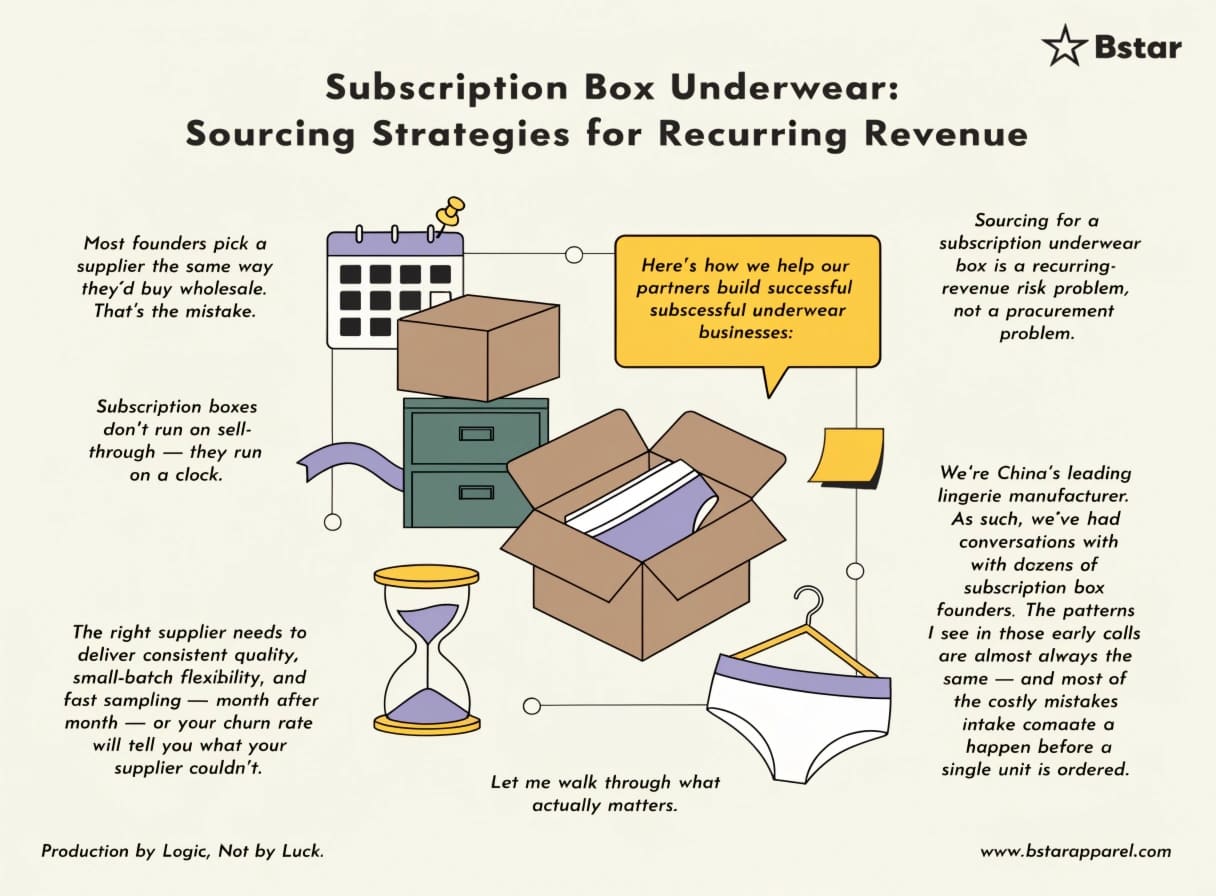
I work on the manufacturer side at BSTAR. We’ve had intake conversations with dozens of subscription box founders. The patterns I see in those early calls are almost always the same — and most of the costly mistakes happen before a single unit is ordered. Let me walk through what actually matters.
Defining the Model: Does Your Supplier Even Fit Your Subscription Tier?
Most founders ask the wrong first question. They open with "what’s your MOQ?" when the question they actually need to answer is "can you deliver 500 units of a new colorway in three weeks, every month?"
Those are not the same question.
Subscription underwear boxes fall into three broad tiers — replenishment, discovery, and exclusive. Each one puts different pressure on your supply chain. Matching your supplier’s capabilities to your tier is the first sourcing decision you need to make, and most founders skip it.
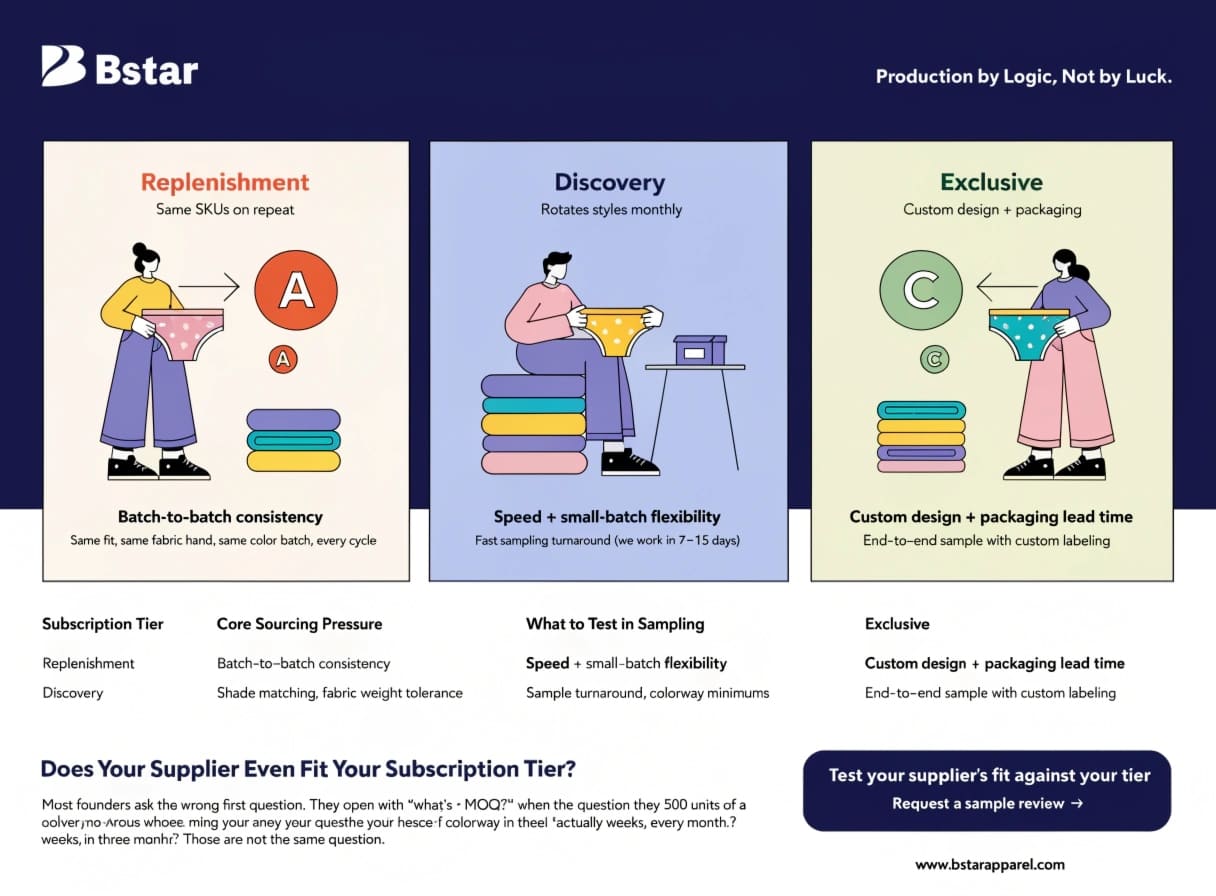
Here’s why the tier matters so much at the sourcing stage. A replenishment model ships the same SKUs on repeat. That looks easy, but it demands near-perfect consistency — same fit, same fabric hand, same color batch, every cycle. A discovery model rotates styles monthly, which means your supplier needs fast sampling turnaround (we work in 7–15 days) and real small-batch agility. An exclusive tier adds custom design and packaging to the equation, which pushes sampling complexity even higher.
| Subscription Tier | Core Sourcing Pressure | What to Test in Sampling |
|---|---|---|
| Replenishment | Batch-to-batch consistency | Shade matching, fabric weight tolerance |
| Discovery | Speed + small-batch flexibility | Sample turnaround, colorway minimums |
| Exclusive | Custom design + packaging lead time | End-to-end sample with custom labeling |
When a founder mismatches their tier to their supplier’s strengths, the failure usually shows up around month three or four1. Either inventory piles up from over-ordering to meet MOQs, or a new style arrives two weeks late and fulfillment misses the ship date. Both outcomes cost subscribers. The fix isn’t operational — it’s a sourcing fix that should have happened before the first order.
Agile Supply Chain Management: Can Your Supplier Actually Keep Up?
Speed is not the same as rushing. A supplier who can do fast production once isn’t the same as one who’s built for recurring cadences.
Here’s what we hear from subscription brands after a bad first supplier experience: "They were fine for the first order. Then month two fell apart." That’s almost always a flexibility problem, not a quality problem.
For subscription underwear brands, supply chain agility means three things: consistent sampling speed, small-batch production capability, and responsive communication. If your supplier is slow on any one of these, your monthly cadence breaks — and broken cadences kill subscriber trust2.
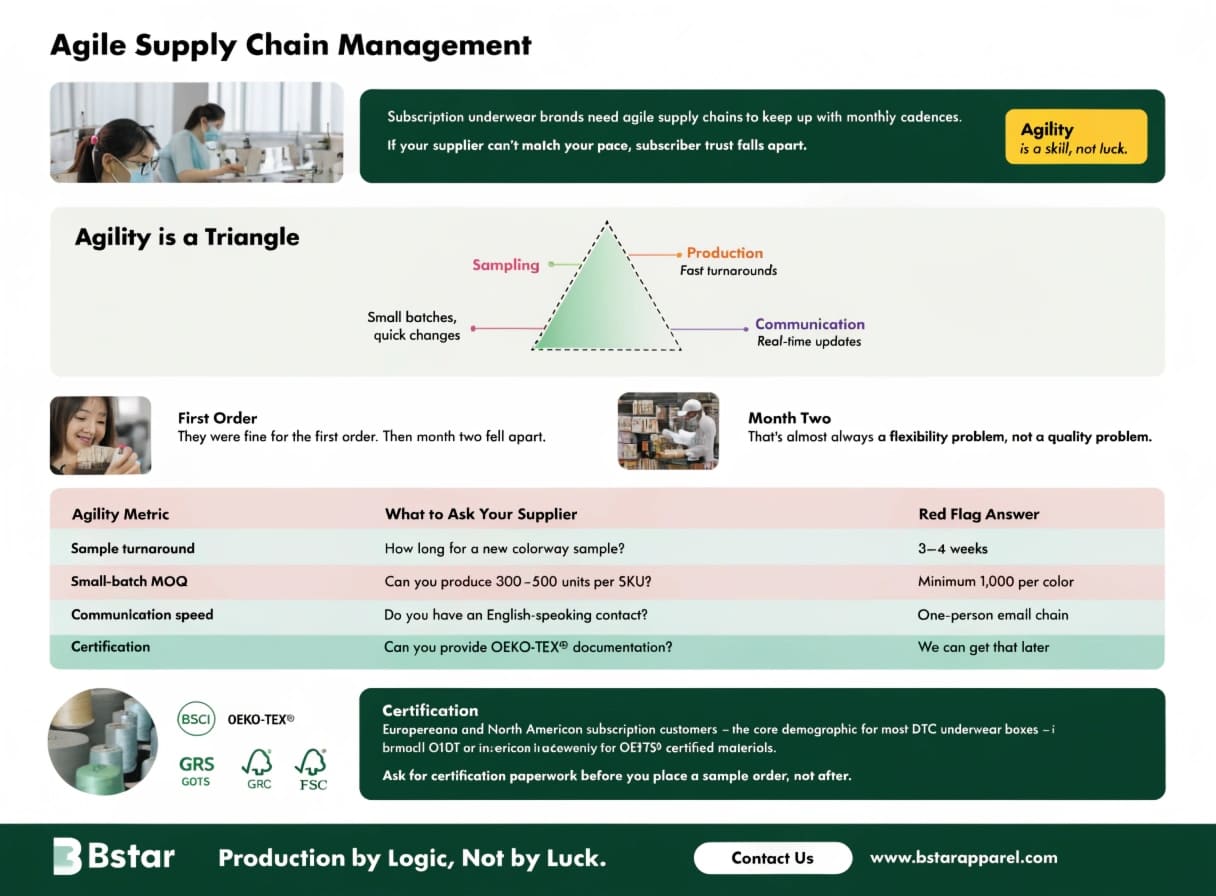
The certifications question also lives here, and founders get this wrong more often than I expect. European and North American subscription customers — the core demographic for most DTC underwear boxes — increasingly expect OEKO-TEX® or GOTS-certified materials3. Discovering a compliance gap after you’ve already onboarded subscribers is far more expensive than checking documentation before you sample. Ask for certification paperwork before you place a sample order, not after.
At BSTAR, we hold BSCI certification, and our materials are backed by OEKO-TEX®4, GOTS5, GRS, and FSC documentation. I’m not saying that to sell you — I’m saying it because we’ve watched founders get burned by skipping this check. Certified materials are non-negotiable for subscriber-facing brands in regulated markets.
| Agility Metric | What to Ask Your Supplier | Red Flag Answer |
|---|---|---|
| Sample turnaround | How long for a new colorway sample? | "3–4 weeks" |
| Small-batch MOQ | Can you produce 300–500 units per SKU? | "Minimum 1,000 per color" |
| Communication speed | Do you have an English-speaking contact? | One-person email chain |
| Certification | Can you provide OEKO-TEX® documentation? | "We can get that later" |
One thing I’ll add here: unit price is the wrong primary filter when you’re building a subscription business. The cheapest-per-unit supplier rarely has the infrastructure to flex with you month after month. What you’re actually buying is consistency and responsiveness. Those things cost something — and they’re worth it.
Curating the Unboxing Experience: Packaging Is Part of the Product
I’ll be direct about this one. Most subscription box cancellations that founders blame on product quality are actually caused by perceived value at the moment of opening.
The underwear was fine. The box felt cheap. The subscriber cancelled.
Unboxing experience directly affects subscription retention. Folding presentation, tissue wrap, custom poly bags, and inserts are not packaging extras — they are part of the product your subscriber is paying for every month. Founders who treat packaging as an afterthought consistently see cancellations spike after the first two to three months.
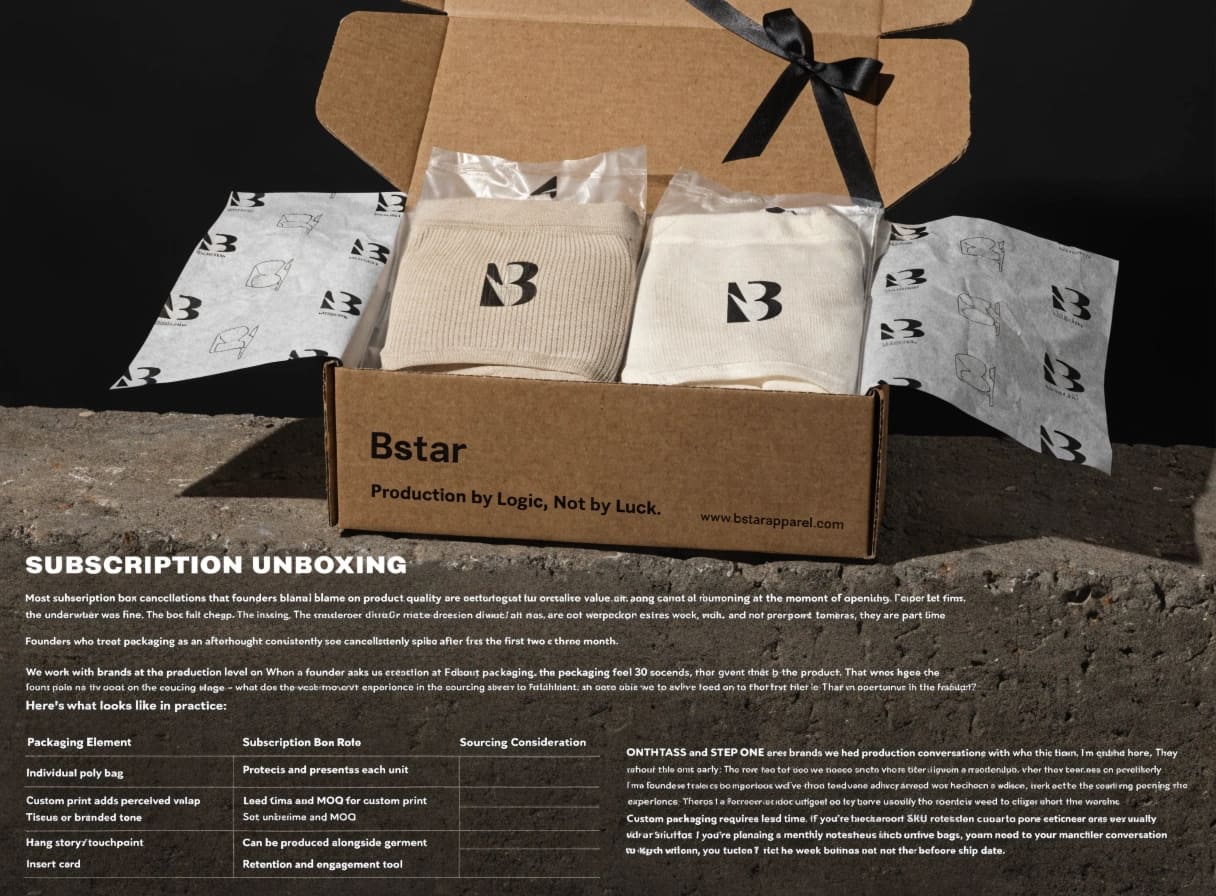
We work with brands at the production level on this. When a founder asks us about packaging, the question they actually need to answer is: what does the subscriber feel in the first 30 seconds? That experience needs to be designed at the sourcing stage, not bolted on at fulfillment.
Here’s what that looks like in practice:
| Packaging Element | Subscription Box Role | Sourcing Consideration |
|---|---|---|
| Individual poly bag | Protects and presents each unit | Custom print adds perceived value |
| Tissue or branded wrap | Sets unboxing tone | Lead time and MOQ for custom print |
| Hang tag or care card | Brand story touchpoint | Can be produced alongside garment |
| Insert card | Retention and engagement tool | Separate print run, plan ahead |
The brands we work with who think about this early — ONTHATASS and STEP ONE are two who have been in our production conversations — tend to move faster on subscriber retention. I’m not inventing outcomes here. I’m saying the founders who ask about packaging in the first supplier conversation are usually the ones who’ve already thought through the subscriber experience. That mindset changes what they prioritize in sourcing.
Custom packaging requires lead time. If you’re planning a monthly SKU rotation with custom printed bags, you need to be talking to your manufacturer about that at least six to eight weeks out — not the week before ship date.
Data-Driven Production: Subscriber Feedback Should Drive Your Purchase Orders
Most founders are sitting on more useful production data than they realize. They’re just not using it to talk to their manufacturer.
Subscriber feedback — sizing complaints, color requests, fabric preferences — is direct demand signal. If you’re not routing that data back into your purchase orders and sampling conversations, you’re managing inventory by instinct.
Subscriber data should drive your monthly production decisions. Size distribution, colorway performance, and cancellation feedback all contain signals that help you minimize dead inventory and reduce waste. A manufacturer who can respond to that data quickly is worth more than one who simply offers the lowest unit cost.
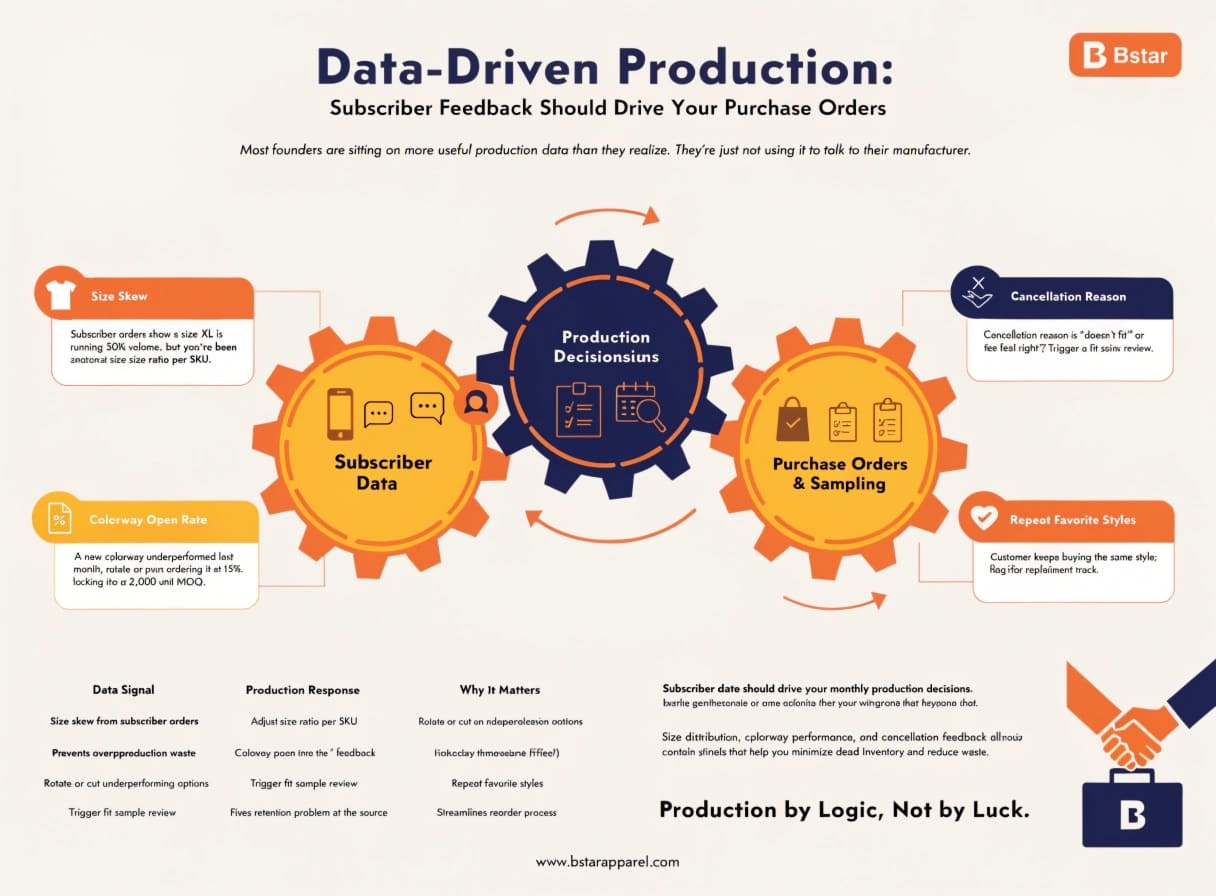
Here’s how that works at the sourcing level. If your subscriber data tells you that size XL is running 30% of volume but you’ve been ordering it at 15%, that’s a stockout risk on your best-converting size6. If a new colorway underperformed last month, you don’t want to be locked into a 2,000-unit MOQ for a repeat run.
This is where small-batch flexibility becomes a competitive advantage, not just a convenience.
| Data Signal | Production Response | Why It Matters |
|---|---|---|
| Size skew from subscriber orders | Adjust size ratio per SKU | Prevents stockouts and dead inventory |
| Colorway open rate / feedback | Rotate or cut underperforming options | Reduces overproduction waste |
| Cancellation reason (fit/feel) | Trigger fit sample review | Fixes retention problem at the source |
| Repeat favorite styles | Flag for replenishment track | Streamlines reorder process |
When founders bring this kind of data into our conversations, the production planning gets sharper. We can adjust size ratios, plan colorway rotations further out, and reduce the guesswork on monthly minimums. That’s what a working supplier relationship looks like for a subscription business — not just order-and-deliver, but a feedback loop that runs both ways.
Conclusion
Subscription underwear sourcing is about recurring reliability, not one-time price. Match your supplier to your tier, verify certifications early, build packaging into your sourcing plan, and let subscriber data drive your POs.
-
"hey guys, what ever happened to subscription boxes? : r/Entrepreneur", https://www.reddit.com/r/Entrepreneur/comments/ly489w/hey_guys_what_ever_happened_to_subscription_boxes/. Research on subscription commerce churn indicates that subscriber attrition is highest in the early months of a subscription lifecycle, suggesting that operational failures surface quickly after launch; see Zuora, ‘Subscription Economy Index’ reports for longitudinal churn data. Evidence role: statistic; source type: research. Supports: That subscription businesses commonly experience operational or retention failures within the first several months of launch. Scope note: Available industry reports measure subscriber churn rather than supply chain failure specifically; the three-to-four month figure cited in the article is not directly corroborated by published data. ↩
-
"Purchasing in the digital age: A meta-analytical perspective on trust …", https://pmc.ncbi.nlm.nih.gov/articles/PMC11044045/. Consumer research on subscription services indicates that delivery reliability and consistency are among the primary factors influencing subscriber retention decisions; see Baxter, R., ‘Understanding the subscription business model’ and related consumer expectation studies in the Journal of Service Management. Evidence role: mechanism; source type: research. Supports: That fulfillment reliability is a significant driver of subscriber retention and that delays increase cancellation probability. Scope note: Published studies address delivery reliability broadly across subscription categories; apparel-specific or underwear-specific data is not available in the open literature. ↩
-
"How perceived sustainability influences consumers’ clothing … – PMC", https://pmc.ncbi.nlm.nih.gov/articles/PMC11576948/. Surveys conducted by the OEKO-TEX Association and third-party market research firms indicate growing consumer awareness of textile certification standards in European and North American markets, with a measurable share of respondents reporting that certifications influence purchase decisions; see OEKO-TEX, ‘Mind the Gap’ consumer survey series. Evidence role: statistic; source type: institution. Supports: That consumers in Western markets are increasingly prioritizing certified sustainable materials when purchasing apparel. Scope note: Available survey data covers apparel consumers broadly and is not disaggregated by subscription commerce channel or underwear category specifically. ↩
-
"Oeko-Tex – Wikipedia", https://en.wikipedia.org/wiki/Oeko-Tex. OEKO-TEX® Standard 100 is an independent testing and certification system for textile products administered by the OEKO-TEX Association, verifying that every component of a certified article has been tested for harmful substances; see OEKO-TEX Association, oeko-tex.com/en/our-standards/oeko-tex-standard-100. Evidence role: definition; source type: institution. Supports: That OEKO-TEX® Standard 100 is an internationally recognized certification testing textiles for harmful substances. ↩
-
"GOTS – Wikipedia", https://en.wikipedia.org/wiki/GOTS. The Global Organic Textile Standard (GOTS) is administered by four international organizations and sets requirements for the organic status of textiles, including ecological and social criteria at all processing stages; see Global Standard gGmbH, global-standard.org. Evidence role: definition; source type: institution. Supports: That GOTS is a globally recognized standard covering both environmental and social criteria across the organic textile supply chain. ↩
-
"[PDF] In-store apparel shopping behavior in relation to stockouts by …", https://behost.lib.iastate.edu/DR/Song_ISU-1996-S65.pdf. Research on apparel inventory management demonstrates that size assortment misalignment is a primary driver of lost sales and markdown costs, with stockouts in high-demand sizes disproportionately affecting revenue; see Caro, F. & Gallien, J., ‘Inventory Management of a Fast-Fashion Retail Network,’ Operations Research (2010). Evidence role: mechanism; source type: paper. Supports: That inaccurate size ratio planning in apparel leads to stockouts that reduce sales and customer satisfaction. Scope note: Caro and Gallien’s study focuses on fast-fashion retail replenishment rather than subscription commerce, so the magnitude of stockout effects may differ in a subscription context. ↩