
Gender-Neutral Underwear Design: What Are the Real Trends and Sizing Challenges?
Brands keep asking about gender-neutral underwear. But most of them hit a wall the moment they get to sampling — and it is almost never a branding problem.
Gender-neutral underwear is a structural redesign challenge. The existing male and female sizing frameworks cannot simply be merged. Waistband height, gusset geometry, and stretch tolerance each require specific decisions before the product can fit across body types. Changing the label is not enough.
There is real demand for this category. I hear it from buyers every month. But demand does not mean the product is easy to build. The brands that launch successfully are the ones who understand what they are actually committing to before they place a sampling order. Let me walk through what that really looks like.
Beyond the Binary: Is the Cultural Shift Actually Driving Real Product Demand?
I get inquiries for unisex briefs and boxers every week. The buyers are serious. They have done their market research, and they believe the category is growing.
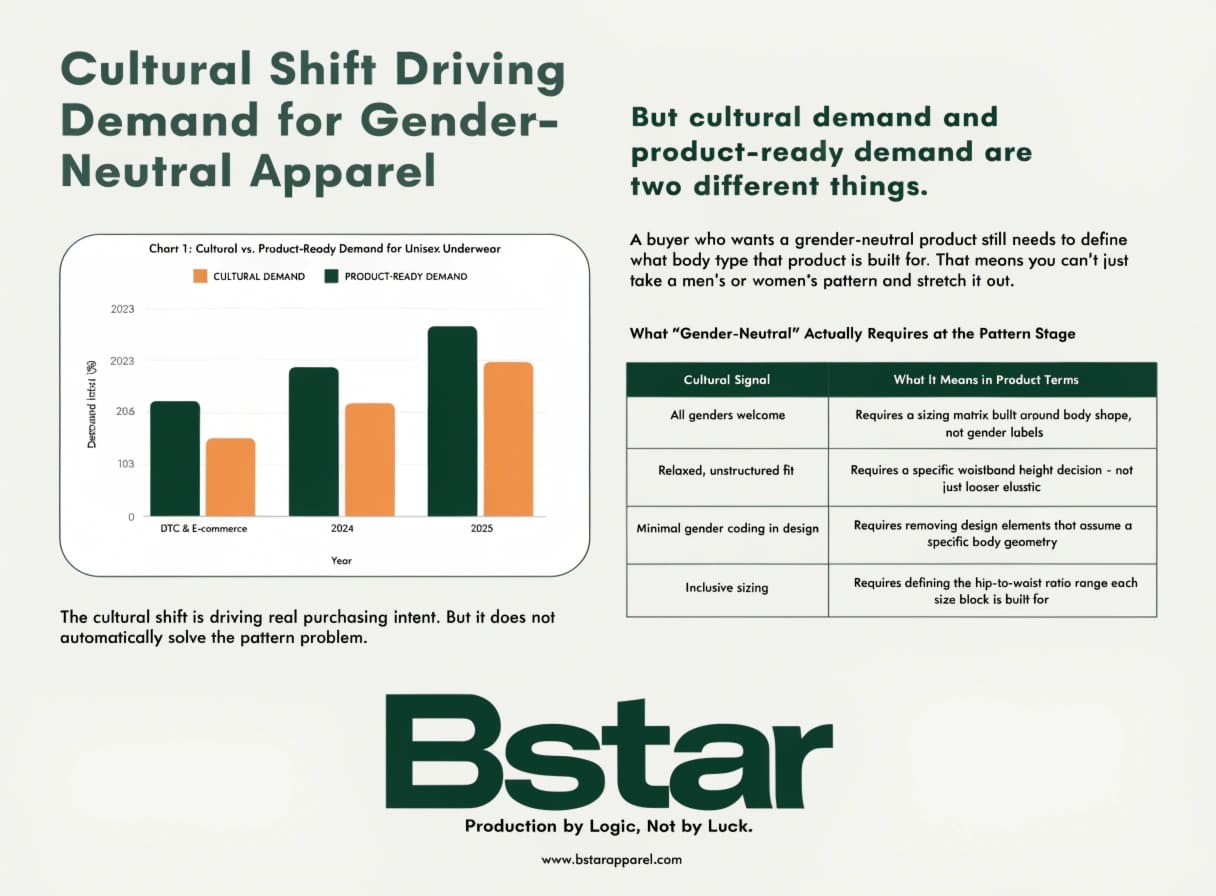
The cultural shift toward gender-neutral apparel is real and measurable. Consumer demand is rising across DTC and e-commerce channels globally.1 But cultural demand and product-ready demand are two different things. A buyer who wants a gender-neutral product still needs to define what body type that product is built for.
When I receive an inquiry for unisex underwear, the first question I ask the buyer is: who is your fit model? Not your target customer — your fit model. The answer tells me everything about whether the project is ready for sampling.
Most buyers at this stage describe their target customer in demographic terms. They say things like "all genders," "non-binary consumers2," or "people who prefer a relaxed fit." These are marketing descriptions. They do not define a body. And underwear has to fit a body.
What "Gender-Neutral" Actually Requires at the Pattern Stage
The cultural shift is driving real purchasing intent. But it does not automatically solve the pattern problem. Here is what I mean:
| Cultural Signal | What It Means in Product Terms |
|---|---|
| "All genders welcome" | Requires a sizing matrix built around body shape, not gender labels |
| "Relaxed, unstructured fit" | Requires a specific waistband height decision — not just looser elastic |
| "Minimal gender coding in design" | Requires removing design elements that assume a specific body geometry |
| "Inclusive sizing" | Requires defining the hip-to-waist ratio range each size block is built for |
Every cultural signal has a structural consequence. If you skip the structural work, you get a product that looks gender-neutral on a hanger but fits badly on a body.
Inclusive Sizing Strategies: How Do You Actually Build a Universal Size Chart?
This is where most projects stall. The buyer wants a size chart. I ask them to define their size range. Then we both realize the standard male and female size tables do not connect in the middle the way most people assume.
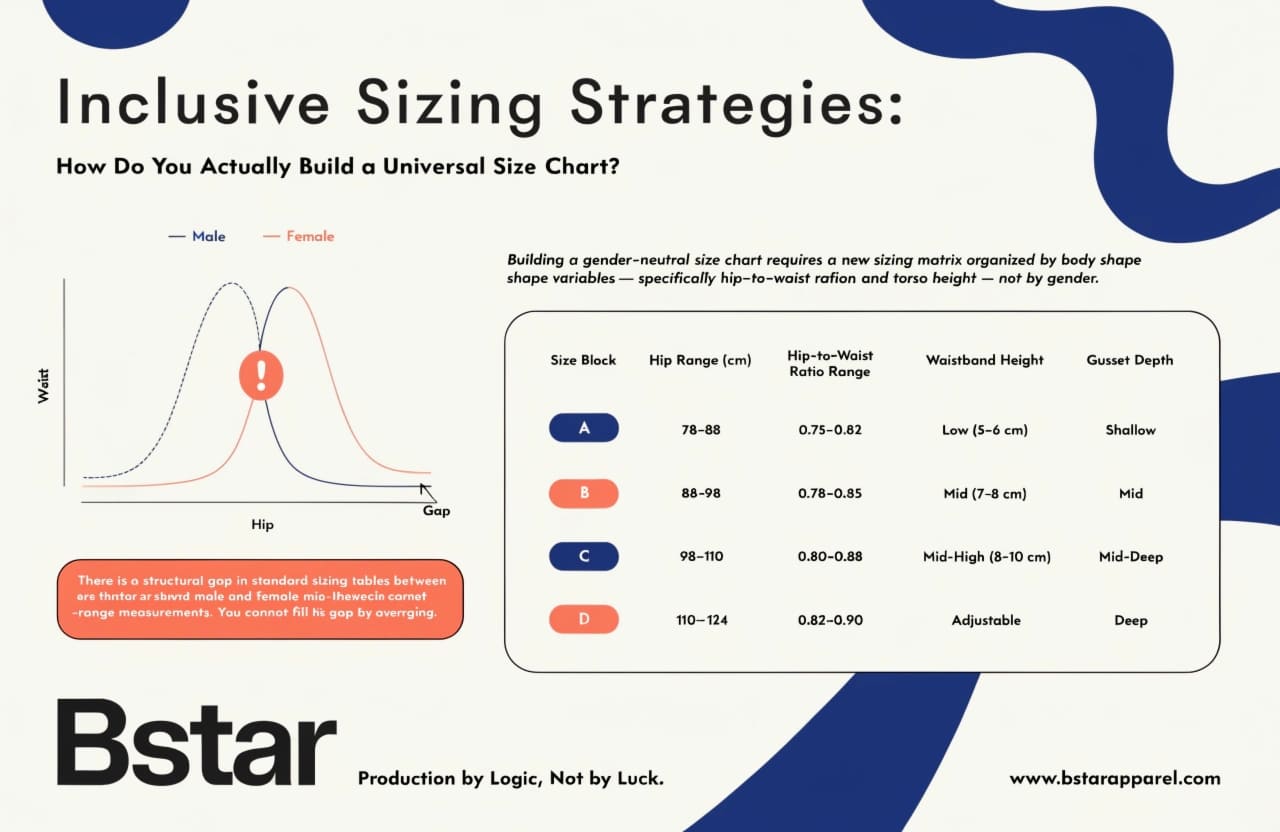
There is a structural gap in standard sizing tables between male and female mid-range measurements. You cannot fill this gap by averaging.3 Building a gender-neutral size chart requires a new sizing matrix organized by body shape variables — specifically hip-to-waist ratio and torso height — not by gender4.
In our sampling process, clients often ask us to start with a standard S/M/L run and adjust from there. I understand the instinct — it feels like a lower-commitment starting point. But it does not work for this category, because the S/M/L framework is built on gendered body assumptions that are baked into the block pattern itself.
Building a Size Matrix That Actually Works
The right approach is to build the size matrix around two or three body shape variables and define each size block explicitly. Here is a simplified version of how we approach this in practice:
| Size Block | Hip Range (cm) | Hip-to-Waist Ratio Range | Waistband Height | Gusset Depth |
|---|---|---|---|---|
| Block A | 78–88 | 0.75–0.82 | Low (5–6 cm) | Shallow |
| Block B | 88–98 | 0.78–0.85 | Mid (7–8 cm) | Mid |
| Block C | 98–110 | 0.80–0.88 | Mid-High (8–10 cm) | Mid-Deep |
| Block D | 110–124 | 0.82–0.90 | Adjustable | Deep |
Each block is a separate sampling commitment. You cannot build this with one pattern and stretch it across all four. Brands that try to compress this step produce products that fail fit testing — not because the concept is wrong, but because the pattern work was not done.
A modular fit system is one way to manage cost. This means building two or three core blocks and using a shared waistband and fabric spec across all of them.5 It reduces tooling cost without eliminating the essential sizing work.
Aesthetic & Material Trends: What Design Choices Are Actually Connected to Fit?
Minimalist design, earth tones, and natural fabrics — these are the three aesthetic trends I hear most from buyers in this category.6 They are real trends. But each one has a structural consequence that is easy to miss.
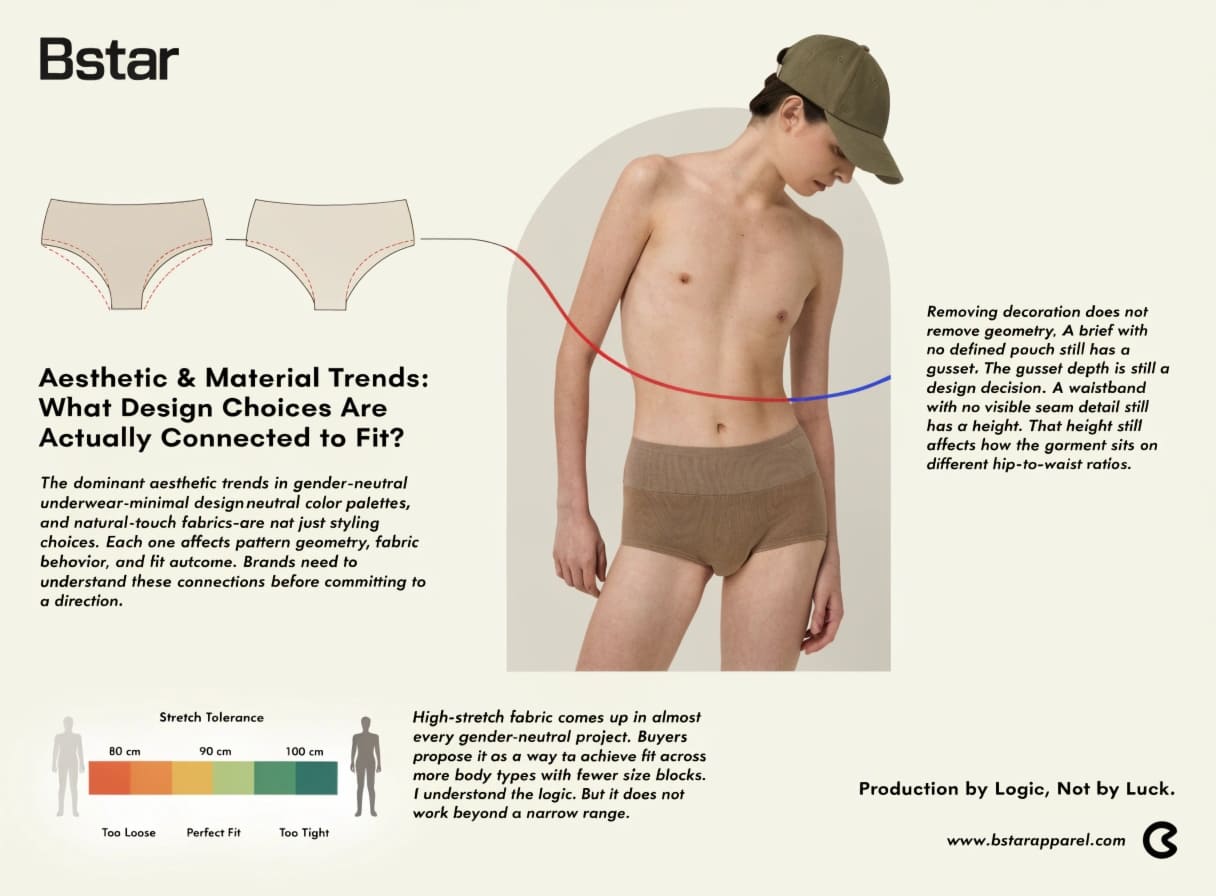
The dominant aesthetic trends in gender-neutral underwear — minimal design, neutral color palettes, and natural-touch fabrics — are not just styling choices. Each one affects pattern geometry, fabric behavior, and fit outcome. Brands need to understand these connections before committing to a direction.
Let me go through each one.
Minimalist Design and What It Means for Pattern Work
Minimalist design usually means removing visible gender-coded elements — no defined pouch, no structured cup, no heavily contoured seaming. This sounds simple. In practice, removing structure does not make the pattern neutral. It just moves the structural decisions into less visible places.
A brief with no defined pouch still has a gusset. The gusset depth is still a design decision. A waistband with no visible seam detail still has a height. That height still affects how the garment sits on different hip-to-waist ratios. Removing decoration does not remove geometry.
Fabric Stretch and Why It Is Not a Shortcut
High-stretch fabric comes up in almost every gender-neutral project. Buyers propose it as a way to achieve fit across more body types with fewer size blocks. I understand the logic. But it does not work beyond a narrow range.
Here is the real problem: stretch compensation distorts silhouette outside its design range7. If you build a pattern for a 90 cm hip and use 40% stretch tolerance to cover 80–100 cm, the garment will look and feel different at the extremes than it does at the center. At 80 cm, it will be loose and shapeless. At 100 cm, it will pull in ways that affect comfort and coverage geometry.
The correct approach is to define the stretch range per size block, not use stretch to replace size blocks. Natural fabrics — cotton modal, organic cotton — have lower stretch tolerance than synthetics8, which means this issue is more acute when buyers want natural materials. We always spec the stretch range explicitly before cutting the first sample.
Operational Efficiency: Does a Unisex Line Actually Simplify Your SKU Structure?
This is a question I hear from e-commerce product managers specifically. The pitch is: if we go gender-neutral, we can cut our SKU count in half. One product, one stock pool, lower complexity.
Unisex product lines can reduce SKU count and simplify inventory management — but only if the size architecture is built correctly from the start. A poorly designed unisex line creates more SKU complexity, not less, because fit failures generate return-driven size fragmentation.9
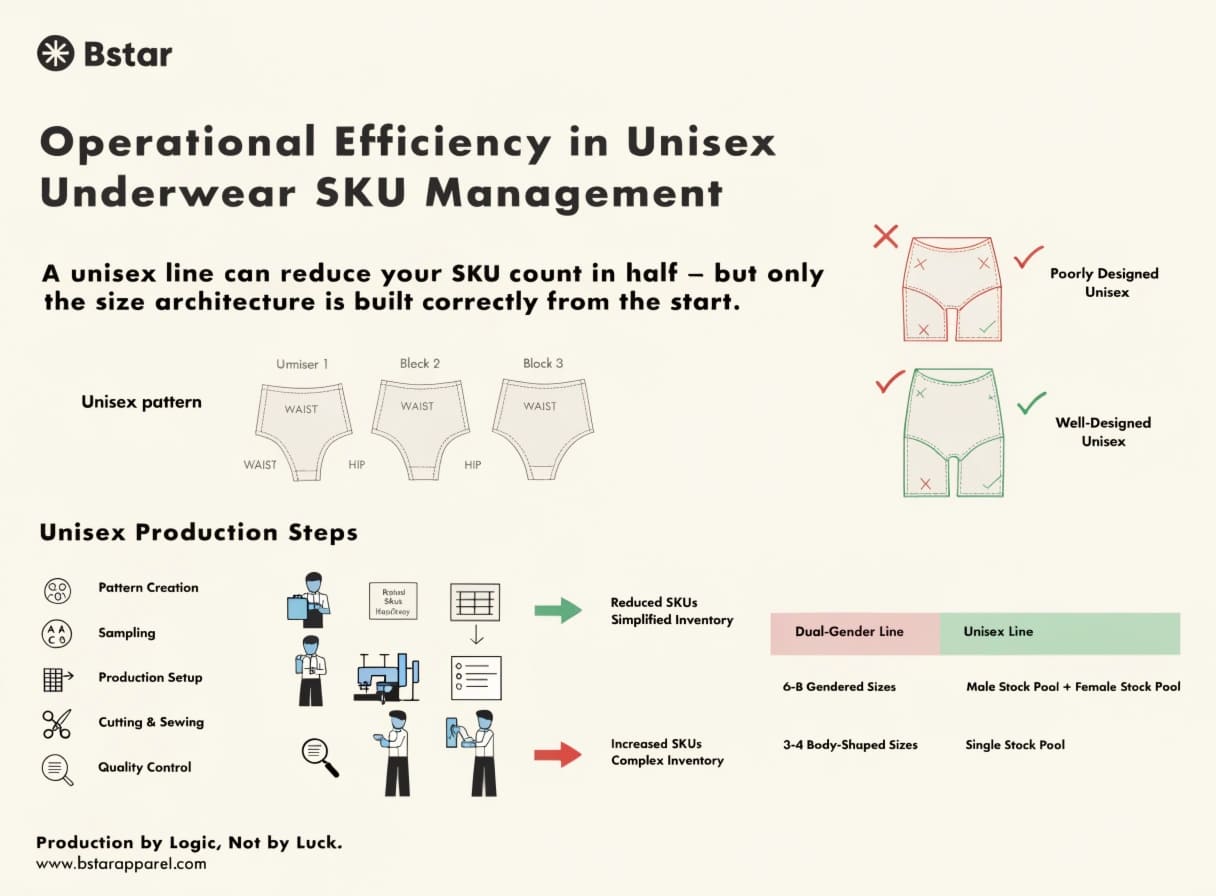
The efficiency gain is real, but it is downstream of the pattern work, not a shortcut around it. Here is how it plays out in practice.
Where Unisex Lines Create Efficiency — and Where They Do Not
| Area | Potential Gain | Condition Required |
|---|---|---|
| SKU count | Fewer total SKUs per style | Size blocks must cover the target body range adequately |
| Inventory pooling | Single stock pool per size | Fit must be consistent enough that customers self-select correctly |
| Fabric purchasing | Higher volume per colorway | Color palette must be shared across all sizes |
| Sampling cost | Fewer gender-split sampling rounds | Only works if one block architecture is used, not two gendered blocks relabeled |
| Returns management | Lower return rate | Requires accurate size guidance and a fit model protocol |
The operational case for unisex is strongest when the brand is willing to do the pattern work up front. Brands that skip the sizing architecture step and rely on stretch or label changes end up with higher return rates, which fragments their effective size run and eliminates the efficiency gain.
From a production standpoint, a well-designed unisex line with three or four body-shape-based size blocks is easier to manage than a dual-gender line with six to eight gendered sizes10. But "well-designed" is doing a lot of work in that sentence.
Conclusion
Gender-neutral underwear is a real category with real demand. But it requires a structural commitment — to new size blocks, explicit gusset and waistband decisions, and a fit model protocol — before any of the business benefits become reachable.
-
"Gender-Fluid Fashion is Male-Centric, But Men Aren’t Primary …", https://business.columbia.edu/press-release/cbs-press-releases/not-so-gender-neutral-gender-fluid-fashion-male-centric-men-arent. Market research tracking apparel purchasing behavior has documented rising consumer interest in gender-neutral clothing categories, particularly among younger demographics and through direct-to-consumer channels, though methodologies and definitions of ‘gender-neutral’ vary across studies. Evidence role: statistic; source type: research. Supports: Quantified growth in consumer demand for gender-neutral or unisex apparel across retail channels. Scope note: Aggregate market data may not isolate underwear specifically from broader gender-neutral apparel categories. ↩
-
"Nonbinary LGBTQ Adults in the United States – Williams Institute", https://williamsinstitute.law.ucla.edu/publications/nonbinary-lgbtq-adults-us/. Survey research by organizations including Gallup and the Pew Research Center has documented the share of adults in the United States who identify as non-binary or outside the gender binary, providing a demographic basis for estimating the size of this consumer segment. Evidence role: statistic; source type: institution. Supports: That non-binary individuals constitute a measurable share of the population and represent a defined consumer segment. Scope note: Population surveys measure identity rather than purchasing behavior; the link between non-binary identity and preference for gender-neutral apparel requires additional consumer research to establish. ↩
-
"Anthropometric Dimensions of Individuals With High Body Mass Index", https://pmc.ncbi.nlm.nih.gov/articles/PMC6820124/. ASTM International and ISO sizing standards for apparel are derived from separate male and female anthropometric surveys, resulting in size tables with distinct measurement ranges that do not form a continuous spectrum at mid-range values. Evidence role: mechanism; source type: institution. Supports: That standardized male and female garment sizing systems are built on distinct anthropometric distributions that do not share a continuous mid-range. Scope note: Published standards describe measurement ranges but do not explicitly characterize the gap as unbridgeable by averaging; that inference is the author’s practical conclusion. ↩
-
"Evaluating machine learning models for clothing size prediction …", https://pmc.ncbi.nlm.nih.gov/articles/PMC12630603/. Anthropometric research on body shape classification has identified waist-to-hip ratio as a primary variable for distinguishing body form categories relevant to lower-body garment fit, supporting its use as an organizing dimension in size system development. Evidence role: mechanism; source type: paper. Supports: That hip-to-waist ratio is a validated anthropometric variable for classifying body shape variation relevant to lower-body garment fit. Scope note: Research typically examines waist-to-hip ratio rather than hip-to-waist ratio, and studies are not always conducted in the context of gender-neutral sizing specifically. ↩
-
"[PDF] Platform-Based Product Design and Development: A Knowledge …", https://tsapps.nist.gov/publication/get_pdf.cfm?pub_id=822620. Product development and manufacturing research has established that platform-based and modular design strategies — in which core components are shared across product variants — reduce development costs, tooling investment, and supply chain complexity compared to fully differentiated product architectures. Evidence role: mechanism; source type: paper. Supports: That modular or platform-based product development strategies, which share components across product variants, reduce development and tooling costs in manufactured goods. Scope note: This literature addresses modular design broadly across manufacturing sectors; direct application to underwear pattern block development is the author’s domain-specific extension of the general principle. ↩
-
"10 Best Sustainable Underwear Brands (2026 Review)", https://www.thegoodtrade.com/features/ethical-lingerie-brands/. Consumer trend reports and fashion industry analyses have identified minimalist design, neutral and earth-tone color palettes, and natural or sustainably sourced materials as recurring characteristics of gender-neutral apparel collections and a stated preference among consumers in this segment. Evidence role: general_support; source type: research. Supports: That minimalist aesthetics, neutral color palettes, and natural or sustainable materials are documented trends in the broader gender-neutral and sustainable apparel market. Scope note: Published trend reports often cover broader apparel categories rather than underwear specifically, and trend identification methodologies vary across sources. ↩
-
"Elastic textile-based wearable modulation of musculoskeletal load", https://pmc.ncbi.nlm.nih.gov/articles/PMC11894418/. Textile and apparel engineering research on stretch knit fabrics has shown that garments worn at the lower and upper bounds of a fabric’s stretch range exhibit measurable differences in silhouette, pressure distribution, and coverage geometry compared to garments worn at the design center measurement. Evidence role: mechanism; source type: paper. Supports: That elastic knit fabrics produce fit and silhouette variation when worn at the extremes of their stretch range, rather than providing uniform fit across that range. Scope note: Published studies typically examine pressure comfort or ease allowance rather than silhouette distortion specifically; the author’s framing extends from established stretch mechanics principles. ↩
-
"Fiber types and fabric structures influence on weft knitted fabrics – PMC", https://pmc.ncbi.nlm.nih.gov/articles/PMC9204663/. Textile science literature characterizes natural cellulosic fibers such as cotton and modal as having lower elongation at break and reduced elastic recovery compared to synthetic fibers such as polyester and nylon, particularly when used without elastane blending. Evidence role: general_support; source type: research. Supports: That natural fiber fabrics including cotton and modal exhibit lower elongation and stretch recovery than synthetic or synthetic-blend knit fabrics. Scope note: Stretch properties vary significantly with fabric construction, yarn count, and finishing treatments; fiber type alone does not fully determine stretch tolerance in a finished knit. ↩
-
"The True Cost of Apparel Returns: Alarming Return Rates Require …", https://coresight.com/research/the-true-cost-of-apparel-returns-alarming-return-rates-require-loss-minimization-solutions/. E-commerce and retail research has consistently identified fit and sizing as the leading cause of apparel returns in online retail, with studies reporting that fit-related returns account for a substantial majority of total return volume in clothing categories. Evidence role: statistic; source type: research. Supports: That fit-related issues are a primary driver of apparel returns in e-commerce, with implications for inventory management. Scope note: Published return rate data is typically aggregated across apparel categories and does not isolate underwear or gender-neutral products specifically. ↩
-
"[PDF] Inventory Pooling with Strategic Consumers: Operational and …", https://www.hbs.edu/faculty/Shared%20Documents/events/163/Pooling.pdf. Supply chain and operations management research has documented that SKU rationalization — reducing the number of distinct product variants — can decrease inventory holding costs, simplify demand forecasting, and reduce stockout risk, provided that the consolidated product range adequately covers customer needs. Evidence role: mechanism; source type: paper. Supports: That reducing SKU count through product line consolidation can lower inventory management complexity and improve supply chain efficiency in apparel retail. Scope note: General SKU rationalization findings apply to the principle; the specific comparison between unisex and dual-gender underwear line structures has not been studied directly in published literature. ↩