
How to Scale Your Underwear Brand from 100 to 10,000 Units?
You’ve got early traction. Orders are coming in. Now you’re thinking about scaling. That’s where most underwear brands make their most expensive mistake.
Scaling from 100 to 10,000 units isn’t a production problem — it’s a sequencing problem. The brands that fail do so because they skip validation before locking into large orders, switch factories for cost savings without checking MOQ fit, or assume sample quality will hold at bulk scale.
I’ve worked with DTC underwear brands at every stage of this jump — from first samples to full bulk runs. I’ve also seen where it breaks down. The failure points are almost always the same. This article is about those failure points, and how to move through them without destroying your margin or your inventory budget.
Streamlining the Supply Chain: How Do You Transition from Small-Batch Sampling to Efficient Mass Production?
The moment your brand starts to grow, the instinct is to find a bigger factory. Lower unit cost, higher capacity — it looks like smart math. But this is where a lot of brands get hurt.
The "big factory = better deal" trap works like this: a brand chasing unit cost savings switches to a high-capacity factory mid-scale, only to discover the MOQ is 5,000–10,000 units per colorway1. That’s fine if your sell-through rate supports it. Most early-stage brands find out it doesn’t — after the order is placed.
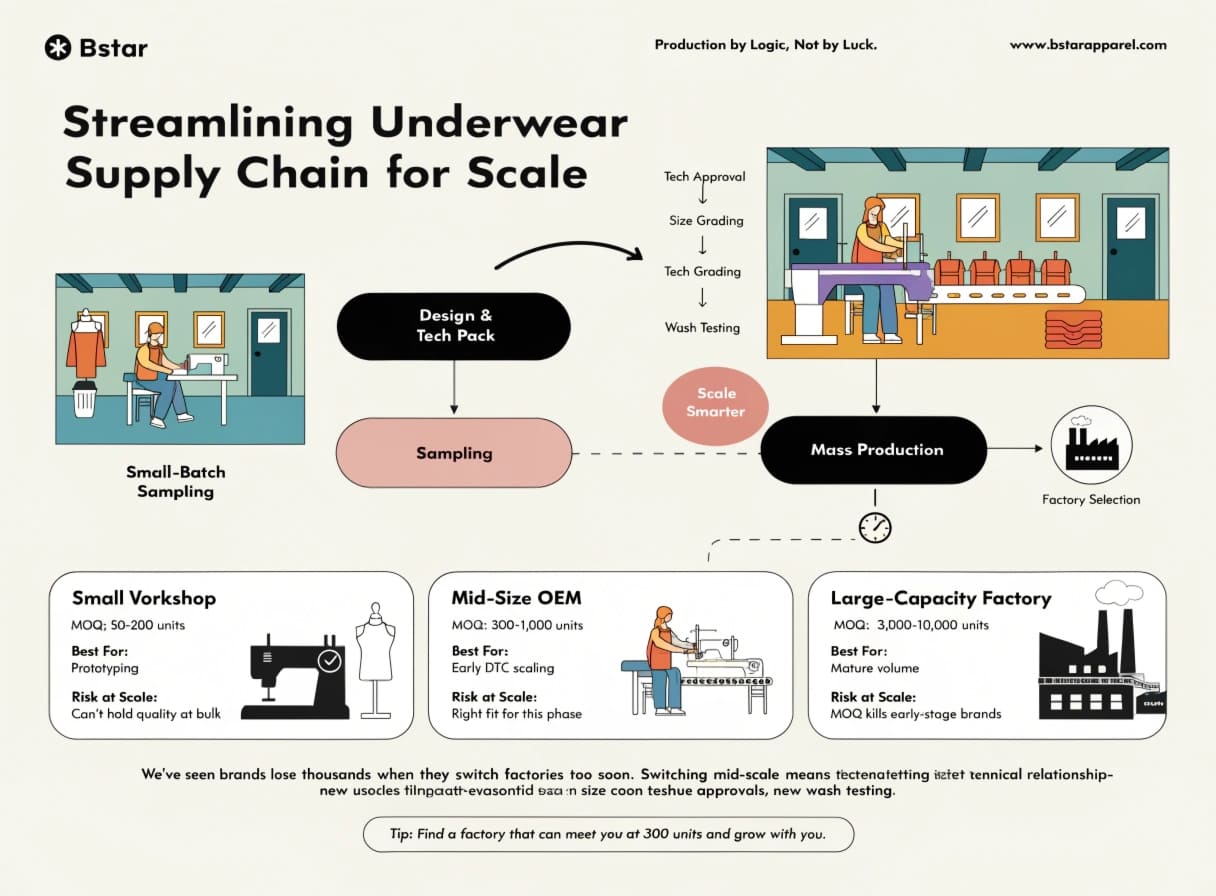
We’ve received production instructions from brands that had already switched factories twice before reaching 2,000 units. Each switch was made to chase a lower unit price. Each switch reset the technical relationship — new fit approvals, new size grading, new wash testing2. That’s not just time lost. That’s real money lost.
What the Right Factory Actually Looks Like at Scale
The factory that’s right for your scaling phase isn’t necessarily the cheapest per unit. It’s the one that can work with you at 300 units and still be relevant when you’re placing 8,000. That flexibility matters more than the per-unit cost difference in the early stage.
Here’s a simple way to evaluate this:
| Factory Type | Typical MOQ | Best For | Risk at Scale |
|---|---|---|---|
| Small workshop | 50–200 units | Prototyping | Can’t hold quality at bulk |
| Mid-size OEM | 300–1,000 units | Early DTC scaling | Right fit for this phase |
| Large-capacity factory | 3,000–10,000 units | Mature volume | MOQ kills early-stage brands |
If your factory can’t meet you at 300 units and grow with you, you’ll be switching mid-scale. And switching mid-scale is one of the most expensive things you can do to your supply chain.
Standardizing Quality Control: How Do You Maintain Consistency When You Move from Samples to Bulk?
Here’s something that surprises a lot of brand founders: the sample you approved and the bulk run are not the same process. They’re not even close.
Dyeing and finishing at bulk scale introduces color variance and post-wash shrinkage that small-batch sampling doesn’t expose3. Brands that sign off on samples without understanding how their factory manages bulk dye lots are taking on a quality risk they can’t see until the container arrives.
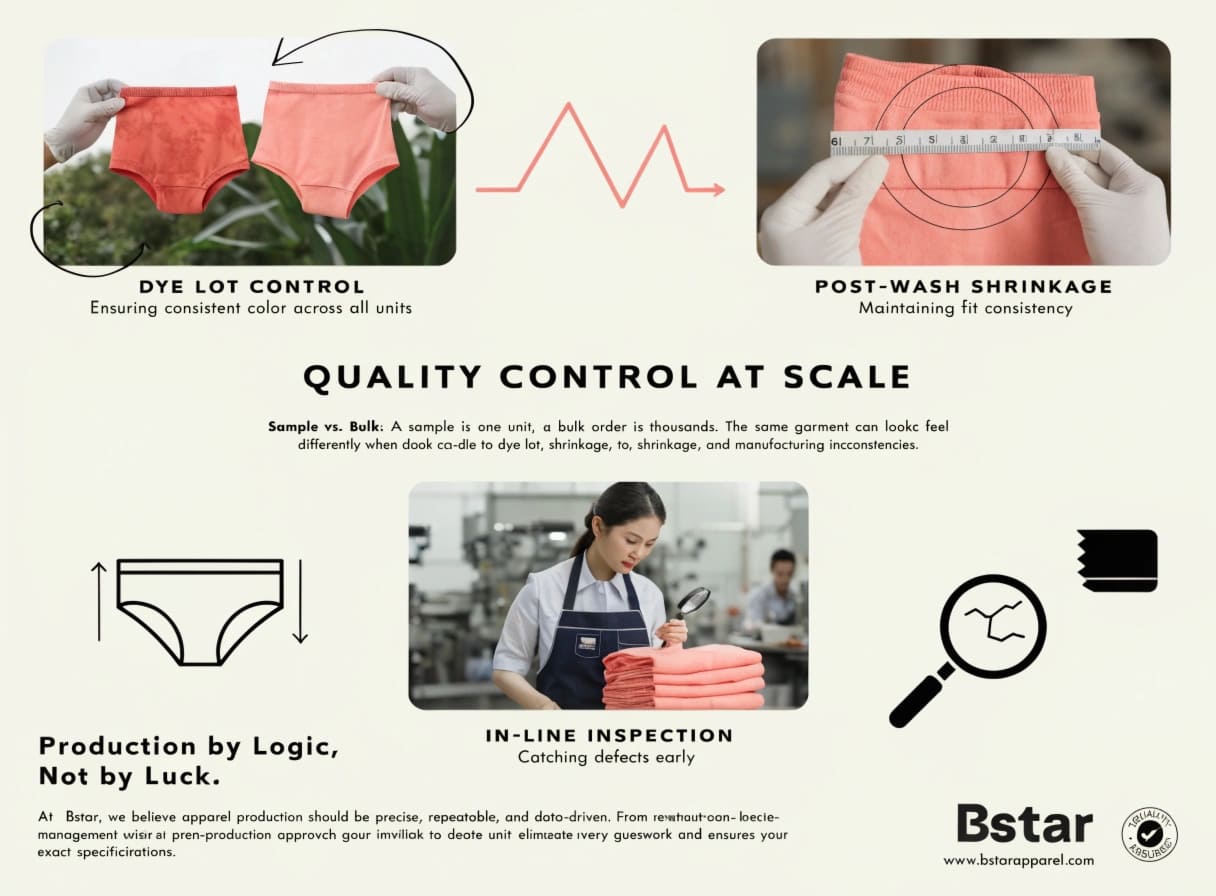
We’ve had clients come back to us after trying a different factory for their first bulk run. The most common thing they say is: "The color looked right on the sample, but the bulk came back uneven." That’s a dye lot control issue — and it’s entirely predictable if you ask the right questions before you approve production.
Questions to Ask Before You Approve Bulk Production
These aren’t audit questions. They’re buying-decision questions. Before you sign off on a bulk run, ask your factory:
- How do you control dye lot consistency across a full production batch? If the answer is vague, that’s your signal.
- What’s your post-wash shrinkage rate for this fabric construction4? If they haven’t tested it, your garment sizing will drift after the first wash.
- Do you do an in-line fabric inspection before cutting5? If they skip this, defects scale with the order.
The Confirmation Loop You Cannot Skip
At 10,000 units, a skipped step becomes a four-figure problem. The confirmation sequence before bulk approval should always cover:
| Checkpoint | What You’re Confirming | What Happens If You Skip It |
|---|---|---|
| Fabric lot approval | Color and weight match sample | Bulk arrives off-color |
| Size grading sign-off | Grade increments are correct | Fit complaints across sizes |
| Wash test sign-off | Shrinkage and color fastness6 | Returns from end customers |
| Pre-production sample | Everything together, in bulk fabric | Unrecoverable production errors |
This isn’t optional at scale. Every one of these steps represents a recoverable delay before production. Skipping any of them creates an unrecoverable loss after production.
Optimizing Inventory and Logistics: How Do You Manage Lead Times, MOQs, and Warehousing for High-Volume Orders?
Staged ordering isn’t just a budget tactic. It’s a risk management method. And it only works if your factory is set up to support it.
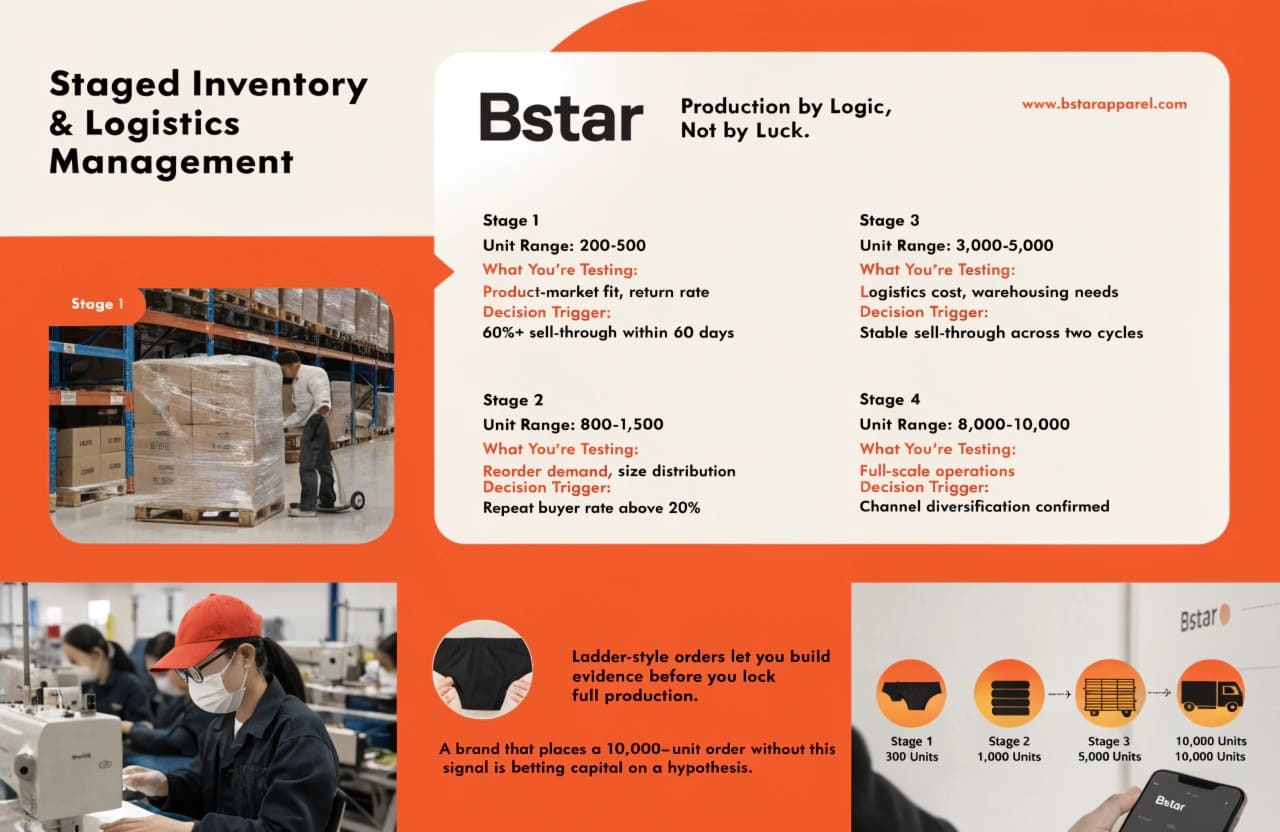
The correct trigger for scaling isn’t "I feel confident." It’s confirmed sell-through velocity and repeat buyer rate from your small batch. A brand that places a 10,000-unit order without this signal is betting capital on a hypothesis. Ladder-style orders — 300 → 1,000 → 5,000 — let you build evidence before you lock into full production.
I’ve seen brands place large orders based on early social media traction before they had real sell-through data7. The traction was real. The conversion wasn’t. The result was a warehouse full of product and a cash flow problem that took two seasons to recover from.
How to Structure a Staged Order Plan
| Order Stage | Unit Range | What You’re Testing | Decision Trigger to Move Up |
|---|---|---|---|
| Stage 1 | 200–500 | Product-market fit, return rate | 60%+ sell-through within 60 days8 |
| Stage 2 | 800–1,500 | Reorder demand, size distribution | Repeat buyer rate above 20%9 |
| Stage 3 | 3,000–5,000 | Logistics cost, warehousing needs | Stable sell-through across two cycles |
| Stage 4 | 8,000–10,000 | Full-scale operations | Channel diversification confirmed |
Each stage requires a factory that doesn’t penalize you for the order size. If your factory won’t take a 300-unit order, you can’t run stage one. And if you can’t run stage one, you’re skipping the validation step — which is the whole point.
Cost Efficiency and Pricing Strategy: How Do You Use Economies of Scale Without Overcommitting Capital?
Economies of scale are real. But they only help you if you’re scaling into confirmed demand — not ahead of it.
At 300 units, your unit cost will be higher than at 3,000. That’s expected10. The mistake brands make is letting that cost difference push them into a larger order before their sell-through rate supports it. A lower unit cost on 5,000 units you can’t move is not a saving — it’s a loss with better math.
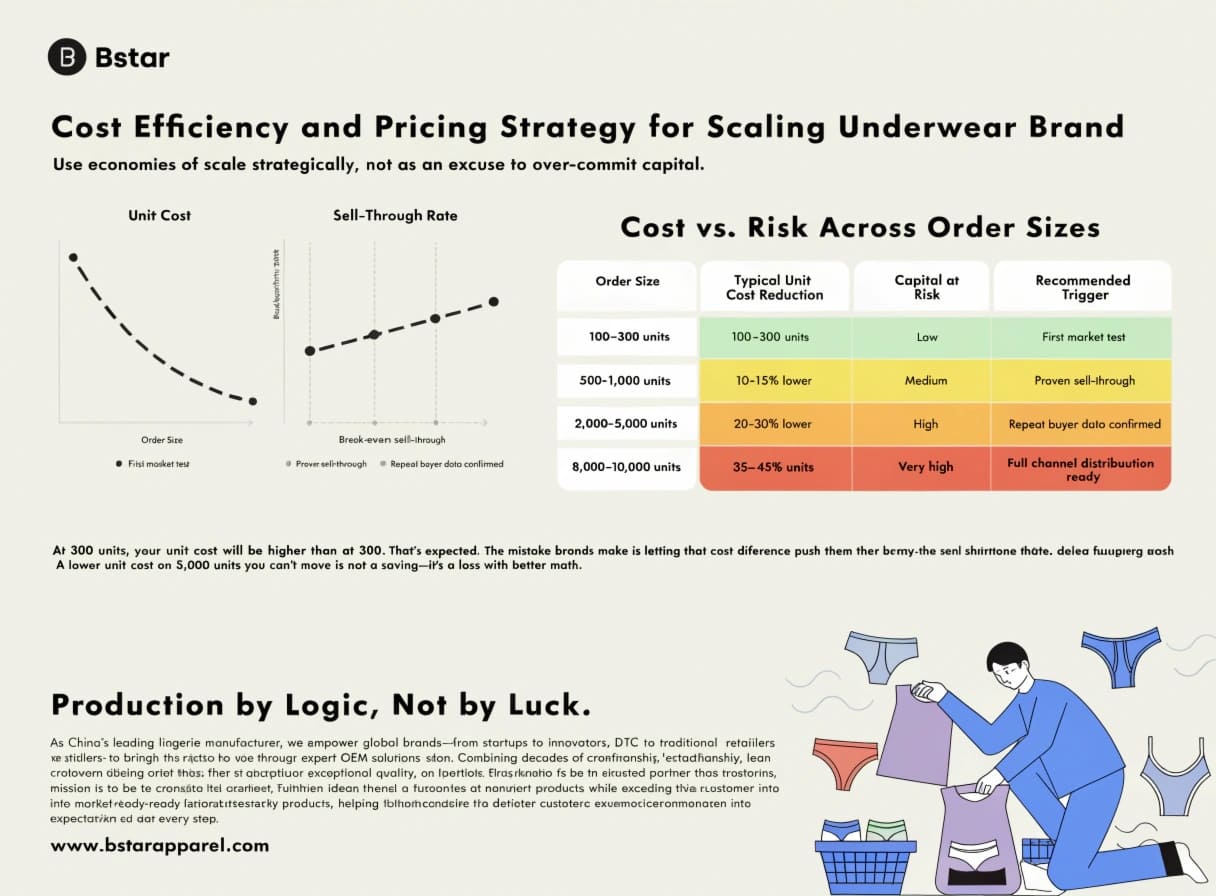
The way to use economies of scale correctly is to treat the cost curve as a reward for validated demand — not as a reason to over-order early. Here’s what that looks like in practice:
Cost vs. Risk Across Order Sizes
| Order Size | Typical Unit Cost Reduction | Capital at Risk | Recommended Trigger |
|---|---|---|---|
| 100–300 units | Baseline | Low | First market test |
| 500–1,000 units | 10–15% lower | Medium | Proven sell-through |
| 2,000–5,000 units | 20–30% lower | High | Repeat buyer data confirmed |
| 8,000–10,000 units | 35–45% lower | Very high | Full channel distribution ready |
Beyond unit cost, the other lever is fabric and trim consolidation11. When you’re ordering at volume, you can lock in fabric pricing across colorways and reduce per-unit trim cost by standardizing components. This is something worth discussing with your factory before finalizing your bulk order — not after.
The brands we’ve seen manage this transition well are the ones that treat each order stage as a deliberate test, not a commitment to a final answer. They scale when the data says scale — not when the unit cost math looks tempting.
Conclusion
Scaling from 100 to 10,000 units is survivable if you validate before you commit, choose a factory that grows with you, and never skip the pre-production confirmation loop.
-
"Low MOQs in Clothing Manufacturing | Hook & Eye UK Blog", https://hookandeyeuk.com/blogs/news/moqs-minimum-order-quantities-explained?srsltid=AfmBOoqArSD_ujZatSTU1SJb_GqtEDD074nFOPCCmzw7PyY6uimltBWI. Industry analyses of apparel manufacturing structures document that large-capacity OEM factories commonly impose minimum order quantities in the range of several thousand units per style or colorway, reflecting fixed setup and dye-lot costs that must be amortized across sufficient volume. Evidence role: general_support; source type: research. Supports: Typical MOQ ranges for large-capacity apparel and garment manufacturers. Scope note: Published MOQ benchmarks vary by product category, region, and factory tier; figures cited in the article should be understood as illustrative ranges rather than universal standards. ↩
-
"Mastering Size Grading Systems in Clothing Production – MFG Merch", https://mfgmerch.com/size-grading-systems-in-clothing-production/. Apparel industry quality management frameworks, including those aligned with ISO 9001 and buyer-specific technical packages, require that fit trials, size grading verification, and wash performance testing be conducted independently for each new manufacturing facility, as process variables differ between production sites. Evidence role: mechanism; source type: institution. Supports: That changing manufacturing partners in apparel requires re-establishing technical approvals including fit, grading, and wash performance. Scope note: The specific steps required vary by brand protocol and product category; the article’s list reflects common practice rather than a universally mandated sequence. ↩
-
"How Factories Prevent Color Variation Between Lots – MFG Merch", https://mfgmerch.com/prevent-color-variation-between-lots/. Textile testing standards bodies, including AATCC and ISO, document that dye uptake uniformity and dimensional stability in woven and knit fabrics are sensitive to batch size, liquor ratio, and process temperature, meaning that results obtained from laboratory or small-batch samples may not predict bulk production outcomes without additional process controls. Evidence role: mechanism; source type: institution. Supports: That bulk dyeing processes introduce color and dimensional variation not present in small-batch samples. Scope note: The degree of variance depends on fiber type, dye class, and factory process controls; the claim is directionally supported but the magnitude of risk varies by context. ↩
-
"TM135 Test Method for Dimensional Changes of Fabrics …", https://members.aatcc.org/store/tm135/543/. AATCC Test Method 135 (Dimensional Changes of Fabrics after Home Laundering) and ISO 6330 provide standardized procedures for measuring fabric shrinkage after repeated wash cycles, establishing the technical basis for the shrinkage rate data that the article recommends brands request from their manufacturers. Evidence role: definition; source type: institution. Supports: That standardized methods exist for measuring post-wash dimensional change in garment fabrics. Scope note: Test results are protocol-dependent; shrinkage values obtained under one wash condition may not reflect consumer laundering behavior. ↩
-
"Apparel QA in In-Process Inspection: A Step-by-Step Guide – LinkedIn", https://www.linkedin.com/posts/asmmanik_discussion-topics-about-%F0%9D%90%A2%F0%9D%90%A7-%F0%9D%90%A9%F0%9D%90%AB%F0%9D%90%A8%F0%9D%90%9C%F0%9D%90%9E%F0%9D%90%AC-activity-7369258289542459393-RDCA. Industry quality control frameworks for apparel manufacturing, including the widely used 4-Point and 10-Point fabric inspection systems, specify that incoming fabric lots should be inspected for defects, weight, and color consistency prior to cutting, as defects identified at this stage can be addressed without the compounding cost of cutting and sewing defective material. Evidence role: expert_consensus; source type: institution. Supports: That pre-cut fabric inspection is a recognized quality control step in apparel manufacturing. ↩
-
"ISO 105-C02:1989 – Textiles — Tests for colour fastness", https://www.iso.org/standard/3803.html. ISO 105 (Textiles — Tests for Colour Fastness) comprises a series of standardized test methods covering fastness to washing, rubbing, light, and perspiration, providing the technical framework against which the color fastness checkpoint referenced in the article is evaluated in commercial apparel production. Evidence role: definition; source type: institution. Supports: That color fastness in textiles is defined and measured by established international standards. ↩
-
"Conceptualising and measuring social media engagement – PMC", https://pmc.ncbi.nlm.nih.gov/articles/PMC8354841/. Marketing and ecommerce research has documented a weak or inconsistent relationship between social media engagement metrics (likes, shares, follower growth) and downstream purchase conversion, suggesting that brands relying on engagement signals as demand proxies risk overestimating inventory requirements prior to confirmed sell-through data. Evidence role: general_support; source type: paper. Supports: That social media engagement metrics are an unreliable predictor of actual purchase conversion and sell-through performance. Scope note: The relationship between engagement and conversion varies by platform, audience demographics, and product category; the article’s claim is directionally supported but should not be generalized without accounting for these variables. ↩
-
"Decoding Retail Sell Through Benchmarks for Success – Stylematrix", https://stylematrix.io/stylematrix-sell-through-decoding-retail-sell-through-benchmarks-for-success/. Retail and apparel industry analyses generally treat sell-through rates above 60–70% within a defined selling window as indicative of strong product-market fit, though benchmarks vary by category, channel, and seasonality; the 60% threshold cited in the article falls within the range commonly referenced in inventory planning literature. Evidence role: statistic; source type: research. Supports: What constitutes a healthy sell-through rate for early-stage DTC apparel brands as a basis for inventory scaling decisions. Scope note: No single universal benchmark exists; the appropriate threshold depends on margin structure, carrying costs, and channel mix specific to each brand. ↩
-
"Repeat Purchase Rate Benchmarks: 18.8% Across 156K Customers", https://bsandco.us/blog-post/repeat-purchase-rate-benchmarks. Ecommerce and DTC performance research indicates that repeat purchase rates for apparel brands typically range from 15–30% depending on category and price point, suggesting that the 20% threshold cited in the article falls within the range associated with viable customer retention and supports its use as a scaling trigger. Evidence role: statistic; source type: research. Supports: That a repeat buyer rate of approximately 20% represents a meaningful retention signal for DTC apparel brands. Scope note: Repeat purchase benchmarks vary substantially by product category, average order value, and customer acquisition channel; the figure should be interpreted as a directional guide rather than a universal standard. ↩
-
"Production Costs, Scale Economies, and Technical Change in U.S. …", https://www.researchgate.net/publication/5144159_Production_Costs_Scale_Economies_and_Technical_Change_in_US_Textile_and_Apparel_Industries. Economic analyses of apparel and textile manufacturing document that unit costs decline with volume primarily through amortization of fixed setup costs (pattern making, machine calibration, dye lot preparation) and bulk input purchasing, consistent with the cost-reduction trajectory described in the article’s order-size table. Evidence role: mechanism; source type: paper. Supports: That unit production costs in apparel manufacturing decline as order volume increases due to fixed cost amortization and input purchasing efficiencies. Scope note: The specific percentage reductions cited in the article (10–45%) are illustrative; actual savings depend on factory overhead structure, fabric type, and negotiated input prices. ↩
-
"A study on the Supply Chain Management Strategies of Structured …", https://jtatm.textiles.ncsu.edu/index.php/JTATM/article/view/18047. Supply chain management literature on apparel sourcing identifies material consolidation — standardizing fabric constructions and trim components across styles or colorways — as a recognized lever for reducing per-unit input costs through volume-based supplier pricing and reduced changeover complexity. Evidence role: mechanism; source type: paper. Supports: That consolidating material and component purchasing in apparel supply chains reduces per-unit input costs. Scope note: Cost savings from consolidation depend on supplier pricing structures and the degree of standardization achievable without compromising product differentiation. ↩