
Kids’ Underwear Manufacturing: Are You Asking the Right Safety Questions?
Children’s underwear recalls happen every year. And most of them don’t start with bad intentions — they start with incomplete questions asked too early in the process.
Getting children’s underwear right means coordinating fabric composition, trims, and real-wear performance together. A certified shell fabric is a starting point. It is not a finished answer. Brands that treat it as one tend to find out the hard way — through customer complaints, retailer rejections, or order revisions.
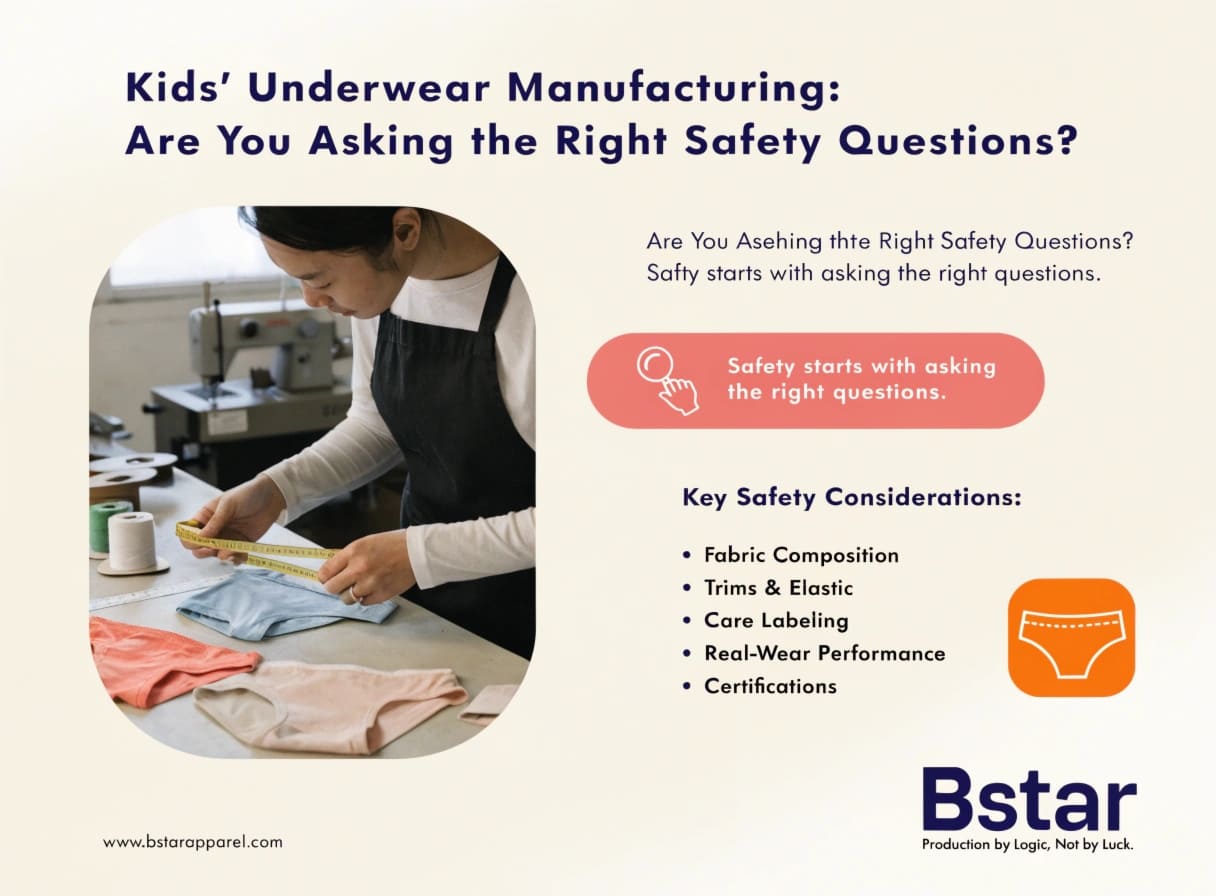
There is a pattern I see from brands entering this category for the first time. They spend weeks selecting the right certified fabric. They confirm OEKO-TEX. They feel confident. Then three months later, something comes back — an elastic that irritates skin after repeated washing, a care label that abrades, a fit that collapses after 30 cycles. The fabric was fine. Everything else wasn’t specified. This article is about closing that gap.
Are You Actually Covered by Global Safety Regulations?
Most brands entering children’s underwear know they need to be "compliant." But compliant where, and for what?
The main regulatory frameworks — China’s GB 31701, the EU’s REACH restrictions, and US CPSC flammability rules — each cover different risks. None of them cover everything. Understanding what each one does and doesn’t address is the first step to knowing where your product is actually exposed.
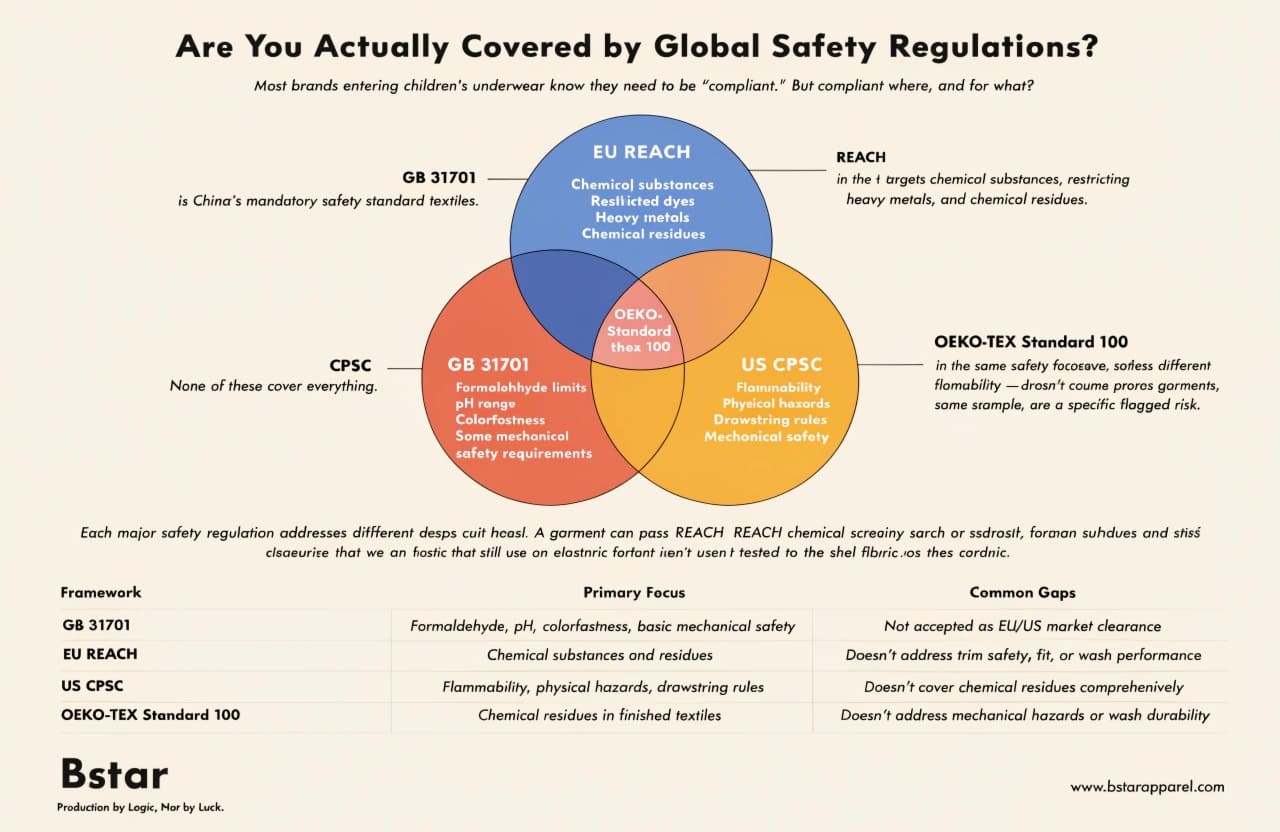
GB 31701 is China’s mandatory safety standard for children’s textiles. It covers formaldehyde limits, pH range, colorfastness, and some mechanical safety requirements. If you’re manufacturing in China for export, your factory should already be working within this framework — but "meeting GB 31701" doesn’t automatically mean your product is cleared for EU or US retail.
REACH in the EU targets chemical substances. It restricts certain dyes, heavy metals, and chemical residues that could harm health. CPSC in the US focuses more on physical hazards and flammability — drawstrings on children’s garments, for example, are a specific flagged risk.
Here’s what I find brands often miss: these regulations address different dimensions of the same product. A garment can pass REACH chemical screening and still fail on a mechanical safety check. It can meet GB 31701 and still use an elastic that isn’t tested to the same standard as the shell fabric.
What Each Framework Actually Covers
| Framework | Primary Focus | Common Gaps |
|---|---|---|
| GB 31701 | Formaldehyde, pH, colorfastness, basic mechanical safety | Not accepted as EU/US market clearance |
| EU REACH | Chemical substances and residues | Doesn’t address trim safety, fit, or wash performance |
| US CPSC | Flammability, physical hazards, drawstring rules | Doesn’t cover chemical residues comprehensively |
| OEKO-TEX Standard 100 | Chemical residues in finished textiles | Doesn’t address mechanical hazards or wash durability |
The right approach isn’t to pick one and assume it covers the rest. It’s to map your target market first, then work backward to what combination of testing and design decisions you actually need.
Is "Pure Cotton" Really the Safest Choice for Kids’ Skin?
This is one of the most common assumptions I hear from brands building their first children’s underwear line. Cotton is natural, so cotton must be safest.
100% cotton is a good starting point for skin contact in children’s underwear. But real-use performance — elasticity recovery, shape retention, softness after 50+ washes — often depends on the blend. A cotton-spandex or cotton-modal combination can be skin-safe and outperform pure cotton in durability.
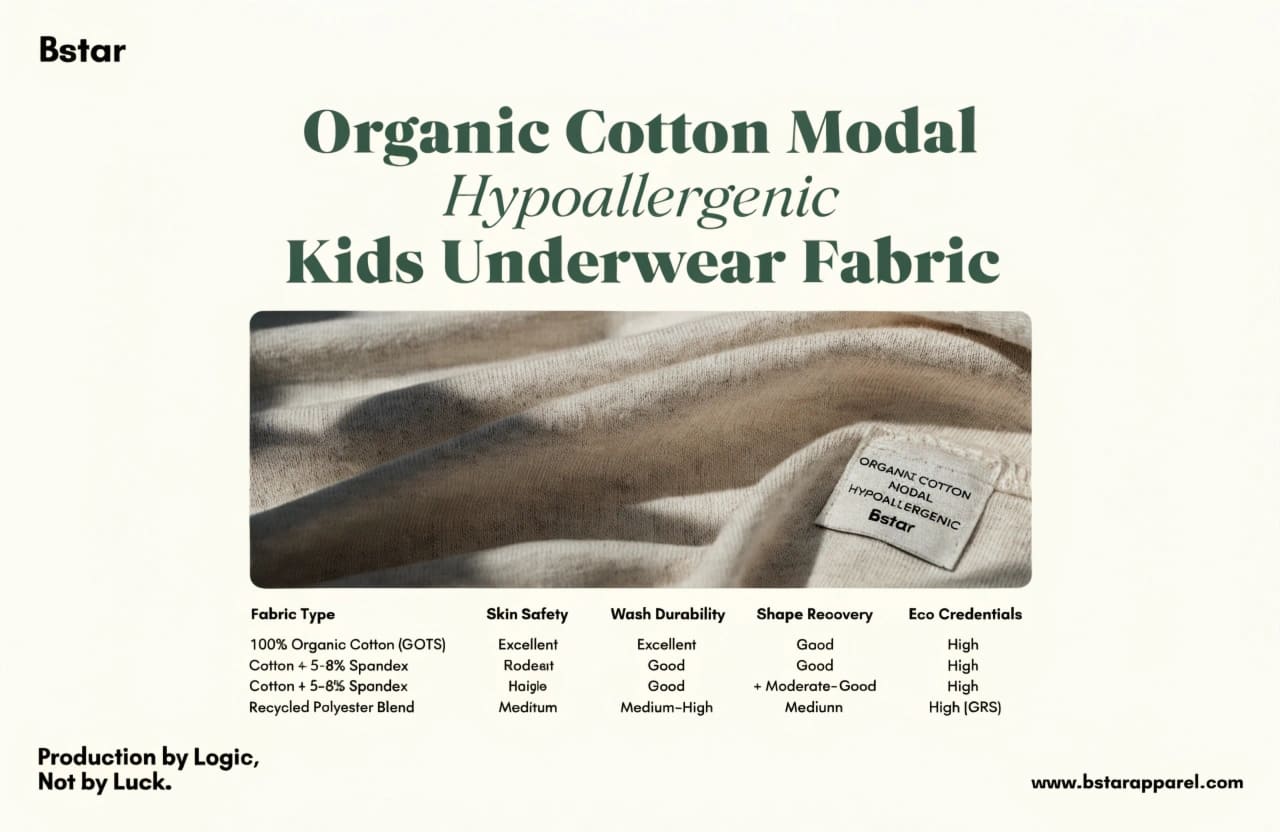
In orders we’ve handled for European DTC brands, the fabric conversation usually starts with "we want 100% organic cotton." That’s a legitimate values-based decision. GOTS certification speaks directly to that — it covers organic fiber sourcing and processing standards, and for brands marketing "natural" or "eco," it’s a meaningful and defensible claim.
But GOTS answers a values question. It doesn’t automatically answer a performance question.
Children’s underwear moves. It stretches. It gets washed dozens of times. Pure cotton — even premium organic cotton — can lose shape faster than a well-constructed blend. If the waistband loses recovery after 20 washes, or the seat area stretches out and doesn’t return, parents notice. The product experience deteriorates even if the fiber certification is valid.
Fabric Performance Comparison for Kids’ Underwear
| Fabric Type | Skin Safety | Wash Durability | Shape Recovery | Eco Credentials |
|---|---|---|---|---|
| 100% Organic Cotton (GOTS) | Excellent | Moderate | Low–Moderate | High |
| Cotton + 5–8% Spandex | Excellent | Good | Good | Medium |
| Cotton + Modal Blend | Excellent | Good | Moderate–Good | Medium–High |
| Recycled Polyester Blend | Moderate | High | High | High (GRS) |
The question I usually ask brands first isn’t "what fabric do you want?" It’s "how many wash cycles do you expect this to hold up for, and what does failure look like for your customer?" That shapes the composition decision more precisely than any certification shortlist.
GOTS and performance requirements are independent decisions — and a good manufacturer should help you hold both at the same time, not make you choose.
Are Trims Getting the Same Scrutiny as Your Shell Fabric?
This is the part most brands don’t think about until something goes wrong.
Trims — elastics, care labels, waistband tapes, any hardware near skin — are the highest-contact, highest-friction components in children’s underwear. They are also the most common source of order revisions and customer complaints in the categories we handle.
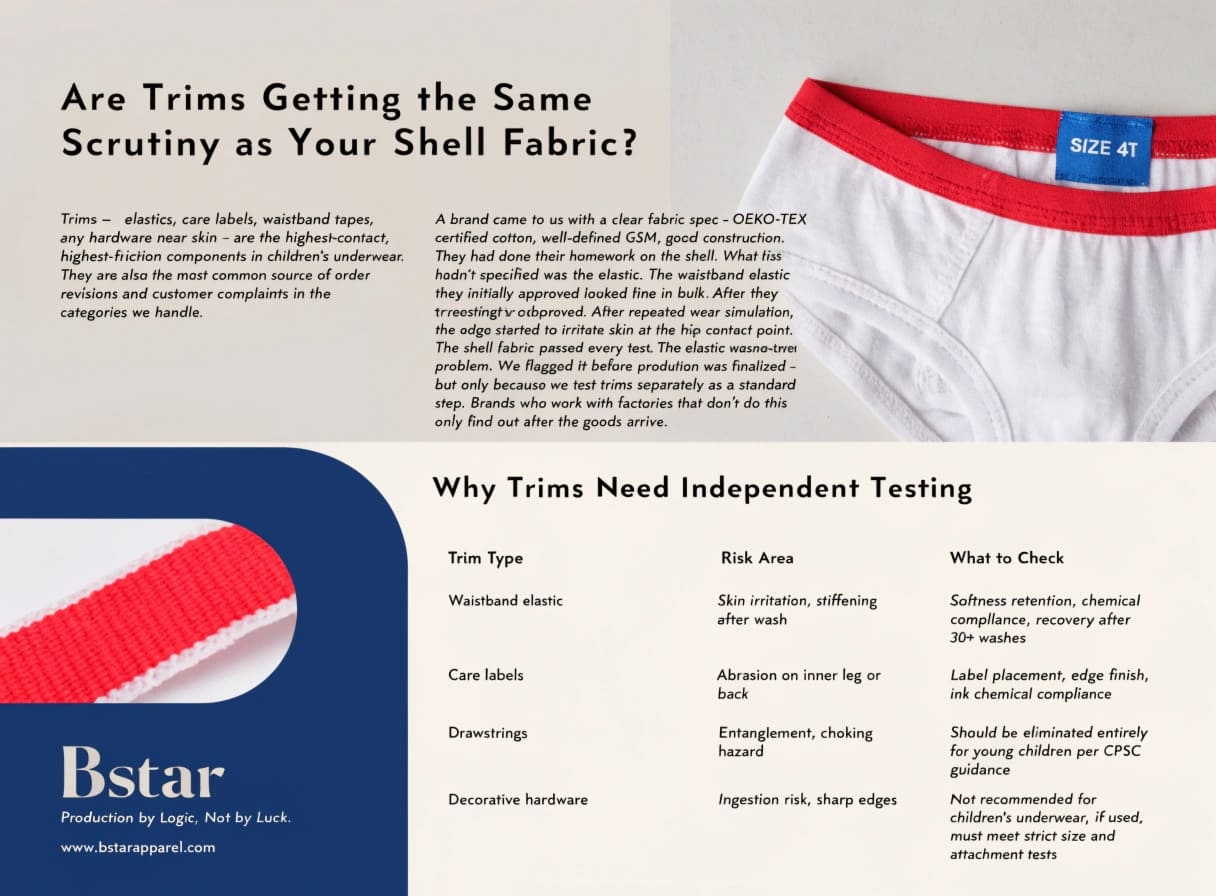
I’ll give you a representative scenario. A brand came to us with a clear fabric spec — OEKO-TEX certified cotton, well-defined GSM, good construction. They had done their homework on the shell. What they hadn’t specified was the elastic. The waistband elastic they initially approved looked fine in bulk. After wash testing, it stiffened. After repeated wear simulation, the edge started to irritate skin at the hip contact point.
The shell fabric passed every test. The elastic was the problem. We flagged it before production was finalized — but only because we test trims separately as a standard step. Brands who work with factories that don’t do this only find out after the goods arrive.
Why Trims Need Independent Testing
| Trim Type | Risk Area | What to Check |
|---|---|---|
| Waistband elastic | Skin irritation, stiffening after wash | Softness retention, chemical compliance, recovery after 30+ washes |
| Care labels | Abrasion on inner leg or back | Label placement, edge finish, ink chemical compliance |
| Drawstrings | Entanglement, choking hazard | Should be eliminated entirely for young children per CPSC guidance |
| Decorative hardware | Ingestion risk, sharp edges | Not recommended for children’s underwear; if used, must meet strict size and attachment tests |
The critical point: trims are often sourced and tested to different standards than shell fabric. OEKO-TEX certification on your main fabric does not automatically extend to every elastic and label in the garment. Each component needs to be screened.
A pattern I see from brands entering this category: they ask detailed questions about fabric certification and almost nothing about trims. That’s where the exposure is.
How Do You Verify That Your Supply Chain Is Actually Traceable?
Certifications on a spec sheet are not the same as traceability in production.
Traceability in children’s apparel means being able to confirm — with documentation — where your fiber came from, how it was processed, and what happened at each stage. Colorfastness and chemical compliance need to be verified at the finished garment level, not just the raw material stage.
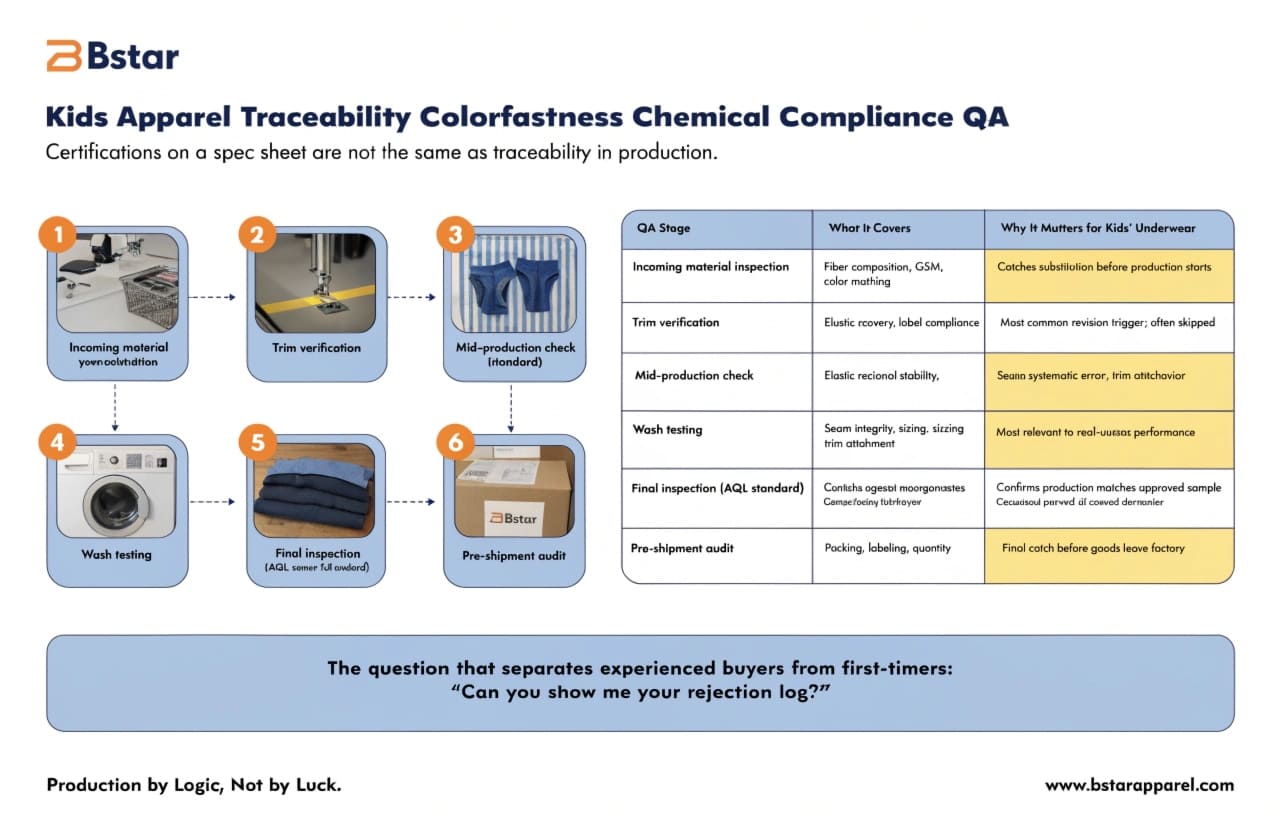
In our production process, we run quality checks at six stages — from incoming material inspection through to final packaging. This isn’t unusual for a serious manufacturer. What is unusual is how rarely brands ask about it when they’re evaluating suppliers.
Colorfastness is a good example of why this matters. A dye lot can pass raw material testing and still bleed or fade after repeated washing at home temperatures. We’ve pulled material from production runs that passed supplier documentation but failed our internal wash testing. The documentation was real. The performance wasn’t good enough.
For children’s apparel specifically, dye migration matters more than in adult categories. Kids sweat more. Underwear is in direct skin contact for long periods. A dye that behaves fine in a t-shirt test environment can behave differently in underwear wear conditions.
What to Ask Your Manufacturer About QA
| QA Stage | What It Covers | Why It Matters for Kids’ Underwear |
|---|---|---|
| Incoming material inspection | Fiber composition, GSM, color matching | Catches substitution before production starts |
| Trim verification | Elastic recovery, label compliance | Most common revision trigger; often skipped |
| Mid-production check | Seam integrity, sizing, trim attachment | Catches systematic errors before full run |
| Wash testing | Colorfastness, dimensional stability, trim behavior | Most relevant to real-use performance |
| Final inspection (AQL standard) | Finished garment against full spec | Confirms production matches approved sample |
| Pre-shipment audit | Packing, labeling, quantity | Final catch before goods leave factory |
The question that separates experienced buyers from first-timers: "Can you show me your rejection log?" A manufacturer who tracks what they’ve pulled from production — and why — is giving you real information about their process. One who can’t answer that question is telling you something too.
Conclusion
Children’s underwear safety is a coordination problem, not a certification problem. Get the fabric, trims, wash performance, and documentation right together — or expect to revise.