
Seamless Underwear Technology: How It Works and Why It Sells?
If you’re a brand founder evaluating seamless underwear, you’ve probably already heard the pitch: no seams, no irritation, better margins. But the real picture is more complicated than that.
Seamless underwear is made on computerized circular knitting machines that form the garment tube in one continuous pass. This eliminates most cut-and-sew labor, reduces material waste, and removes the seam lines that cause chafing. The result is a smoother silhouette and a faster production path — when the style fits the machine’s capabilities.
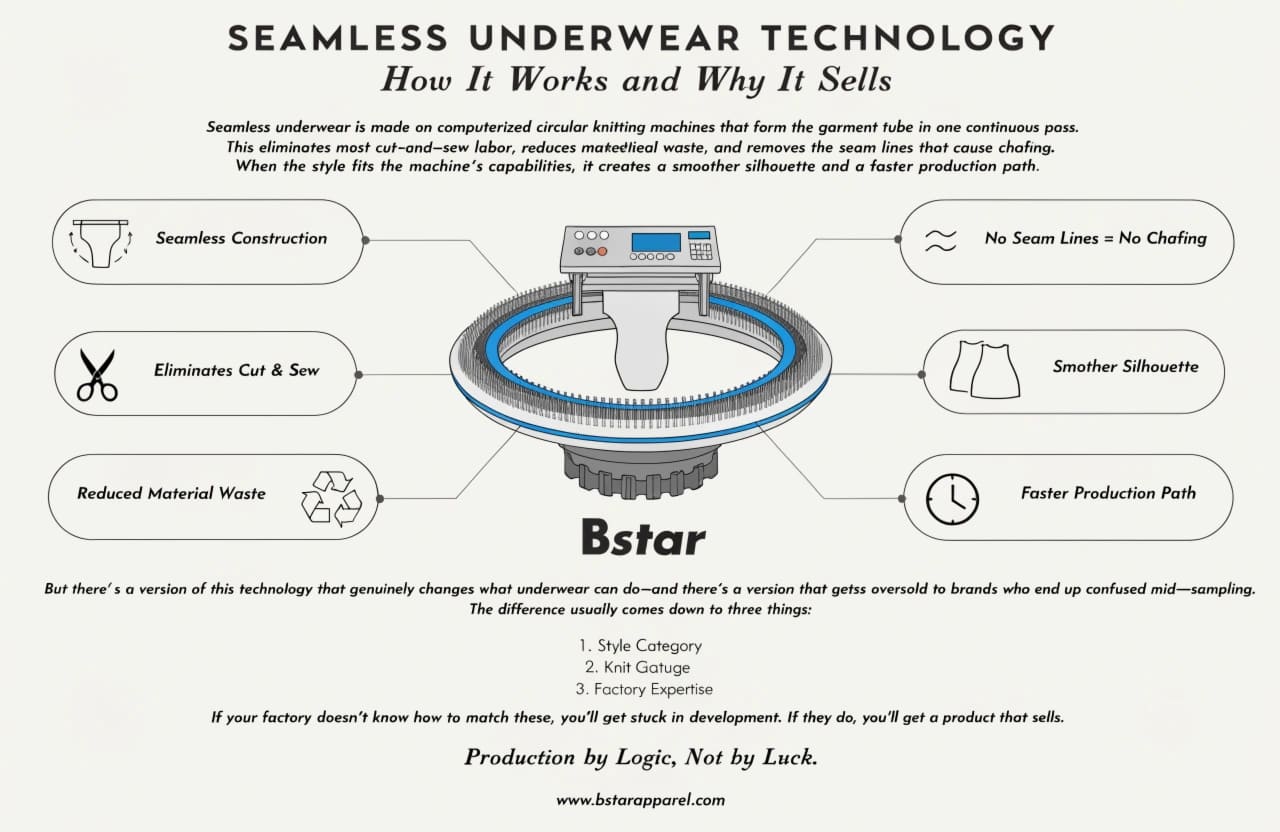
There’s a version of this technology that genuinely changes what underwear can do. There’s also a version that gets oversold to brands who end up confused mid-sampling. The difference usually comes down to three things: your style category, the knit gauge you choose, and whether your factory actually knows how to match the two. Let me walk through each layer.
The Mechanics of Seamless Knitting: Utilizing Computerized Circular Looms to Create One-Piece Garments?
Most brands hear "seamless" and picture a garment that comes off the machine complete and finished. That’s not quite right — and this gap in expectations causes more rework requests than anything else we deal with in early sampling.
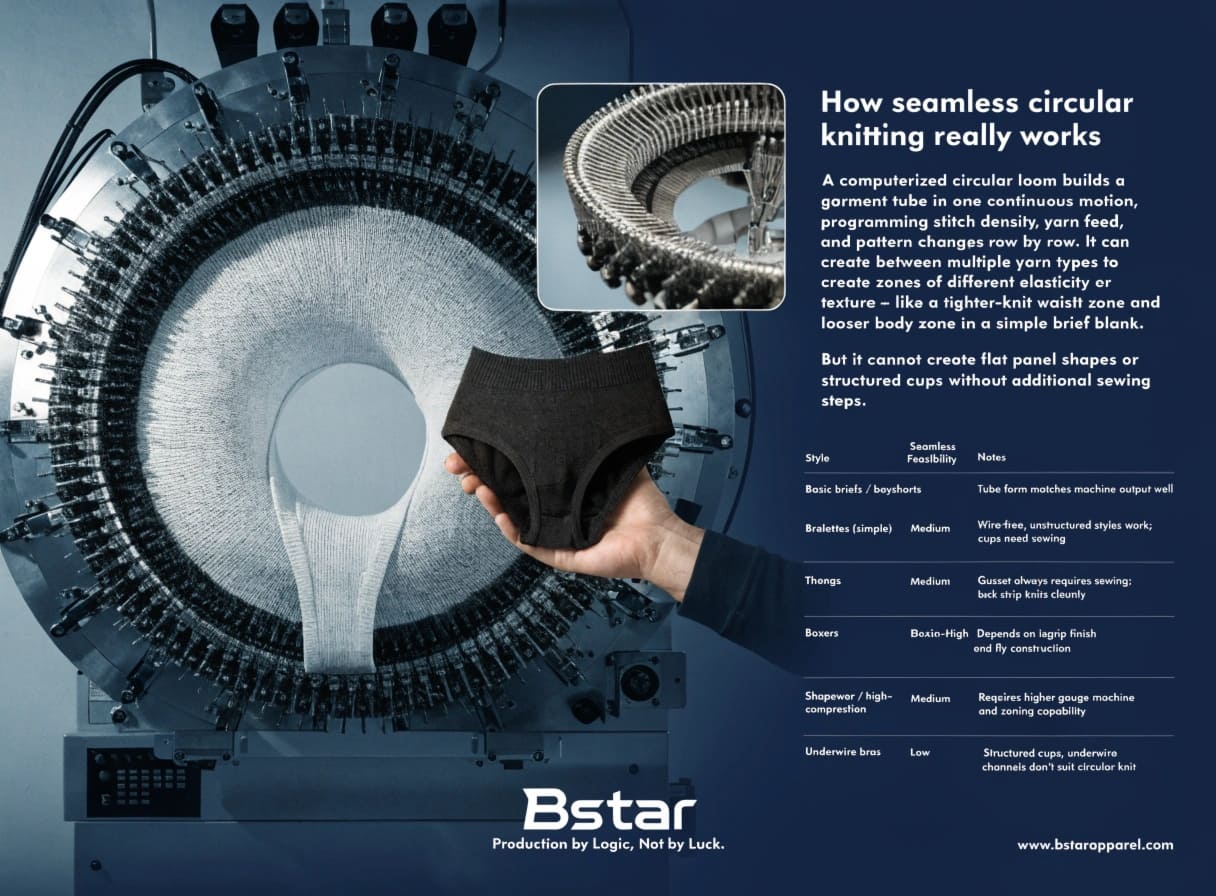
Seamless circular knitting uses a computerized loom to build a garment tube in one continuous motion. The machine programs stitch density, yarn feed, and pattern changes row by row. This creates a near-finished blank with minimal cut pieces. But most styles still require sewn gussets, finished waistbands, or overlocked edges before they become a wearable product.
The word "seamless" describes the knitting method, not the final construction state. When we talk to clients in pre-sales, this is usually the first correction we make.
Here’s what actually happens on a circular knitting machine and why it matters for your product decisions:
How the Machine Builds a Garment
The loom feeds multiple yarn types simultaneously. It can switch between them to create zones of different elasticity or texture within a single pass. A simple brief blank, for example, can have a tighter-knit waist zone and a looser body zone — all built in during the knitting step, not added later.
What the machine cannot do is create flat panel shapes or structured cups without additional sewing steps. This is where the style category question becomes critical.
Style Category vs. Machine Capability
| Style | Seamless Feasibility | Notes |
|---|---|---|
| Basic briefs / boyshorts | High | Tube form matches machine output well |
| Bralettes (simple) | Medium | Wire-free, unstructured styles work; cups need sewing |
| Thongs | Medium | Gusset always requires sewing; back strip knits cleanly |
| Boxers | Medium-High | Depends on leg opening finish and fly construction |
| Shapewear / high-compression | Medium | Requires higher gauge machine and zoning capability |
| Underwire bras | Low | Structured cups, underwire channels don’t suit circular knit |
If your target style sits in the "medium" range, the question isn’t whether to go seamless — it’s whether the construction trade-offs fit your cost target and wearability expectation. We see brands skip this question before committing to sampling, and it costs them two to four weeks of iteration time.
Advanced Bonding and Heat-Sealing: Replacing Traditional Stitching with Ultrasonic Welding and Hot-Melt Adhesives?
Once you have a seamless knit blank, there’s still the question of how to finish the edges and attach any remaining construction elements. This is where bonding technology comes in — and where a lot of brands upgrade their thinking about what "no seams" can actually mean.
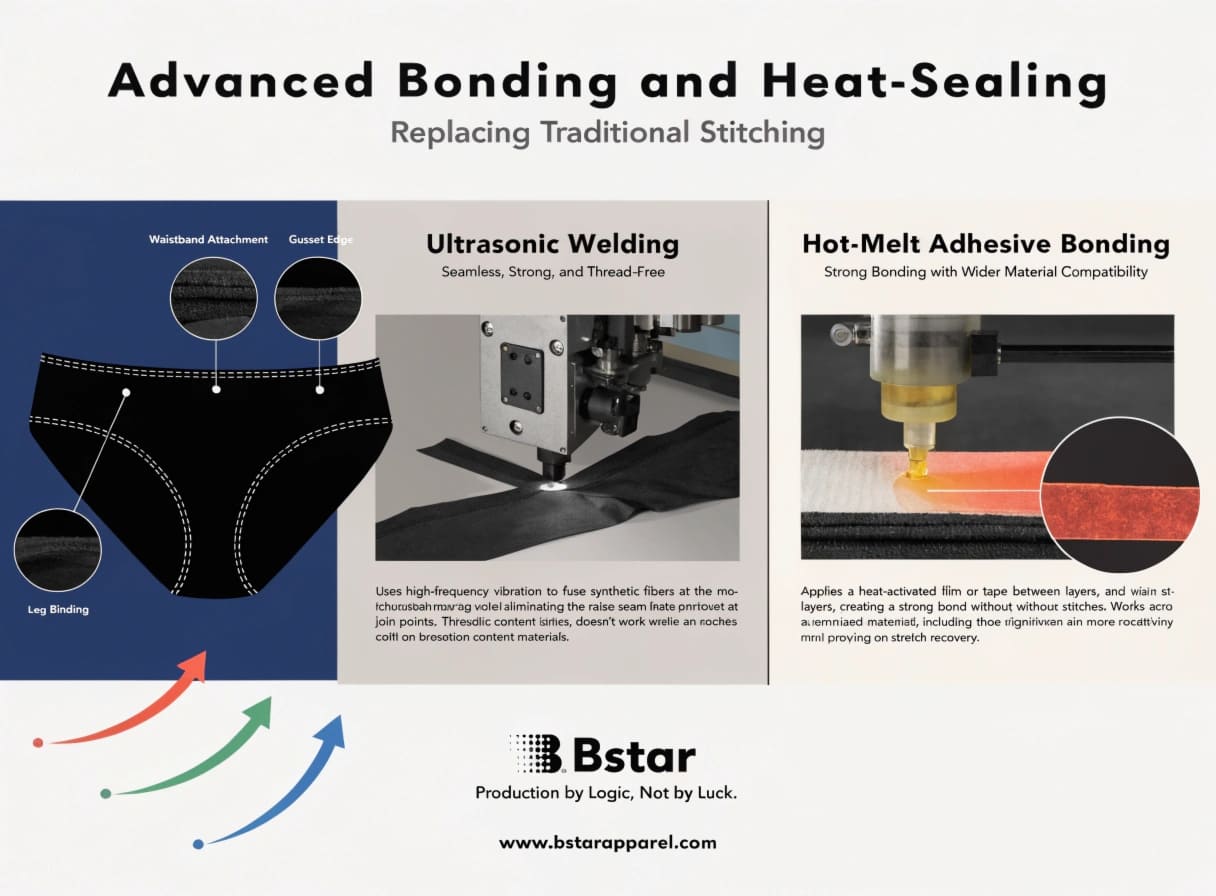
Ultrasonic welding and hot-melt adhesives bond fabric layers using heat or sound-wave energy rather than thread. This eliminates the raised seam ridge at join points. In underwear construction, it’s most commonly used at waistband attachment, gusset edges, and leg binding — the exact points where traditional sewing creates friction against skin.
Bonding and heat-sealing are not the same thing, and not every factory runs both. This distinction matters more than most brands realize when they’re comparing quotes.
Bonding Methods and Their Trade-offs
Ultrasonic welding uses high-frequency vibration to fuse synthetic fibers at the molecular level. It’s clean, fast, and produces a very flat join. It works best on high-synthetic content fabrics — nylon, polyester blends. It doesn’t work well on high-cotton content materials because the fibers don’t fuse the same way1.
Hot-melt adhesive bonding applies a heat-activated film or tape between fabric layers. It bonds across a wider material range and is more forgiving on stretch recovery. The trade-off is wash durability — lower-quality hot-melt bonds can delaminate after repeated washing if the adhesive grade or application temperature isn’t controlled correctly2.
From our production experience, clients who want bonded construction need to confirm two things before sampling: fabric composition and wash cycle expectation. A bonded waistband on a 92% nylon brief behaves very differently from the same construction on a 60% cotton boxer. Getting this alignment right before sampling saves a full revision round.
Ergonomic Zoning and 3D Body Mapping: Integrating Targeted Compression, Ventilation, and Structural Support?
This is the part of seamless technology that genuinely excites product teams — and also the part most often misunderstood in spec briefs.
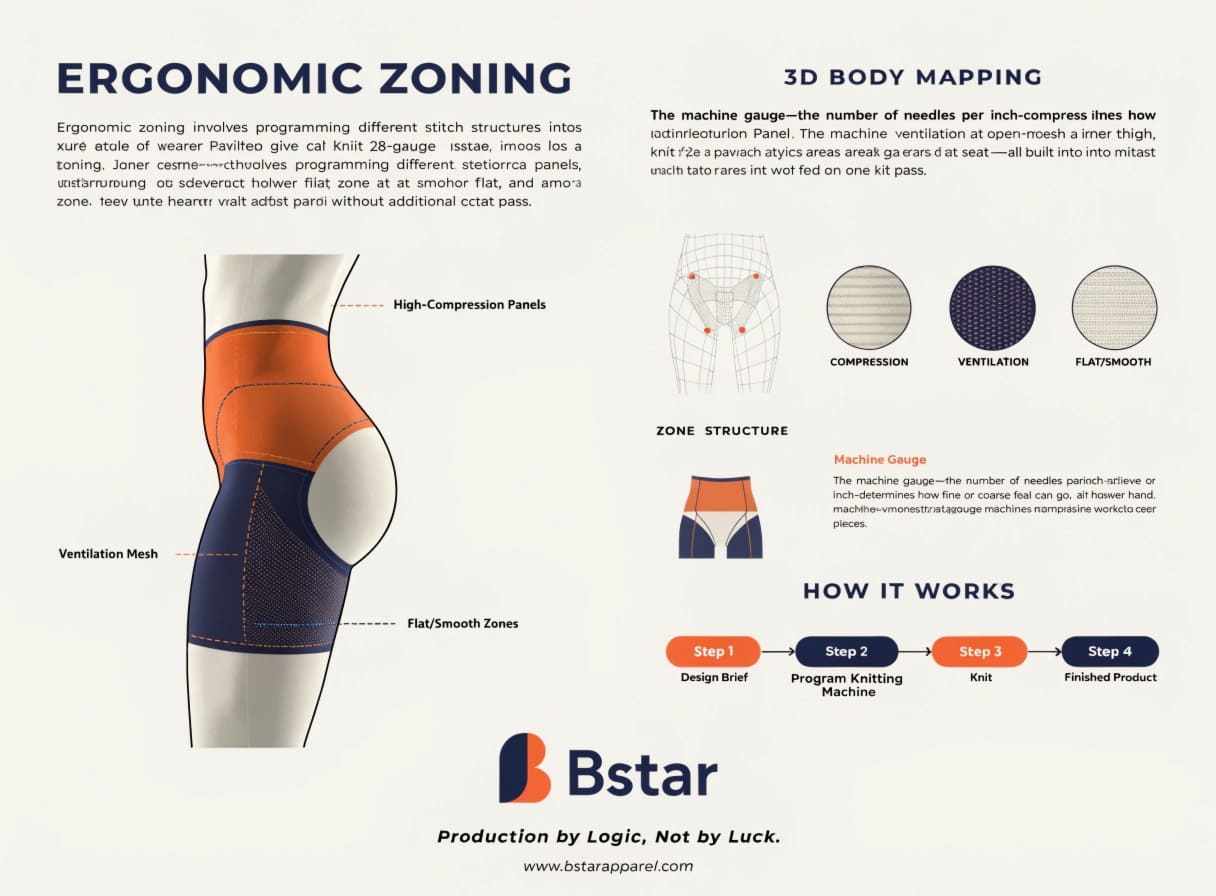
Ergonomic zoning means programming different stitch structures into specific areas of a seamless garment during knitting. A single brief can have high-compression panels at the waist, open-mesh ventilation at the inner thigh, and a smooth flat zone at the seat — all built into one knit pass without additional cut pieces.
The key word here is "programmed." This is not a finishing step. It’s a machine instruction that has to be set correctly before the first stitch. If your factory’s programming team doesn’t understand body mapping, you won’t get functional zoning — you’ll get a generic two-zone blank with a marketing label on it.
What Zoning Actually Requires
| Zone Type | What It Does | Machine Requirement |
|---|---|---|
| Compression zone | Tighter stitch, higher yarn tension | Precise needle count + yarn weight matching |
| Ventilation mesh | Open-knit structure, moisture escape | Stitch pattern programming, not just looser knit |
| Flat/smooth zone | Minimal texture, no ridge at contact points | Consistent stitch density, correct finishing |
| Support panel | Firmer structure without added layers | Higher gauge machine + specific yarn blend |
The machine gauge — the number of needles per inch — determines how fine or coarse the knit can go. A 28-gauge machine can hit finer detail and softer hand feel. A lower-gauge machine works for heavier compression styles. Clients frequently ask us why two "seamless" samples from different suppliers feel completely different. Almost every time, the answer is gauge and yarn weight — not brand name or marketing claim.
Comfort in seamless underwear comes from material composition and knit specification, not from the absence of seams alone. A poorly specified seamless garment can be just as uncomfortable as a badly sewn conventional one. We tell clients this early because it changes how they write their initial spec brief.
Market Appeal and Consumer Value: Driving Sales Through Superior Comfort, Invisible Wearability, and Enhanced Aesthetics?
Technology only matters if it translates to something the end consumer actually buys. And in the seamless underwear category, the consumer case is genuinely strong — but it’s not automatic.
Seamless underwear sells because it solves visible problems: no panty lines, no chafe points, no bulky seam ridges under fitted clothing3. These are benefits consumers can see and feel immediately. For DTC brands, this translates to lower return rates, higher review scores, and a clear product story that doesn’t require technical explanation.
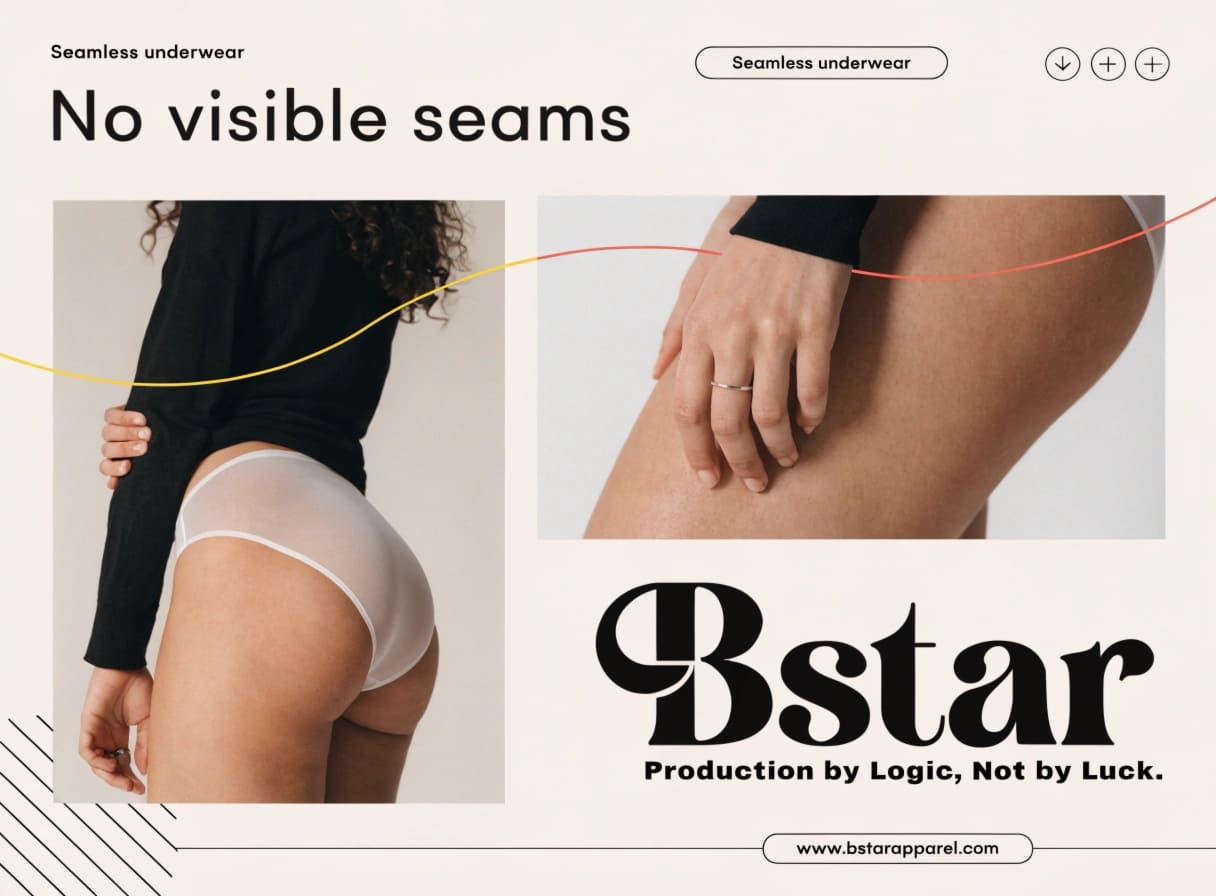
The consumer doesn’t need to know what a circular knitting machine is. They need to know the underwear disappears under their clothes and doesn’t hurt after eight hours. That’s a simple, repeatable value proposition — and it’s why seamless underwear has held shelf space across both fast fashion and premium DTC for over a decade4.
Where the Business Case Gets Real
The cost advantage of seamless construction is real for simple silhouettes. A basic brief or boyshort in a high-synthetic yarn can move through production faster than the cut-and-sew equivalent because there are fewer labor steps. But this advantage shrinks — or reverses — when the style requires complex shaping, structured support, or significant post-knit assembly.
| Business Factor | Seamless Advantage | Condition |
|---|---|---|
| Production speed | Faster for tube-form styles | Simple silhouette, no heavy assembly |
| Material waste | Lower than cut-and-sew | Depends on blank size vs. finished dimensions |
| Labor cost | Fewer sewing steps | Only applies to styles that don’t need extensive post-knit work |
| Return rate | Lower (comfort-driven) | Requires correct spec — not just any seamless product |
| Brand story | Strong and easy to communicate | Most effective in DTC, social, and influencer channels |
The brands we’ve worked with who get the best results from seamless underwear are the ones who come to sampling with a clear style category, a realistic price target, and an honest answer to this question: does my design actually benefit from what a circular knitting machine can do? When the answer is yes, the product usually lands well. When the answer
Conclusion
Seamless underwear technology works — but only when your style, gauge, and factory capability are matched correctly. If you’re evaluating a seamless SKU, the next step is a real sampling conversation, not a spec sheet comparison.
-
"[PDF] Ultrasonic seaming of PET, PET/cotton blend, and spectra fabrics", https://commons.emich.edu/context/theses/article/1176/viewcontent/reddy.pdf. Textile joining literature notes that ultrasonic welding is limited to thermoplastic materials; natural fibers such as cotton do not melt and resolidify under ultrasonic energy, precluding effective bonding in high-cotton-content constructions. Evidence role: mechanism; source type: paper. Supports: That natural cellulosic fibers such as cotton lack the thermoplastic properties required for ultrasonic fusion, making the technique unsuitable for high-cotton-content fabrics. Scope note: Sources may address this limitation in the context of industrial welding broadly rather than specifically in underwear or apparel manufacturing ↩
-
"Towards Reliable Adhesive Bonding: A Comprehensive Review of …", https://pmc.ncbi.nlm.nih.gov/articles/PMC12195023/. Studies on adhesive-bonded textile constructions report that wash durability is critically dependent on adhesive polymer grade and application temperature, with inadequate process control leading to progressive delamination across repeated laundering cycles. Evidence role: mechanism; source type: paper. Supports: That hot-melt adhesive bonds in textile applications are susceptible to delamination under repeated laundering conditions when adhesive formulation or processing parameters are suboptimal. Scope note: Published studies may use standardized wash protocols that differ from consumer laundering conditions referenced in the article ↩
-
"Best Male Bulge Enhancing Underwear for Everyday Comfort and …", https://ojs.law.cornell.edu/plugins/generic/pdfJsViewer/pdf.js/web/viewer.html?file=%2Findex.php%2Findex%2Flogin%2FsignOut%3Fsource%3D%2Enutrao%2Eshop%2Fmale%2F&id=080BSl. Consumer research on intimate apparel purchasing behavior identifies comfort attributes — including absence of visible seam lines under clothing and reduction of skin irritation at seam contact points — as leading drivers of preference for seamless constructions over traditional cut-and-sew alternatives. Evidence role: general_support; source type: institution. Supports: That elimination of visible seam lines and reduction of skin friction are primary consumer motivations for purchasing seamless underwear. Scope note: Publicly available consumer studies on this specific category are limited; support may come from broader apparel comfort research rather than underwear-specific surveys ↩
-
"Underwear – Wikipedia", https://en.wikipedia.org/wiki/Underwear. Industry market analyses of the intimate apparel sector document seamless knit underwear as an established product category with sustained retail presence across price tiers since at least the early 2010s, driven by consumer demand for comfort and invisible wearability. Evidence role: historical_context; source type: institution. Supports: That seamless knit underwear has been a sustained commercial category in both mass-market and premium retail channels for at least a decade. Scope note: Precise timeline and channel-specific data vary by source; the claim of ‘over a decade’ is directionally supported but exact market entry dates differ by brand and geography
is "we just want it to say seamless," it’s a harder conversation. ↩