

How to Start a Men’s Underwear Brand With an OEM Factory?
You want to launch a men’s underwear brand. You’ve done the research. You’ve seen the margins. But you have no idea how to actually get a product made — and every factory website looks the same.
You can start a men’s underwear brand with an OEM factory even without a big budget or prior sourcing experience. The real barrier isn’t minimum order quantity — it’s arriving at the factory conversation prepared. Founders who come with clear fabric references, fit direction, and brand specs get usable samples. Founders who don’t, waste months.

I work on the factory side. Every week, I talk to DTC founders at different stages — some with a full brief, some with just a screenshot of a competitor’s product. The gap in outcomes between those two groups is enormous. This article is what I’d tell every first-time founder before they send that first inquiry email.
How Do You Define Your Brand Before You Even Talk to a Factory?
Most founders think the factory conversation is where the product gets defined. It isn’t. If you walk in without a clear brand direction, you’ll get a generic product — because the factory will fill in every blank you leave open with whatever they’ve made before.
Before contacting any OEM factory, you need three things: a target customer profile, a price point, and at least one physical fabric or fit reference. These three inputs determine everything — fabric composition, waistband construction, and where your product sits in the market.
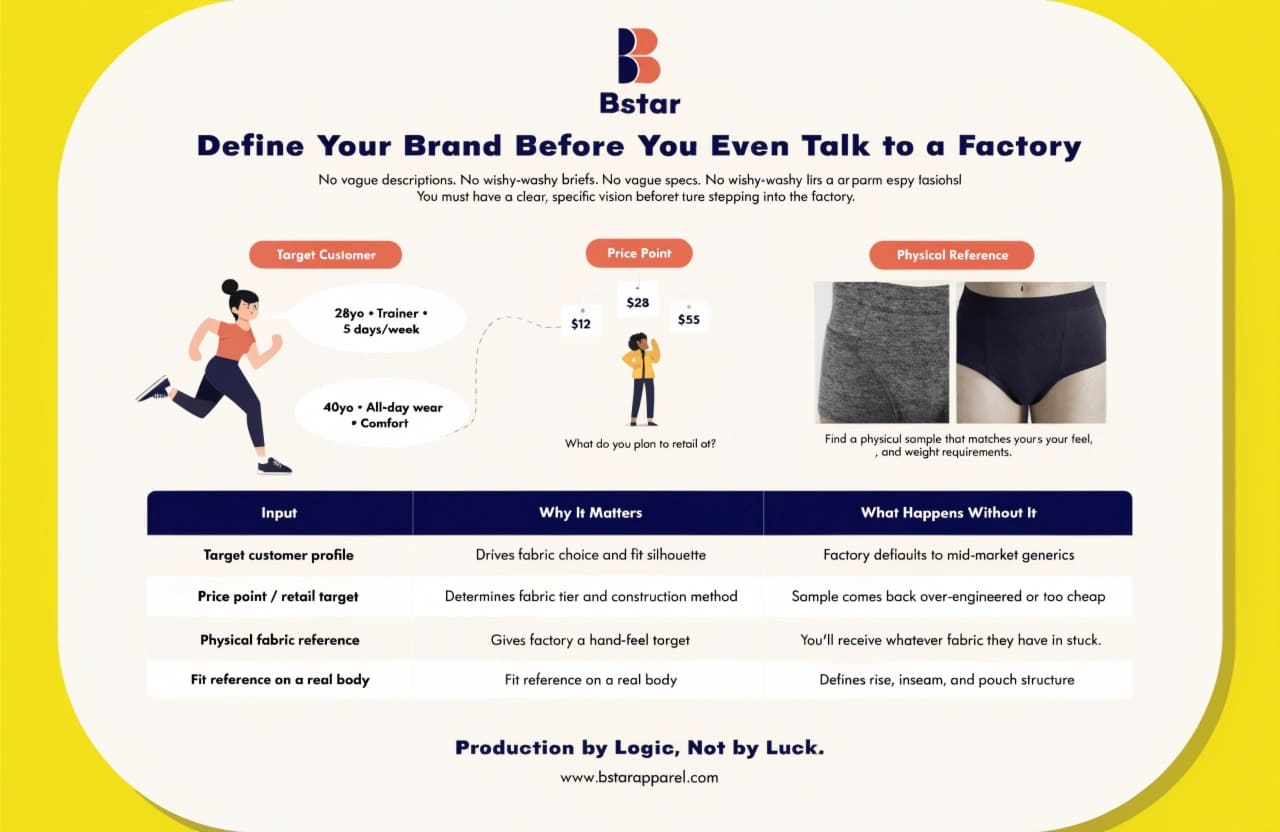
Your target customer shapes everything downstream. A 28-year-old who trains five days a week wants different fabric behavior than a 40-year-old who prioritizes all-day comfort. These aren’t marketing distinctions — they’re spec decisions that affect modal percentage, spandex ratio, and waistband width.
Here’s where most first-time founders make their first mistake: they skip the physical reference step. They find a photo online and send it over. That’s not a brief. That’s a starting point for misaligned expectations.
What You Actually Need to Prepare
| Input | Why It Matters | What Happens Without It |
|---|---|---|
| Target customer profile | Drives fabric choice and fit silhouette | Factory defaults to mid-market generics |
| Price point / retail target | Determines fabric tier and construction method | Sample comes back over-engineered or too cheap |
| Physical fabric reference | Gives factory a hand-feel target | You’ll receive whatever fabric they have in stock |
| Fit reference on a real body | Defines rise, inseam, and pouch structure | Sample fit is a guess |
The price point conversation is especially important. If you want to retail at $28 per pair, the factory needs to engineer a product that hits your cost target while meeting that expectation. That’s a two-way calibration — not something the factory does alone.
How Do You Find and Vet an OEM Factory That Actually Fits Your Scale?
The factory sourcing stage looks easy from the outside. You post on Alibaba, get forty replies, pick one. In practice, choosing wrong here delays your launch by months.
When evaluating an OEM underwear factory, check three things first: whether they’ve made comparable products for Western DTC brands, what their actual sample lead time is, and whether their minimum order flexibility matches your launch plan. A factory that only talks about bulk capacity is not the right partner for a first-time founder.
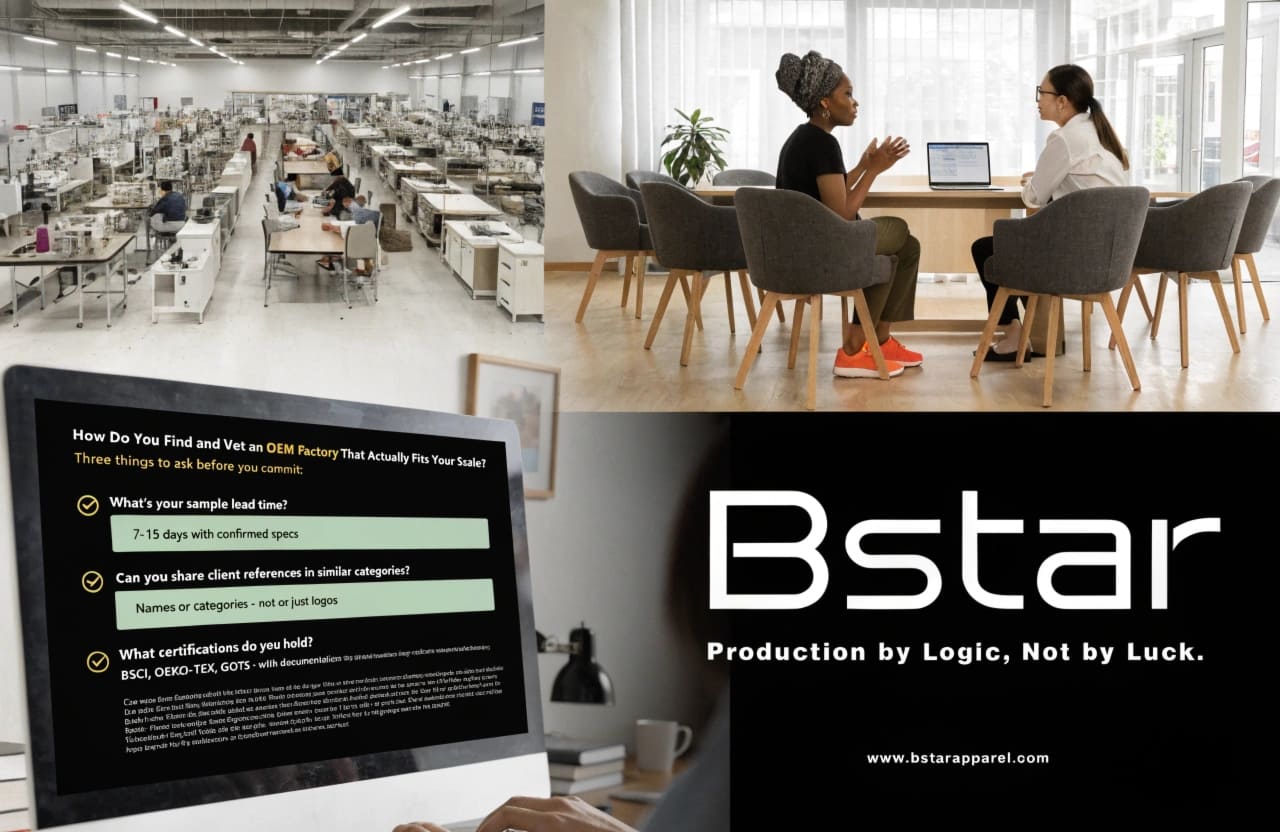
From where I sit, I can tell within two or three emails whether a founder is going to have a smooth sampling experience. The ones who do have already thought through their product. The ones who struggle are often trying to outsource the thinking to the factory.
What to Ask Before You Commit
Don’t evaluate a factory on their website photos. Evaluate them on how they answer specific questions.
| Question to Ask | What a Good Answer Looks Like |
|---|---|
| What’s your sample lead time? | 7–15 days with confirmed specs |
| Can you share client references in similar categories? | Names or categories — not just logos |
| What certifications do you hold? | BSCI, OEKO-TEX, GOTS — with documentation |
| What do you need from me to start a sample? | Fabric spec, fit reference, tech pack or sketch |
A note on certifications: BSCI and OEKO-TEX don’t guarantee your product will fit well or sell. What they do give you is a compliance baseline that matters when you’re selling into Europe or North America — for customs, for retail buyers, and for the increasing number of consumers who check this before they buy. Ask for the actual certificates, not just the logo on the website.
One more thing: a factory that supports small-batch development isn’t doing you a favor — it’s a normal capability in the knit apparel space. Don’t let low MOQ be the main reason you choose a factory. It’s the floor, not the ceiling.
How Do You Get Through the Sample Stage Without Losing Three Months?
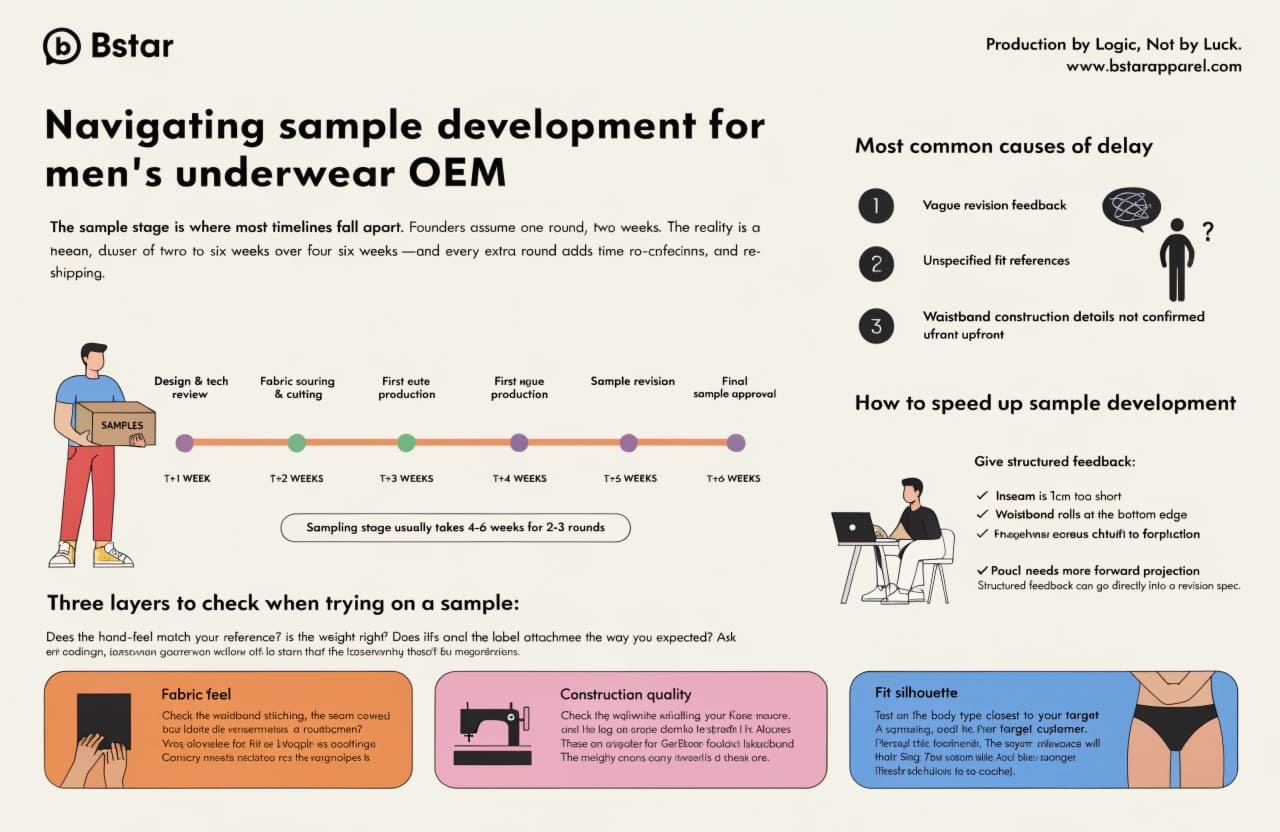
The sample stage is where most timelines fall apart. Founders assume one round, two weeks, done. The reality is closer to two or three rounds over four to six weeks — and every extra round adds time because of shipping, revision notes, and re-confirmation.
The sampling stage for men’s underwear typically requires two to three rounds and takes four to six weeks total. The most common causes of delay are vague revision feedback, unspecified fit references, and waistband construction details that weren’t confirmed upfront.
Here’s what I see over and over: a founder gets the first sample, tries it on, and says "the fit feels off." That feedback tells us almost nothing. Which part feels off — the rise, the leg opening, the pouch? On what body type? Compared to what reference?
The founders who get through sampling fast are the ones who give structured feedback. They say: "The inseam is 1cm too short, the waistband rolls at the bottom edge, and the pouch needs more forward projection." That feedback can go directly into a revision spec.
The Three Layers of Fit Feedback
When you try on a sample, check these three layers separately:
Fabric feel — Does the hand-feel match your reference? Is the weight right? Does it breathe the way you expected? Ask the factory to confirm fiber composition against what was specified. This is something you should ask them to verify with a lab report if it matters to your brand claims.
Construction quality — Check the waistband stitching, the seam allowance at the leg opening, and the label attachment. These are the first things that fail in wash testing. Ask the factory what their in-line quality checks cover at each stage.
Fit silhouette — Test on the body type closest to your target customer. A sample that fits a medium-build factory model will not necessarily fit a broader athletic build. If fit is your brand’s main promise, this is where you invest the most revision rounds.
How Do You Move From Approved Sample to a Successful Brand Launch?
You have an approved sample. The temptation is to place the bulk order immediately and start counting down to launch. This is where founders make their last and most expensive mistake.
After sample approval, bulk production typically takes four to six weeks depending on order size and fabric lead time. Founders who don’t account for this in their launch timeline often run out of runway before their first shipment lands.
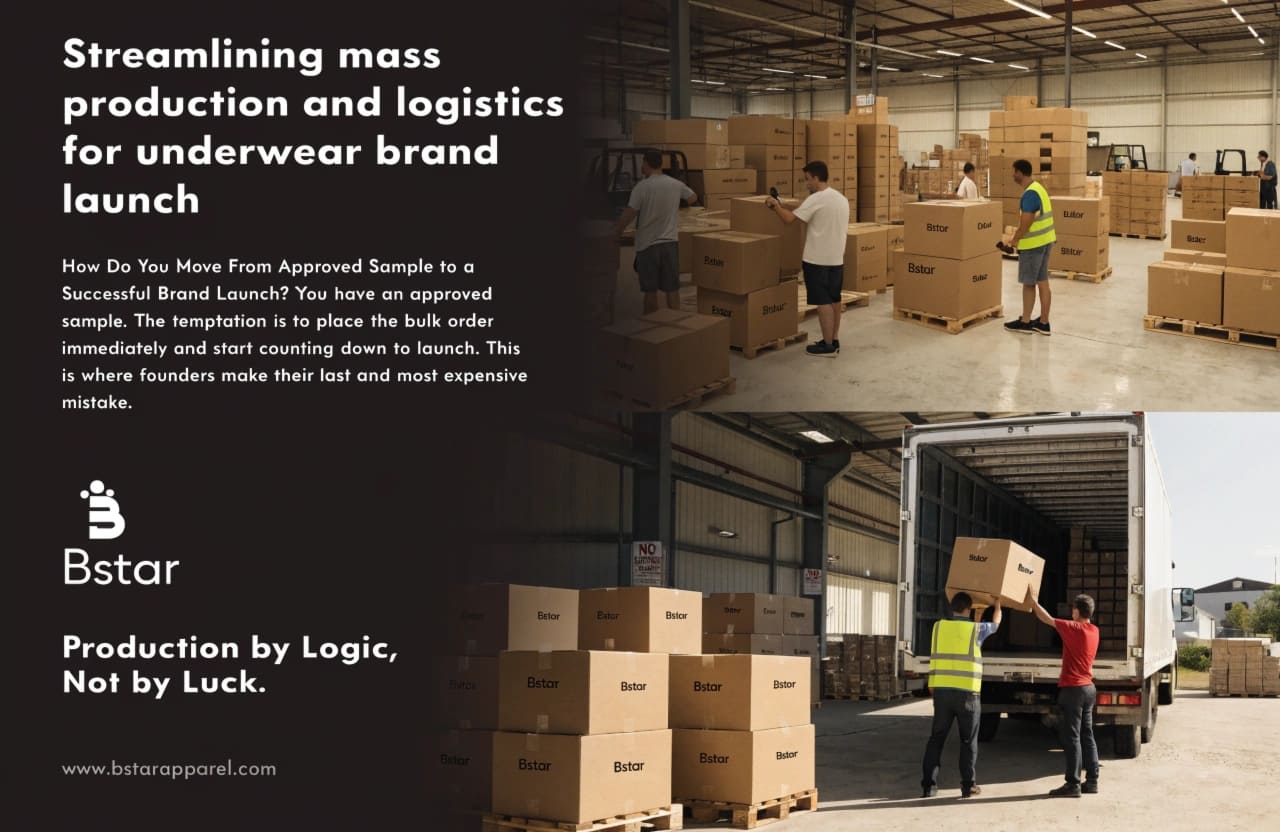
Build your timeline backwards from your launch date. If you want product in-hand by a specific date, work back through shipping time (three to five weeks for sea freight to Europe or North America), production time, and pre-production confirmation. Most founders who miss their launch date didn’t miss it in production — they missed it in planning.
A Realistic Timeline From First Inquiry to Bulk-Ready
| Stage | Realistic Time |
|---|---|
| Brief preparation and factory selection | 1–2 weeks |
| First sample development | 7–15 days |
| Sample revisions (2–3 rounds) | 2–4 weeks |
| Bulk production | 4–6 weeks |
| Sea freight to EU / NA | 3–5 weeks |
| Total minimum | 10–16 weeks |
Plan for sixteen weeks. If things go well, you’ll finish in ten. If you plan for ten and hit one delay, your launch window closes.
During bulk production, ask for a mid-production quality check. This is not standard unless you request it. Ask the factory to pull units at the midpoint and confirm that waistband construction, stitching consistency, and fabric lot match the approved sample. This one step catches most bulk quality drift before it becomes a return problem.
Conclusion
Starting a men’s underwear brand with an OEM factory is doable at your current scale — but preparation is what separates a clean launch from a six-month delay. Come with clear specs, give structured feedback, and plan your timeline honestly.
Discussion & questions 0 comments