
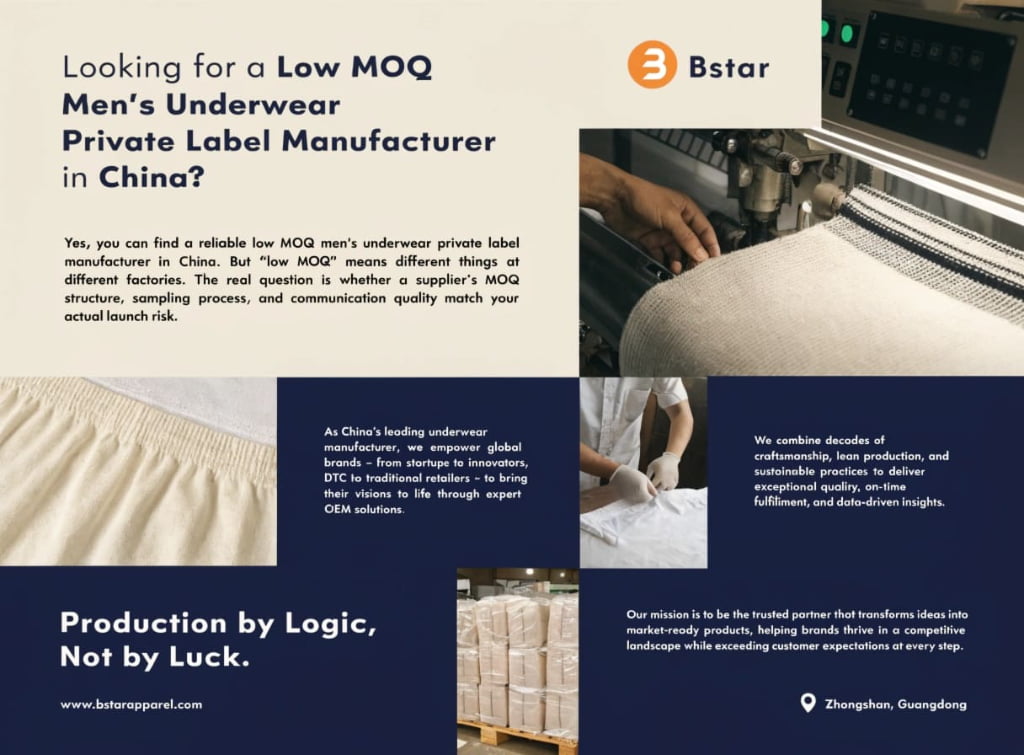
Looking for a Low MOQ Men’s Underwear Private Label Manufacturer in China?
Starting a men’s underwear brand feels exciting — until you realize most factories want 1,000+ pieces before they’ll even talk to you. That kills momentum fast.
The short answer: yes, low MOQ private label manufacturing for men’s underwear exists in China, and it is a realistic path for DTC founders. But "low MOQ" means different things at different factories. The real question is whether a supplier’s MOQ structure, sampling process, and communication quality match your actual launch risk.
I work with DTC brands at BSTAR, a knitwear OEM/ODM factory in Zhongshan, Guangdong. I talk to first-time founders almost every week. The same questions come up again and again. This post answers the ones that actually matter.
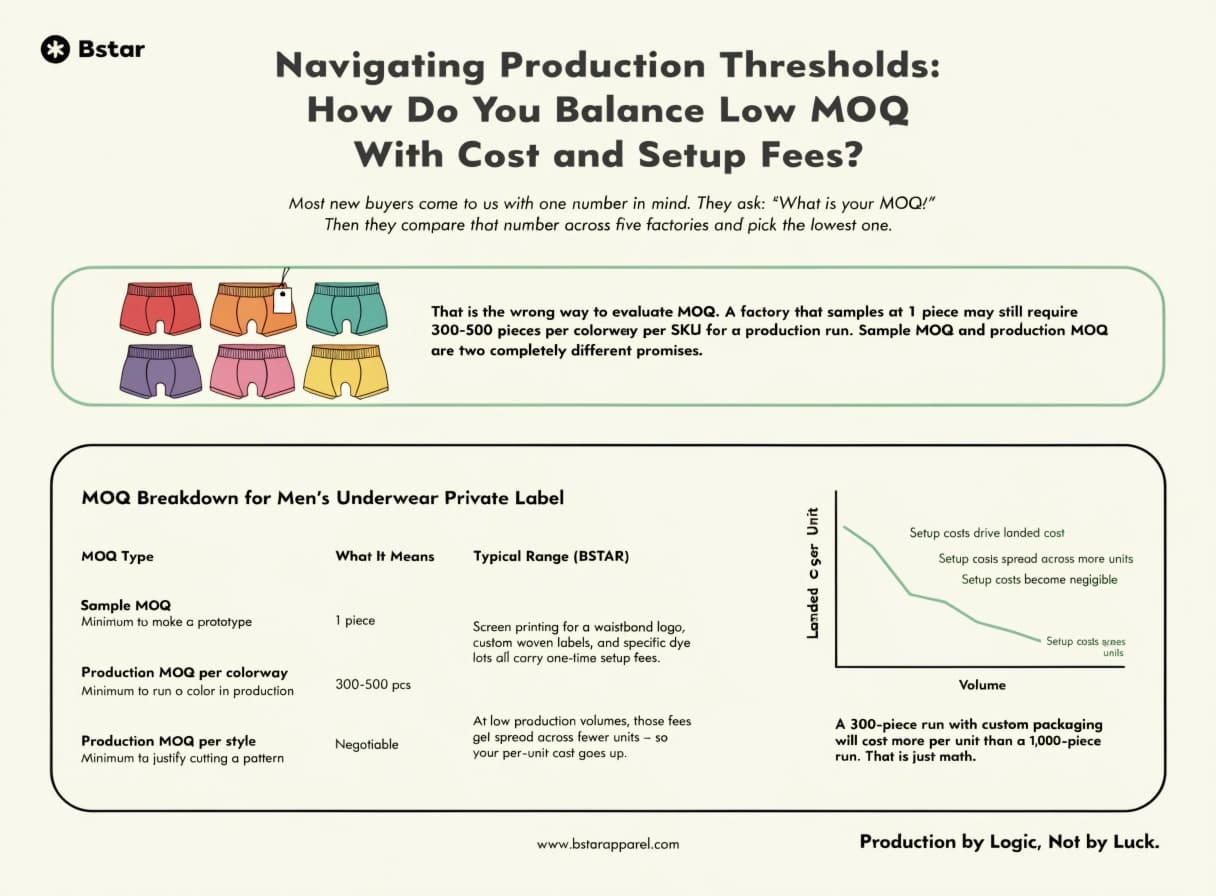
Most new buyers come to us with one number in mind. They ask: "What is your MOQ?" Then they compare that number across five factories and pick the lowest one.
That is the wrong way to evaluate MOQ. A factory that samples at 1 piece may still require 300–500 pieces per colorway per SKU for a production run1. Sample MOQ and production MOQ are two completely different promises.
Here is how to think about this more clearly.
What Does the MOQ Number Actually Cover?
| MOQ Type | What It Means | Typical Range (BSTAR) |
|---|---|---|
| Sample MOQ | Minimum to make a prototype | 1 piece |
| Production MOQ per colorway | Minimum to run a color in production | 300–500 pcs |
| Production MOQ per style | Minimum to justify cutting a pattern | Negotiable |
When you see a factory advertising "MOQ: 1 piece," they usually mean samples. Production is a separate conversation.
Setup costs matter too. Screen printing for a waistband logo, custom woven labels, and specific dye lots all carry one-time setup fees2. At low production volumes, those fees get spread across fewer units — so your per-unit cost goes up. A 300-piece run with custom packaging will cost more per unit than a 1,000-piece run. That is just math.
What I tell new clients: don’t chase the lowest MOQ. Ask instead whether the supplier can walk you through the full cost structure — sampling fee, production unit price, setup fees, and shipping — so you can see your real landed cost before committing.
Private Label Customization at Small Volumes: Can You Still Get Real Branding?
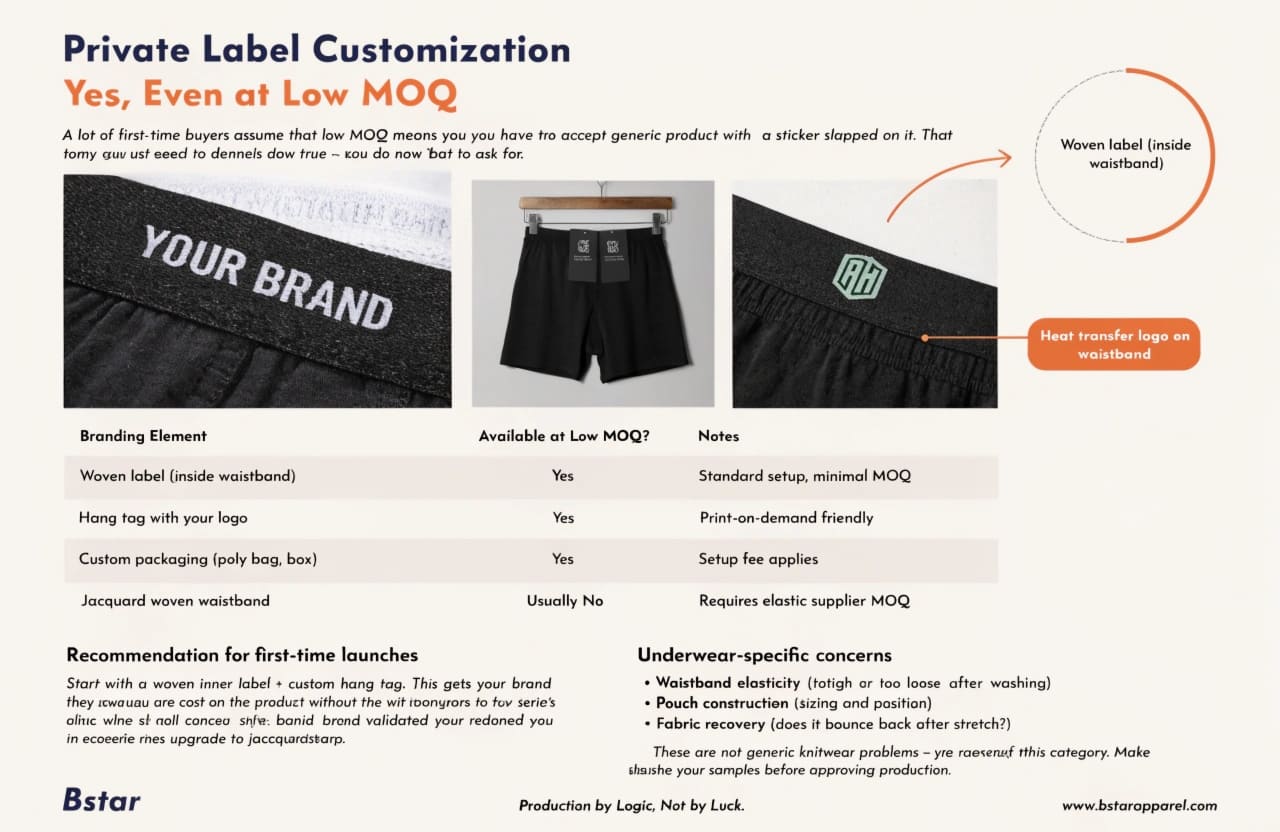
A lot of first-time buyers assume that low MOQ means you have to accept generic product with a sticker slapped on it. That is not true — but you do need to know what to ask for.
At small volumes, private label customization for men’s underwear typically includes custom woven waistband labels, hang tags, inner care labels, and packaging. Full waistband jacquard (where your brand name is woven into the elastic itself) usually requires higher MOQs because the elastic is custom-made3.
Here is how I break it down for new clients.
Branding Options by Volume
| Branding Element | Available at Low MOQ? | Notes |
|---|---|---|
| Woven label (inside waistband) | Yes | Standard setup, minimal MOQ |
| Hang tag with your logo | Yes | Print-on-demand friendly |
| Custom packaging (poly bag, box) | Yes | Setup fee applies |
| Jacquard woven waistband | Usually No | Requires elastic supplier MOQ |
| Heat transfer logo on waistband4 | Yes | Good low-MOQ alternative |
For a first launch, I usually recommend starting with a woven inner label and custom hang tag. This gets your brand on the product without the cost of a full custom waistband. Once you have validated the style and have reorder volume, you upgrade to jacquard.
One more thing specific to underwear: fit and fabric feel matter more here than in most other categories. The most common complaints we hear after first samples are about waistband elasticity (too tight or too loose after washing), pouch construction (sizing and position), and fabric recovery (does it bounce back after stretch?)5. These are not generic knitwear problems — they are specific to this category. Make sure you test wash your samples before approving production.
Vetting Reliable Chinese Suppliers: What Should a New DTC Brand Actually Look For?
I have heard some painful stories from founders who got burned. Not because the factory was malicious — but because the founder did not know what questions to ask before placing an order.
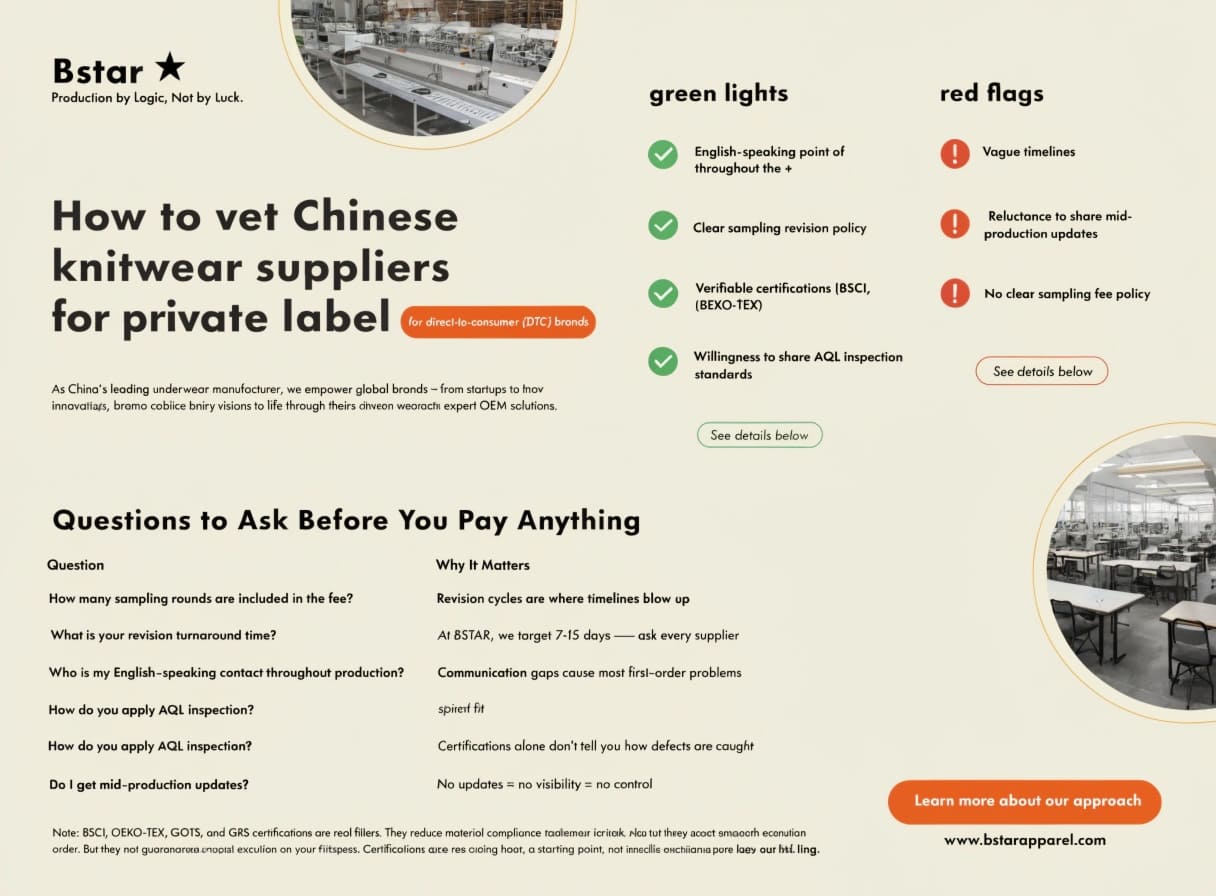
The green lights for a reliable men’s underwear supplier are: English-speaking point of contact throughout the order, clear sampling revision policy, verifiable certifications (BSCI, OEKO-TEX), and willingness to share AQL inspection standards6. Red flags are vague timelines, reluctance to share mid-production updates, and no clear sampling fee policy.
Let me be more specific about what to ask.
Questions to Ask Before You Pay Anything
| Question | Why It Matters |
|---|---|
| How many sampling rounds are included in the fee? | Revision cycles are where timelines blow up |
| What is your revision turnaround time? | At BSTAR, we target 7–15 days — ask every supplier |
| Who is my English-speaking contact throughout production? | Communication gaps cause most first-order problems |
| How do you apply AQL inspection? | Certifications alone don’t tell you how defects are caught |
| Do I get mid-production updates? | No updates = no visibility = no control |
On certifications: BSCI, OEKO-TEX, GOTS, and GRS certifications are real filters. They reduce material compliance risk7. But they do not guarantee smooth execution on your specific order. A certified factory can still deliver late or miss fit specs. Certifications are a starting point, not a finish line8.
The real green light is a supplier who can answer every question in the table above without hesitation. If they go quiet or get vague on any of those — especially revision policy and mid-production updates — that is a real warning sign.
Scaling Up: How Do You Move From a Trial Order to Full Production?
Most first-time buyers think about the trial order. They do not think about what comes after.
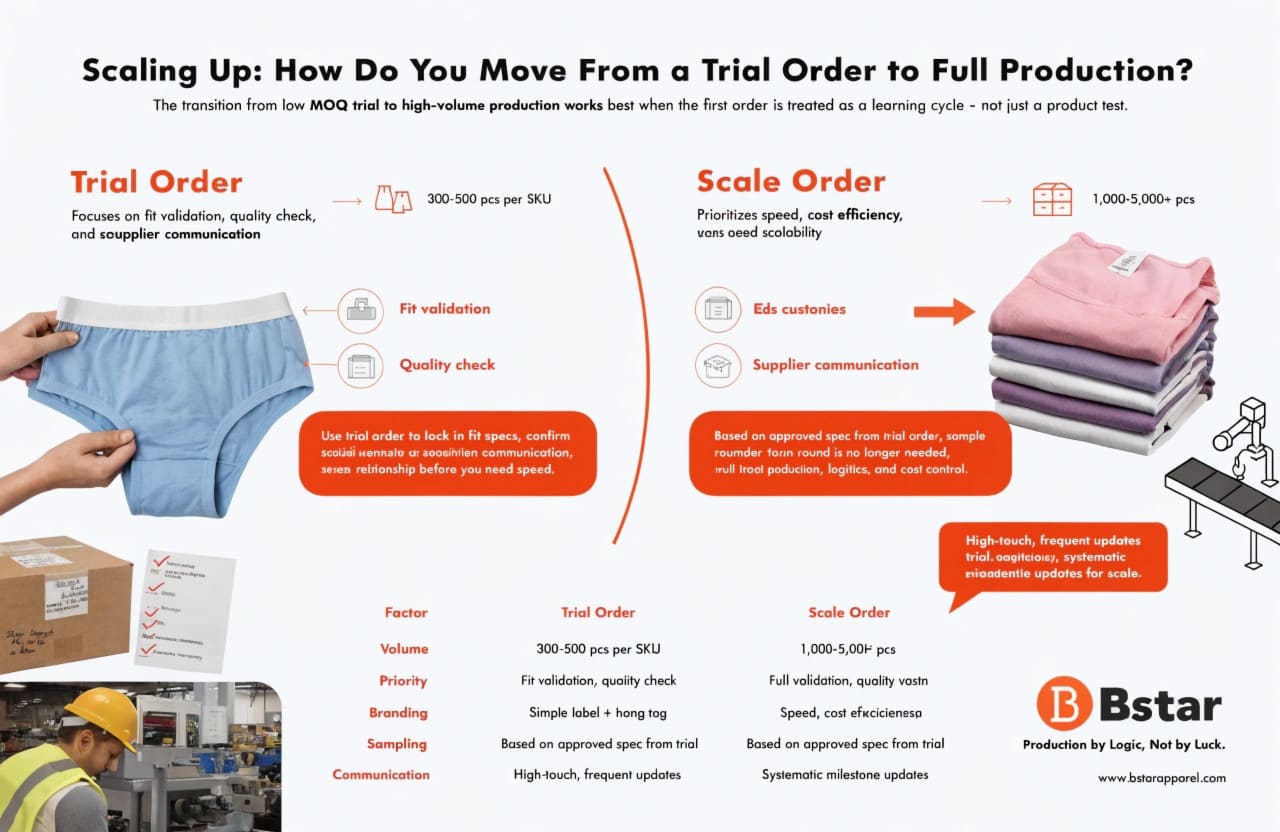
The transition from low MOQ trial to high-volume production works best when the first order is treated as a learning cycle9 — not just a product test. Use it to lock in fit specs, confirm supplier communication, and build a reorder relationship before you need speed.
Here is how I think about the two phases.
Trial Order vs. Scale Order: What Changes
| Factor | Trial Order | Scale Order |
|---|---|---|
| Volume | 300–500 pcs per SKU | 1,000–5,000+ pcs |
| Priority | Fit validation, quality check | Speed, cost efficiency |
| Branding | Simple label + hang tag | Full custom waistband possible |
| Sampling | Multiple rounds expected | Based on approved spec from trial |
| Communication | High-touch, frequent updates | Systematic milestone updates |
At BSTAR, we can support up to 50,000 pieces per day at full capacity10 — but that is not what a first-order client needs to hear. What matters for a new brand is that the supplier has the systems to grow with you, so you are not re-qualifying a new factory every time you scale.
The signal that a supplier is worth scaling with: they keep your approved specs on file, they have a production team familiar with your style, and they can give you a realistic lead time when you come back with a bigger order. That relationship only builds if the trial order goes well — which is why getting the first one right matters more than getting it cheap.
Conclusion
Low MOQ men’s underwear manufacturing in China is real and workable — but only if you pick the right supplier structure, ask the right questions, and treat your trial order as a foundation, not just a transaction.
-
"Minimum Order Quantity (MOQ): A Guide for Apparel Brands", https://www.wearview.co/glossary/minimum-order-quantity. Industry analyses of apparel supply chains document that production minimum order quantities commonly range from 300 to 500 units per colorway, reflecting the economic thresholds of fabric cutting, dyeing, and machine setup, whereas sample production operates under separate, lower minimums. Evidence role: statistic; source type: research. Supports: Typical production MOQ ranges in apparel and knitwear manufacturing, distinguishing sample from production minimums. Scope note: Published MOQ benchmarks vary by product category, region, and factory tier; figures cited may not uniformly apply to underwear or knitwear specifically ↩
-
"Private Label Fashion Tops Manufacturing Cost Guide – Argus Apparel", https://argusapparel.com/blog/fashion-tops-manufacturing-cost/. Cost accounting principles applied to manufacturing establish that fixed setup costs—such as tooling, screen preparation, and dye lot formulation—are amortized across total units produced, causing per-unit cost to decline as volume increases, a relationship documented in operations management literature. Evidence role: mechanism; source type: education. Supports: The cost mechanics by which fixed setup fees increase per-unit cost at lower production volumes. Scope note: General cost accounting principles support the mechanism described, but specific fee amounts for apparel setup operations are not standardized and vary by supplier ↩
-
"How Is Jacquard Elastic Webbing Made? – Anmyda", https://anmyda.com/how-jacquard-elastic-webbing-made/. Jacquard elastic production involves programming specialized looms to weave pattern-specific designs directly into the elastic structure, a process requiring dedicated machine setup and yarn preparation that elastic suppliers typically offset through minimum order thresholds distinct from standard elastic supply. Evidence role: mechanism; source type: research. Supports: Why jacquard woven elastic requires custom manufacturing processes that impose higher minimum order quantities. Scope note: Direct published data on jacquard elastic MOQ thresholds is limited; the mechanism is supported by textile engineering literature on jacquard weaving rather than elastic-specific sourcing studies ↩
-
"Heat Transfer Labels vs Woven Labels: Which Is Better? – DOY Label", https://www.doylabel.com/heat-transfer-labels-vs-woven-labels/?srsltid=AfmBOoqZGz-5oxb6twMBuxs6jrUsGNjfA2zdt_9Q9k3H7oDmFJAuV2ow. Heat transfer printing applies pre-printed designs to textile substrates using heat and pressure to bond a carrier film; textile testing standards such as ISO 105-C06 assess colorfastness and adhesion durability after laundering, with heat transfer labels generally showing acceptable performance on stable substrates but variable results on high-stretch elastic materials depending on adhesive formulation. Evidence role: mechanism; source type: research. Supports: The technical basis and durability characteristics of heat transfer printing as a branding method on elastic and textile substrates. Scope note: Performance data for heat transfer on elastic waistband substrates specifically is limited in published literature; durability outcomes depend heavily on adhesive type and application conditions ↩
-
"Microfiber release from real soiled consumer laundry and the impact …", https://pmc.ncbi.nlm.nih.gov/articles/PMC7274375/. Consumer product research on men’s underwear identifies fit, waistband comfort, and fabric performance after repeated laundering as leading determinants of satisfaction and return rates, consistent with textile testing standards that evaluate elastic retention and dimensional stability after washing. Evidence role: general_support; source type: research. Supports: That waistband performance, fit construction, and fabric elastic recovery are primary quality dimensions in men’s underwear. Scope note: The claim reflects practitioner experience; published consumer complaint data specific to men’s underwear private label is limited, and available studies may reflect mass-market rather than small-batch production contexts ↩
-
"[PDF] ISO 2859-1 – UNT Chemistry", https://chemistry.unt.edu/~tgolden/courses/iso2859-1.pdf. Acceptable Quality Level (AQL) inspection is governed by ISO 2859-1 (formerly MIL-STD-1916 and ANSI/ASQ Z1.4), which defines statistical sampling plans used to determine whether a production lot meets a specified maximum defect rate; the standard is widely adopted in apparel and consumer goods manufacturing to systematize incoming and outgoing quality inspection. Evidence role: definition; source type: institution. Supports: The definition and function of AQL inspection as an internationally standardized sampling method for quality control. ↩
-
"Oeko-Tex – Wikipedia", https://en.wikipedia.org/wiki/Oeko-Tex. OEKO-TEX Standard 100 tests for harmful substances in textiles; GOTS (Global Organic Textile Standard) governs organic fiber processing and social criteria; BSCI (Business Social Compliance Initiative) audits social standards in supply chains; and GRS (Global Recycled Standard) verifies recycled content claims—each administered by independent bodies that conduct third-party audits to reduce specific categories of compliance risk. Evidence role: definition; source type: institution. Supports: What OEKO-TEX, GOTS, BSCI, and GRS certifications cover and how they reduce material and social compliance risk. Scope note: Certification scope is defined by each standard’s published criteria; the article’s broader claim that certifications reduce ‘material compliance risk’ is accurate for OEKO-TEX and GRS but only partially applicable to BSCI, which addresses social rather than material compliance ↩
-
"“Obsessed with Audit Tools, Missing the Goal”: Why Social Audits …", https://www.hrw.org/report/2022/11/15/obsessed-audit-tools-missing-goal/why-social-audits-cant-fix-labor-rights-abuses. Supply chain management research has documented that third-party social and environmental audits assess compliance with defined standards at a point in time but do not measure operational capabilities such as production scheduling, quality control systems, or specification management, leading scholars to caution against treating certification as a proxy for overall supplier reliability. Evidence role: expert_consensus; source type: paper. Supports: That social and material compliance certifications do not reliably predict supplier operational performance such as delivery timeliness or specification adherence. Scope note: Research on audit limitations focuses primarily on social compliance audits; peer-reviewed studies specifically linking OEKO-TEX or GRS certification to delivery performance gaps are limited ↩
-
"Supplier Development Training – Supply Chain Resource Cooperative", https://scm.ncsu.edu/scm-articles/article/supplier-development-training. Supply chain and new product development literature supports the use of pilot or trial production runs as structured learning opportunities, emphasizing that early orders should be used to validate specifications, assess supplier communication systems, and establish shared quality standards before committing to high-volume production. Evidence role: expert_consensus; source type: paper. Supports: That iterative, learning-oriented trial orders improve supplier relationship quality and scaling outcomes in apparel supply chains. Scope note: Published research on this topic addresses general manufacturing and supply chain contexts; studies specific to small-batch DTC apparel brand scaling are limited ↩
-
"Apparel Manufacturing: NAICS 315 – Bureau of Labor Statistics", https://www.bls.gov/iag/tgs/iag315.htm. Industry reports on Chinese apparel and knitwear manufacturing document wide variation in factory daily output capacity, with small workshops producing hundreds to low thousands of units per day and mid-to-large facilities capable of tens of thousands, depending on product complexity, automation level, and workforce size. Evidence role: statistic; source type: research. Supports: Industry context for daily production capacity figures in knitwear and underwear manufacturing. Scope note: Publicly available, independently verified capacity benchmarks for underwear-specific manufacturing are limited; figures vary substantially by factory size, product type, and automation investment ↩
Discussion & questions 0 comments