Men’s Underwear Factory Audit Checklist (BSCI/Sedex): What Buyers Actually Need to Check?
Sourcing from a new factory always carries risk. But when your supplier holds a BSCI or Sedex certificate, buyers often stop asking questions — and that is exactly when compliance gaps go undetected.
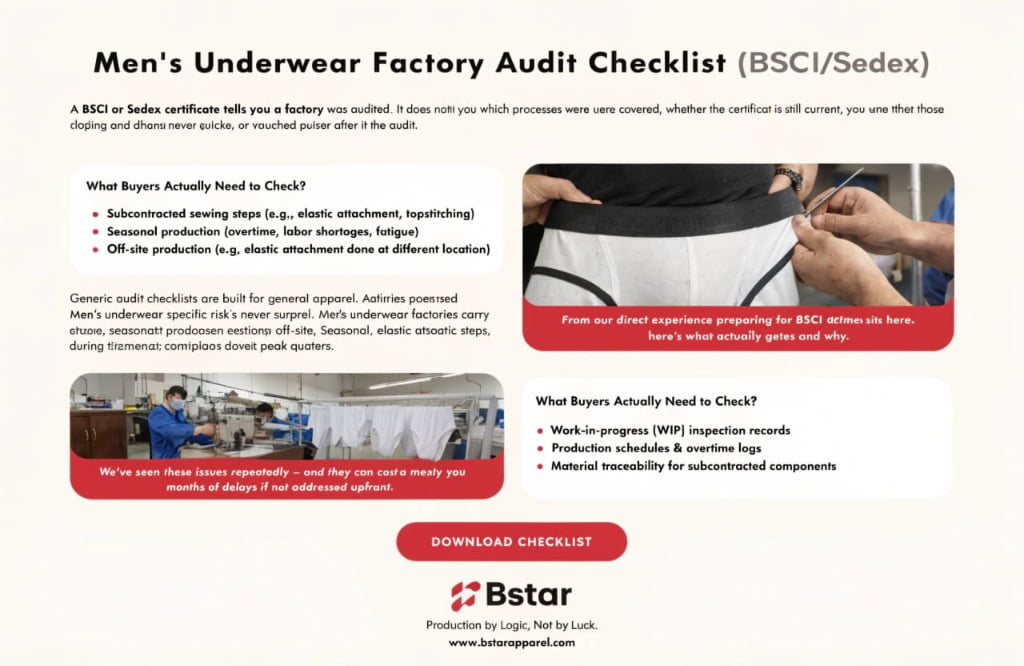
A BSCI or Sedex certificate tells you a factory was audited. It does not tell you which processes were covered, whether the certificate is still current, or whether seasonal production pushed the factory out of compliance after the audit date. This checklist covers the questions a certificate alone cannot answer.
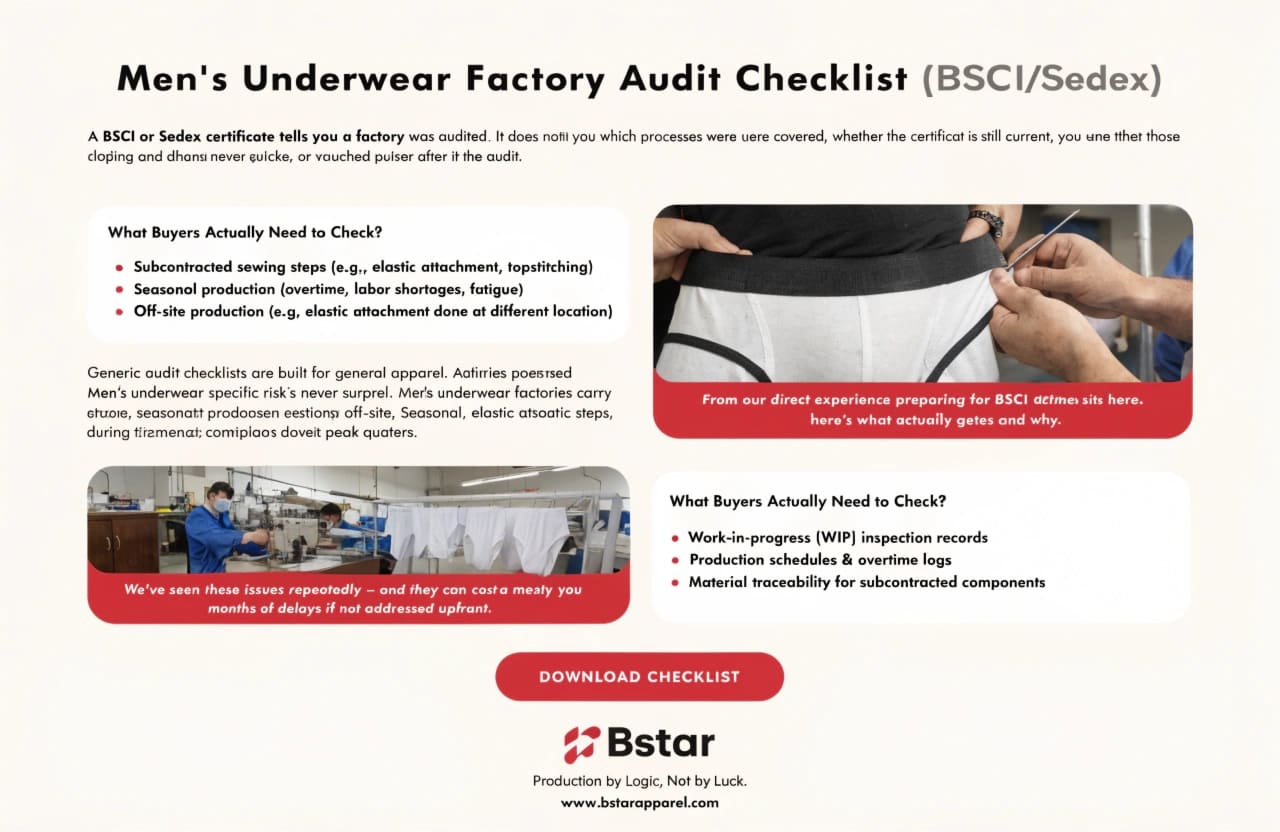
Generic audit checklists are built for general apparel. Men’s underwear factories carry specific risks that those lists never surface — subcontracted sewing steps, elastic attachment done off-site, seasonal overtime spikes during peak quarters. I want to walk through each major audit area and tell you, from our direct experience preparing for BSCI audits at BSTAR, what actually gets flagged and why.
Decoding Audit Frameworks: Are BSCI and Sedex Actually the Same Thing?
Many buyers treat them as interchangeable. They are not, and conflating them leads to either duplicated work or missing requirements.
BSCI is a brand-facing certification with a pass/fail outcome1. Sedex is a data-sharing platform — factories upload compliance data, and buyers run their own risk assessments against it2. Passing BSCI does not automatically satisfy a Sedex buyer’s internal threshold, and the reverse is also true.
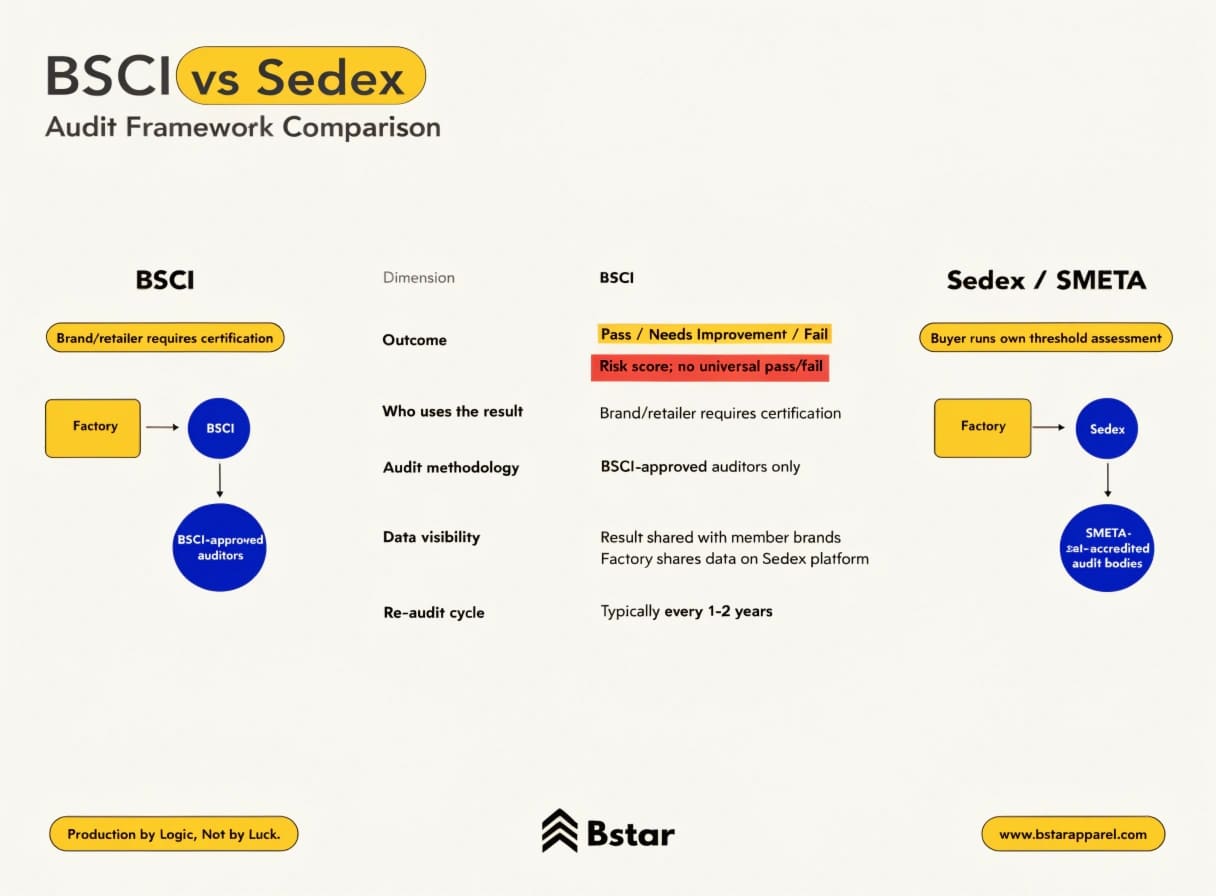
Here is how the two frameworks sit differently in a sourcing workflow:
How Do the Two Frameworks Compare in Practice?
| Dimension | BSCI | Sedex / SMETA |
|---|---|---|
| Outcome | Pass / Needs Improvement / Fail | Risk score; no universal pass/fail |
| Who uses the result | Brand/retailer requires certification | Buyer runs own threshold assessment |
| Audit methodology | BSCI-approved auditors only | SMETA-accredited audit bodies3 |
| Data visibility | Result shared with member brands | Factory shares data on Sedex platform |
| [Re-audit cycle | Typically every 1–2 years](https://www.amfori.org/amfori-bsci/)[^4] | Set by buyer requirement |
The practical implication for buyers: when you shortlist a Chinese underwear factory, ask which framework their certificate covers and whether your own compliance program requires a specific one. Do not assume a BSCI pass satisfies a Sedex buyer’s threshold — confirm it with your compliance team first.
One more thing worth checking early: certificate scope. A factory can hold a valid BSCI certificate for its main production building while key steps — waistband stitching, gusset assembly, bar tacking — happen at external workshops that sit entirely outside audit coverage4. Always ask: "Does your certificate cover every process involved in producing this product?"
Labor Rights and Compliance: Are the Wage and Hours Records Telling the Full Story?
This is the section where most underwear factories run into real friction. Wage and hours records look clean on paper. But underwear demand peaks sharply, and during high-season quarters, actual overtime can tell a very different story.
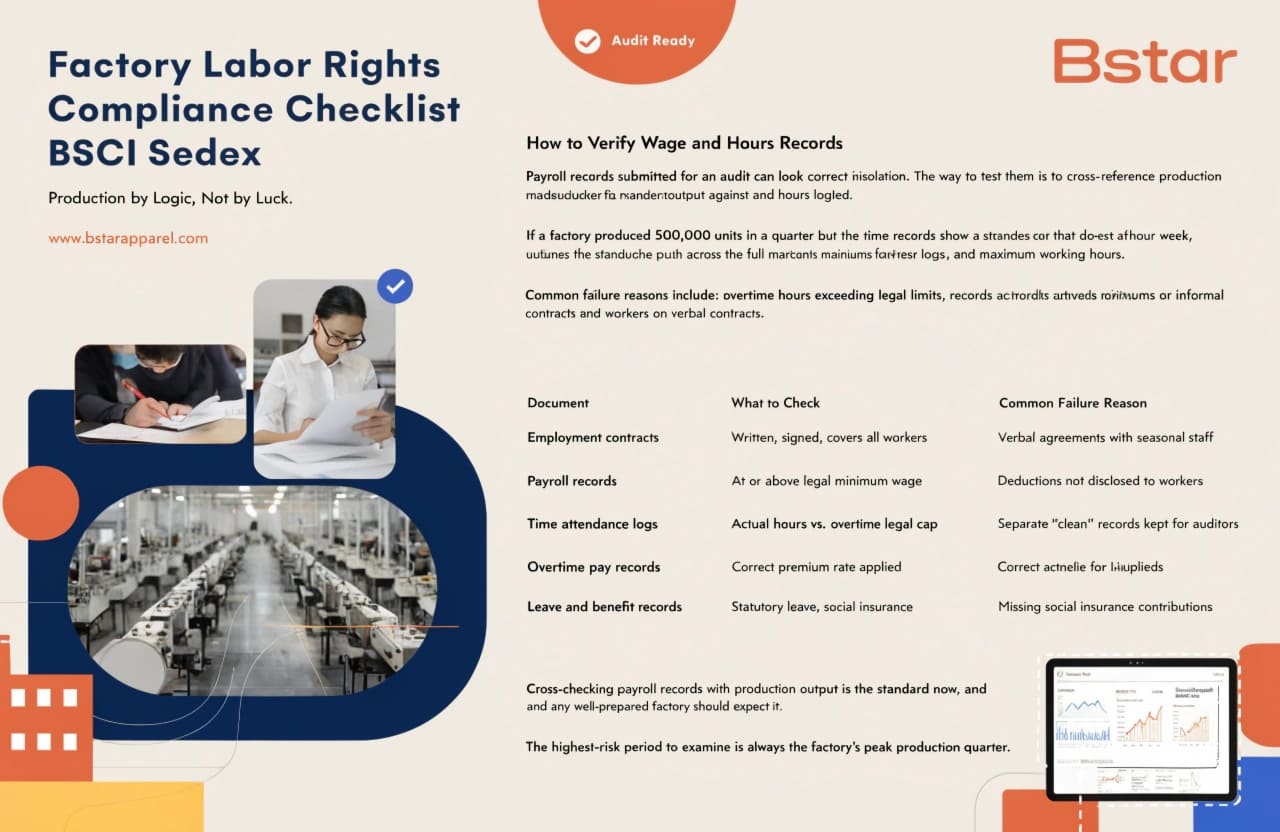
Auditors check payroll records, time attendance logs, and employment contracts against the legal minimums for wages and maximum working hours. Common failure reasons include: overtime hours exceeding legal limits5 [verify: local labor law figure for your jurisdiction], records that do not match actual output volumes, and workers on informal or verbal contracts.
What Should You Actually Cross-Check in the Records?
Payroll records submitted for an audit can look correct in isolation. The way to test them is to cross-reference production output against headcount and hours logged. If a factory produced 500,000 units in a quarter but the time records show a standard 40-hour week across the full workforce, the math usually does not hold up.
When we prepared for our BSCI audit at BSTAR, the auditor specifically asked us to produce both time attendance logs and production output reports for the same period — side by side6. That cross-check is the standard now, and any well-prepared factory should expect it.
Here is what to verify in this section:
| Document | What to Check | Common Failure Reason |
|---|---|---|
| Employment contracts | Written, signed, covers all workers | Verbal agreements with seasonal staff |
| Payroll records | At or above legal minimum wage | Deductions not disclosed to workers |
| Time attendance logs | Actual hours vs. overtime legal cap | Separate "clean" records kept for auditors7 |
| Overtime pay records | Correct premium rate applied | Standard rate paid for all hours |
| Leave and benefit records | Statutory leave, social insurance | Missing social insurance contributions8 |
The highest-risk period to examine is always the factory’s peak production quarter. Ask for records from that specific period, not a quiet month.
Health, Safety, and Environmental Standards: Does the Factory Floor Match the Paperwork?
A factory can have a fire safety policy on paper and a blocked emergency exit on the floor. Health and safety is the area where document review alone is not enough — someone needs to walk the production space.
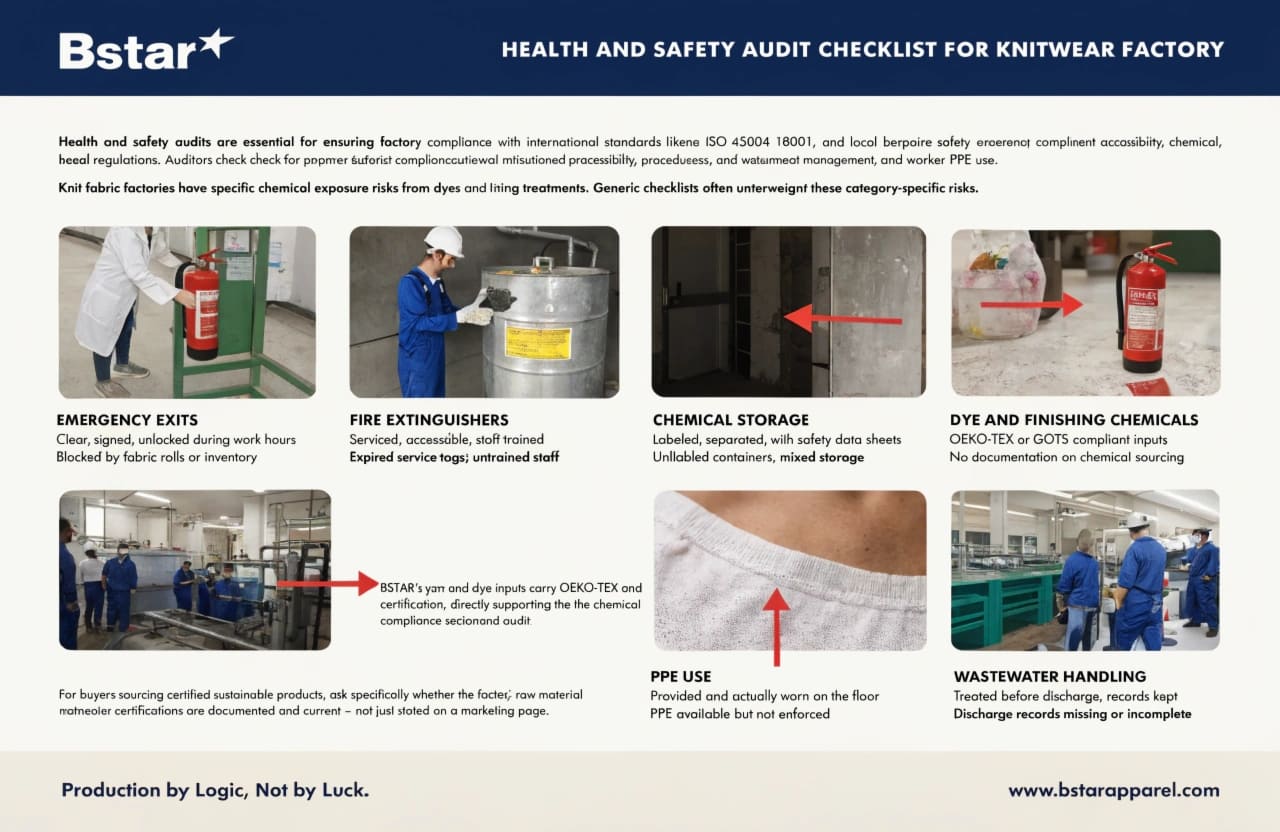
Auditors assess fire safety equipment, emergency exit accessibility, chemical handling procedures, wastewater and emissions management, and worker PPE use. Knit fabric factories carry specific chemical exposure risks from dyes and finishing treatments that generic checklists often underweight9.
What Does a Compliant Factory Floor Actually Look Like?
For a men’s underwear factory specifically, the health and safety checklist needs to cover both general factory requirements and category-specific risks from elastic materials, dyes, and fabric finishing chemicals.
| Area | What Compliant Looks Like | Common Gap |
|---|---|---|
| Emergency exits | Clear, signed, unlocked during work hours | Exits blocked by fabric rolls or inventory |
| Fire extinguishers | Serviced, accessible, staff trained | Expired service tags; untrained staff |
| Chemical storage | Labeled, separated, with safety data sheets | Unlabeled containers, mixed storage |
| Dye and finishing chemicals | OEKO-TEX or GOTS-compliant inputs10 | No documentation on chemical sourcing |
| PPE use | Provided and actually worn on the floor | PPE available but not enforced |
| Wastewater handling | Treated before discharge, records kept | Discharge records missing or incomplete |
At BSTAR, our yarn and dye inputs carry OEKO-TEX and GOTS certification, which directly supports the chemical compliance section of an audit. For buyers sourcing certified sustainable products, ask specifically whether the factory’s raw material certifications are documented and current — not just stated on a marketing page.
Audit Preparation and Remediation: Is the Factory Actually Ready, or Just Paper-Ready?
Factories that fail audits are not always non-compliant in practice. Many fail because their documentation is incomplete, their records are unorganized, or they have not closed out corrective actions from a previous audit cycle.
A well-prepared factory has three things in order before an audit: a complete, organized document trail; a log of any previous non-conformities and how they were closed; and a clear map of which production processes are in-scope for the audit certificate.

What Does a Clean Audit Preparation Trail Include?
When we were required to remediate a documentation gap during a previous audit cycle, the corrective action process was straightforward — but only because we already had the underlying records. The factories that struggle in remediation are the ones that need to recreate records after the fact, which is both time-consuming and a red flag to auditors.
Here is the core document set a factory should have organized and ready:
| Document Category | Specific Items | Red Flag |
|---|---|---|
| Corporate documents | Business license, factory registration | Expired or scope mismatch |
| Previous audit results | Last BSCI/SMETA report + corrective action log | No record of previous CAPs |
| Worker records | Full headcount list, contracts, payroll | Gaps in seasonal or contract worker records |
| Production scope map | Which processes are on-site vs. subcontracted | Subcontracted steps with no audit coverage |
| Environmental permits | Wastewater, emissions, waste disposal | Missing or out-of-date permits |
| Training records | Fire safety, chemical handling, first aid | Training completed but not documented |
The subcontracted process question is especially important for underwear factories. Small-batch, high-SKU knitwear production often routes specific sewing steps — car seams, elastic attachment — to external workshops11. Before commissioning a formal audit, ask the factory directly: "Which processes are performed off-site, and are those sites included in your current audit scope?" A factory that cannot answer that question clearly is not ready for audit.
Conclusion
A certificate is a starting point, not a final answer. The factories worth investing in are the ones that can show you clean records, a clear production scope, and closed corrective actions — not just a document on a wall.
-
"BSCI Audit: Your Complete Guide to Responsible Supply Chain …", https://www.testcoo.com/en/blog/BSCI-Audit-Your-Complete-Guide-to-Responsible-Supply-Chain-Compliance. amfori BSCI audits rate factory performance on a scale from A (outstanding) to E (unacceptable), with ratings of C and above generally considered acceptable by member brands; the system is not strictly binary pass/fail. Evidence role: definition; source type: institution. Supports: The specific grading or rating methodology used by BSCI/amfori for social audits. Scope note: Individual brand thresholds for acceptable ratings may vary, so the practical effect can resemble pass/fail for specific buyer relationships. ↩
-
"Sedex Platform: Streamline Your Supply Chain Sustainability", https://www.sedex.com/solutions/sedex-platform/. Sedex describes itself as a membership organization that provides a platform for businesses to share data on labor rights, health and safety, environment, and business ethics; it does not issue certifications or pass/fail judgments. Evidence role: definition; source type: institution. Supports: Sedex is a membership organization providing a collaborative platform for sharing responsible sourcing data, not a certification scheme. ↩
-
"Choose SMETA Audits with Sedex Affiliates", https://www.sedex.com/about/who-we-work-with/affiliate-auditors/. Sedex requires that SMETA audits be conducted by approved audit firms listed as Sedex Associate Audit Companies, which must demonstrate competence in social auditing and adhere to SMETA methodology guidelines. Evidence role: definition; source type: institution. Supports: SMETA audits must be conducted by Sedex Affiliate Audit Companies (AACs) that meet specific qualification criteria. Scope note: The specific accreditation criteria and list of approved firms are maintained by Sedex and may change over time. ↩
-
"[PDF] Management and Operating Contractors’ Subcontract Audit Coverage", https://energy.gov/sites/prod/files/2013/04/f0/IG-0885.pdf. Industry research and audit framework documentation indicate that social audit certificates apply to the specific site or entity audited; subcontracted processes at separate locations require independent audit coverage unless explicitly included in the audit scope, a gap widely documented in garment supply chain transparency reports. Evidence role: mechanism; source type: institution. Supports: Social audit scope is typically defined by physical site and may not automatically extend to subcontracted facilities. Scope note: amfori BSCI does have policies encouraging supply chain transparency, but enforcement of subcontractor disclosure varies in practice. ↩
-
"Working conditions & Working hours in China – L&E Global", https://leglobal.law/countries/china/employment-law/employment-law-overview-china/03-working-conditions/. Article 41 of the PRC Labour Law stipulates that overtime shall generally not exceed one hour per day, or three hours per day under special circumstances, and shall not exceed 36 hours per month. Evidence role: statistic; source type: government. Supports: China’s Labour Law (Article 41) limits overtime to no more than 36 hours per month. Scope note: Enforcement varies by province and local labor bureau interpretation; some special economic zones may have additional regulations. ↩
-
"Key Topic: What Is Social Auditing? | U.S. Department of Labor", https://www.dol.gov/agencies/ilab/sourcingstrong/steps-to-a-social-compliance-system/step-5-monitor-compliance/key-topic-what-is-social-auditing. Social audit best practices, as outlined in guidance from organizations such as amfori and the Social Accountability International framework, include triangulating payroll data with production records and worker interviews to detect discrepancies in reported working hours. Evidence role: mechanism; source type: institution. Supports: Social auditors use production output reconciliation against payroll and attendance records as a verification technique. Scope note: Specific auditor techniques may vary by audit firm and are not always publicly documented in full detail. ↩
-
"SEC Charges China Affiliates of Big Four Accounting Firms …", https://www.sec.gov/newsroom/press-releases/2012-2012-249htm. Academic research and investigative reports, including work published by scholars such as Locke (2013) and organizations like the Clean Clothes Campaign, have documented the practice of factories maintaining falsified attendance and payroll records specifically prepared for social audits, undermining the reliability of audit-based compliance verification. Evidence role: case_reference; source type: research. Supports: Dual record-keeping to deceive social auditors is a documented practice in global supply chains. Scope note: The prevalence of this practice is difficult to quantify precisely; documented cases may not represent the majority of audited factories. ↩
-
"How China Trade Affects Social Security", https://crr.bc.edu/how-china-trade-affects-social-security/. Research on Chinese labor conditions, including studies by organizations such as the China Labour Bulletin and academic institutions, documents that social insurance non-enrollment remains a persistent issue in manufacturing, with migrant workers disproportionately affected due to the hukou-linked social security system. Evidence role: statistic; source type: research. Supports: Social insurance non-compliance is widespread among Chinese manufacturing facilities, particularly for migrant and temporary workers. Scope note: Compliance rates vary significantly by region, factory size, and industry segment; aggregate statistics may not reflect conditions at any specific facility. ↩
-
"Determinants of Knowledge and Safety Practices of Occupational …", https://pmc.ncbi.nlm.nih.gov/articles/PMC5575456/. Research published in occupational health journals identifies textile dyeing and finishing as processes with significant chemical exposure risks, including contact with reactive dyes, formaldehyde-based resins, and organic solvents, which can cause respiratory and dermatological conditions in workers. Evidence role: mechanism; source type: research. Supports: Textile dyeing and finishing processes expose workers to hazardous chemicals including azo dyes, formaldehyde, and volatile organic compounds. Scope note: Risk levels depend on specific chemicals used, ventilation systems, and factory-level controls; not all knit factories use the same finishing processes. ↩
-
"OEKO-TEX® STANDARD 100", https://www.oeko-tex.com/en/our-standards/oeko-tex-standard-100/. OEKO-TEX Standard 100 certifies that textile products have been tested for harmful substances against a catalogue of several hundred regulated and unregulated chemicals; GOTS certification includes criteria for chemical inputs and environmental management in textile processing. Evidence role: mechanism; source type: institution. Supports: OEKO-TEX Standard 100 tests textiles for harmful substances and GOTS includes chemical input criteria, both of which provide documented evidence of chemical management. Scope note: These certifications address product safety and environmental processing standards respectively; they do not directly certify occupational health and safety conditions, which are the primary focus of social audit chemical handling sections. ↩
-
"How Brands Can Anticipate Unauthorized Subcontracting of Apparel …", https://anderson-review.ucla.edu/brand-ignorance/. Supply chain research in the garment sector documents that subcontracting to informal or semi-formal workshops is structurally embedded in apparel manufacturing, driven by demand variability, specialized process requirements, and cost pressures, with estimates suggesting significant portions of production in some regions occurs in subcontracted facilities. Evidence role: general_support; source type: research. Supports: Subcontracting of specific production steps to smaller workshops is a well-documented structural feature of garment manufacturing, particularly for complex or variable orders. Scope note: Most research focuses on garment manufacturing broadly rather than underwear/knitwear specifically; the degree of subcontracting varies by product complexity and factory capacity. ↩

Discussion & questions 0 comments