
What Are the Best Underwear Fabrics for Hot and Humid Climates?
Choosing the wrong underwear fabric for a humid market doesn’t just disappoint customers — it triggers returns, bad reviews, and reformulation costs that eat your margins before you’ve even scaled.
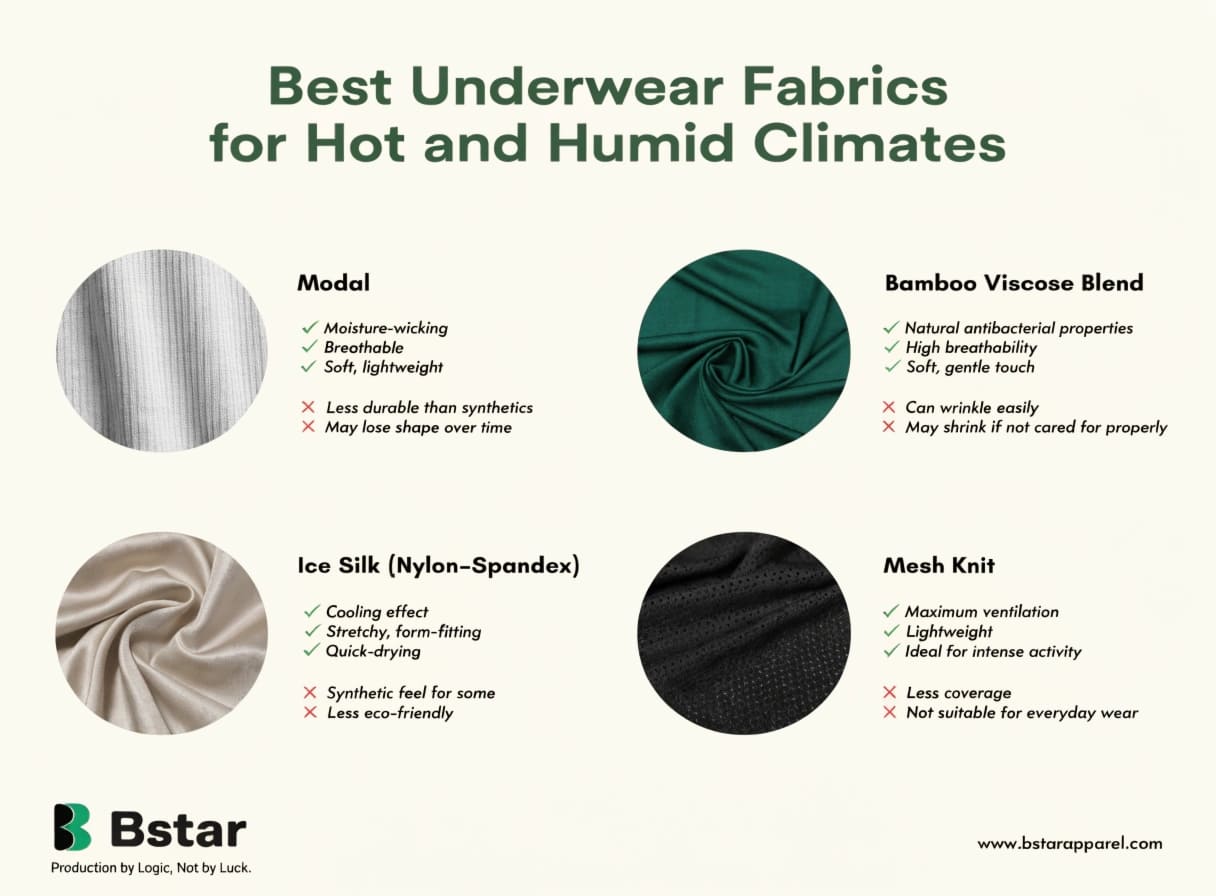
The best underwear fabrics for hot and humid climates are those engineered for moisture wicking, not just moisture absorption. Modal, bamboo viscose blends, ice silk (nylon-spandex), and mesh knit constructions each offer different performance profiles. The right choice depends on your end-use case, not just the fiber’s marketing label.
Here’s the thing most first-time underwear founders get wrong: they treat fabric selection as a "natural vs. synthetic" preference call. It isn’t. In hot, humid conditions, fabric selection is a moisture-management performance decision. And the most aggressively marketed option — pure cotton, sometimes bamboo — is also the most common wrong answer for this specific climate. I’ve seen this play out in real production cycles with real buyers. The rest of this article breaks down exactly why, and what to pick instead.
Why Do Modal and Bamboo Viscose Excel at Moisture Management?
You’ve probably seen both modal and bamboo viscose marketed as "naturally cooling" and "breathable." That language is not technically wrong — but it is incomplete, and incomplete information in fabric sourcing leads to bad SKU decisions.
Modal is a regenerated cellulose fiber made from beech wood pulp. Bamboo viscose is also a regenerated cellulose fiber, but sourced from bamboo. Both absorb moisture well and feel soft against skin. The key difference from cotton: they release moisture faster, which means they feel lighter and less clingy in humid conditions. But their wicking performance still depends heavily on fabric construction and blend ratio.
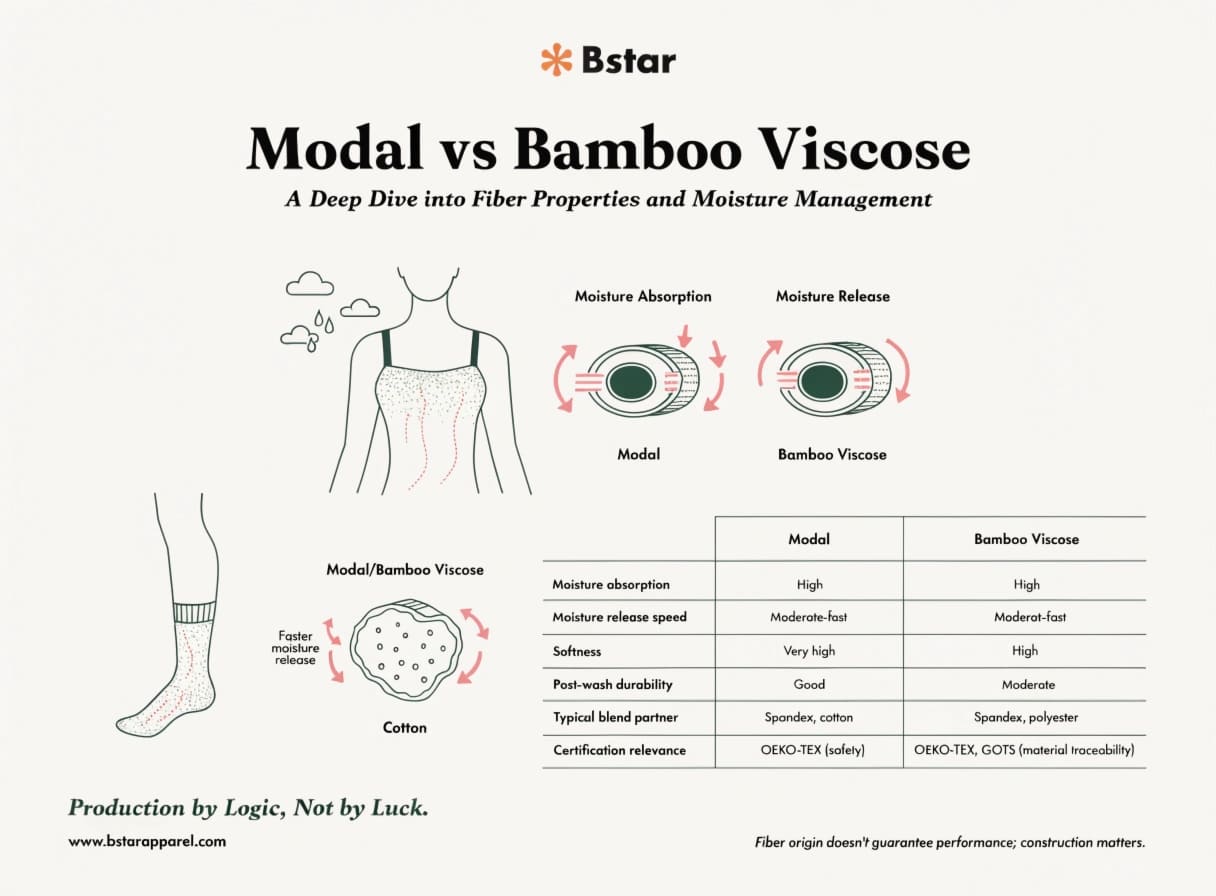
Let me be direct about something. A bamboo jersey with a loose, single-knit construction will perform worse in sustained sweat conditions than a well-built nylon-spandex blend. The fiber origin doesn’t save a poor construction. When buyers ask us about bamboo viscose, we always ask back: what’s your target blend ratio, and what knit structure are you planning? Those two variables matter more than the "bamboo" label on the hang tag.
Here’s how the two fibers compare in practical terms:
| Property | Modal | Bamboo Viscose |
|---|---|---|
| Moisture absorption | High | High |
| Moisture release speed | Moderate-fast | Moderate |
| Softness | Very high | High |
| Post-wash durability | Good | Moderate |
| Typical blend partner | Spandex, cotton | Spandex, polyester |
| Certification relevance | OEKO-TEX (safety) | OEKO-TEX, GOTS (material traceability) |
One more thing worth stating clearly: OEKO-TEX and GOTS certifications tell you the material is safe and traceable. They do not tell you anything about moisture-wicking performance. Don’t use certification status as a proxy for functional claims in your product copy — that’s a separate spec entirely.
What Are Ice Silk and Mesh Knits, and Do They Actually Keep You Cool?
"Ice silk" is one of the most searched terms in underwear development right now. It sounds almost too good — a fabric that literally cools your skin. So what is it actually?
Ice silk is a marketing term, not a fiber classification. It typically refers to fabrics made from nylon-spandex or polyester-spandex blends with a fine, smooth knit construction. The "cooling" sensation comes from the fabric’s contact-cool surface and fast moisture evaporation rate — not from any chemical cooling agent, in most cases.
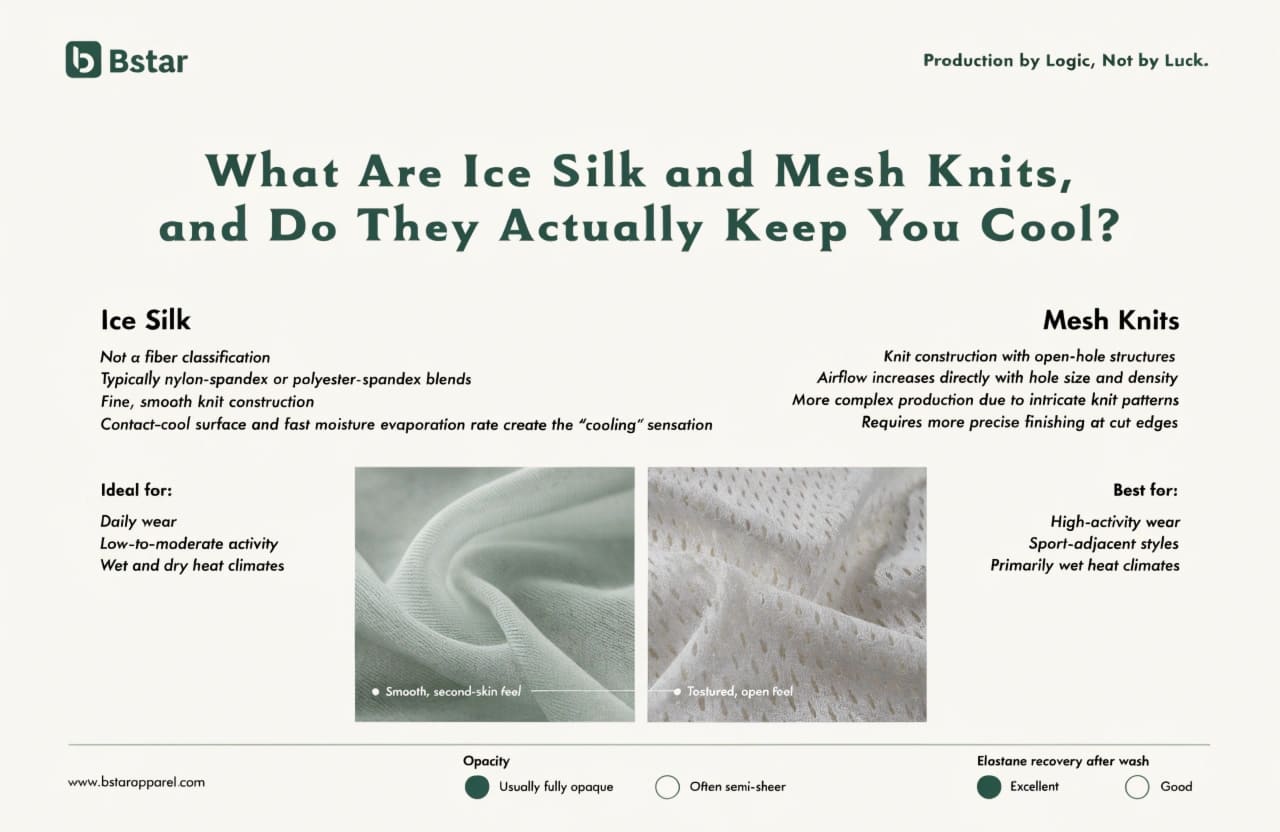
We produce ice silk underwear for buyers targeting Southeast Asia and the Gulf region. The performance feedback is consistently strong for daily, low-to-moderate activity wear. The fabric moves sweat away from skin fast, dries quickly, and maintains its shape better than cotton after repeated washes. That last point matters more than most founders expect when they’re sampling.
Mesh knits work on a different principle. Instead of relying on fiber composition alone, mesh constructions use open-hole structures to increase airflow directly. Here’s how they compare:
| Feature | Ice Silk (Nylon/Spandex) | Mesh Knit |
|---|---|---|
| Cooling mechanism | Contact-cool surface + fast evaporation | Airflow through open structure |
| Best use case | Daily wear, light activity | High-activity, sport-adjacent |
| Skin contact feel | Smooth, second-skin | Textured, open feel |
| Opacity | Usually fully opaque | Often semi-sheer |
| Elastane recovery after wash | Excellent | Good |
| Suitable climate | Wet heat + dry heat | Primarily wet heat, high activity |
One thing to watch: mesh knits require more precise finishing at the cut edge. If your factory isn’t experienced with mesh underwear, you’ll see curling hems and inconsistent stretch across units. That’s a QC conversation to have before sampling, not after.
Should You Use Pure Cotton or High-Performance Cotton Blends for Tropical Markets?
Cotton is the default answer. For a lot of underwear markets, it’s the right one. For hot and humid climates with consistent body heat and sweat, it’s more complicated.
Pure cotton absorbs moisture well but releases it slowly. In sustained heat and humidity, it becomes heavy and clingy against the skin. For tropical and humid markets, cotton-modal or cotton-polyester blends typically outperform pure cotton because they add moisture-wicking capability without removing the familiar feel and breathability buyers associate with cotton.
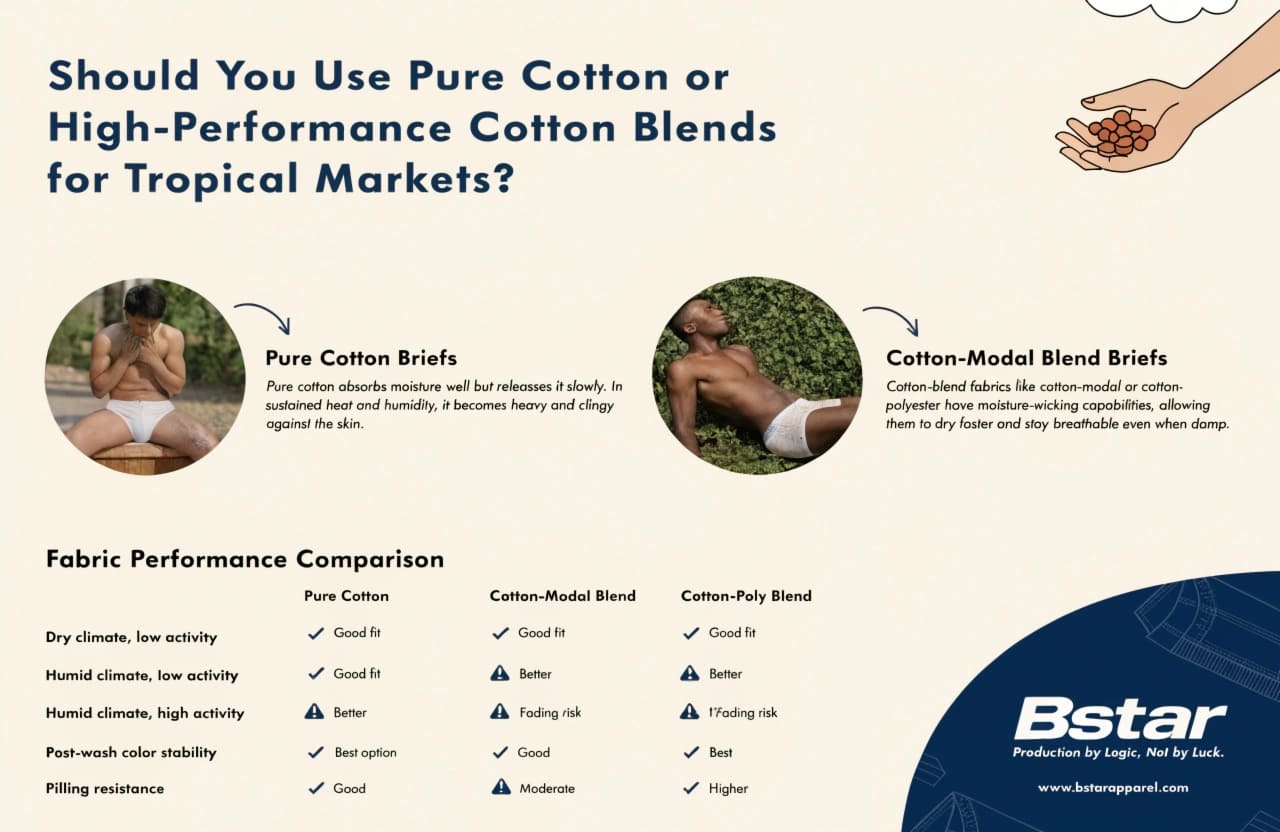
We had a client — a first-time underwear founder — who ordered a pure-cotton brief for distribution in a humid-climate market. After the goods shipped, we received complaints from the buyer: end consumers reported pilling and dye fading after regular wear. This wasn’t a production defect. The fabric performed exactly as pure cotton performs in that environment. The issue was a mismatch between fabric spec and climate use case. That’s not a quality problem. It’s a sourcing decision problem.
Here’s an honest breakdown of where pure cotton works and where it doesn’t:
| Scenario | Pure Cotton | Cotton-Modal Blend | Cotton-Poly Blend |
|---|---|---|---|
| Dry climate, low activity | ✅ Good fit | ✅ Good fit | ✅ Good fit |
| Humid climate, low activity | ⚠️ Gets heavy | ✅ Better | ✅ Better |
| Humid climate, high activity | ❌ Stays wet | ⚠️ Moderate | ✅ Best option |
| Post-wash color stability | ⚠️ Fading risk | ✅ Good | ✅ Good |
| Pilling resistance | ⚠️ Moderate | ✅ Higher | ✅ Higher |
If your customers are in Southeast Asia, Australia, or the US South, and they’re wearing your underwear through an active day, a 60/40 cotton-modal blend is a more defensible choice than 100% cotton. It still lets you say "cotton content" — it just performs better in real wear.
How Do Silver and Copper Ion Fibers Help with Odor and Bacteria in Humid Conditions?
Odor and bacterial buildup are real problems in hot-humid underwear wear. Humidity accelerates bacterial growth on fabric surfaces. That’s not a comfort issue — it’s a hygiene issue, and in DTC markets, it’s a return and review issue.
Silver and copper ion fibers work by releasing antimicrobial ions that disrupt bacterial cell membranes on the fabric surface. They don’t replace moisture management, but they extend the "fresh" window between washes. For underwear sold into humid climates, antimicrobial fiber treatment is a functional upgrade, not just a marketing feature.
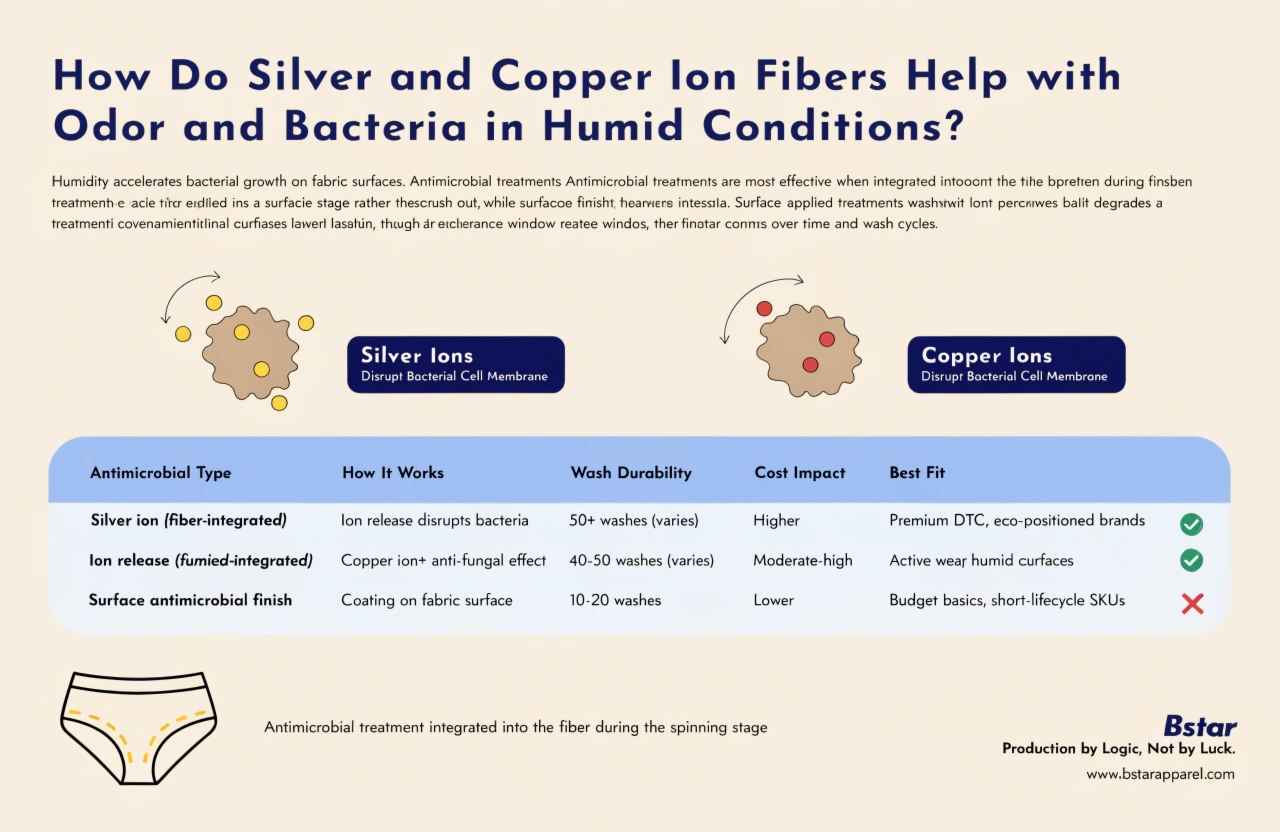
In our production experience, antimicrobial treatments are most effective when they’re built into the fiber at the spinning stage — not applied as a surface finish after the fabric is made. Surface-applied treatments wash out. Fiber-integrated treatments have a longer functional lifespan, though the performance window still degrades over time and wash cycles. Buyers should ask specifically: is this a yarn-level treatment or a fabric-level finish? That question alone changes the durability picture significantly.
Here’s a comparison of the two main antimicrobial approaches we see in underwear development:
| Antimicrobial Type | How It Works | Wash Durability | Cost Impact | Best Fit |
|---|---|---|---|---|
| Silver ion (fiber-integrated) | Ion release disrupts bacteria | 50+ washes (varies) | Higher | Premium DTC, eco-positioned brands |
| Copper ion (fiber-integrated) | Ion release + anti-fungal effect | 40-50 washes (varies) | Moderate-high | Active wear, humid-climate basics |
| Surface antimicrobial finish | Coating on fabric surface | 10-20 washes | Lower | Budget basics, short-lifecycle SKUs |
A note on claims: antimicrobial performance needs to be verified through third-party testing if you’re making functional claims in your product listing. We can provide fabrics with ion-treated yarns, but test data for your specific product should come from an accredited lab test on the finished garment. Don’t use a yarn supplier’s test result as your product’s proof point — that’s a different test scope.
Conclusion
Fabric selection for hot and humid markets is a performance decision. Get the moisture-wicking spec right first, then match the fiber to your use case, price point, and wash durability requirements.