

How to Prevent Underwear Riding Up: Design Solutions
You’ve seen the complaint before. The underwear looks right on a flat lay, fits okay at first wear, then creeps up the moment someone moves. It’s not a minor annoyance — it kills repeat purchases.
Underwear rides up because of a design architecture problem, not a fit problem. The three main causes are gusset geometry, fabric stretch direction, and how these two interact under body movement. Fixing only the waistband rarely solves it.
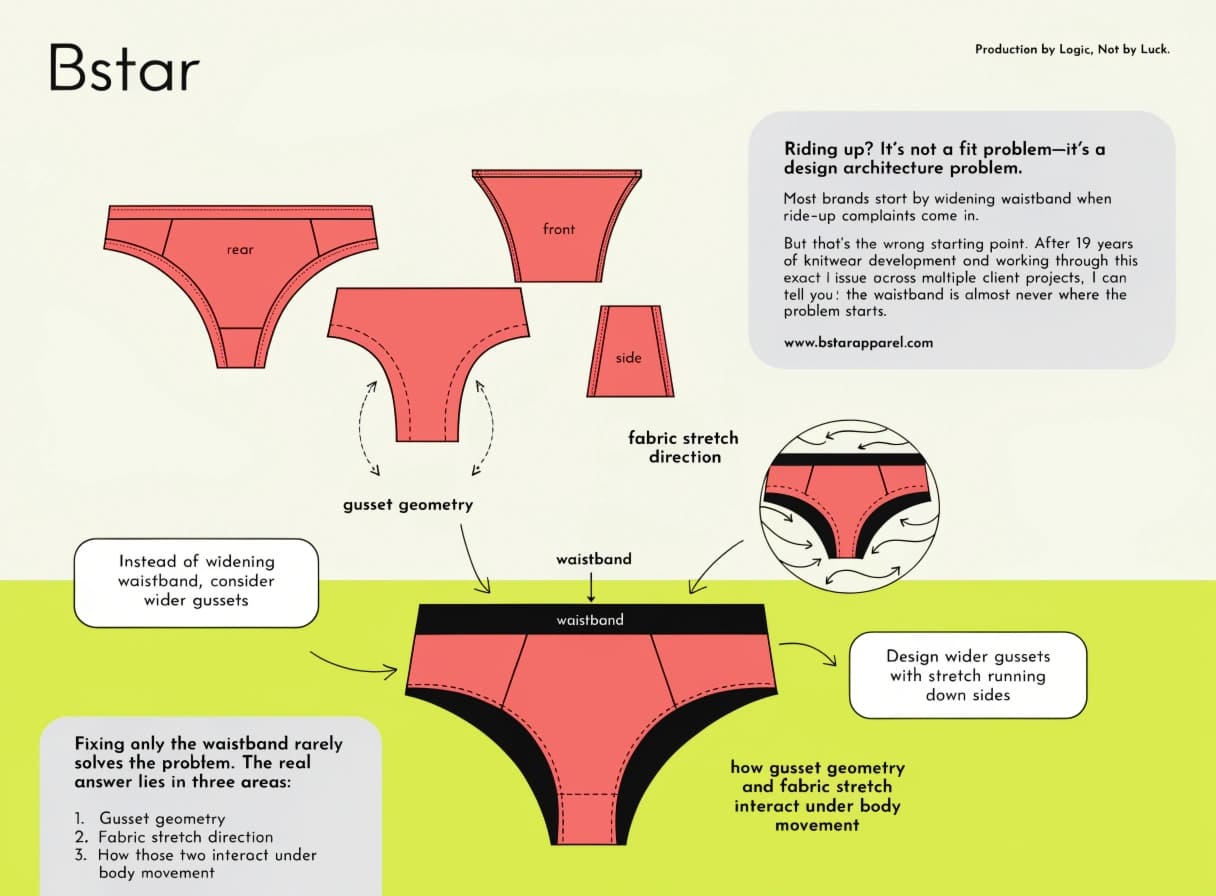
Most brands start by widening the waistband when ride-up complaints come in. That’s the wrong starting point. After 19 years of knitwear development and working through this exact issue across multiple client projects, I can tell you: the waistband is almost never where the problem starts. Let me walk you through where it actually starts — and what you need to change.
The Science of Fit: How Does Sizing, Leg Openings, and Body Mechanics Actually Cause Ride-Up?
You send out samples, they feel fine in a static try-on, then testers report ride-up after twenty minutes of walking. What changed?
The body moves in multiple directions at once. When the inner thigh pushes inward and the hip flexes forward, the fabric between the legs experiences upward tension1. If the leg openings and gusset can’t absorb that tension, the whole garment shifts up.
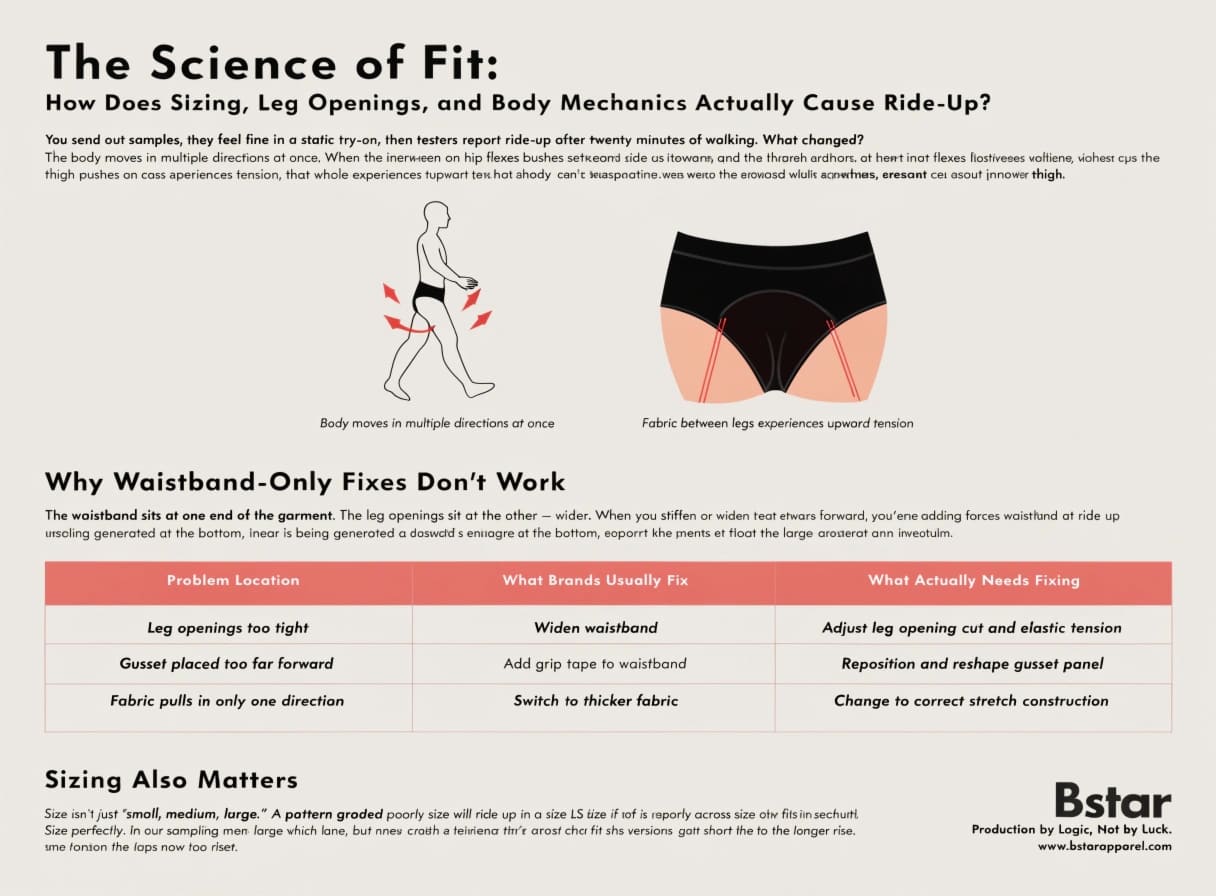
The leg opening is one of the most overlooked variables. A leg opening that’s cut too small creates constant tension against the thigh. That tension has to go somewhere, and it goes up. At the same time, if the leg opening elastic is too tight, it grips the thigh and pulls the fabric upward every time the leg moves forward.
Why Waistband-Only Fixes Don’t Work
Here’s the mechanical reality. The waistband sits at one end of the garment. The leg openings sit at the other. When you stiffen or widen the waistband, you’re adding resistance at the top — but the upward force is being generated at the bottom, near the crotch and inner thigh.
| Problem Location | What Brands Usually Fix | What Actually Needs Fixing |
|---|---|---|
| Leg openings too tight | Widen waistband | Adjust leg opening cut and elastic tension |
| Gusset placed too far forward | Add grip tape to waistband | Reposition and reshape gusset panel |
| Fabric pulls in only one direction | Switch to thicker fabric | Change to correct stretch construction |
Fixing only the waistband is like tightening the roof when the foundation is shifting2. It doesn’t address where the force comes from.
Sizing also matters beyond just "small, medium, large." A pattern graded poorly across sizes will ride up in a size L even if the size S fits perfectly3. In our sampling process, we often catch this during fit review — the medium fits, but the large version has a gusset that’s now too short relative to the longer rise.
Fabric Selection Strategies: Does Spandex Percentage Actually Prevent Ride-Up?
A client once came to us with a ride-up problem they’d been trying to solve for three sample rounds. They kept asking for higher spandex content. The fabric already had 20% spandex4. That wasn’t the issue.
The direction of stretch matters more than the amount of stretch. A fabric with two-way stretch (horizontal only) behaves completely differently from four-way stretch (horizontal and vertical) under body movement5. Using the wrong one for your pattern will cause ride-up regardless of spandex percentage.
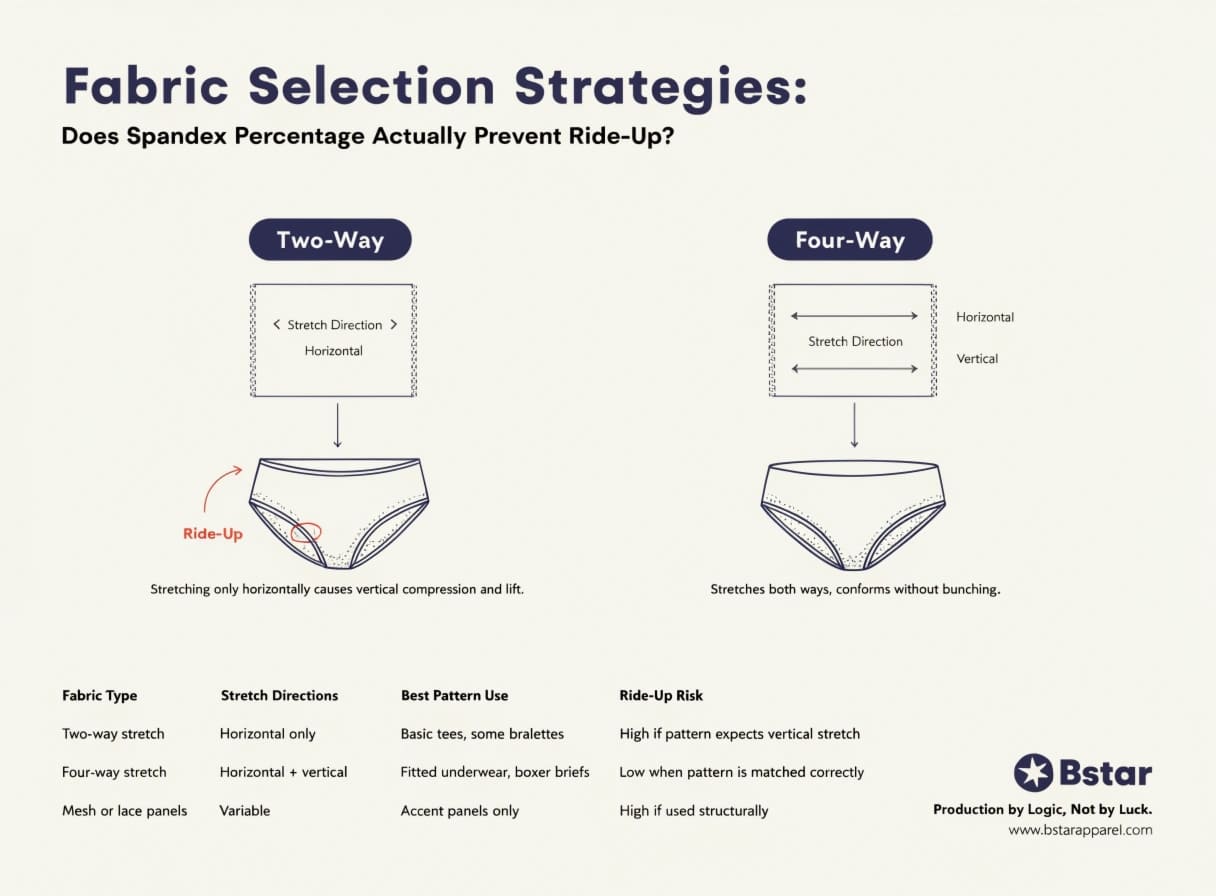
This is a point that brand founders often don’t know to ask about. When you’re briefing a factory and you just say "I want a soft stretch fabric," you might get a two-way stretch construction. If your pattern was designed for four-way stretch, that mismatch will produce ride-up — every time, predictably.
How to Think About Fabric and Pattern Together
| Fabric Type | Stretch Directions | Best Pattern Use | Ride-Up Risk |
|---|---|---|---|
| Two-way stretch | Horizontal only | Basic tees, some bralettes | High if pattern expects vertical stretch |
| Four-way stretch | Horizontal + vertical | Fitted underwear, boxer briefs | Low when pattern is matched correctly |
| Mesh or lace panels | Variable | Accent panels only | High if used structurally |
In our experience developing fitted briefs and boxer briefs, four-way stretch is almost always the right choice for the main body fabric. The vertical stretch allows the fabric to move with the body during hip flexion instead of pulling upward6.
Moisture-wicking finishes also affect behavior. A dry-touch surface reduces friction between the fabric and skin, which helps the garment sit still rather than grip and pull7. But this is a secondary factor — it only helps after the geometry and fabric direction are already correct.
Innovative Pattern Engineering: Do Longer Legs and Anatomical Pouches Actually Work?
Yes — but only when the geometry is right. A longer leg hem that’s cut straight will still ride up. The shape of the leg hem matters as much as the length.
A longer inseam reduces the amount of bare skin in contact with itself, which reduces the friction that pulls fabric upward8. An anatomical pouch, when placed correctly, shifts the fabric distribution so that forward body movement doesn’t drag the crotch panel upward.
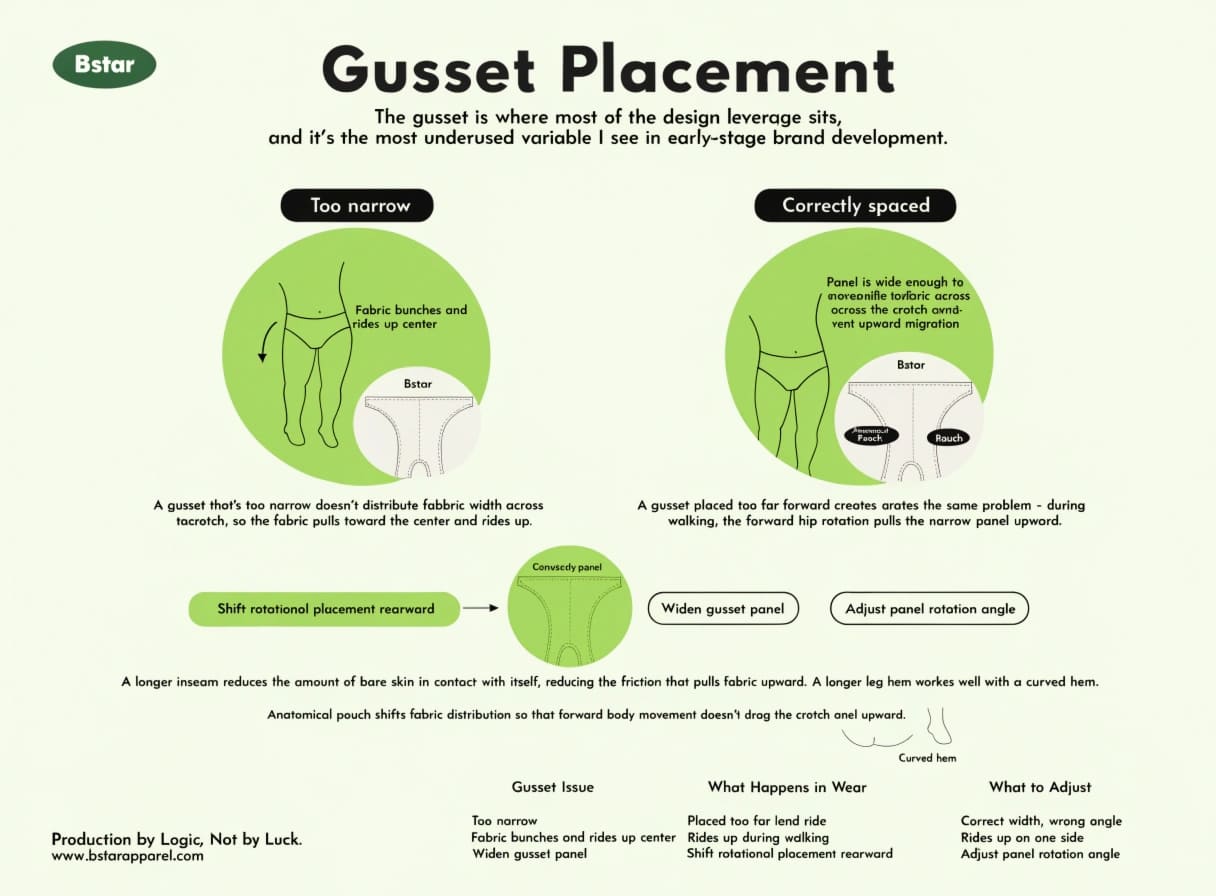
The gusset is where most of the design leverage sits, and it’s the most underused variable I see in early-stage brand development.
What Good Gusset Geometry Looks Like
The gusset panel determines where the underwear anchors on the body. A gusset that’s too narrow doesn’t distribute fabric width across the crotch, so the fabric pulls toward the center and rides up. A gusset placed too far forward creates the same problem — during walking, the forward hip rotation pulls the narrow panel upward.
| Gusset Issue | What Happens in Wear | What to Adjust |
|---|---|---|
| Too narrow | Fabric bunches and rides up center | Widen gusset panel |
| Placed too far forward | Rides up during walking | Shift rotational placement rearward |
| Correct width, wrong angle | Rides up on one side | Adjust panel rotation angle |
A client developing a mid-rise brief came to us after three sample rounds with the same ride-up complaint. The waistband was already wide. The fabric was a good four-way stretch jersey. The issue turned out to be gusset placement — the panel was positioned about 15mm too far forward for the rise height they’d specced. One pattern adjustment, and the problem was gone in the next sample.
Longer legs on boxer briefs also help significantly, but the leg hem needs a slight curve cut — not a straight horizontal line. A curved hem follows the natural angle of the upper thigh, so there’s no edge to grip and pull upward9.
Advanced Anti-Slip Features: Do Silicone Grippers and Ergonomic Waistbands Actually Hold?
Silicone grippers and engineered waistbands do help. But they work best as a finishing layer — not as a substitute for solving the underlying geometry.
Silicone grip strips on the waistband inner edge reduce vertical slippage by creating friction between the fabric and skin10. Ergonomic waistbands with varied elastic tension across the width distribute pressure more evenly, which stops the garment from rolling or shifting during movement.
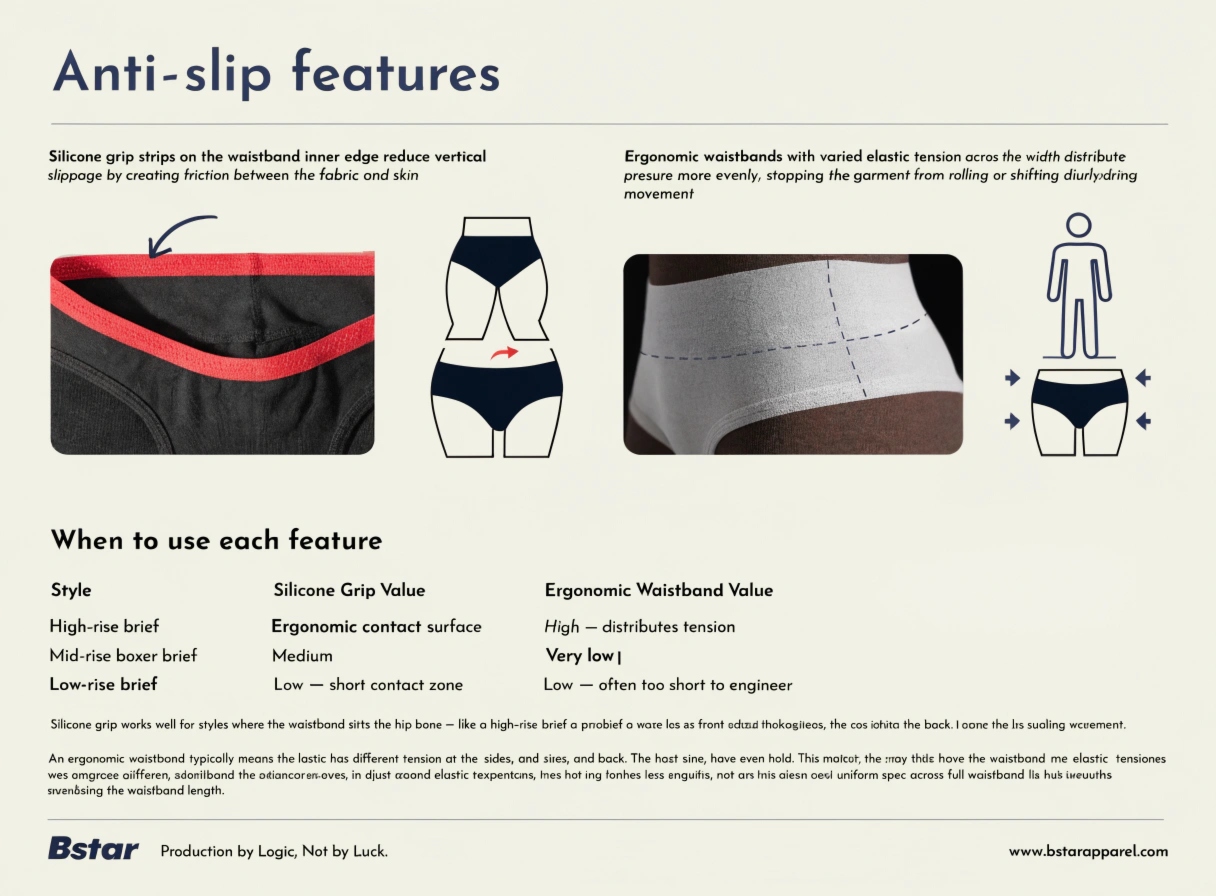
In our production experience, silicone grip works well for styles where the waistband sits above the hip bone — like a high-rise brief or a high-waist short. For a standard mid-rise waistband, the gripper has less surface contact and less mechanical advantage.
When to Use Anti-Slip Features
| Style | Silicone Grip Value | Ergonomic Waistband Value |
|---|---|---|
| High-rise brief | High — good contact surface | Medium |
| Mid-rise boxer brief | Low — short contact zone | High — distributes tension |
| Low-rise brief | Very low | Low — often too short to engineer |
An ergonomic waistband typically means the elastic has different tension at the front, sides, and back11. The front sits flatter and softer. The sides have slightly more hold. This matches the way the waistband experiences different pulling forces depending on body position. In our sampling process, we adjust elastic tension in segments — not as a single uniform spec across the full waistband length.
The key point: if the gusset geometry is wrong and the fabric stretch direction is mismatched, no amount of silicone grip will hold the garment in place permanently. You’re adding friction at the top while the mechanical cause keeps operating from the bottom. Fix the architecture first. Add the grip features after.
Conclusion
Underwear ride-up is a design architecture problem. Fix the gusset geometry and fabric stretch direction first — then add grip features. Widening the waistband alone won’t do it.
If you’re currently in development and seeing ride-up across multiple sample rounds, it may be worth a conversation about the design architecture before you spend another round on the same issue.
-
"Gait kinematics of the hip, pelvis, and trunk associated with external …", https://pmc.ncbi.nlm.nih.gov/articles/PMC6945754/. Biomechanical analyses of normal gait document concurrent hip flexion and thigh adduction during the swing phase of walking, producing multi-directional tensile forces on any material spanning the crotch and inner thigh; see, e.g., Perry & Burnfield, Gait Analysis: Normal and Pathological Function (2010), for joint kinematics during the gait cycle. Evidence role: mechanism; source type: paper. Supports: That hip flexion and thigh adduction occur simultaneously during normal gait, generating multi-directional forces on materials in the crotch region. Scope note: General gait biomechanics literature does not specifically study textile tension in underwear; the application to fabric ride-up is inferential ↩
-
"Tension (physics) – Wikipedia", https://en.wikipedia.org/wiki/Tension_(physics). Fundamental principles of textile mechanics establish that tensile forces in a fabric panel are transmitted through the structure from the point of load application to boundary constraints; adding resistance at a boundary remote from the load origin does not reduce the applied force but may increase stress concentration at intermediate seams; see Hearle, Grosberg & Backer, Structural Mechanics of Fibers, Yarns and Fabrics (1969), for foundational textile force transmission principles. Evidence role: mechanism; source type: paper. Supports: That in a textile system under tension, constraining one end of the fabric does not eliminate the driving force applied at the opposite end, and that effective intervention requires addressing the point of force generation. Scope note: Classical textile mechanics literature addresses ↩
-
"Towards more inclusivity in pattern making – Ready To Sew", https://readytosew.fr/en/journal/sharing-my-research-and-methods-towards-more-inclusivity-in-pattern-making-b124.html?rewrite=sharing-my-research-and-methods-towards-more-inclusivity-in-pattern-making&id=124&module=leoblog. Apparel pattern grading literature establishes that grading increments applied to a base size can introduce cumulative dimensional errors, particularly in curved seam areas such as the crotch and inseam; see Shoben & Ward, Pattern Cutting and Making Up (1990), or equivalent technical patternmaking references for grading methodology in fitted garments. Evidence role: mechanism; source type: education. Supports: That incremental grading errors accumulate across size breaks, causing fit distortions in larger sizes that are absent in the base size. Scope note: Published grading literature focuses broadly on garment construction; specific empirical data on ride-up incidence by size grade is not available in the open literature ↩
-
"Impact of the Elastane Percentage on the Elastic Properties of … – PMC", https://pmc.ncbi.nlm.nih.gov/articles/PMC9570736/. Industry and textile standards bodies note that elastane content in fitted intimate apparel typically ranges from approximately 5% to 25% by weight, with higher percentages associated with compression and performance categories; the Textile Exchange Fiber Market Report and ASTM D4964 (standard for tension and elongation of elastic fabrics) provide relevant context for elastane performance benchmarks. Evidence role: general_support; source type: institution. Supports: That elastane content in underwear fabrics typically falls within a defined industry range, and that 20% represents a level at which stretch performance is generally considered adequate for fitted intimate apparel. Scope note: Published standards address elastic fabric performance testing rather than prescribing optimal spandex percentages for ride-up prevention; the 20% figure in the article is presented as a client-specific case rather than a universal threshold ↩
-
"Understanding 2-Way vs 4-Way Stretch Fabrics – Spandexbyyard", https://spandexbyyard.com/blogs/spandex-vs-other-stretch-fabrics-type-explained/understanding-2-way-vs-4-way-stretch-fabrics2-way-vs-4-way-stretch-fabrics-guide?srsltid=AfmBOorDr33D0VQeibgg-pbBnem60RUZWJojoj9liE69ROPyBX14Vw1c. Textile engineering literature defines two-way stretch knits as those exhibiting elasticity primarily in the course direction, while four-way stretch constructions incorporate elastomeric yarns in both course and wale directions, yielding distinct anisotropic mechanical properties under biaxial loading; see Horrocks & Anand (eds.), Handbook of Technical Textiles (2000), for knit fabric mechanics. Evidence role: definition; source type: paper. Supports: That two-way stretch fabrics extend in one axis while four-way stretch fabrics extend in both warp and weft directions, producing different mechanical responses under multi-directional loading. Scope note: General textile mechanics references do not specifically model underwear ride-up; the connection to garment behavior requires inferential application ↩
-
"Exploring variations in gait patterns and joint motion characteristics …", https://pmc.ncbi.nlm.nih.gov/articles/PMC10478655/. Gait analysis literature reports that normal walking involves hip flexion of approximately 30–40 degrees during the swing phase, imposing elongation demands on garment panels spanning the hip and crotch; see Neumann, Kinesiology of the Musculoskeletal System (2010), for hip joint range of motion during functional activities. Evidence role: mechanism; source type: paper. Supports: That normal walking requires a defined range of hip flexion that imposes corresponding elongation demands on fabrics spanning the hip and crotch region, which only vertically extensible fabrics can accommodate without displacement. Scope note: Gait literature reports joint angles rather than fabric elongation requirements; the translation to specific stretch percentage demands in underwear construction requires additional engineering analysis not available in the cited source ↩
-
"Influence of epidermal hydration on the friction of human skin … – PMC", https://pmc.ncbi.nlm.nih.gov/articles/PMC2607440/. Studies on skin-textile tribology demonstrate that fabric surface characteristics, including moisture content and finish treatments, measurably affect the coefficient of friction at the skin-fabric interface; see Derler & Gerhardt, ‘Tribology of Skin: Review and Analysis of Experimental Results for the Friction Coefficient of Human Skin,’ Tribology Letters (2012), for friction measurement methodology applicable to textile contact. Evidence role: mechanism; source type: paper. Supports: That surface finishes affecting moisture management alter the coefficient of friction between fabric and skin, influencing garment positional stability during movement. Scope note: Cited tribology research addresses skin friction broadly; direct experimental data linking dry-touch finishes specifically to reduced underwear displacement during gait is not established in the open literature ↩
-
"Chafing Causes, Treatment & Prevention – Cleveland Clinic", https://my.clevelandclinic.org/health/diseases/23517-chafing. Research on skin friction and chafing documents that repeated skin-on-skin contact at the medial thigh during ambulation produces frictional forces sufficient to cause tissue irritation and to displace interposing materials; see Nacht et al., ‘Skin friction coefficient: changes induced by skin hydration and emollient application and correlation with perceived skin feel,’ Journal of the Society of Cosmetic Chemists (1981), for baseline skin friction data. Evidence role: mechanism; source type: paper. Supports: That contact friction between medial thigh skin surfaces during walking generates lateral and upward forces capable of displacing interposing fabric. Scope note: Available skin friction literature focuses on dermatological outcomes rather than garment displacement mechanics; the causal link to ride-up is inferential ↩
-
"Digital Anthropometry for Body Circumference Measurements – PMC", https://pmc.ncbi.nlm.nih.gov/articles/PMC9224732/. Anthropometric surveys document the three-dimensional geometry of the upper thigh, including the medial taper and crease angle at the gluteal fold, which inform ergonomic hem placement in fitted lower-body garments; ANSUR II (U.S. Army anthropometric survey, 2012) provides relevant lower-body dimensional data applicable to garment hem geometry design. Evidence role: general_support; source type: institution. Supports: That the upper thigh has a defined anatomical geometry that curved hem cuts can be designed to follow, reducing mechanical edge contact that would otherwise generate upward fabric displacement. Scope note: Anthropometric databases provide body measurement data but do not directly study the relationship between hem curvature and ride-up prevention; the design inference is the article author’s application ↩
-
"Skin Friction: Mechanical and Tribological Characterization of … – PMC", https://pmc.ncbi.nlm.nih.gov/articles/PMC10456811/. Materials science literature on silicone elastomers documents their characteristically high surface friction against biological tissues, a property exploited in medical and apparel applications requiring grip; see Pailler-Mattei et al., ‘In vivo measurements of the elastic mechanical properties of human skin by indentation tests,’ Medical Engineering & Physics (2008), for skin-elastomer contact mechanics context. Evidence role: mechanism; source type: paper. Supports: That silicone elastomers exhibit elevated coefficients of friction against skin compared to textile surfaces, providing a mechanical basis for their use as anti-slip elements in garment waistbands. Scope note: Published friction data for silicone against skin is largely derived from medical device and prosthetics research; direct measurement of silicone waistband grip in underwear applications is not available in peer-reviewed literature ↩
-
"Elastic textile-based wearable modulation of musculoskeletal load", https://pmc.ncbi.nlm.nih.gov/articles/PMC11894418/. Technical apparel construction references describe the use of differential elastic tension in waistband engineering as a method of matching garment resistance to the anatomically variable forces experienced at the front, side, and back of the torso during movement; see Aldrich, Metric Pattern Cutting for Menswear (2011), for waistband construction principles in fitted garments. Evidence role: definition; source type: education. Supports: That engineered waistbands in fitted garments may incorporate differential elastic tension across anatomical zones to match the varying mechanical demands of the front, lateral, and posterior body during movement. Scope note: General patternmaking references describe waistband construction principles without providing empirical performance data comparing uniform versus segmented elastic tension in underwear specifically ↩
[…] a lot of otherwise well-designed underwear falls down. Knitwear developers routinely find that ride-up traces back to gusset geometry and stretch direction rather than the waistband at all, and that widening the band was often the wrong fix being applied […]