
Solving the "Bunching" Problem in Boxer Briefs?
If your customers keep complaining about bunching, you’ve probably already tried changing the fabric. It didn’t fully work. Here’s why.
Bunching in boxer briefs is rarely caused by one thing. It’s usually a combination of fabric elasticity direction, pattern geometry, and seam placement working against each other. Fixing only one variable without diagnosing the others is why most brands end up in multiple sampling rounds without a real resolution.
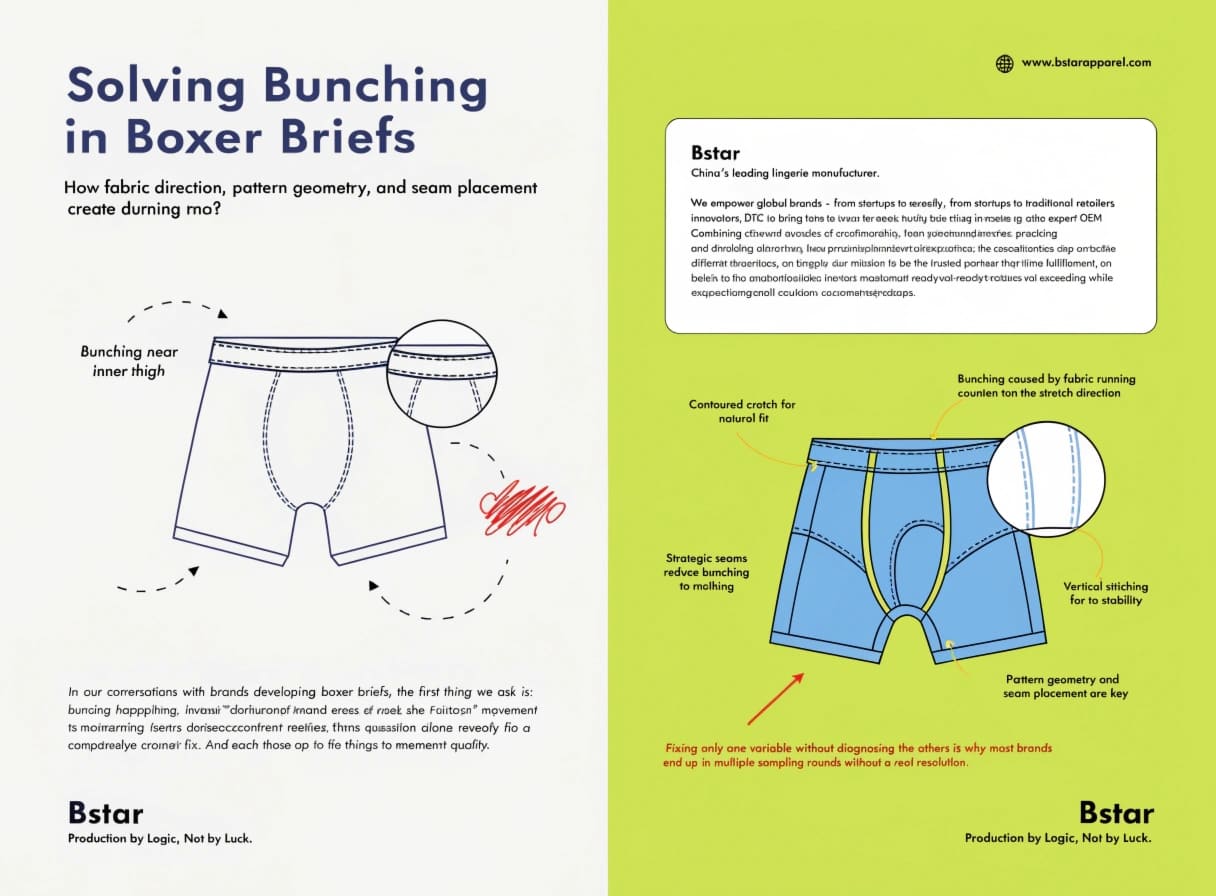
In our conversations with brands developing boxer briefs, the first thing we ask is: where exactly is the bunching happening, and during what kind of movement? That question alone usually reveals that "bunching" means three different things to three different customers. And each of those things points to a completely different fix.
Identifying the Root Causes: How Fabric, Fit, and Lifestyle Contribute to Unwanted Bunching?
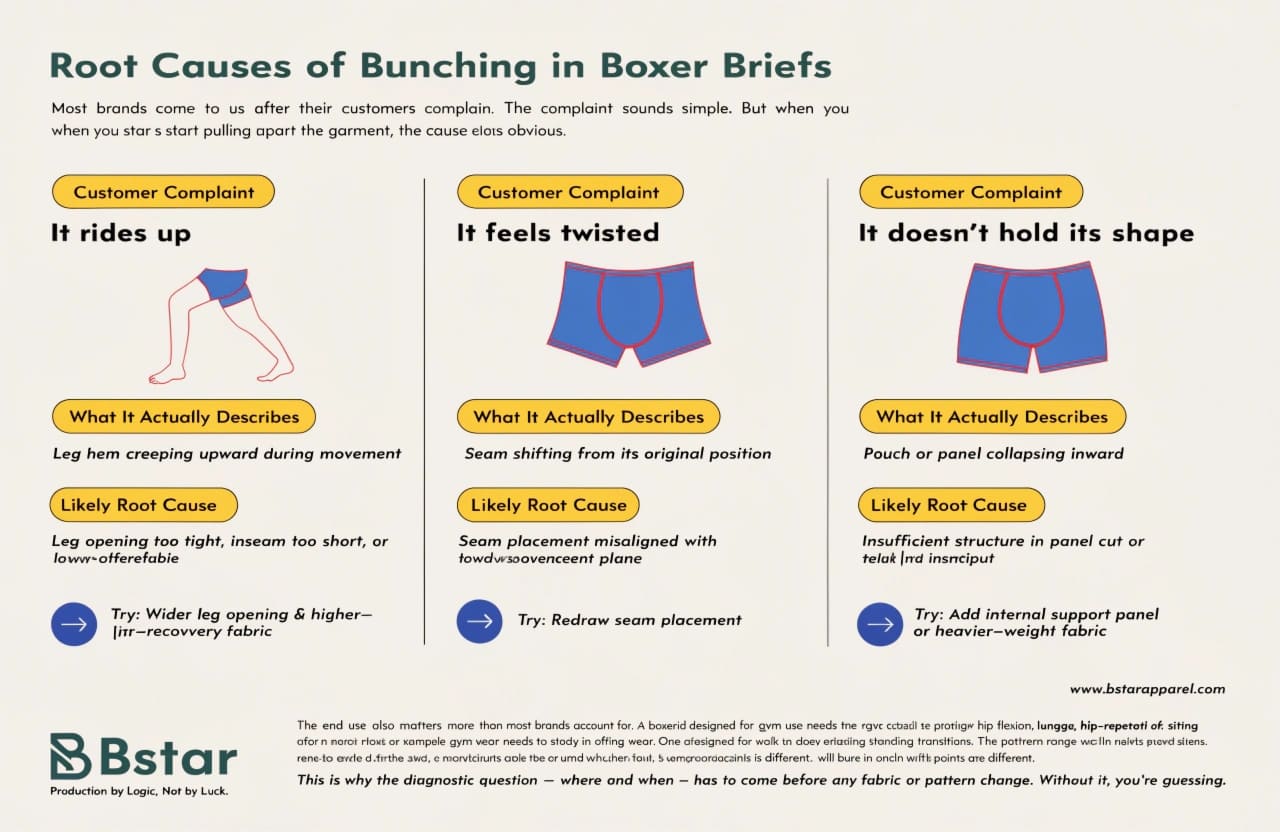
Most brands come to us after their customers complain. The complaint sounds simple. But when you start pulling apart the garment, the cause is rarely obvious.
"Bunching" as a customer complaint is almost always a proxy. It can mean the fabric is riding up the thigh, the pouch is collapsing inward, or the inseam is twisting and shifting. Each of these has a different cause — and a different fix. Treating them as the same problem is where most revision cycles go wrong.
When we look at samples from brands that are stuck in repeat iterations, the most common pattern we see is this: someone made a decision early on — usually about fabric — and then carried that decision forward into pattern and construction without re-checking whether everything still lined up.
Breaking Down the Three Types of Bunching
| Customer Complaint | What It Actually Describes | Likely Root Cause |
|---|---|---|
| "It rides up" | Leg hem creeping upward during movement | Leg opening too tight, inseam too short, or low-recovery fabric |
| "It feels twisted" | Seam shifting from its original position | Seam placement misaligned with body movement plane |
| "It doesn’t hold its shape" | Pouch or panel collapsing inward | Insufficient structure in panel cut or wrong fabric weight |
The end use also matters more than most brands account for. A boxer brief designed for gym use needs to handle repeated hip flexion, lunging, and sweat1. One designed for all-day office wear needs to stay in place during sitting and standing transitions. The movement range is different. The stress points are different. A pattern that works well in one context will bunch in the other.
This is why the diagnostic question — where and when — has to come before any fabric or pattern change. Without it, you’re guessing.
The Role of Fabric Composition: Why Blending Cotton, Modal, and Spandex is Key to Stability?
The most common mistake we see is brands treating spandex percentage as the main variable for stretch performance. It’s not. The percentage matters, but it’s not the whole picture.
In most of the garments we’ve worked on, the stretch direction matters more than the spandex ratio. A fabric with 12% spandex and proper 4-way stretch alignment will typically outperform a 20% spandex fabric that only stretches well in one direction2. The axis of stretch has to match the axis of movement.
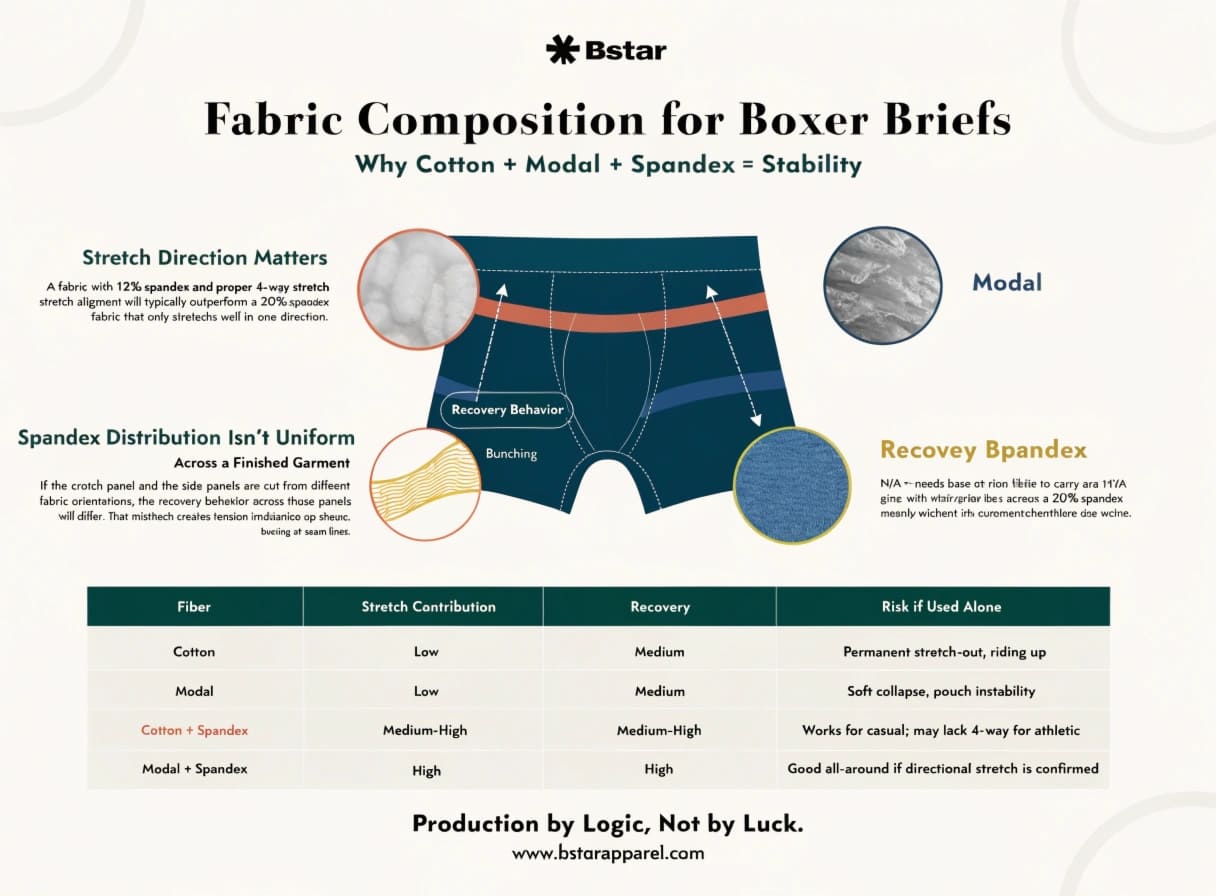
Here’s how the three main components actually behave in a boxer brief context:
How Each Fiber Type Contributes
Cotton gives structure and breathability, but it has poor recovery. On its own, cotton will stretch out and not bounce back3. That’s a bunching risk after a few hours of wear.
Modal is softer and has better drape than cotton. It’s commonly used for premium-feel underwear. But modal also has limited recovery if the spandex isn’t distributed correctly across the panels.
Spandex (elastane) provides recovery — the ability to return to shape after stretching. But here’s what brands often miss: spandex distribution isn’t uniform across a finished garment4. If the crotch panel and the side panels are cut from different fabric orientations, the recovery behavior across those panels will differ. That mismatch creates tension imbalance, which shows up as bunching at the seam lines.
| Fiber | Stretch Contribution | Recovery | Risk if Used Alone |
|---|---|---|---|
| Cotton | Low | Low | Permanent stretch-out, riding up |
| Modal | Medium | Medium | Soft collapse, pouch instability |
| Spandex | High | High | N/A — needs base fiber to carry it |
| Cotton + Spandex | Medium-High | Medium-High | Works for casual; may lack 4-way for athletic |
| Modal + Spandex | High | High | Good all-around if directional stretch is confirmed |
The practical question to ask your supplier is not "what’s the spandex percentage?" It’s "what’s the stretch and recovery rate in both directions, and how was the fabric cut relative to the grain?" If your current factory can’t answer that, that gap in communication is likely contributing to your sampling problems.
Pattern Engineering: Designing Anatomical Pouches and Gussets for a Secure, Stay-in-Place Fit?
Fabric can be perfectly specced and still bunch if the pattern doesn’t account for how a body actually moves. This is one of the most under-discussed parts of boxer brief development.
In our experience, brands developing their first boxer brief line often import pattern blocks from other garment categories — swimwear, athletic shorts — without adjusting5 for the specific movement range of underwear. The crotch panel shape, inseam length, and gusset geometry all need to be calibrated specifically for the intended end use.
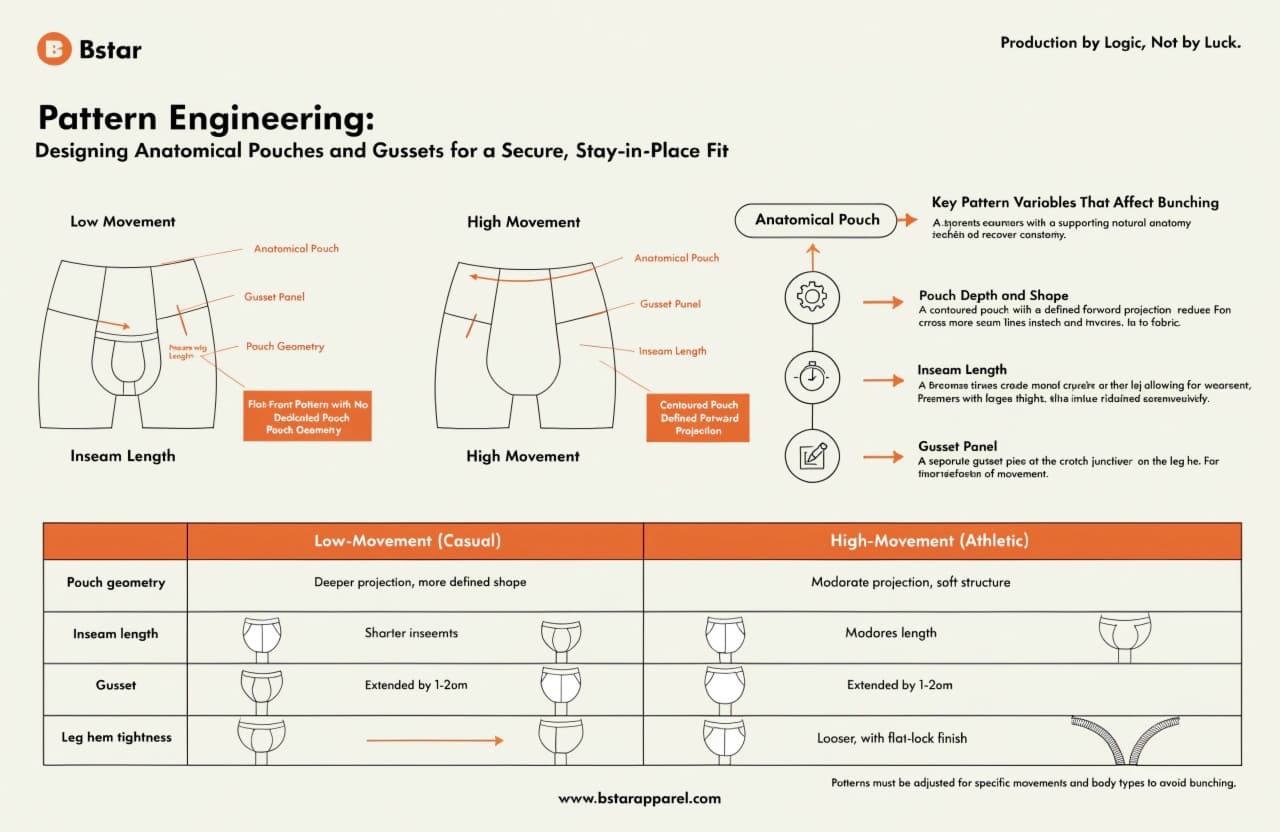
The pouch is where most of the structural decisions converge. A flat-front pattern with no dedicated pouch geometry puts all the strain on the fabric itself. When the wearer moves, the fabric shifts to accommodate — and it doesn’t always shift back. That’s what customers describe as "collapsing" or "bunching forward."
Key Pattern Variables That Affect Bunching
Pouch depth and shape: A contoured pouch with a defined forward projection reduces the need for the fabric to stretch and recover constantly6. It holds its position because the shape already accounts for the space needed.
Inseam length: Shorter inseams create more upward pressure on the leg hem. For wearers with larger thighs, this increases riding-up significantly7. The right inseam length depends on the target body range — not just a size chart average.
Gusset panel: A separate gusset piece at the crotch junction distributes stress across more seam lines instead of concentrating it at one point8. Without it, the single crotch seam becomes the weak link during movement.
| Pattern Element | Low-Movement (Casual) | High-Movement (Athletic) |
|---|---|---|
| Pouch geometry | Moderate projection, soft structure | Deeper projection, more defined shape |
| Inseam length | Standard | Extended by 1–2cm |
| Gusset | Optional | Recommended |
| Leg hem tightness | Moderate | Looser, with flat-lock finish |
Construction Quality: The Impact of Seam Placement and Elastic Tension on Garment Performance?
Even with the right fabric and pattern, poor construction decisions at the seam level can reintroduce bunching. This is the variable that brands least often think to check — because it’s not visible on a tech pack.
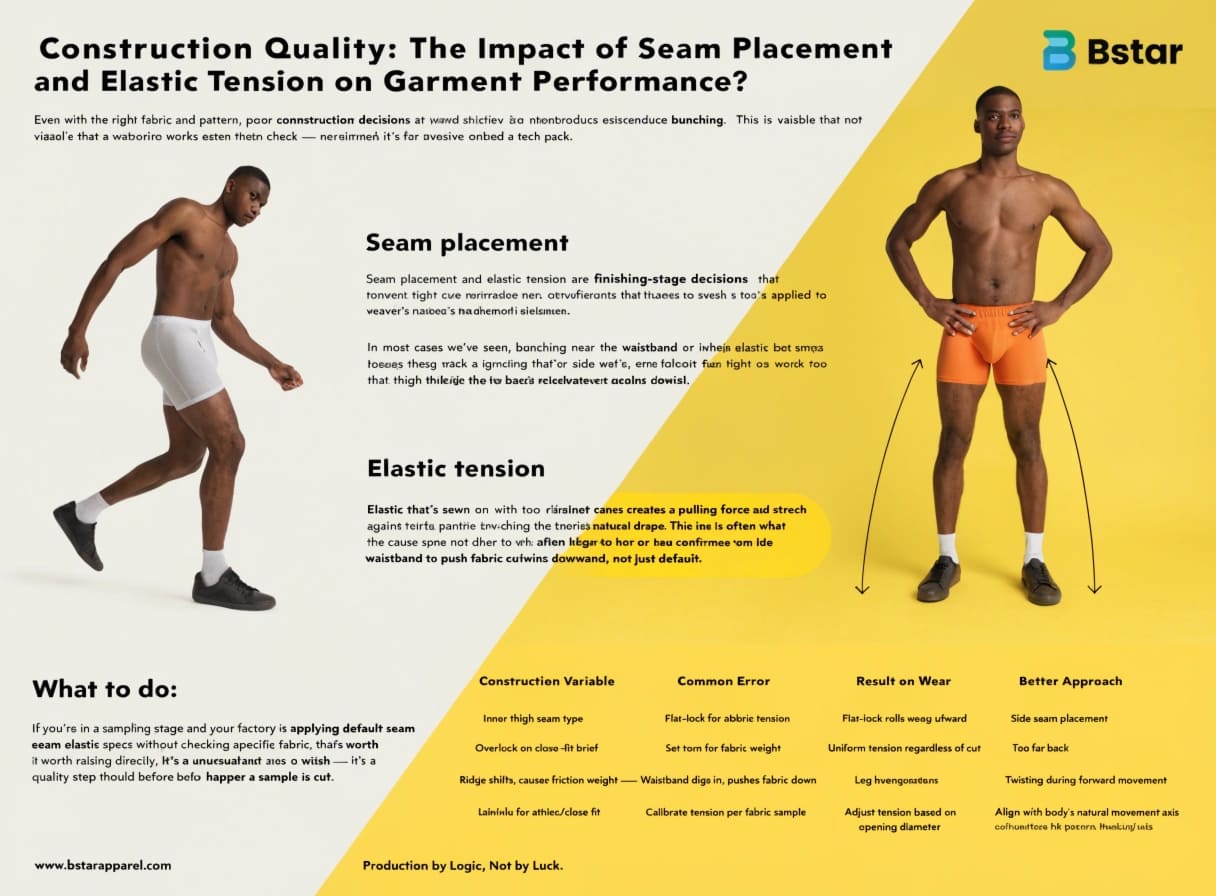
Seam placement and elastic tension are finishing-stage decisions that significantly affect where stress concentrates in a worn garment. In most cases we’ve seen, bunching near the waistband or inner thigh traces back to elastic that’s applied too tight, or side seams that sit too far back relative to the wearer’s natural movement axis9.
The Two Construction Variables That Matter Most
Seam type and placement: Overlock seams at high-friction zones — like the inner thigh — create a ridge that shifts during movement. Flat-lock seams lie flat against the skin and move with the body10. For athletic or close-fit boxer briefs, flat-lock at the inseam and crotch junction is typically the better choice. For casual wear, a clean overlock finish is usually fine, but placement still matters.
Elastic tension at the waistband and leg openings: Elastic that’s sewn on with too much tension creates a pulling force that works against the fabric’s natural drape11. This is often what causes the leg hem to roll or the waistband to dig in and push fabric downward. The right tension varies by fabric weight and stretch recovery — which is why elastic specs need to be confirmed against the specific fabric combination, not just set by default.
| Construction Variable | Common Error | Result on Wear | Better Approach |
|---|---|---|---|
| Inner thigh seam type | Overlock on close-fit brief | Ridge shifts, causes friction bunching | Flat-lock for athletic/close fit |
| Waistband elastic tension | Set too tight for fabric weight | Waistband digs in, pushes fabric down | Calibrate tension per fabric sample |
| Leg opening elastic | Uniform tension regardless of cut | Leg hem rolls upward | Adjust tension based on leg opening diameter |
| Side seam placement | Too far back | Twisting during forward movement | Align with body’s natural movement axis |
If you’re in a sampling stage and your factory is applying default seam and elastic specs without checking against your specific fabric, that’s worth raising directly. It’s not an unusual ask — it’s a basic quality step that should happen before a sample is cut.
Conclusion
Bunching in boxer briefs comes from fabric direction, pattern geometry, and construction tension working against each other — fix the right one first, and your next sample round won’t be wasted.
-
"Biomechanical Analysis of the Anterior Lunge During 4 External …", https://pmc.ncbi.nlm.nih.gov/articles/PMC3396296/. Biomechanical analyses of lower-body exercise movements document hip flexion angles of 90–120 degrees during lunging and squatting, representing significant fabric strain at the crotch and inseam of fitted garments and supporting the need for differentiated pattern engineering for athletic versus sedentary end uses. Evidence role: mechanism; source type: paper. Supports: Activities such as lunging and squatting involve substantial hip flexion angles that place measurable tensile stress on garments covering the hip and crotch region. Scope note: Published biomechanics data describes joint angles rather than garment stress directly; the link to specific seam failure modes requires inference. ↩
-
"2 Way vs 4 Way Stretch Fabric: What’s The Difference? – Ice Fabrics", https://icefabrics.com/blogs/news/2-way-vs-4-way-stretch-fabric?srsltid=AfmBOor65mZpQlaBqb29qNjZ393R6Ky82QGjlqOkFrmXf1GzUfC3icdK. Textile performance testing standards such as ASTM D2594 measure stretch and recovery in both warp and weft directions, reflecting the principle that multi-directional elasticity is a distinct performance variable from elastane content alone; garments requiring multi-plane movement benefit from confirmed biaxial recovery. Evidence role: mechanism; source type: paper. Supports: Biaxial (4-way) stretch alignment in elastane-blend fabrics provides more consistent recovery across movement planes than higher elastane content in a single stretch direction. Scope note: The specific performance crossover point (12% vs. 20% spandex) cited in the article is an experiential claim and is not directly verified by a single published study. ↩
-
"Low-bagging (growth) stretch denim yarn production by spinning …", https://pmc.ncbi.nlm.nih.gov/articles/PMC9988486/. Cotton’s low elastic recovery is a well-documented property of the fiber’s cellulosic structure; studies in textile science confirm that untreated cotton retains permanent deformation after repeated tensile stress, unlike elastomeric fibers such as spandex. Evidence role: mechanism; source type: paper. Supports: Cotton fibers have inherently low elastic recovery compared to synthetic fibers, meaning they do not return to original dimensions after stretching. Scope note: Most sources address cotton recovery in the context of woven fabrics; direct data on knitted underwear constructions may require extrapolation. ↩
-
"Low-bagging (growth) stretch denim yarn production by spinning …", https://pmc.ncbi.nlm.nih.gov/articles/PMC9988486/. Research in apparel engineering demonstrates that the angle at which elastane-blend fabrics are cut relative to the yarn grain significantly alters tensile stretch and elastic recovery in the finished panel, with off-grain cutting producing asymmetric stress distribution at seam junctions. Evidence role: mechanism; source type: paper. Supports: The orientation of fabric grain during cutting affects the directional stretch and recovery behavior of spandex-blend fabrics in assembled garments. Scope note: Published studies typically address woven stretch fabrics; direct experimental data on knitted underwear panels may be limited in open literature. ↩
-
"Intimate Apparel & Swimwear Certificate", https://www.fitnyc.edu/academics/academic-divisions/ccps/noncredit/intimate-apparel-swimwear.php. Apparel patternmaking texts distinguish underwear crotch curve geometry, ease allowances, and inseam proportions from those used in swimwear and athletic shorts, noting that each category is calibrated to different movement ranges, fabric recovery expectations, and body-contact requirements. Evidence role: general_support; source type: education. Supports: Underwear pattern construction requires specific crotch curve geometry and ease allowances that differ from swimwear and athletic shorts, making direct block transfer problematic. Scope note: The claim that brands commonly transfer blocks without adjustment is an industry observation; published literature documents the technical differences between categories rather than the frequency of this specific error. ↩
-
"Cover Male Pouch Enhancing Cheeky Boxer: A Closer Look at Fit …", https://ojs.law.cornell.edu/plugins/generic/pdfJsViewer/pdf.js/web/viewer.html?file=%2Findex.php%2Findex%2Flogin%2FsignOut%3Fsource%3D%2Enutrao%2Eshop%2Fmale%2F&id=1pkVTn. Ergonomic apparel design principles establish that pre-formed three-dimensional panels reduce the magnitude and frequency of fabric deformation cycles during wear; by geometrically accommodating body volume, contoured constructions lower peak tensile strain on the fabric and reduce the recovery demand that leads to progressive shape loss. Evidence role: mechanism; source type: paper. Supports: Pre-shaped three-dimensional garment panels reduce the cyclic stretch-recovery demand on fabric by providing geometric accommodation of body volume, thereby reducing cumulative fabric fatigue and shape loss. Scope note: Direct experimental measurement of strain reduction in contoured versus flat-front underwear pouches is not widely available in open literature; the principle is supported by broader ergonomic garment design research. ↩
-
"[PDF] ABSTRACT ROSS, TAIHESIA ALTOVISE. Sizing and Fit of Men’s …", https://repository.lib.ncsu.edu/bitstreams/ed36c324-d382-4200-a302-bbda116be1b6/download. Fit research in lower-body garments identifies the ratio of leg opening circumference to thigh girth as a primary determinant of hem migration; shorter inseams reduce the anchoring length available to resist upward displacement, an effect amplified in wearers with larger thigh-to-leg-opening differentials. Evidence role: mechanism; source type: paper. Supports: Thigh circumference relative to leg opening circumference and inseam length determines the frictional and compressive forces that cause boxer brief leg hems to migrate upward during movement. Scope note: Published fit studies on this specific interaction in underwear are limited; the mechanism is supported by general garment fit principles and friction dynamics rather than underwear-specific experimental data. ↩
-
"The development of anti-heat stress clothing for construction …", https://pubmed.ncbi.nlm.nih.gov/26399956/. Principles of apparel structural engineering indicate that introducing additional panels at high-stress junctions — such as the crotch — divides tensile load among a greater number of seam lines, consistent with general stress distribution theory applied to fabric assemblies under dynamic loading. Evidence role: mechanism; source type: paper. Supports: Inserting a separate gusset panel at the crotch junction redistributes tensile load across multiple seam lines, reducing peak stress concentration at any single point. Scope note: Direct experimental measurement of stress distribution in underwear crotch constructions with and without gussets is not widely published; the claim is supported by structural engineering principles applied contextually. ↩
-
"Job Rotation Designed to Prevent Musculoskeletal Disorders and …", https://pmc.ncbi.nlm.nih.gov/articles/PMC5470087/. Apparel ergonomics research on lower-body garments identifies seam alignment with the body’s primary movement planes as a determinant of seam stability during gait and exercise; seams positioned off the natural movement axis experience rotational shear forces that cause progressive displacement, perceived by wearers as twisting. Evidence role: mechanism; source type: paper. Supports: Side seam placement that does not align with the body’s sagittal or frontal movement plane results in rotational torque on the seam during locomotion, causing progressive seam displacement. Scope note: Most published research addresses trousers and athletic tights rather than underwear specifically; the biomechanical principle is transferable but direct underwear-specific studies are limited. ↩
-
"A Comparison between Bonding and Sewing : Application in Sports …", https://www.academia.edu/76178241/A_Comparison_between_Bonding_and_Sewing_Application_in_Sports_Performance_Wear. Studies on athletic apparel comfort identify seam bulk and ridge height as primary contributors to skin friction and garment displacement during exercise; flat-lock (cover stitch) construction is documented to reduce seam thickness and improve conformity to body contours relative to standard overlock finishing. Evidence role: mechanism; source type: paper. Supports: Flat-lock seam construction reduces seam ridge height and skin contact pressure compared to overlock seams, lowering friction and displacement during repetitive movement. Scope note: Most published friction studies focus on outer athletic garments; direct comparative data specific to underwear inseam construction is less common in open literature. ↩
-
"Research on yarn tension control technology for knitting underwear …", https://pmc.ncbi.nlm.nih.gov/articles/PMC11928500/. Apparel construction literature identifies elastic application tension as a critical parameter in waistband and leg-opening finishing; when elastic is sewn under tension exceeding the fabric’s recovery capacity, the resulting compressive differential produces puckering, rolling, and displacement of adjacent fabric panels in the finished garment. Evidence role: mechanism; source type: paper. Supports: The tension at which elastic is applied during sewing determines the compressive force exerted on the adjacent fabric, with excessive tension producing distortion of the fabric panel and altering its drape and fit characteristics. Scope note: Quantitative tension thresholds vary by elastic type, width, and fabric combination; general principles apply but specific values require empirical testing per material. ↩