
How to Create a Best-Selling Period Panty Line?
Period panty brands are flooding the market. Most of them fail quietly. The product works fine in the lab but dies on the review page.
A best-selling period panty line starts with one question: who exactly is wearing this, and in what situation? Your answer to that question drives every fabric, every layer, and every certification decision after it. Get that wrong first, and no amount of good materials will save the product.
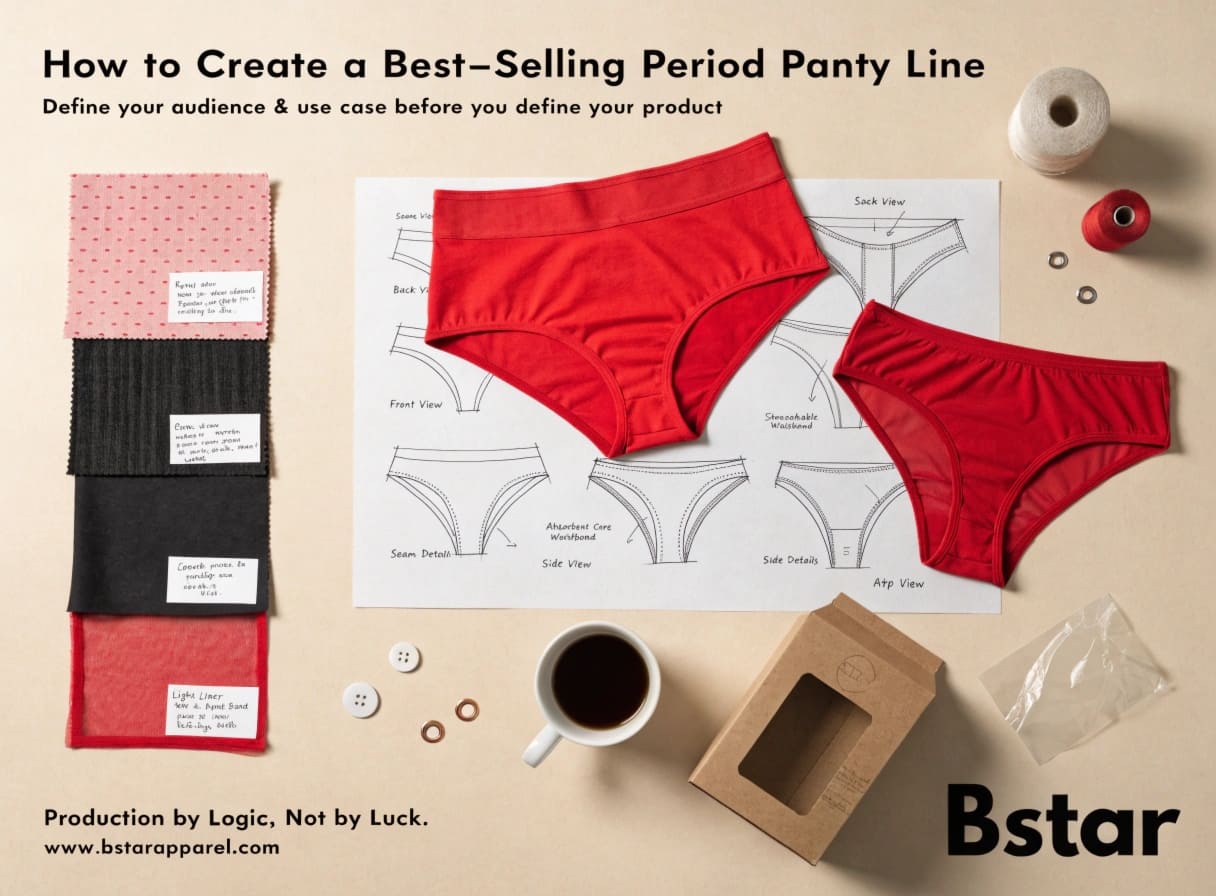
Most founders come to us with a brand concept already formed. They have a name, a color palette, maybe a target price point. What they don’t have is a clear picture of who is actually wearing the product and what that person needs it to do. That gap is where most period panty lines break down — not at the factory, but in the brief that arrives before sampling even starts. Let’s walk through where the real decisions live.
Mastering Absorbency Technology: Are You Optimizing for the Right Thing?
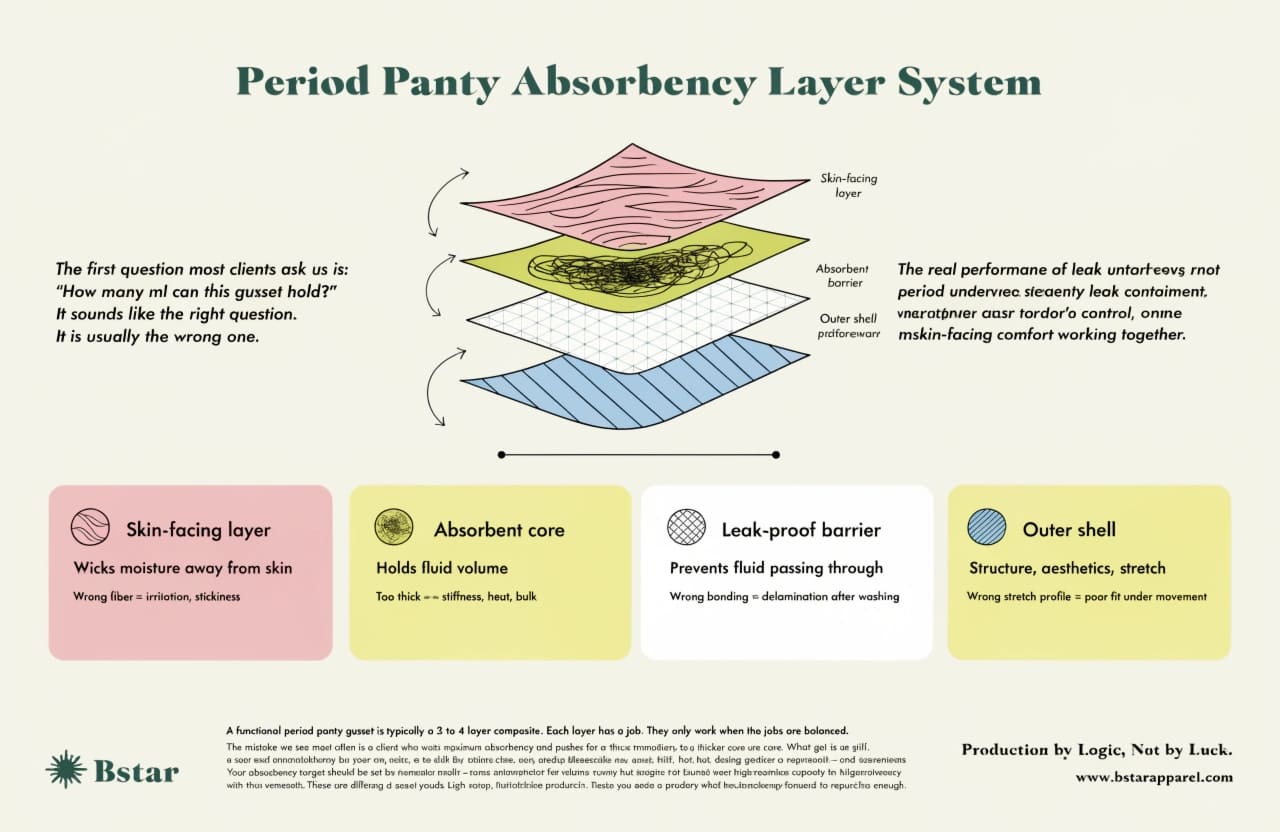
The first question most clients ask us is: "How many ml can this gusset hold?" It sounds like the right question. It is usually the wrong one.
The real performance standard for period underwear is not maximum absorbency. It is the combination of leak containment, odor control, and skin-facing comfort working together. A gusset that holds 30ml but feels like a diaper against the skin will not get a repeat purchase1 — no matter what the product page says.
What the Layer System Actually Does
A functional period panty gusset is typically a 3 to 4 layer composite2. Each layer has a job. They only work when those jobs are balanced.
| Layer | Function | What Goes Wrong When It’s Off |
|---|---|---|
| Skin-facing layer | Wicks moisture away from skin | Wrong fiber = irritation, stickiness |
| Absorbent core | Holds fluid volume | Too thick = stiffness, heat, bulk |
| Leak-proof barrier | Prevents fluid passing through | Wrong bonding = delamination after washing |
| Outer shell | Structure, aesthetics, stretch | Wrong stretch profile = poor fit under movement |
The mistake we see most often is a client who wants maximum absorbency and pushes for a thicker core. What they get is a gusset that is stiff, hot, and uncomfortable — and customers leave reviews saying the fit felt wrong, not that the absorbency failed. The functional problem gets filed as a comfort complaint.
Your absorbency target should be set by your end user’s use case. Light daily wear needs a thinner, softer build. Heavy-flow or overnight use needs more volume capacity but also more attention to how the gusset sits during sleep movement. Sports and active use needs a flatter profile with higher stretch recovery. These are different products. Designing one gusset for all three is how you end up with a product that satisfies nobody well enough to repurchase.
Designing for Comfort and Discretion: Can a Functional Product Still Feel Like Underwear?
The category has a perception problem. Many consumers still associate period underwear with bulk, visible lines, and a "medical" feel. This is a design problem, not a technology limit.
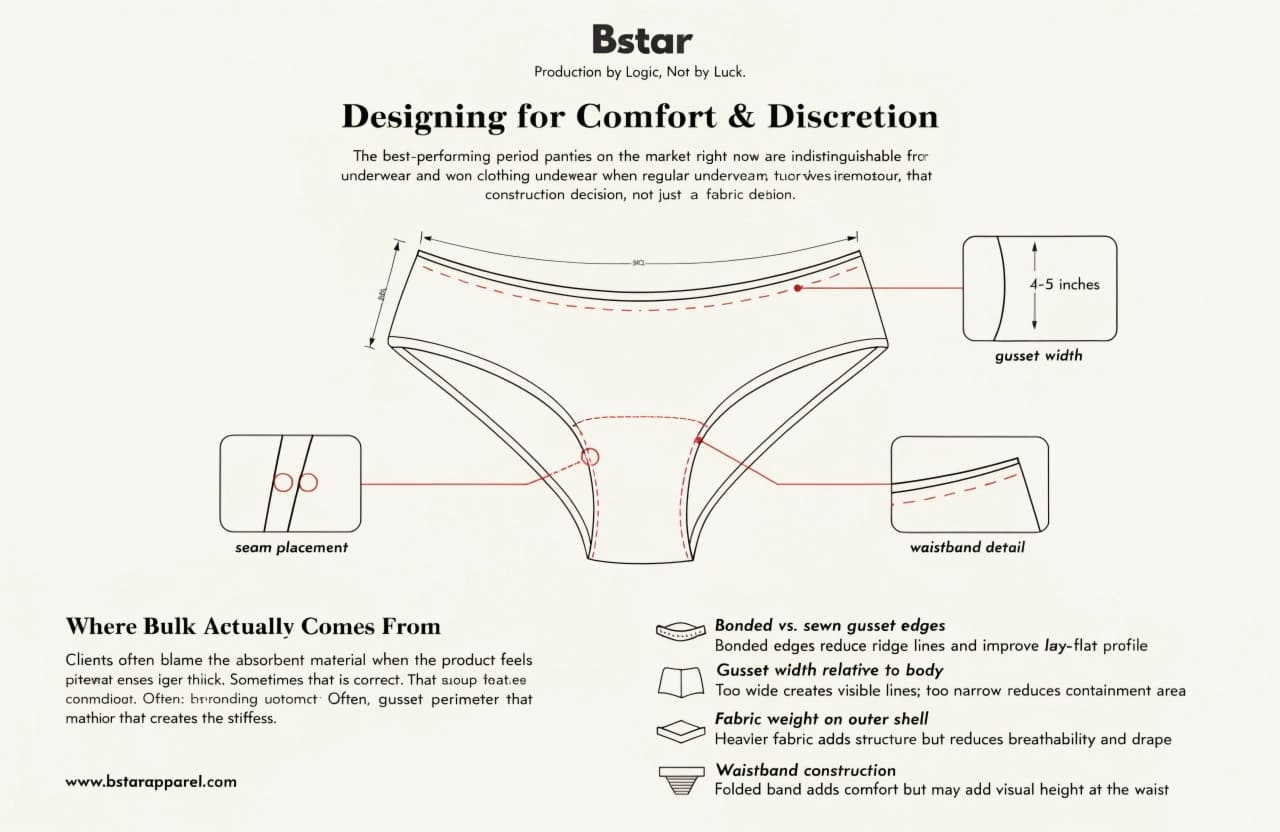
The best-performing period panties on the market right now are indistinguishable from regular underwear when worn under clothing. That outcome is a construction decision, not just a fabric decision. Seam placement, gusset width, waistband stretch, and leg opening finish all contribute to whether the product reads as intimate apparel or as a hygiene device.
Where Bulk Actually Comes From
Clients often blame the absorbent material when the product feels thick. Sometimes that is correct. Often, it is the bonding method or the seam construction around the gusset perimeter that creates the stiffness.
| Design Variable | Impact on Bulk and Comfort |
|---|---|
| Bonded vs. sewn gusset edges | Bonded edges reduce ridge lines and improve lay-flat profile3 |
| Gusset width relative to body | Too wide creates visible lines; too narrow reduces containment area |
| Fabric weight on outer shell | Heavier fabric adds structure but reduces breathability and drape |
| Waistband construction | Folded band adds comfort but may add visual height at the waist |
Breathability is the other half of this. A sealed, multi-layer gusset traps heat by design. Your skin-facing fabric choice directly affects how comfortable this is during extended wear4. Clients building products for hot-climate markets or active-use positioning need to weight this higher in their brief than clients building for overnight or home wear.
The point is this: comfort and discretion are not features you add at the end. They are outputs of early construction decisions. If you wait until the first sample to ask "why does this feel thick," the answer is usually buried several decisions back.
Prioritizing Health and Hygiene: Which Certifications Does Your Market Actually Require?
Period panties sit against the most sensitive skin on the body, worn for hours at a time. Buyers in Europe, North America, and premium wellness retail channels know this. They check for certifications.
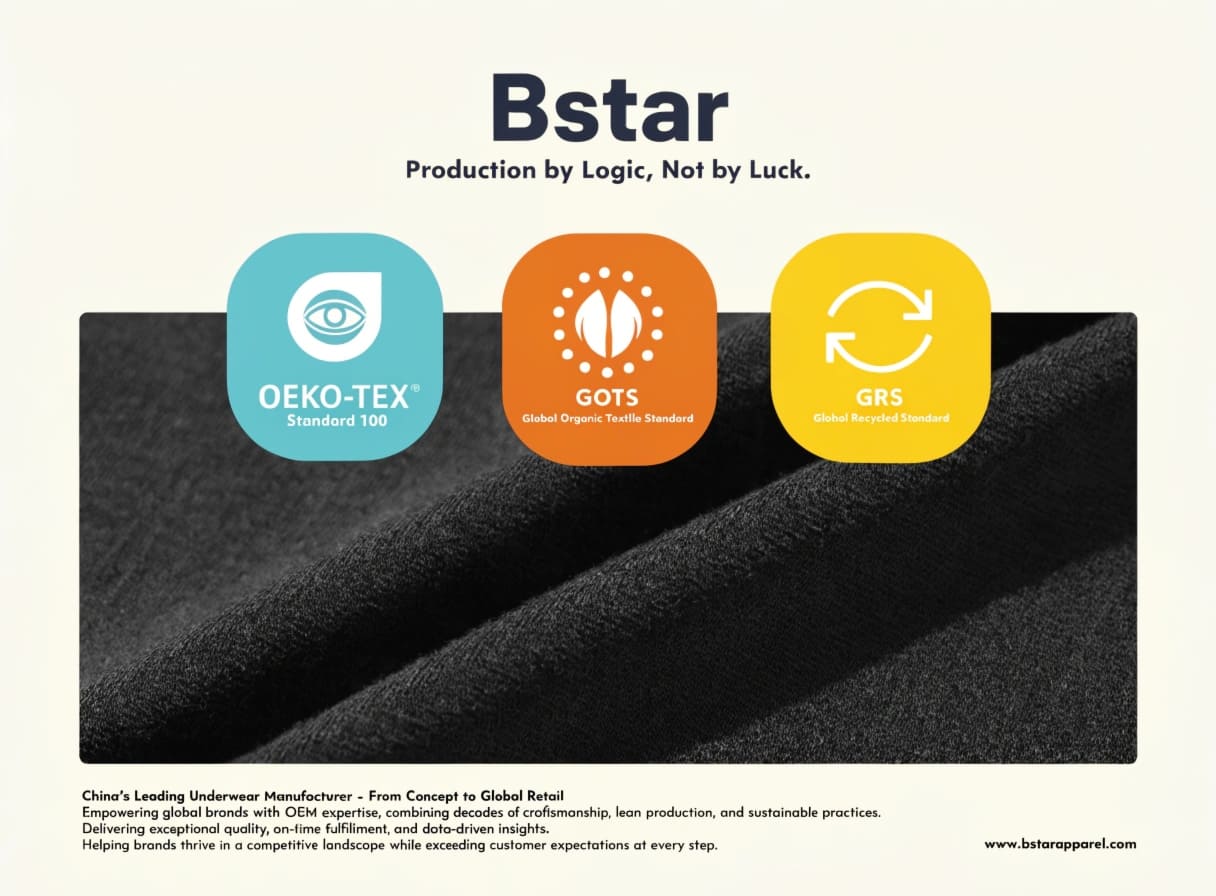
For brands entering health-conscious or premium retail channels, OEKO-TEX Standard 100 or GOTS certification on your materials is not a differentiator — it is a baseline credibility threshold5. Launching without it in those markets does not mean you stand out less. It means buyers and stockists question your product before they read the rest of your pitch.
Match Your Certification to Your Channel
Not every market requires the same proof. The right certification depends on where you are selling and who you are selling to.
| Certification | What It Covers | When You Need It |
|---|---|---|
| OEKO-TEX Standard 100 | Tests for harmful substances in finished fabric | Minimum threshold for EU and US premium retail |
| GOTS | Organic fiber sourcing and processing | Required for organic positioning; appeals to wellness segment |
| GRS (Global Recycled Standard) | Recycled content claims | Needed if you are making recycled fiber claims |
| BSCI | Factory social compliance | Often required by larger retail buyers and B2B partners |
The antimicrobial question comes up constantly. Many brands want to add antimicrobial treatment to the skin-facing layer for odor control. This is reasonable. However, some treatments are chemical-based and may not pass OEKO-TEX testing. Others use silver-ion or zinc-based technologies that do comply6. The decision about which approach to use should happen before sampling — not after you have already selected a fabric.
Our standard recommendation to clients is: decide your target sales channel first. Then work backward to understand which certifications that channel requires. Then build your material brief around compliant options. Doing this in the other order wastes sampling time and sometimes requires restarting the material selection entirely.
Building Consumer Trust: How Do You Sell a Product That People Still Feel Awkward Buying?
Period underwear is a considered purchase. The buyer is evaluating something personal, potentially replacing a product habit they have had for years7. They need to be educated before they convert, not just convinced.
The brands that build durable period panty businesses treat customer education as a core marketing function, not an afterthought. Explaining how the product works, what to expect the first time, and how to care for it properly reduces return rates, reduces negative reviews, and increases repurchase — all at once8.
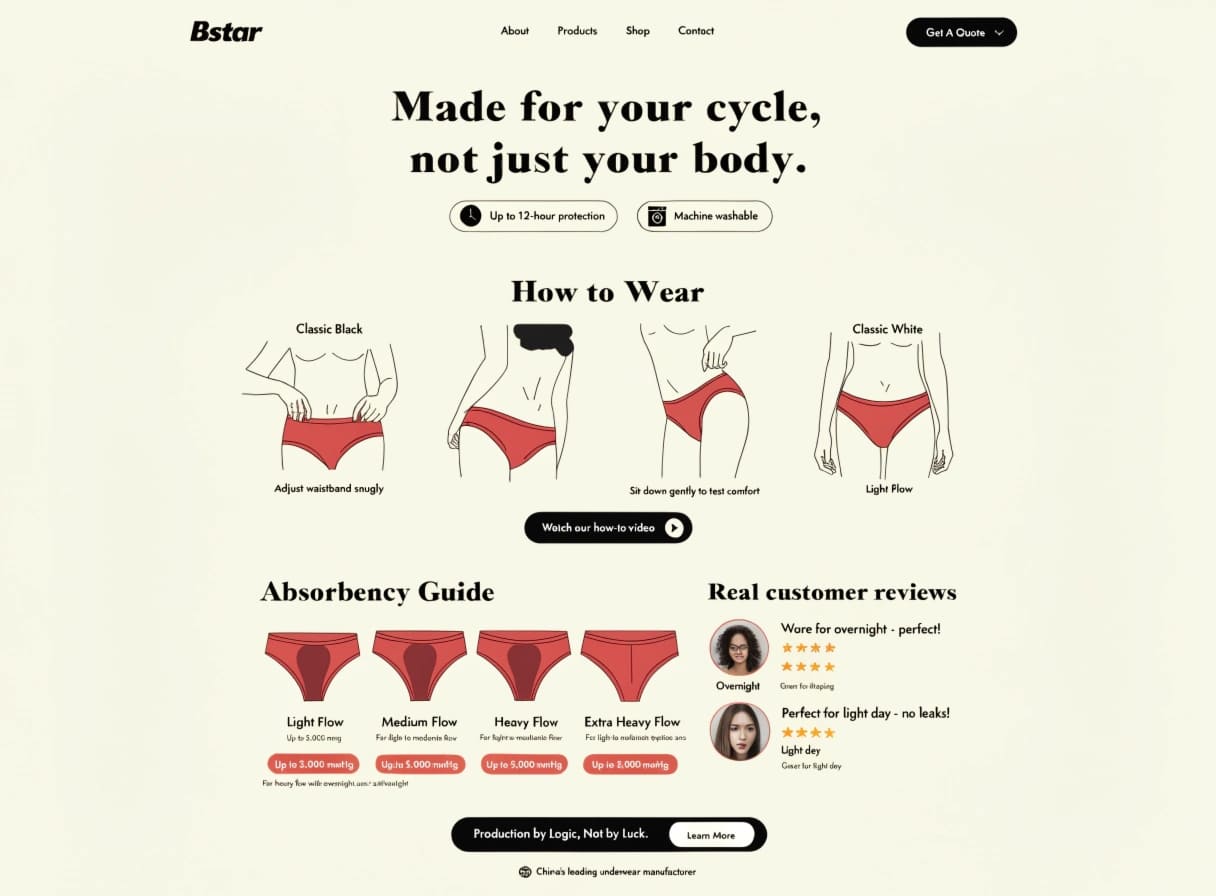
What Education Actually Looks Like in Practice
| Content Type | What It Does for Conversion |
|---|---|
| Absorbency comparison chart | Helps buyers select the right product for their flow level |
| First-use guide | Reduces disappointment from incorrect expectations |
| Wash and care instructions | Protects product performance and reduces returns |
| Real customer reviews with use-case details | Builds social proof for specific scenarios (overnight, sports, light days) |
The stigma angle is real but often overcomplicated by brands. Most buyers are not deeply ashamed of menstruation. They are skeptical that the product will actually work9. That skepticism is a functional question, not a cultural one. Answer the functional question clearly and directly, and most of the perceived stigma barrier dissolves.
The brands we work with that do this best are the ones who speak plainly about what the product does and does not do. They do not oversell absorbency claims. They do not promise a product experience that the construction cannot reliably deliver. That honesty is what builds the review profile that sustains the line past the launch window.
Conclusion
A best-selling period panty line starts with knowing your customer, not your fabric. Get the brief right before you touch a sample.
-
"Breaking the period product insecurity cycle – PMC – NIH", https://pmc.ncbi.nlm.nih.gov/articles/PMC11273700/. Consumer behavior research on intimate apparel and menstrual products consistently identifies tactile comfort and discretion as leading determinants of repurchase intent, with functional capacity metrics ranking lower in post-purchase satisfaction surveys. Evidence role: general_support; source type: paper. Supports: That comfort and wearability are primary drivers of repeat purchase in intimate apparel and menstrual products, relative to functional capacity metrics. Scope note: Direct studies specific to period underwear repurchase drivers are limited; broader intimate apparel or menstrual product research may serve as a proxy. ↩
-
"Engineered structures for use in disposable incontinence products", https://pubmed.ncbi.nlm.nih.gov/12885194/. Technical literature on absorbent hygiene textiles describes multilayer composite structures in which discrete layers perform wicking, fluid retention, and liquid-barrier functions, a design principle applied across disposable and reusable menstrual products. Evidence role: definition; source type: paper. Supports: That functional absorbent textile products for menstrual use employ multilayer composite construction with differentiated wicking, absorbent, and barrier layers. Scope note: Published standards may describe disposable product architecture; direct specification literature for reusable period underwear construction is less systematically documented. ↩
-
"[PDF] Development of fabric seaming for clothing using ultrasonic sealing …", https://commons.emich.edu/cgi/viewcontent.cgi?article=1227&context=honors. Textile engineering literature on bonded and ultrasonic seam construction in intimate apparel documents reduced seam bulk and improved lay-flat characteristics relative to conventional stitched seams, attributed to the elimination of folded fabric allowances. Evidence role: mechanism; source type: paper. Supports: That bonded seam construction in intimate apparel produces a flatter, lower-profile edge compared to conventional sewn seams. Scope note: Performance comparisons are typically reported for specific fabric weights and bonding technologies; results may not generalize uniformly across all gusset material combinations. ↩
-
"Thermal and Moisture Management Properties of Knitted Fabrics for …", https://pmc.ncbi.nlm.nih.gov/articles/PMC12029065/. Textile thermophysiology research demonstrates that sealed multilayer constructions reduce moisture vapor transmission relative to single-layer fabrics, with skin-facing layer properties—including fiber hydrophilicity and surface texture—identified as significant determinants of perceived comfort during extended wear. Evidence role: mechanism; source type: paper. Supports: That sealed multilayer textile constructions reduce vapor permeability and increase localized heat retention, and that skin-facing layer fiber selection influences perceived thermal comfort during wear. Scope note: Published studies focus primarily on wound dressings, sportswear, or disposable hygiene products; direct data on reusable period underwear thermal performance under wear conditions is limited. ↩
-
"Sustainable Fashion and Apparel Design: Standards | Certificates", https://guides.library.cornell.edu/c.php?g=662121&p=5277662. OEKO-TEX Association documentation indicates that Standard 100 certification tests for harmful substances across all textile components and is referenced by numerous European and North American retailers as a procurement requirement for skin-contact products. Evidence role: expert_consensus; source type: institution. Supports: That OEKO-TEX Standard 100 certification is widely required or expected by European and North American retailers for textiles in direct skin contact categories. Scope note: Formal mandatory status varies by retailer and jurisdiction; the claim reflects widespread industry practice rather than a universal regulatory requirement. ↩
-
"Antimicrobial textile: recent developments and functional perspective", https://pmc.ncbi.nlm.nih.gov/articles/PMC8275915/. OEKO-TEX Standard 100 testing protocols include limits on biocidal substances and certain chemical finishes; silver-based and zinc-based antimicrobial technologies have been documented in compliance contexts, though approval depends on concentration and application method. Evidence role: mechanism; source type: institution. Supports: That OEKO-TEX Standard 100 testing criteria distinguish between antimicrobial treatment types, with certain silver-ion and zinc-based technologies meeting compliance thresholds. Scope note: Compliance status for specific treatments is version- and concentration-dependent; manufacturers should verify against the current OEKO-TEX Annex 6 substance list rather than relying on general category guidance. ↩
-
"[PDF] The Acceptance and Usage Intention of Menstrual Underwear", https://digital.library.unt.edu/ark:/67531/metadc1609076/m2/1/high_res_d/PHAN-THESIS-2019.pdf. Research on menstrual product adoption documents significant inertia in product switching, with consumers citing familiarity, uncertainty about performance, and personal sensitivity as barriers to trialing alternative product formats. Evidence role: mechanism; source type: paper. Supports: That menstrual product switching involves high consumer involvement and habit-change barriers, consistent with considered purchase behavior. Scope note: Published studies on period underwear adoption specifically are limited; findings from broader menstrual product switching research are used as a contextual proxy. ↩
-
"The impact of characteristic factors of the direct-to-consumer … – PMC", https://pmc.ncbi.nlm.nih.gov/articles/PMC10944917/. E-commerce and consumer behavior research indicates that detailed product information, including usage guidance and care instructions, is associated with reduced return rates and lower incidence of negative post-purchase reviews, consistent with expectation-confirmation theory. Evidence role: general_support; source type: paper. Supports: That consumer education content addressing product use and care reduces return rates and negative reviews while supporting repurchase in direct-to-consumer retail. Scope note: Studies directly measuring these effects for period underwear specifically are not available; the cited mechanism is drawn from broader DTC and apparel e-commerce research. ↩
-
"The persistent power of stigma: A critical review of policy initiatives …", https://pmc.ncbi.nlm.nih.gov/articles/PMC10021325/. Studies on reusable menstrual product adoption in higher-income markets identify performance uncertainty and unfamiliarity with use as prominent barriers, with cultural stigma playing a comparatively smaller role in populations with higher menstrual health literacy. Evidence role: expert_consensus; source type: paper. Supports: That functional performance skepticism is a significant, and potentially primary, barrier to period underwear adoption among consumers in markets where menstrual stigma is lower. Scope note: The relative weight of functional skepticism versus stigma varies substantially by demographic, cultural context, and market; the claim may not generalize across all target consumer segments. ↩