Dropshipping Custom Underwear: Is It Viable for New Brands?
You want to launch a custom underwear brand with zero inventory. It sounds clean. It sounds low-risk. But before you search for a supplier, you need to answer one question first.
Dropshipping custom underwear is viable — but only under specific conditions. The model works when customization is your real competitive advantage, and when you understand that "custom" and "dropshipping" pull your supply chain in opposite directions. Get that tension wrong, and the model breaks.
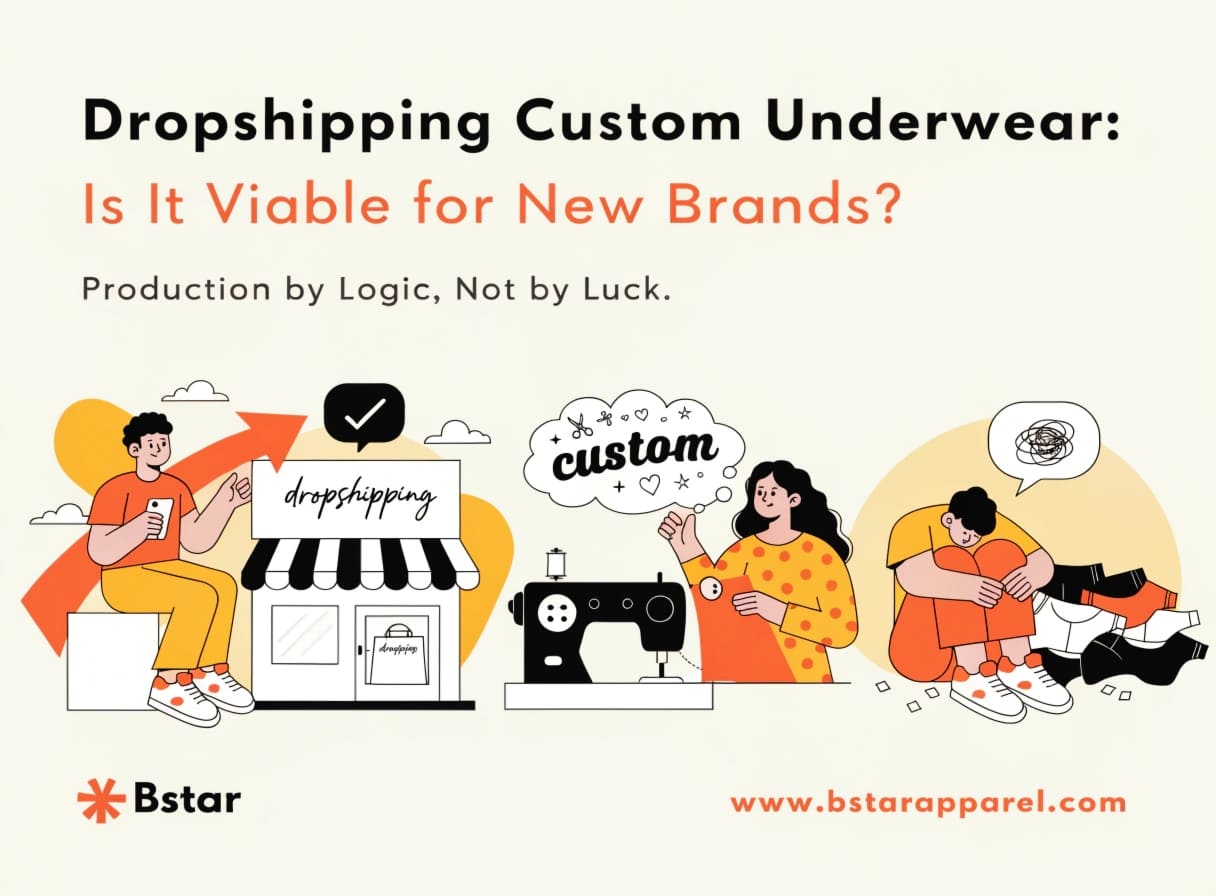
Most founders come to this topic thinking the hard part is finding the right supplier. It isn’t. The hard part is being honest about what your brand actually needs before you talk to anyone. This article walks through that honestly — from capital risk to supplier fit to how you use this model as a testing tool, not a permanent structure.
The Zero-Inventory Advantage: Does It Actually Reduce Financial Risk for New Brands?
You’ve heard the pitch: no inventory, no warehouse, no capital locked up in stock1. For a new brand, that sounds like the safest possible start.
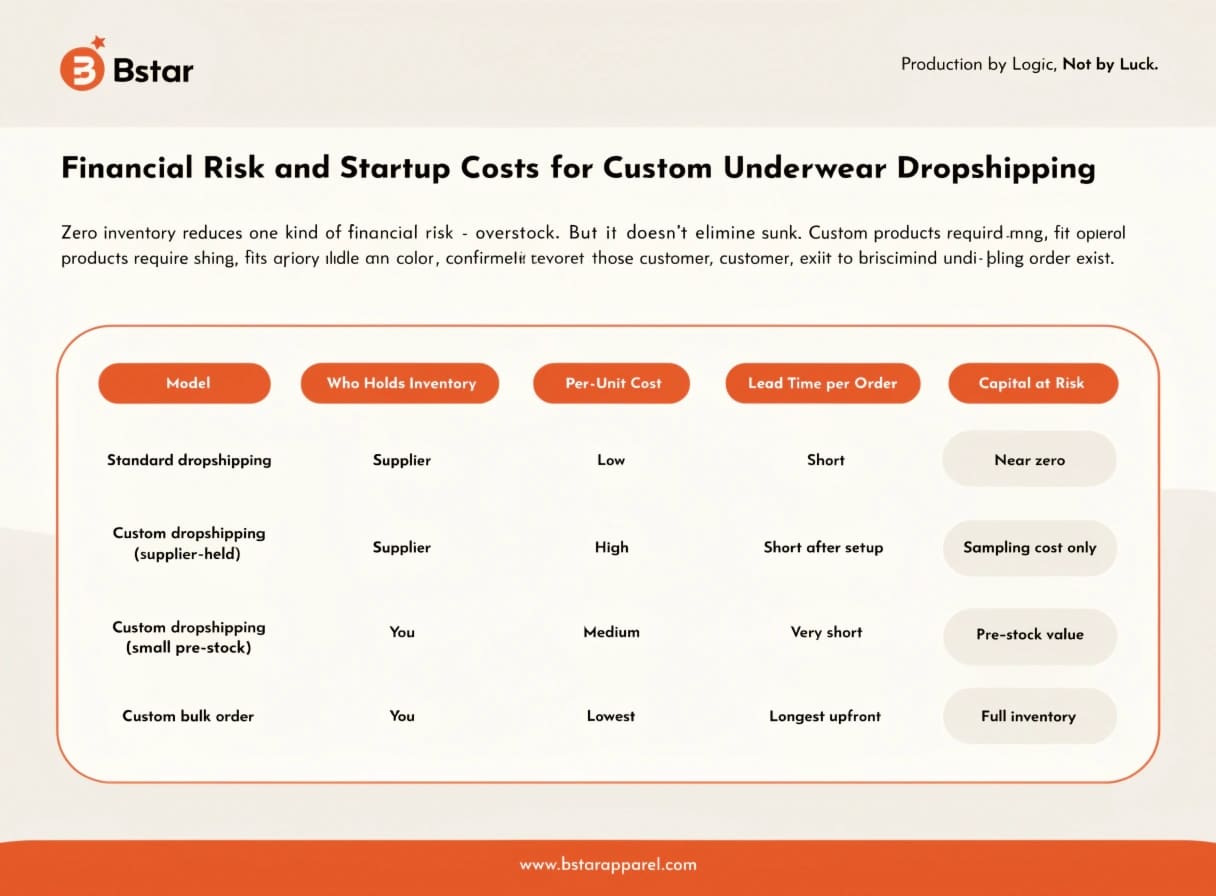
Zero inventory reduces one kind of financial risk — overstock. But it doesn’t eliminate sunk costs. Custom products require sampling, fit approval, and color confirmation before a single unit ships to a customer. Those costs exist before order one. The question isn’t whether you hold inventory. It’s who holds it, and what you paid to get there.
When clients come to us asking about custom dropshipping, the first thing we clarify is the difference between holding risk and pre-production cost. These are two separate things, and new founders often only think about the first one.
Here’s how the capital risk actually breaks down:
What "Zero Inventory" Actually Means in a Custom Model
In standard dropshipping, the product already exists. The supplier made it, stocks it, and ships it when you sell it.2 Your risk is near zero because you never touch the product.
In custom dropshipping, someone has to manufacture your specific product first. That means someone holds finished inventory per SKU — your fabric, your cut, your label. If the supplier holds it, they take on that risk. They will price that risk into your per-unit cost, or they’ll require a minimum commitment. If you hold a small pre-stock yourself, you reduce per-unit cost and lead time, but you lock capital.
| Model | Who Holds Inventory | Per-Unit Cost | Lead Time per Order | Capital at Risk |
|---|---|---|---|---|
| Standard dropshipping | Supplier | Low | Short | Near zero |
| Custom dropshipping (supplier-held) | Supplier | High | Short after setup | Sampling cost only |
| Custom dropshipping (small pre-stock) | You | Medium | Very short | Pre-stock value |
| Custom bulk order | You | Lowest | Longest upfront | Full inventory |
The right model depends on your order volume, your cash position, and how confident you are in your first SKUs. Low MOQ is not a universal solution — it shifts risk, it doesn’t remove it.
Sourcing Reliable Partners: What Does "Quality" Actually Mean in This Context?
Everyone says they want a "quality" supplier. But quality in underwear manufacturing is specific, and the wrong definition leads to bad decisions.
For custom knit underwear, quality means consistent fabric composition, accurate sizing across runs, colorfastness, and seam durability under wash cycles. A supplier who can hit these specs at low MOQ is genuinely rare. Most low-MOQ options either use off-the-shelf fabrics or sacrifice consistency between small runs.
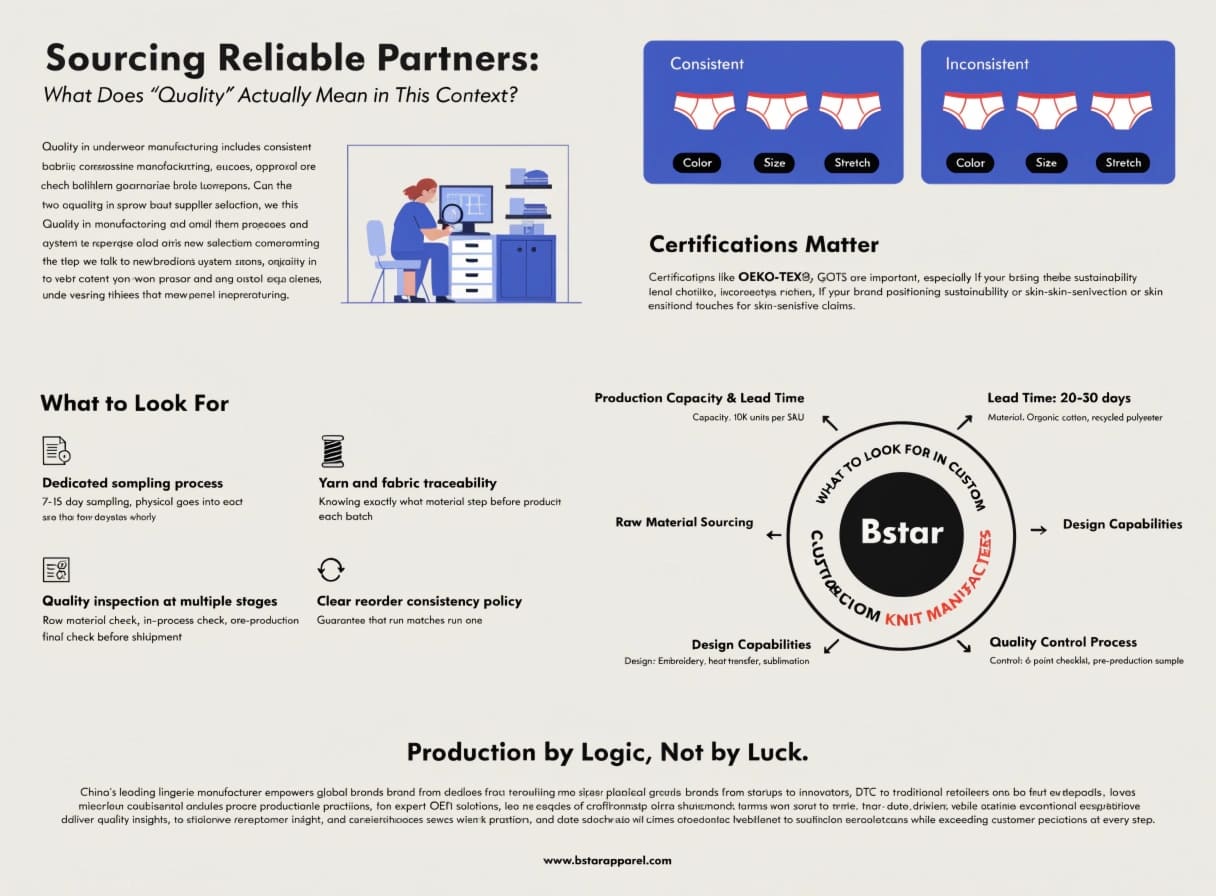
When we talk to new brands about supplier selection, we tell them to separate two questions: Can this supplier make my product? And can this supplier make my product the same way every time at low volume?
The Consistency Problem at Low MOQ
A factory that runs 10,000 units per SKU can maintain tight process control. Color, weight, and stretch are easy to dial in at scale. At 50 or 100 units, the same factory is running a separate short batch — sometimes on different equipment, sometimes with slightly different yarn lots.3
What to look for in a custom knit manufacturer:
- Dedicated sampling process: 7–15 day sampling with a physical approval step before production
- Yarn and fabric traceability: Know exactly what material goes into each batch
- Quality inspection at multiple stages: Raw material check, in-process check, final check before shipment
- Clear reorder consistency policy: What guarantees that run two matches run one?
At BSTAR, we use a 6-checkpoint quality system across all production runs, including small batches. This isn’t a marketing claim — it’s a structural requirement because our clients use these products to build brand reputation, and one bad batch at low volume does proportionally more damage than one bad batch at scale.
Certifications like OEKO-TEX® and GOTS matter here too, especially if your brand positioning touches sustainability or skin-sensitive claims.4 Verify these — don’t take a supplier’s word for it.
Customization and Fast Fulfillment: Can You Actually Have Both?
This is the tension most founders don’t see coming. Customization requires pre-production time. Fast fulfillment requires finished goods already on hand. These two requirements conflict directly.
You can have both — but not at the same time and not without cost. Fast fulfillment on custom products only works if finished inventory is already built. That means someone committed capital before the orders arrived. The "fast" part is only fast after a slow, expensive setup phase.
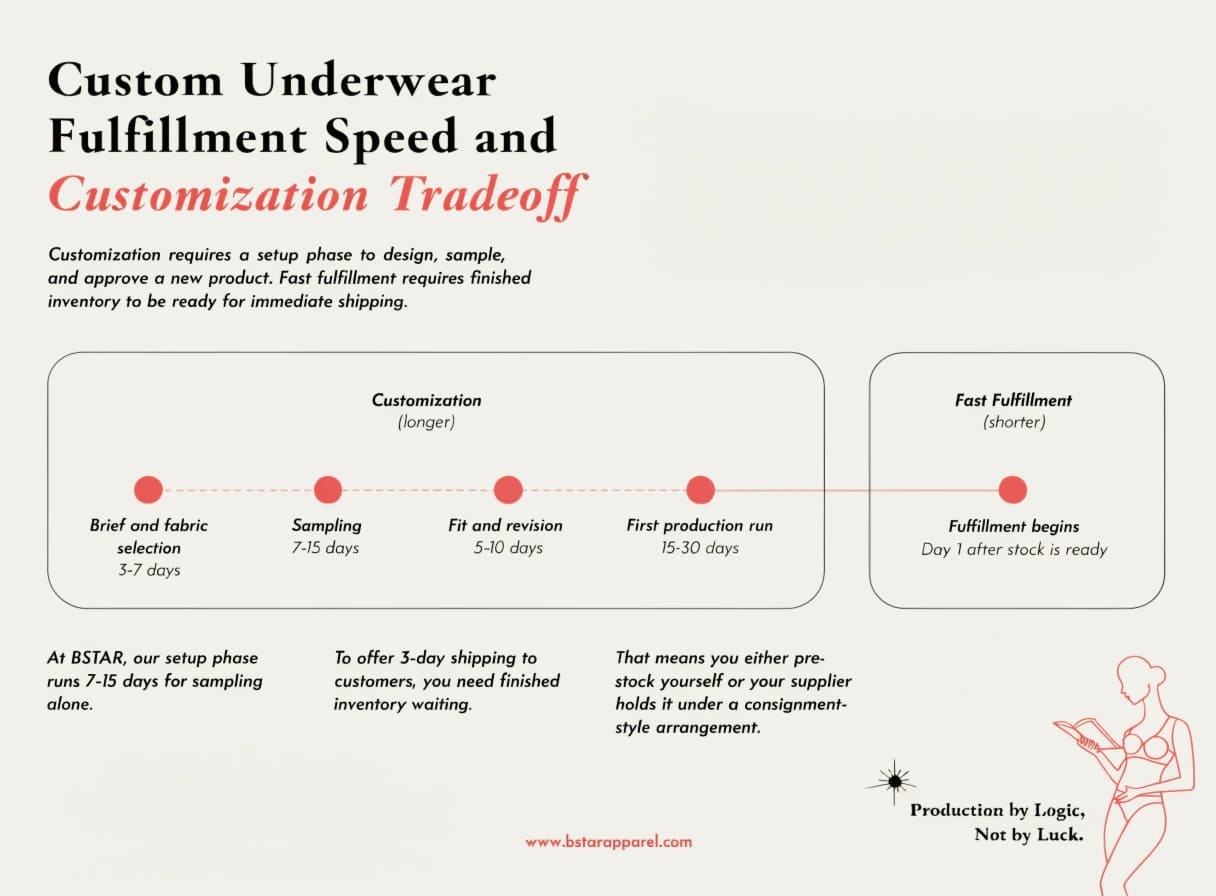
The setup phase for a custom product typically includes fabric sourcing, sample making, fit review, revision rounds, and pre-production approval. At BSTAR, this runs 7–15 days for sampling alone.5 After approval, the first production run takes additional time. None of this is unusual — it’s just the reality of making something that didn’t exist before.
How to Structure the Timeline Realistically
| Phase | Typical Duration | What You’re Doing |
|---|---|---|
| Brief and fabric selection | 3–7 days | Defining specs, choosing materials |
| Sampling | 7–15 days | First physical product made |
| Fit and revision | 5–10 days | Approval or correction rounds |
| First production run | 15–30 days | Actual manufacturing |
| Fulfillment begins | Day 1 after stock is ready | Orders ship from held inventory |
If you want 3-day shipping to customers, you need finished inventory waiting. That means you either pre-stock yourself or your supplier holds it under a consignment-style arrangement. Both have costs. Neither is free.
Three operational problems kill custom dropshipping models faster than anything else. Most founders only discover them after launch.
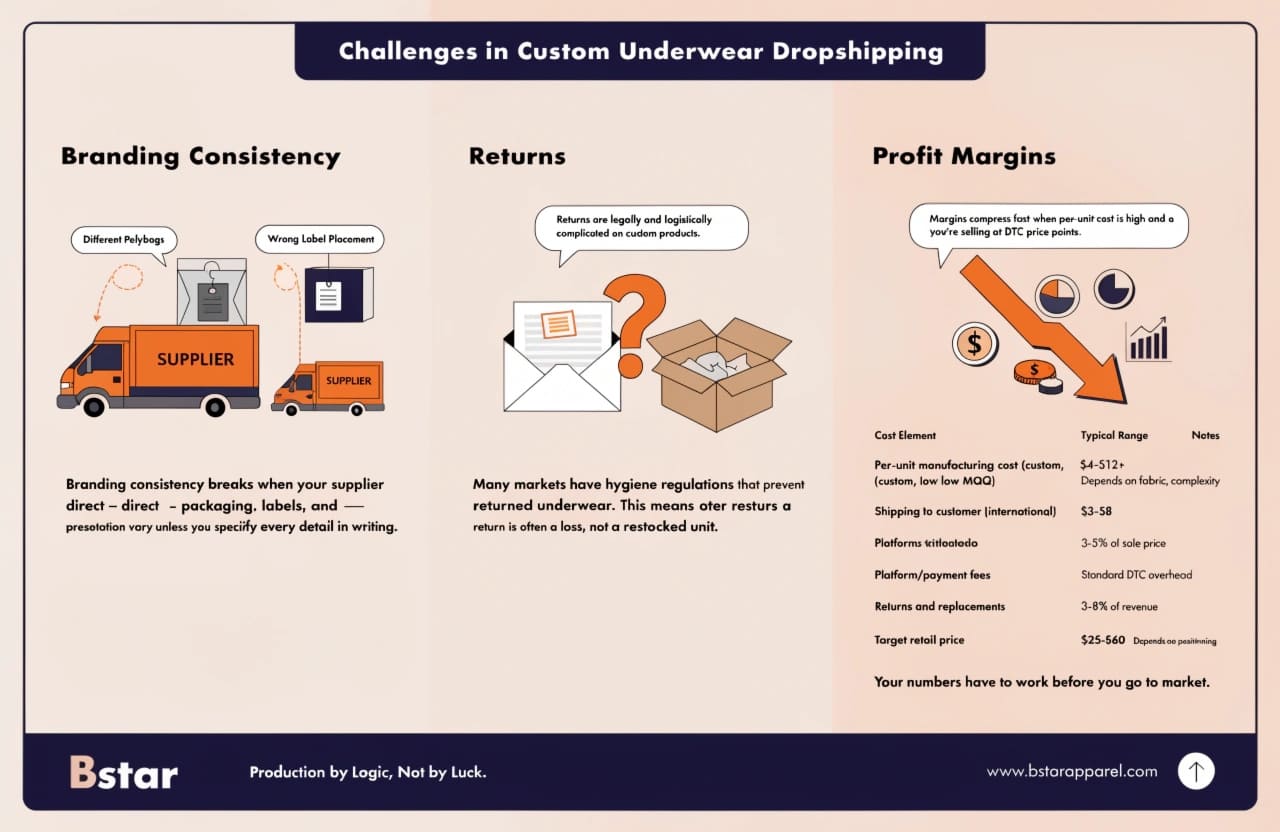
Branding consistency breaks when your supplier ships direct — packaging, labels, and presentation vary unless you specify every detail in writing. Returns are expensive and complicated on custom products. And margins compress fast when per-unit cost is high and you’re selling at DTC price points without volume discounts.
Breaking Down Each Challenge
Branding consistency requires a packaging spec document, not just a logo file. This means polybag type, hang tag design, label placement, fold method, and any inserts. Without this, two orders from the same customer can look different. Suppliers won’t standardize unless you specify — it’s not their default behavior.
Returns on custom underwear are legally and logistically complicated. Many markets have hygiene regulations that prevent resale of returned underwear.6 This means a return is often a loss, not a restocked unit. Your return policy, your supplier’s return policy, and the applicable consumer protection law in your target market all need to align before you launch.
Margins are the most honest test of whether your model works. Map this before you commit:
| Cost Element | Typical Range | Notes |
|---|---|---|
| Per-unit manufacturing cost (custom, low MOQ) | $4–$12+ | Depends on fabric, complexity |
| Shipping to customer (international) | $3–$8 | Varies by destination |
| Platform/payment fees | 3–5% of sale price | Standard DTC overhead |
| Returns and replacements | 3–8% of revenue | Budget for this |
| Target retail price | $25–$60 | Depends on positioning |
If your numbers don’t produce a margin you can operate on, no supplier improvement fixes that. The math has to work before you go to market.
Strategic Roadmap: Using Dropshipping as a Market Testing Tool, Not a Permanent Model
The smartest use of custom dropshipping isn’t as a permanent business model. It’s as a validation tool. Use it to test which SKUs sell, which price points hold, and which customer segments actually buy — before you commit to bulk inventory.
Custom dropshipping makes strategic sense as a low-volume testing phase. Run 2–3 SKUs at low MOQ, measure real demand, then transition to small pre-stock batches on your best performers.7 This path reduces total capital risk while still giving you real market data.
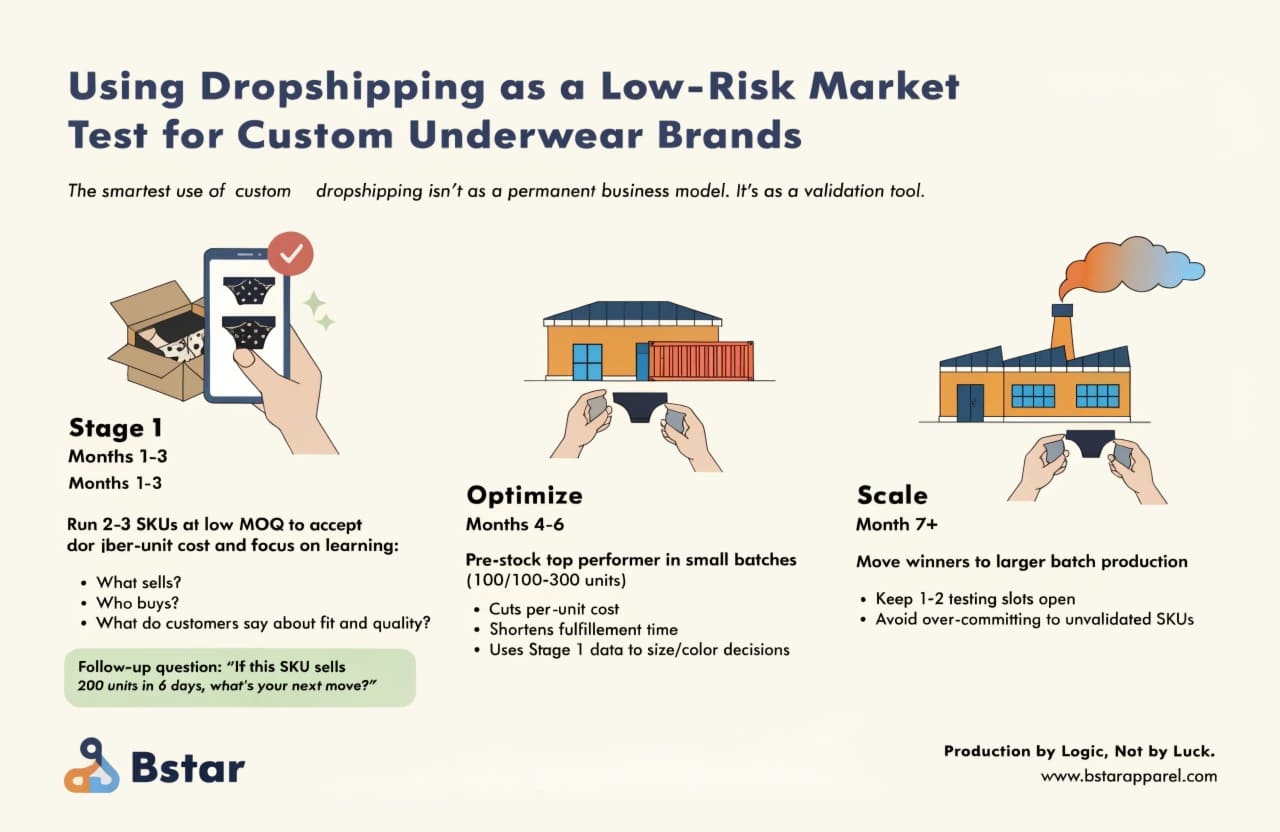
When I talk to new brand founders who are serious about this space, I ask them a follow-up question: "If this SKU sells 200 units in 60 days, what’s your next move?" The answer tells me whether they’ve thought through the model or just the launch.
A Practical Three-Stage Path
Stage 1 — Validate (Months 1–3)
Run 2–3 custom SKUs at the lowest viable MOQ. Accept higher per-unit cost. Focus entirely on learning: What sells? Who buys? What do customers say about fit and quality?
Stage 2 — Optimize (Months 4–6)
Take your top-performing SKU and pre-stock a small batch — 100 to 300 units. This cuts per-unit cost and shortens fulfillment time. Use the data from Stage 1 to make sizing and color decisions with real evidence.
Stage 3 — Scale (Month 7+)
Move winners to larger batch production. Keep 1–2 testing slots open for new SKUs using the original low-MOQ model. This keeps your pipeline fresh without betting capital on unvalidated products.
This approach treats dropshipping as a phase, not a destination. It’s a lower-risk entry strategy — not a lower-effort one.
Conclusion
Custom underwear dropshipping works when customization is your real edge, your capital plan accounts for pre-production costs, and you use it to test before you scale — not as a permanent model.
-
"What Is Dropshipping in Business? – Keiser University", https://www.keiseruniversity.edu/articles/what-is-dropshipping-new-business-trends-in-2023/. Academic and industry literature on dropshipping consistently identifies inventory elimination as the model’s primary marketing proposition, though researchers note this framing obscures other cost categories such as supplier premiums and pre-production expenses. Evidence role: general_support; source type: paper. Supports: That dropshipping is widely promoted as a low-capital-risk model for new e-commerce entrants. Scope note: Most published studies focus on logistics efficiency rather than the financial risk framing directed at new founders specifically. ↩
-
"Supply chain – Wikipedia", https://en.wikipedia.org/wiki/Supply_chain. Dropshipping is defined in supply chain literature as a retail fulfillment method in which the seller does not keep goods in stock but instead transfers customer orders to a manufacturer or wholesaler who ships directly to the end customer. Evidence role: definition; source type: encyclopedia. Supports: The standard dropshipping model in which the retailer holds no inventory and the supplier ships directly upon sale. ↩
-
"Batch-to-Batch Quality Consistency Evaluation of Botanical Drug …", https://pmc.ncbi.nlm.nih.gov/articles/PMC3665986/. Research in textile quality management identifies lot-to-lot variation as a significant challenge in short-run production, attributing inconsistencies to yarn dye lot differences, machine setup variability, and reduced statistical process control opportunities at low volumes. Evidence role: mechanism; source type: paper. Supports: That smaller production batches in textile manufacturing are more susceptible to inter-run variation in material properties such as color and weight. Scope note: Published studies typically address industrial-scale variation thresholds; direct data on consumer-product batches of 50–100 units is limited in peer-reviewed literature. ↩
-
"OEKO-TEX® STANDARD 100", https://www.oeko-tex.com/en/our-standards/oeko-tex-standard-100/. OEKO-TEX® Standard 100 is an independent testing and certification system for textile products that tests for harmful substances, while the Global Organic Textile Standard (GOTS) certifies organic fiber content and responsible manufacturing practices; both maintain publicly searchable databases of certified suppliers. Evidence role: definition; source type: institution. Supports: That OEKO-TEX® and GOTS are established third-party certification systems for textile safety and sustainability that can be independently verified. ↩
-
"Tech-Driven Transformation of Fashion Product Development Stages", https://browzwear.com/blog/main-stages-of-product-development-in-fashion. Fashion product development literature describes a standard pre-production sequence encompassing technical specification, prototype sampling, fit evaluation, and revision cycles, with industry sources indicating that sampling phases for custom knit products commonly require one to three weeks depending on complexity and supplier location. Evidence role: expert_consensus; source type: education. Supports: That custom apparel sampling and pre-production approval involves multiple sequential stages and typically requires one to several weeks. Scope note: Published timelines vary widely by product category, supplier geography, and communication efficiency; the 7–15 day figure represents a specific operational context rather than a universal standard. ↩
-
"Returns, Refunds, and Other Resolutions – FTC Consumer Advice", https://consumer.ftc.gov/node/77484. European Union consumer rights directives include a hygiene exemption permitting retailers to refuse returns on sealed goods that have been unsealed after delivery for health or hygiene reasons, a provision commonly applied to underwear and intimate apparel by member state implementations. Evidence role: historical_context; source type: government. Supports: That consumer protection or hygiene regulations in major markets restrict or prohibit the resale of returned intimate apparel. Scope note: Specific application varies by jurisdiction; the article’s claim that ‘many markets’ prohibit resale is directionally supported but requires market-by-market legal verification. ↩
-
"Lean startup – Wikipedia", https://en.wikipedia.org/wiki/Lean_startup. Lean startup and new product development literature supports iterative, low-commitment market testing as a mechanism for reducing capital exposure, with researchers identifying early demand validation as a key predictor of successful inventory scaling decisions. Evidence role: expert_consensus; source type: paper. Supports: That limiting initial SKU count and production volume to gather demand data before scaling inventory is a recognized risk-reduction strategy for new product launches. Scope note: Academic literature on this topic is largely drawn from software and technology product contexts; direct empirical studies on staged SKU testing in apparel e-commerce are limited. ↩