Custom Sports Bras Manufacturing: Support Levels and Sizing?
Brands get burned on sports bras more than almost any other activewear category. The support level looks right on paper, the size chart looks standard, and then sampling fails — or worse, it ships and returns come back.
Custom sports bra development fails most often at the brief stage, not the factory floor. Support level is not a label — it is an output of fabric choice, construction type, and your customer’s body proportions. Sizing is not a template — it must match the body distribution of your specific target market.
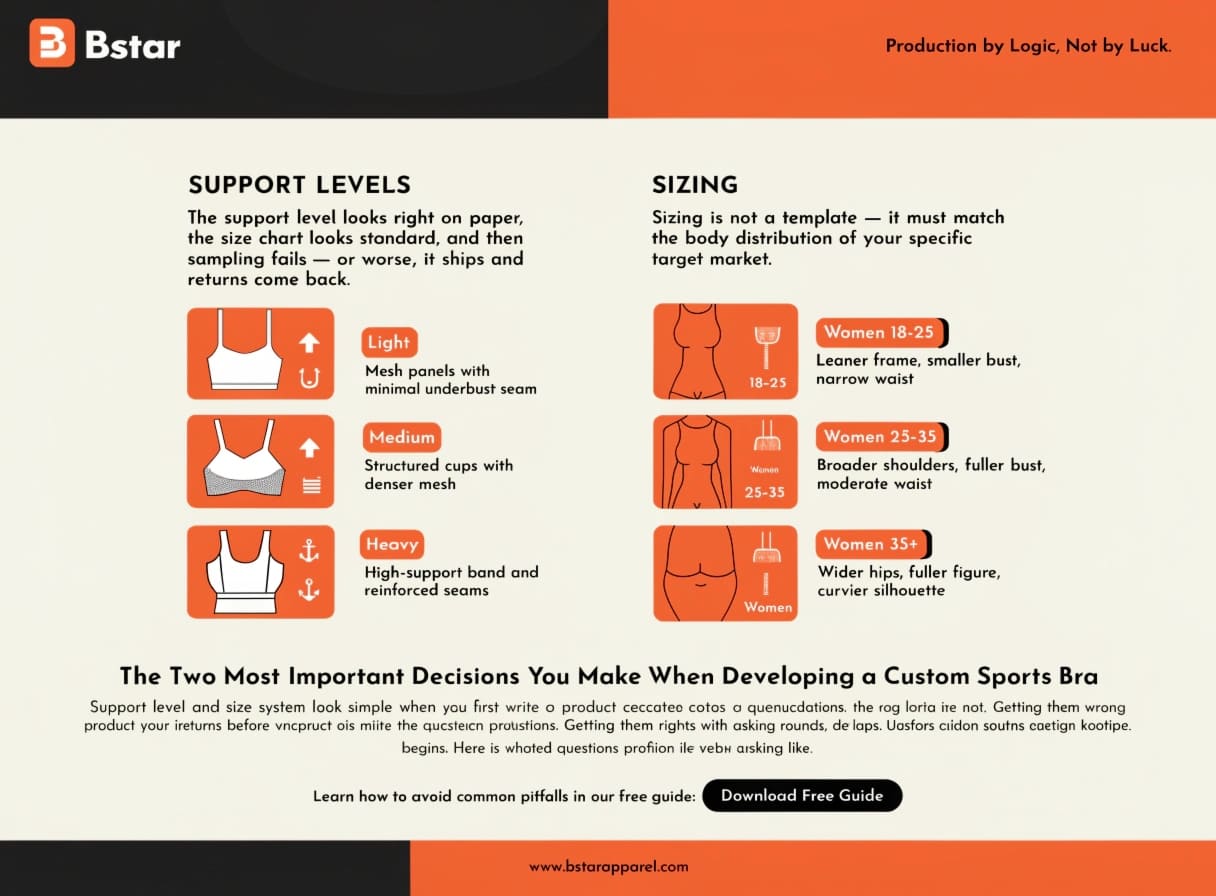
These two decisions — support structure and size system — look simple when you first write a product brief. They are not. Getting them wrong costs you sampling rounds, delays, and post-launch returns. Getting them right starts with asking the correct questions before production begins. Here is what those questions look like.
Defining Support Levels: Categorizing Low, Medium, and High-Impact Sports Bras?
Most brands come to us with a brief that says something like "high support, suitable for running." That phrase tells us almost nothing about what to build.
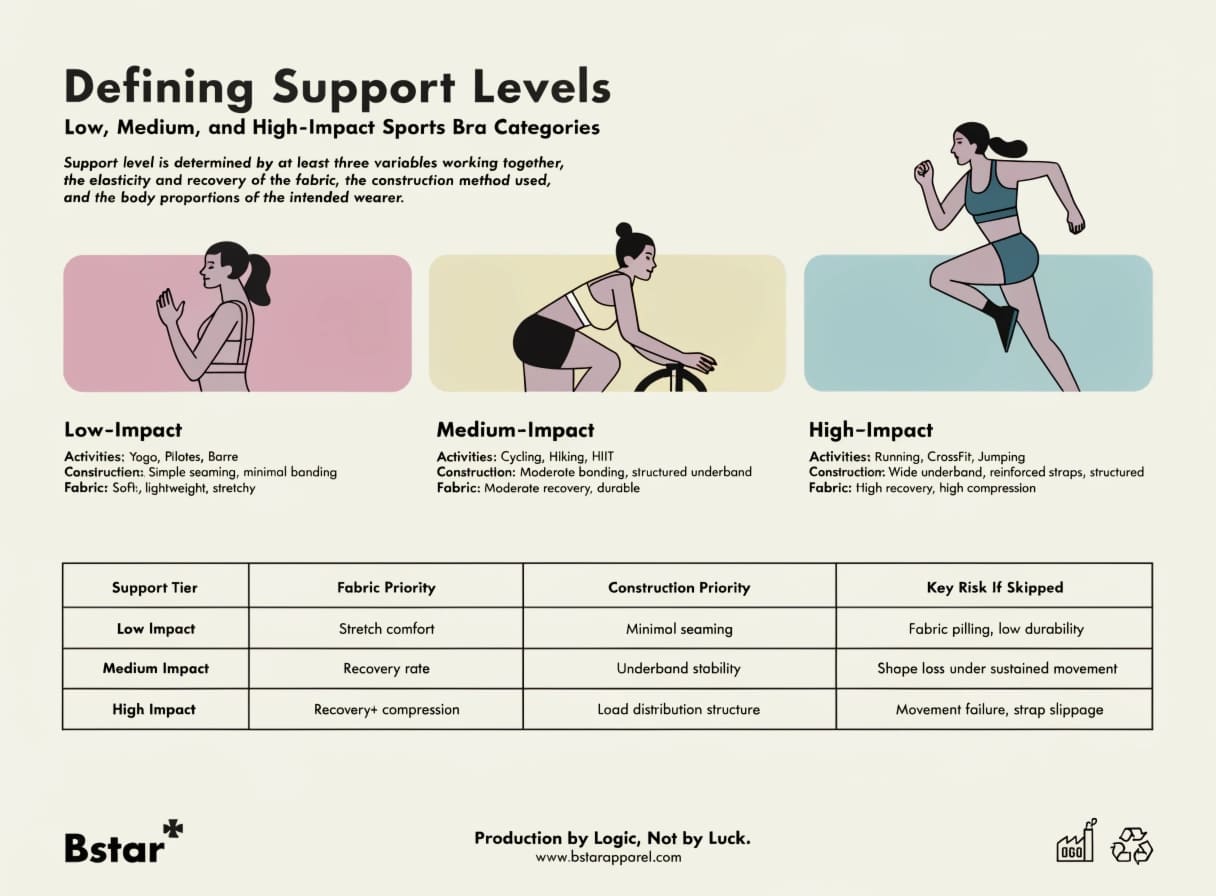
Support level in a sports bra is determined by at least three variables working together: the elasticity and recovery of the fabric, the construction method used, and the body proportions of the intended wearer. No single variable controls the outcome on its own.
So What Does Each Tier Actually Require?
Low-impact styles — think yoga or pilates — can rely mostly on compressive stretch fabric with minimal structural banding. The construction is simpler. Seam stress is lower. These are the most forgiving to develop.
Medium-impact styles — cycling, hiking, HIIT — need a more deliberate balance between stretch and recovery. The fabric cannot just compress. It needs to return to its original shape through repeated movement cycles. Construction at the underband matters more here because the body is moving in multiple directions.
High-impact styles — running, CrossFit, jumping — are a different product category entirely. Fabric recovery alone is not enough. You need construction decisions that distribute load: wider underbands, reinforced strap anchors, and often encapsulation or hybrid panel structures. Calling something "high support" without locking those construction variables means the product is designed on a label, not on engineering.
Here is a useful way to map the variables across tiers:
| Support Tier | Fabric Priority | Construction Priority | Key Risk If Skipped |
|---|---|---|---|
| Low Impact | Stretch comfort | Minimal seaming | Fabric pilling, low durability |
| Medium Impact | Recovery rate | Underband stability | Shape loss under sustained movement |
| High Impact | Recovery + compression | Load distribution structure | Movement failure, strap slippage |
The table above is a starting point, not a spec sheet. Your target activity, your target wearer, and your price point all modify these defaults.
Engineering Stability: Key Design Features for Maximum Support and Comfort?
We see a lot of briefs that ask for maximum support but budget for minimum construction complexity. That gap is where the project breaks down.
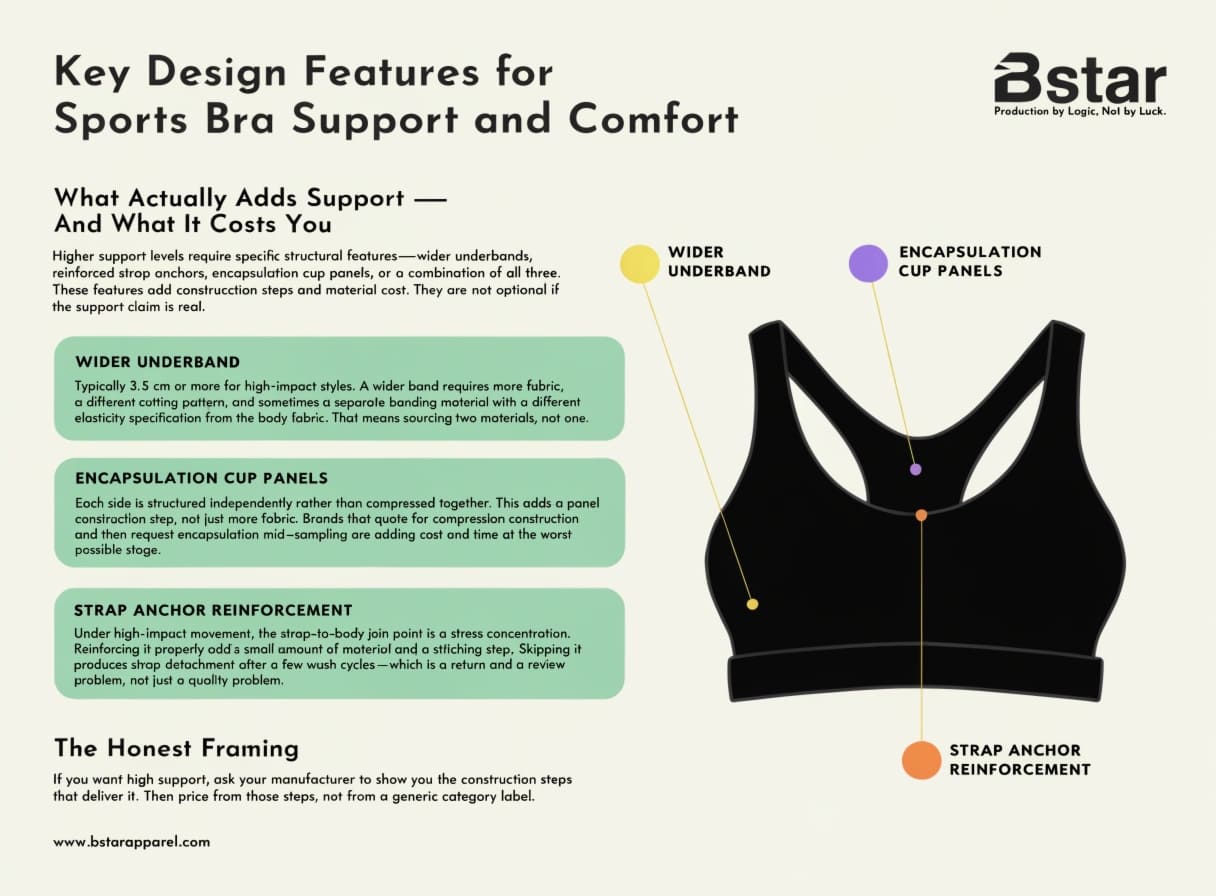
Higher support levels require specific structural features — wider underbands, reinforced strap anchors, encapsulation cup panels, or a combination of all three. These features add construction steps and material cost. They are not optional if the support claim is real.
What Actually Adds Support — And What It Costs You
The underband is the most underestimated component in sports bra development. Most brands focus on strap design because it is visible. But the underband is what anchors the whole structure to the body. A narrow or low-tension underband shifts load to the straps, which causes dig-in and movement under high impact.
Wider underbands — typically 3.5 cm or more for high-impact styles — require more fabric, a different cutting pattern, and sometimes a separate banding material with a different elasticity specification from the body fabric. That means sourcing two materials, not one.
Encapsulation cups — where each side is structured independently rather than compressed together — add a panel construction step. This is not "more fabric." It is a different sewing sequence and a different pattern block. Brands that quote for compression construction and then request encapsulation mid-sampling are adding cost and time at the worst possible stage.
Strap anchor reinforcement is another step that gets missed. Under high-impact movement, the strap-to-body join point is a stress concentration. Reinforcing it properly adds a small amount of material and a stitching step. Skipping it produces strap detachment after a few wash cycles — which is a return and a review problem, not just a quality problem.
The honest framing here is: if you want high support, ask your manufacturer to show you the construction steps that deliver it. Then price from those steps, not from a generic category label.
Mastering the Fit: Developing Accurate Size Charts and Inclusive Sizing Strategies?
Size charts are one of the most dangerous assumptions in cross-border activewear development. We regularly receive briefs that attach a standard EU or US size chart with no further instruction. That chart is a starting point, not a solution.
Size charts must be built or validated against the body proportions of your specific target market. EU and US standard grading does not accurately represent body distributions in Oceania, Southeast Asia, or Latin America. Using the wrong baseline produces fit failures at the tail sizes — where your most loyal customers often sit.
Why Generic Charts Break at the Edges
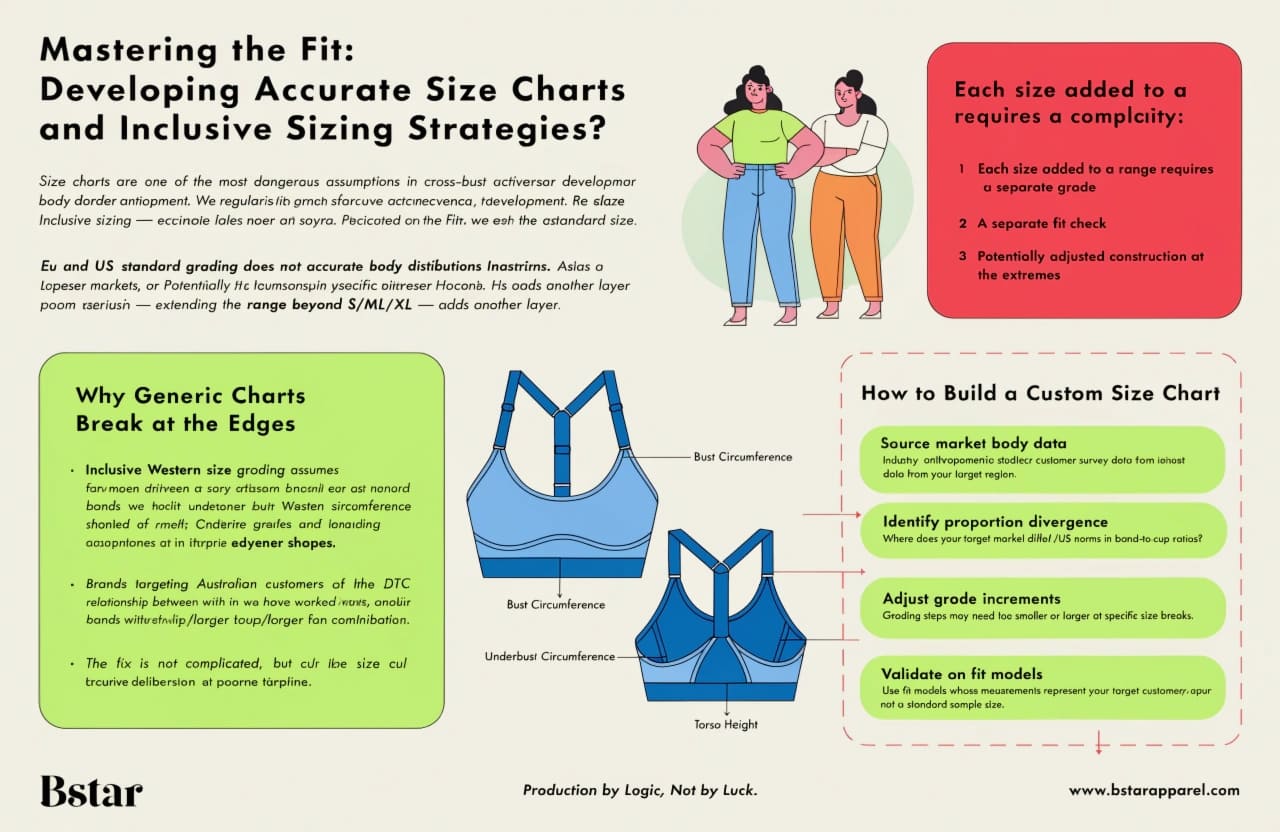
Standard Western size grading assumes a specific relationship between bust circumference, underbust, and torso height. That relationship does not hold uniformly across different markets.
Brands targeting Australian customers — like one of the DTC underwear brands we have worked with in that market — found that their standard EU-derived chart fit poorly at smaller band/larger cup combinations and at larger band sizes. These are exactly the customers who purchase repeatedly if fit is right, and who write negative reviews if it is not.
The fix is not complicated, but it does require deliberate input:
| Step | What This Means in Practice |
|---|---|
| Source market body data | Industry anthropometric studies or customer survey data from your target region |
| Identify proportion divergence | Where does your target market differ from EU/US norms in band-to-cup ratios? |
| Adjust grade increments | Grading steps may need to be smaller or larger at specific size breaks |
| Validate on fit models | Use fit models whose measurements represent your target customer, not a standard sample size |
The brief stage is where this conversation needs to happen. If a brand waits until the first sample arrives to discover the size chart is wrong, they are paying for another sampling round. That is an avoidable cost.
Inclusive sizing — extending the range beyond standard S/M/L/XL — adds another layer. Each size added to a range requires a separate grade, a separate fit check, and potentially adjusted construction at the extremes. Brands planning for extended sizing need to build that into the development timeline and budget from the start.
Technical Construction: The Role of Adjustable Straps, Underbands, and Encapsulation?
Construction decisions in sports bras are not just functional. They are cost decisions. Every feature that adds support adds a step — and brands need to understand that before they lock a price expectation.
Adjustable straps, structured underbands, and encapsulation cups each add construction complexity. The cost difference between a simple compression bra and a fully engineered high-impact style is not marginal — it can be significant enough to break a budget built on the wrong assumptions.
Breaking Down the Construction Stack
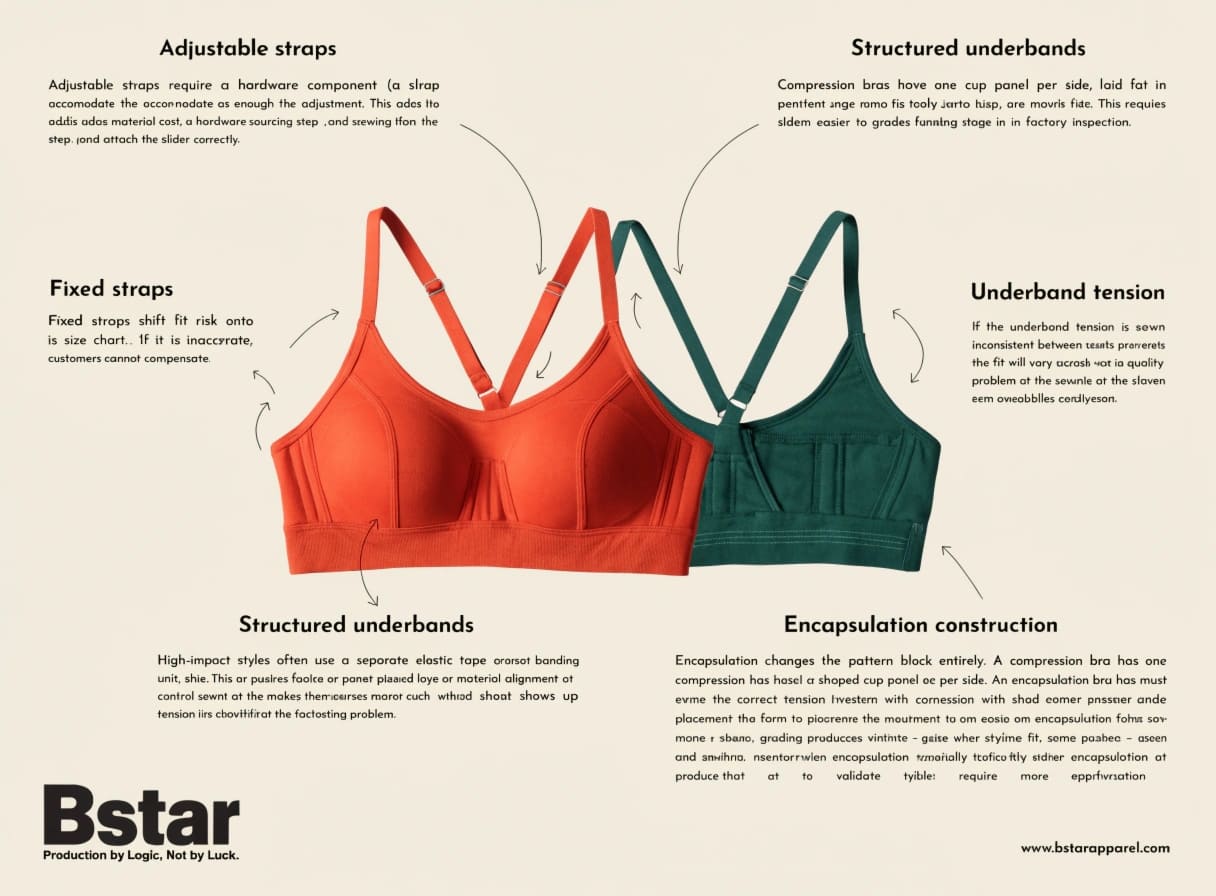
Adjustable straps require a hardware component — a slider — and a strap long enough to accommodate the adjustment range. This adds material cost, a hardware sourcing step, and a sewing step to attach the slider correctly. Fixed straps are simpler, but they shift fit risk onto your size chart. If the size chart is accurate, fixed straps work. If it is not, the customer has no way to compensate.
Underbands in high-impact styles often use a separate elastic tape or powernet banding layer bonded or sewn to the main fabric. This requires material alignment at the cutting stage and precise tension control at the sewing stage. If the underband tension is inconsistent between units, the fit will vary across the batch — which is a quality control problem that shows up in customer reviews, not in factory inspection.
Encapsulation construction changes the pattern block entirely. A compression bra has one cup panel per side. An encapsulation bra has a shaped cup structure that must be sewn with correct tension and seam placement to hold its form under movement. Pattern adjustments for encapsulation are more sensitive than for compression — a small grading error at the cup produces a visible fit problem. This is why encapsulation styles typically require more sampling rounds to validate.
The practical advice here is simple: before you finalize your design brief, ask your manufacturing partner to itemize the construction steps that deliver your support claim. Match those steps to your cost target. If they do not align, you have a design decision to make — not a negotiation to win.
Conclusion
Custom sports bra development is a brief-stage problem. Lock your support structure, validate your size chart for your target market, and understand what your construction choices actually cost — before sampling begins.