OEM vs. ODM Underwear Services: What’s the Real Difference for Your Brand?
Picking the wrong manufacturing model can waste months and thousands of dollars. Most buyers know OEM and ODM are different. Few know which one fits their situation right now.
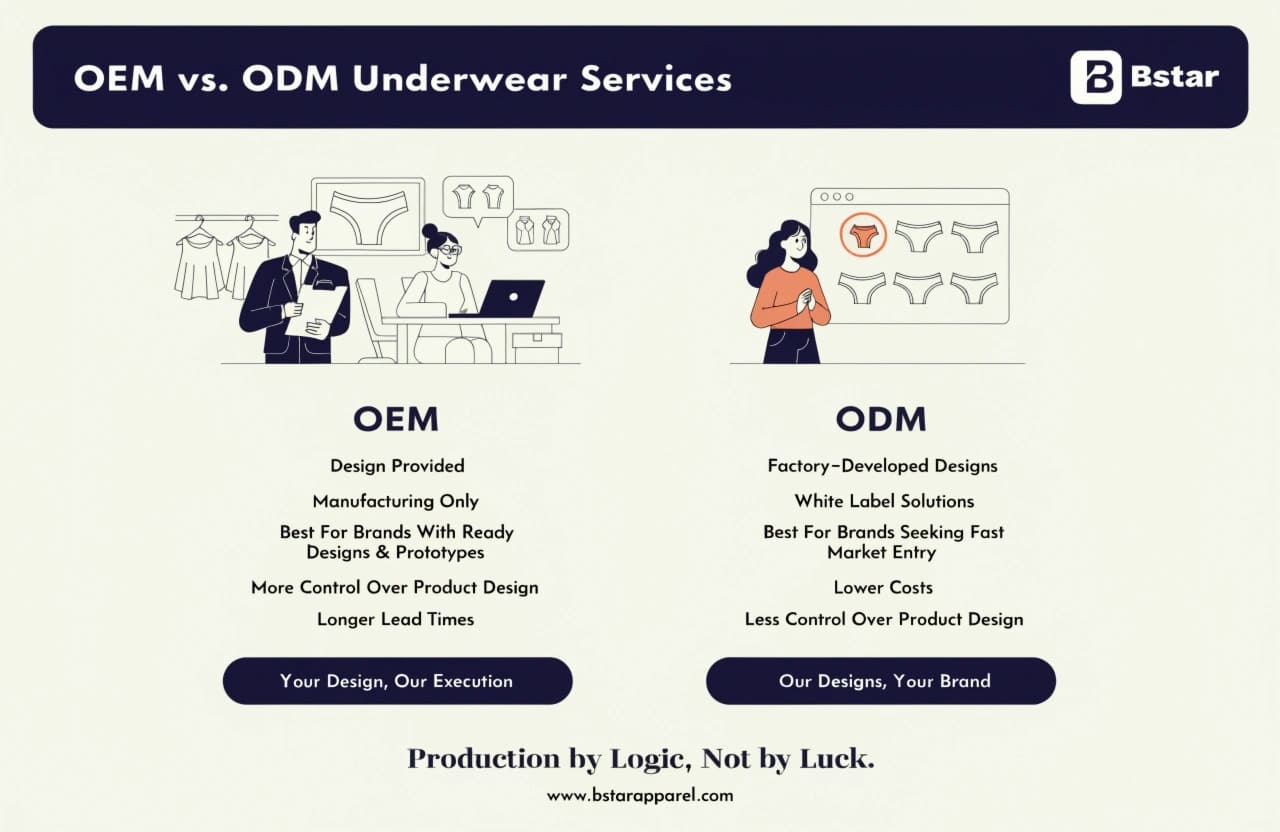
OEM means you supply the design and the factory produces it. ODM means the factory already has designs you can adopt and brand as your own. The faster question to answer is not "what do these mean?" but "where is my brand right now?" — because that determines everything else.
Both models can work well. Both can go wrong if you choose for the wrong reasons. Let me walk you through the real trade-offs, because after 19 years of working directly with overseas DTC brands and e-commerce sellers, I can tell you the conversation almost always comes down to three things: your brand stage, your order volume, and how much creative control you actually need.
Defining the Models: What Do OEM and ODM Actually Mean in Practice?
Here is the honest version: the industry does not use these terms consistently. Some factories flip the definitions1. Some buyers use OEM to mean any outsourced production.
At BSTAR, OEM means you bring the design — the silhouette, the fabric spec, the fit detail — and we manufacture to your exact specification. ODM means you choose from designs we have already developed, and we produce them under your brand label. One starts with your ideas. The other starts with ours.
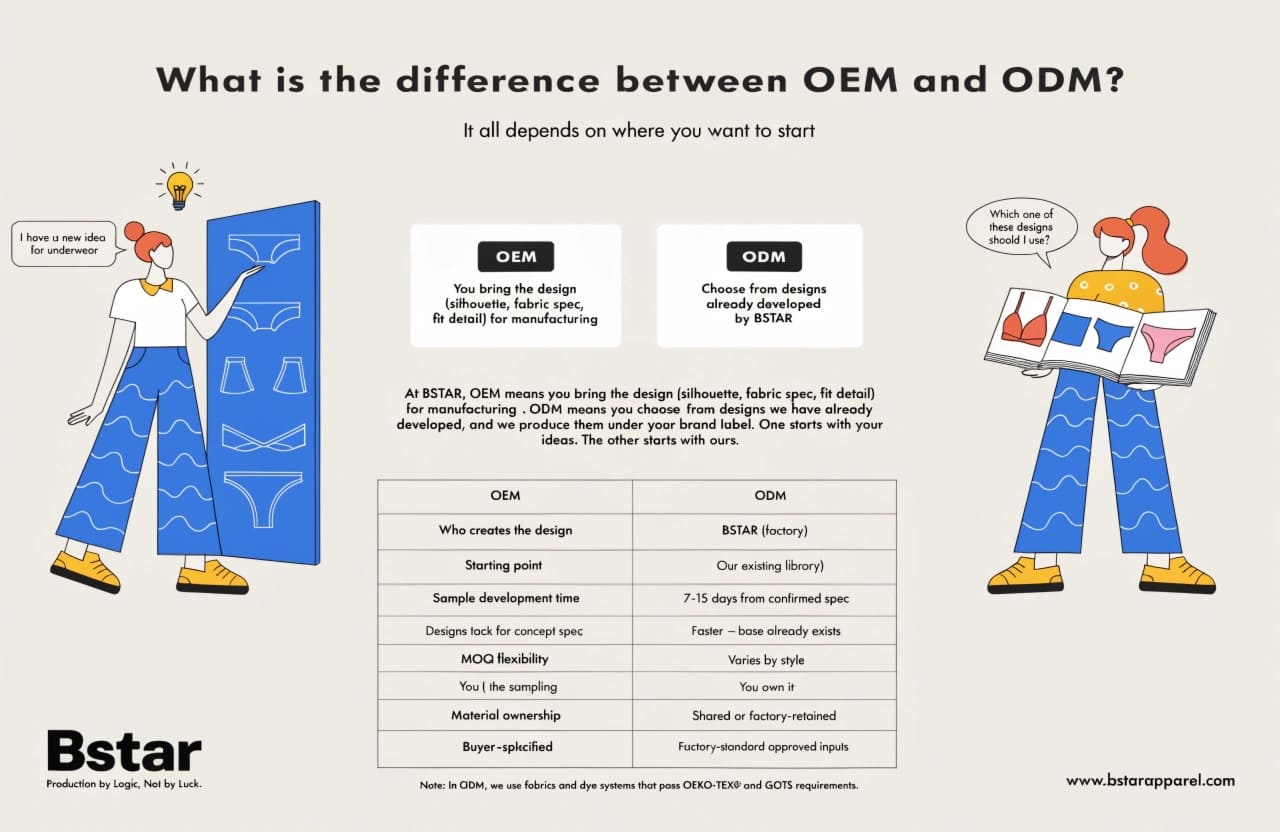
The reason this distinction matters for underwear specifically is that the product sits directly against skin. Material choices, seam placement, waistband construction — these are not decorative decisions. They affect fit, comfort, and compliance2. In OEM, you are making those calls. In ODM, we have already made them, using fabrics and dye systems that pass OEKO-TEX® and GOTS requirements3.
When a buyer comes to us without a technical spec — no pattern, no fabric reference, just a concept — the honest answer is that they are not ready for full OEM yet. That is not a criticism. It is just a starting point issue. Some of our best long-term customers started with an ODM base, validated their market, and moved into OEM once they had real order data behind them.
What each model actually involves
| OEM | ODM | |
|---|---|---|
| Who creates the design | You (the buyer) | BSTAR (factory) |
| Starting point | Your tech pack or concept | Our existing library |
| Sample development time | 7–15 days from confirmed spec | Faster — base already exists |
| MOQ flexibility | From 1 piece for sampling | Varies by style |
| Design ownership | You own it | Shared or factory-retained |
| Material selection | Buyer-specified | Factory-standard approved inputs |
The table above is a simplified version. The real conversation is always more conditional than any table can show.
Intellectual Property and Control: Who Actually Owns What You’re Selling?
This is the question most buyers forget to ask until it is too late. I have seen brands invest in a product, build a customer base around it, and then realize they have no exclusive rights to the design they are selling.
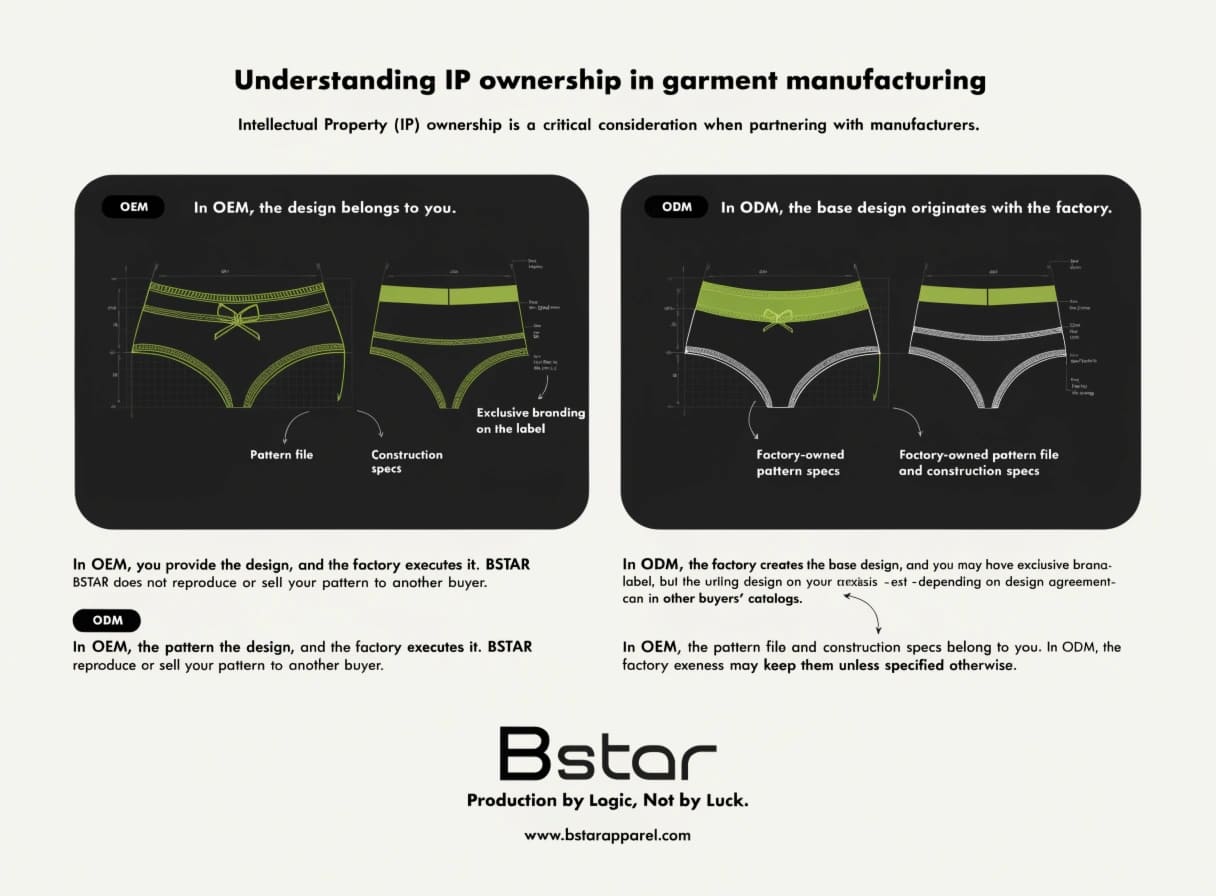
In OEM, the design belongs to you. You brought it. The factory executed it.4 BSTAR does not reproduce or sell your pattern to another buyer. In ODM, the base design originates with the factory. You may have exclusive branding on the label, but the underlying design can — depending on your agreement — exist in other buyers’ catalogs.
For a startup testing a new underwear category, design exclusivity may not be the priority. Getting a quality product to market fast and at manageable cost is. ODM solves that.
For an established DTC brand that has built its identity around a specific fit or fabric story, ODM is a risk. If a competitor sources the same base design — same pattern, same fabric — your differentiation disappears at the product level5. OEM protects against that.
How to think about IP before you sign anything
The practical questions to ask your factory before committing are straightforward. Will this design be sold to other buyers? Can I trademark the pattern geometry or the fabric specification under this agreement? What happens to the tooling and patterns if we stop working together?
At BSTAR, OEM orders come with clear documentation: the pattern stays with the brand. We retain the right to use our production knowledge — that is universal — but the specific design file and construction spec belong to the buyer. That is a basic business expectation, and any serious manufacturer should be able to confirm it in writing before you pay a sample fee.
Cost and Speed: The Trade-Off Is Real, But It Is Not What Most People Think
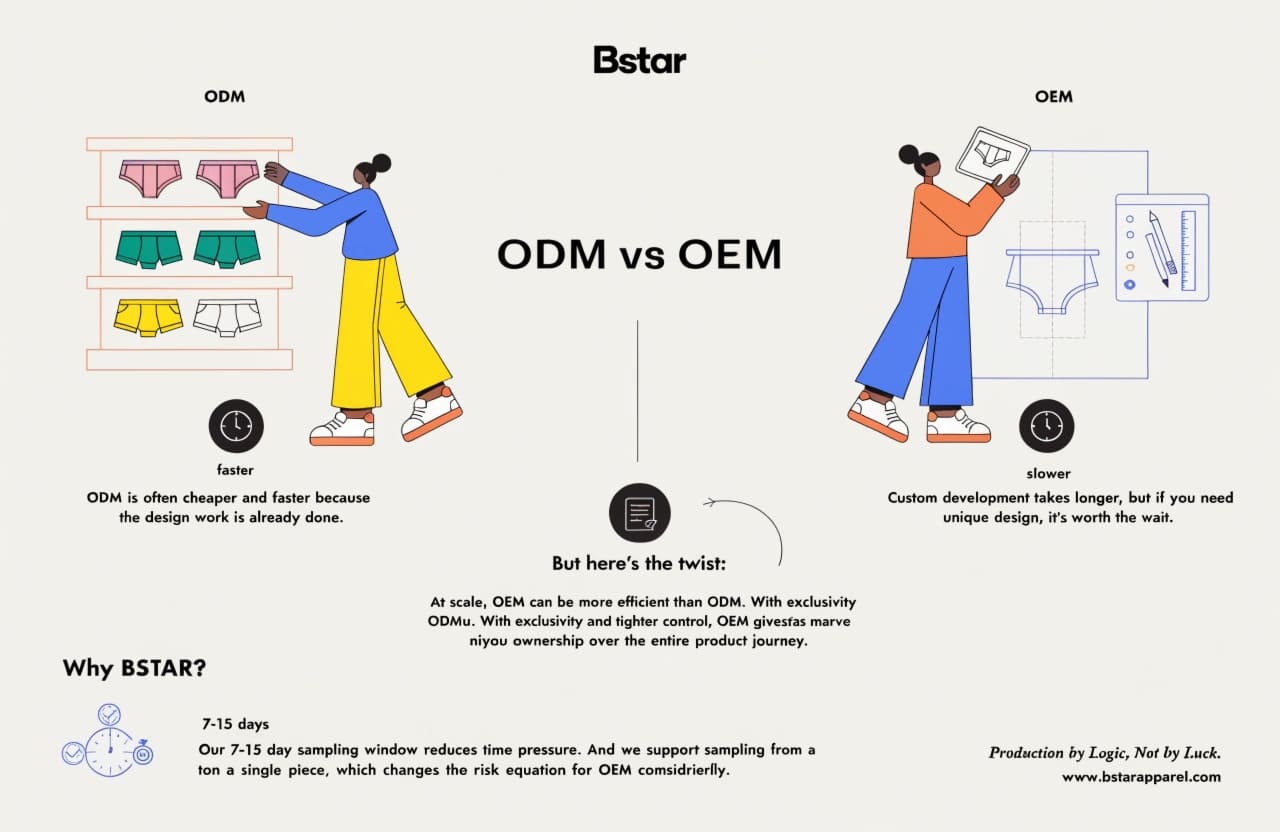
Most buyers assume ODM is always cheaper and faster. It often is — but the reason matters. ODM is faster because the design work is already done. You are selecting, not creating. That reduces time and development cost on your side.
OEM costs more upfront because you are funding original development: pattern making, fit sampling, material sourcing, and multiple approval rounds. But the cost comparison changes once volume grows. At scale, OEM’s exclusivity and tighter margin control often make it the more efficient model long-term.
Here is how I think about it with buyers who are genuinely unsure.
A new e-commerce seller launching their first men’s underwear line with under 300 units per style is taking on real demand risk. They do not know yet which silhouettes will sell. Spending heavily on custom development before that is confirmed is a fast way to burn budget. ODM lets them test product-market fit with less financial exposure6. If a style works, they can invest in an OEM version later with a differentiated fabric or fit detail.
An Australian DTC brand that already has a loyal customer base and wants to introduce a new seamless brief line is in a different position. They have order history, they know their customer’s body type preferences, and they want something that cannot be copied by a white-label competitor. That is an OEM brief.
How BSTAR’s 7–15 day sampling changes the OEM calculation
One reason buyers default to ODM is the assumption that custom development takes too long. In many factories, that is true. But our 7–15 day sampling window — starting from a confirmed design brief7 — is specifically built to reduce that time pressure. We support sampling from a single piece, which means you can test fit and material without committing to a bulk order. That changes the risk equation for OEM considerably.
Strategic Selection: How to Choose the Right Model for Where Your Brand Is Today
The wrong way to choose is by feature comparison alone. The right way is to match the model to your current stage and realistic order capacity.
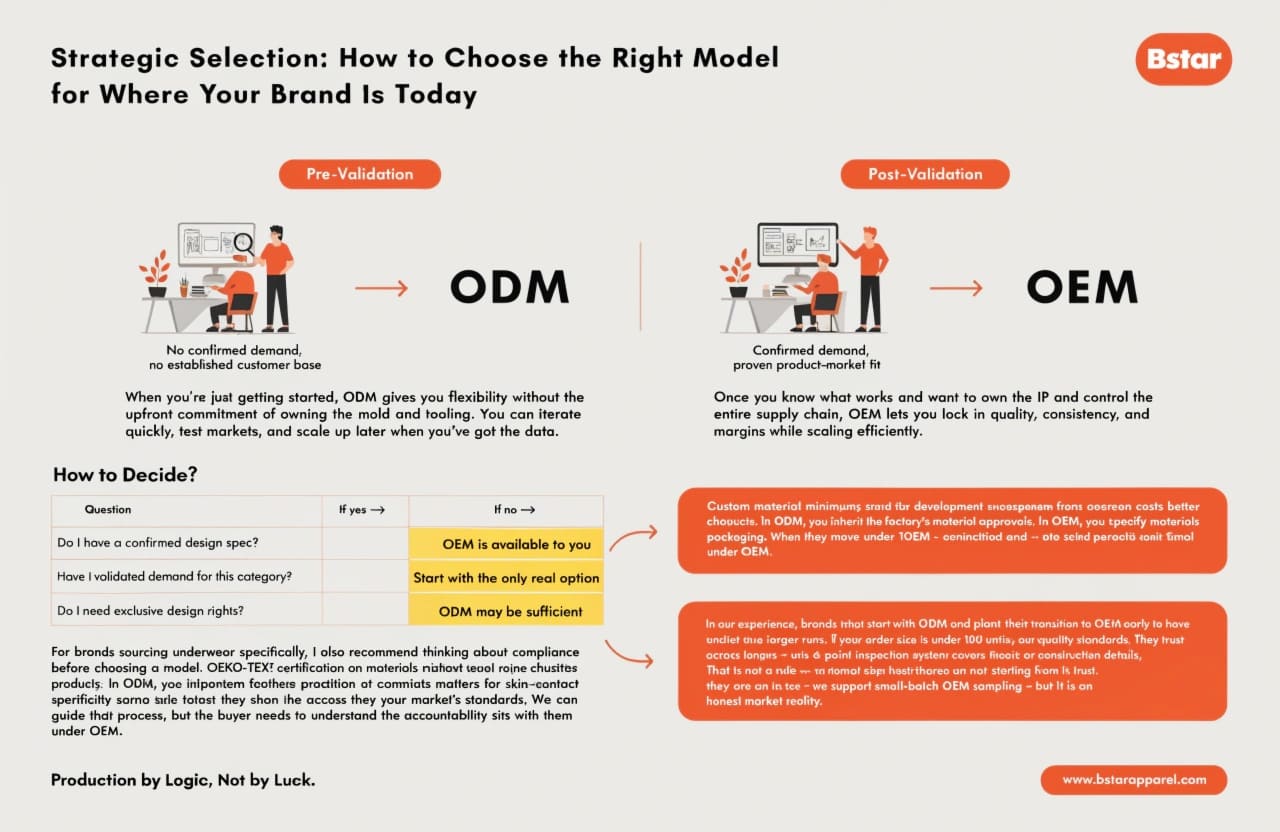
If you are pre-validation — no confirmed demand, no established customer base — start with ODM. If you are post-validation — you know what sells and you want to own it — move into OEM. The model should change as your brand changes.
In our experience, brands that start with ODM and plan their transition to OEM early tend to have smoother supplier relationships8. They already know our quality standards. They trust the QC process — our 6-point inspection system covers incoming materials through final packaging9. When they move to OEM and specify their own fabrics or construction details, they are not starting from zero on trust.
A simple decision framework
Ask yourself these three questions honestly:
| Question | If yes → | If no → |
|---|---|---|
| Do I have a confirmed design spec? | OEM is available to you | Start with ODM or co-development |
| Have I validated demand for this category? | OEM investment makes sense | ODM reduces your risk |
| Do I need exclusive design rights? | OEM is the only real option | ODM may be sufficient |
There is also a volume reality. If your order size is under 100 units per style at launch, ODM is often the more practical entry point purely on unit economics10. Custom material minimums and pattern development spread costs better across larger runs11. That is not a rule — we support small-batch OEM sampling — but it is an honest market reality.
For brands sourcing underwear specifically, I also recommend thinking about compliance before choosing a model. OEKO-TEX® certification on materials matters for skin-contact products12. In ODM, you inherit the factory’s material approvals. In OEM, you specify materials and take on the responsibility of confirming they meet your market’s standards. We can guide that process, but the buyer needs to understand the accountability sits with them under OEM.
Conclusion
OEM gives you ownership and exclusivity. ODM gives you speed and lower entry cost. The right choice depends on your brand’s current stage, volume, and how much creative control you actually need today.
-
"OEM vs ODM: What’s the Difference in Hardware Manufacturing?", https://www.seacomp.com/resources/oem-vs-odm-manufacturing. Wikipedia’s entries on ‘Original equipment manufacturer’ and ‘Original design manufacturer’ note that the terms have evolved differently across industries and regions, with OEM carrying different meanings in electronics, automotive, and apparel sectors, contributing to definitional inconsistency in practice. Evidence role: definition; source type: encyclopedia. Supports: That OEM and ODM are distinct but frequently conflated or variably defined terms in manufacturing and supply chain contexts. Scope note: Wikipedia reflects common usage rather than authoritative industry standardization; the degree of inconsistency in apparel specifically is not quantified in published literature. ↩
-
"[PDF] A Guide to United States Apparel and Household Textiles …", https://www.cpsc.gov/s3fs-public/Guide-to-US-Apparel-and-Household-Textiles.pdf. Research in textile ergonomics has documented that seam placement, pressure distribution from waistbands, and fabric-to-skin contact area are significant determinants of garment comfort and can contribute to skin irritation, particularly in close-fitting garments worn for extended periods (Hu, J., ‘Fabric Testing’, Woodhead Publishing; relevant ergonomics journals). Evidence role: mechanism; source type: paper. Supports: That seam placement and construction details in skin-contact garments have measurable effects on wearer comfort and may interact with textile safety standards. Scope note: Published studies focus primarily on comfort and irritation outcomes; the specific link to regulatory compliance thresholds depends on the applicable standard and jurisdiction. ↩
-
"Oeko-Tex – Wikipedia", https://en.wikipedia.org/wiki/Oeko-Tex. OEKO-TEX Standard 100 tests textile products at every stage of production for harmful substances, with stricter limits applied to product classes in direct skin contact; GOTS (Global Organic Textile Standard) additionally governs organic fiber content and social criteria throughout the supply chain (OEKO-TEX Association; Global Organic Textile Standard). Evidence role: definition; source type: institution. Supports: What OEKO-TEX Standard 100 and GOTS certifications test for and why they are relevant to skin-contact garments such as underwear. Scope note: These sources describe the certification frameworks generally; they do not independently verify any specific factory’s compliance status. ↩
-
"Manufacturing and Purchase Agreement – SEC.gov", https://www.sec.gov/Archives/edgar/data/1110647/000119312512225119/d347533dex105.htm. In contract manufacturing relationships, ownership of intellectual property—including design files and patterns—is governed by the terms of the manufacturing agreement and applicable national law; absent explicit contractual assignment, default ownership rules vary significantly across jurisdictions (World Intellectual Property Organization, ‘Intellectual Property and Contract Manufacturing’). Evidence role: mechanism; source type: education. Supports: That IP ownership in OEM arrangements is determined by contract terms and jurisdiction, not automatically assigned to the buyer. Scope note: General IP principles apply; the article’s specific claim that the buyer always owns the design in OEM is a contractual best practice, not a universal legal default. ↩
-
"OEM vs ODM vs Private Label Cosmetics: Key Differences Explained", https://arisecosmetic.com/oem-vs-odm-vs-private-label-cosmetics/. Strategic management literature on competitive advantage identifies product imitation as a primary risk when firms lack proprietary design assets; in private-label and ODM contexts, where the same design may be available to multiple buyers, differentiation must rely on branding or marketing rather than product uniqueness (Porter, M.E., ‘Competitive Advantage’; Teece, D.J., ‘Profiting from Technological Innovation’). Evidence role: general_support; source type: research. Supports: That reliance on non-exclusive ODM designs exposes brands to competitive imitation risk, undermining product-level differentiation. Scope note: General competitive strategy literature does not address ODM apparel sourcing specifically; the magnitude of this risk depends on the factory’s exclusivity policies and market concentration. ↩
-
"Finding Product-Market Fit in the Tech Industry | HBS Online", https://online.hbs.edu/blog/post/how-to-find-product-market-fit. The lean startup methodology, as described by Ries (2011), advocates validating customer demand with minimum viable products before investing in full-scale custom development, a principle applicable to sourcing decisions in consumer goods. Evidence role: general_support; source type: other. Supports: That validating demand before committing to high-cost custom development reduces financial risk for early-stage product launches. Scope note: Lean startup literature addresses product development broadly and does not specifically address OEM versus ODM sourcing decisions in apparel manufacturing. ↩
-
"a study on lead time management in garments industry", https://www.academia.edu/145106488/A_STUDY_ON_LEAD_TIME_MANAGEMENT_IN_GARMENTS_INDUSTRY. Industry analyses of apparel supply chains report that sample development lead times commonly range from three to eight weeks depending on complexity, factory location, and material sourcing requirements, though fast-response manufacturers have reduced this window (McKinsey & Company, ‘The State of Fashion’; Just-Style industry reports). Evidence role: statistic; source type: research. Supports: What typical sample development lead times are in the apparel manufacturing industry, providing context for evaluating a 7–15 day claim. Scope note: Published benchmarks vary widely by product category, factory tier, and geography; a direct comparison to underwear-specific sampling timelines is not available in public literature. ↩
-
"[PDF] Investigating the role of apparel supplier satisfaction in developing a …", https://libres.uncg.edu/ir/uncg/f/J_Su_Investigating_2023.pdf. Supply chain management research identifies trust, accumulated transactional experience, and mutual knowledge as key antecedents of successful long-term buyer-supplier relationships, with prior collaborative history reducing coordination costs when relationship scope expands (Dyer, J.H. & Singh, H., ‘The Relational View’, Academy of Management Review, 1998; Cousins, P.D. et al., ‘Strategic Supply Management’). Evidence role: general_support; source type: paper. Supports: That established trust and familiarity between buyers and suppliers, built through prior transactional experience, improves outcomes when relationships deepen or become more complex. Scope note: Academic literature addresses buyer-supplier relationships generally; the specific claim about ODM-to-OEM transitions in apparel manufacturing is not directly studied in published research. ↩
-
"Garment Quality Control | Process, Stages & Checks – Silq", https://www.onesilq.com/blog/garment-quality-control. Quality management frameworks for apparel manufacturing, including those aligned with ISO 9001 and industry guidelines from bodies such as the American Society for Quality, recommend inspection checkpoints at multiple production stages—including incoming material inspection, in-process checks, and final product audit—to detect defects before goods reach the buyer (ISO 9001:2015; AATCC and ASTM textile testing standards). Evidence role: general_support; source type: institution. Supports: That multi-stage quality inspection systems in garment manufacturing, covering materials intake through finished goods, are an established quality assurance practice. Scope note: External standards describe inspection principles generally; they do not validate the specific content or rigor of any individual factory’s proprietary inspection protocol. ↩
-
"Economic order quantity – Wikipedia", https://en.wikipedia.org/wiki/Economic_order_quantity. Supply chain economics literature establishes that fixed costs associated with pattern development, tooling, and material minimums are amortized across production volume, resulting in higher per-unit costs at low order quantities; this cost structure is well-documented in apparel manufacturing contexts (Gereffi, G. & Frederick, S., ‘The Global Apparel Value Chain’; OECD trade and supply chain reports). Evidence role: mechanism; source type: research. Supports: That fixed development and tooling costs in custom garment manufacturing spread more favorably across larger order quantities, affecting the economic viability of OEM at low volumes. Scope note: The specific 100-unit threshold cited in the article is a practical heuristic rather than a figure derived from published cost modeling. ↩
-
"Economic order quantity – Wikipedia", https://en.wikipedia.org/wiki/Economic_order_quantity. Textile sourcing literature and apparel industry analyses document that fabric mills typically impose minimum order quantities (MOQs) ranging from 300 to 1,000 meters or more for custom constructions or colorways, with the fixed cost of dyeing, finishing, and setup amortized across the minimum run, resulting in elevated per-unit material costs for small orders (Gereffi, G. & Memedovic, O., ‘The Global Apparel Value Chain’, UNIDO; Just-Style sourcing reports). Evidence role: mechanism; source type: research. Supports: That textile mills impose minimum order quantities for custom fabrics, and that these minimums create cost inefficiencies when spread across small production runs. Scope note: Specific MOQ thresholds vary substantially by mill, fiber type, and fabric construction; published figures represent ranges rather than universal standards. ↩
-
"[PDF] A Guide to United States Apparel and Household Textiles …", https://www.cpsc.gov/s3fs-public/Guide-to-US-Apparel-and-Household-Textiles.pdf. OEKO-TEX Standard 100 classifies tested products into four categories based on intended use, with Product Class I (items for babies) and Product Class II (items with direct skin contact, including underwear) subject to the most stringent limits for harmful substances such as pH value, formaldehyde, and heavy metals (OEKO-TEX Association, Standard 100 by OEKO-TEX). Evidence role: definition; source type: institution. Supports: That OEKO-TEX Standard 100 applies stricter testing criteria to textiles classified as direct skin-contact products, making it especially relevant for underwear. ↩