
How to Photograph Underwear for E-commerce: Tips for Brands
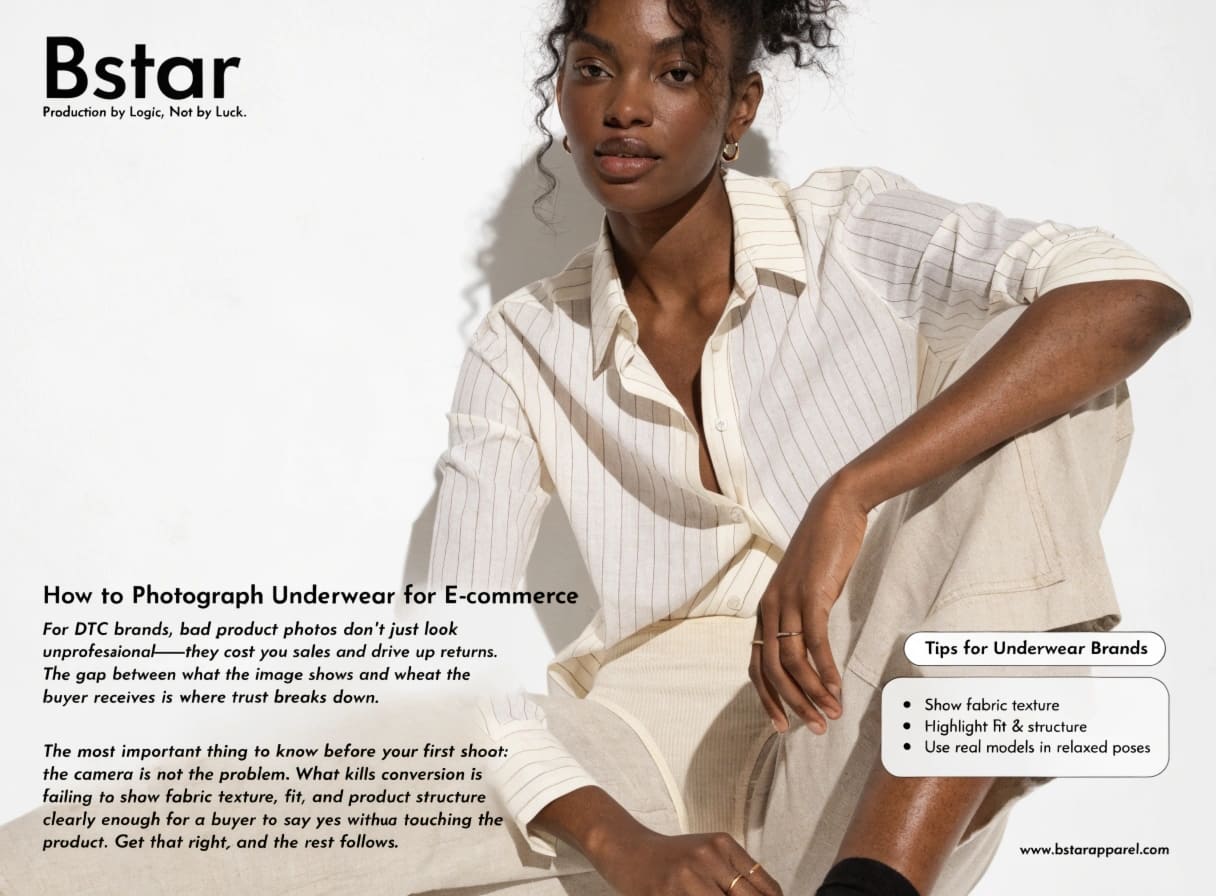
Bad product photos don’t just look unprofessional — they cost you sales and drive up returns. For underwear brands, the gap between what the image shows and what the buyer receives is where trust breaks down.
The most important thing to know before your first shoot: the camera is not the problem. What kills conversion is failing to show fabric texture, fit, and product structure clearly enough for a buyer to say yes without touching the product. Get that right, and the rest follows.
In our experience working with DTC clients across Europe, Australia, and North America, the brands that struggle most after launch are usually not the ones with the worst photos. They’re the ones with photos that looked fine — until customers started returning products because the fabric felt nothing like what they expected. That problem starts at the shoot, not at the factory.
Does Lighting Actually Affect Fabric Returns?
Most first-time brand founders think about lighting as a quality-of-photo issue. It isn’t. It’s a quality-of-information issue — and for underwear, wrong lighting is a direct cause of mismatched buyer expectations1.
Soft, diffused light with a properly calibrated white balance is the minimum standard for underwear photography. It preserves fabric sheen, shows texture definition in ribbing and waistbands, and keeps colors honest — especially for whites, blacks, and skin-adjacent nudes that shift easily under the wrong light.
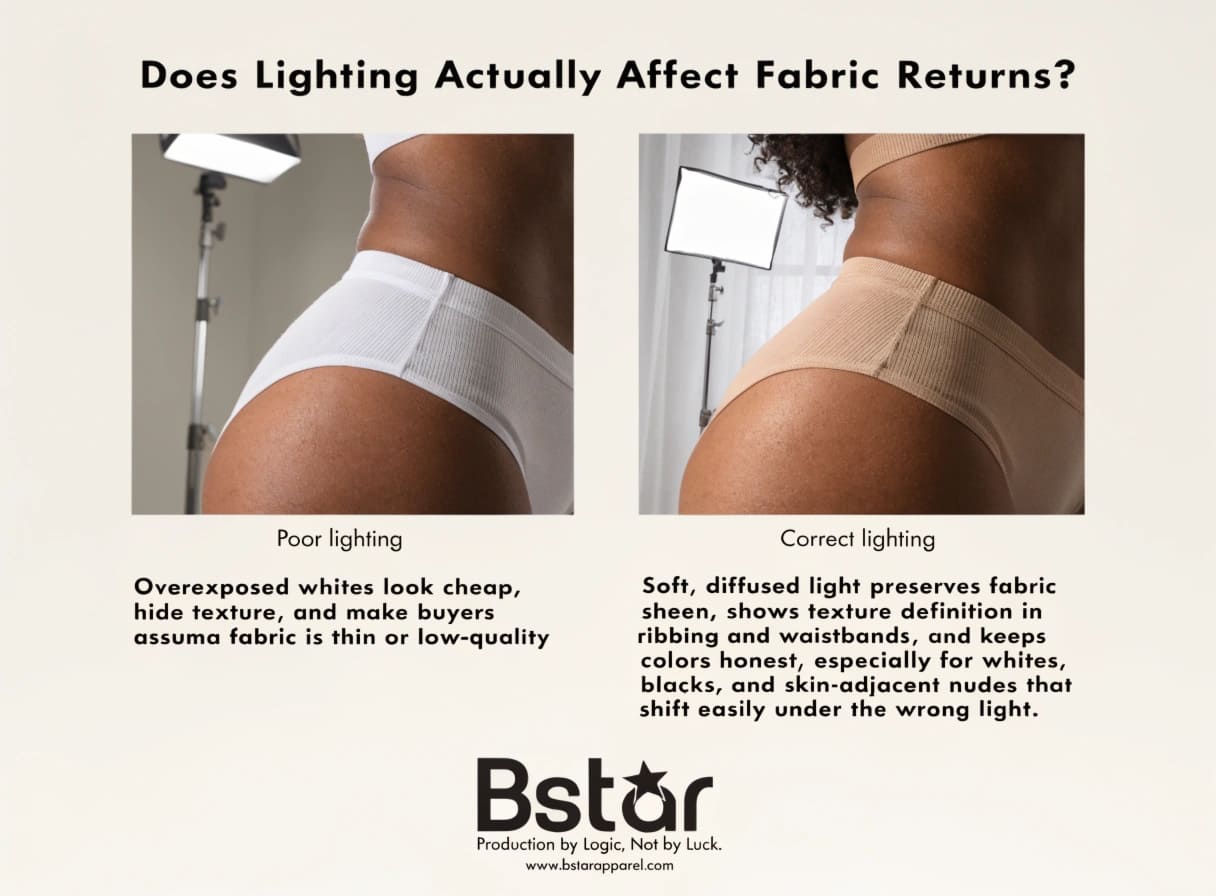
Overexposed whites are one of the most common problems we see when brands send us post-shoot samples for fit confirmation. The fabric looks flat and featureless in the photo, and buyers assume it’s cheap or thin. In reality, the product is fine — the light burned out the texture information.
Here’s the thing about underwear specifically: buyers are making a decision based on inferred touch2. They can’t feel the fabric. So they read visual cues — the way light catches a ribbed waistband, the opacity of a mesh panel, the matte vs. satin finish of a modal brief. If your lighting destroys those cues, you’ve made the buyer’s job harder, and they’ll either bounce or buy and return.
What to actually control on shoot day
| Issue | What it affects | What to do |
|---|---|---|
| Overexposed whites | Looks cheap, hides texture | Pull back light intensity, use reflectors instead of direct sources |
| Color-shifted darks | Navy looks black, charcoal looks grey | Set a custom white balance with a grey card before shooting |
| Flat ribbing or waistbands | Removes texture cues buyers use to judge quality | Use a slight side angle to catch texture relief |
| Mixed color temp across SKUs | Inconsistent catalog appearance | Lock your white balance setting and don’t change it mid-shoot |
White balance calibration sounds technical, but the practical version is simple: shoot a white or grey reference card3 at the start of each lighting setup and correct from there. Your photographer knows how to do this. Your job as a brand decision-maker is to ask if it’s being done.
Does the Mannequin or Model Choice Really Matter for Conversion?
Yes — and most brands underestimate how much. Underwear communicates fit through body shape. Remove the body, and you remove the information buyers need to make a confident purchase decision.
For underwear, a model or 3D invisible mannequin shot almost always outperforms a flat lay as the primary product image4. Body-fitted shots show stretch, coverage, and silhouette — the three things a first-time buyer of a new brand needs to see before purchasing.
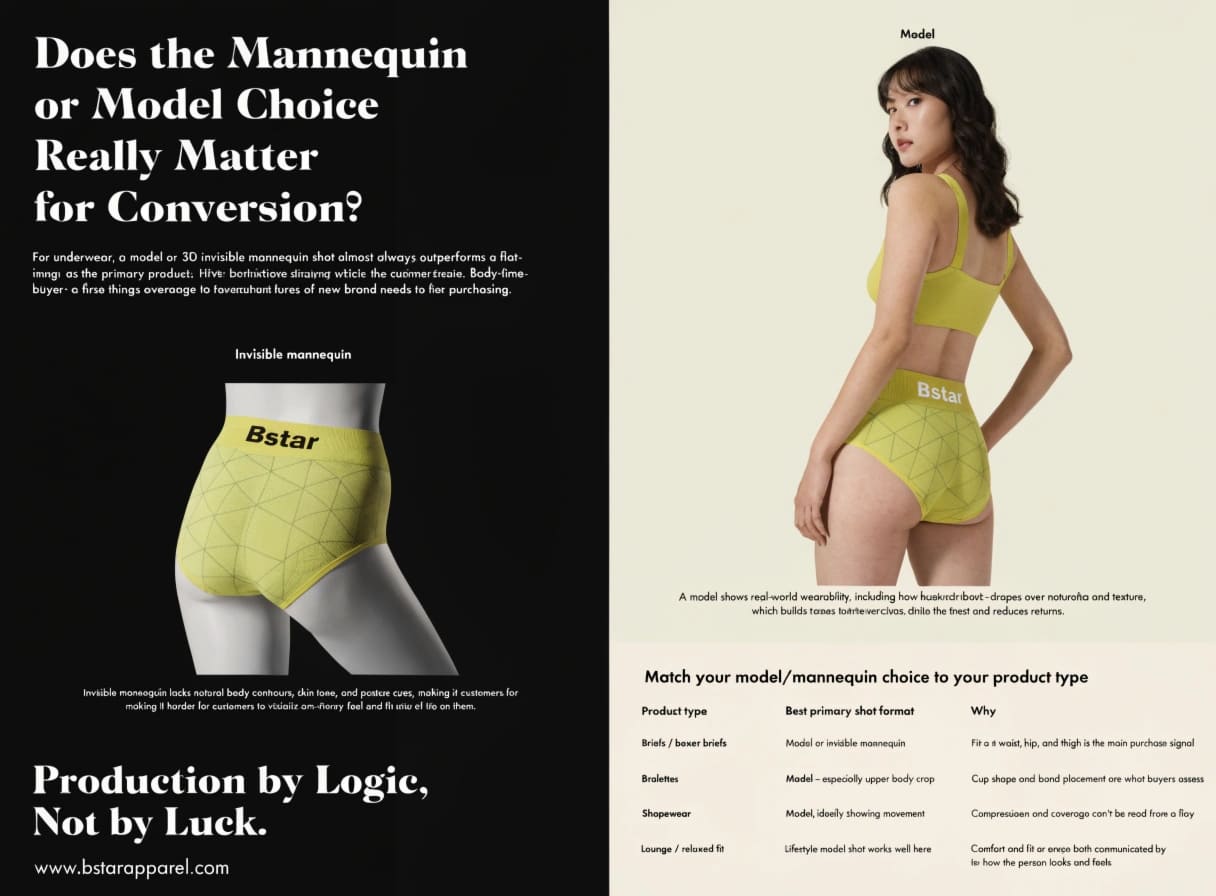
Flat lays work well as secondary images — particularly for showing fabric detail or pattern. But as a hero shot for briefs, boxer briefs, bralettes, or shapewear? They leave too much to imagination. Buyers have to guess how it’ll sit on a body, and guessing leads to uncertainty, and uncertainty leads to no purchase — or worse, a return5.
The choice of model matters too. It’s not just aesthetics. Skin tone contrast affects how color reads in the final image6. Body proportions affect whether a buyer with a similar build feels represented and can predict fit7. Natural posture vs. forced poses affects how the fabric appears — a stiff pose can make stretch fabric look rigid when it isn’t.
Match your model/mannequin choice to your product type
| Product type | Best primary shot format | Why |
|---|---|---|
| Briefs / boxer briefs | Model or invisible mannequin | Fit at waist, hip, and thigh is the main purchase signal |
| Bralettes | Model — especially upper body crop | Cup shape and band placement are what buyers assess |
| Shapewear | Model, ideally showing movement | Compression and coverage can’t be read from a flat lay |
| Lounge / relaxed fit | Lifestyle model shot works well here | Comfort and fit are both communicated by how the person looks and feels |
Are Close-Up Detail Shots Worth Including?
In our experience, yes — especially for buyers who’ve already decided they like the product and are now deciding if they trust it enough to buy.
Macro shots of seam construction, waistband elasticity, and pouch or gusset structure act as proof points. They answer the questions a buyer has after the hero shot: Is this well-made? Will it hold its shape? Is this seam going to irritate me?
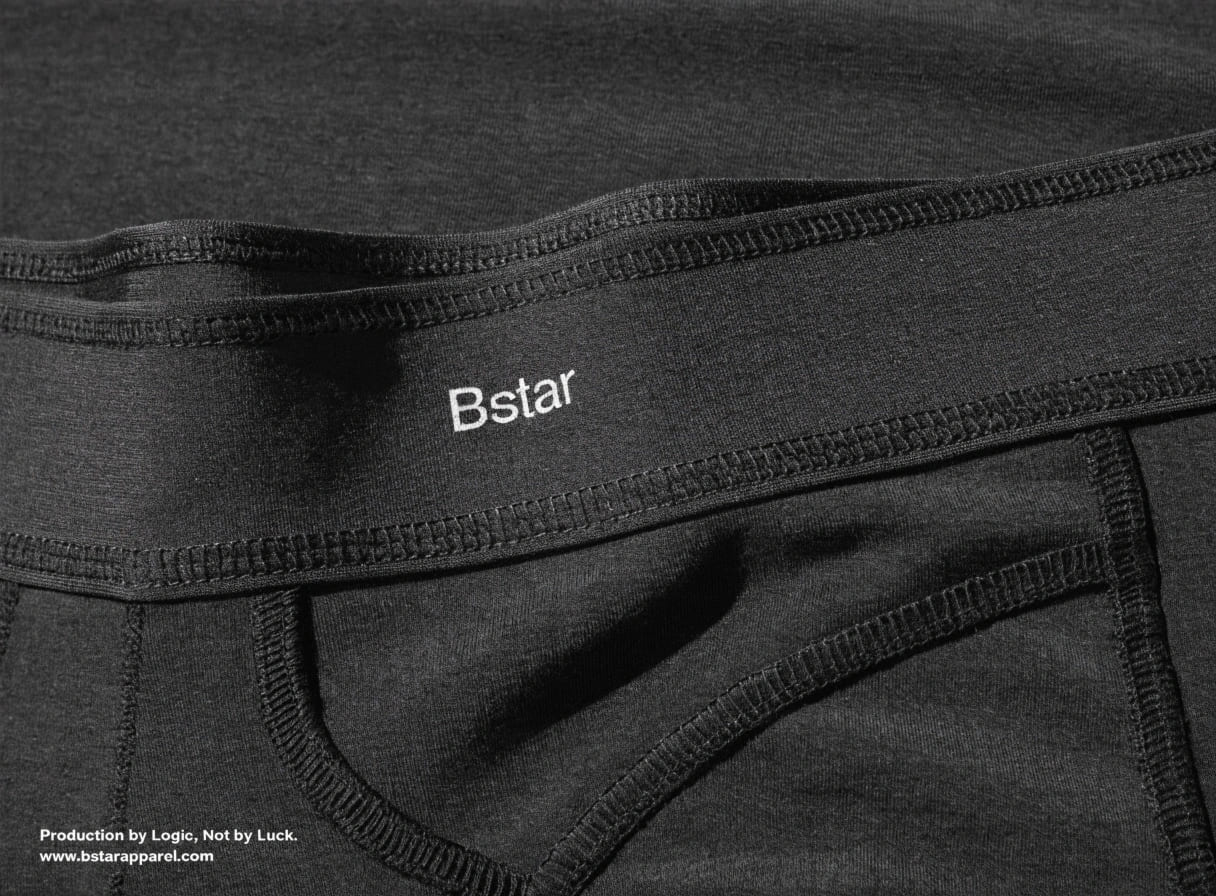
Brands we work with have found that detail shots reduce post-purchase complaints about construction quality8 — not because the product changed, but because buyers who saw the detail image already knew what they were getting. The expectation was set accurately.
What details actually matter depends on what you’re selling.
For performance or sports-adjacent underwear, flat seams and stretch zones are high-value details. Show the seam lying flat against the skin, and show the fabric at full stretch with a hand or body pull to demonstrate recovery.
For everyday basics, the waistband and leg opening elastic are the most returned-about features. If the waistband rolls in real use, buyers will find out. Your photos should show the waistband structure honestly — not styled flat in a way that hides how it actually behaves.
For premium or modal fabrics, a close-up of the fabric surface texture is often the single highest-converting detail image. Buyers paying more want visual confirmation that the hand feel justifies the price point.
Detail shots by product type
| Feature | Why it matters | What to capture |
|---|---|---|
| Seam construction | Comfort signal, especially for sensitive skin | Flat lay close-up, no shadows hiding the seam line |
| Waistband elastic | #1 complaint in reviews if it rolls or digs | Show it lying naturally, not stretched or pressed flat |
| Pouch or gusset structure | Functional buyers actively look for this | Front-on close-up showing 3D shape without overexposing |
| Fabric texture | Key conversion signal for premium products | Slight angle, soft side light to catch surface relief |
Does Platform Optimization Actually Change How Images Perform?
It does — and this is one of the most fixable problems in a brand’s first-year catalog.
Each major e-commerce platform has different image ratio requirements, background standards, and zoom threshold requirements. Shooting without these in mind means cropping decisions get made after the shoot, often badly — and a hero image that looked great at full size becomes awkward or non-compliant when uploaded.
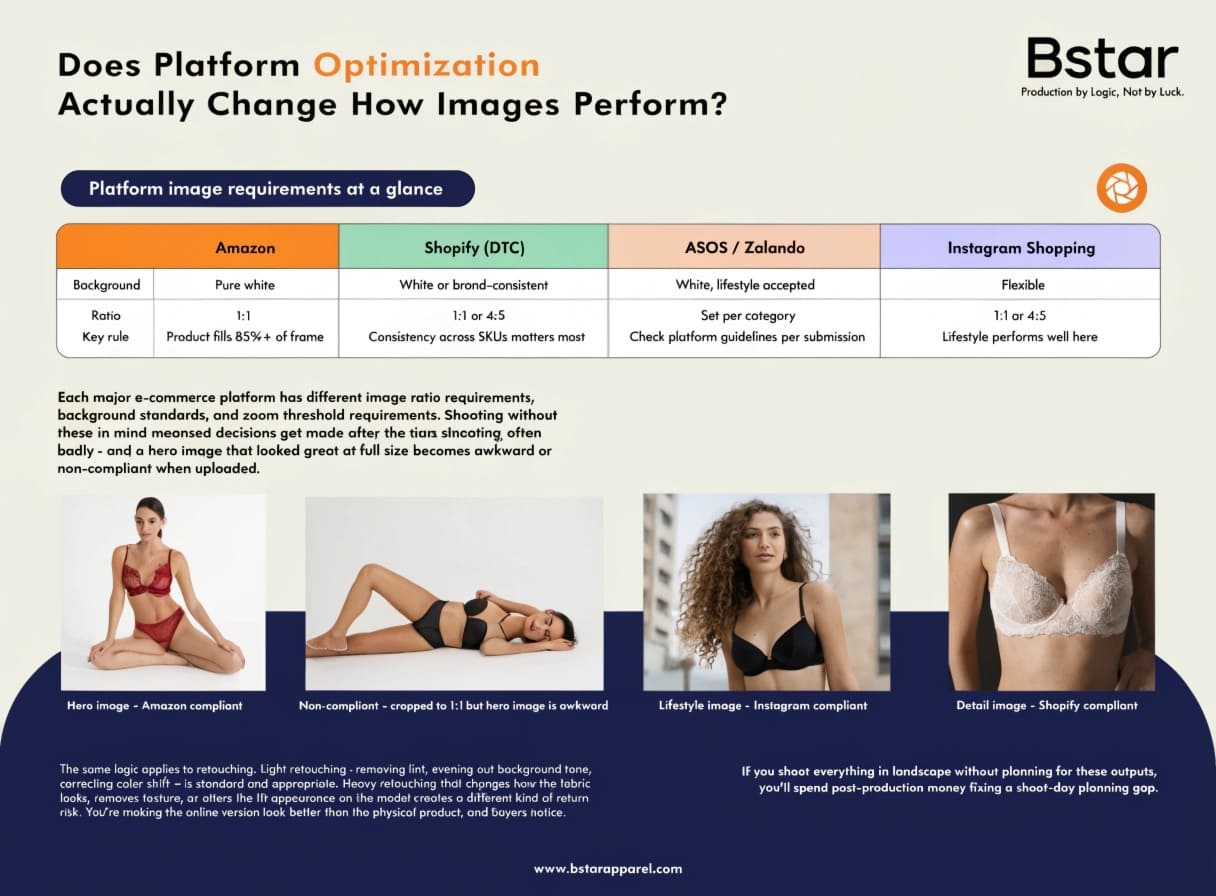
Amazon requires a pure white background (RGB 255,255,255) and the product filling at least 85% of the frame9. Shopify-hosted DTC stores typically use square (1:1) or portrait (4:5) formats for grid consistency10. Instagram shopping leans toward portrait. If you shoot everything in landscape without planning for these outputs, you’ll spend post-production money fixing a shoot-day planning gap.
The same logic applies to retouching. Light retouching — removing lint, evening out background tone, correcting color shift — is standard and appropriate. Heavy retouching that changes how the fabric looks, removes texture, or alters the fit appearance on the model creates a different kind of return risk11. You’re making the online version look better than the physical product, and buyers notice.
Platform image requirements at a glance
| Platform | Background | Ratio | Key rule |
|---|---|---|---|
| Amazon | Pure white | 1:1 | Product fills 85%+ of frame |
| Shopify (DTC) | White or brand-consistent | 1:1 or 4:5 | Consistency across SKUs matters most |
| ASOS / Zalando | White, lifestyle accepted | Set per category | Check platform guidelines per submission |
| Instagram Shopping | Flexible | 1:1 or 4:5 | Lifestyle performs well here |
Build your shot list before the shoot. For each SKU, plan: one hero shot, one back detail, one close-up detail, one lifestyle or context image. This structure is repeatable, platform-flexible, and keeps your catalog consistent as it grows.
Conclusion
Great underwear photos aren’t about gear — they’re about giving buyers enough information to say yes. Get the light, the fit presentation, the details, and the specs right from the start.
-
"The Role of Digital Photography in E-commerce | RMCAD", https://www.rmcad.edu/blog/the-role-of-digital-photography-in-e-commerce/. Research on online consumer behavior has documented that product image fidelity is a primary driver of expectation formation, with discrepancies between displayed and received products identified as a leading cause of returns in apparel e-commerce. Evidence role: mechanism; source type: paper. Supports: That product image quality and accuracy shape consumer expectations and influence return behavior in e-commerce. Scope note: Most published studies address image accuracy broadly rather than isolating lighting as a specific variable; direct causal evidence for lighting alone is limited. ↩
-
"How multisensory perception promotes purchase intent in the … – PMC", https://pmc.ncbi.nlm.nih.gov/articles/PMC9816429/. Consumer psychology research has examined how the absence of tactile feedback in online retail leads shoppers to rely on visual cues—including texture, sheen, and surface detail—as substitutes for physical touch when evaluating apparel quality. Evidence role: mechanism; source type: paper. Supports: That consumers use visual information as a proxy for tactile assessment when evaluating fabric products online, a phenomenon studied under haptic deprivation in e-commerce contexts. Scope note: Studies typically address tactile deprivation effects on purchase confidence generally; specific findings on underwear or intimate apparel may not be directly reported. ↩
-
"How to Set Your White Balance with a Gray Card – Video Tutorial", https://www.steeletraining.com/tutorials/whitebalance/index.html. Standard photographic practice and colorimetric guidelines establish the use of neutral grey or white reference targets as the baseline method for custom white balance calibration, ensuring that the camera’s color rendering accurately reflects the scene’s actual illuminant. Evidence role: definition; source type: education. Supports: That neutral grey or white reference cards are the established method for setting custom white balance in digital photography to ensure color accuracy. Scope note: This is a well-established technical practice documented across photography education resources; formal academic citation may be less relevant than authoritative technical standards documentation. ↩
-
"AI Fashion Photography for E-commerce Stores – WearView", https://www.wearview.co/use-cases/ecommerce-stores. Industry conversion studies and academic research on apparel e-commerce have generally found that on-figure presentations—whether live model or ghost mannequin—provide stronger purchase signals than flat lay formats by communicating fit, drape, and proportion. Evidence role: general_support; source type: research. Supports: That on-figure or mannequin product presentation outperforms flat lay formats in driving purchase decisions for fitted apparel categories. Scope note: Controlled A/B test data specific to underwear categories is not widely published; available evidence is largely drawn from broader apparel categories or proprietary platform data. ↩
-
"The Impact of Information Overload of E-Commerce Platform … – PMC", https://pmc.ncbi.nlm.nih.gov/articles/PMC9265496/. E-commerce consumer behavior research has linked perceived information insufficiency—particularly for experience goods such as apparel—to both purchase abandonment and higher post-purchase return rates, as consumers who purchase under uncertainty are more likely to find the product does not meet expectations. Evidence role: mechanism; source type: paper. Supports: That information uncertainty at the point of purchase in online retail is associated with both cart abandonment and elevated return rates in apparel categories. Scope note: Studies typically measure information quality effects on one outcome (abandonment or returns) rather than both simultaneously; the combined pathway described is an inference from separate research streams. ↩
-
"Simultaneous Color Contrast Increments with Complexity and … – PMC", https://pmc.ncbi.nlm.nih.gov/articles/PMC11856768/. Color science literature on simultaneous contrast demonstrates that the perceived hue and lightness of a surface are influenced by adjacent colors, a principle applicable to apparel photography where model skin tone can shift the apparent color of garments in the final image. Evidence role: mechanism; source type: paper. Supports: That surrounding colors, including skin tones, influence the perceived color of adjacent objects through simultaneous contrast effects documented in color science. Scope note: Published research addresses simultaneous contrast as a general perceptual phenomenon; direct experimental studies on skin tone and garment color perception in product photography are limited. ↩
-
"[PDF] The Impact of Diversity, Equity, and Inclusion in the Fashion Industry", https://digitalcommons.bryant.edu/cgi/viewcontent.cgi?article=1058&context=honors_finance. Consumer research on model-consumer similarity in apparel retail has found that shoppers are more likely to accurately predict fit and report higher purchase confidence when product imagery features models whose body proportions are comparable to their own. Evidence role: mechanism; source type: paper. Supports: That consumers use model body similarity as a reference point for predicting personal fit, and that representation of diverse body types in product imagery improves purchase confidence among consumers with similar builds. Scope note: Research in this area often focuses on size diversity and body image attitudes broadly; studies isolating fit-prediction accuracy as a function of model proportion similarity are less common. ↩
-
"Why review images help reduce online shopping returns", https://giesbusiness.illinois.edu/news/2026/05/18/why-review-images-help-reduce-online-shopping-returns. Research on the expectation-confirmation model in e-commerce suggests that more complete and accurate product information—including detailed imagery—reduces post-purchase cognitive dissonance and complaint behavior by aligning pre-purchase expectations with product reality. Evidence role: mechanism; source type: paper. Supports: That providing detailed product imagery reduces the expectation gap between online presentation and received product, thereby lowering post-purchase dissatisfaction. Scope note: The specific effect of macro construction detail shots on complaint rates has not been isolated in published literature; the mechanism is inferred from broader expectation-confirmation research. ↩
-
"Product image guide – Amazon Seller Central", https://sellercentral.amazon.com/help/hub/reference/external/G1881?locale=en-US. Amazon Seller Central’s product image requirements specify that main images must have a pure white background (RGB 255, 255, 255) and that the product must fill at least 85% of the image frame, as documented in the platform’s official image standards guidelines. Evidence role: definition; source type: other. Supports: Amazon’s official image guidelines specifying background color standards and minimum product-to-frame coverage ratios for main product images. Scope note: Platform policies are subject to change; readers should verify current requirements directly against Amazon Seller Central documentation at the time of use. ↩
-
"Product media types – Shopify Help Center", https://help.shopify.com/en/manual/products/product-media/product-media-types. Shopify’s official help documentation and theme guidelines recommend consistent image aspect ratios—commonly 1:1 (square) or portrait formats—for product listings to ensure visual uniformity across store collection grids. Evidence role: definition; source type: other. Supports: Shopify’s recommended image aspect ratios for product listings and the platform’s guidance on maintaining consistent image dimensions across a store’s product grid. Scope note: Shopify’s specific ratio recommendations may vary by theme and are subject to platform updates; readers should verify current guidance in Shopify’s official help center at the time of implementation. ↩
-
"Advertising and Marketing | Federal Trade Commission", https://www.ftc.gov/business-guidance/advertising-marketing. Regulatory guidance from consumer protection authorities, including the U.S. Federal Trade Commission, establishes that product representations—including images—must not be materially misleading, a standard that contextually supports the commercial risk of retouching that misrepresents fabric texture or fit. Evidence role: general_support; source type: government. Supports: That product images which materially misrepresent a product’s appearance can constitute deceptive advertising and are associated with consumer dissatisfaction and returns. Scope note: Regulatory guidance addresses legal standards for deception rather than directly measuring the effect of retouching on return rates; the return-rate consequence is an inference from consumer expectation research. ↩