
How to Test Fabric Shrinkage Before Mass Production?
Garments arrive. Customer washes them once. They no longer fit. You eat the returns, the refunds, and the reputation damage — all because nobody confirmed a shrinkage standard before bulk production started.
Fabric shrinkage testing is not just a quality check your factory runs. It is a decision framework you and your factory build together before bulk production begins. The real risk is not shrinkage itself — it is not knowing what threshold to set, or having a number you do not know how to act on.
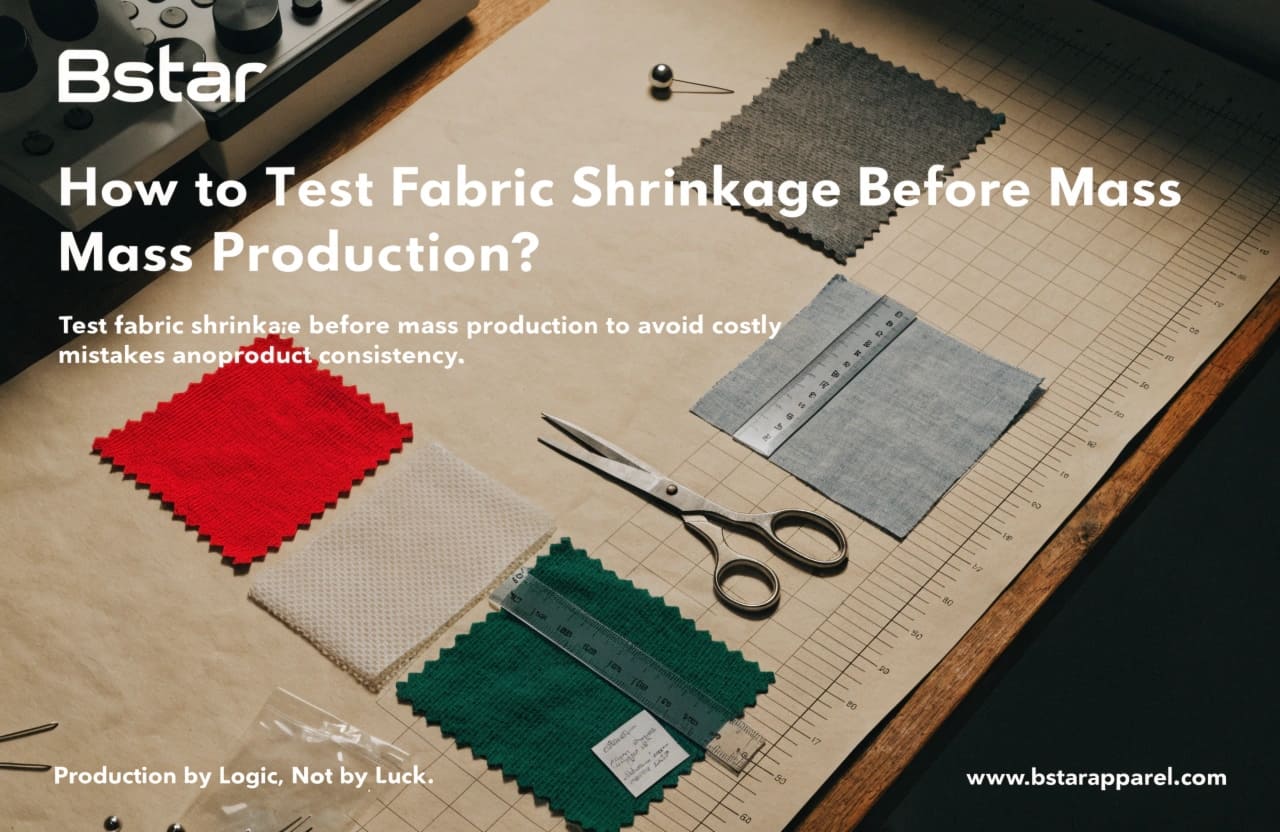
Most DTC brands treat shrinkage testing as the factory’s job. They wait for a result, glance at a number, and approve production. That is exactly where things go wrong. The number means nothing without a pre-agreed standard behind it. In the sections below, I will walk you through how we handle this at BSTAR — from specimen prep to batch management — so you know what to ask and what to confirm before you sign off on anything.
Standardized Sampling and Marking: How Do You Prepare a Specimen That Actually Gives You Useful Data?
Bad specimen prep gives you a number that looks clean but tells you nothing real. If the sample is cut wrong or marked without a reference grid, the measurement you get after washing is not reliable.
The standard practice is to cut a 50×50cm specimen from the fabric, then mark a precise 30×30cm reference grid inside it1 using washable ink. The outer border absorbs edge distortion from cutting. The inner grid is what you measure before and after washing.
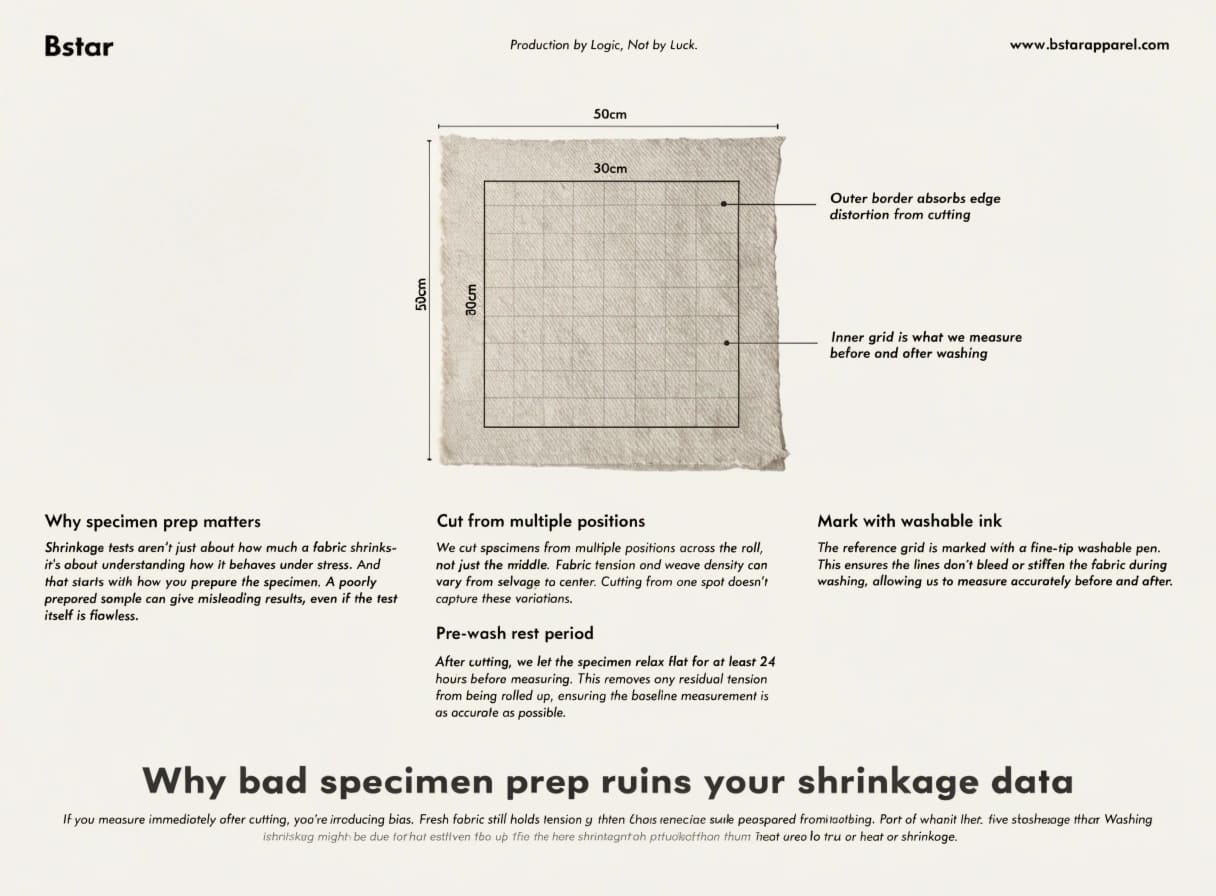
Here is what we actually do in our QC process. We cut specimens from multiple positions across the fabric roll — not just the middle. Fabric tension and weave density can vary from selvage to center2, so one sample from one spot is not enough. We mark the grid with a fine-tip washable pen and let the specimen relax flat for at least 24 hours before we measure the baseline dimensions3. That resting step matters. Freshly cut fabric still holds tension from the roll. If you measure immediately and then wash, part of what looks like shrinkage is actually just the fabric relaxing — not true heat or water shrinkage.
| Step | What We Do | Why It Matters |
|---|---|---|
| Cut size | 50×50cm | Outer border absorbs edge distortion |
| Inner grid | 30×30cm | This is the actual measurement zone |
| Sample positions | Multiple across roll width | Catches variation in weave density |
| Pre-wash rest | 24 hours flat | Removes tension from rolling before baseline measurement |
| Marking tool | Washable ink pen | Does not bleed or stiffen fabric |
The buyer’s question to ask at this stage: "Where on the roll are you cutting specimens, and how long do they rest before baseline measurement?" If your factory cannot answer that, the data they give you later is already suspect.
Simulating Real-World Conditions: Are You Testing the Way Your Customer Actually Washes?
A single cold wash tells you almost nothing about how your garment performs in the real world. But that is what many factories default to if you do not specify otherwise.
Test conditions — wash temperature, number of cycles, and drying method — should match the end consumer’s actual laundry behavior. A garment sold in Australia likely gets machine-washed warm and tumble dried4. That is a completely different stress profile than a 30°C delicate cycle in Germany.
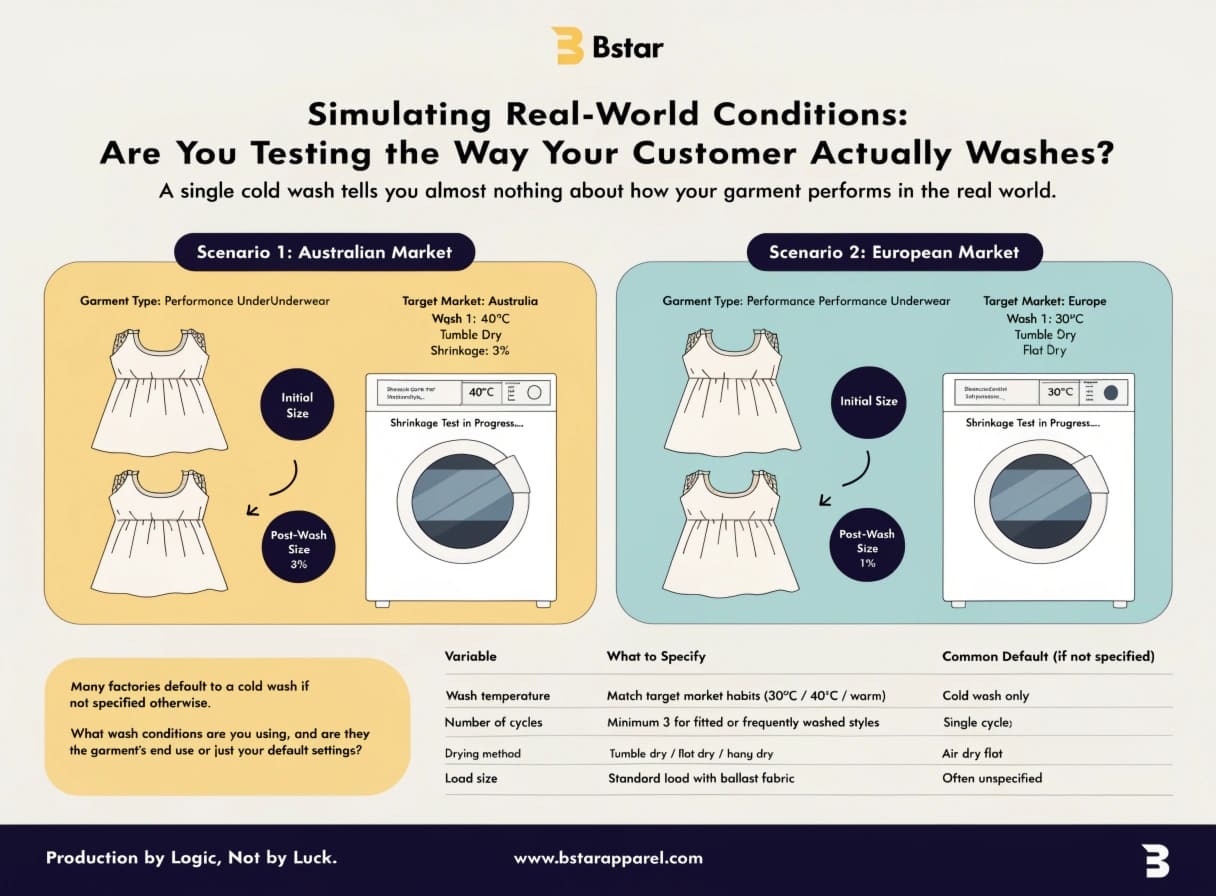
This is something we always confirm with the client before testing starts. The target market matters. In one project with an Australian brand, we ran tests at 40°C with tumble drying because that matched their customer’s laundry habits. For a European loungewear brand, we used a 30°C gentle cycle with flat drying5. Same fabric construction, different test conditions, different shrinkage results — and both were correct for their respective contexts.
The other variable people miss is the number of wash cycles. One wash gives you initial shrinkage. But most garments shrink more on the second or third wash before stabilizing6. If your care label says "machine washable," your customer is not washing it once. We typically run three cycles minimum on performance or fitted styles — more if the end use involves frequent washing, like activewear or underwear.
| Variable | What to Specify | Common Default (if not specified) |
|---|---|---|
| Wash temperature | Match target market habits (30°C / 40°C / warm) | Cold wash only |
| Number of cycles | Minimum 3 for fitted or frequently washed styles | Single cycle |
| Drying method | Tumble dry / flat dry / hang dry | Air dry flat |
| Load size | Standard load with ballast fabric | Often unspecified |
Ask your factory: "What wash conditions are you using, and are they based on the garment’s end use or just your default settings?"
Calculating Dimensional Changes: How Do You Turn a Shrinkage Number Into a Pattern Decision?
You get a shrinkage percentage. Now what? Most buyers stare at it and have no idea whether to approve, reject, or compensate for it in the pattern.
The basic shrinkage formula is: Shrinkage % = (Original measurement − Post-wash measurement) ÷ Original measurement × 1007. But the number only becomes useful when you know your pre-agreed threshold and what action that threshold triggers.
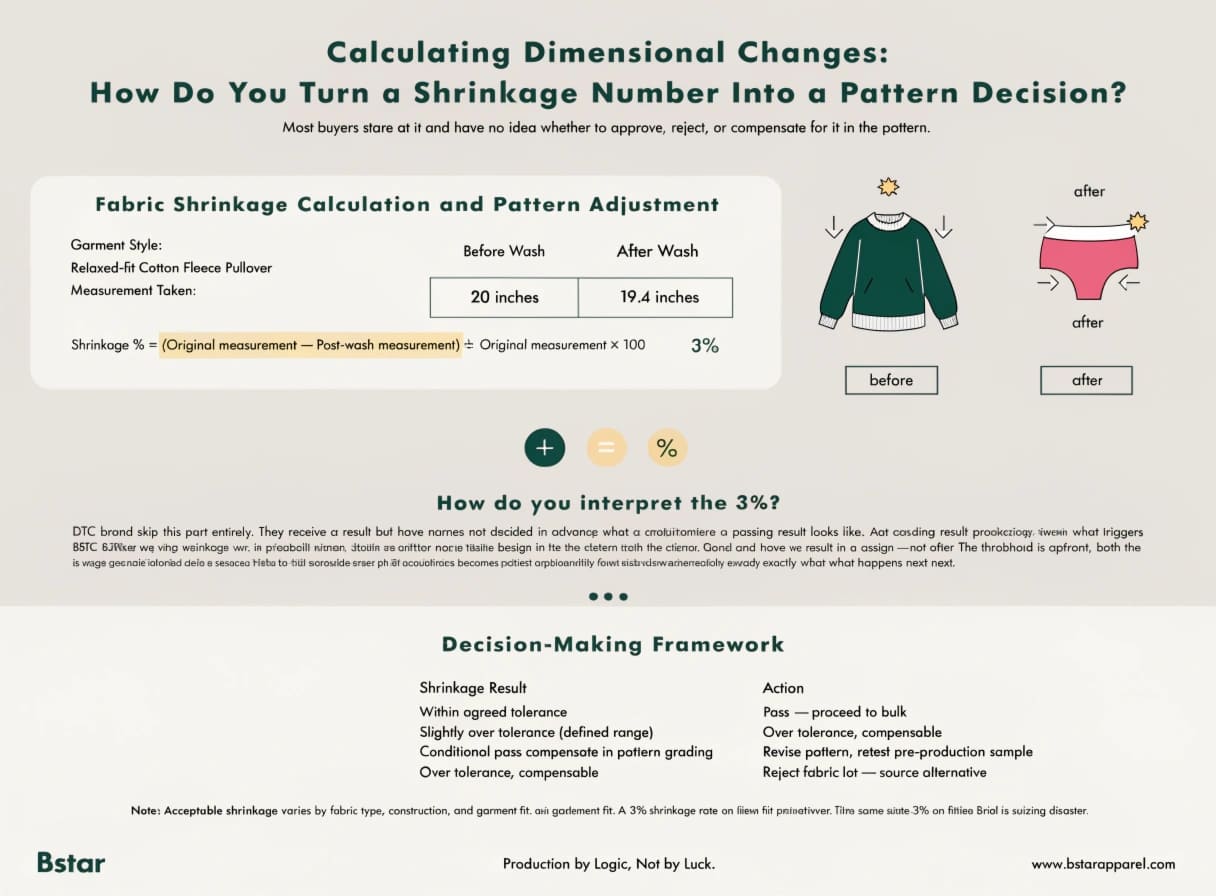
This is the part most DTC brands skip entirely. They receive a result but have not decided in advance what a passing result looks like, what a conditional pass looks like, and what triggers rejection. At BSTAR, we lock in the shrinkage tolerance in writing with the client before testing begins — not after we have a result in hand. Once a problem exists, accountability becomes hard to assign. When the threshold is agreed upfront, both sides know exactly what happens next.
Here is a simple decision framework we use with clients:
| Shrinkage Result | Action |
|---|---|
| Within agreed tolerance | Pass — proceed to bulk |
| Slightly over tolerance (defined range) | Conditional pass — compensate in pattern grading |
| Over tolerance, compensable | Revise pattern, retest pre-production sample |
| Over tolerance, not compensable | Reject fabric lot — source alternative |
One more thing worth understanding: acceptable shrinkage is not a fixed universal number. A 3% shrinkage rate on a relaxed-fit cotton fleece pullover may be completely fine. The same 3% on a fitted knit brief is a sizing disaster8. Fabric type, construction, and how fitted the final garment is all change what "acceptable" means. Do not let anyone — including your factory — hand you a single number without that context.
Batch Consistency and Pre-Shrinking: What Happens When Different Fabric Lots Behave Differently?
You test one lot. You approve it. Then the next lot of the same fabric from the same supplier arrives and behaves differently in the wash. This is more common than most buyers expect.
Fabric dye lots and production batches vary in yarn tension, finishing chemistry, and heat exposure — all of which affect shrinkage behavior9. Managing this means testing each new lot and considering industrial pre-shrinking or heat-setting treatments before cutting.
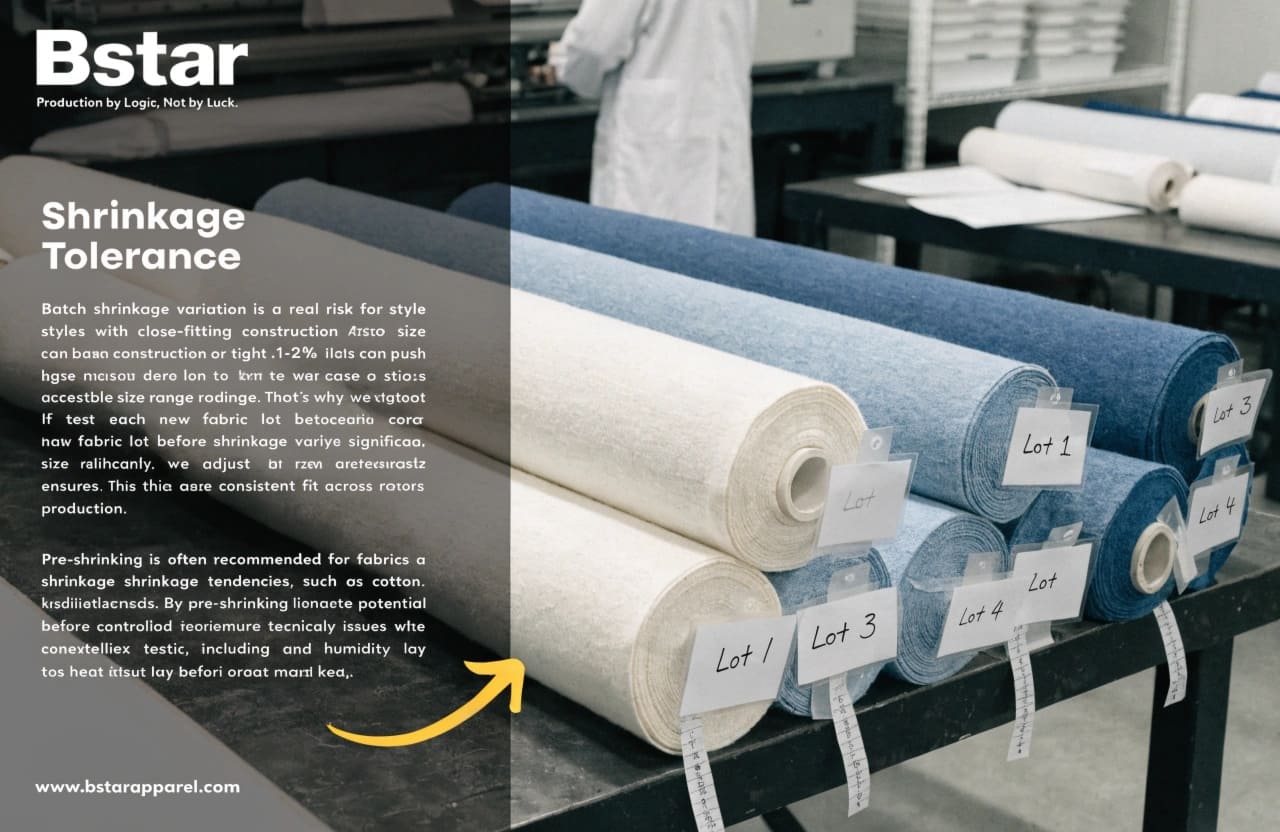
In our production process, we do not assume that an approved fabric spec carries over automatically to a new batch. When a new lot arrives, it gets tested against the agreed tolerance before we cut. This is especially important for styles with close-fitting construction or tight size grading, where a 1–2% variation between lots can push a garment outside the acceptable size range.
For fabrics with known shrinkage tendencies — particularly cotton knits and fleece10 — we sometimes recommend pre-shrinking before cutting. Industrial relaxation involves laying fabric flat under controlled humidity and heat before it goes to the cutting table11. Heat-setting is used for synthetic blends to stabilize the fiber structure12. These are not always necessary, but they are worth discussing with your factory if your fabric type or target shrinkage tolerance makes batch variation a real risk.
| Treatment | Best For | What It Does |
|---|---|---|
| Industrial relaxation | Cotton knits, fleece | Releases tension, reduces post-wash shrinkage |
| Heat-setting | Synthetic and blended knits | Stabilizes fiber structure against heat |
| Lot-by-lot retesting | All fabrics in new batches | Catches variation before cutting begins |
| Pre-production wash test | Fitted or size-critical styles | Confirms pattern compensation before bulk cut |
The question to ask: "Do you retest each new fabric lot against our agreed shrinkage tolerance, or do you rely on the original approved spec?"
Conclusion
Shrinkage testing works only when both sides agree on the standard before the test runs. Know your threshold, match your test conditions to real use, and confirm every new lot before cutting.
-
"ISO 6330 Test: Expert Insights and Practical Guidance from …", https://www.linkedin.com/pulse/iso-6330-test-expert-insights-practical-guidance-from-shirley-dane-pwkvf. ISO 6330 and AATCC 135 specify specimen preparation procedures for dimensional change testing of fabrics, including prescribed sample sizes and reference marking methods to isolate edge distortion from measurement zones. Evidence role: definition; source type: institution. Supports: Standardized specimen dimensions and inner reference grid requirements for fabric shrinkage testing. Scope note: Exact specimen dimensions may vary between ISO and AATCC versions; the article’s stated dimensions should be verified against the specific standard edition in use. ↩
-
"Evaluation of the impact of cotton sheath linear density of core spun …", https://pmc.ncbi.nlm.nih.gov/articles/PMC9344022/. Textile engineering literature documents that loom tension gradients and reed spacing can produce measurable differences in thread density and residual stress between the selvage and center of woven fabrics, affecting downstream dimensional stability. Evidence role: mechanism; source type: education. Supports: Variation in weave density and tension across fabric width from selvage to center. Scope note: The degree of variation is fabric- and loom-specific; this general principle may not apply uniformly to all constructions referenced in the article. ↩
-
"Physical Testing Lab FAQ – Wilson College of Textiles", https://textiles.ncsu.edu/zte/physical-testing-lab-faq/. ASTM D1776 and ISO 139 specify standard atmospheres and minimum conditioning times for textile specimens before testing, recognizing that residual tension from storage or processing can affect dimensional measurements. Evidence role: mechanism; source type: institution. Supports: Required conditioning or relaxation time for textile specimens prior to baseline measurement. Scope note: Conditioning requirements vary by standard and fiber type; the 24-hour figure cited in the article may reflect laboratory practice rather than a single universally mandated duration. ↩
-
"[PDF] COMPLETE CARE EDITION – FROM WASHING TO DRYING, 2025", https://admin.betterlivingprogram.com/wp-content/uploads/2025/08/Truth-About-Laundry-2025.pdf. Consumer behavior surveys on household laundry practices indicate regional variation in wash temperatures and drying methods, with warmer-climate markets and those with higher tumble dryer penetration rates showing different fabric stress profiles than European markets favoring lower-temperature cycles. Evidence role: statistic; source type: institution. Supports: Australian consumer laundry habits including wash temperature and drying method preferences. Scope note: The article’s specific characterization of Australian laundry habits as ‘warm wash and tumble dry’ is a generalization; actual behavior varies by household, garment type, and demographic. ↩
-
"(PDF) Electricity and water consumption for laundry washing by …", https://www.academia.edu/28877264/Electricity_and_water_consumption_for_laundry_washing_by_washing_machine_worldwide. European Commission and industry research on household energy consumption have documented a trend toward lower wash temperatures in EU member states, with 30°C cycles representing a significant share of laundry loads, partly driven by energy efficiency labeling and consumer awareness campaigns. Evidence role: statistic; source type: institution. Supports: European consumer preference for lower wash temperatures such as 30°C. Scope note: Laundry behavior varies considerably within Europe; the article’s use of Germany as representative of European practice is a simplification. ↩
-
"[PDF] Dimensional changes in 100% cotton hand and machine knit fabrics /", https://etd.ohiolink.edu/acprod/odb_etd/ws/send_file/send?accession=osu1752069552391978&disposition=inline. Research on cotton and knit fabrics has documented that dimensional change is not fully realized after a single laundering cycle, with additional shrinkage occurring in subsequent washes before the fabric reaches equilibrium, a phenomenon attributed to continued fiber swelling and relaxation of residual manufacturing stresses. Evidence role: mechanism; source type: paper. Supports: Progressive dimensional change in fabrics across multiple wash cycles before stabilization. Scope note: The number of cycles required for stabilization varies by fiber type, fabric construction, and wash conditions; the article’s claim of second or third cycle stabilization is a generalization. ↩
-
"ISO 6330 Test Experience from a Lab Technician – Textile Tester", https://darongtester.com/iso-6330/. ISO 6330 and AATCC 135 define the calculation of dimensional change as the difference between pre- and post-wash measurements divided by the original measurement, expressed as a percentage, with negative values indicating shrinkage and positive values indicating growth. Evidence role: definition; source type: institution. Supports: The mathematical formula used to calculate fabric dimensional change as a percentage. ↩
-
"Dimensional stability (fabric) – Wikipedia", https://en.wikipedia.org/wiki/Dimensional_stability_(fabric). Apparel quality standards bodies, including ASTM and ISO technical committees, recognize that dimensional change tolerances must be specified relative to garment end use, with closer-fitting constructions requiring tighter tolerances because equivalent percentage shrinkage produces proportionally greater deviation from intended fit. Evidence role: expert_consensus; source type: institution. Supports: That acceptable shrinkage tolerances vary by garment fit category and construction rather than being universally fixed. Scope note: Specific tolerance values by garment category are not universally standardized and are often negotiated between buyer and supplier; the article’s illustrative comparison is qualitatively sound but not quantitatively sourced. ↩
-
"Dimensional stability (fabric)", https://en.wikipedia.org/wiki/Dimensional_stability_(fabric). Textile quality management literature identifies yarn tension during knitting or weaving, wet finishing chemical concentrations, and heat treatment parameters as sources of measurable inter-batch variation in fabric properties including dimensional stability, supporting the practice of lot-by-lot testing rather than reliance on a single approved specification. Evidence role: mechanism; source type: paper. Supports: That production batch variables including yarn tension, finishing chemistry, and heat exposure contribute to inter-lot variation in fabric shrinkage behavior. Scope note: The relative contribution of each variable to shrinkage variation depends on fabric type and manufacturing process; the article treats these factors as equally significant without quantitative differentiation. ↩
-
"[PDF] Cohesive, Temporary, or Permanent Set and Hygral Expansion One …", https://repository.si.edu/bitstream/handle/10088/11191/mci_More_on_Moisture_TCN_32-Spring1997-5-20.pdf?sequence=1&isAllowed=y. Textile science references attribute cotton’s pronounced shrinkage tendency to the hygroscopic swelling of cellulosic fibers upon water absorption, which causes fiber diameter increase and length reduction; knit constructions amplify this effect due to their looped structure, which allows greater dimensional movement than woven constructions under the same fiber swelling conditions. Evidence role: mechanism; source type: education. Supports: That cotton knit and fleece fabrics exhibit higher shrinkage tendencies due to fiber and construction characteristics. ↩
-
"relaxation shrinkage", https://www2.cs.arizona.edu/patterns/weaving/books/lds_fof_12.pdf. Textile finishing references describe fabric relaxation as a process in which tension accumulated during knitting, weaving, or finishing is released under controlled temperature and humidity conditions prior to cutting, reducing the potential for dimensional change during subsequent consumer laundering. Evidence role: definition; source type: education. Supports: Industrial relaxation as a fabric pre-treatment involving controlled humidity and heat to reduce post-wash shrinkage. Scope note: Specific process parameters such as temperature, humidity level, and dwell time vary by fabric type and equipment; the article’s description is a general characterization. ↩
-
"(PDF) Studio practices for shaping and heat-setting synthetic fabrics", https://www.academia.edu/87204670/Studio_practices_for_shaping_and_heat_setting_synthetic_fabrics. Textile science literature explains that heat-setting of thermoplastic fibers such as polyester and nylon involves heating the fabric above the glass transition temperature to relieve internal stresses and set the fiber in a new dimensional configuration, reducing shrinkage in subsequent thermal exposures below the set temperature. Evidence role: mechanism; source type: paper. Supports: Heat-setting as a process that stabilizes thermoplastic synthetic fiber structures to reduce subsequent dimensional change. ↩