
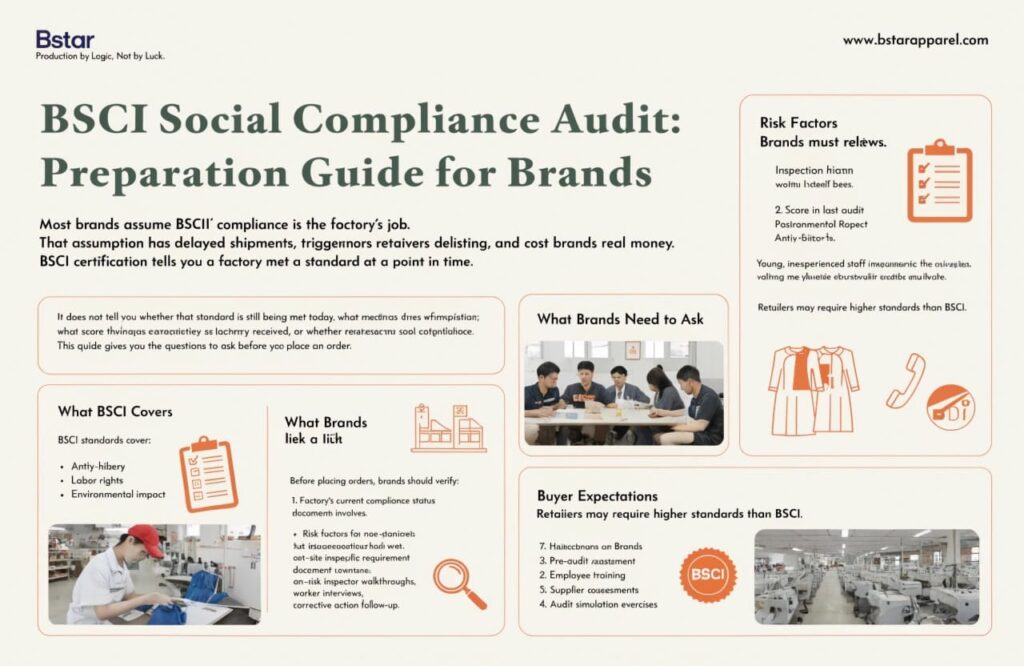
Most brands assume BSCI compliance is the factory’s job. That assumption has delayed shipments, triggered retailer delisting, and cost brands real money.
BSCI certification tells you a factory met a standard at a point in time. It does not tell you whether that standard is still being met today, what score the factory received, or whether your specific retailer will even accept that report. This guide gives you the questions to ask before you place an order.
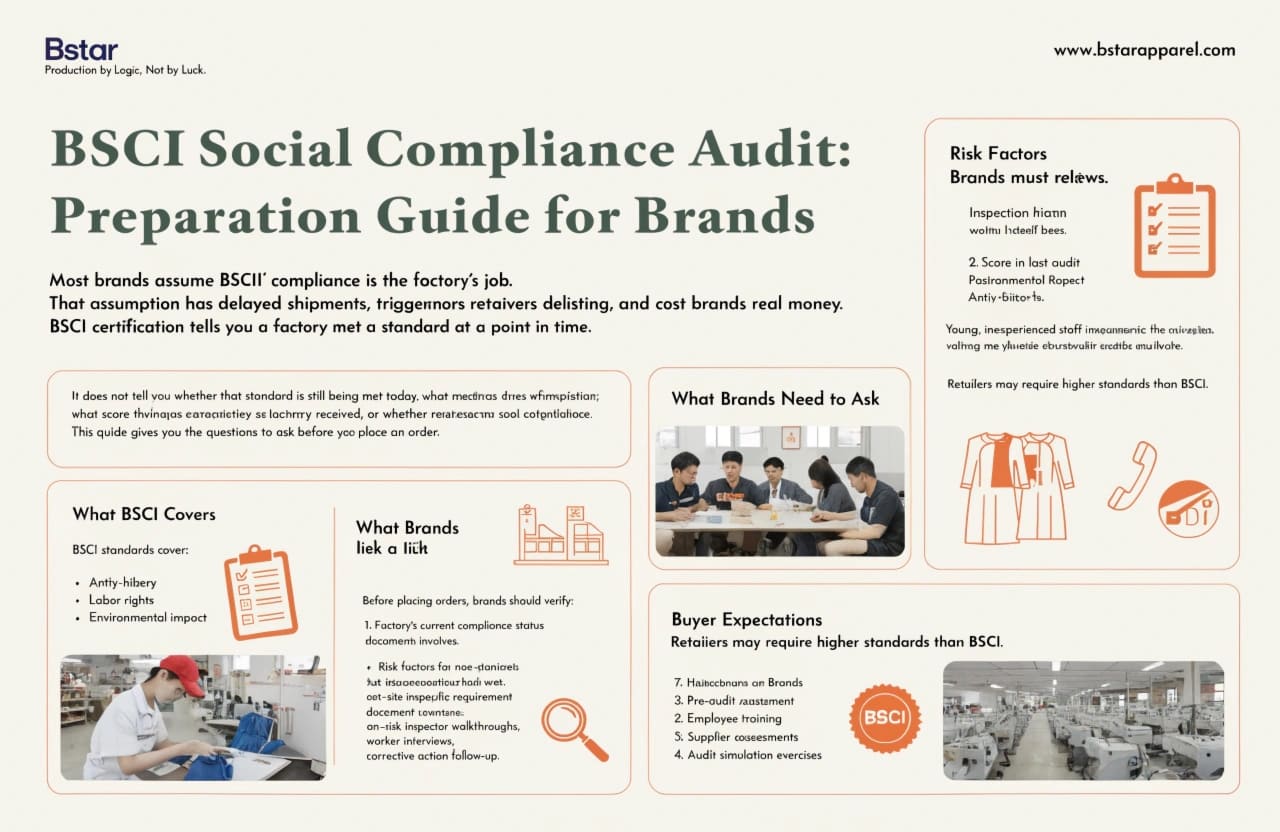
We’ve been through the full BSCI audit process at our factory in Zhongshan, China — document reviews, on-site inspector walkthroughs, worker interviews, corrective actions. Our sales team gets BSCI-related questions from brand buyers almost every week. What I’ve noticed is that most brands are asking the wrong questions. This guide is written to fix that.
Most buyers have heard "BSCI" and know it relates to factory ethics. But when a retailer pushes back on a supplier’s report, buyers are often caught off guard because they never understood what was actually being measured.
The amfori BSCI framework evaluates 13 performance areas, covering topics from wages and working hours to health and safety, child labor, and management systems.1 Each area is scored, and the overall grade determines whether a factory is compliant, requires improvement, or is considered high-risk.2
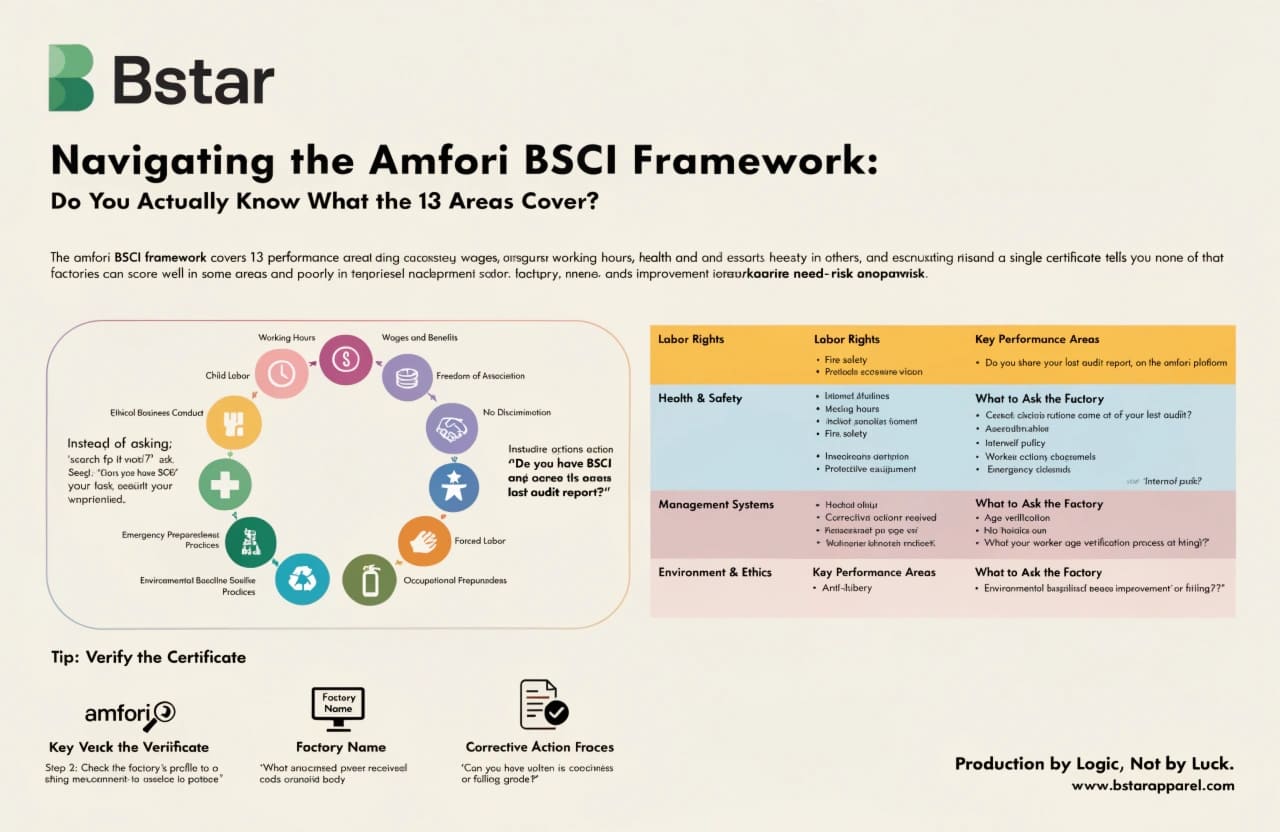
The point here is not to memorize all 13 areas. The point is that a factory can score well in some areas and poorly in others, and a single certificate tells you none of that. Here is how I’d break down the 13 areas into what actually matters for your sourcing decisions:
| Category | Key Performance Areas | What to Ask the Factory |
|---|---|---|
| Labor Rights | Working hours, wages, freedom of association3 | "Can you share your last audit report, not just the certificate?" |
| Health & Safety | Fire safety, emergency exits, protective equipment | "What corrective actions came out of your last audit?" |
| Management Systems | Internal policy, worker grievance channels | "Do you have a documented supplier code of conduct on file?" |
| Forced & Child Labor | Age verification, no bonded labor | "What is your worker age verification process at hiring?" |
| Environment & Ethics | Anti-bribery, environmental baseline practices | "Has your factory ever received a ‘needs improvement’ or failing grade?" |
Notice that none of those questions are "do you have BSCI certification?" That question tells you almost nothing. The questions in the right column above will tell you a lot more about whether a factory’s compliance is real or just on paper.
One more thing: verify the certificate directly. Go to the amfori platform, search the factory by name, and confirm the certificate is current and issued by an accredited auditing body.4 We’ve seen buyers discover mid-production that a factory’s certificate had expired six months earlier.
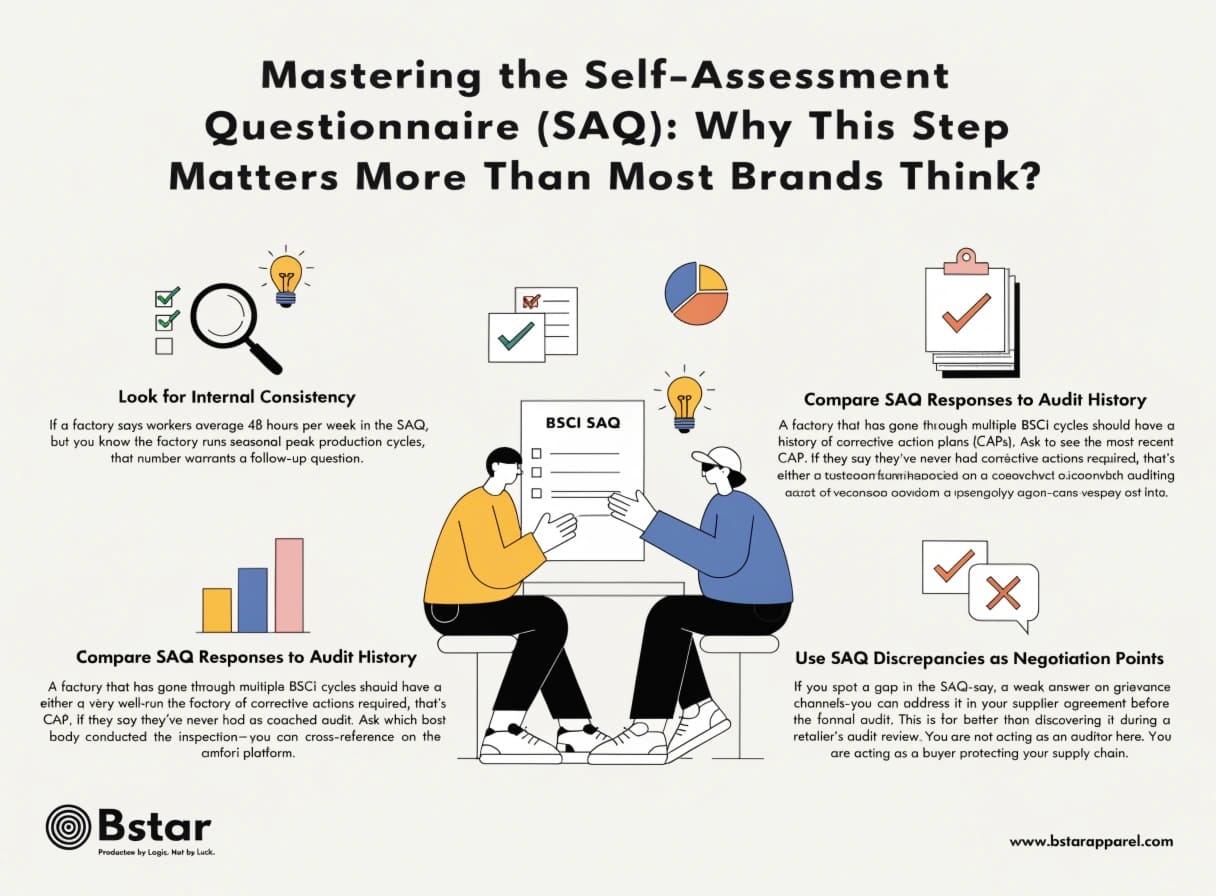
Mastering the Self-Assessment Questionnaire (SAQ): Why This Step Matters More Than Most Brands Think?
Many brands skip the SAQ stage entirely. They get a certificate from the factory, forward it to their retailer, and assume that is enough. It is usually not enough — and when it isn’t, the problem surfaces at the worst possible time.
The SAQ is a structured self-evaluation that factories complete before a formal BSCI audit.5 As a brand, reviewing a factory’s SAQ responses gives you an early signal of where gaps might exist before an auditor — or your retailer — finds them first.
In our experience going through this process ourselves, the SAQ is where factories are most likely to present an idealized version of their operations. That is not always dishonest — sometimes it is genuinely how management perceives the factory. But perception and ground reality in a 300-person factory can diverge, especially on working hours.
Here is what to pay attention to when reviewing an SAQ:
Look for Internal Consistency
If a factory says workers average 48 hours per week in the SAQ, but you know the factory runs seasonal peak production cycles, that number warrants a follow-up question. Ask: "How do you manage overtime during peak season and how is it documented?"
Compare SAQ Responses to Audit History
A factory that has gone through multiple BSCI cycles should have a history of corrective action plans (CAPs).6 Ask to see the most recent CAP. If they say they’ve never had corrective actions required, that’s either a very well-run factory or a coached audit. Ask which auditing body conducted the inspection — you can cross-reference on the amfori platform.
Use SAQ Discrepancies as Negotiation Points
If you spot a gap in the SAQ — say, a weak answer on grievance channels — you can address it in your supplier agreement before the formal audit. This is far better than discovering it during a retailer’s audit review. You are not acting as an auditor here. You are acting as a buyer protecting your supply chain.
Comprehensive Document Management: How to Tell If a Factory’s Records Will Hold Up?
This is the area where audits most commonly fail. In our direct audit experience, the two areas auditors dig into hardest are working hours records and wage payment records. Not fire exits. Not child labor policies. Hours and wages.7
Auditors we’ve worked with typically cross-check three things: time-tracking system data, payroll records, and worker interview responses.8 When these three sources don’t align, the factory fails — regardless of how good everything else looks.
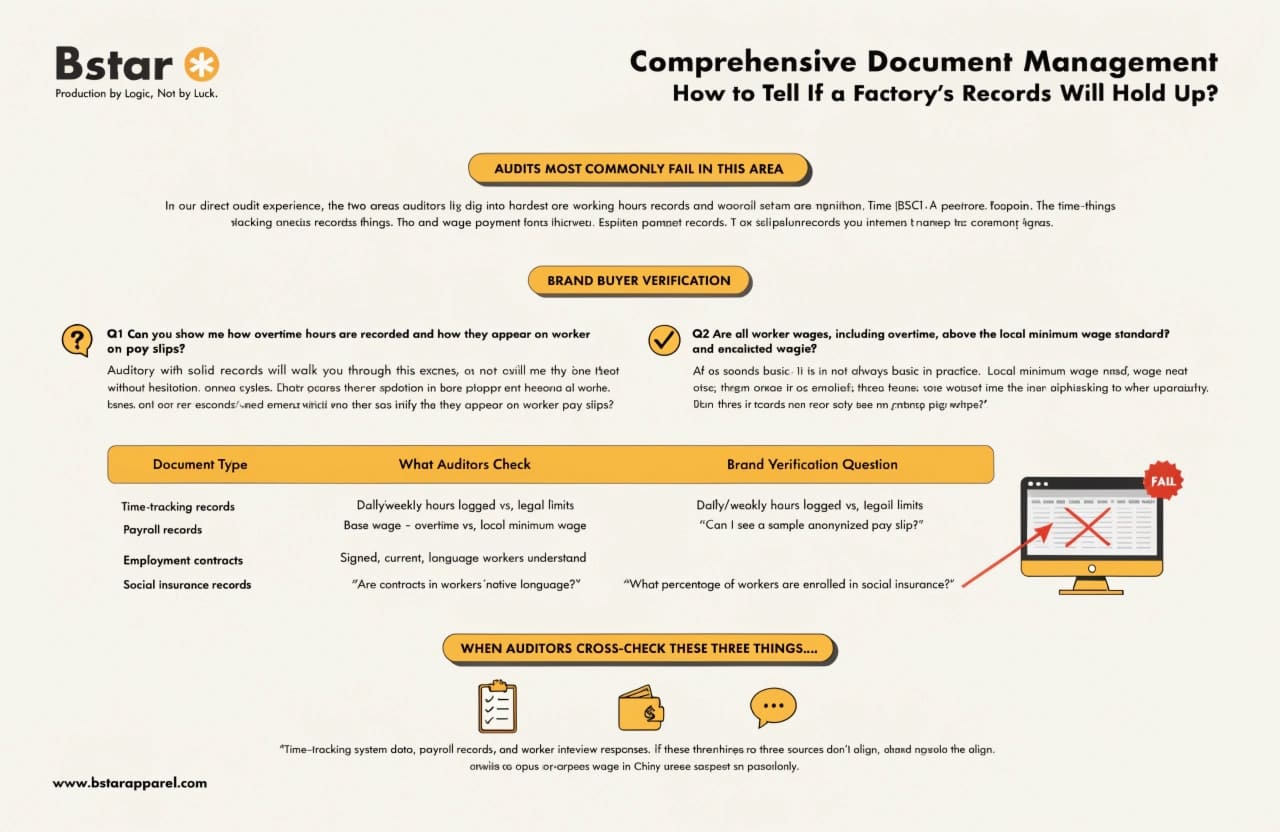
As a brand buyer, you can ask a factory two specific questions that will tell you more than any certificate:
Question 1: "Can you show me how overtime hours are recorded and how they appear on worker pay slips?"
A factory with solid records will walk you through this without hesitation. The time-tracking data — whether it’s a punch card system or digital — should match the wage line items on each worker’s monthly pay slip. If there’s a gap between those two records, an auditor will find it.
Question 2: "Are all worker wages, including overtime, above the local minimum wage standard?"
This sounds basic. It is not always basic in practice. Local minimum wage rates in China are updated regularly, and some factories’ base wage structures were set years ago and haven’t been formally reviewed.9 You don’t need to know the exact local standard yourself — you just need the factory to confirm it on record, in writing.
| Document Type | What Auditors Check | Brand Verification Question |
|---|---|---|
| Time-tracking records | Daily/weekly hours logged vs. legal limits | "What system do you use to track hours?" |
| Payroll records | Base wage + overtime vs. local minimum wage | "Can I see a sample anonymized pay slip?" |
| Employment contracts | Signed, current, language workers understand | "Are contracts in workers’ native language?" |
| Social insurance records | Enrollment and payment for all workers | "What percentage of workers are enrolled in social insurance?" |
These questions position you as a serious buyer. They also protect you. If a retailer later rejects your factory’s audit report, you want a paper trail showing you did real due diligence, not just certificate collection.
On-Site Readiness and Stakeholder Communication: What Brands Need to Do Before Audit Day?
Here is something most brands don’t realize: you are a participant in audit readiness, not a spectator. Brands often assume the audit is entirely between the auditor and the factory. In practice, the audit outcome can be affected by things the brand controls.
Before a formal BSCI audit, brands should send the factory a written supplier code of conduct, confirm the audit timeline with the factory’s compliance contact, and clarify what audit grade their downstream retailers or marketplaces require — before, not after, the audit takes place.
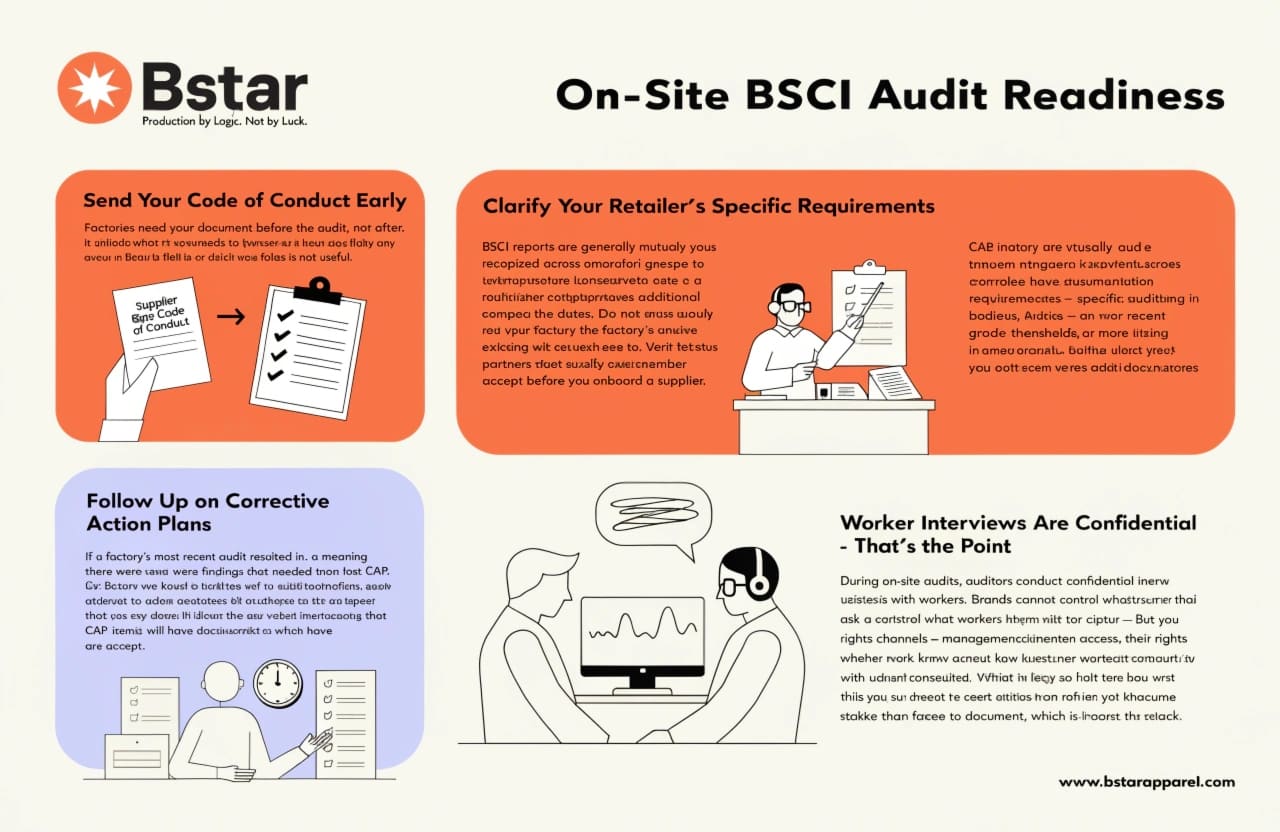
Send Your Code of Conduct Early
Many brands have a supplier code of conduct sitting in a procurement folder somewhere. Factories need that document before the audit, not after. It signals what standards you expect and gives the factory a chance to flag any gaps in advance. Sending it two days before an audit is not useful.
Clarify Your Retailer’s Specific Requirements
This is a risk that catches multi-retailer brands off guard. BSCI reports are generally mutually recognized across amfori member companies10 — but some retailers or marketplaces have additional requirements: specific auditing bodies, minimum grade thresholds, or more recent audit dates11. Do not assume your factory’s existing BSCI report will satisfy every customer you sell to. Verify directly with your retail partners what they accept before you onboard a supplier.
Follow Up on Corrective Action Plans
If a factory’s most recent audit resulted in a CAP — meaning there were findings that needed addressing — you need to know the status of that CAP. Ask: "What items were flagged in your last BSCI audit, and can you show me what was done to address them?" A factory that has closed out its CAP items properly will have documentation. A factory that deflects this question is a risk you are choosing to accept.
Worker Interviews Are Confidential — That’s the Point
During on-site audits, auditors conduct confidential interviews with workers.12 Brands cannot control what workers say. But you can ask a factory how they communicate with workers about their rights — grievance channels, management access, whether workers know they can speak to an auditor without consequences. This tells you a lot about the factory’s culture, which is harder to fake than a document stack.
Conclusion
A BSCI certificate is a starting point, not an answer. Ask for the audit report, verify it on the amfori platform, and ask about hours, wages, and corrective actions before you place your first order.
-
"amfori BSCI – Business Social Compliance Initiative", https://www.amfori.org/amfori-bsci/. The amfori BSCI system documentation outlines the performance areas evaluated during social audits, providing the authoritative basis for the 13-area structure described here. Evidence role: definition; source type: institution. Supports: The official amfori BSCI framework defines the number and scope of performance areas assessed during audits.. Scope note: The exact naming and grouping of performance areas may be updated across framework versions; readers should consult the current amfori BSCI system description for the applicable version. ↩
-
"[PDF] amfori BSCI audit rating overview", https://www.amfori.org/uploads/2025/06/amfori-BSCI-Audit-Rating-guide-FINAL.pdf. According to amfori’s audit methodology documentation, each performance area receives an individual score and the aggregated result determines the factory’s overall compliance classification. Evidence role: mechanism; source type: institution. Supports: The amfori BSCI audit process assigns scores to individual performance areas and derives an overall grade that maps to compliance categories.. Scope note: Detailed scoring rubrics may be accessible only to amfori members; publicly available summaries may not reflect the full grading criteria. ↩
-
"The ILO Convention on Freedom of Association and its …", https://scholarship.law.gwu.edu/cgi/viewcontent.cgi?article=1437&context=faculty_publications. Freedom of association, as defined under ILO Convention No. 87 (Freedom of Association and Protection of the Right to Organise, 1948) and Convention No. 98 (Right to Organise and Collective Bargaining, 1949), constitutes a core labor right that social compliance frameworks including BSCI incorporate as an assessed performance area. Evidence role: definition; source type: institution. Supports: Freedom of association is a fundamental labor right defined under ILO Conventions 87 and 98, and its inclusion as a BSCI performance area reflects the framework’s grounding in international labor standards.. Scope note: The practical auditability of freedom of association varies significantly by country legal context; audit findings in this area may reflect legal restrictions rather than factory-level non-compliance. ↩
-
"amfori Sustainability Platform", https://www.amfori.org/help-topic/amfori-sustainability-platform/. Amfori operates a platform through which member companies can access and verify audit reports and certificate status for participating factories, supporting the due diligence process described in this article. Evidence role: general_support; source type: institution. Supports: The amfori platform provides a mechanism for verifying the validity and currency of BSCI audit certificates for registered factories.. Scope note: Full certificate verification functionality may require amfori membership; the extent of public access to factory audit data should be confirmed directly with amfori. ↩
-
"[DOC] Download – Amfori.org", https://www.amfori.org/uploads/2025/06/amfori-ukmodernslaveryact-statementtemplate-2023.docx. Amfori’s BSCI system incorporates a self-assessment questionnaire as a structured step in the audit cycle, enabling factories to evaluate their own practices against the framework’s performance areas prior to formal auditor assessment. Evidence role: definition; source type: institution. Supports: The amfori BSCI process includes a self-assessment questionnaire that factories complete as part of the audit preparation cycle.. Scope note: The mandatory or optional status of the SAQ and the degree to which brands have access to SAQ responses may vary by membership arrangement and audit cycle stage. ↩
-
"[PDF] Guide: The Continuous Improvement methodology – Amfori.org", https://www.amfori.org/uploads/2025/10/amfori-members-guide-on-Continuous-Improvement-FINAL-1.pdf. Under the amfori BSCI framework, audit findings that require remediation are documented in corrective action plans, which are tracked through the amfori platform and accessible to member buyers as part of the supplier improvement process. Evidence role: mechanism; source type: institution. Supports: The amfori BSCI system includes a corrective action plan process through which audit findings are documented and tracked, with records accessible to participating members.. Scope note: Access to specific CAP records may be subject to platform membership tier and supplier consent; the article’s implication that brands can routinely request CAP documentation directly from factories reflects best practice rather than a guaranteed entitlement. ↩
-
"Payroll Audit Independent Determination (PAID)", https://www.dol.gov/agencies/whd/paid. Industry analyses of social audit findings consistently identify working hours and wage payment as high-frequency non-compliance areas, supporting the article’s characterization of auditor focus in these domains. Evidence role: general_support; source type: research. Supports: Working hours and wage payment are among the most frequently cited areas of non-compliance in social audits of manufacturing facilities.. Scope note: The claim reflects the author’s direct experience; published audit finding statistics vary by sector, region, and auditing body and may not uniformly rank these areas above health and safety findings. ↩
-
"“Obsessed with Audit Tools, Missing the Goal”: Why Social Audits …", https://www.hrw.org/report/2022/11/15/obsessed-audit-tools-missing-goal/why-social-audits-cant-fix-labor-rights-abuses. Recognized social audit frameworks, including SMETA and SA8000, describe triangulation of time records, payroll documentation, and confidential worker interviews as a core verification method for labor standards compliance. Evidence role: mechanism; source type: institution. Supports: Social compliance audit methodologies, including those used under BSCI and comparable schemes, employ triangulation of documentary evidence and worker interviews to assess working hours and wage compliance.. Scope note: The specific three-source triangulation described reflects common practice; individual auditing bodies may apply variations in their proprietary methodologies. ↩
-
"Minimum wage in China – Wikipedia", https://en.wikipedia.org/wiki/Minimum_wage_in_China. China’s minimum wage system is administered at the provincial and municipal level under national guidelines, with rates subject to periodic adjustment; factories operating under outdated wage structures risk non-compliance with current local standards. Evidence role: mechanism; source type: government. Supports: Minimum wage standards in China are set at the provincial and municipal level and are subject to periodic revision, meaning factory wage structures may fall out of compliance if not regularly reviewed.. Scope note: Adjustment frequency varies by province and economic conditions; the claim of ‘regular’ updates is directionally accurate but the precise cycle differs across jurisdictions. ↩
-
"Sustainable Wine Programme: amfori and Equalitas Reach an …", https://www.amfori.org/news/sustainable-wine-programme-amfori-and-equalitas-reach-an-agreement-of-mutual-audit-recognition/. Amfori’s membership framework provides for the sharing of audit results among member companies through its platform, supporting the principle of mutual recognition described in this article. Evidence role: expert_consensus; source type: institution. Supports: Amfori’s platform enables member companies to share and mutually recognize BSCI audit reports, reducing duplicative auditing of the same supplier.. Scope note: Mutual recognition is subject to individual retailer or marketplace requirements that may override the general policy, as the article itself notes. ↩
-
"BSCI Audit: Your Complete Guide to Responsible Supply Chain …", https://www.testcoo.com/en/blog/BSCI-Audit-Your-Complete-Guide-to-Responsible-Supply-Chain-Compliance. Research on global supply chain compliance practices documents that major retailers and marketplaces commonly layer proprietary requirements onto recognized audit schemes, creating variation in acceptable auditing bodies, grade thresholds, and audit recency that suppliers must navigate individually. Evidence role: general_support; source type: research. Supports: Retailers and online marketplaces frequently impose social compliance requirements that exceed or differ from standard audit scheme criteria, including preferred auditing bodies and minimum performance thresholds.. Scope note: Specific retailer requirements are typically communicated through private supplier agreements rather than public policy documents, making systematic citation of individual retailer standards difficult. ↩
-
"Key Topic: Interview Questions for Social Audits", https://www.dol.gov/agencies/ilab/sourcingstrong/steps-to-a-social-compliance-system/step-5-monitor-compliance/key-topic-interview-questions-for-social-audits. Amfori BSCI audit procedures, consistent with broader social auditing standards, require that worker interviews be conducted confidentially and without management presence to safeguard worker candor and prevent retaliation. Evidence role: definition; source type: institution. Supports: Social compliance audit standards require that worker interviews be conducted confidentially, without management present, to protect workers from retaliation and ensure honest responses.. Scope note: Enforcement of confidentiality protocols depends on auditor conduct and factory cooperation; documented cases of coached or observed interviews exist in the broader audit literature. ↩

Discussion & questions 0 comments